Until recently, I didn’t know much about Frances Streumpf Sendke. Only stories my father and aunts shared–passed down through the generations–about my paternal great grandmother.
One is a memory Dad shared about September 1. Apparently, every year on the morning of this day, his Grandma Sendke (she and Grandpa Sendke lived with them when Dad and his sisters Thelma and Violet were children) walked into their bedrooms, pulled back the covers, and shouted “September morn!”
I don’t know the cultural history behind that, but Dad’s “September morn” memory was cast as a celebratory moment long before Neil Diamond wrote his September Morn song.
Instead, I believe my great grandmother was acknowledging the arrival of September’s light and the nip in the air. It was a harbinger of fall days.
Another favorite bit of folklore about Frances Streumpf Sendke came from my Aunt Thelma. She shared a gauzy story about her grandmother, riding horseback in rural Missouri during the Civil War as union soldiers stormed through the countryside.
Today, on this September morn, I’m learning more about my great grandmother thanks to Ancestry DNA. According to census records, she was born in Westphalia, Missouri, in 1857 (exactly one hundred years before me). She died in the St. Louis area in October 1933.
Along the way, she married Charles Ludwig Sendke. He emigrated from Princelau, Germany. (According to Aunt Thelma, he left Germany as a stowaway on a ship at age 13.)
On October 14, 1884, their daughter Anna Louise Sendke Johnson (she went by Louise) was born. I remember the large floral print dresses she wore, the over-powering scent of her powder and perfume, how much she loved her soap operas, and visiting her in the hospital a few days before she died of a heart attack in April 1968. She was my paternal grandmother.
I’m sure I’ll be writing more about genealogy in the coming weeks. But for now, suffice it to say I’m enjoying learning more about my ancestors, all of whom have contributed to the person I am.
***
Incidentally, after submitting my DNA swab several weeks ago, Ancestry DNA says I am comprised of the following heritage:
I don’t know why it’s taken me so long. Especially because over the past ten years I’ve written extensively about my family, my lineage, and our propensity to seek, find, and carve our own paths. Plus, our impulses to leave behind a trail of our own observations. All of that runs through my DNA.
At any rate, last week I finally bought an Ancestry DNA kit. I opened the cardboard box. Read the directions. Spit my saliva into the provided vial. Put a cap on it. Closed up the box. I sent it away in the mail. I expect to receive the results via email in six to eight weeks.
From my mother’s branch of the family tree, I know I am Scots Irish; from my father’s family, German, Swedish, Norwegian, and French lineage. But maybe there will be a surprise or two.
This additional family research is also prompted by my mother’s one hundredth birthday–coming next week on July 26–and the personal reflection that comes with this significant milestone.
Meanwhile, with nineteen days of 110-plus temperatures under our belts here in the Valley of the Sun, Tom and I are poised for an escape to celebrate Mom’s birthday.
We’re planning a three-day, mountain getaway to Flagstaff, Arizona, where–at an altitude of 7,000 feet–we will be (blissfully) twenty-five degrees cooler than Scottsdale.
Because my mother’s life story (and my associated grief) has served as a catalyst for my writing, I’m offering my first book as a Goodreads Giveaway through July 26th. One hundred readers (chosen randomly) will receive a free download of my book.
Simply enter by July 26. If you’re a lucky recipient of my book, you’ll be notified right after. Then, find a quiet corner away from the heat (I think it’s hot everywhere right now) and get lost in my three-generation story of love, loss, and our family’s passion for writing.
I look forward to hearing your thoughts and would appreciate your rating/review online.
She’s been gone nine-and-a-half years. I no longer feel the frequent weightiness of her loss. But on this day–what would have been Helen Johnson’s ninety-ninth birthday–I do.
My mother was a lifelong gardener and nature lover. So, this morning–as a symbolic gesture–Tom and I walked the Desert Botanical Garden. It was quiet and muggy there; just us, a few other couples, and a parade of random reptiles doing push-ups on the concrete path before scampering off.
Grief is a tricky thing. If you’ve lost someone you loved (and who hasn’t?), the discomfort appears as an uninvited clunky extra, who wanders on stage to disrupt a scene … only to vanish until the next anniversary, birthday, favorite song, or serendipitous moment.
As a soothing balm, I have kept the treasure trove of hundreds of letters my mother sent me. They represent a lifetime of her wisdom–her pain, joy, uncertainty, pride, denial, and acceptance. It only became wisdom and the catalyst for my first book, because she had the foresight to share it.
Perhaps the image of her–sitting at her desk or dining room table composing another letter–is her greatest gift of all to me in my literary, later-in-life years.
Out of her death and my grief, I was able to comb the beaches of her life (and mine) and make sense of it. Her letters–like this joyous one from 1999, which I included in From Fertile Ground–are the meaningful shells that washed up on shore and remain.
***
July 11, 1999
Dear Mark,
I really enjoyed your visit! It is good to see you happy and at peace. The fact that you plan to end your group therapy indicates a confidence in your life’s path that is reassuring. I wish for you continued growth and success in every area of your life. The next 20 years should be your best!
The boys are growing up. Nick seems to have recovered some of his old verve and displayed more of the child of old than I had seen in a few years. As he matures and charts his own course as a man, more of that lovely, lovable child nature will return and be revealed to his family members. Kirk is still an adorable rascal and much fun to have around. Enjoy it. Everything can change quickly …
Love to you and the boys. Hello to Tom.
Mom
***
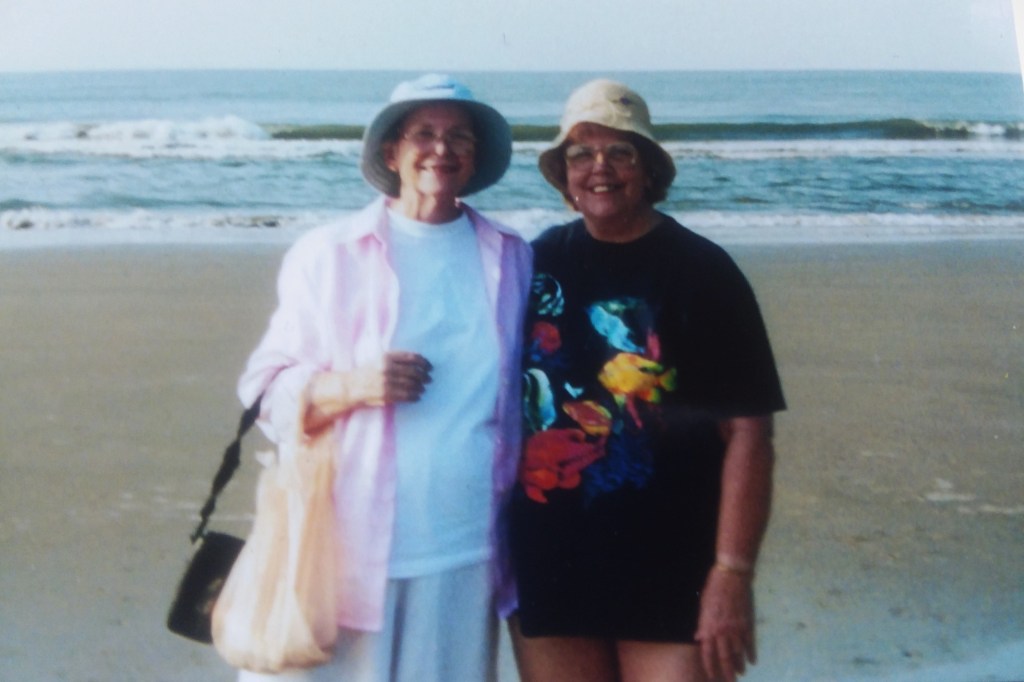
Two years before, in the fall of 1997 while vacationing with her sister Frances, Mom wore a light blue hat in this grainy photo. She scoured the South Carolina shoreline for seashells and shark teeth. She marveled at the way the ocean’s high and low tides polished their sharp edges.
Twenty-five years later, I marvel at the wisdom and intellect my mother shared and left behind. It is her letters and my love for her that linger.
I have Georgia on my mind today. Not the Peach Tree state, but my peach-ice-cream-loving grandmother. April 7 would have been my maternal grandma’s 119th birthday.
Warm-hearted and hard-working, Georgia lived most of her seventy-one years in North Carolina.
In 1914, Georgia Evabell Miller met Sherrell Richardson (S.R.) Ferrell. Both attended a one-room school in Mecklenburg County. Six years later, they married at Georgia’s home in the same community. She was sixteen; he was nineteen.
A generation before I appeared, Georgia’s ordinary rural existence–tending to family, home, meals, and livestock–took an extraordinary toll on her body and emotional wellbeing. She bore four children: Helen (my mother) and Richard in the mid 1920s; James and Frances in the early 1930s.
In between, Georgia suffered a double whammy of grief and pain. Richard died of meningitis in 1926 one month before his first birthday. Not long after, cervical cancer compounded Georgia’s trauma. She was bedridden for an extended period. Helen grew up quickly and helped care for her mother.
Even with Georgia’s burden and her heavy body that contributed to arthritic knees and misshapen feet, my grandma maintained a girlish southern giggle into her late fifties and beyond.
In the summer of ’62, during one of our family visits to the farm, I absorbed the scene like a ready sponge as she prepared ham, grits, and biscuits for breakfast.
I loved Georgia and her jolly nature. As she toiled and told rambling stories over the sink, rolls of laughter shook her stout body. If she were here, she would describe it as the “gift of gab” handed down through her Irish descent.
Intermittently, she tossed table scraps and leftovers into a slop bucket for a trio of hungry hogs that waited impatiently in their pen.
On occasion, I accompanied her whenever the contents came close to sloshing over the sides of the dented metal pail. Together we squealed as the pigs poked their large snouts through wooden slats to explore what concoction was on the menu.
Like a southern-stitched patchwork quilt handed down through the generations to keep them warm, this moment remains cordoned off in my 1960s Carolina consciousness. It lives next door to Georgia’s humid hugs.
When I was a toddler, I begged for her to scoop me into the lap of her tattered periwinkle dress … churn butter or crank ice cream on the sagging back porch … venture into the earthen cellar where she stored pickled fruits and vegetables … or gather eggs from the chicken coup and cradle them in her apron on the return trip.
A victim of heart disease and decades of early mornings and long days working the farm, Georgia died nearly forty-eight years ago on July 4, 1974.
Two days later (after we drove through the night from St. Louis to attend her funeral), sprays of gladiolas surrounded her casket.
I can still envision the tacky floral arrangement–sent by a neighbor–with a plastic telephone teetering on top. Three words were written in ribbon: “God has called.” Ironically, my grieving grandpa loved it most.
Through our tears, Frances and I laughed about it. Georgia would have liked that and the image of my aunt and me consoling each other on my seventeenth birthday. We stood over her fresh grave in Huntersville, North Carolina, at a little cemetery outside Asbury United Methodist Church.
It was the center of the universe in “Ferrelltown”–where my southern family worshipped, married, gathered as a community, celebrated birthdays, consumed countless cakes and delectable pies, buried the beloved, and grieved for those who left early and stayed late.
***
Years later, it is the thought of Georgia’s gentility and kindness that endures. It is the love and laughter she planted in my heart that will never die.
As I began to write From Fertile Ground after my mother died–and later when I returned from North Carolina after another round of consoling with Frances and visit to my grandparents’ graves in the church yard–Annie Lennox’ soaring voice from her CD Nostalgia inspired me.
It was her stirring, melancholy rendition of the Ray Charles’ classic Georgia on My Mind that captivated me most. Listening to it, I channeled my grief and reconstructed my southern memories before they landed on the pages of my book.
Every child should be so lucky to spend a few weeks every other summer with a grandparent who simply smothers them with goodness and genuine love. That and the bucolic snippets of a farm populated with kittens, puppies, cows, chickens, pigs, and peacocks are forever stitched in my psyche.
When you add them all up, what do all these vivid memories mean? That in the course of any life, it is the collective music of a simple-but-extraordinary grandma’s unconditional love that keeps us hoping, that keeps us dreaming, that keeps us living, that keeps us singing.
Long after she is gone.
***
I said Georgia Georgia A song of you Comes as sweet and clear As moonlight through the pines.
Other arms reach out to me Other eyes smile tenderly Still in peaceful dreams I see The road leads back to you.
I said Georgia Oh Georgia, no peace I find Just an old sweet song Keeps Georgia on my mind.
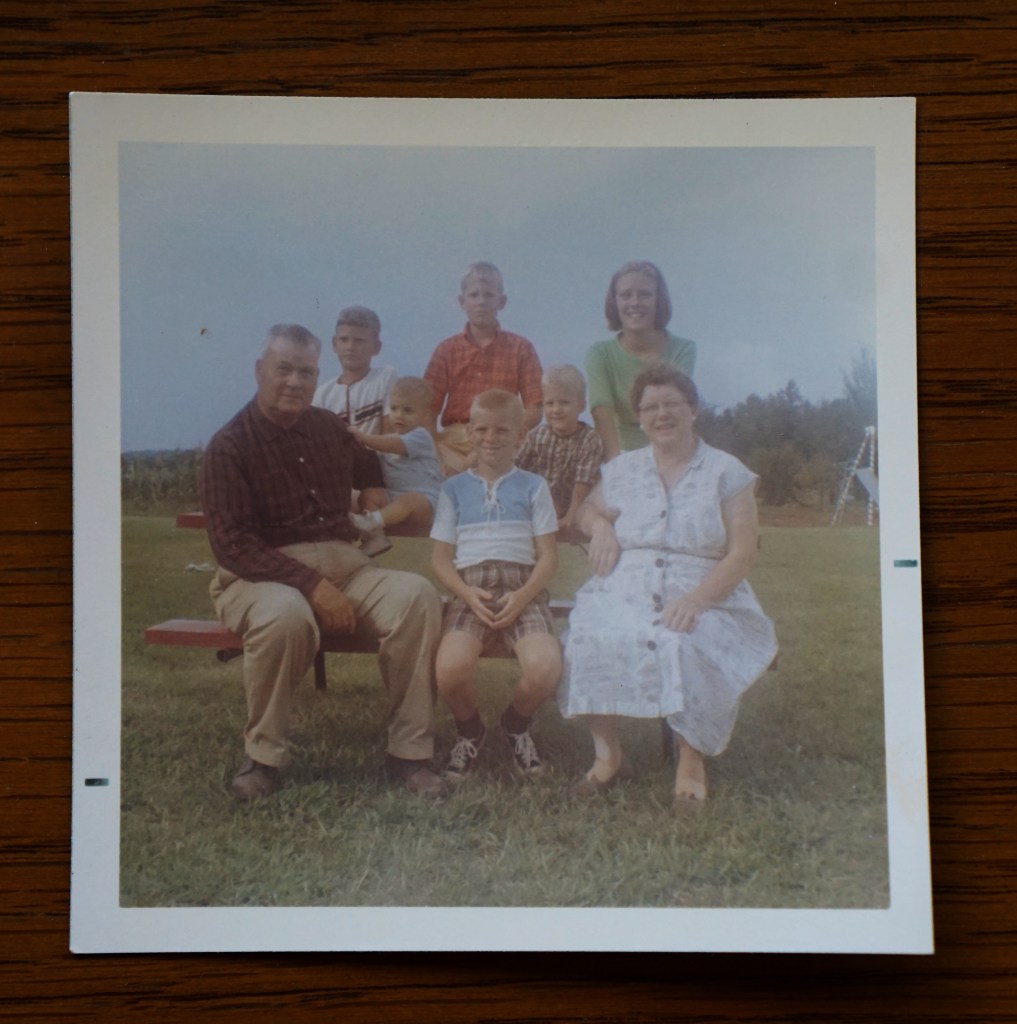
Georgia at age fifty-three on the steps of my parents’ apartment during a rare visit to St. Louis in 1956. About a decade later, she and S.R. enjoyed the company of six of their seven grandchildren in rural NC.
There is no better time than St. Patrick’s Day to pay tribute to the Emerald Island.
In late August 2017–just six weeks after I suffered a mild heart attack–Tom and I boarded a flight for Dublin, Ireland.
It was an excursion we had planned months before. But on July 6th (our shared sixtieth birthday) the trip and our future felt very much in doubt as I lie on a gurney in a St. Louis hospital.
Remarkably, my health improved considerably in a month. Doctors in Scottsdale, Arizona–my new hometown–encouraged us to proceed with our plans. The journey to Ireland would help us heal.
Looking back five years, both of us were anxious about traveling abroad, but we also needed to reclaim our joy. As I wrote in An Unobstructed View, Tom and I spent eight days with forty other travelers from around the world. Brian, our capable guide with CIE Tours, led us clockwise around the island.
It’s a bit of a blur now. But in one week’s time we moved from Dublin to Waterford, Killarney, the Ring of Kerry, the Cliffs of Moher, Galway, the sheepdogs in Sligo, the Giant’s Causeway in North Ireland, and the Titanic Museum in Belfast … before returning to Dublin and riding atop a double-decker bus with the wind racing through my hair.
Along the way, on our farewell dinner with the tour, we enjoyed an evening of Irish songs and music at the Glyde Inn just south of Dundalk.
In the spontaneity of the experience, I was pulled onto the floor to join in a broom dance. For a few fleeting moments, I rediscovered my spark away from the worries of the previous month.
I also spotted a little old Irish lady, singing her heart out across the room. She resembled my Scotch-Irish mother, who never had the opportunity to return to her ancestral home country. Seeing her there was an important step in my healing process.
In 2019, I wrote The Irish Mist. My poem is a tribute to the comfort I felt looking out over the Atlantic Ocean across the vast Cliffs of Moher on the west coast of Ireland as the clouds rolled in on August 27, 2017.
***
I’ll always remember you, rolling in over the gaelic green.
I felt cool comfort knowing the veiled intentions you whispered in my ear wouldn’t be denied.
No matter how much I wanted to gaze beyond the moss and ferns you shrouded, you held me there.
You knew I needed to stand strong above the craggy cliffs of my past.
You knew I needed to feel rooted to the emerald island, thankful for the mystery of my mending heart.
Sherrell Richardson Ferrell, my farming and writing grandfather, posing in the 1930s.
As a writer and gardener, I’ve learned there is constancy and comfort embedded in the rituals of life.
Each time I sit before my laptop to tell another story I feel a sense of grounding. My hard-working grandfather, the North Carolina farmer, must have understood that. He kept a journal every day for fifty-two consecutive years–from 1933 until the day he died in 1985.
Less about his personal reflections, much of what S.R. Ferrell wrote was about the day-in-day-in responsibilities of farm life. For instance, forty-nine years ago on his seventy-second birthday, this is what he had to say:
I did my farm chores in cloudy foggy wet morning. The mud is getting deeper by the day. I mopped the kitchen after I got my outside work done. I changed my clothes and went to Huntersville to get prescriptions filled. My 72nd birthday. Jimmy, Frankie and Frances came and ate lunch with us today. Mamma and Zelma called and talked to me. Cloudy, wet, muddy, mild all day. More rain expected tonight. 54 degree low; 60 degree high.
There is nothing spectacular in these words until you consider that he wrote down his thoughts for more than five decades. Little did he know that–long after he was gone–I would read every page of his journals and (after my mother and his daughter died) write a book about the writing DNA that runs through my blood.
Now that I’m a desert rat, I keep a speckled rock from S.R.’s farm in our Arizona garden. At this moment, it’s wedged in the ground under our fig tree. Every time I water the tree, I see the stone. It reminds me of my southern roots and connection to the earth.
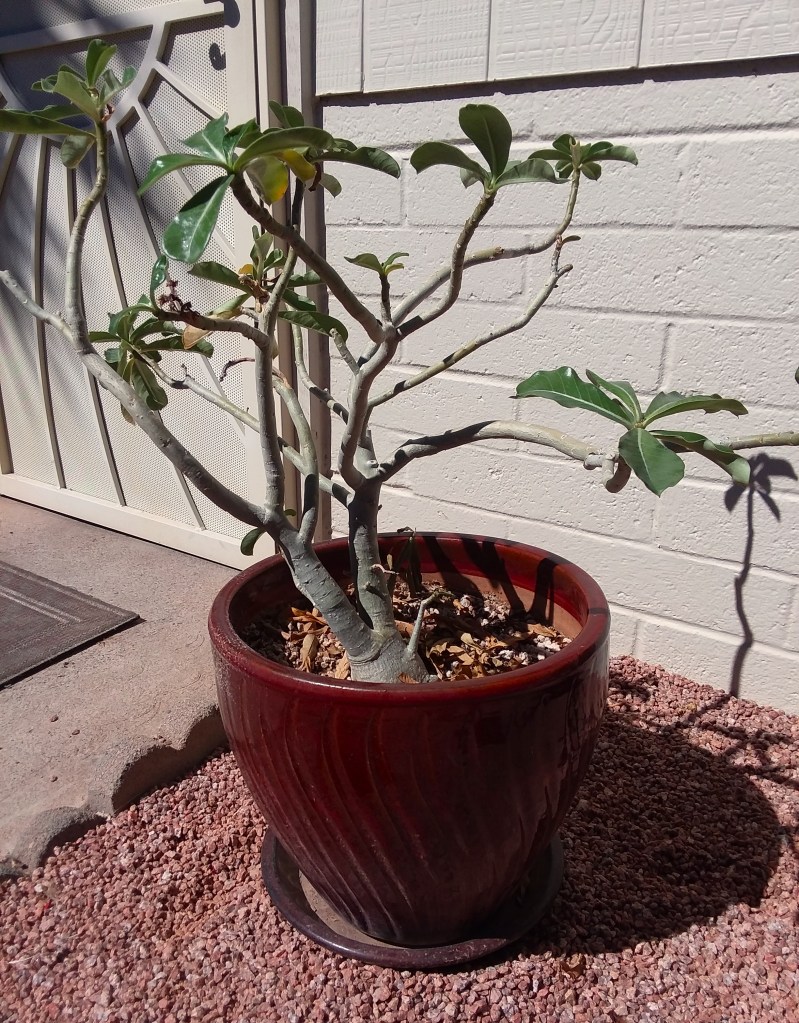
In keeping with the ebb and flow of nature and lineage, I do this ceremonial gardening dance twice a year. In early December, I lug my beloved desert roses (aka, adeniums) inside away from winter’s chill. They hide dormant in the darkest corners of our condo until March, when I haul them back outside to face the world again.
Yesterday morning, one day before S.R.’s 121st birthday, I renewed part two of this desert rose ritual. This year, it also happened to be the day Tom hired Chem Dry to clean our carpet.
Before Drew from Chem Dry arrived, my husband and I hoisted our slumbering desert rose and situated it outside our backdoor. We didn’t want to spill any soil on our freshly manicured carpet.
All of that went without a hitch. Neither of us strained our backs and Drew finished his job in less than an hour. The carpet even dried more quickly than expected.
By early afternoon, we were able to walk on the surface without wearing blue booties. By 3 p.m., we had moved all of our furniture back to where it belonged.
The blooming cycle for our prized adenium will take quite a bit longer. Rest assured, new leaves will appear this spring, prompted by warmer, longer days. Though S.R. never traveled to Arizona, I can imagine him sitting with his sleeves rolled up between farm tasks, nodding in his rocking chair as I write these words.
By June (maybe sooner) when the temperatures have reached 100-plus again here in the Valley of the Sun, this remarkable plant will produce several gorgeous double-red blooms. With it all, once again, I will have physical proof that natural beauty is constant.
Even though it feels like the rest of the world has gone mad, I draw strength from fertile ground and the knowledge that these rituals help me feel hope is always on the horizon.
Grief is an insidious and universal human condition. When you love someone–and they leave or die–you need something to fill the space they’ve left behind. Grief enters to fill the void.
If you are in the midst of grieving (as I was in 2013 and 2014 after my mother passed away), it may feel as if you are wandering through a deep fog. Or you might wonder if you are chained to the floor in the middle of an empty room with water pouring in over all four walls and seeping through the floor boards.
That’s how grief can manifest itself, but for each of us the path is different. The loss lightens over the years. Still, we carry it wherever we go. It becomes an extension of us, ingrained in our identities.
In 2014 and 2015, I saved myself from drowning in grief by writing about it. My mother and grandfather helped immensely. They left behind a trail of their thoughts and experiences on paper … in the form of a mountain of letters from Helen (my resilient mother) and diaries from S.R. (my farming grandfather).
After my mother’s demise, reading her handwritten and wisdom-filled memories and her dad’s more stark observations prompted me to tell all three of our stories in one book. From Fertile Ground became my salvation. Yes, in 2015 it consumed me, but it also gave me renewed creative purpose and focus after I left my corporate job.
When I finished and published the book in 2016, I felt it was a story that would alleviate pain for grief-stricken souls. Five years later, I still feel that way. It helps me to revisit my book and my grief from time to time. Readers have taken the time to write reviews like this one online.
“From Fertile Ground” is more than just a terrific read. Johnson is generous in taking the reader into his world, his journey, his family, his emotions. In so doing, the reader obtains a soothing sense of identification of the human condition, particularly how we work through grief and loss. Johnson’s mother’s and grandfather’s letters are interspersed throughout the narrative (and connected) which adds to the reassuring sense of a collective history.
We live in a complicated world. Many of us are suffering through the side effects of loss and searching for answers. It gives me joy knowing that my book is a creative balm for many, possibly even an antidote for grief.
At any rate, as the days grow shorter in the Northern Hemisphere, I hope this personal and universal three-generation story inspires you and brightens your world … no matter who you’ve loved and lost, no matter where you live.
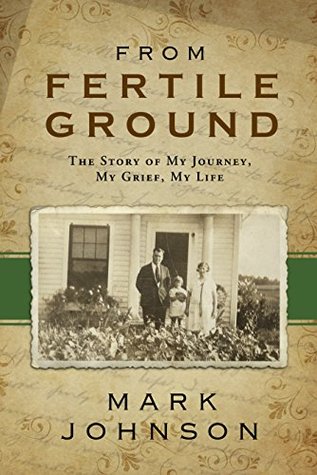
From Fertile Ground is a three-generation memoir and writer’s mosaic of love and loss. Published in 2016, it examines the implications of grief and our quest to make sense of our past so that we can find our path and move ahead.
It rained most of September 4, 2021, in eastern Missouri. Fortunately, scattered-but-heavy showers didn’t wash away our plans.
At nine a.m., Tom and I drove north thirty minutes from our room at Hampton Inn Valley Park to visit my cousin Phyllis and her family in their St. Charles, Missouri home.
After we exchanged hugs, Phyllis’ husband Tom prepared homemade blueberry-and-apple pancakes. We volleyed catch-up stories between the kitchen and family room, while their golden retriever Truman sidled up to Tom and me on the couch, placed each of his front paws in our laps, and stole our hearts.
For the next two hours eleven of us–spread across three generations–gathered around a rectangular kitchen table framed by angled windows and a lush backyard.
The two Toms, Phyllis and I represented the senior set. Amanda, Austin, Kelsey, and Bryant smiled and shared stories of their thirty-something, heavy-lifting, career-and-child-rearing years. They shepherded and cradled: three-year-old Ava, who danced around the table in her princess gown; adorable one-year-old Violet, who is learning to walk; and baby Brooks born in July with a head of hair.
It was a treat for me to spend time with them all, the entirety of my Johnson family connection that remains in the St. Louis area.
Thankfully, the reunion around Phyllis’ and Tom’s table superseded our previous encounter at an Italian restaurant in St. Louis on July 5, 2017. It was one day before I suffered a mild heart attack as Tom and I walked to Left Bank Books in St. Louis’ central west end to see my book of light-hearted Missouri stories on the shelf.
***
When we left St. Charles just before noon, I pointed our rental car southeast. Tom typed the address for Jefferson Barracks National Cemetery into his smartphone to find the most direct route to my parents’ graves.
Ironically, our most recent visit to the rolling hills of white marble grave markers on the banks of the Mississippi River was four years ago–the same day we last saw Phyllis and Tom. But on this occasion–September 4–we were in town on what would have been Dad’s and Mom’s seventy-third wedding anniversary.
I had hoped to stop somewhere for a small bunch of flowers to leave on their graves. That never happened. Instead, we arrived at the cemetery entrance empty handed, made two right turns and one left, drove past the chapel, traveled up a hill, and parked our rental car under a tree.
About the time we arrived, the rain paused. We walked a hundred steps or so to DD 355, where Dad and Mom are buried near a large oak tree. As Tom and I surveyed the grounds and knelt quietly, he spotted two acorns side-by-side on top of the wet grass on Mom’s side of the marker.
Before we left, I placed the acorns on top of the marker in honor of their wedding anniversary.
I suppose even in the solemn solitude of a cemetery the strength of our family ties endure and life goes on.
My parents, Walter A. Johnson and Helen F. Johnson, are buried at Jefferson Barracks National Cemetery south of St. Louis, Missouri. Walter was a sergeant in the Army, who served in World War II. Mom and Dad met on January 4, 1948 and married on September 4, 1948 in St. Louis. Walter died one week shy of his eightieth birthday, on November 26, 1993. Helen passed away on January 26, 2013. She was eighty-nine years old.
This season of triple digits in Arizona–followed by a few days of overdue, soaking monsoon rains–is the perfect time to rummage indoors through personal, vintage photos.
The best of them, like peering into the Grand Canyon, leave me with a mix of joy and insignificance. They tell stories about humanity before I entered the picture.
I’m fortunate to have accumulated photographic treasures from both sides of my family. Some of them, tattered and faded, date back to the early 1900s.
I don’t recall seeing this image from July 1955 before. I imagine one of my maternal grandparents captured it on their Huntersville, North Carolina farm. Sixty-six years later, I stumbled across it in a forgotten album. Today, on July 26, 2021, it is speaking loudly through the sepia tone.
If she were alive, the woman on the left (my mother, Helen Ferrell Johnson) would be celebrating her ninety-eighth birthday today. In 1955, she held my sister Diane on her lap and celebrated her thirty-second birthday with her sister Frances (cradling her first born, Michael) and brother Jim by her side in her original home state.
Mom has been gone since 2013. Grief has taught me there will be days like today when I miss her smile, wisdom, perspective and resolve. Fortunately, thanks to the passage of time, the abyss of grief–the Grand Canyon of loss–subsided in 2015 as I wrote.
When you love someone, grief is the price you pay. It is everlasting, sometimes surprising, but often predictable. Photos, birthdays, anniversaries, and specific songs (I’ll Be Seeing You sung by Peggy Lee) provide the cues.
What makes this photo a rare find is that I have just a few images of my mother and her adult siblings together. Helen left North Carolina right after World War II to begin a new life in a bigger city … St. Louis, Missouri … where she and Dad met, married, settled, raised Diane and me, and discovered their share of happy, challenging, and unbearable moments together.
Jim and Frances stayed to build their lives in the Tar Heel State. They were teenagers on the farm in the late 40s. In the 50s, Jim and Frances (born in 1930 and 1932 respectively) left the nest, but returned frequently to this front porch that faced west. They met and married partners, traveled a few miles down the road to raise their families, and remained near their parents.
What I love most about this photo is the sense of possibilities and optimism in the eyes of Helen, Frances, and Jim. The wear and worry of life hadn’t yet entered the picture. By the mid 60s, Helen had two children. Frances had three. Jim had two. My grandparents loved all seven of us grandchildren. We now lead disparate lives.
Mom loved her brother. He was a friendly, handsome man, who loved to fish, hunt, drink beer, and smoke cigarettes. Unfortunately, the harsh realities and complexities of life had a way of catching up with Jim. In 1987, he died of lung cancer at age fifty-six. When she learned of Jim’s passing, it frightened her. Mom saw his demise as a harbinger of her own mortality. She retired immediately after returning from his funeral.
Frances still lives in North Carolina. She is the most significant personal connection I have to my southern roots. I spoke with her a few months ago. She isn’t the spitfire she once was, but is content with her husband in their Davidson, North Carolina home.
Like all of us who remain, Frances is thankful to have survived the pandemic. She is looking forward to her ninetieth birthday, which she will celebrate January 1, 2022. In 2015, two years after Mom died, I traveled south to see Frances. At that time, we needed to see and hug each other to escape the throes of grief.
My quest to rediscover my southern family and find comfort with Frances ultimately became fodder for From Fertile Ground, my first book. It’s the story of my journey and grief told in part through the writings my grandfather and mother left behind. If you’ve lost someone close recently and are living with the fog of grief, I hope you’ll pick up a copy of my book. Reading it may soothe you.
With each passing year, I continue to find more fertile ground from the photos and writings my mother and father left behind. Reexamining them and rediscovering their importance reactivates the love I feel for imperfect–yet beloved–family members. They shaped my past and the memories of them still inform my present.






 Mark Johnson Stories