Category: Civil Rights

Safe Haven

I don’t typically tackle social and political issues in my blog. I prefer to focus on the splendor of love, family, community, nature, and serendipity that runs through our lives.

But over the past weeks and months–years, really–I’ve been ruminating over what it feels like to live in the heaviness and post-Covid-social-upheaval of the United States in 2024.

Even though I am in good health and am fortunate to have the companionship of my husband and a cozy home, I often feel a gnawing, low-level anxiety.

I attribute this to worry. What will happen to disenfranchised members of our community–non-white immigrants, people of color, minority women, all women, all children, elderly people, trans people, gay people (like me), etc.–who would be especially vulnerable if our past president (the one just found guilty on thirty-four felony counts by a jury of his peers) should be elected in November?

I should tell you this blogpost isn’t intended to sway your opinion. I don’t think that is possible. I can’t imagine any American being undecided–not in this us-versus-them world exacerbated by lies and constant media attention.

Yes, I will vote for Joe Biden. It’s pretty simple for me. I’m not naive. Of course, he’s made mistakes, but he’s done a lot of good for our country economically and otherwise. I see him as a decent man–the only decent man whose name will appear on the 2024 Presidential ballot. I think he has the best interests of Americans in mind and sees the presidency as a job designed to serve the people, not his personal agendas.

If you feel differently, you are entitled to that. Just know that the democratic values and rule of law that generations of American men and women have fought for will be flushed down the toilet if enough people in swing states like Arizona vote for the other guy. I won’t include his name here.

Why did I choose to write about this today? Because I suddenly have greater clarity concerning all of the weight, which I’ve been carrying around concerning the potential loss of a safe haven–something all of us are entitled to.

The remarkable thing is my clarity came from an incident outside my front door on Sunday morning … an incident involving a feral animal Tom and I have come to love.

If you follow my blog, you know I’m talking about Poly. For the past three years, on many mornings she has appeared at our front door. Poly lives a reckless life, but at the very least is the beneficiary of food on the cool tile of our entryway (and probably others).

Her visits are a brief escape from the heat of the Sonoran Desert. Maybe her visits are also an escape for Tom and me to leave behind the worries of the world, which I’ve outlined above.

Recently, Poly has moved closer to us. Winding her way around our ankles. Sleeping in our wicker chairs. She has even decided to sleep outside on the gravel underneath our loveseat on occasion… before she moves on to explore other places, porches, and hideaways. Such is the life of a lovable, but forever-feral feline.

Anyway, on Sunday morning one of our neighbors (someone we care about who owns a sweet dog) happened to approach our front door at the same time Poly was eating with our door ajar. Normally, the dog is on a leash, but she wasn’t yesterday–though she should have been.

Poly (and I) were freaked. She ran out our door and down the sidewalk as the dog chased in hot pursuit. I feared for her safety and gave my neighbor an angry earful for not leashing her dog.

As I swam laps this morning in Scottsdale, I realized that my rightful (but intense) anger had roots. Metaphorically, in my mind and heart at least, Poly represented the plight of thousands of vulnerable Americans who might be on the run … whose lives might be in danger if we lose our democracy.

I say that knowing that some of my LGBTQ friends–particularly those in the trans community–are considering alternative plans of where to live if Biden doesn’t win the election. That’s a daunting thought and potential reality, which you may not be aware of if you don’t have gay friends.

One thing I am certain of. It doesn’t have to be Pride month for me to remain authentic and visible. I will continue to care about those less fortunate (humans and animals) … no matter what happens in November and beyond … because we all deserve respect and kindness … no matter who we love … no matter our identity.

Meanwhile, back in our Polynesian Paradise community, my neighbor and I have repaired our relationship and regained our equilibrium. (She apologized for not having her dog on leash and told me she hoped it wouldn’t deter Poly from returning.)

Late yesterday, Poly reappeared–safe and sound–outside our front door. This morning, she had her breakfast on the cool tile of our Sonoran entryway.

An hour later, I found her tucked underneath the loveseat in her safe haven. Peeking through the cacti containers and elephant food succulent on our patio, she allowed me to take this photo.

I am thankful Poly (and I) survived our Sunday scare. I hope our nation and democracy are as fortunate in November.

My Way Out

In this world of perpetual social upheaval, being who I am-openly gay–isn’t always easy. But I persist.

I decided more than twenty-five years ago that coming out was the only healthy way to live.

With the assistance of two amazing therapists (thank you, Barry and Valerie!) and the love of a small circle of friends and family, I discovered that authenticity was my way out of denial, depression, and anxiety.

Over the years, I’ve written frequently on this topic in my books and here in my blog. Today, on National Coming Out Day in the United States, I’m here to remind you once again that I am a proud gay man.

This one aspect of my identity–the fact that I am attracted to the same sex and married happily to another man–certainly defines the way I see the world. It gives me compassion and empathy for others who are different … no matter their skin color, religious beliefs, economic status, or capabilities.

All my life, I have been protective of those who are disenfranchised and less fortunate. I came from a modest background and have survived personal and family hardships.

As a teenager and young man, I didn’t understand or love myself, but now that I do I feel it is my obligation to remain visible. To pave the way for queer teens and adults who may not yet feel comfortable enough to come out.

In 2023, I think most Americans are supportive of their gay friends, family members, and neighbors. Of course, there is a vocal minority that would prefer we don’t exist. I have no control over their beliefs.

No doubt, a handful of haters will be demonstrating at the end of the Phoenix Pride Parade route on October 22, when I sing and march with my friends in the Phoenix Gay Men’s Chorus.

But they will be overshadowed by the thousands of LGBTQ supporters–gay and straight–who will line the parade route with their parents and children, cheer, and wave their rainbow flags.

We are a country that was founded on the notion of “liberty and justice for all.” At times, we have failed miserably at fulfilling our mission as a democratic society.

But I’m not ready to give up. I still have hope–as a sixty-six-year-old gay man, husband, father, brother, writer, singer, friend, neighbor, voter, and citizen of the United States–that we will find our way out of the political divisiveness that exists.

I’m not sure how we’ll get there, but today–and everyday–all of us who are different must continue to come out, be ourselves, love each other, and remind the world that LGBTQ citizens are valuable, kind, contributing, and responsible Americans. We will not be denied.

Empty Soles

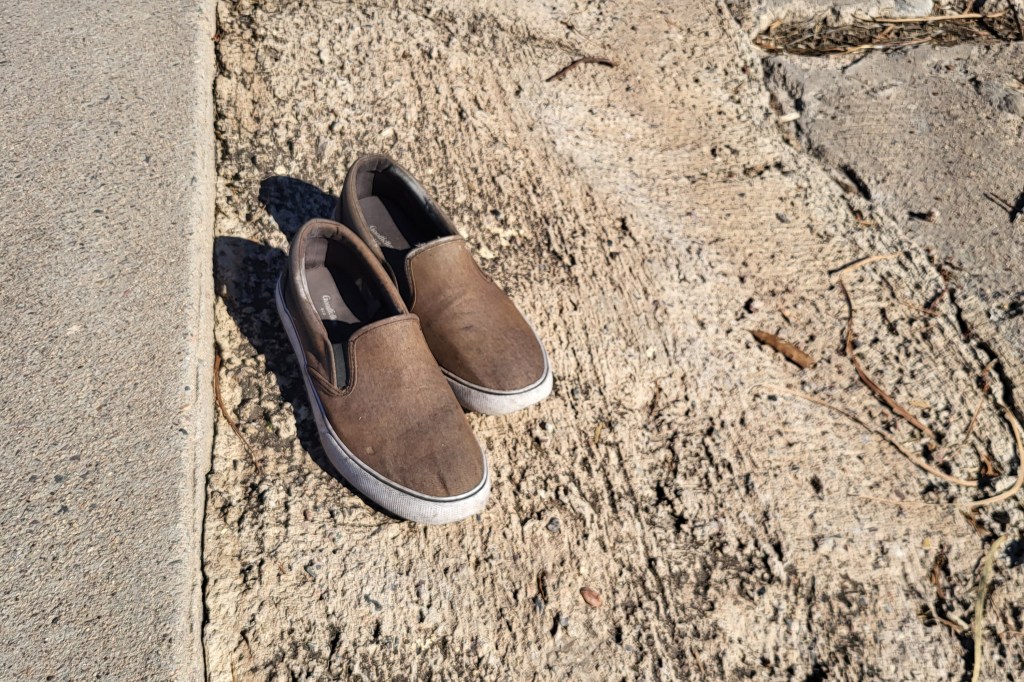
November 3 was a brisk Thursday morning in Scottsdale, Arizona. But when I walked past these empty soles on the edge of Camelback Road after my workout at the gym, I felt an eerie sensation. It was almost like learning a close friend had died or vanished.

My focus shifted immediately away from our cooler-than-average temperatures in the Valley of the Sun. I felt compelled to pay tribute to the remnants of a life well lived. To stop and take this photo and–three days later–write a story about what I saw and felt in those moments. Because that is what I do.

What would provoke someone to leave behind a pair of decent canvas shoes on the side of the road in such an orderly fashion? Did they suddenly outlive their usefulness? Perhaps they were simply an extra pair a homeless person could no longer carry. Or the sensible shoes were forgotten by someone who waited for a bus and was ready to advance to the next station in life.

For my storytelling purposes they are a metaphor for the sense of displacement many of us feel in our country. We’ve been pushed to jump out of our shoes from the criminal escape antics of our past president and the barrage of political ads spewing venom through our devices. Whatever the case, we wait for the next shoe to drop as we anticipate the outcome of the mid-term elections.

If you follow my blog, you know I am a positive person. Generally. I’m thankful for the beauty of nature that surrounds me and the quieter life my husband and I have carved into the desert landscape.

But as a nation we teeter on the precipice of despair. The future of democracy–as I’ve known it for my 65 years and 181 years before that–is definitely on the ballot this coming Tuesday.

Tom and I have already voted. Nearly two weeks ago. I checked the boxes alongside the names of only those who will protect our democracy. Not the high-profile election deniers in Arizona running for senator, governor, secretary of state, and attorney general. We need to believe them when they tell us they wouldn’t necessarily respect and honor the will of the majority of the people.

If you live in the U.S., be sure to vote on or before Tuesday. When you do, I hope you will support those who uphold our beloved U.S. Constitution.

Otherwise, I fear that the close friend who disappeared without their shoes is actually the democracy we once loved before we allowed it to vanish.

Beaver’s Pigeons

At seven-fifteen in my Monday-morning, Me-TV, Leave It to Beaver universe, older brother Wally delivered sad news to Beaver from the other side of their closed bedroom door.

A mischievous neighborhood cat had killed Miss Canfield and Miss Landers, Beaver’s pigeons named after his favorite teachers. The crisis occurred during Wally’s watch as crestfallen Beaver quarantined with a case of chicken pox.

“Beaver’s Pigeons” (season 2, episode 20 of Leave It to Beaver) first aired on February 12, 1959, in an America long gone and mostly forgotten.

But it still exists as a comfortable escape for Tom and me–a lesson-laden gift from our past civilization that taught children right from wrong and nudged parents toward greater understanding through humor and humility.

Watching it over breakfast today momentarily softened the blow of 2022’s cataclysmic news tsunami: the U.S. Supreme Court’s repeal of Roe v. Wade that turns the clock back fifty years in human rights; the stunning evidence of corruption unearthed by the January 6th committee that dwarfs Watergate; and the devastation of the war in Ukraine that has shaken the world.

Then, as the episode unfolded, I felt the velvet hammer of realization clobber me. What was it about Beaver’s loss of two ordinary pigeons that moved me to tears over my yogurt and granola?

Certainly, it was the kind response of Beaver’s friends Larry and Whitey. They told Wally–and Ward and June, Beaver’s idyllic parents–they knew it would help Beaver deal with the loss of his pets if he could watch from his second-story window as they dug a hole and buried the pigeons in the side yard.

As Beaver glanced down to view the pet funeral, my tears also were prompted by this harsh reality that slaps me in the face daily: I live in a country that has lost its way, dismisses innocence as weakness, and embraces conspiracy theories over truths.

Too many in this nation fight more vehemently to protect their guns than their youngsters, reject books and diversity in favor of fear, and resist proven vaccinations that keep safe our most vulnerable citizens.

I know I’m not alone in my observations, anxieties, and worries. The majority would agree with my assessment. But as I approach my sixty-fifth birthday next week, I wonder if we will find a way to turn the tide for our children and grandchildren.

Like black-and-white Beaver in the late 50s–now more than ever as the losses mount–we need to give our youngest citizens the love, guidance, truth, and protection they deserve to cope in an often-upsetting world.

Wide and Deep

My heart raced and jaw clenched. Like thousands of Americans, on Tuesday I tuned in to watch true patriots from Arizona and Georgia do the right thing.

The 2020 election numbers–votes counted and recounted numerous times–don’t lie. Neither did Arizona House Speaker Rusty Bowers, Georgia Secretary of State Brad Raffensperger and his deputy Gabe Sterling, and Georgia election worker, Shaye Moss.

At a defining moment in American history, on June 21, 2022, they delivered their testimony before the U.S. House Select Committee investigating the January 6, 2021, attack on the U.S. Capitol.

They sat before the nation. They breathed deeply, mopped their brows, and somehow maintained their composure. They told us how they kept their fingers in the dike to keep a corrupt president and his allies from breaking through the dam and cheating the American people. They upheld the law and the letter of the U.S. Constitution.

Over three hours of testimony, we heard heart-stopping stories. Each witness detailed how some of those who still support the ex-president have threatened and targeted their professional and personal lives. All in an effort to illegally change the outcome of the 2020 election.

In this one blog post, it is impossible to address the sense of fear, anxiety, and division that exists in our current culture. But suffice it to say, this insurrection and its related tentacles run wide and deep. It appears there is much more evidence to come. Each day we brace ourselves for more of the ugly truth about the targeting of public servants and slates of fake electors.

What will happen next in this drama? Who knows? But the biggest question of all looms on the horizon: Will the U.S. Department of Justice pursue criminal charges against the forty-fifth President of the United States and others who apparently have violated the rule of law?

Young and old alike, we watch and wait. Our nation’s future is at stake. Our sense of freedom hangs in the balance.

***

Tuesday’s hearing occurred fifty years and four days after five men were arrested for breaking into the Democratic National Committee headquarters at the Watergate Hotel in Washington, D.C.

Soon after, the Watergate political scandal dominated our lives. Our nation was thrust into the pain and complexity of a constitutional crisis and investigation that would expose President Richard Nixon and members of his administration.

I was a teenager at the time. I didn’t understand the gravity of the Watergate scandal. But I remember the anxiety of uncertainty that pervaded our country and how outraged I felt that our president would lie and cheat and do all he could to try to cover up his deceit. That pain has resurfaced today.

I also remember pausing for breakfast with my friends John and Jon in the middle of our western camping adventure on August 9, 1974. It was the day Nixon finally resigned after two years of political denial and trauma.

John, Jon and I chowed down on steak and eggs in a dark tavern/diner somewhere in Wyoming, while on the other side of the room, through the tube of a grainy black-and-white TV, we watched Nixon break the news in an address to the nation.

Before and after that moment, my buddies and I drove through miles and miles of magnificent western landscapes–mostly through the Rocky Mountains in Colorado and Wyoming. But we also ventured through the beauty and desolation of Arizona and New Mexico.

Imagine three sets of parents of three teenagers, permitting one seventeen-year-old and two sixteen-year-old boys to pack up a beat-up AMC Javelin without adult supervision. Somehow, we convinced them to let us go.

Over a ten-day period, the three of us towed a small camper more than a thousand miles each way from St. Louis to the Rockies and back again. We had fun, drank Coors beer, exercised our freedom, cooked over a Coleman stove, slept in a tent, and managed to stay out of trouble. Those were simpler and safer days. That trip wouldn’t happen today.

As a young man about to begin my senior year of high school, the possibilities of life surrounding me traveled as wide and deep as the terrain you see in this photo of Shiprock, New Mexico, which I captured and saved from our 1974 journey.

Little did I know that one day nearly five decades down the road–as I approached my sixty-fifth birthday in this western literary chapter of my life–our nation would face a much darker and historic challenge.

We must find a way to restore some semblance of sanity to our culture and political process … we must punish the perpetrators to resurrect our democracy from the jaws of an insurrection that continue to haunt us.

Fallout

We sat–quietly and obediently–in rows facing the front of the room. Most of the girls wore frilly dresses, bangs, and patent-leather shoes; the boys sported bold-striped shirts, crew cuts, and bright-white Keds.

Our mornings and early afternoons were occupied with simple math, spelling, reading, recess, and cartons of cold milk on lunch trays. The American flag draped over the alphabet border above the blackboard.

Images of George, Abraham, and John–Washington, Lincoln, and Kennedy–stood guard. I suspect they were there to ease our minds and protect our American innocence.

If only it were that simple.

***

I don’t remember feeling fear, when our teacher told us it was time for another drill. We knew the routine and followed instructions.

A voice on the public address system told us when to practice hiding under our desks, when to duck and cover, when to escape to fallout shelters in hallways if a bomb were dropped.

It lasted but a few minutes. We covered our heads and faces until the all-clear signal came from our teacher. We absorbed the fear–the height of the Cold War–without knowing what it was.

This was what we knew in the early 1960s in middle America. We were fortunate these were merely practice drills, false alarms.

I imagine the scenes weren’t much different in schools on the outskirts of Chicago, Cincinnati or Cleveland. At Mesnier School in Affton–ten miles from downtown St. Louis–we aspired to a gleaming symbol. We lived in the shadow of an emerging national monument.

By its completion in 1965, the Gateway Arch would soar, though across the nation the fog of pollution and social issues intensified.

As history would have it, all of the names of St. Louis school children would be stored in a time capsule in the base of the Arch. Mine is among them.

Back in the classroom, between random drills and parent-teacher conferences, we learned to add, subtract, multiply, and divide. We tied our shoes and kept on skipping in a world where rules were prescribed narrowly for girls and boys.

This was the credo for boys: Get good grades in school. Be prepared. Keep your eye on the ball. Run faster. Jump higher. Find a decent job. Don’t be a sissy. Meet and marry a woman. Buy a house. Have kids. Keep your nose to the grindstone. Pass the baton to the next generation.

But what about those of us who are different? Where do we fit into the story? We had to figure that out for ourselves.

***

The sixties weren’t pretty. Assassinations reigned. The Vietnam War raged. Poverty and racism amplified. People felt trapped, ready to shed the remnants of restrictive gender roles and sexuality, sealed in the repressive 1950s.

But the world is exponentially more complicated now. The latest madman is hellbent on ravaging innocent people in Ukraine. Though love appears in abundance in many circles across all continents, ignorance and hate manifest themselves next door and around the world.

Once again, sixty years later, we find ourselves living in fear of the fallout. We must find ways to duck and cover, to speak the truth while standing as tall and mighty as the Gateway Arch.

We owe it to our children and grandchildren to put politics aside, to protect our planet, to uphold individual rights and civil liberties, to teach them about black and white, but also the color and grayness of the world and all its permutations. Pandemic or not, they are watching.

Even if they don’t know it, the youngest members of our society are counting on us to speak the truth, denounce racism and hate, celebrate gay and straight lives, and to teach them that every generation has a responsibility to remember and honor the seminal moments in history, and–hopefully–carry the best of humanity forward.

What I Feel

In addition to writing four memoirs, I’ve been blogging for nearly four years. A few of you have joined me for every twist and turn. I feel humbled by your interest and loyalty.

In my first post (May 4, 2018), I shared ten tips for writing a meaningful memoir. I believed then (as I do today), that each of us has at least one story to tell. If you are an aspiring writer, who is searching for a little inspiration, you may find these tips helpful.

#4 on the list is especially important if you are looking to engage readers, because feelings–fear, disappointment, grief, joy, excitement, anticipation, etc.–are universal:

Write what you feel. Go beyond reporting what you know. The details are important, but not as much as how you were affected by the occurrences that appear in your story. Tell your reader how you feel. Describe your experience—how the positive, negative and unusual happenings in your story touched your life.

Often when I sit down to write a new blogpost–and my fingertips touch the keyboard of my laptop–I’m uncertain what I want to write. But from the beginning of this odyssey, I’ve vowed to follow my own advice to tell and show you what I feel about personal and global issues.

That has included the emotions connected to creating an authentic life as a gay man and father of two sons; recovering from a heart attack; building a new life in the Sonoran Desert with my husband; aging in a predominately youth-focused society; surviving a global pandemic; and simply observing the healing properties of animals and nature.

Even in our uncertain American society–still hamstrung politically and dealing with the ravaging effects of COVID-19–I feel fortunate to have a safe home, good health, enough food to eat, and a community of family and friends nearby.

However, I also feel a strange mix of anger, anxiety, and sadness. I attribute that to the frightening stories and images of what’s happening in Ukraine.

I won’t pretend to understand the politics of it but can imagine the tremendous pain that is occurring as Russian troops invade and thousands of innocent Ukrainian civilians are threatened.

The deceptions and power-hungry antics of certain world leaders–rooted in lies and insatiable egos–are unacceptable to me. So is the growing level of American ignorance and intolerance for the truth of what history and provocative literature can teach us.

Yet we have too many “adults” in communities clamoring for the removal of books, which might help teach our children to become critical thinkers. On that note, what I feel today is the excruciating pain of what our world has become.

Rest assured, I will continue to write and voice my concerns, but I feel it’s best if I set aside my laptop for the moment. Here in the Valley of the Sun, I’m going to lace up my sneakers on a gorgeous Friday afternoon and take a hike to Papago Park.

I’m certain the sun is shining there, and the saguaro cacti are standing tall.

On a September Sunday Morning in St. Louis

All of us are required to play roles in society, especially to earn a living. We project a persona that may or may not align with who we are or what we value. We wear masks.

Of course, in a pandemic some us wear them more than others in public situations. But in my post-corporate sixties–even if I’m donning a face covering for physical protection–I prefer to spend time with people who are genuine. I don’t have the patience for games or innuendoes.

My need for authenticity has roots that wind back to my formative years. In the 1970s, as a budding-but-denying gay adolescent who had unnamed feelings for other boys and wasn’t allowed to express them, my personal development was frozen in time.

Imagine closing off one portion of your identity entirely with no light, voice or path encouraging you to explore it. None of the relationship rites of passage for straight kids–flirting, dating, parties, dances–were available to gay and lesbian kids in the 70s.

In my middle school years, I became close with Daniel. There was a lot I liked about him: his intelligence, his quirkiness, his dimples, his love of language and the arts.

On occasion, Daniel came over to my house after school. We played board games or simply talked about school and the teachers we liked. We never acted physically on the bond and attraction we shared.

I remember that Mom and Dad liked Daniel … and Daniel admired some of my parents’ most endearing qualities: my father’s exuberance and sensitivity; my mother’s kindness and sensibility.

In seventh grade, I was the spelling bee champion for Mackenzie Junior High School. I represented our school at the St. Louis-area finals. Each student was allowed to bring one friend in addition to his or her family. My choice was Daniel. I remember him sitting in the audience that day in April 1970. It felt like he belonged there, like he was a part of my family.

Not long after I lost the spelling bee, a few boys at school must have recognized something about the care and closeness Daniel and I demonstrated for each other in the halls and in the classroom. They spewed venom. They bullied us physically and verbally. It hurt me deeply and pushed me further into the darkness.

Daniel and I remained friends in eighth grade and beyond, but we spent less time with each other as a result of that trauma and feelings of vulnerability that surfaced. Our paths crossed only rarely in high school even though we both performed in plays and musicals.

Looking back, it was a survival strategy for me to pull away from Daniel, but I always regretted that we never had a chance to be authentic with one another or to talk about the elephant in the room … the experience of being chastised for being different.

That would change on a September Sunday morning in St. Louis.

***

In August 2021, I contacted Daniel online to tell him that I wanted to reconnect with him while I was in St. Louis for the Six Flags reunion. (We hadn’t seen each other since 1995, and then it was just a brief hello at our twentieth high school reunion.)

Daniel loved the idea. So, on Sunday, September 5, 2021–before Tom and I left Missouri to drive to the Chicago area to see our sisters and my son Kirk–we met him for coffee at a place he recommended. The three of us spent an hour together talking on the patio of a lovely cafe in the Soulard neighborhood of St. Louis.

For the first time, I was able to tell Daniel how awful I felt about the way our friendship was derailed. That led to a deeper discussion about other boys who were tormented to worse outcomes. But that wasn’t the entirety of our conversation. It was just one moment in a warm exchange with each of us … Daniel, Tom and me … sharing stories of our careers, families, and adventures. The bonus for me was watching and listening as my husband and my first boyfriend discussed their favorite films.

Before Tom and I departed, we invited Daniel to come visit us in the Phoenix area. As we left the cafe, I hugged Daniel and said goodbye. I truly believe there will be another chapter to our friendship. Maybe it will happen in Phoenix. Maybe it will happen in St. Louis.

Either way, on my Midwest journey in 2021, I was able to tie together a few more of the disparate ends of my past rollercoaster life to my more fully actualized Arizona existence, and for that I am grateful.

Counting Life’s Numbers

Writing is my thing. Not arithmetic. It has never been my forte. Going way back to 8th grade, I was lost in algebra class. That precipitated a math do-over in 9th grade.

Nonetheless, I realize we live in a number-centric society. Keeping track of and understanding numbers allows us to measure progress or lack there of.

Of course, the most obvious and disheartening example these days is the accelerating number of COVID cases and deaths, thanks to the Delta variant and a disturbing number of Americans who are still unwilling to get vaccinated for their sake and those around them.

But that’s not what this post is about. I want to talk about the personal side of math–when you find yourself counting life’s numbers and celebrating the love, commitment, and longevity they represent.

Today marks 25 years since Tom and I met. In this ever-changing society, I’m proud of that significant number, though it pales when compared with the total our neighbors Mary and Earl have accumulated. They will celebrate their 55th wedding anniversary in October.

At any rate, Tom and I are thankful to be together for a quarter of a century. We’re escaping the summer heat of Scottsdale to spend a few cooler nights in a cozy B&B in Flagstaff, a mountain community we love.

We’re like a lot of gay couples in the sense that we remember and celebrate 2 anniversaries: the day (August 17, 1996) we met and the day (September 6, 2014) almost 7 years ago when we were married in an outdoor courtyard on a gorgeous late summer afternoon in Illinois, surrounded by 60 friends and family members.

In 1996, we didn’t imagine it would ever be legal in the United States for same-sex couples to marry and receive equal rights to those of straight ones. The idea of marriage equality was barely a whisper. Less than 2 decades later it became a reality thanks to a movement we fully endorsed … proof of an astonishing, positive shift supported by a majority of American people.

In the time since Tom and I met at a northwest suburban Chicago gay bar, we have emerged from a hidden life to an open one. Along the way, we have counted life’s numbers.

Collectively, in the past 25 years we have: raised and counseled my 2 boys into adulthood; loved and lost 1 adorable basset hound and 1 crafty cockatiel; cared for and buried 3 of our parents; endured 36 years in the workforce; vacationed in 4 European countries (Italy, Ireland, Germany, and Austria) and 10 or 12 American states; watched our favorite baseball teams win 3 World Series (2 for my St. Louis Cardinals in 2006 and 2011; 1 for Tom’s Chicago Cubs in 2016); written and published 5 books; and survived 1 mild heart attack during 1 cross-country move. As I write this, we continue to navigate our way through 1 global pandemic that won’t end.

Of course, the glue that keeps our relationship going isn’t really about the numbers. It’s in the love and laughter we share, the relationships we’ve formed with friends and neighbors, the hundreds of movies we’ve watched together, the countless Scrabble games we’ve played over coffee, the unexpected hospital visits we’ve negotiated, the quieter moments reading and writing we protect; and the sense of day-in-day-out respect, comfort, and security we provide one another.

When it comes to the most important relationship in my life, it makes perfect sense why I’m not a math guy. I simply can’t put a number or value on the love Tom and I share, the hurdles we’ve cleared, and the successes we’ve realized.

Together, we are greater than the sum of our parts.

Tom and me in October 1996 enjoying a Wisconsin weekend.
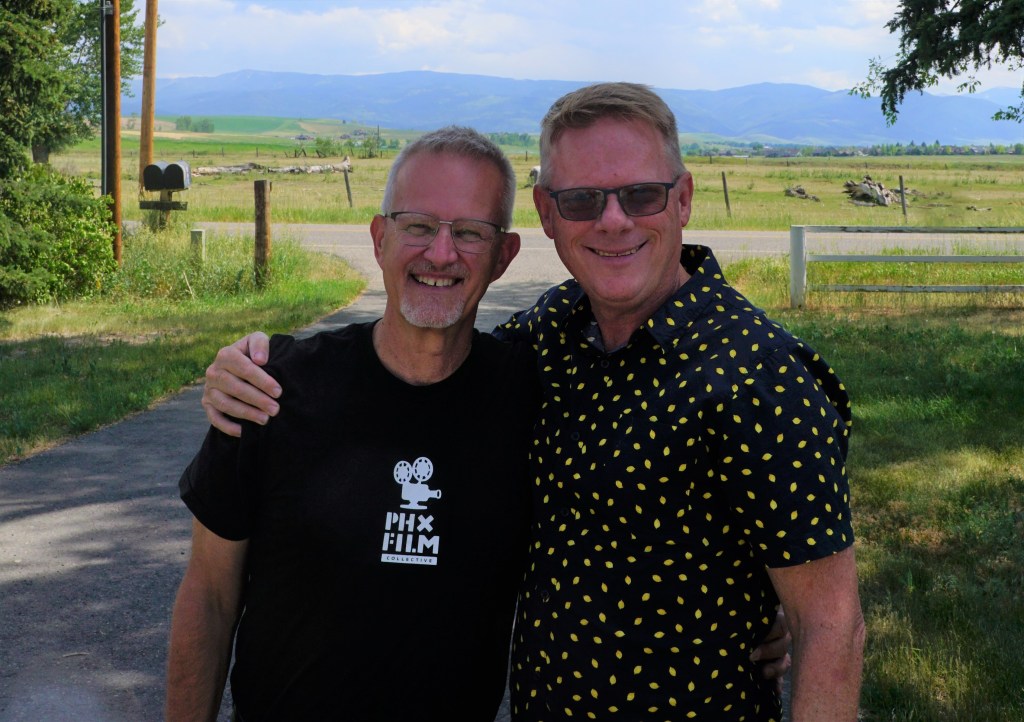
Tom and me in June 2021 during our Montana vacation.

The Pledge of Allegiance

Because I am a writer, you might imagine it would be easy for me to put my anger and pain into words.

You might think it would be simple enough for me to describe the brutality our current president has brought to our country for the past four years or the shame and frustration I felt as I watched a mob of misguided lemmings follow his lead, storm the U.S. Capitol, and pillage it on January 6, 2021.

But it is not.

It appears (to at least half of us and the rest of the world) that we have lost our bearings, sense of righteousness, and humility. The rest (some of whom smashed windows, dishonored our House and Senate chambers, and scaled walls for a selfie) are content to wallow in lies, deception and misinformation.

Most of this destruction was perpetrated by a man who has no moral compass, no interest in the well-being of our nation’s citizens as we wander for another day through the darkness of this pandemic, as we watch the death toll grow, as we wait for a vaccine that is slow to arrive.

It’s time for a history lesson. It’s time to examine The Pledge of Allegiance–something I learned and recited in first or second grade as I stood by my desk with my hand over my heart back in the suburbs of St. Louis, Missouri.

It’s time to ask: Do these words mean anything anymore? Do we still believe and adhere to these words that open our congressional sessions and have served as guideposts for our children, adults and–most important–government officials to follow?

I pledge allegiance to the flag of the United States of America, and to the republic for which it stands, one nation under God, indivisible, with liberty and justice for all.

If they do, we need to hold all of those involved–including the current president and his enablers– accountable for their treasonous and criminal behavior. We need to remove them from their offices, fire them from their jobs, convict them of their crimes.

We need to uphold our civil rights and liberties for the masses. We need to ensure there is justice for all.