Category: Creative nonfiction

Write a Memoir, Read a Memoir

It’s a beautiful Friday in Scottsdale, Arizona. The weather is sunny and mild–warm enough for me to swim laps outside a few hours ago–and my brain is firing creatively.

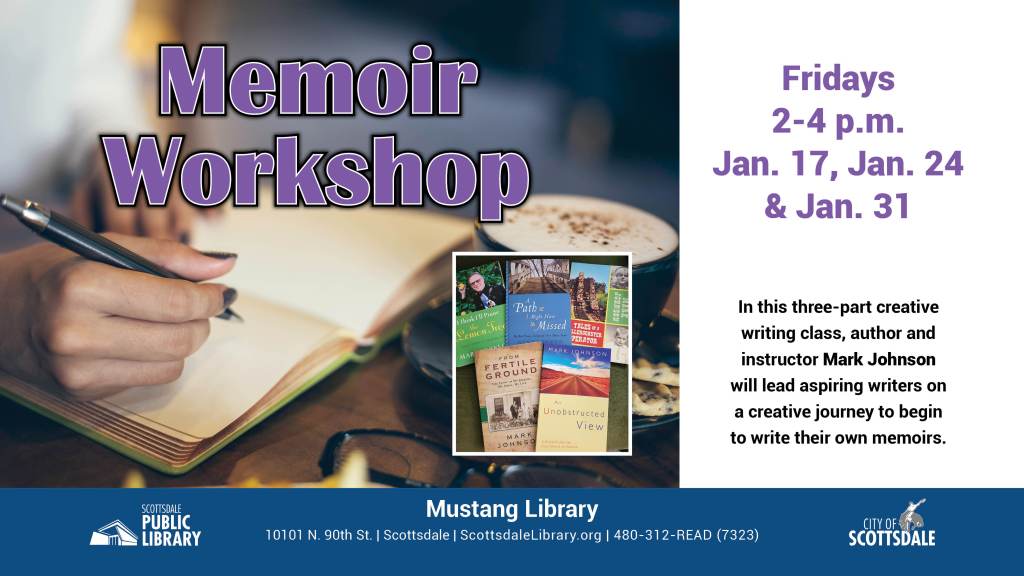
I’m preparing to lead my next memoir writing workshop later this month at the Scottsdale Public Library (Mustang location).

I expect a dozen aspiring writers will file into a large conference room on January 17 for session #1.

I will welcome them with a smile and a commitment to prompt and guide them as they move ahead on their memoir writing journeys.

It will be a free-and-safe space to begin to dislodge vivid memories, write a few pages, share respectful feedback across a table with other writers, develop a writing practice, and (hopefully) leave on the last day (January 31) with a little momentum to tell their stories.

I know how much work, time, and commitment is required to make it happen. But when you are a writer, it’s worth it. It’s what you are meant to do.

You tell stories of all kinds. Simple. Complicated. Painful. Joyful. Unbelievable true-and-false stories.

The best memoirs are filled with emotional and sensory details: visuals, smells, tastes, sounds, personal touches.

I think that is one of my strong suits … not only telling but showing readers the story, so that they must keep reading to find out what happens at the end of the story.

It’s rather like sitting with a friend in front of a cozy fireplace. That is what I will tell my workshop attendees to imagine as they begin to write their memoirs.

I don’t think you need to be famous to write a great memoir. It’s really the story that must be compelling, not the namedropping that some celebrities like to smear over every page.

You simply must be authentic and artful in the way you approach your story–whether it’s a story of love and loss, transformation, redemption, survival, success, or a recollection of a vivid place, time or person that makes your heart swell.

In addition to writing memoirs (somehow, I’ve written and published four since 2016) and encouraging others to bring their stories to the page, I enjoy reading memoirs.

January is a good time of year to assemble a recommended reading list.

Here are ten memoirs (written by famous and ordinary people) I have read over the past ten years that have moved me, entertained me, spoken to me, and broadened my appreciation for creative, true storytelling in the world of nonfiction.

By the way, I will share this same list with my memoir writing workshop attendees later this month. So, in a sense, you are getting an insider’s preview.

(Note: I have included one of my books–From Fertile Ground–on this list … because I feel it is an unusual creative concept/structure for a memoir about a family of writers sharing their diverse voices across three generations.)

Happy memoir reading (and writing), everyone!

***

My Recommended Memoir Reading List

The Year of Magical Thinking (by Joan Didion; 2005) … possibly the best book I’ve read about grief.

Ever By My Side: A Memoir in Eight Pets (by Nick Trout; 2011) … perfect if you are an animal lover.

From Fertile Ground: The Story of My Journey, My Grief, My Life (by Mark Johnson; 2016) … a writer’s mosaic about love and loss.

Between Them: Remembering My Parents (by Richard Ford; 2017) … revealing portrait of parents.

Insomniac City: New York, Oliver, and Me (by Bill Hayes; 2017) … gripping, personal, New York study.

The Best of Us (by Joyce Maynard; 2017) … finding true love late in life, then losing it to pancreatic cancer.

Pops: Fatherhood in Pieces (by Michael Chabon; 2018) … poetic snippets about a son’s love for his father.

All the Young Men (by Ruth Coker Burks; 2020) … a woman comes to the rescue for dying AIDS patients in the 1980s.

My Name is Barbra (by Barbra Streisand; 2023) … if you love Barbra, a must read.

My Mama, Cass: A Memoir (by Owen Elliot-Kugell; 2024) … revealing odyssey of a daughter constructing her life after the death of her famous mother.

Inside the U

I have a passion for learning, teaching, and uncovering the truth. So much so, that in another lifetime, I might have pursued a career as a full-time educator.

While that never happened, over the past thirty years, I’ve discovered episodic ways to teach … sharing my communication expertise as an adjunct PR instructor, opening minds as a diversity trainer and consultant, and–now–encouraging others to write and share their stories.

***

On Monday, October 21, fourteen people walked through the door of The Loft on the second floor of the Scottsdale Public Library. Each found a place at the table around a U-shaped configuration.

Lisanne, the library’s program supervisor, welcomed them, introduced me, and described each of my books (which she propped on easels at the far end of the room).

I sat–inside the U–smiling and ready to share my tips and guide them on their memoir-writing journey.

First, I asked each writer to introduce themselves. Some told me they have been writing in various forms for years.

Others have fought the impulse to do so or simply have never found the time or place but have always wanted to write.

“This is a safe space for you to begin,” I told them.

To mine vivid memories. To spin them into previously unwritten sentences. To shape them into stories that one day they may want to share with the world or simply pass along to immediate family and friends.

By the end of our first session together, we got to know each other better. I walked them through a “prompting” exercise.

Each person selected a random image–fanned out in my hands like a deck of playing cards–and then proceeded to write a paragraph or two relating to it.

One selected a photo of a tiger lily. She wrote (and shared) an especially sad, but poignant and revealing story about her flower-loving mother.

Another recalled a funny encounter with a monarch butterfly. All of the stories written and shared had merit.

During the last part of the class, they completed a three-page “Telling Your Story” Worksheet I prepared. It will be the baseline for each participant to begin to write their memoirs.

I asked each person to write one to two manuscript pages for next Monday’s session. I will offer constructive feedback at that time, and they will share insights with each other.

We will meet one final time to discuss another round of writing on Monday, November 4.

Already, this workshop is proving to be a meaningful experience for me.

I hope it is a catalyst for each of my fourteen fellow writers.

If I can make even a small difference as a library volunteer to help them on their storytelling journeys, my time–inside and outside the U–will be time well spent.

Turning Memories into Memoirs

Writing is a solitary practice. But when our best ideas flow from our brains through our fingertips, it can feel like we are creating a galaxy of possibilities and fascinating characters to keep us company.

Still, we all need the support and encouragement of others to help us tell our personal-yet-universal stories, so that they touch the hearts and stimulate the minds of our readers.

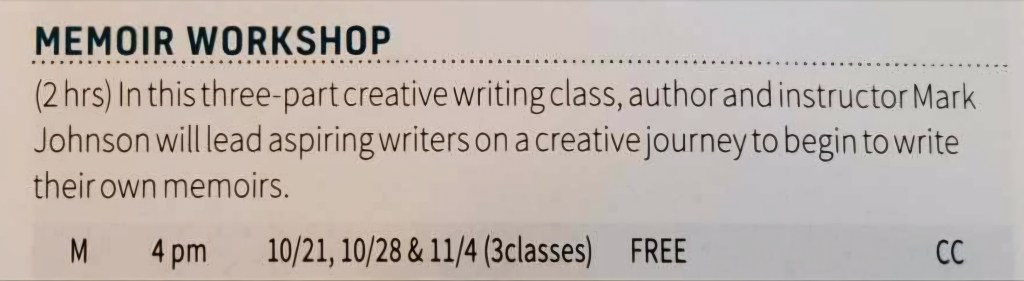
To meet that need for external creative input, for the next three Mondays –October 21, October 28, and November 4 (from 4 to 6 p.m.) — I will lead a fun, interactive, and free memoir writing workshop at the Scottsdale Public Library, Civic Center location.

If you live in the Phoenix area, I hope you will join me. No reservations are required, but space will be limited. Arrive 30 minutes before the first class to get a ticket at the door. It will entitle you to participate in all three sessions.

Honestly, I’m excited to share a little of my time and memoir writing tips. And–perhaps–give a literary boost to a few individuals who are where I was ten years ago: ready to cross the creative threshold, but in need of direction and inspiration to turn memories into memoirs.

Student and Teacher

It’s time to come clean. I haven’t been devoting enough time to an important piece of my life and identity. I haven’t been scheduling–and honoring–a critical creative need: uninterrupted time to write.

Like an untuned car with dirty spark plugs, this sputtering connection–between me and my creative self–has been misfiring for about a year.

Though I have produced creative things (like a few librettos for my chorus and a blogpost once each week), I haven’t been protecting my creative time. I haven’t been developing enough ideas that are purely mine.

It’s time to take action. To go back to school. To open the metaphorical hood of this mid-century car. To do something about it.

I know this is a challenge for all writers … and I’m luckier than most. I’m not juggling a full-time job at this stage of my life.

Still, external forces and demands often flood through the door–disrupting my good writing intentions. (Even as I began to write this, a sprinkler head outside our front door just went haywire. I texted one of our condo board members to tell him a fountain of water is spraying everywhere!)

I’m back to the keyboard of my writing universe. Beyond the whack-a-mole geysers that pop up in every life, it’s time I became more selective and vigilant with how I choose to spend my time.

It’s time for me to find a better balance again. To be more attentive to my own creative needs (like I did when I wrote and published four memoirs and one book of poetry from 2016 to 2023) … while still taking some time to help others.

Today I began by scheduling two hours–between 10 a.m. and noon–to write this blog post about the writing process.

Tomorrow, I have another two hours on my calendar. Wednesday, Thursday, and Friday will be the same.

Perhaps it is fitting that I’m treating myself like a misaligned student, who needs guidance from the teacher in me. Because this fall I will be leading a three-part “Meaningful Memoirs Matter” writing workshop for up to eight students at the Scottsdale Public Library.

I’m excited about the opportunity to teach again. (In the early 2000s, I taught the fundamentals of public relations as an adjunct instructor for Roosevelt University in Chicago.)

I think this 2024 experience will be more fulfilling on a personal level than the communication courses I led more than twenty years ago.

I genuinely want to help aspiring writers in my community tell their own stories. I want to tell them they don’t have to be celebrities to do it.

Extraordinary things happen to all of us. Important stuff flies under the radar in our everyday lives.

Just as important, I want to share my passion for the memoir art form and set this small group of individuals on a path to discover and unearth their own voices.

Back to scheduling. One of the things I will tell my students is that writing is a discipline. It requires solitude, time, dedication, energy, and–of course–passion.

But if you start small and string enough hours, days, weeks, and months of devoted and affirming writing sessions together–with time–the misfiring or underutilized writing jalopy can become a well-oiled machine.

Simply writing this is helping me get my creative energy back.

It’s time for me to practice what I will preach. To nurture the most important pieces of who I am … the writer, the storyteller, the essayist, the poet, the creative protagonist.

Because I am happiest when I am producing something that is entirely mine. Something that speaks to our human condition. Something that celebrates our connections to animals and nature.

Something that amplifies the importance of raising your voice and sharing your truth … even if the rest of the world has blown a gasket.

Five Hundred

Numbers–like true stories that capture a moment on a page–are meaningful.

They aren’t merely markers on the shore of life waiting to be washed away with the next high tide.

They measure our progress. They tell us how far we’ve gone; how much we’ve achieved; how many we’ve accumulated.

My dad loved numbers, especially twin digits. On his fifty-second birthday–December 4, 1965–he wrote a poem about their significance in his life as a twin.

I published Unity 66 and the Twin Digits in the context of my first book. It belongs there, embedded alongside and intertwined with the writings of my grandfather, mother, and me. In its purest form, From Fertile Ground is an immersion into our family’s writing DNA.

Despite Dad’s volatility, he could be an exuberant, charming man. He believed in celebrating life’s mundane and magnificent moments as they happened.

On the road of our family vacations in the late 1960s (from his position behind the wheel of our white, four-door, 1965 Chevy Biscayne sedan), he announced to my mother (in front) and my sister and I (in back) when the odometer of our car was about to reach a milestone.

“Hey kids … we’re about to reach 50,000 miles.”

That was our cue to sing with him like circus clowns dancing to a calliope from the backseat.

“Da da da da … da da da da … da da da, da da … da da … da da da!”

Earlier this week–on April 7, 2024, to be precise–I hit the five hundred books sold mark since February 2016 when I first became a published author.

(If you are one of those who have supported my creative writing pursuits, thank you! I’ll bet there are a five hundred more who’ve read my books free through libraries and Goodreads giveaways I’ve sponsored.)

How do I know? First, I keep track of all my book sales on a spreadsheet I update monthly. Second, my Amazon sales dashboard tells me that someone in the United States bought number 500, my book of poetry, that day.

Of course, these aren’t best-selling numbers. Not even close. I’d need to add a few more zeroes to play with the big leaguers. However, numbers–while important–aren’t necessarily equivalent to quality or creative impact. (If you’ve seen the movie American Fiction, you know what I mean.)

At any rate, for an independent writer operating with a paltry budget, my book sales numbers aren’t too shabby.

Somewhere, on the highway of life and in the universe of creative possibilities, I imagine my father smiling at me from the front seat through the rearview mirror with the wind buffeting his combed-back hair.

He’s gripping the wheel with his left hand, while waving an imaginary conductor’s wand with his right. He’s singing along with the crazy circus music from our 60s family vacations.

Like my husband Tom–last night sitting on the fold out couch in our cozy Arizona den–my father Walter–if he were still alive–would be telling me to keep writing about the things I enjoy.

Because writing, telling, and sharing serendipitous stories is what I was meant to do. No matter what the numbers say.

December’s Delight

Nature’s mid-century palms rose early without caffeine’s jolt. The quartet whisked breakfast into curls of golden cotton candy best consumed in a wondrous hush.

Perched on sprinkled pavement and slanted roofs, a mix of mourning doves, misplaced pigeons, and I marveled at December’s delight beyond distant flurries.

***

To enjoy more of my poetry, buy my latest book–A Path I Might Have Missed–on Amazon.

Our New View

Trees connect us to the earth and sky. They adorn our natural spaces with character, continuity, and shade. Though they never speak, trees–if we listen–whisper wisdom in the wind.

***

Tom and I have missed the presence of a tree in front of our Scottsdale home for nearly six months.

In May, carpenter bees sawed our fifty-year-old fig tree, selected and planted by Tom’s grandfather in the early 1970s.

Sadly, it split in two and tumbled down in the darkness. Only a stump remained for nearly six months.

During the long, hot summer of 2023, I missed the solitude and protection of a tree outside our north-facing window.

Each time I walked past our fig tree’s stump, it reminded me of other recent losses: our friend Dave last December; Frances (my mother’s sister) in July; then another friend Chad … suddenly in September.

Strange as it sounds, the space where our fig tree once stood felt like an open wound or incomplete canvas. But that changed in September when Tom and I shopped for a new tree.

I felt the exuberance of nature’s possibilities as we walked through Moon Valley Nursery in Phoenix–sizing up the options: Hong Kong Orchid (flowers in the spring); Chinese Elm (strong shade tree); Ficus (evergreen and can be trimmed to stay small); and Red Push Pistache (drought-resilient with a pop of color in the late fall).

Jonnie was our escort and sales rep. She helped us compare and contrast the leading candidates. By the end of September, the choice was clear for Tom and me.

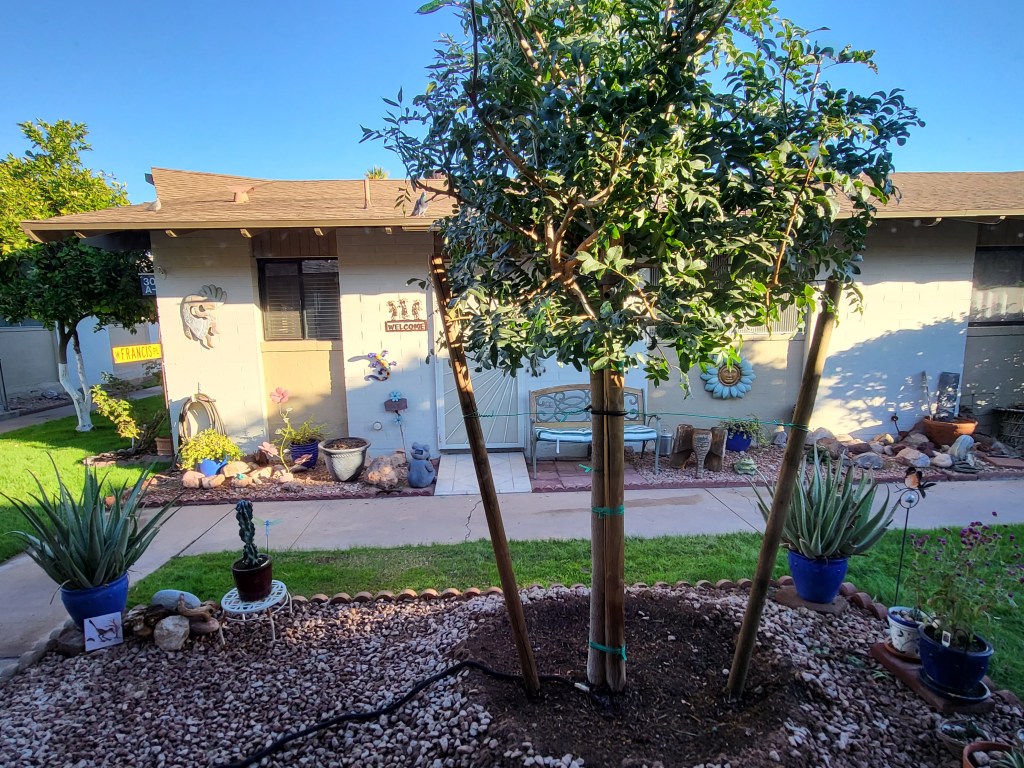
We picked the new tree of our dreams, a hearty Red Push Pistache. It is best known for the vivid red color it produces in late November.

In that sense, it will remind us of the Burning Bush we planted in the front yard of our home in Mount Prospect, Illinois in the summer of 2013.

It turned blood red every October (and still provides a splash of color though we left in 2017), after the Blue Spruce that preceded it died in the spring of 2013 … a few months after my mother left this earth.

***

On November 1, a crew from Moon Valley Nursery arrived to remove our fig tree stump. As they dug up the remaining gnarly and decaying roots and hollowed out the hole, Tom and I could feel relief pour in.

The following afternoon, our new, mature, Red Push Pistache tree arrived on the back of a long, flatbed truck. A team of five men from Moon Valley maneuvered it through the gate and down the sidewalk. Moments later, the crew enlarged the hole to accommodate our new tree’s three-foot ball of roots.

By five o’clock they had anchored our durable-and-drought-resistant shade tree in the ground in front of our condo. Soon after, they left to deposit another tree for another customer.

I imagine, in a few weeks–as Tom and I prepare to sit down at our kitchen table and give thanks on a Thursday–our new tree will lavish us with a blaze of red leaves.

But even before the redness appears, it feels as though some semblance of balance, normality, and renewal has returned to reveal our new view in south Scottsdale outside our north-facing window.

A Ticket to the World Series: Part One

The St. Louis Cardinals finished with a 71-91 record this year, landing in last place in the National League Central Division. With a thud in early October, my favorite team–rich with winning tradition that decorated my 1960’s childhood memories–ended the season with its worst win-loss record since 1990.

However, as luck would have it, the Arizona Diamondbacks (D-Backs)–my second favorite team now that I live in the Valley of the Sun– blind-sided all prognosticators.

Against all odds, this young, exciting, resilient team defeated the Milwaukee Brewers, Los Angeles Dodgers, and Philadelphia Phillies in previous playoff series and advanced to the World Series to play the Texas Rangers.

As I write this, the Rangers and Diamondbacks have each won a game in this best-of-seven fall classic. Beginning Monday, the teams will play the next three games in Phoenix at Chase Field.

The stadium is about ten miles west of our home in Scottsdale, but Tom and I have no inclination to spend thousands–or even hundreds of dollars–to sit in the stands and cheer for the team. Instead, we will watch the action and results unfold on TV–or the “tube” or “idiot box” as Dad would have called it.

Speaking of Dad, the timing and topic is right for me to share an excerpt from Tales of a Rollercoaster Operator, my book of stories from my Missouri youth. I hope you enjoy this tale about the baseball bond he and I–two Cardinals’ lovers–shared.

***

With Dad as my ever-loving companion, I hoped we would someday see a World Series game together in person. That possibility seemed akin to flying to the moon and back. But, in October 1968, we tried to make that dream a reality.

I was eleven years old. That summer the Cardinals clinched the National League pennant for the third time in five years on the strength of a 97-65 record. They would defend their 1967 World Series crown and face the Detroit Tigers in the Fall Classic.

On a crisp October morning, as I munched on stale Apple Jacks and Dad drained the contents of his saucer back into his coffee cup, I cupped my left ear toward the kitchen radio speaker.

The KMOX announcer provided details of when and where fans could line up that day to buy bleacher tickets for games 1, 2, 6 and 7. The Cardinals would host those four games in St. Louis.

I turned to Dad. He had the same “let’s do it!” look on his face. We were about to embark on an important mission: landing two World Series bleacher tickets.

With a surge of adrenalin and spontaneity that swept us off the front porch, we grabbed our jackets, hopped in our ’65 Chevy Biscayne, and drove ten miles into downtown St. Louis (a few blocks from the Gateway Arch).

I had a grand illusion that we would drive up to the ballpark, step up to the ticket window, plop down some cash, grab our newly minted tickets, and be on our way.

But, when we arrived, a stream of Cardinals fans snaked around Busch Memorial Stadium and down a few blocks. I soon realized this game of standing in line for tickets was likely to go extra innings.

Our first step was to find a parking space. Like a miner searching for gold nuggets, Dad circled the stadium two or three times for that elusive spot. Just as we were about to abort our mission, we hit pay dirt.

Dad landed our boxy craft in an unmarked open space, in the shadow of dingy, abandoned brick warehouse several blocks away. From there, we hoofed it and found our way to the end of the elongated queue of ticket-hungry spectators.

Minutes and hours passed, but the line stood still. As darkness descended, fans all around us unrolled sleeping bags to ride out the night rooted in cement.

Except for our jackets and a few snacks, we were unprepared for the madness, but managed to buddy up with a few of our neighbors. Between sighs and “what if” scenarios, we borrowed a square or two of an old quilt to sit down and wait out the marathon.

Dawn broke after a sleepless night with relative strangers and policemen hovering nearby. So did the veritable ticket-hungry logjam. We moved slowly at first. After a few hours, we could see the progress we were making.

Without warning, line jumpers cascaded in from all directions. We felt our tempers rise and wondered what happened to the cops from the night before. Even so, we were close enough to feel an ending was in sight.

That’s when several ballpark personnel strolled by to announce the most dreaded five words: There are no tickets left. With the ticket window closed, our mission was over.

Our tempers were in tatters. Our spirits were shattered. We crash landed. We left the line ticketless and turned around to make the long walk back to the car.

Maybe the walk was exactly what we needed. Dad and I were able to burn off steam and warm up after our long, empty sojourn on St. Louis streets. But there was one more surprise in store–a reminder of our overnight, urban odyssey.

When we arrived back at our car, we found a St. Louis parking violation flapping in the breeze under the worn wiper blade on the passenger side of our windshield. Technically, we had secured a World Series ticket after all. Just not the kind we imagined.

As it turned out, the Cardinals lost the World Series that year, thanks to Mickey Lolich’s pitching heroics on behalf of the Tigers. So, I suppose Dad and I didn’t miss much in the way of celebrating in October 1968.

***

If you follow my blog, look for part two of this story in the coming week.

In the Valley of Fiery Light

Nearly half drained, September–in the valley of fiery light where tiny lizards scurry–cues the hiss of early morning sprinklers.

They spray precious droplets that pool, surround, and saturate parched succulents, palms, and citrus trees.

The latter wonder if the fruits of their labors will prove less luscious when snowbirds return to snatch and gather golden orbs from sagging January branches.

***

To read more of my poetry, purchase A Path I Might Have Missed on Amazon.

Send Away … Get Away … Give Away

I don’t know why it’s taken me so long. Especially because over the past ten years I’ve written extensively about my family, my lineage, and our propensity to seek, find, and carve our own paths. Plus, our impulses to leave behind a trail of our own observations. All of that runs through my DNA.

At any rate, last week I finally bought an Ancestry DNA kit. I opened the cardboard box. Read the directions. Spit my saliva into the provided vial. Put a cap on it. Closed up the box. I sent it away in the mail. I expect to receive the results via email in six to eight weeks.

From my mother’s branch of the family tree, I know I am Scots Irish; from my father’s family, German, Swedish, Norwegian, and French lineage. But maybe there will be a surprise or two.

This additional family research is also prompted by my mother’s one hundredth birthday–coming next week on July 26–and the personal reflection that comes with this significant milestone.

Meanwhile, with nineteen days of 110-plus temperatures under our belts here in the Valley of the Sun, Tom and I are poised for an escape to celebrate Mom’s birthday.

We’re planning a three-day, mountain getaway to Flagstaff, Arizona, where–at an altitude of 7,000 feet–we will be (blissfully) twenty-five degrees cooler than Scottsdale.

Because my mother’s life story (and my associated grief) has served as a catalyst for my writing, I’m offering my first book as a Goodreads Giveaway through July 26th. One hundred readers (chosen randomly) will receive a free download of my book.

Simply enter by July 26. If you’re a lucky recipient of my book, you’ll be notified right after. Then, find a quiet corner away from the heat (I think it’s hot everywhere right now) and get lost in my three-generation story of love, loss, and our family’s passion for writing.

I look forward to hearing your thoughts and would appreciate your rating/review online.

Goodreads Book Giveaway

From Fertile Ground by Mark      Johnson

From Fertile Ground

by Mark Johnson

Giveaway ends July 26, 2023.

See the giveaway details at Goodreads.

Enter Giveaway