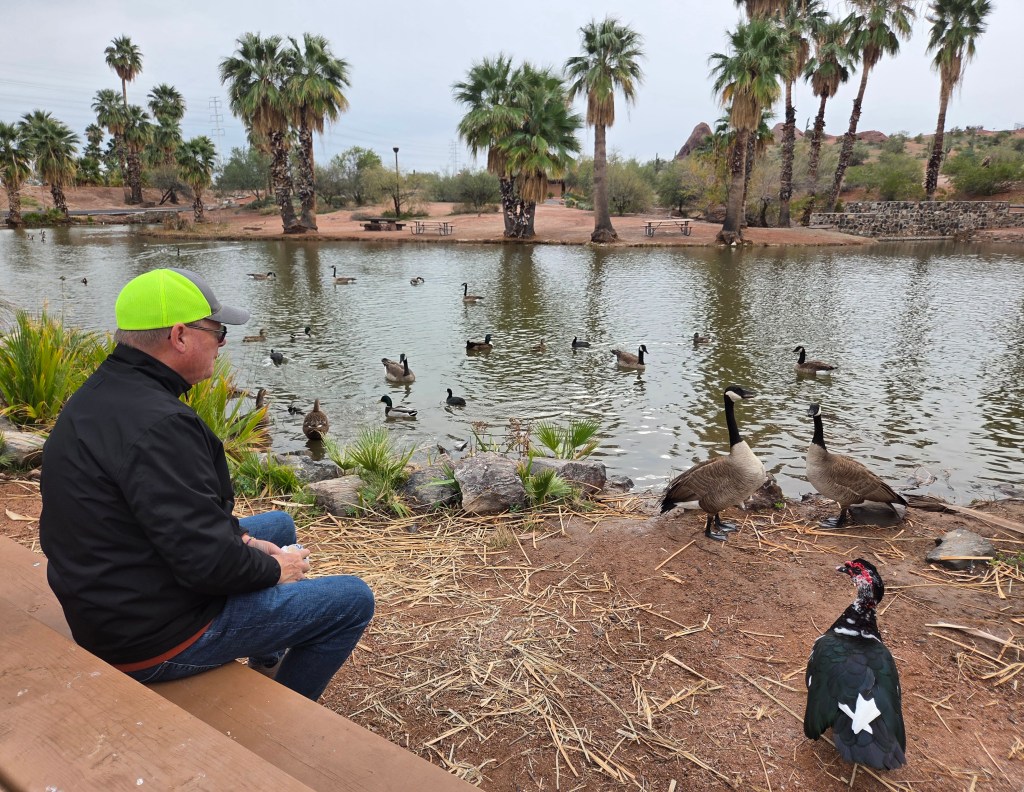
While we box up our flickering, ever-tangled holiday lights, compartmentalize them with our fading democracy, shove them into insanity’s dusty attic beside our president’s latest lawless actions streaming 24/7, we also attempt to climb above and beyond accumulating ominous clouds, by feeding old-year bread to new-year geese, by examining each piece of life’s puzzle with bleary-but-thoughtful eyes, by loving ourselves, each other, and all animals, by emulating kind lives under fleeting desert candlelight, by resuming our daily quest for survivorship and unflappable wisdom, even as every institution, every once-reliable media conglomerate or teetering motherboard (like the dying one on Tom’s old phone) signals the end is near and must be replaced. So, we replace it. We move on. We give thanks. We cherish every labor of love and every hidden oasis. We welcome every petite, heartful bouquet. We marvel at one rare, exquisite, night-blooming cereus, paint-plus-provenance. It is the perfect gift on canvas from a dear friend.
The downstream darkness of January is real, but in our upstream hearts, in the serenity of nature (and now framed in splendor on our living room wall thanks to Dougal) there is a profound, constant, but private reminder: there is always beauty and hope, even when there is darkness.
The middle of October is upon us, and I am addicted to the pumpkin spice lattes at Grounds on 2nd, our favorite haunt in Old Town Scottsdale.
More important, I am delighted to report I have completed the manuscript for another book. It’s called Sixty-Something Days.
Book six is a memoir tapestry that first entered my consciousness around my sixty-fifth birthday in July 2022. I began to closely consider what it means to stay creative and relevant in our later years … especially in our divisive culture enamored with youth but often dismissive of wisdom.
This book explores that idea in episodic ways. It features sixty-five essays, poems, and flashes of fiction, which I first published here over the past three years. Now, I am stitching them together.
With time–and the encouragement of friends and readers–I began to see a thread of truth running through them: that as human beings (lovers of music and nature) we must remember the poignant arc-of-life moments (past and present) while striving to stay involved, influence others through our compassion, and share our hard-earned wisdom.
Those themes appear in my other books, but this one feels more urgent. More emphatic. I feel an obligation to share what I have learned, find beauty and hope wherever we can in our lives, and raise a banner that is a call to action to survive this period of tremendous upheaval in our country.
Currently, I am working closely with Sam, graphic designer extraordinaire, to create a cover and develop the interior format. Sam has partnered with me on all of my books.
Yesterday, he sent me the first galleys for review. I can see book six taking shape. I feel my enthusiasm swelling. If all goes well, I will publish Sixty-Something Days sometime in November.
The arc of life in my sixties–its highs and lows–has proved mostly to be an unexpected artistic one. Yet it is an uneven tapestry of co-existing emotions: fear for our eroding democracy; love for new and old friends; and boundless gratitude currently after returning to St. Louis for my Affton High School Class of ’75 reunion and reconciling my midwestern roots with my southwestern reality.
***
A trip to St. Louis would not be complete without a visit to my parents’ graves at Jefferson Barracks National Cemetery. So, we began there.
On Friday, September 19, Tom and I stopped at Dierberg’s in Creve Coeur near our hotel to buy a handful of burnt orange carnations.
Twenty minutes later, we arrived in the sea of marble stones on rolling hills ten miles south of downtown St. Louis.
We parked our rented Mazda SUV and tiptoed past a veteran’s funeral in progress under a makeshift canopy. A female vocalist sang Amazing Grace. Instantly, my tears began to flow.
Each time I go to Jefferson Barracks, it is a touchstone experience. Tapping one side of the stone and then the other. Remembering the love and best intentions of Helen and Walter Johnson–both long gone but not forgotten.
Minutes later, sitting on a nearby bench with Tom under the sturdy branches of an oak tree that has lost its earliest leaves due to an especially dry Missouri summer.
Friday afternoon was also somber and reflective. We met our friend Mark, a docent at St. Louis Kaplan Feldman Holocaust Museum, for a visit there.
He guided us through horrific-then-hopeful survivor stories, images, and vintage artifacts, curated from proud Jewish St. Louis residents who lived through the awful experience. Only a few remain, but their legacies live on.
All in all, it was a chilling, relevant, immersive few hours. Cautionary evidence of hate and authoritarian evil that inundated the world in the 1930s and 40s, and now–in the US in 2025–threatens the existence of those who are not straight, Christian white men.
After deep breaths and a refreshing Friday nap in our hotel, Tom and I drove to University City for an evening with Mark and his husband David at their home. It was a celebration of our unfolding friendship.
At sunset, they lit candles and recited Shabbat blessings before we shared wine and bread. At their table, I felt our bond of friendship, which began just a few years ago, grow.
We met Mark and David when–as snowbirds living part-time in Arizona–they first attended one of Tom’s free film screenings at the Scottsdale Public Library.
Now, they have become the newest, welcoming community component of our St. Louis connection.
Ollie hated swimming lessons. But it was summer, and he promised his mother Jill that he would commit to one structured activity while school was out.
Every Tuesday and Thursday morning in June and July, Ollie packed his swim trunks, towel, and goggles begrudgingly. At 8:55, his older sister Lydia, fresh from earning her driver’s license, dropped him at the curb outside Chaparral Pool.
Ollie wasn’t afraid of the water or physical activity. What bothered him was getting naked in front of the other middle school boys and showering near them when their lesson was over.
To soothe his anxiety, Ollie hatched a plan. He decided to stash one of his tiny butterfly drawings—pink wings, beady red eyes, black antenna, and blue thorax on a white sticky note—in his bag. Then, when he arrived at the pool, he would post it discreetly inside locker 8.
An hour later, when he returned to the locker room after class, he twirled the dial on his lock—16 then 8 then 32—popped open the latch and rediscovered his prized artwork hanging there. This ritual distracted him as he peeled off his wet royal blue trunks, then scampered to the nearest open shower stall.
***
Ollie’s meticulous butterfly drawings covered his desk at home. Each one was unique in size, color, and configuration, but all were Ollie’s creations.
Before dinner one night in late May, Jill passed Ollie’s bedroom door. She knocked, then peeked in to check on her son and his homework progress. Before she left, she declared, “I love your drawings, Ollie! What do you love most about butterflies?”
Caught off guard, Ollie shrugged. He couldn’t find the precise words.
Was it their fragility? Their freedom? Their gentility? Their rare ability to transform from a cocoon and flit about—unfettered—floating above a weighty world that discouraged everyone around him?
Or simply that Ollie’s preoccupation with his art quieted his nerves even as he felt excitement stir in his growing penis?
***
On July’s last Thursday after Ollie’s final swimming class, he showered quickly to avoid contact with Jake. Weeks before, he made fun of Ollie’s oversized beach towel. It featured a canary yellow smiling sun wearing funky sunglasses.
“Did your mommy buy that big, beautiful towel for you, Ollie?” Jake chided.
What would Jake say if he found my butterfly tucked inside my locker door? Ollie wondered.
Undeterred, Ollie wiggled into his gym shorts, threw on his Arizona Diamondbacks jersey, slipped into his flipflops, and folded his belongings in his bag.
Rather than plucking his prized butterfly drawing from locker 8 and bringing it home to cluster with his other creations, Ollie left it hanging there. He left it clinging inside the metal wall for unknown days, weeks, or years.
Ollie left his art—his reassuring beauty—for another boy who might one day appear and appreciate it. For another boy who might feel threatened by a world of ominous clouds that surrounded him and what he didn’t yet understand about himself.
***
Lately, I have been writing short fiction, exploring and developing stories with a social statement that fit within the realm of my reality. It helps me feel I am making a small difference in this country I live in and still love … even as the madness within and outside our borders continues to spin out of control.
Visual prompts (like this photo I captured in July at my community pool in Scottsdale, Arizona) open an alternative world of creative possibilities for me. This is a technique I recommend to participants in my memoir writing workshops. So, in this instance, you might say I am wearing several hats … student, teacher, writer, gay man, concerned citizen.
I’d love to know what you think of this story. How does it make you feel? As always, I appreciate your insights and feedback.
In my memoirs, I’ve written about discovering and embracing my gayness later in life … remembering that horrific feeling of squashing my true self to fit into a prescribed notion of “all-American” masculinity.
I worry about the Ollies in the United States … the poets, artists, visionaries … the young, emerging, gay, lesbian and trans members of our society … all who face growing up in our country that is turning a blind eye toward anyone who isn’t a straight, white, MAGA male.
“Are you guys going to the protests this Saturday?” Nick wondered last Wednesday via a text.
“No. We aren’t planning to. It’s just too hot,” I responded to my son.
But as the week wore on, I began to regain my energy following three phenomenal concerts with my Phoenix Gay Men’s Chorus pals.
On Friday, I reconsidered Nick’s question. I told him Tom and I would do it. A few of our chorus friends wanted to join us too at a No Kings protest in Scottsdale.
I should tell you that I don’t consider myself an activist, though I have marched for various causes on several occasions in my life. I prefer to share my voice and perspective through my writing.
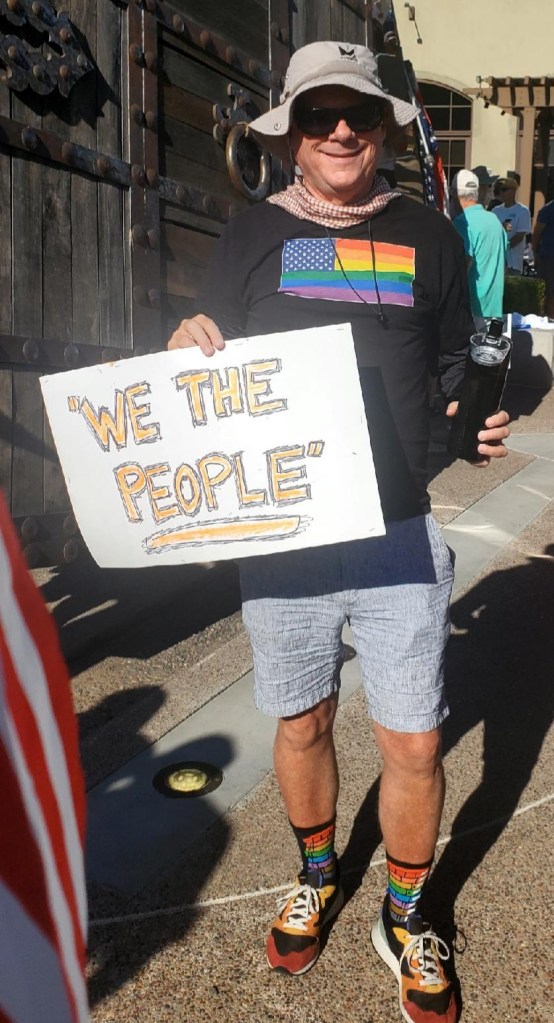
But I also recognize the dire state of our democracy. I decided if my World War II veteran father (he defended democracy in Europe with the allied forces during the Battle of the Bulge in late 1944) could endure frozen feet in foxholes with his buddies and risk his life as an army sergeant, I could certainly endure the 90-plus desert temperatures in Arizona for two hours, wave my American flag and “We the People” sign, and join forces with family and friends to raise my voice. To make sure it was heard.
So, Saturday came, and we did it … Mark, Tom, Nick, Kim, Dougal, George and one to two thousand others represented democracy in Old Town Scottsdale. We were a dot in a map of some five million in the U.S. and abroad who took to the streets in big cities and small towns. All of us deeply concerned.
Locally, it was an inspiring and peaceful No Kings protest consisting of angry but well-behaved women and men. Young and old. A few children with parents and grandparents. Couples. Singles. Straight. Gay. Multi-cultural. Dogs, too. Dare I say diverse?
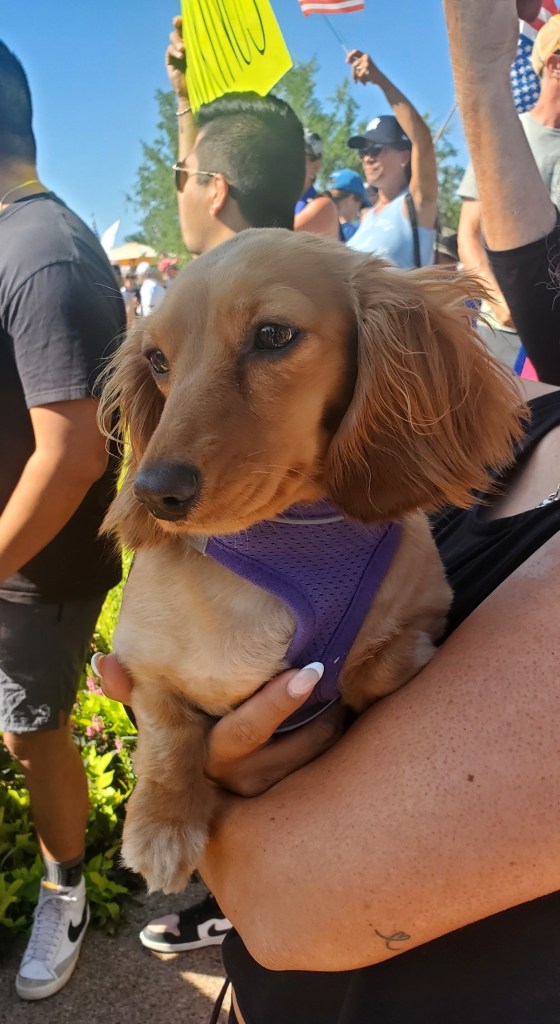
At one point, Tom and I chatted with a fifty-something mother from San Diego. She was visiting her daughter who lives in Scottsdale. They took turns chanting “No Kings” while cradling their adorable, slightly overwhelmed dachshund.
The dog’s benevolent eyes seemed to say, “what are we all doing here?” All I could do was shrug and smile. There is no explaining all we have endured in this country over the past six months. Not to mention the previous eight or nine years.
A short while later, I turned to discover a man holding a profoundly-funny-and-literary sign. A parody of American poet Robert Frost’s The Road Not Taken. I imagine Frost would have loved it, if he had been alive and standing beside me.
I asked the man if I could take his picture. I told him it spoke to my wordsmithing sensibilities. He surprised me by saying he was a math guy.
I’ll likely never cross paths with him again. He’ll never know that my book of poetry, A Path I Might Have Missed, was inspired by my love for Robert Frost’s verses. But on June 14, 2025, we stood on the same page … on the same street corner … on the same shared path.
Together–close friends, like-minded acquaintances, and distant strangers–we proclaimed our desire and hope to rescue American democracy from the clutches of fascism.
In a natural sense, it produces turmoil in the Northern Hemisphere … growth and beauty laced with intense storms and wild swings in temperatures.
Of course, those meteorological transitions pale when you compare them with the societal turmoil, which I feel daily living in the United States in 2025.
My only recourse is to try to make a difference in my own way: stay visible, protest beside like-minded friends …”Hands OFF our Social Security” … all the while remodeling my home with Tom, singing, writing, and leading my memoir writing workshops. (Twelve aspiring writers are meeting with me later today in the middle of three workshop sessions at the Scottsdale Public Library.)
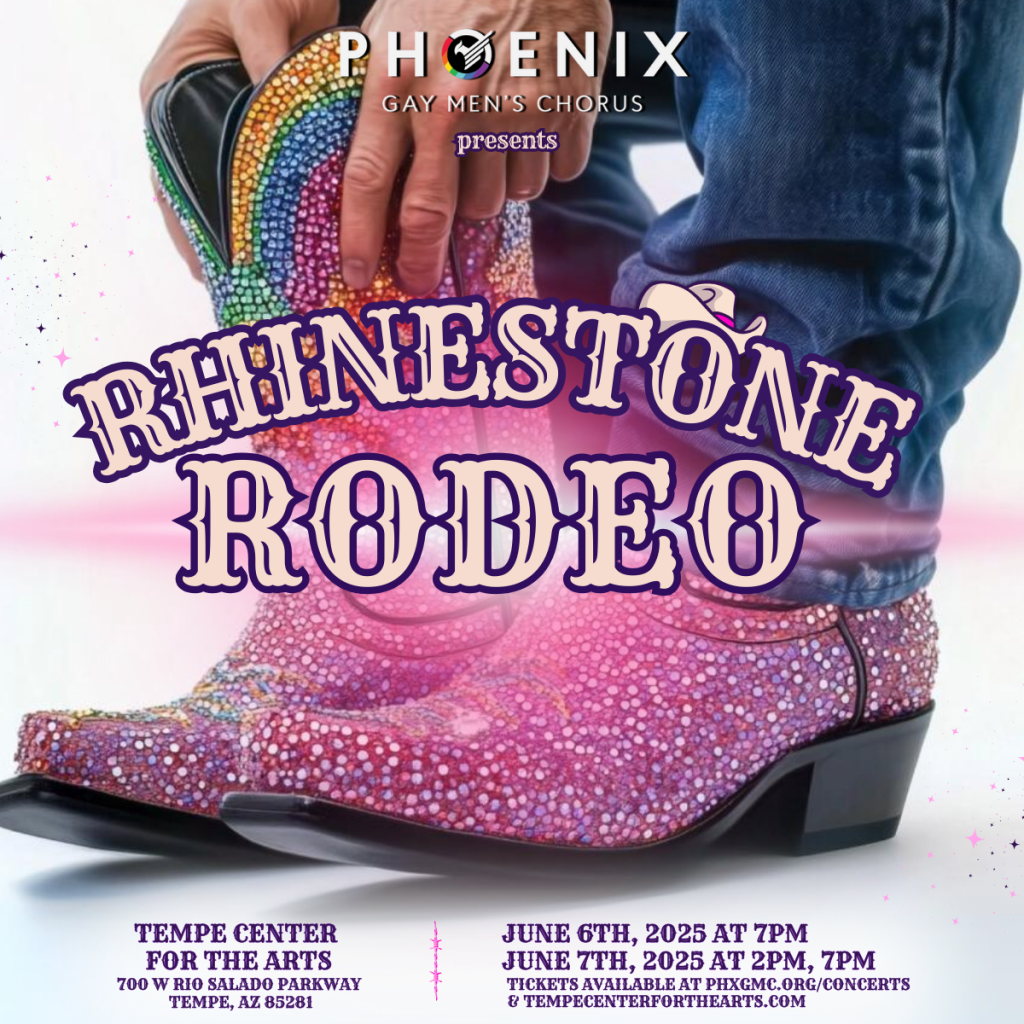
It’s appropriate that my Phoenix Gay Men’s Chorus comrades and I will perform an inspiring arrangement of Bob Dylan’s The Times They Are A-Changin’ at our Rhinestone Rodeo concert on June 6 and 7 at Tempe Center for the Arts.
Because they most definitely are … and you better start swimmin’, or you’ll sink like a stone, for the times, they are a-changin’ …
On to more personal transitions that fly under the radar. It is the grimy stuff of life. A friend’s mother dies. Another grieves the loss of his wife. A third deals with a cancer diagnosis. I will do my best to continue to be there for all of them.
If you live in the Phoenix area, come in from the heat and attend one of our June concerts. We will entertain and energize you … make you smile, laugh, shed a few tears, too … as we lift our voices.
No one can stop me from being who I am … who I love … who I care for … who I sing with.
It’s late Friday afternoon in the desert. The mockingbird outside our backdoor is singing his or her heart out. It’s a tender, hopeful, pre-weekend serenade … a chirpy, lyrical refrain coming from the top of a telephone pole that connects our heavier world of technology and dissonant news and noise.
None of us knows what tomorrow will bring … ever. But especially now.
Case in point: early this afternoon as Tom and I devoured a few remaining slices of sausage and veggie pizza from the night before, a military jet zoomed overhead.
The sudden surge of decibels jarred our nerves. Though we live near a military base at Papago Park, we rarely hear that intense noise. Only an occasional squadron of helicopters arriving or departing.
We are a nation of divided people living on the edge of time, sound, and sensibility. Each day when we climb out of bed, we are aware of the dismantling of institutions we have come to know and respect.
Each day we are threatened by another batch of edicts tossed out the sidedoor by an authoritarian regime bringing shame and constant anxiety to those of us raised to believe in a country that once valued high ideals over low morals.
I don’t pretend to have the answers. But I know silence will kill us.
I won’t pretend to be someone I’m not. Or as I have said frequently to friends lately, “I’m not putting this genie back in a bottle.”
What do I mean? I spent too many years as a teenager and young adult (of the 1970s, 80s and early 90s) denying my true gay identity, subverting my whole self to try to fit into a predominantly straight, suburban culture.
That caused me (and others in my life at the time) tremendous personal pain. And, on a larger scale, denying the truth kept our society from advancing to a higher plain of equality, freedom, and human possibilities.
Yet now our federal (and some of our state and local government officials, too) are attempting to wipe away the contributions and accomplishments of our “diverse” people from websites and history books.
For instance, native code talkers who–by virtue of their distinct language–were instrumental in helping to bring an end to World War II.
Did you know that recently pages on the Arlington National Cemetery website–highlighting the graves of Black and female service members–have been removed?
These and other efforts are designed to erase the accomplishments of women and people of color.
How far will this attempt at whitewashing our history go? I don’t pretend to know. But I do know that the best attributes of our diverse culture exist in the past and present and people need to know about these contributions.
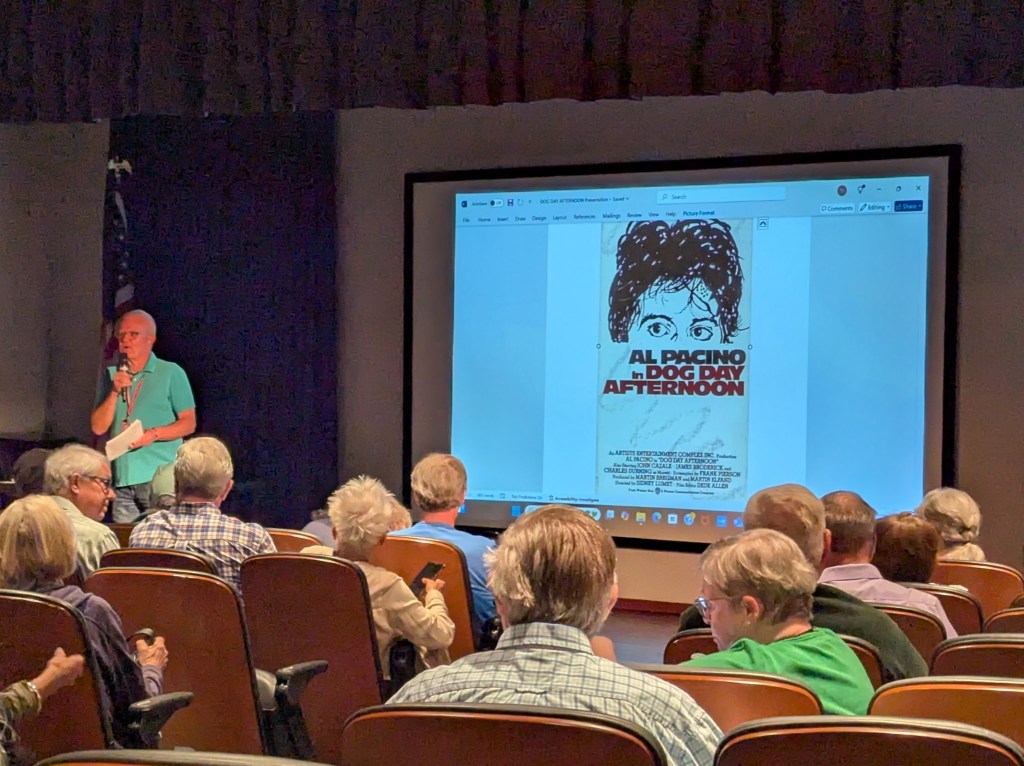
My husband Tom, an aficionado of films from the 1960s and 70s, has been leading a film series this winter and spring at the Scottsdale Public Library, titled “Movies That Matter: the 1970s.”
Each Monday afternoon, between 75 and 100 people attend this free series. The audience is mostly white people who love great films.
Last week, Tom screened “Dog Day Afternoon”. Directed by Sidney Lumet and starring Al Pacino, the film–based on a true story that occurred in Brooklyn, New York, in the 1970s–chronicles a botched bank robbery in the heat of the summer.
It’s an intense and sometimes funny film early on. Pacino plays Sonny. He’s desperate to get the money his partner needs for a sex change operation. But we don’t know that until more than half the movie has spooled through what once was a movie projector.
It’s a must-see flick. I won’t spoil the outcome if you haven’t seen it. But the most meaningful and important aspect of this story is that 93 people attended. They listened to Tom’s stage-setting intro for historical context. They watched the film, and then they talked about it. Together.
They talked about what it meant. They examined the techniques employed in the film to tell the story effectively. They existed in that space for three hours as a community of people in a shared experience.
I don’t pretend to know all of the political affiliations represented in that room. But I’m certain they left with a greater appreciation for film and how it can shed light on the differences and pressures–like them or not–that have existed in our American society for decades.
Tom delivers his opening remarks at a screening of Dog Day Afternoon at the Scottsdale Public Library on March 17, 2025. Photo by our friend and neighbor Diego.
When you’re living through a full-blown constitutional crisis–and feeling vulnerable–you need to find ways of coping and caring for the ones you love.
So, I bought two of these beaded rainbow wristbands from the Human Rights Campaign for Tom and me to wear.
We are wrist-banding together.
This is a symbolic gesture. I want the world to know that this gay couple isn’t going anywhere, though it is a period in the United States where some would prefer that those of us who are different would go away.
But I–we–remain visible.
As I write this blogpost, I realize it is number 500 … a true milestone for any writer.
When I began blogging in May 2018, I had no illusions of where it might lead.
I simply wanted to give my books and literary voice more room to grow, more visibility.
For that reason, I suppose it is fitting that today I choose to write about my gay identity and continue to exercise personal aspects of my voice … visibly.
In many respects, the life my husband and I lead is not all that different from any couple.
We shop for groceries together. Go to the gym together. Enjoy quiet moments and meals together. Love and nurture each other.
We do our best to support each other and our family members during highs and lows.
We spend time with our friends. They are young and old, straight and gay, black and white.
We love and respect them, and they love and respect us.
I think it’s accurate to say this about our friends: we enrich each other’s lives, no matter our skin color, religious beliefs, cultural perspectives, gender identities, or sexual orientations.
It is a personal jolt to realize–and read on trusted news sources each day–that our differences are under attack and being eroded in my home country … the country I still love.
I don’t think I’m depressed. But I am definitely sad and angry. Definitely grieving. Me and a boatload of others of all backgrounds and persuasions.
There are times when I want to scream from the top of a mountain. “This is my country, too. How dare you try to take that away from me!” But then I wonder, “Is anybody listening?”
So, I bring this here, instead and I type these words in blogpost number 500.
At any rate, thank you for joining me–possibly even enduring me at times–on this blogging journey since May 2018.
As long as I continue to feel I have something important and relevant to say (to shed light on the topics of the day … to celebrate a literary success or the latest Phoenix Gay Men’s Chorus performance … to pay tribute to those I love … to tell a funny story about our stray cat Poly … to observe and honor the beauty of nature … to share a vivid, meaningful memory about my childhood … or to pen a poem that is in need of artistic space and oxygen) you will find me here.
I hope you have been informed or entertained and will continue to tag along with me on this organic literary odyssey, wherever it may lead.
As I walked the treadmill at the gym this morning–on Abraham Lincoln’s two-hundred-sixteenth birthday–a weird, dark, and discomforting question swirled through my brain.
What if we–all the diverse people in this country, all the people of color, all the LGBTQ folks–were gone?
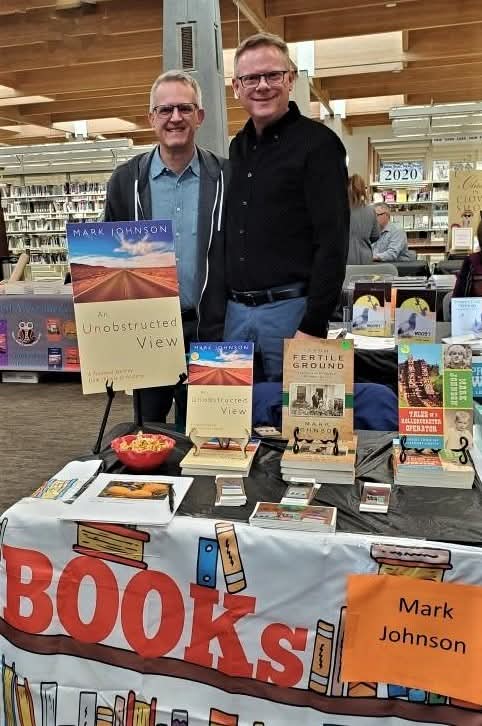
In the old days (the pre-Covid days)–just five years ago this week–I hawked my books with my husband by my side at a local author book fair at the Scottsdale Public Library.
We didn’t know about the dark days ahead. Holed up in our cozy condo. Wondering if we and our closest family and friends would survive. Wondering if the race to create a viable vaccine might save us.
Fortunately, science did produce a vaccine that saved lives (for those of us who had the gumption to protect ourselves and others).
We did survive and Tom and I have gone on to create new chapters at the library … him leading several successful film series; me guiding those intent upon writing their own memoirs.
Strangely, those Covid years feel quaint now as our nation disintegrates daily. Tom and I cling to one other, as our nation turns a blind eye toward anyone who is different.
Yes, we have many friends and family who love us. But, to put it bluntly, I don’t feel safe. This experience of living in 2025 in the United States (we aren’t really united) has cued old tapes in my psyche that remind me that–once again–I am living in a straight, white world of shallow masculinity.
I will keep trudging along. Loving my husband. Guiding my adult sons. Speaking my mind. Telling my stories. Holding my closest friends close. Giving to organizations that might make a difference. Advocating for those less fortunate. Donating my time, talents, and voice to the Scottsdale Public Library and the Phoenix Gay Men’s Chorus.
Most of all–like many of you–I just need to keep breathing today. And, for tomorrow and the next day, I need to save any reserves of energy and sanity I have to fight the good fight.
My mother was a collector of fine furniture, ceramic pitchers, and–occasionally–commemorative coins.
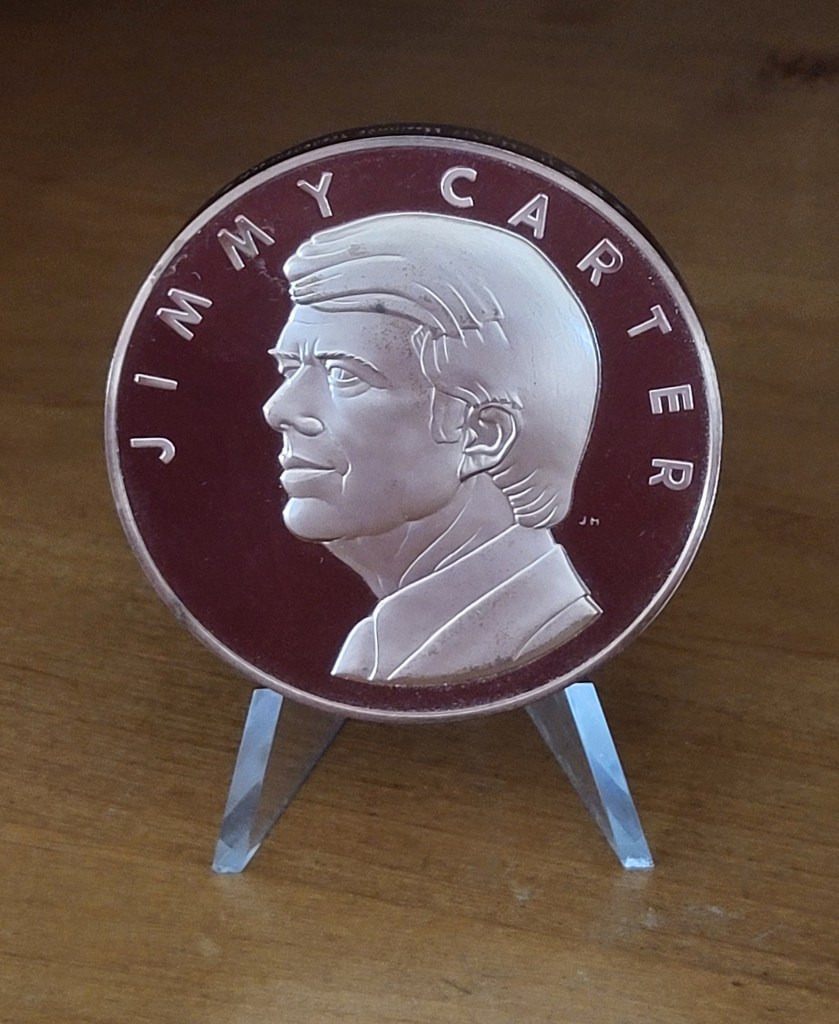
On March 17, 1977, she purchased this Franklin Mint medal. It celebrates the inauguration of Jimmy Carter, the thirty-ninth President of the United States.
This bronze coin has occupied a space inside a box in my father’s WWII army trunk for the past few decades.
I was nineteen and a first-time voter when I cast my ballot for Carter in November 1976.
Most of my college friends at the University of Missouri were Gerald Ford supporters.
I suppose they were willing to forgive him for pardoning Richard Nixon.
I wasn’t. I opted for Carter, the peanut farmer from Plains, Georgia.
As history would have it, Carter’s four years as president (1977 to 1981) included many ups and downs.
For instance, Carter successfully negotiated the Camp David Accords, political agreements signed by then Egyptian president Anwar Sadat and Israeli prime minister Menachem Begin.
Carter also signed into law bills that created the U.S. Department of Energy and Department of Education.
However, the Iran hostage crisis (when fifty-three U.S. diplomats and citizens were held hostage at the U.S. embassy in Tehran by a group of Iranian college students who supported the Iranian Revolution) and related oil crisis led to his unraveling popularity.
In November 1980, Ronald Reagan defeated Jimmy Carter. His loss was punctuated on January 20, 1981, when the hostages were released on the first day of Reagan’s presidency.
Of course, we now know Jimmy Carter wasn’t through yet. He lived another forty-three years and made good use of his century-long (1924-2024) life.
After leaving the White House–with his wife and life partner Rosalynn Carter ever by his side–he established the Carter Center. He worked tirelessly to promote and expand human rights.
That led him to receive the Nobel Peace Prize in 2002.
Jimmy and Rosalynn Carter also became famous for the houses they helped build for Habitat for Humanity and the faithful lives they shared with family and friends in their community and all around the world.
***
This morning, after watching C-SPAN coverage of Jimmy Carter’s funeral at the National Cathedral in Washington, D.C.–and listening to a parade of praise in eulogies given by past Republican and Democratic leaders and grieving family members–I extricated the bronze medallion.
I brought it into the light. I placed it on the shelf of our bureau in our Arizona sunroom. I pondered Jimmy Carter’s astounding legacy of faith, hope, service, and perseverance.
I wondered if–as he was laid to rest–our nation’s democracy might not be far behind.
I hate the trite phrase “only time will tell.” But it certainly applies as inauguration day–January 20, 2025–approaches.
Consider this. Tucked inside the box that normally houses the Carter medallion is a little booklet with information about the tradition of the presidential inaugural medals. Here is an excerpt:
“The Official 1977 Inaugural Medal commemorates the solemn ritual, repeated every four years, through which Americans and their President refresh the nation’s commitment to free government.
During the inauguration, the President, in the presence of Congress, pledges to serve faithfully and to uphold the Constitution to the best of his ability.
Americans have always treated this ceremony as a portentous moment in the life of the republic, a time of celebration and of renewed dedication.”
But we live in 2025. Will the incoming president uphold the Constitution to the best of his ability?
That bit of history–beyond the funereal pageantry of today–has yet to be written.



 Mark Johnson Stories