Category: Essays

I Don’t Pretend

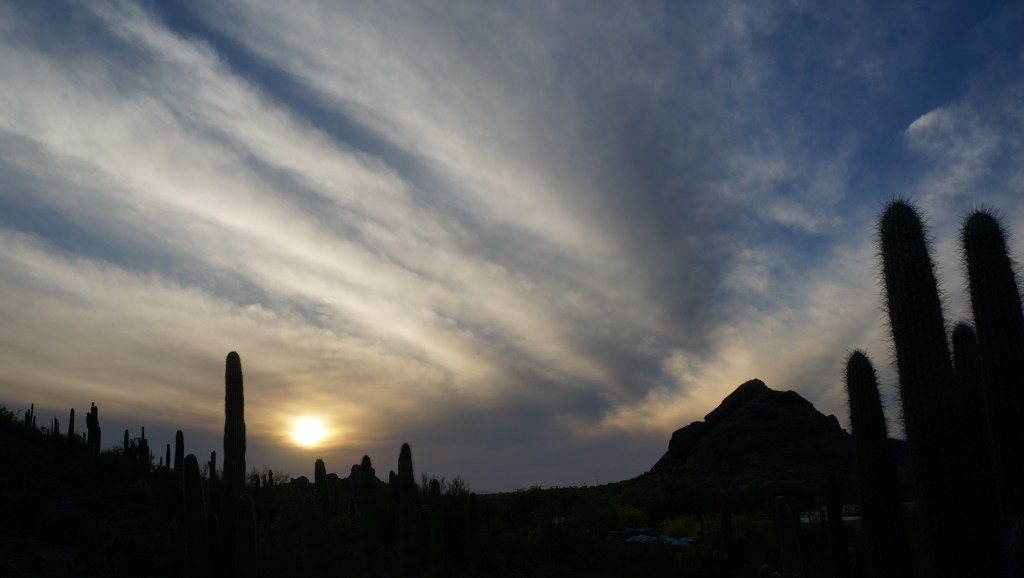
It’s late Friday afternoon in the desert. The mockingbird outside our backdoor is singing his or her heart out. It’s a tender, hopeful, pre-weekend serenade … a chirpy, lyrical refrain coming from the top of a telephone pole that connects our heavier world of technology and dissonant news and noise.

None of us knows what tomorrow will bring … ever. But especially now.

Case in point: early this afternoon as Tom and I devoured a few remaining slices of sausage and veggie pizza from the night before, a military jet zoomed overhead.

The sudden surge of decibels jarred our nerves. Though we live near a military base at Papago Park, we rarely hear that intense noise. Only an occasional squadron of helicopters arriving or departing.

We are a nation of divided people living on the edge of time, sound, and sensibility. Each day when we climb out of bed, we are aware of the dismantling of institutions we have come to know and respect.

Each day we are threatened by another batch of edicts tossed out the sidedoor by an authoritarian regime bringing shame and constant anxiety to those of us raised to believe in a country that once valued high ideals over low morals.

I don’t pretend to have the answers. But I know silence will kill us.

I won’t pretend to be someone I’m not. Or as I have said frequently to friends lately, “I’m not putting this genie back in a bottle.”

What do I mean? I spent too many years as a teenager and young adult (of the 1970s, 80s and early 90s) denying my true gay identity, subverting my whole self to try to fit into a predominantly straight, suburban culture.

That caused me (and others in my life at the time) tremendous personal pain. And, on a larger scale, denying the truth kept our society from advancing to a higher plain of equality, freedom, and human possibilities.

Yet now our federal (and some of our state and local government officials, too) are attempting to wipe away the contributions and accomplishments of our “diverse” people from websites and history books.

For instance, native code talkers who–by virtue of their distinct language–were instrumental in helping to bring an end to World War II.

Did you know that recently pages on the Arlington National Cemetery website–highlighting the graves of Black and female service members–have been removed?

These and other efforts are designed to erase the accomplishments of women and people of color.

How far will this attempt at whitewashing our history go? I don’t pretend to know. But I do know that the best attributes of our diverse culture exist in the past and present and people need to know about these contributions.

My husband Tom, an aficionado of films from the 1960s and 70s, has been leading a film series this winter and spring at the Scottsdale Public Library, titled “Movies That Matter: the 1970s.”

Each Monday afternoon, between 75 and 100 people attend this free series. The audience is mostly white people who love great films.

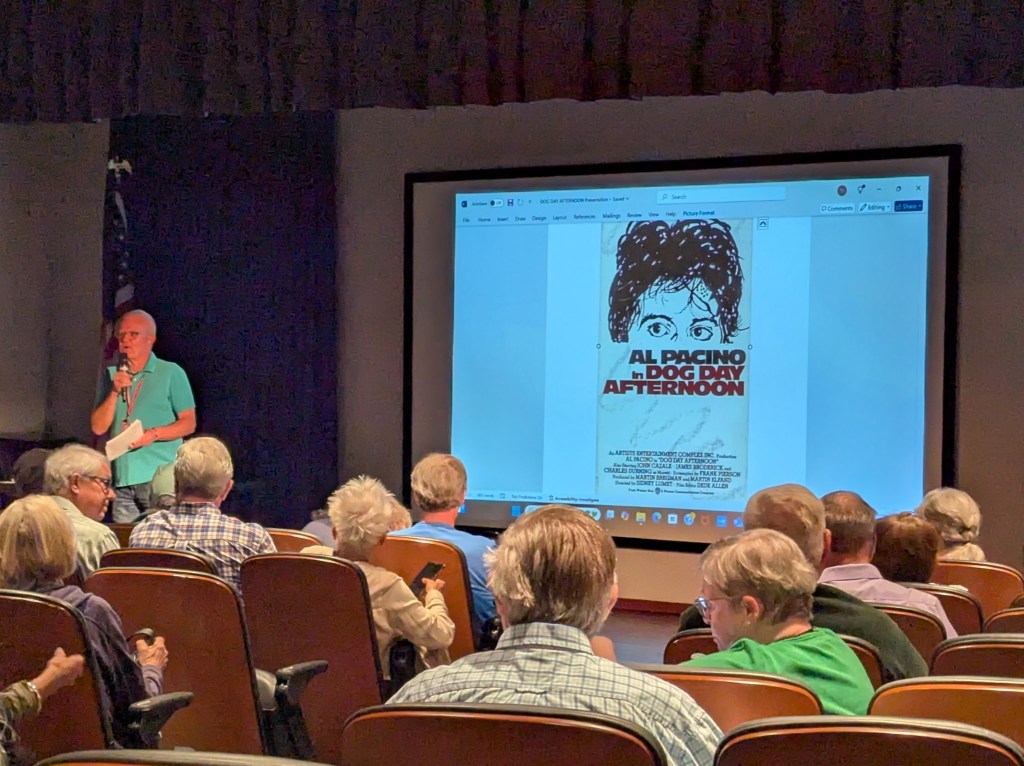
Last week, Tom screened “Dog Day Afternoon”. Directed by Sidney Lumet and starring Al Pacino, the film–based on a true story that occurred in Brooklyn, New York, in the 1970s–chronicles a botched bank robbery in the heat of the summer.

It’s an intense and sometimes funny film early on. Pacino plays Sonny. He’s desperate to get the money his partner needs for a sex change operation. But we don’t know that until more than half the movie has spooled through what once was a movie projector.

It’s a must-see flick. I won’t spoil the outcome if you haven’t seen it. But the most meaningful and important aspect of this story is that 93 people attended. They listened to Tom’s stage-setting intro for historical context. They watched the film, and then they talked about it. Together.

They talked about what it meant. They examined the techniques employed in the film to tell the story effectively. They existed in that space for three hours as a community of people in a shared experience.

I don’t pretend to know all of the political affiliations represented in that room. But I’m certain they left with a greater appreciation for film and how it can shed light on the differences and pressures–like them or not–that have existed in our American society for decades.

Tom delivers his opening remarks at a screening of Dog Day Afternoon at the Scottsdale Public Library on March 17, 2025. Photo by our friend and neighbor Diego.

Wrist-banding Together

When you’re living through a full-blown constitutional crisis–and feeling vulnerable–you need to find ways of coping and caring for the ones you love.

So, I bought two of these beaded rainbow wristbands from the Human Rights Campaign for Tom and me to wear.

We are wrist-banding together.

This is a symbolic gesture. I want the world to know that this gay couple isn’t going anywhere, though it is a period in the United States where some would prefer that those of us who are different would go away.

But I–we–remain visible.

As I write this blogpost, I realize it is number 500 … a true milestone for any writer.

When I began blogging in May 2018, I had no illusions of where it might lead.

I simply wanted to give my books and literary voice more room to grow, more visibility.

For that reason, I suppose it is fitting that today I choose to write about my gay identity and continue to exercise personal aspects of my voice … visibly.

In many respects, the life my husband and I lead is not all that different from any couple.

We shop for groceries together. Go to the gym together. Enjoy quiet moments and meals together. Love and nurture each other.

We do our best to support each other and our family members during highs and lows.

We spend time with our friends. They are young and old, straight and gay, black and white.

We love and respect them, and they love and respect us.

I think it’s accurate to say this about our friends: we enrich each other’s lives, no matter our skin color, religious beliefs, cultural perspectives, gender identities, or sexual orientations.

It is a personal jolt to realize–and read on trusted news sources each day–that our differences are under attack and being eroded in my home country … the country I still love.

I don’t think I’m depressed. But I am definitely sad and angry. Definitely grieving. Me and a boatload of others of all backgrounds and persuasions.

There are times when I want to scream from the top of a mountain. “This is my country, too. How dare you try to take that away from me!” But then I wonder, “Is anybody listening?”

So, I bring this here, instead and I type these words in blogpost number 500.

At any rate, thank you for joining me–possibly even enduring me at times–on this blogging journey since May 2018.

As long as I continue to feel I have something important and relevant to say (to shed light on the topics of the day … to celebrate a literary success or the latest Phoenix Gay Men’s Chorus performance … to pay tribute to those I love … to tell a funny story about our stray cat Poly … to observe and honor the beauty of nature … to share a vivid, meaningful memory about my childhood … or to pen a poem that is in need of artistic space and oxygen) you will find me here.

I hope you have been informed or entertained and will continue to tag along with me on this organic literary odyssey, wherever it may lead.

As I walked the treadmill at the gym this morning–on Abraham Lincoln’s two-hundred-sixteenth birthday–a weird, dark, and discomforting question swirled through my brain.

What if we–all the diverse people in this country, all the people of color, all the LGBTQ folks–were gone?

That fearful quandary led me to write this poem.

****

If We Were Gone

If we were gone,

you would miss

our minds, our hearts,

our beauty, our tenacity,

our sensitivity,

our sensibility,

our kindness, our love,

our compassion, our humor,

our leadership, our style,

our guidance, our wisdom,

our friendship, our support,

our joy, our pain, our truth,

our sun, our moon, our stars,

our books, our movies,

our artistry,

our contributions,

our serendipitous stories.

But, most of all, you

would miss us.

You would miss

the clarity and

strength of our

distinctive lives

and beautiful voices.

That would be

the greatest loss of all.

From Longing to Belonging

I’m back home. Inside the furnace, better known as the Valley of the Sun.

I have begun to reemerge from an affirming, magical, inspiring five days of LGBTQ bonding and music with my chosen family at the 2024 GALA Festival in Minneapolis.

From July 10-14, 7,000 singers (representing nearly 300 choruses and presenters from around the world) inhabited the Twin Cities.

We owned the stages. Occupied the hotels. Flooded the restaurants, bars, shops and streets with gaiety and glee.

But it was more than the magnitude of this quadrennial event that has left an indelible imprint on my creativity and identity. It was the sense of joy, kindness, support, and human possibilities that dazzled me most.

At a time in this country and our world where so much hatred abounds, I was reminded that when love is present–when people truly come together to care for one another and cheer each other on–we can be that Bridge Over Troubled Water (one of the songs my Phoenix Gay Men’s Chorus mates and I performed) of hope for one another.

This was my third GALA. I shared all of them with my husband Tom: 2012 and 2016 in Denver; 2024 in Minneapolis. Each one has nurtured me, deepened my sense of artistry and compassion, and reinforced the importance of rekindling/kindling old and new relationships.

In this 2024 installment, over a five-day period I was able to reconnect and celebrate with friends from Chicago (who perform with the Windy City Gay Chorus and the Chicago Gay Men’s Chorus), Washington, Seattle, and–of course–Phoenix.

A friend and ex-colleague (from my past consulting career) who lives in the Minneapolis area, also surprised and delighted me by attending our performance on July 12. It was a treat seeing her again.

If you follow my blog, you know I have written five books. One is a book of poetry; the other four are memoirs or creative nonfiction. I’ve also written lyrics and librettos for the Phoenix Gay Men’s Chorus.

Already, I have begun to scribble ideas in a spiral notebook that were sparked by my latest GALA experience. Who knows? This may lead me to a stream of poems or lyrics I have yet to compose.

For now, I will leave you with an idea and image that captured my attention on Saturday as Tom and I watched a series of choruses perform inside the auditorium of the Minneapolis Convention Center.

A few rows in front of us, a couple neither of us knows relaxed and leaned in. Away from the heat and fire in the world, they rested their heads against one another. They held each other. They listened to beautiful music in a safe space.

Many of us in the LGBTQ community have spent large portions of our lives searching for answers, longing for love and understanding.

The beauty of the GALA Festival is that–through the power of music, relationships, and community–we can move from longing to belonging.

Moving beyond this amazing and affirming five days in the upper Midwest, we will continue to raise our voices inside our choruses and be our authentic selves outside in the everyday world.

Truly, we are much more than a large collection of singers. Together, we represent a movement of kind, talented, and diverse humans with the power to change hearts, minds, and attitudes.

Under Construction

Writing can be gratifying, but it’s not easy. It requires introspection, imagination, and a healthy dose of discipline away from the demands of the day.

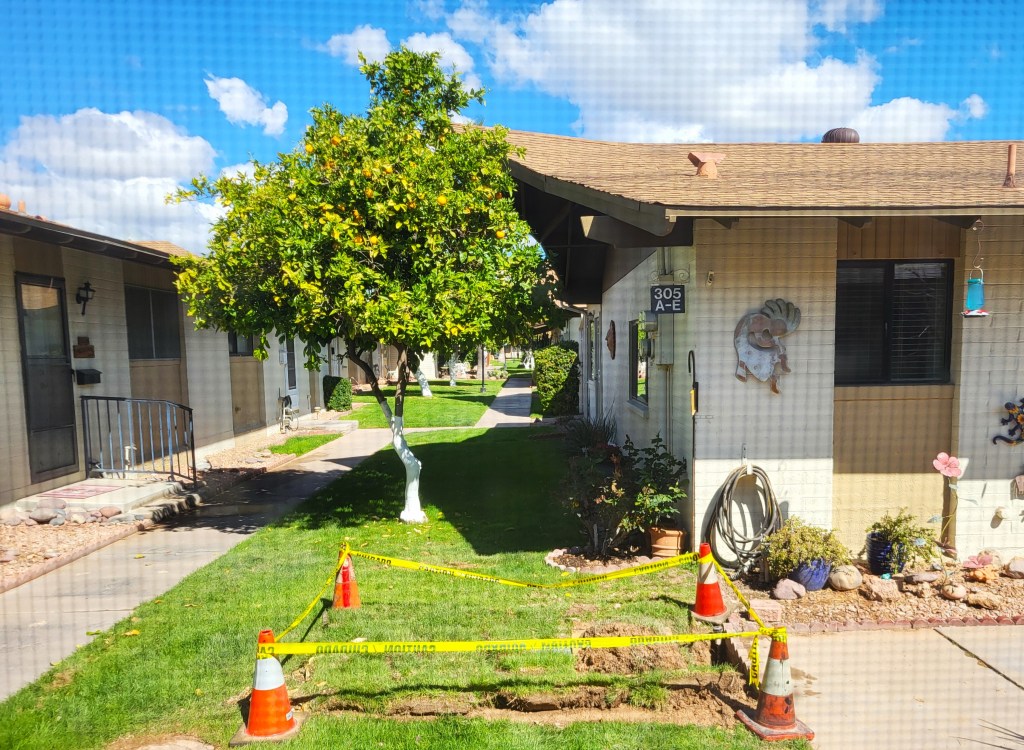
As I write this, my creative inspiration has been less certain and more diffused. Perhaps the construction cones, yellow tape, and jagged chunks of sod–prominent through the screen of our kitchen window after the replacement of a water main valve this week–are a fitting metaphor for the disruption I feel.

I’m living between and among several writing-related projects that deserve attention. The largest of these is a novel I’ve been mining … and drifting in and out of for the past eighteen months or so.

It’s a compelling (I think) fictionalized story of twin brothers navigating the pitfalls of their differences and a significant/sudden loss that muddies their family waters and transforms them.

I’ve written six or eight chapters, spent significant hours developing the back stories of both characters, and have a clear idea of the troubles they will face and how the story will end, but there is at least a year of research, writing and editing ahead. That feels daunting.

In the near term, I’m committed to blogging once a week and working with Marc, the artistic director of the Phoenix Gay Men’s Chorus, on another libretto later this month. This one, called “Encore”, will appear on stage in late June.

I’m also refashioning a retrospective essay about a teen’s emerging gay identity. This is something I’ve submitted to a few literary magazines. So far, no takers. But I’m determined to find a home for it.

Meanwhile, I want to teach a memoir writing class. On Monday, I presented the Scottsdale Public Library with a concept for a workshop I have developed. They like the idea. There are details and timeframes to figure out, but I hope to lead the first session with a small group of attendees this fall.

Yes, there is a lot under construction inside my brain and around me as snowbirds tiptoe to and from the parking lot past the various plots of uneven ground the plumbing crew left in their wake.

At least I’m choosing creative projects that are important to me … doing my best to entice more folks to read my books, while maximizing the slippery slope of my sixties.

It all feels exhilarating and overwhelming.

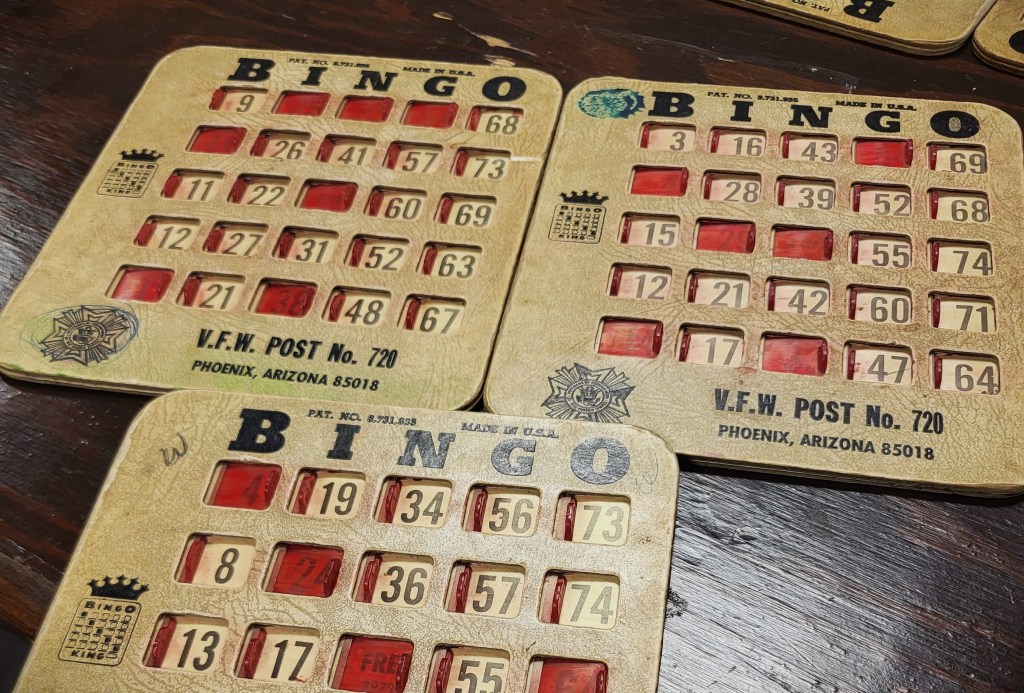
BINGO Is Back

It’s been happening under the slanted roof of the Polynesian Paradise clubhouse for decades.

Old and young residents and guests gather a few times each month for old-school, low-tech Arizona fun.

They flock there to play BINGO on Wednesday nights in January, February and March when the snowbirds have returned.

Spirits are high, but stakes are low.

Fifty or sixty friends and neighbors huddle over long metal tables with wooden tops. They scan their BINGO boards with dreams of leaving with fifteen or twenty dollars in their pockets.

Hit the switch and you can hear the hum of the BINGO ball cage as it spins. The caller pulls a number and announces it over the microphone. B-15, O-66, and so on.

Over the years, the number callers have come and gone. Phyllis and Sherry shared the duties admirably on January 31, 2024.

Last night’s first game was dedicated to Bill H. He passed last year. In his honor, you had to cover all the numbers on one of your boards to fill the shape of the letter H to win $10.

After that, each game was more traditional. You needed to get five in a row across, up and down, or diagonally to win $5.

Or–if you were lucky enough to cover the four corners or create a “postage stamp”–a four-square shape in one of the corners–that would suffice too.

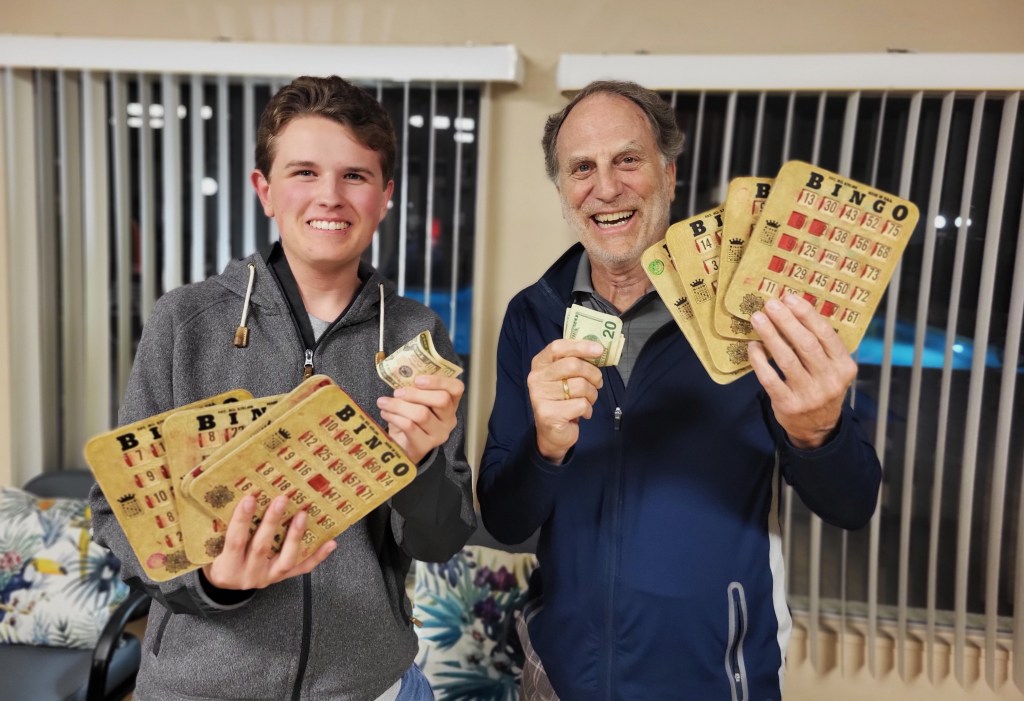
The final game of the night is always “black-out” BINGO. The goal is to cover every space on your card. The first one to do it, shouts BINGO and wins $20.

Last night, two–Theo and John–landed there at the same time and shared the winnings.

But the beauty of BINGO isn’t really the amount of cash you win.

It’s about the shared experience of sitting side-by-side in the same room.

It’s about the kitschy camaraderie, silly laughter, and goofy cross talk before, during, and after each game.

It’s about celebrating the “what ifs” of life … “Oh, if only she’d called I-30. I would have been the big winner!” … no matter your political preferences or social status.

It’s about the realization that the small, yummy square of lemon cake Jean baked for consumption at the half-way point contained a splash of zesty lemon from one of our luscious community citrus trees.

It’s about the reminiscing with friends as you walk back home to your respective condos at the end of the day on a mild desert evening.

It’s about hugging and bidding each other a good night … until the next game of BINGO.

American Fiction

I don’t usually write film reviews. I prefer to leave the nuances of critiquing movies to my cinephile husband. However, in this case, I will break the rules. You’ll understand why in just a moment.

In American Fiction, Jeffrey Wright plays Monk, a frustrated novelist who feels his books have been lost in the bluster of less literary works that fly off the shelves on the wings of tired stereotypes about the Black community.

Against the advice of his agent, he decides to prove his point by writing a one-dimensional, inflammatory book under a pen name.

He considers it garbage, but ironically the story wins immediate acclaim. He finds himself faced with the conundrum of accepting his financial windfall and hypocrisy or coming clean.

No spoilers here. You’ll have to see the movie to understand the permutations of his dilemma.

However, the story–written and directed by Cord Jefferson–is a dazzling bit of witty screen writing, laced with well-drawn, believable characters navigating painful personal traumas.

It’s been a long time since I was so entertained watching a movie. Tom and I laughed. Out loud. And so did the fifty or so others who sat around us in the theater at Camelview Theater at Fashion Square Mall in Scottsdale on Friday night.

I even shed a few tears, because there is a story thread about Monk’s mother–played by Leslie Uggams–that hit rather close to home.

But what resonated most for me was the brilliant way the film explored the world of a writer. We tell our stories, hoping our truths will land with readers.

We spill our guts (or those of our fictional characters) on the page but have no control over the tastes and proclivities of readers.

We do it because we love to write. It’s what we were meant to do. But secretly–or maybe not so much–we pine for our books to blaze a trail and rake in the royalties.

For those of us with dreams and scruples, we want our books to sell … but never want to sell out.

Thanksgiving in the Desert

Grief is a strange, but reliable, motivator.

With Thanksgiving 2013 approaching, Tom and I knew we needed to change things up after my mother’s slow-and-painful exit the previous January. We decided to escape our suburban Chicago home.

In the wake of our significant loss, we wanted to create a new tradition and plan a week-long Thanksgiving holiday in the desert (in our cozy Scottsdale condo) with my twenty-something sons Kirk and Nick, and Nick’s girlfriend Stephanie.

Early November came. Each of us cleared our schedules. About ten days before our flight from Chicago to Phoenix, Tom developed pneumonia. He was hospitalized for a few days, but insisted he would be well enough to make the trip.

Remarkably, Tom recovered enough for his doctor to clear us for take-off. When we landed at Sky Harbor Airport in Phoenix just west of the Papago buttes, I felt relief.

Over the next few days, Tom’s health continued to improve. We even climbed a portion of “A” Mountain in Tempe near the ASU (Arizona State University) campus.

On Thanksgiving Day 2013, Tom, Nick, Stephanie, Kirk and I dined outside under an orange tree on the patio of Mission Palms hotel, also in Tempe.

In those cool-but-sun-soaked moments–still a year before Tom and I would marry and four before we would move to Arizona permanently–I realized that the space created by my mother’s passing would mean more than a horizon shrouded in tears.

It would mean new possibilities … new chapters … for all of us.

Our New View

Trees connect us to the earth and sky. They adorn our natural spaces with character, continuity, and shade. Though they never speak, trees–if we listen–whisper wisdom in the wind.

***

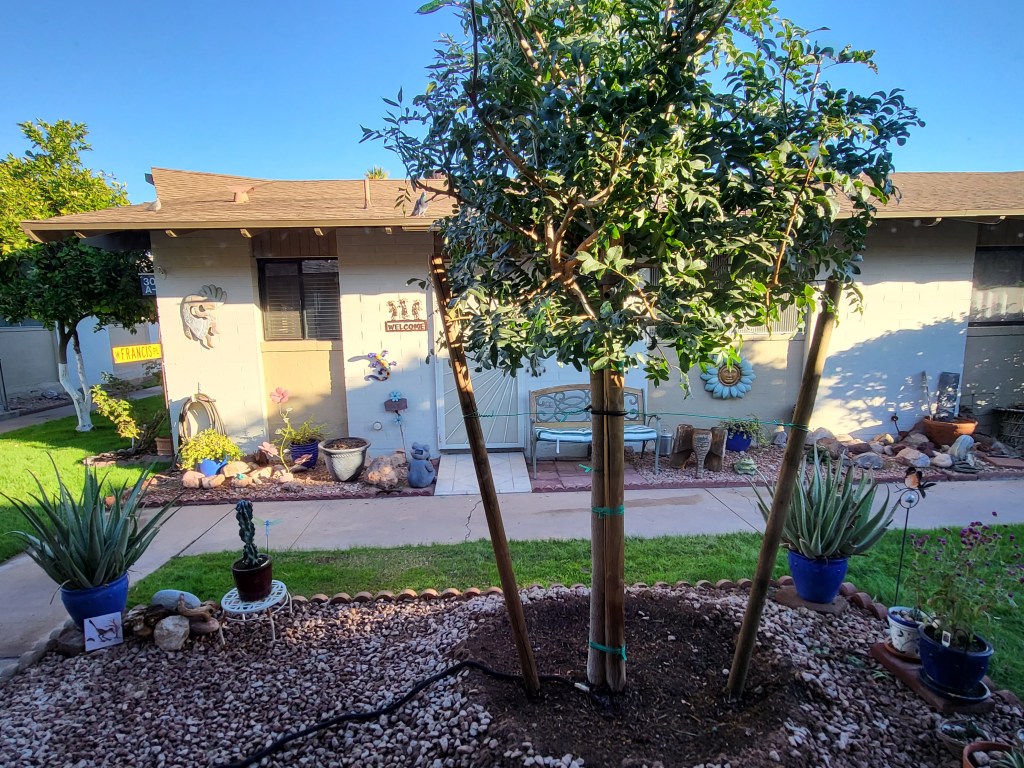
Tom and I have missed the presence of a tree in front of our Scottsdale home for nearly six months.

In May, carpenter bees sawed our fifty-year-old fig tree, selected and planted by Tom’s grandfather in the early 1970s.

Sadly, it split in two and tumbled down in the darkness. Only a stump remained for nearly six months.

During the long, hot summer of 2023, I missed the solitude and protection of a tree outside our north-facing window.

Each time I walked past our fig tree’s stump, it reminded me of other recent losses: our friend Dave last December; Frances (my mother’s sister) in July; then another friend Chad … suddenly in September.

Strange as it sounds, the space where our fig tree once stood felt like an open wound or incomplete canvas. But that changed in September when Tom and I shopped for a new tree.

I felt the exuberance of nature’s possibilities as we walked through Moon Valley Nursery in Phoenix–sizing up the options: Hong Kong Orchid (flowers in the spring); Chinese Elm (strong shade tree); Ficus (evergreen and can be trimmed to stay small); and Red Push Pistache (drought-resilient with a pop of color in the late fall).

Jonnie was our escort and sales rep. She helped us compare and contrast the leading candidates. By the end of September, the choice was clear for Tom and me.

We picked the new tree of our dreams, a hearty Red Push Pistache. It is best known for the vivid red color it produces in late November.

In that sense, it will remind us of the Burning Bush we planted in the front yard of our home in Mount Prospect, Illinois in the summer of 2013.

It turned blood red every October (and still provides a splash of color though we left in 2017), after the Blue Spruce that preceded it died in the spring of 2013 … a few months after my mother left this earth.

***

On November 1, a crew from Moon Valley Nursery arrived to remove our fig tree stump. As they dug up the remaining gnarly and decaying roots and hollowed out the hole, Tom and I could feel relief pour in.

The following afternoon, our new, mature, Red Push Pistache tree arrived on the back of a long, flatbed truck. A team of five men from Moon Valley maneuvered it through the gate and down the sidewalk. Moments later, the crew enlarged the hole to accommodate our new tree’s three-foot ball of roots.

By five o’clock they had anchored our durable-and-drought-resistant shade tree in the ground in front of our condo. Soon after, they left to deposit another tree for another customer.

I imagine, in a few weeks–as Tom and I prepare to sit down at our kitchen table and give thanks on a Thursday–our new tree will lavish us with a blaze of red leaves.

But even before the redness appears, it feels as though some semblance of balance, normality, and renewal has returned to reveal our new view in south Scottsdale outside our north-facing window.

A Ticket to the World Series: Part Two

Here in Arizona, the Diamondbacks’ dream of winning the World Series in 2023 faded more quickly than a fleeting November sunset. But life goes on in the Valley of the Sun. Congratulations to the Texas Rangers for winning the World Series for the first time in their fifty-two-year history.

In my previous blogpost, Dad and I failed to secure bleacher tickets to the 1968 World Series. However, we did discover a parking ticket flapping on our windshield when we returned to our car. Now, as promised, on to part two of my story, also an excerpt from Tales of a Rollercoaster Operator.

***

Fourteen years later, the 1982 Cardinals returned to the World Series to face the Milwaukee Brewers.

I was living in the Chicago area and working as a copywriter at Sears Tower. My boss Dave–Sears national retail advertising department head–called me into his office late one afternoon. That had never happened before.

He told me he knew I was a die-hard St. Louis Cardinals fan working alongside dozens of Cubs and White Sox fans, who had long since lost interest in the pennant race.

Because of his position and advertising influence, the powers that be at Sports Illustrated had given Dave one complimentary ticket to game four in Milwaukee, which he couldn’t use.

When Dave handed me the ticket, my jaw dropped to the floor and out poured a stammering stream of thank yous. He told me to enjoy myself, but to keep my mouth shut.

I’m sorry Dave. I managed to keep this secret for thirty-four years (note: I wrote this in 2016). Somehow, I feel the statute of limitations on this must have expired. I hope you don’t mind that I’m breaking my vow of silence after all this time.

The following Saturday morning I headed north to Milwaukee and made my way into County Stadium. Of course, I wish Dad could have joined me. He was back at home in St. Louis and ready to watch the game on TV, while I–wearing my Cardinals cap–was seated among a sea of Brewers fans in another beer town four hundred miles north of St. Louis.

The Cardinals lost 7-5 that afternoon. They were the victims of a dramatic seventh-inning surge by Harvey’s Wall Bangers. (Harvey Kuenn was the manager of the Brewers.)

During the rally, I was doused with suds by Brewers fans sitting in the grandstands above me. They were tired of hearing me chirp about the Cardinals. Even so, I finally saw my team play a World Series game in person and a few days later got my revenge.

Led by manager Whitey Herzog, the ’82 Cardinals–Willie McGee, Ozzie Smith, Lonnie Smith, Keith Hernandez, Tom Herr, Bob Forsch, Joaquin Andujar, Bruce Sutter, and the like–won it all in the seventh and deciding game.

Win or lose, after a fourteen-year wait I could finally say I stood in the stands and watched my team play in the World Series on a crisp afternoon in Milwaukee.

Moments before the first pitch, I placed my hand on my heart and sang the national anthem with about fifty thousand Brewers fans I didn’t know … and one weary World War II veteran back at home in St. Louis.

I knew Dad would be standing in his living room, belting out the Star-Spangled Banner in front of his TV. Knowing that made it all the sweeter.

***

After sharing this story from my World Series vault with you, I can now say the 2023 baseball season is over officially. Sports allegiances are like the roots of family trees … they run deep. So, you can be sure I’ll be rooting for the St. Louis Cardinals to rebound in 2024 and add a new chapter to their rich history.

If that isn’t in the cards, maybe the young, talented Arizona Diamondbacks can produce another magical run next year to capture the crown.

A Ticket to the World Series: Part One

The St. Louis Cardinals finished with a 71-91 record this year, landing in last place in the National League Central Division. With a thud in early October, my favorite team–rich with winning tradition that decorated my 1960’s childhood memories–ended the season with its worst win-loss record since 1990.

However, as luck would have it, the Arizona Diamondbacks (D-Backs)–my second favorite team now that I live in the Valley of the Sun– blind-sided all prognosticators.

Against all odds, this young, exciting, resilient team defeated the Milwaukee Brewers, Los Angeles Dodgers, and Philadelphia Phillies in previous playoff series and advanced to the World Series to play the Texas Rangers.

As I write this, the Rangers and Diamondbacks have each won a game in this best-of-seven fall classic. Beginning Monday, the teams will play the next three games in Phoenix at Chase Field.

The stadium is about ten miles west of our home in Scottsdale, but Tom and I have no inclination to spend thousands–or even hundreds of dollars–to sit in the stands and cheer for the team. Instead, we will watch the action and results unfold on TV–or the “tube” or “idiot box” as Dad would have called it.

Speaking of Dad, the timing and topic is right for me to share an excerpt from Tales of a Rollercoaster Operator, my book of stories from my Missouri youth. I hope you enjoy this tale about the baseball bond he and I–two Cardinals’ lovers–shared.

***

With Dad as my ever-loving companion, I hoped we would someday see a World Series game together in person. That possibility seemed akin to flying to the moon and back. But, in October 1968, we tried to make that dream a reality.

I was eleven years old. That summer the Cardinals clinched the National League pennant for the third time in five years on the strength of a 97-65 record. They would defend their 1967 World Series crown and face the Detroit Tigers in the Fall Classic.

On a crisp October morning, as I munched on stale Apple Jacks and Dad drained the contents of his saucer back into his coffee cup, I cupped my left ear toward the kitchen radio speaker.

The KMOX announcer provided details of when and where fans could line up that day to buy bleacher tickets for games 1, 2, 6 and 7. The Cardinals would host those four games in St. Louis.

I turned to Dad. He had the same “let’s do it!” look on his face. We were about to embark on an important mission: landing two World Series bleacher tickets.

With a surge of adrenalin and spontaneity that swept us off the front porch, we grabbed our jackets, hopped in our ’65 Chevy Biscayne, and drove ten miles into downtown St. Louis (a few blocks from the Gateway Arch).

I had a grand illusion that we would drive up to the ballpark, step up to the ticket window, plop down some cash, grab our newly minted tickets, and be on our way.

But, when we arrived, a stream of Cardinals fans snaked around Busch Memorial Stadium and down a few blocks. I soon realized this game of standing in line for tickets was likely to go extra innings.

Our first step was to find a parking space. Like a miner searching for gold nuggets, Dad circled the stadium two or three times for that elusive spot. Just as we were about to abort our mission, we hit pay dirt.

Dad landed our boxy craft in an unmarked open space, in the shadow of dingy, abandoned brick warehouse several blocks away. From there, we hoofed it and found our way to the end of the elongated queue of ticket-hungry spectators.

Minutes and hours passed, but the line stood still. As darkness descended, fans all around us unrolled sleeping bags to ride out the night rooted in cement.

Except for our jackets and a few snacks, we were unprepared for the madness, but managed to buddy up with a few of our neighbors. Between sighs and “what if” scenarios, we borrowed a square or two of an old quilt to sit down and wait out the marathon.

Dawn broke after a sleepless night with relative strangers and policemen hovering nearby. So did the veritable ticket-hungry logjam. We moved slowly at first. After a few hours, we could see the progress we were making.

Without warning, line jumpers cascaded in from all directions. We felt our tempers rise and wondered what happened to the cops from the night before. Even so, we were close enough to feel an ending was in sight.

That’s when several ballpark personnel strolled by to announce the most dreaded five words: There are no tickets left. With the ticket window closed, our mission was over.

Our tempers were in tatters. Our spirits were shattered. We crash landed. We left the line ticketless and turned around to make the long walk back to the car.

Maybe the walk was exactly what we needed. Dad and I were able to burn off steam and warm up after our long, empty sojourn on St. Louis streets. But there was one more surprise in store–a reminder of our overnight, urban odyssey.

When we arrived back at our car, we found a St. Louis parking violation flapping in the breeze under the worn wiper blade on the passenger side of our windshield. Technically, we had secured a World Series ticket after all. Just not the kind we imagined.

As it turned out, the Cardinals lost the World Series that year, thanks to Mickey Lolich’s pitching heroics on behalf of the Tigers. So, I suppose Dad and I didn’t miss much in the way of celebrating in October 1968.

***

If you follow my blog, look for part two of this story in the coming week.