Category: Essays

A Ticket to the World Series: Part Two

Here in Arizona, the Diamondbacks’ dream of winning the World Series in 2023 faded more quickly than a fleeting November sunset. But life goes on in the Valley of the Sun. Congratulations to the Texas Rangers for winning the World Series for the first time in their fifty-two-year history.

In my previous blogpost, Dad and I failed to secure bleacher tickets to the 1968 World Series. However, we did discover a parking ticket flapping on our windshield when we returned to our car. Now, as promised, on to part two of my story, also an excerpt from Tales of a Rollercoaster Operator.

***

Fourteen years later, the 1982 Cardinals returned to the World Series to face the Milwaukee Brewers.

I was living in the Chicago area and working as a copywriter at Sears Tower. My boss Dave–Sears national retail advertising department head–called me into his office late one afternoon. That had never happened before.

He told me he knew I was a die-hard St. Louis Cardinals fan working alongside dozens of Cubs and White Sox fans, who had long since lost interest in the pennant race.

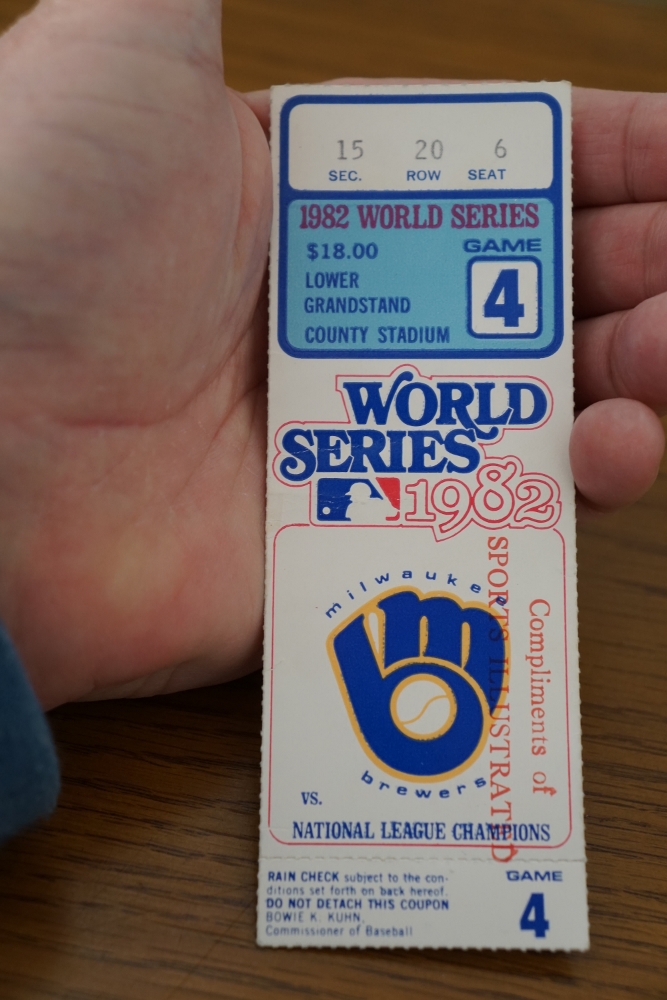
Because of his position and advertising influence, the powers that be at Sports Illustrated had given Dave one complimentary ticket to game four in Milwaukee, which he couldn’t use.

When Dave handed me the ticket, my jaw dropped to the floor and out poured a stammering stream of thank yous. He told me to enjoy myself, but to keep my mouth shut.

I’m sorry Dave. I managed to keep this secret for thirty-four years (note: I wrote this in 2016). Somehow, I feel the statute of limitations on this must have expired. I hope you don’t mind that I’m breaking my vow of silence after all this time.

The following Saturday morning I headed north to Milwaukee and made my way into County Stadium. Of course, I wish Dad could have joined me. He was back at home in St. Louis and ready to watch the game on TV, while I–wearing my Cardinals cap–was seated among a sea of Brewers fans in another beer town four hundred miles north of St. Louis.

The Cardinals lost 7-5 that afternoon. They were the victims of a dramatic seventh-inning surge by Harvey’s Wall Bangers. (Harvey Kuenn was the manager of the Brewers.)

During the rally, I was doused with suds by Brewers fans sitting in the grandstands above me. They were tired of hearing me chirp about the Cardinals. Even so, I finally saw my team play a World Series game in person and a few days later got my revenge.

Led by manager Whitey Herzog, the ’82 Cardinals–Willie McGee, Ozzie Smith, Lonnie Smith, Keith Hernandez, Tom Herr, Bob Forsch, Joaquin Andujar, Bruce Sutter, and the like–won it all in the seventh and deciding game.

Win or lose, after a fourteen-year wait I could finally say I stood in the stands and watched my team play in the World Series on a crisp afternoon in Milwaukee.

Moments before the first pitch, I placed my hand on my heart and sang the national anthem with about fifty thousand Brewers fans I didn’t know … and one weary World War II veteran back at home in St. Louis.

I knew Dad would be standing in his living room, belting out the Star-Spangled Banner in front of his TV. Knowing that made it all the sweeter.

***

After sharing this story from my World Series vault with you, I can now say the 2023 baseball season is over officially. Sports allegiances are like the roots of family trees … they run deep. So, you can be sure I’ll be rooting for the St. Louis Cardinals to rebound in 2024 and add a new chapter to their rich history.

If that isn’t in the cards, maybe the young, talented Arizona Diamondbacks can produce another magical run next year to capture the crown.
A Ticket to the World Series: Part One

The St. Louis Cardinals finished with a 71-91 record this year, landing in last place in the National League Central Division. With a thud in early October, my favorite team–rich with winning tradition that decorated my 1960’s childhood memories–ended the season with its worst win-loss record since 1990.

However, as luck would have it, the Arizona Diamondbacks (D-Backs)–my second favorite team now that I live in the Valley of the Sun– blind-sided all prognosticators.

Against all odds, this young, exciting, resilient team defeated the Milwaukee Brewers, Los Angeles Dodgers, and Philadelphia Phillies in previous playoff series and advanced to the World Series to play the Texas Rangers.

As I write this, the Rangers and Diamondbacks have each won a game in this best-of-seven fall classic. Beginning Monday, the teams will play the next three games in Phoenix at Chase Field.

The stadium is about ten miles west of our home in Scottsdale, but Tom and I have no inclination to spend thousands–or even hundreds of dollars–to sit in the stands and cheer for the team. Instead, we will watch the action and results unfold on TV–or the “tube” or “idiot box” as Dad would have called it.

Speaking of Dad, the timing and topic is right for me to share an excerpt from Tales of a Rollercoaster Operator, my book of stories from my Missouri youth. I hope you enjoy this tale about the baseball bond he and I–two Cardinals’ lovers–shared.

***

With Dad as my ever-loving companion, I hoped we would someday see a World Series game together in person. That possibility seemed akin to flying to the moon and back. But, in October 1968, we tried to make that dream a reality.

I was eleven years old. That summer the Cardinals clinched the National League pennant for the third time in five years on the strength of a 97-65 record. They would defend their 1967 World Series crown and face the Detroit Tigers in the Fall Classic.

On a crisp October morning, as I munched on stale Apple Jacks and Dad drained the contents of his saucer back into his coffee cup, I cupped my left ear toward the kitchen radio speaker.

The KMOX announcer provided details of when and where fans could line up that day to buy bleacher tickets for games 1, 2, 6 and 7. The Cardinals would host those four games in St. Louis.

I turned to Dad. He had the same “let’s do it!” look on his face. We were about to embark on an important mission: landing two World Series bleacher tickets.

With a surge of adrenalin and spontaneity that swept us off the front porch, we grabbed our jackets, hopped in our ’65 Chevy Biscayne, and drove ten miles into downtown St. Louis (a few blocks from the Gateway Arch).

I had a grand illusion that we would drive up to the ballpark, step up to the ticket window, plop down some cash, grab our newly minted tickets, and be on our way.

But, when we arrived, a stream of Cardinals fans snaked around Busch Memorial Stadium and down a few blocks. I soon realized this game of standing in line for tickets was likely to go extra innings.

Our first step was to find a parking space. Like a miner searching for gold nuggets, Dad circled the stadium two or three times for that elusive spot. Just as we were about to abort our mission, we hit pay dirt.

Dad landed our boxy craft in an unmarked open space, in the shadow of dingy, abandoned brick warehouse several blocks away. From there, we hoofed it and found our way to the end of the elongated queue of ticket-hungry spectators.

Minutes and hours passed, but the line stood still. As darkness descended, fans all around us unrolled sleeping bags to ride out the night rooted in cement.

Except for our jackets and a few snacks, we were unprepared for the madness, but managed to buddy up with a few of our neighbors. Between sighs and “what if” scenarios, we borrowed a square or two of an old quilt to sit down and wait out the marathon.

Dawn broke after a sleepless night with relative strangers and policemen hovering nearby. So did the veritable ticket-hungry logjam. We moved slowly at first. After a few hours, we could see the progress we were making.

Without warning, line jumpers cascaded in from all directions. We felt our tempers rise and wondered what happened to the cops from the night before. Even so, we were close enough to feel an ending was in sight.

That’s when several ballpark personnel strolled by to announce the most dreaded five words: There are no tickets left. With the ticket window closed, our mission was over.

Our tempers were in tatters. Our spirits were shattered. We crash landed. We left the line ticketless and turned around to make the long walk back to the car.

Maybe the walk was exactly what we needed. Dad and I were able to burn off steam and warm up after our long, empty sojourn on St. Louis streets. But there was one more surprise in store–a reminder of our overnight, urban odyssey.

When we arrived back at our car, we found a St. Louis parking violation flapping in the breeze under the worn wiper blade on the passenger side of our windshield. Technically, we had secured a World Series ticket after all. Just not the kind we imagined.

As it turned out, the Cardinals lost the World Series that year, thanks to Mickey Lolich’s pitching heroics on behalf of the Tigers. So, I suppose Dad and I didn’t miss much in the way of celebrating in October 1968.

***

If you follow my blog, look for part two of this story in the coming week.

My Way Out

In this world of perpetual social upheaval, being who I am-openly gay–isn’t always easy. But I persist.

I decided more than twenty-five years ago that coming out was the only healthy way to live.

With the assistance of two amazing therapists (thank you, Barry and Valerie!) and the love of a small circle of friends and family, I discovered that authenticity was my way out of denial, depression, and anxiety.

Over the years, I’ve written frequently on this topic in my books and here in my blog. Today, on National Coming Out Day in the United States, I’m here to remind you once again that I am a proud gay man.

This one aspect of my identity–the fact that I am attracted to the same sex and married happily to another man–certainly defines the way I see the world. It gives me compassion and empathy for others who are different … no matter their skin color, religious beliefs, economic status, or capabilities.

All my life, I have been protective of those who are disenfranchised and less fortunate. I came from a modest background and have survived personal and family hardships.

As a teenager and young man, I didn’t understand or love myself, but now that I do I feel it is my obligation to remain visible. To pave the way for queer teens and adults who may not yet feel comfortable enough to come out.

In 2023, I think most Americans are supportive of their gay friends, family members, and neighbors. Of course, there is a vocal minority that would prefer we don’t exist. I have no control over their beliefs.

No doubt, a handful of haters will be demonstrating at the end of the Phoenix Pride Parade route on October 22, when I sing and march with my friends in the Phoenix Gay Men’s Chorus.

But they will be overshadowed by the thousands of LGBTQ supporters–gay and straight–who will line the parade route with their parents and children, cheer, and wave their rainbow flags.

We are a country that was founded on the notion of “liberty and justice for all.” At times, we have failed miserably at fulfilling our mission as a democratic society.

But I’m not ready to give up. I still have hope–as a sixty-six-year-old gay man, husband, father, brother, writer, singer, friend, neighbor, voter, and citizen of the United States–that we will find our way out of the political divisiveness that exists.

I’m not sure how we’ll get there, but today–and everyday–all of us who are different must continue to come out, be ourselves, love each other, and remind the world that LGBTQ citizens are valuable, kind, contributing, and responsible Americans. We will not be denied.

No Walk in the Park

On a regular basis, all of us encounter unexpected small and large obstacles.

One day, they may be as fixable as a “low tire pressure” warning light that illuminates on the dashboard.

The next, something far more unimaginable, unexplainable and unrepairable. Like learning of the apparent suicide of a forty-three-year-old friend, who seemed to embody the definition of vitality.

It was simple to stop at Discount Tire to ask an attendant to increase the air pressure in our tires. (The cooler desert temperatures must have deflated them.)

It will take much longer–time, space, and reflection–for Tom and me to process Chad’s demise.

I’ve often thought that resiliency is one of the most important human characteristics to cultivate.

It is our ability to cope, process, manage, and emote our way through or around life’s setbacks that defines our longevity. This latest loss confirms my belief.

These observations surfaced this morning during a walk in the park in my community. At Chaparral Park in Scottsdale, Arizona to be precise.

My husband and I had just finished our yoga class. Afterwards, he wanted to lift a few weights in the gym.

I opted for stretching my legs on my own under a few puffy clouds that dotted Arizona’s wide-open October sky.

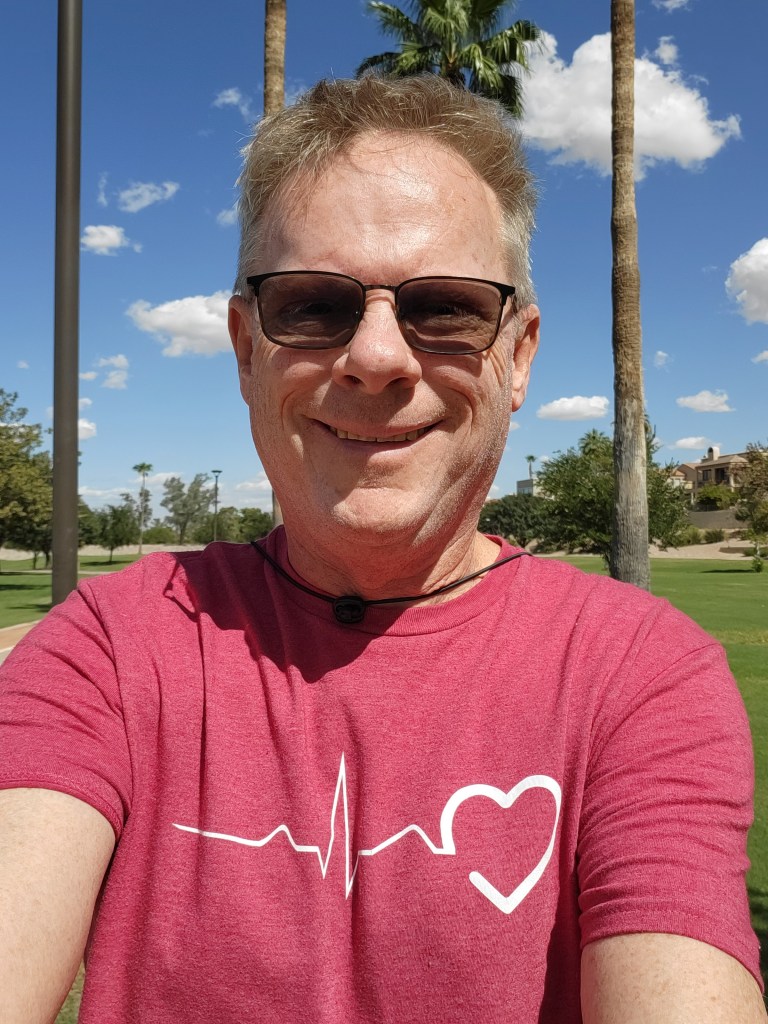
Near the midpoint of my walk a fit couple jogged up as I waited for the light to turn green at Chaparral and Hayden roads. One of them admired my shirt.

“You must be in the medical profession,” he gestured toward the beating heart I wore proudly.

“No, I’m a heart attack survivor,” I explained. “I helped raise money for the American Heart Association.”

They smiled and wished me well. Then, they dashed off when the WALK sign turned white.

It was a simple exchange, a reminder of a trauma I experienced and wrote about which now feels way off in the rearview mirror.

But those few sentences with two sympathetic strangers infused me with a renewed appreciation for my personal resiliency.

No doubt, it’s a quality I observed in my mother, a saver and survivor. She always described herself as a child of the Depression.

It’s also a trait I began to mine in my thirties after my divorce. A strength I’ve fine-tuned on countless treadmills since suffering a mild heart attack six-plus years ago on my sixtieth birthday.

I have no regrets regarding my friendship with Chad, but I wish he would have called Tom or me before he made his worst and most irreversible decision.

I would have told him that while life is no walk in the park, it is always worth the fight. To find a skilled therapist. To dig deep on the darkest days. To survive the pain. To accept our losses.

To embrace each and every day we are granted. To reach out for love and hope. To live to see tomorrow.

The Possibilities of Pruning

In October 2019, I puttered in my garden as I often do.

I had already begun to assemble tongue-in-cheek and serious stories about life in the Grand Canyon State. But I needed a creative hook to link the essays and my desert fantasies to the wide-open experience of living in Arizona.

Strangely, sagging citrus tree branches provided the stimulus for my book title. While they impeded our sidewalk, identifying the obstacle cleared a path in my brain. Tom stood by as seven words flew from my mouth and tumbled into the arid Arizona air: “I Think I’ll Prune the Lemon Tree.”

***

Nearly four years have passed. In early 2021, I completed and published my book. Folks near and far have told me how much they’ve enjoyed reading it.

Of course, I hope more will discover it and find meaning in the essays, including those I wrote about living in a global community we never imagined–a place I call Coronaville.

This afternoon I found myself in the same space outside my front door, examining the same tree, realizing it needed another haircut. I grabbed the loppers, pulled on my gardening gloves, and pruned only the most problematic branches that hung low.

Sadly, there were a few lemon casualties that fell to the earth looking more like green limes than the fully matured lemons they might have become in December.

Still, I think I did a good thing for Tom and me … and our neighbors and delivery people, who pass daily on the sidewalk of our mid-twentieth-century condo community and go about their lives under the radar.

And the lemon tree? It’s now shapelier than before and has inspired me to write yet another story about the possibilities at play in nature.

One Step Closer to Midnight

At six, I ducked. I covered. When Cronkite broke the news, I grieved for JFK. I wondered what might have been. I watched John-John salute his dad’s horse-drawn casket as it passed by.

At sixteen, I drove and grew. I discovered the stage. My long hair hid my face, but through the blond strands I watched the lies and disgrace of Nixon and Watergate unfold and consume our nation.

At twenty-six, I cradled my first-born son. I played ad man in the tallest building in the world. I watched the AIDS epidemic rage without relief. Reagan stood by to pontificate.

At thirty-six, I grieved for my father and raised two little boys–alone. Clinton signed Don’t Ask, Don’t Tell. In short order, I watched the military expand its closets. Meanwhile, I found a way out of mine.

At forty-six, I climbed the ladder, fed our dog, and paid more child support. I watched my weight escalate. My blood pressure and responsibilities soared as George W fanned the flames in Iraq.

At fifty-six, I grieved for my mother. I shed my corporate skin. I wrote. I sang again. I photographed dragonflies. I watched Obama change course and support marriage equality. I felt hopeful.

Now, six days before my sixty-sixth, I cleave to my husband and pray that the masses will continue to support Biden–our buffer from total mayhem–while insanity lurks on the horizon.

We watch and sigh as another wave of misguided declarations from the misnamed Supremes–and their perpetrators–land on the doorstep of freedom and turn back the clock on once-protected classes.

What has become of our red-white-and-blue country? The country I still love–that beacon of hope–no longer exists. Now we are black and blue. Punch drunk from the previous administration. Bruised from an insurrection that took us to the brink nearly thirty months ago.

Still, we watch and wait for justice and accountability. Will it ever come? Or are we simply poised for another distraction? Another round of fireworks to illuminate our darkness and denial?

It certainly feels like we are one step closer to midnight.

***

If my poem moved you, check out my latest book A Path I Might Have Missed on Amazon.

After and Before

Remarkably, here in the Valley of the Sun, we have enjoyed a relatively comfortable early June. Seventies in the mornings. Low-to-mid nineties in the afternoons.

I’ve made the most of these breezy bonus days. Walking, hiking, swimming outside to rediscover my energy after a few weeks of long rehearsals and performances on stage indoors with my pals in the Phoenix Gay Men’s Chorus.

Of course, all of us Sonoran Desert rats know the mild temperatures won’t last.

We now brace ourselves, before triple-digit high temperatures arrive later this week and stay like unwelcome houseguests through most of September.

I’m not complaining. The summers here are quiet, beautiful, and hot–gorgeous sunsets, rugged buttes–away from the rush of the world and the traffic generated by snowbirds.

Our sizzling stillness is punctuated in July and August by monsoon storms that boil down from the mountains that surround us.

Now that Tom and I have lived here almost six years, our Midwestern years and associated memories have begun to fade like colorful t-shirts, hanging on a clothesline, bleached by constant exposure to the sun.

This day-in, day-out aging awareness, as we approach our shared 66th birthday in early July, makes me especially thankful that I wrote stories about my Illinois, Missouri, and North Carolina memories when they were fresh in my brain.

I guess you could say I’m between creative projects. I don’t know what I’ll decide to write next, beyond the weekly ramblings that appear here.

There is a fictionalized story I set aside late last year, when I devoted more time to writing dialogue for the chorus and completing my book of poetry.

In my mind, the main character of this yet-to-emerge family drama is living in the mountains near Flagstaff, Arizona–trying to come to terms with a significant loss he has experienced.

The good news is Tom and I have made plans to spend several days in the higher, cooler altitude of that area in late July to commemorate what would have been my mother’s 100th birthday.

Maybe this journey north, several thousand feet over the saguaros and into the ponderosa pines, is exactly what I need to rekindle my next story away from the scorching sunsets of our regular Sonoran life.

Blueberries for the Brave

Life gets messy at times. For instance, Tuesday morning Tom and I were grocery shopping at Fry’s near our home in south Scottsdale. We picked up a pint of blueberries and placed them in our cart.

As we turned the corner and left the produce section, the container popped open. Half of the contents spilled out and tumbled to the floor. Some smashed and splattered. Others rolled fifty feet away.

Of course, accidents happen. We apologized. We helped a few kind Fry’s employees clean up the mess.

On the other end of life’s spectrum, there are spectacular moments that produce a cascade of love and joy. Crescendo moments we imagine and envision on paper, which work out better than we had planned. Seminal moments that transcend our dreams.

Last weekend was filled with those moments–standing on stage at Tempe Center for the Arts with about seventy of my Phoenix Gay Men’s Chorus mates, manufacturing an amazing blend of transformative music and stirring stories for three appreciative, enthusiastic, and occasionally tearful audiences. (They were simply responding to the heartfelt, emotional, honest Born to Be Brave moments that revealed themselves on stage.)

From stage right on the top riser, I sang as a chorus member and watched as a writer. With style, panache, and musicality, five of my chorus friends embodied and embellished a quintet of LGBTQ characters I created months before.

Over the course of the past few months, I’ve observed as they’ve evolved: Bry, a trans character from Idaho who found their voice with the support of friends; Toni, a bisexual artist with an unruly heart of gold; Gregory, a wise-and-resilient survivor of the AIDS-plagued 1980s; Les, an ultra-available, funny and sexy accountant; and Q, a young, flamboyant, energetic, queer leader who owns the stage and won’t be denied.

The premise? In an ode to A Chorus Line, they all audition for the Phoenix Gay Men’s Chorus in Act One. Ultimately, in Act Two, they each grow and join the group. They take the stage. They sing and dance. They find their voices and a new community of friends. In the show’s finale, they perform with the chorus and realize they were born to be brave.

***

Now, a few days have passed. The show is over. The blueberries at Fry’s have been cleaned up. I’m enjoying the high of a successful performance and artistic experience … the creative aftermath … but also recognizing the lull that comes after.

I’m beginning to regain my energy. (I left a lot of it on stage last weekend.) I’m also realizing the power of music and theatre. Friends who attended the concert have told me how much they enjoyed the show, and what a positive emotional impact it had on them–seeing and hearing the triumphant stories of five LGBTQ characters told through music in a world and community that needs love in all its forms … in all its splendor.

It gives me solace to know that — maybe — all of my chorus members and I have helped to create and produce sweet, luscious blueberries for the brave. To help nourish all of us on the rocky road of life.

Write. Share. Live. Loudly.

This is a momentous post for me–number 400 written and shared over the past five-plus years here.

As we begin June — Pride month — the topic of this one is more consequential than most.

Since May 2018, I’ve posted a long-and-winding stream of diverse stories about the Scottsdale-Arizona community I inhabit and about my life … as an independent writer, avid gardener, animal lover, critical thinker, loyal son, non-traditional father, and fortunate husband.

This openness is something I’ve learned and earned. More than sixty years ago, I was a shy child. I hid behind my mother and sucked my thumb for reassurance.

On a subconscious level, I must have felt I needed protection … for being different … though it would be decades before I would understand and embrace my gayness.

In the early 1990s (after my divorce from Jean and before I met my husband Tom), I felt lost and afraid. I certainly didn’t imagine I would one day sing on a stage with dozens of other gay men in Chicago … and then again in Phoenix.

Or that my husband and older son Nick (also living in Arizona) would watch and smile from the audience.

Much less, that I would write lyrics for the Phoenix Gay Men’s Chorus or develop dialogue for a palette of LGBTQ characters–a libretto, of sorts–for a concert in June 2023, titled Born to Be Brave.

This latest thrilling endeavor will premiere June 3 (2 pm and 7 pm shows) and then again June 4 (2 pm) at Tempe Center for the Arts.

All of this leads me to the point of this post.

In 2023–in a country where some would prefer not to say or hear the word gay or work to pass legislation to remove books from shelves written by gay authors–it is more important for all of us to live openly and loudly.

Moving back into the closet is simply not a viable or healthy option.

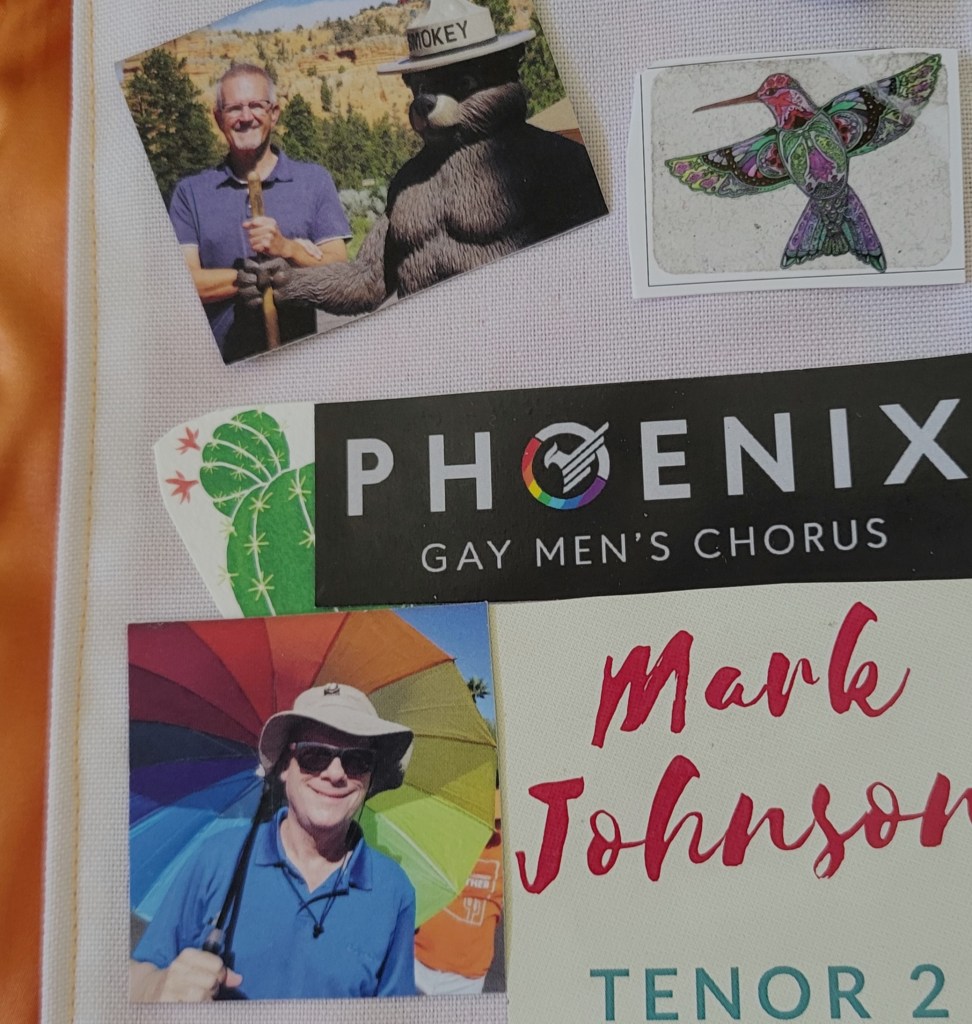
In that spirit, I am sharing two photos with this post. They contain images of my family members (past and present) and a sampling of the most important aspects of my authentic life.

For the concert this weekend, each of us (about seventy members of the Phoenix Gay Men’s Chorus) will wear a stole that drapes around our necks with such images … images that tell the stories of our lives for all the world to see.

Yes, in June or any month, all of us have much to be proud of. With the help of inspirational music, compassion from friends and neighbors, and the safe haven of our community, we’ve come a long way.

There’s no turning back.

The Magic of a Letter (with a Touch of Grief)

More than a week has passed, but my brain still swims in joy, appreciation, and disbelief.

It’s the understandable side effect of receiving a handwritten, personal letter from Carol Burnett earlier this month.

In it, she thanked me for sending I Think I’ll Prune the Lemon Tree to her as a gift for her birthday.

It’s my book of Arizona stories and St. Louis flashbacks, which includes a chapter on The Carol Burnett Show and the positive impact the program had on our family in the 1970s.

There is one other significant and unexpected side effect, which Carol’s letter has prompted: a touch of grief.

If you follow my blog or have read any of my books, you know that my mother–Helen Johnson–was the consummate letter writer.

From the late 1980s (when Mom retired) until 2010, she sent me more than a thousand letters laced with love and wisdom.

Some of them appear in From Fertile Ground. It is a three-generation writer’s mosaic about love, loss, and grief. I wrote and published the book a few years after my mother died in 2013.

Helen didn’t quite make it to ninety, the milestone Carol Burnett transcended recently. She came up six months short.

So, when Carol’s letter arrived in the mail it cued a few pangs of sadness and a familiar pleasure. One that has been missing from my life … missing from all of our lives … for a long time. That is the personal, human, and lasting connection produced by a handwritten letter.

With all of this as background, yesterday I pulled out the large blue plastic container that holds all of my mother’s letters–sent to Tom, Nick, Kirk, and me over the years. I have them classified by year.

I began to leaf through her 2003 correspondence. That was the year she turned eighty, on July 26, 2003, to be precise. My sister Diane and I hosted a big party for Mom that summer in Geneva, Illinois.

Family and friends traveled from near and far to attend Helen Johnson’s birthday dinner at the Mill Race Inn. We celebrated her first eighty years. Afterwards, we crossed a bridge over the Fox River to continue the party at the Herrington Inn, where many of our guests were staying.

At one point, a gentleman playing violin walked through the lobby. He asked my mother if she would like him to play Waltzing Matilda, her favorite song. (Matilda was her middle name.)

Mom’s eyes sparkled with glee as he stood over her. He slid the bow across the strings, and I watched her spirit soar. In short order, she began to sing … “Waltzing Matilda, waltzing Matilda, you’ll come a waltzing Matilda with me.”

Ordinarily, my mother didn’t enjoy being the center of attention. But, looking back, that moment in a posh hotel on the banks of the Fox River surrounded by loved ones may have been the happiest and most spontaneous moment of Helen Matilda Ferrell Johnson’s life.

If you’ve been doing the math as you read this story, you know that my mother’s 100th birthday is approaching. It’s just two months away. One of the best ways I can celebrate the memories of her is to read her letters, which she mailed to me.

In this one from May 26, 2003–twenty years ago–she recounted for Nick (my older son) and me that she and my dad bought their first new car (a black, four-door Plymouth) in Texas in February 1951.

I must have just told her about Nick’s first car, a used Toyota Camry, which his mom and I had just helped him buy when he was nineteen.

Whether a letter comes from a legend of stage and screen like Carol Burnett or someone who lived a more ordinary (yet still remarkable) life like my extraordinary mother, the words and the movement of the pen on the physical page speak directly from one heart to another … far exceeding the temporary status of a text, email, or phone call.

That’s the context and beauty–the magic, really–of an authentic, handwritten letter.