This isn’t a story about cherries or ice cream sundaes–or even about the yummy gluten-free, 9 x 12-inch decadent chocolate sheet cake I baked over the weekend. (Tom and I are in the process of devouring it.)
No, it’s a tale about an unexpected, sweet, extraordinary exchange (shared from afar through snail mail) between this independent writer and a legendary actor of stage and screen, who recently celebrated a milestone birthday.
***
On April 27, I wrote a letter to Carol Burnett. I mailed it in a padded pouch with my book I Think I’ll Prune the Lemon Tree. It is comprised of thirty-nine essays … a mix of true stories and desert fantasies … which I published in 2021.
One of them (A Custodian, A Scrub Woman, and Me) is about the special meaning The Carol Burnett Show held in our suburban St. Louis family in the 1970s.
In the story, I describe how Carol’s weekly hijinks, madcap comedic troop, and sense of humanity brought joy to my father (a depressed janitor) and me (an emerging adolescent).
On April 26, 2023–Carol’s ninetieth birthday–Tom and I watched her birthday celebration and tribute on NBC. The program resurfaced so many fabulous memories. It also prompted me to draft and send my letter (and enclose the book as a gift) to Carol through her agent.
I really didn’t expect to hear back. The act of sending the book to Carol was gratifying enough. To share my joy of watching her variety show every week decades ago.
But then, the mailed arrived today. Wedged between our SRP bill and instructions for me concerning an upcoming routine health procedure, was a handwritten letter addressed to me in beautiful penmanship.
On the upper left corner of the outside envelope just one cursive word appeared in dark blue ink: Burnett. The street address was printed on the back flap.
I carefully opened the card without ripping the corners. Inside was this personal message from that kooky comedienne with a toothy smile and infectious laugh. The same one who captured my twelve-year-old heart and creative imagination more than fifty years ago.
Best. Carol Burnett … Is there anything better than that?!
In this world of incessant breaking news, a personal note from a star (who took the time to tell me she was touched by what I wrote) is just the encouragement I needed to keep writing. To tell and follow the story. To send cards and letters when I feel compelled to do so.
Because one hot evening in May–when you least expect it–you just might receive the cherry on top you never imagined.
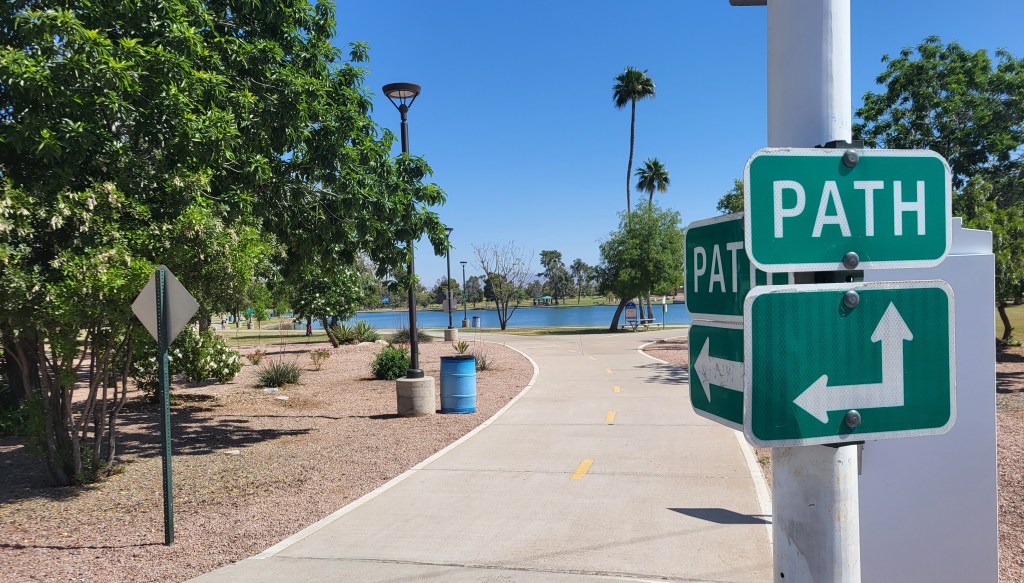
Yesterday, after a trip to Walgreens for our latest Covid boosters, Tom and I enjoyed thirty minutes walking through Vista del Camino Park in south Scottsdale.
It’s one of many washes and greenspaces that run north and south, connecting walkways and bike paths throughout our community.
After parking our 2012 indigo Hyundai Sonata–our same faithful friend that carried us west from Illinois in July 2017 after I suffered a mild heart attack–we followed the path.
We smiled as ducks paddled through a meandering creek. It is adorned with a wild splash of lavender lilies that climb the bank in one small section.
We waved to a few disc golfers, and watched a few others wade through murky water to fish out errant throws.
We admired a thicket of tall reeds, flourishing near the northern edge of the park thanks to our wetter-than-normal winter.
But the highlight came as we made our way back to the car. We paused under this enormous eucalyptus tree. It’s one of our favorite Scottsdale nature spots–a place we have visited many times over the past nearly six years.
I was compelled to capture the strength and shade of the tree, because I wanted to savor the memory and carry it home.
In that moment, I also realized I needed to write about the tree–its enduring status–and what it represents on the fifth anniversary of my blogging adventure.
Back on May 4, 2018, when I wrote my first blog post, I was looking for a way to carve my initials into the blogosphere. (Incidentally, I never considered carving my initials into the trunk of this beautiful tree. Sadly, over the decades, vandals have had different ideas. Whatever happened to the notion of respecting property and nature?)
Anyway, through my books and blog, it has been my goal to leave a trail of my thoughts and observations for anyone who might want to follow the late-in-life stories of a sixty-five-year-old heart-attack survivor living a warmer, lighter, and gayer existence in the Sonoran Desert with his husband.
This odyssey has helped me connect with all sorts of people all around the world. To voice my opinions. To learn more about yours. And, to frequently step back to marvel at the beauty of nature in Arizona and how I desperately need it.
Perhaps most important of all, blogging has helped me stay sane, vital, and relevant. We’ve all had to look for ways to navigate a raging pandemic and try to come out the other side as relatively whole human beings.
Last night, Tom and I watched a program about Gordon Lightfoot, the prolific Canadian singer and songwriter who died recently. In one particular clip, he talked about the salvation his music provided–allowing him to work out his emotions (perhaps, his demons) through song.
My writing serves that same purpose. On my saddest, most anxious, happiest, and most triumphant days–all of it–writing down my ideas and preparing them into something artful and reasonably coherent helps me make sense of the idiosyncrasies and madness in the world. In other words, my writing helps me rise above the fray … and we all know there is plenty of fray today.
It helps me feel less afraid about a whole host of things … growing older in a more vulnerable and less safe society … seeing previously recognizable American institutions (like truth, honor, and decency) vanish … cringing as my favorite baseball team from the sepia-tone recollections of my 1960s childhood (the St. Louis Cardinals) coughs up another game and sinks further into the abyss of last place (something they have seldom seen in their rich history) … and shedding a few more tears to say goodbye to old friends and Polynesian Paradise neighbors. (Another of our desert-loving flock, Bill, died yesterday after a hard-fought battle.)
While all of this happens around me and is out of my control, I feel as if I am like the eucalyptus tree in Vista del Camino Park. Despite the increasing number of wrinkles and imperfections on my skin, I’m still strong enough to smear ointments on the rough patches and move ahead along this path I might have missed. To live, love, sing, swim, and survive. To write more poems and tell more stories.
Specifically, along the banks of whatever may come next, I’ll continue to strive to produce some degree of shade for the ones I love: my husband, my sons, my friends, my neighbors, and my followers.
It’s a sizzling Saturday in the Phoenix area … 97, 98, and climbing. Hats and water bottles for protection and hydration are in order. They are now regulation gear for the next several months.
When Tom and I left the Phoenix Farmer’s Market mid-morning–clutching a clump of chard, a few red peppers, and a bouquet of snapdragons–I could feel the crackle and pop of heat bouncing off the sidewalks. Pulsating through the air.
Tom has since trimmed the pink and magenta snapdragons. He arranged them in a cobalt-blue-glazed ceramic pitcher I treasure. My mother left it behind.
We began buying fresh-cut flowers three years ago as Covid raged and tightened its grip on the world. It was our way of bringing natural beauty into our home, while we worked to avoid the bombardment of fear and disease.
Thirty-six months later, you might say this practice has taken root and grown into a full-fledged tradition.
Certainly, there is beauty outside in the surrounding rugged buttes, startling sunsets, chirping birds, and April cactus blooms.
But this bouquet (featured on a table beneath our Brokeback Mountain poster we bought when we lived in the Chicago area) provides us with a more private splash of color. Tucked away from the heat of the day both meteorologically and metaphorically.
Thank you, Carol, for your enduring sense of humanity and a lifetime of laughs.
I’m so glad we had this time together.
***
A Custodian, A Scrub Woman, and Me
At 9 p.m. Central Time on Monday nights in 1970–fifty years before the contagious Covid-19 stunned our world–a kooky comedienne with a toothy smile and infectious laugh captured my twelve-year-old heart and creative imagination. Her name was Carol Burnett.
Born April 26, 1933–in the depths of the Great Depression–this legendary actor of stage and screen first tasted success with her Tony-nominated Broadway performance in Once Upon a Mattress in 1959. Soon after she appeared as a regular on The Gary Moore Show. My exposure to her madcap comedic skills began on September 11, 1967. That’s when The Carol Burnett Show debuted on CBS-TV.
Through the spring of 1971, the network ran the hour-long variety and sketch comedy format opposite two popular programs: NBC’s I Spy; and ABC’s The Big Valley. (Later in the seventies, as the show gained a larger audience and momentum, CBS moved The Carol Burnett Show into its Saturday night lineup following four other prime-time powerhouse comedies: All in the Family, M*A*S*H, The Mary Tyler Moore Show, and The Bob Newhart Show.)
Back in 1970, after I finished my homework on Monday nights, the lights on stage came up around Carol and were transmitted through our Zenith color TV in suburban St. Louis. Long before I first imagined taking flight in my dusty desert time machine, she proceeded to field questions from her studio audience and lead me and thousands of other viewers across the country on a metaphoric and comedic joy ride.
Every week we sat mesmerized. We watched Carol and her creative troop–Harvey Korman, Vicki Lawrence, Lyle Waggoner … and later Tim Conway–perform their magical TV mayhem. Together they represented creative constancy in my life.
At that time, Dad worked the night shift as a custodian for a government agency in St. Louis: sweeping and mopping floors; cleaning toilets and urinals; emptying waste baskets.
It was a life of late-night drudgery my father, the ex-salesman and unfulfilled poet, couldn’t stomach and never dreamed of—especially when the rest of the world had Carol and the hilarity of her As the Stomach Turns weekly soap parody at their disposal from the comfort of their living room couches.
But like clockwork, at 9:30, Dad called during a break from his janitorial job. He craved a creative escape too. He wanted my color commentary on Carol’s show. The ringing on our kitchen phone was my cue to fill in the comedic gaps.
I stretched the curly cord into the living room and translated Carol’s hour-long variety show into something positive that might sustain him….at least for one night.
To put this in its proper personal perspective, Dad felt he was missing the important moments in life: a traditional schedule of evenings at home with his wife and children watching Carol’s shenanigans. All for the sake of a weekly paycheck and a job that clogged his ego like a stopped-up toilet.
As far as Walter Johnson was concerned, there was nothing else remotely funny about 1970. The Vietnam War was raging. Nixon was president. That was awful enough. Especially for a life-long Democrat.
I’d like to think our phone exchange during his break and my play-by-play of Carol’s comedy sketches and crazy Bob Mackie costumes he missed helped transform his melancholy spirit.
Ironically, over the course of Burnett’s career, she frequently reprised the role of a soulful scrub woman, who cleaned up after everyone else went home. It was Burnett’s tattered-but-enduring character, which became her show’s symbol of humor, heart and humanity.
Like the rotary phone that rang on our kitchen wall, I never imagined the show would one day disappear. But on March 29, 1978, after eleven seasons and 279 episodes (notwithstanding another nine episodes that aired in the fall of 1991) the curtain came down on The Carol Burnett Show.
In the mix, the Vietnam War ended. The troops came home. Nixon resigned in 1974. I graduated from high school and went on to college in 1975. Dad did his best to complete his night-shift janitorial duties.
In August of 1976, at sixty-two-years old—the age I am now—he retired from a job he despised but tolerated to contribute what he could to the well-being of our family. Remarkably, my father lived another seventeen years, despite his struggles with heart disease and depression.
“I’m so glad we had this time together, just to have a laugh or sing a song. Seems we just get started and before you know it, comes the time we have to say so long.”
At the close of each of her shows, Carol Burnett sang this familiar tune, tugged on her left earlobe, and signed off. Evidently, it was a signal to her grandmother to let her know she was doing okay.
I loved it all. Carol’s shenanigans, her show, her sidekicks, her song, her signal, her sentiment. Dad did too. Everything she represented … her physical humor, uproarious laughter and wacky demeanor … sustained us through difficult times.
Fortunately, Carol Burnett lives on. So do the best moments from her comedy sketches on her Carol Burnett and Friends shows that appear in syndication.
In the universe of potential outcomes, I’ve discovered that an idea can spring out of nothing and lead nowhere. But, more often than not, like a hummingbird on a mission it takes flight to somewhere and lands somewhere else. It’s really an associative process of linking one idea to another.
Often this odyssey is driven by a sensory experience. Maybe it’s a familiar scent (like fresh-mowed grass) or sound (like the coo of a dove). Or a compelling image, such as a trail of hidden stairs. Or a winding creek rambling through nature with no end in sight. Or a defined space on a windy day with a few options to pursue toward a final destination.
As I writer, I’ve learned that I am at my best when I am open to all of these eventualities and possibilities. In other words, it’s better to say “yes” to an idea and let it simmer than to say “no” outright to something that might become something more.
I suppose you could call this my creative philosophy. It led me to write four memoirs and–more recently–a book of poetry. All of these are the result of committing to the practice of writing frequently. Often, I find myself composing words in my head while I’m swimming or exercising. Then, a few hours later, they travel to my fingers and land on a page as a story or poem.
One thing’s for sure. I know my life would feel relatively empty if I could never write again.
Back in January, Marc–the artistic director for the Phoenix Gay Men’s Chorus (PHXGMC)–asked if I would develop the stories and dialogue for five fictionalized LGBTQ characters. The script would provide the framework for the chorus’ June 2023 concert, Born To Be Brave.
If you follow my blog, you know I sing with PHXGMC and have written lyrics for the chorus in the past. Both the singing and the lyrical adventure have proven to be exhilarating creative experiences. So, I immediately said “yes” to Marc’s request, and knew this new challenge would stretch me in unfamiliar ways.
Sitting before my laptop, I began to create these five individuals–composites of people I have known. With time and nurturing, they began to represent the joys, fears, hopes, dreams, uncertainties, and triumphs of what it means to be gay, bi, or transgendered living in 2023.
In March (after numerous drafts, edits and tweaks), I finalized the script for the concert. In the process, five fully defined and diverse characters–Les, Bry, Q, Gregory, and Toni–were born on the page. Since then, the roles have been cast. Rehearsals are running full tilt.
On Saturday and Sunday June 3 and 4, Les, Bry, Q, Gregory, and Toni will take the stage. They will tell their stories and connect the music at Tempe Center for the Arts.
That weekend, I will be singing with the chorus. From my tenor-two position somewhere on stage, I will watch with wonder as five other chorus members embody the five characters. They will bring them to life, tell their stories, sing their songs, and shape their journeys in their own personalized ways.
What a mysterious, organic, and fulfilling creative path this has become. With every step forward, it is leading me to places I never imagined. And, ironically, I’m discovering this new fertile ground in the desert in my sixties.
We are human, not robots. So, we all do it to some degree or another. We reflect on seminal moments that have passed rather than living in the present.
In my case, that means occasionally remembering the full moon, which dominated the January horizon the morning my mother died in 2013.
Or–further back in my psyche–the sweet scent of magnolia blossoms, emerging in late March on the front lawn of my suburban St. Louis childhood home. Often, mother nature tricked them with an early April frost that turned the pink petals brown.
Oddly, when we aren’t contemplating the past, many of us focus on the future. We anticipate significant events–personal and social–that approach.
We ponder pressing issues ahead, such as paying the rent or mortgage when it comes due at the end of the month, speculating on the latest batch of troublesome news on the world stage, or waiting impatiently for medical test results.
Though I am a memoir writer–and soon-to-be-published poet (stay tuned)–once-unforeseen yoga sessions (which I now practice frequently on the aqua mat of my sixties) teach me that I am better off focusing on the space in between the memories and the what ifs.
It is the breathing in and out that keeps me whole as I write this sentence on the keys of my laptop. It is the random chirping punctuating my afternoon in the palm tree outside my back door.
It is the rushing water of life, which currently swooshes through the normally dry Salt River gulch in Tempe, thanks to frequent rains in the Valley of the Sun and melting snow from Arizona’s high country.
At this moment in time, I need to remind myself that it is all of these things–happening now–that make life rewarding and meaningful on an otherwise gauzy Wednesday in March.
Tom and I get this question a few times a month–sometimes more often. In Arizona, Illinois, or anywhere in between.
We could be at the check-out counter of a grocery store, a restaurant as we wait to be seated, or on the treadmill at the gym we frequent in Scottsdale as we were on Monday.
That’s when a friendly man, wearing a San Francisco Giants ball cap, popped the question. (No, he didn’t ask me to marry him.)
In 2023, I generally smile and respond as I did Monday with “No, we aren’t, though we get that question a lot.” And the conversation ends there.
Depending on my mood–and how much I choose to share my personal story (after all, I am a memoir writer)–I have often gone on to say, “Tom and I are married.” Or “Tom and I are partners.” Or “Tom and I have been together for more than twenty-five years.”
Along the way, we have never received any open backlash concerning our relationship (nor should we). Quite the opposite. We have made more friends of all kinds because of our openness and comfort in our skins. (By the way, it took me decades to get here and I’m not going back.)
With time and reflection, I’ve realized that the question is more of an observation in the world of people we contact who aren’t able to classify the intimacy or closeness they identify between two men standing before them.
Or maybe it’s an acknowledgment on a less significant level that we have picked up some mannerisms from one another that two brothers might have in common. However, we really don’t look alike.
At any rate, I will continue to live my open life as a gay man–proudly–in my community. I will continue writing about my experiences–positive and negative–as a gay man, a husband, a father of two adult sons, a neighbor, a friend.
I will continue singing on stage with the Phoenix Gay Men’s Chorus. As I write this, I have just completed drafting a script about five fictionalized characters living in the Phoenix LGBTQ community in 2023. Their dialogue will be the glue that ties together the music of our next concert: “Born To Be Brave”, June 3 and 4 at Tempe Center for the Arts.
I feel it is my duty to demonstrate that two men–a gay, married couple–don’t have to be blood brothers to love each other.
Especially in a country where some want to remove the books of gay authors from the shelves. Or try to erase the checkered history of our country on race relations because the truth is threatening to some. Or ban drag shows, because they view them as recruitment activities for current or future generations.
Okay, I’ll get off my soapbox now. But Tom and I aren’t brothers. We’re a gay couple living happily in 2023, and there are lots of us out in the world.
We’re making significant contributions. Loving our families. Loving our neighbors. Loving our friends. Loving the legacy, which we are leaving for future generations of children who need to know the truth about the past and the present. That there are all kinds of people in the world loving each other. And that’s just as it should be.
Here in the Valley of the Sun–home to Super Bowl LVII in Glendale, Arizona, and the Waste Management Phoenix Open this weekend–the media hype is way, way up (somebody make it stop!) and so are the crowds of football and golf fans who have descended on Old Town Scottsdale.
Meanwhile, there’s lots of hammering happening too on Super Saturday.
A trio of industrious men are replacing the roof of our condo. As background, the planning for this project began a month ago, when heavy rain and pea-sized hail (yes, it hailed in the desert!) produced a leak on the edge of our north-facing roof on New Years’ Day 2023.
At this moment, Tom and I are holed up in our cozy den with our fingers and toes crossed. Outside tarps surround us. All of our containers of cacti and succulents are scattered or safely tucked under the eaves.
Hopefully, none of the old shingles (currently flying off the roof like a scene from The Wizard of Oz and landing on the ground in a series of whooshes) will destroy them.
That scraping and pounding is super noisy. But, if all goes well, we will have a new roof by noon today.
And after tomorrow–no matter whether the Chiefs or Eagles win the Super Bowl–the throngs from the Midwest and East Coast (Kansas City and Philadelphia, I’m talking to you) will begin to return home with sunny (and unusually brisk) Arizona memories.
Perhaps they will also leave with a tumbler like the one this local bought at our Fry’s grocery store to commemorate the madness.
“Dogs have no idea how wonderful they are.They walk all around us and make the world a better place.”
***
On a chilly, but sunny, Thursday morning in Scottsdale, Arizona, this was Yumi’s thought of the day.
How serendipitous that our instructor should choose these two sentences as inspiration for Tom, me and six others on February 2, 2023, as we stood on our mats and began our weekly seventy-five-minute journey into yoga.
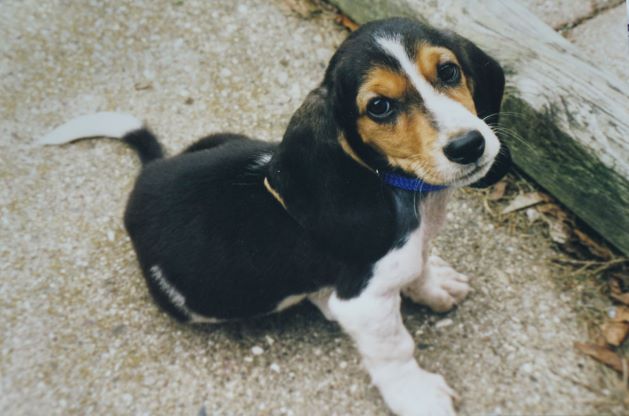
On Ground Hog Day fifteen years ago our basset hound Maggie crossed over the Rainbow Bridge.
When it’s your pet, you never forget the highs and lows long after the calendar pages have come and gone.
The frolics with Kirk, Nick, Tom, and me in the lush green of our backyard … the comfort of her velveteen elongated ears as I stroked her coat … the gnaws and crunches of rawhide bones and petite carrots as she gobbled up another evening snack, after racing to welcome us home at the kitchen door.
Then along came that sad-and-snowy suburban Chicago morning in 2008 when our dog endured another–particularly horrible– seizure.
After the shaking had stopped, she looked up at me with resignation from the tile of our kitchen floor without the energy or inclination to lick the maple syrup off a breakfast plate.
Soon after, Tom and I scooped her into our sedan, arrived at our vet’s office, and whispered goodbye to her as she sprawled on a blanket on the floor.
***
Today, seventeen hundred miles and a lifetime away from the northern Illinois home she patrolled and dominated, I recall the “glue” and comic relief our dog provided (through her warm fur, misshapen front legs, and bellowing howl).
She was the antidote for our non-traditional family: two men (in a loving relationship just doing our best to coexist in a less enlightened world) with my two sons zooming in and out of our life as they grew.
Our dog simply demanded our constant attention and stood by our sides witnessing it all.
It was the love and companionship of Maggie and the litany of her daily adventures–walks, feedings, treats, medicines, rabbits, squirrels, accidents in the hall, and countless cuddles–that magically connected us all.
Certainly, from 1998 to 2008, our dog made our world a better place.
I take a blood thinner; therefore, I bruise easily.
So, for instance, if I’m putting away dishes in our cupboard after dinner and bump the top of my hand on the corner of the cabinet, I am sure to leave that mundane household experience with a souvenir–an immediate red patch that will last a few days in the afflicted area.
I haven’t always been ultra-self-conscious about the condition of my extremities. It’s only lately–in my sixties with thinner skin on my thinner body–that I’ve become aware of my aging hands and, of course, my mortality. They go hand in hand.
Since I’m a writer and rely on my fingers, wrists, and hands to write these sentences on my laptop, I’m fortunate not to have arthritis in my joints–in my hands.
My sister Diane seems to be the one in our family who has inherited that painful component of our mother’s DNA. Particularly in her hips, knees, and feet.
Diane is sixty-eight-years old. She doesn’t read what I write. We live seventeen hundred miles apart. She in Illinois. Me in Arizona.
Even so, I love my sister. I always have and will. Tom and I visited her and Steve (Diane’s husband) for an afternoon last October while we were in the Chicago area. In this age of Covid, we recounted all the things we are thankful for.
Diane will always be my only sibling, my only big sister. We talk and text occasionally. I worry about Diane’s physical wellness and longevity. We’re the only two remaining in our family of origin, since Mom passed away ten years ago.
Diane also is the only other person who remembers the nuances of our St. Louis childhood, our homelife (good, bad, and indifferent), our difficult plight as a family after Dad’s heart attack in 1962, our mother’s resolve in her fifties and fragility in her eighties, our mother’s aging hands.
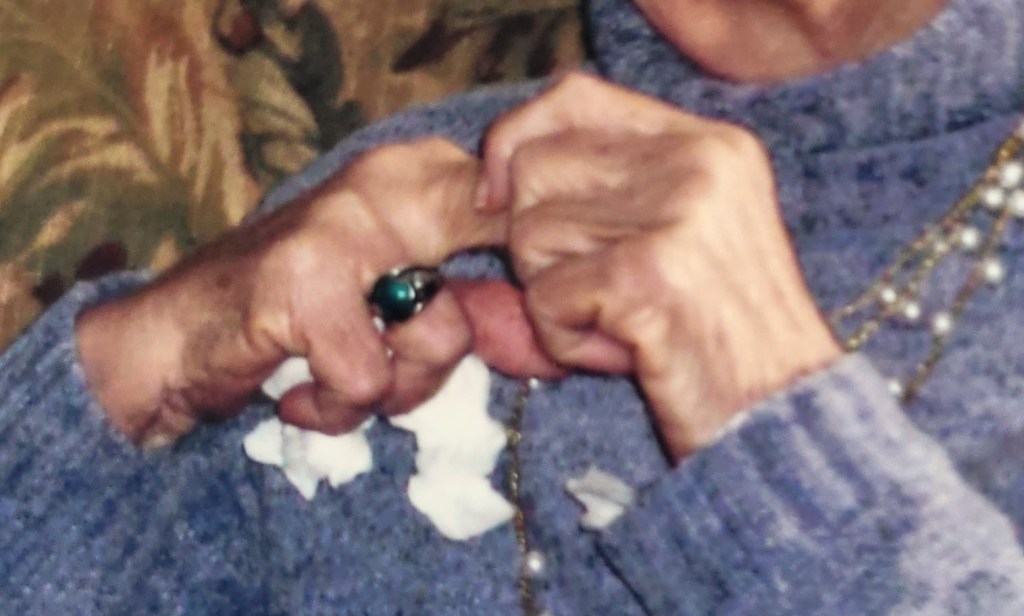
I came across this photo of Mom’s folded hands from Christmas Eve 2008. That night, we gathered at Diane’s home in Illinois to celebrate the holiday and open gifts. Mom would live to share another four Christmases with us.
It’s a cropped image and not the clearest, but when I saw it, I was reminded of Mom’s age spots and blemishes that grew with the passage of time on her fair, loose, thin skin. The rough patches on her hard-working hands go back in time to her rural southern roots in High Point, North Carolina, and fifty years in St. Louis, Missouri, which I chronicle in From Fertile Ground.
In her final nine years living in northern Illinois, our mother had this habit of clutching a tissue in her palms. She often hid an auxiliary one in the arm of her blouse or sweater. If you look closely, you can see it peeking out of the sleeve of her heather-flecked turtleneck.
These are the little personal idiosyncrasies that only a sibling would remember. They don’t matter in the grander scheme of things, but they do when it’s your mother and you still love and miss her after ten years of living without her. And you realize that your own mortality creeps ever closer with every blogpost.
Sure, I stay active–mentally and physically–and will continue to mount the treadmill several times each week to keep my heart strong.
But there is no denying the evolving appearance of my spotted, aging hands. They are looking more like my mother’s every day.





 Mark Johnson Stories