Category: Europe

Helene and The Mousetrap

Life repeats itself in strange and unexpected ways.

As Tom and I traveled throughout Ireland in August of 2017, some of our tour mates followed the US weather forecast with growing interest and anxiety.

Hurricane Harvey–a category 4 storm–was about to make landfall along the Texas coast.

Houston was in its path. Houston was their home.

Harvey unleashed its wrath. We never learned what impact it ultimately had on their lives.

Seven years and one month later, we were back in the United Kingdom on a tour of England and Scotland with twenty-two other tourists (plus Phil, our guide, and coach driver, John).

Two of our entourage, John and Jill of Tampa, told us they were watching the swirl of Helene–another category 4 storm–approach the Gulf coast of Florida and the vicinity of their home.

Though Tom and I knew we would return home to the Phoenix area and prolonged 110-plus temperatures, we felt lucky about our weather plight. Yes, more heat. But not John and Jill’s uncertainty.

There were no giant storm swirls for Tom and me to contend with in Phoenix.

Still–far away from pending devastation of Helene–John, Jill, Tom and I bonded in the United Kingdom.

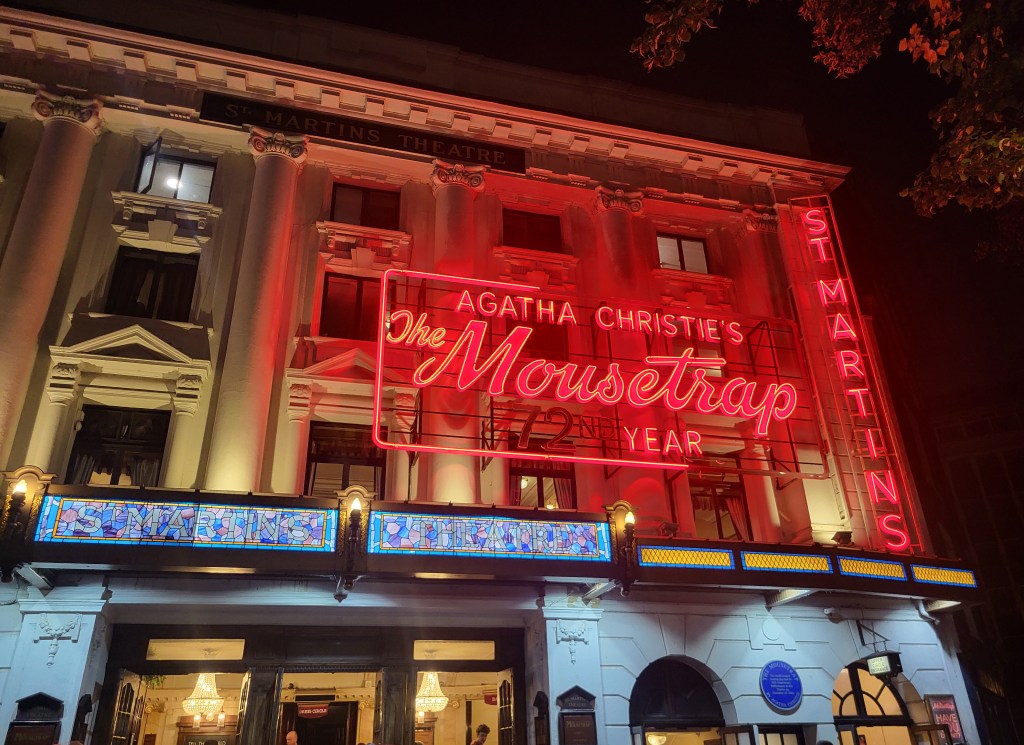
I remember telling them when we first met in London that we were excited to see a play independently in the West End at the St. Martin’s Theatre on Saturday, September 21.

Not just any play. The longest running play in the world. It’s called The Mousetrap.

Based on an Agatha Christie story, The Mousetrap, has been performed for seventy-two years in London.

(There were no performances during the height of the pandemic from March 2020 to May 2021.)

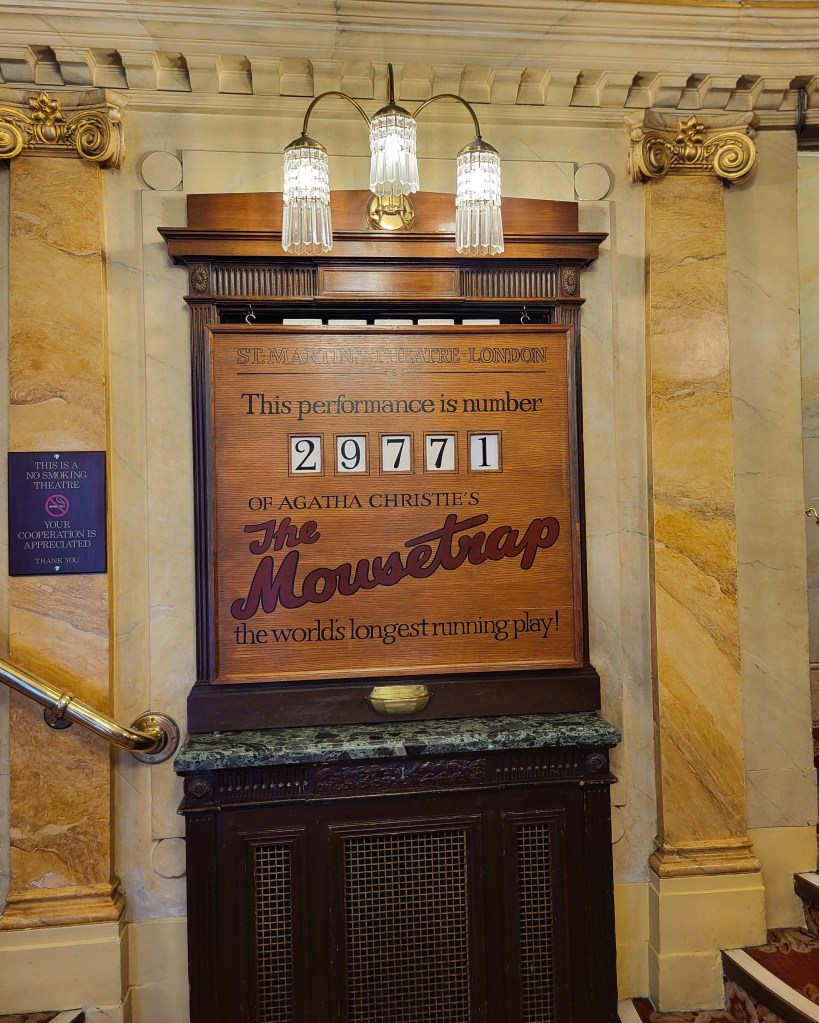
Tom and I were in the audience for performance #29,771.

It’s a classic whodunit with a twist ending.

A young couple owns Monkswell Manor guesthouse in England in the early 1950s.

Four guests arrive, while the snow (not a hurricane) swirls outside.

There is a radio report of a woman’s murder. A suspect is loose in the area.

A police sergeant arrives on skis to warn them that a notebook was found at the crime scene.

It contains the address of Monkswell Manor and the words “three blind mice.”

Pinned to the victim’s body is a note that says, “this is the first”.

Everyone at the inn is in danger. Everyone is a suspect.

At the end of the performance, the seven actors took their curtain call.

They asked us in the audience to keep their seventy-two-year-old secret.

You’ll get no spoilers here.

***

Anyway, along our journey through England and Scotland, we shared with John and Jill from Tampa how much we enjoyed this theatrical experience.

The night before we departed Edinburgh, Scotland–to return to our respective sunbelt homes via London–John and Jill suspected their flight from London to Tampa the following morning would be cancelled due to Helene.

When it was, they had a free day in London. They texted to say they bought two tickets to see The Mousetrap as we wound our way through Heathrow Airport security.

Later, during intermission on September 26, 2024, while Tom and I were making our way home, Jill texted: “We are in intermission, and I am stumped!” Then, a few hours later, “Great show!! So glad you both recommended it.”

The next day, we were relieved to learn from Jill that their home was safe, even though there were flooding waters all around them.

What does it all mean? This story is no mystery. But, nonetheless, still meaningful I think.

You can fly seven or eight thousand miles to a place you’ve never been and make a connection with fellow travelers you didn’t know … someone who has shared a coach, watched the scenery go by … someone who chooses a similar theatrical experience … someone who dodges the mousetrap of a catastrophic storm … someone you hope to see again someday in another London or Edinburgh or in the sunbelt of your everyday lives.
Worth the Journey

On Thursday, as I was flying home over the Atlantic Ocean at 38,000 feet with my husband on an eleven-hour, nonstop British Airways flight from London to Phoenix, I wondered “what will I choose to write about our week-long journey through England and Scotland?”

Today, it is this big picture observation. At this somewhat advanced stage of life–I am sixty-seven going on sixty-eight–traveling to previously unseen, faraway places is both the great rejuvenator and the not-so-great discombobulator.

Even so, as I shed the remnants of jet lag, I’ve gathered new memories and experiences that fire the creative and sensory synapses of my brain … reigniting splendid moments that transcend the ordinary view from the couch.

We certainly brought home a boatload of those: from performance #29,771 of The Mousetrap at the St. Martin’s Theatre in London’s West End; to fascinating tours of Buckingham Palace, Windsor Castle, and the Roman baths of Bath, England; to heavy rains on the road that led us to William Shakespeare’s family home in Stratford-upon-Avon; through the Lake District of the splendid English countryside and discovering poet William Wordsworth’s grave in Grasmere; to a photographic moment with statues of The Beatles in Liverpool; to a blustery climb up the cobblestones in Scotland into the sky of the Edinburgh Castle; to winding down circuitous streets that finally led us to find the Writer’s Museum proclaiming the literary achievements of Scottish icons Robert Burns, Sir Walter Scott, and Robert Louis Stevenson.

And that says nothing about the fine food and acquaintances we met along the way.

I will be recounting each of these adventures and more in the coming days. But, for now, I simply want to remember this serene moment, gliding on the top deck of the Swan on Lake Windemere in England on Tuesday, September 24, 2024.

Yes, it was a short week and two long flights across the pond.

But it was worth the journey.

September Morn

Until recently, I didn’t know much about Frances Streumpf Sendke. Only stories my father and aunts shared–passed down through the generations–about my paternal great grandmother.

One is a memory Dad shared about September 1. Apparently, every year on the morning of this day, his Grandma Sendke (she and Grandpa Sendke lived with them when Dad and his sisters Thelma and Violet were children) walked into their bedrooms, pulled back the covers, and shouted “September morn!”

I don’t know the cultural history behind that, but Dad’s “September morn” memory was cast as a celebratory moment long before Neil Diamond wrote his September Morn song.

Instead, I believe my great grandmother was acknowledging the arrival of September’s light and the nip in the air. It was a harbinger of fall days.

Another favorite bit of folklore about Frances Streumpf Sendke came from my Aunt Thelma. She shared a gauzy story about her grandmother, riding horseback in rural Missouri during the Civil War as union soldiers stormed through the countryside.

Today, on this September morn, I’m learning more about my great grandmother thanks to Ancestry DNA. According to census records, she was born in Westphalia, Missouri, in 1857 (exactly one hundred years before me). She died in the St. Louis area in October 1933.

Along the way, she married Charles Ludwig Sendke. He emigrated from Princelau, Germany. (According to Aunt Thelma, he left Germany as a stowaway on a ship at age 13.)

On October 14, 1884, their daughter Anna Louise Sendke Johnson (she went by Louise) was born. I remember the large floral print dresses she wore, the over-powering scent of her powder and perfume, how much she loved her soap operas, and visiting her in the hospital a few days before she died of a heart attack in April 1968. She was my paternal grandmother.

I’m sure I’ll be writing more about genealogy in the coming weeks. But for now, suffice it to say I’m enjoying learning more about my ancestors, all of whom have contributed to the person I am.

***

Incidentally, after submitting my DNA swab several weeks ago, Ancestry DNA says I am comprised of the following heritage:

Sweden and Denmark = 33%

Scotland = 30%

Germanic Europe = 23%

Norway = 14%

Eight Days on the Emerald Island

There is no better time than St. Patrick’s Day to pay tribute to the Emerald Island.

In late August 2017–just six weeks after I suffered a mild heart attack–Tom and I boarded a flight for Dublin, Ireland.

It was an excursion we had planned months before. But on July 6th (our shared sixtieth birthday) the trip and our future felt very much in doubt as I lie on a gurney in a St. Louis hospital.

Remarkably, my health improved considerably in a month. Doctors in Scottsdale, Arizona–my new hometown–encouraged us to proceed with our plans. The journey to Ireland would help us heal.

Looking back five years, both of us were anxious about traveling abroad, but we also needed to reclaim our joy. As I wrote in An Unobstructed View, Tom and I spent eight days with forty other travelers from around the world. Brian, our capable guide with CIE Tours, led us clockwise around the island.

It’s a bit of a blur now. But in one week’s time we moved from Dublin to Waterford, Killarney, the Ring of Kerry, the Cliffs of Moher, Galway, the sheepdogs in Sligo, the Giant’s Causeway in North Ireland, and the Titanic Museum in Belfast … before returning to Dublin and riding atop a double-decker bus with the wind racing through my hair.

Along the way, on our farewell dinner with the tour, we enjoyed an evening of Irish songs and music at the Glyde Inn just south of Dundalk.

In the spontaneity of the experience, I was pulled onto the floor to join in a broom dance. For a few fleeting moments, I rediscovered my spark away from the worries of the previous month.

I also spotted a little old Irish lady, singing her heart out across the room. She resembled my Scotch-Irish mother, who never had the opportunity to return to her ancestral home country. Seeing her there was an important step in my healing process.

In 2019, I wrote The Irish Mist. My poem is a tribute to the comfort I felt looking out over the Atlantic Ocean across the vast Cliffs of Moher on the west coast of Ireland as the clouds rolled in on August 27, 2017.

***

I’ll always remember you, rolling in over the gaelic green.

I felt cool comfort knowing the veiled intentions you whispered in my ear wouldn’t be denied.

No matter how much I wanted to gaze beyond the moss and ferns you shrouded, you held me there.

You knew I needed to stand strong above the craggy cliffs of my past.

You knew I needed to feel rooted to the emerald island, thankful for the mystery of my mending heart.

The Reckoning

Kirk and I talked this morning. Every few weeks–usually on Sunday mornings–we connect via phone.

My thirty-three-year-old son is a kind counselor, who lives in Chicago. He lives a full, demanding life. He has navigated the Covid years on his own. I continue to do my best to bolster him from afar.

I always look forward to our conversations. Kirk tells me what’s happening in his world. I tell him what’s happening in mine. He’s planning a trip to Portugal at the end of March with a friend. The trip has been postponed twice due to the global pandemic. We both hope the third time is the charm.

Kirk is the adventurer in our family. He volunteered with the Peace Corps–taught English to children in Vanuatu on the island of Tanna in the South Pacific–in 2014 and 2015. He hasn’t traveled abroad since then due to Covid and career demands.

I admire Kirk’s sense of wonder. He told me he’s missed the opportunity to explore new worlds; to get lost in unfamiliar cultures. I could hear the loss in his voice.

While news of the war in Ukraine rages on, and we global citizens are catapulted into the uncertainty of another international drama, I think it’s likely that many will deny or try to forget the pain of the past two years. But we can’t and we shouldn’t.

At the very least, each of us must have a personal reckoning to account for the pain, anxiety, disruption, and multitude of losses. This is something I’ve contemplated for a while. This weekend it has surfaced more clearly.

During my conversation with Kirk, I recounted my Saturday with Tom. I told him I sang with my Phoenix Gay Men’s Chorus pals at the Melrose Street Fair. It’s a lively community event in Phoenix that has gone missing for two years–for obvious reasons.

As I stood on the stage yesterday on a partly sunny and breezy morning–with Tom and a group of our close friends watching and listening–the last two years came flooding back.

Why? Because our chorus performed at the same event two years ago. It was right before the world stopped spinning and we all retreated. I will always remember the pain of that. None of us knew the magnitude and length of the tidal wave of fear and uncertainty that was coming. Somehow, we endured.

Yesterday’s moment was one to embrace and celebrate. Like a long, lost friend missing in action, the world felt suddenly alive as we sang. I wasn’t sure when or if I would feel that free again. But I did.

As I retold this story to Kirk on the phone, my tears appeared out of nowhere. The full emotion of Saturday’s reawakening arrived on Sunday morning with my younger son listening attentively seventeen hundred miles away.

Though it wasn’t in person, I am thankful that Kirk and I had a few moments of reckoning together. Like all of us who have lived through the darkness, we have earned the time and space to reflect and process all of the madness.

I hope my son is able to re-ignite his passion for travel in Portugal and find a little solace … maybe even realize a dream in an unfamiliar place in late March.

Ironic or not, one of the songs our chorus sang yesterday was Come Alive from The Greatest Showman. Let the lyrics wash over you and rekindle your best instincts. We have all earned the reckoning.

***

And the world becomes a fantasy, and you’re more than you could ever be,

’cause you’re dreamin’ with your eyes wide open.

And you know you can’t go back again to the world that you were livin’ in,

’cause you’re dreamin’ with your eyes wide open.

So come alive!

Tom captured this moment as the Phoenix Gay Men’s Chorus prepared to perform at the Melrose Street Fair on March 5, 2022.

Nine Years Ago in Italy

It’s been a while since I’ve boarded my dusty desert time machine. I figure we can all use a summer holiday escape. Away from daily reports of emerging COVID-19 hot spots, social unrest, and the grind of our shrunken stay-at-home lives.

Join me as I travel back nine years to late July 2011. When our resourceful guide and friend Yvette (a Canadian living in Tunisia), led six men (five Americans and one Canadian) on an eleven-day, Outgoing Adventures tour of Italy.

It was my first European odyssey. Six years before our 2017 Ireland immersion. Eight before Tom and I made a delicious 2019 dash through Germany and Austria.

There will always be a special place in my heart for Italy. The architecture, ancient history, hum and handsome men of Rome. The mystery and magic of Siena.

The countrysides and cooking of Tuscany. The alleys and alabaster of Volterra. The cliffs and colors of Cinque Terra. The style and silk of Florence.

Most of all, the enduring exuberance of the Italian people we met all along the way … lovers of art, pasta, wine, afternoon strolls and evening gelato.

Consider this my tribute to beloved Italy. A splendid sampler of nine representative images I captured that–nine years later–continue to feed my creative consciousness, spirit of adventure, and wonder about a nameless Florentine boy with a blue umbrella who followed his mother’s red shoes.


Thelma’s Rosy Response

Stories of war, like global pandemics, aren’t only about those fighting on the front lines. There are the lovers, the brothers, the sisters, who worry and wait. They wonder about the worst and hope for the best.

***

World War II was winding down, while Walter’s older sister Thelma waited five long weeks in eastern Missouri for his next words. She didn’t receive his May 16, 1945 letter and photo of him linking arms with a somber Czechoslovakian girl until Friday, June 22.

Evidently, the Army bundled it with two others he wrote on June 10 and 12. The U.S. military transported all three across the Atlantic Ocean with a sea of other correspondence from service men and women stationed in Europe.

In 1945, Thelma was a single-and-sentimental-thirty-six-year-old secretary. By day, she worked at a branch of the Kroger Grocery & Baking Company in St. Louis. After completing her shift, she boarded the streetcar to 4218 Labadie Avenue on the north side of town. That’s where she lived in a modest, two-story, rented home with Louise and Albert Johnson, her mother and father.

My aunt was a gardening guru. A real rose and ballroom lover. Later, in the 1960’s when she and her husband Ralph owned a suburban St. Louis home, it was her ritual to lead us on a parade through her backyard to admire her flowers.

Through that gardening lens, I can imagine her coming home from Kroger on Friday, June 22, 1945, kicking off her shoes, flipping through the mail, and eagerly opening Walter’s letters while waltzing through her parents’ postage-stamp-size Victory Garden. That summer it might have been brimming with vegetables and herbs (perhaps even a few ruby-red roses) designed to supplement food rations and boost morale.

No matter how close or far my fantasy is from reality, I have in my possession proof that Thelma penned a rosy response to her brother later that night in an attempt to bolster his sagging spirit.

Here’s an excerpt of that letter, dated June 22, 1945 and postmarked June 26, 1945. She sent it via air mail from Chicago, Illinois. Incidentally, the Drake Hotel Thelma refers to, just east of North Michigan Avenue on Chicago’s Gold Coast, still operates today. It’s a few blocks south of Oak Street Beach, where Thelma and Vi likely tanned themselves that weekend on the shore of Lake Michigan.

***

Dearest Walter, 

Your fine letters of June 10 and 12 arrived today and found us happy and anxious for word from you. Also, we received today those wonderful pictures taken by you in Czechoslovakia. They are really “super” Wal and that little girl is a doll. Vi was here for supper and she too was pleased and happy by seeing you again … if only in a photograph. You look thinner, Wal–but as Vi said–he’s regained his figure and looks wonderfully handsome, younger, and really on the beam. We surely are proud of our dearest Walter boy, and justly so. I have the negative you sent in a recent letter and shall have it developed too … it looks like another Czech girl, right? …

Well Wal, Vi and I leave in the a.m. for Chicago and since the weather has taken a change for the good … we hope to have nice sunshine and a chance to get a tan on the beach and am sure we’ll find the “Drake” the finest hotel in Chicago as it’s accessible to everything …

I am enclosing some snapshots taken on Mother’s Day, Wal, and with them comes all our love to you, our dearest and most missed member. I hope you get to be around Paris for a while … so you can take it all in … and I’m hoping too you’ll be assigned to occupation forces even though it would delay our meeting it would ensure its being permanent when it did come …

With all the love of your loving but lonesome family and many thanks for the fine pictures (and I hope there’ll be more later–I can send film so just ask Wal and its yours) until a little later then its ever and always.

Your loving sister,

Thelma xxxxx

***

I’m not sure if Walter, my father, ever made it to Paris that summer. But when Thelma wrote her letter six weeks after V-E Day, there was the frightening possibility he would be shipped east to help fight the war still raging in the Pacific Theatre.

Instead, he returned to the United States on the U.S.S. Monticello in July 1945, carrying his dog tags, nightmares, a foot locker filled with possessions, and a fistful of family love letters. Dad received his honorable discharge from the U.S. Army on October 11, 1945.

This is one of the photos Thelma enclosed with her June 22, 1945 message. Thelma–the ever-exuberant, flower enthusiast–is on the right, smiling behind her corsage. Violet, my father’s twin sister, is on the left. On the back, Thelma wrote:

To our dearest brother Walter with all the deepest love of his adoring sisters

Violet & Thelma, May 13, 1945

VioletThelma_May13_1945