My parents labored through much of their forty-five years of marriage. In that sense, it is fitting that their wedding anniversary–September 4–often coincides with Labor Day, as it does this year.
Despite their differences, struggles, and heartaches, by the late 1980s Mom and Dad seemed more content whenever I drove from Chicago to visit them in St. Louis.
Mom had retired from her stressful government job. She spent more time in her beloved garden. Dad’s mental illness had quieted. He found solace, reading his Daily Word in their wing-backed chair.
Ironically, this more even footing in their relationship appeared as their physical frailties–and risk of falling–became more obvious.
They went to church together. They cultivated deeper friendships with neighbors. They dined regularly at nearby Grone’s Cafeteria. Life was much simpler.
Comparatively, Tom and I are far more active in our “retirement” than my parents ever were. But we have discovered a similar contentment. There are fewer demands on us. We spend more time on the things we enjoy with the people–friends and family–who mean the most to us.
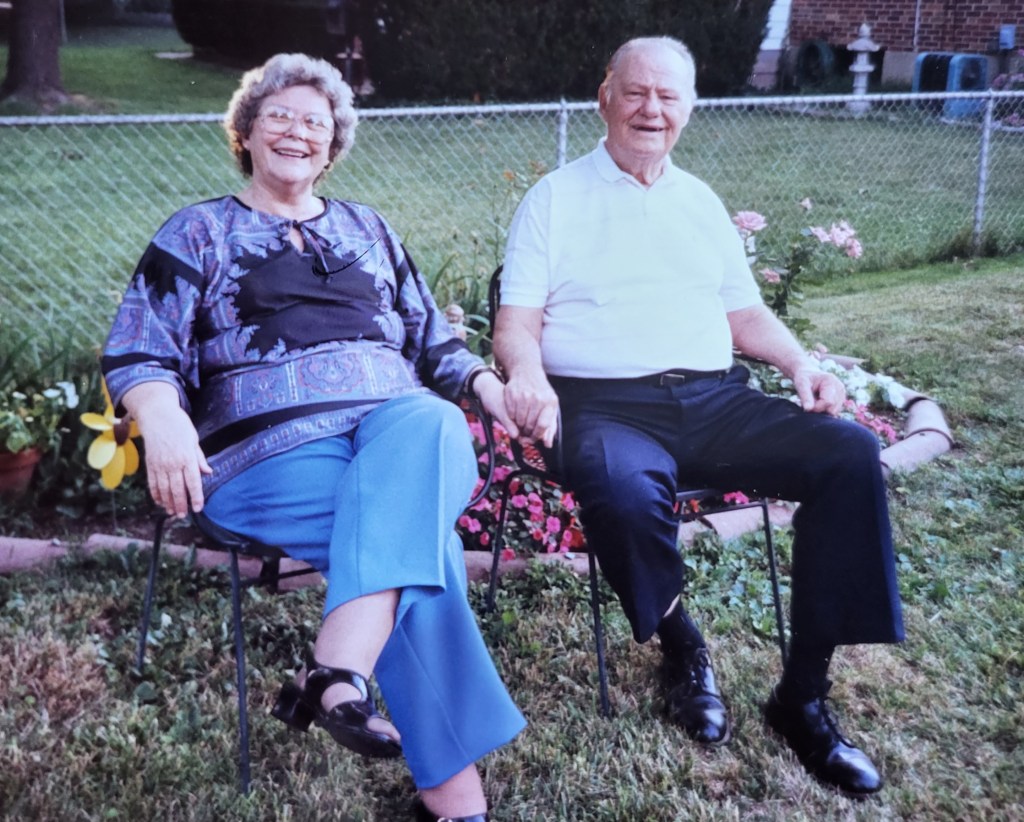
Today–on what would have been Helen and Walter Johnson’s 75th wedding anniversary–the two people holding hands in this photo are the ones I choose to remember.
But, even during the troubles and heavy lifting of their younger years, I’m grateful for the many things they taught me. How to respect the elderly. How to save for a rainy day. How to be kind to neighbors and care for animals. How to put people before material things. How to be a loyal friend. How to work hard and earn my keep. How to show compassion.
Most important of all, how to love my family, warts and all.
Certainly, by watching Helen and Walter struggle, I learned lessons about how to endure in a world that can often feel unendurable. That may feel like a strange way to pay tribute to my parents on their diamond wedding anniversary. But it’s honest and true.
Though Dad has been gone thirty years and Mom ten, the love I feel for them endures.
In the summer of 1988, Helen and Walter Johnson enjoyed their suburban St. Louis backyard. Mom was 65; Dad was 74.
Until recently, I didn’t know much about Frances Streumpf Sendke. Only stories my father and aunts shared–passed down through the generations–about my paternal great grandmother.
One is a memory Dad shared about September 1. Apparently, every year on the morning of this day, his Grandma Sendke (she and Grandpa Sendke lived with them when Dad and his sisters Thelma and Violet were children) walked into their bedrooms, pulled back the covers, and shouted “September morn!”
I don’t know the cultural history behind that, but Dad’s “September morn” memory was cast as a celebratory moment long before Neil Diamond wrote his September Morn song.
Instead, I believe my great grandmother was acknowledging the arrival of September’s light and the nip in the air. It was a harbinger of fall days.
Another favorite bit of folklore about Frances Streumpf Sendke came from my Aunt Thelma. She shared a gauzy story about her grandmother, riding horseback in rural Missouri during the Civil War as union soldiers stormed through the countryside.
Today, on this September morn, I’m learning more about my great grandmother thanks to Ancestry DNA. According to census records, she was born in Westphalia, Missouri, in 1857 (exactly one hundred years before me). She died in the St. Louis area in October 1933.
Along the way, she married Charles Ludwig Sendke. He emigrated from Princelau, Germany. (According to Aunt Thelma, he left Germany as a stowaway on a ship at age 13.)
On October 14, 1884, their daughter Anna Louise Sendke Johnson (she went by Louise) was born. I remember the large floral print dresses she wore, the over-powering scent of her powder and perfume, how much she loved her soap operas, and visiting her in the hospital a few days before she died of a heart attack in April 1968. She was my paternal grandmother.
I’m sure I’ll be writing more about genealogy in the coming weeks. But for now, suffice it to say I’m enjoying learning more about my ancestors, all of whom have contributed to the person I am.
***
Incidentally, after submitting my DNA swab several weeks ago, Ancestry DNA says I am comprised of the following heritage:
It’s a daunting task, trying to capture a full life–in this case, my mother’s–in one hundred words (and a dozen pictures). But, today, on the one hundredth anniversary of her birth, this is how I choose to remember Helen Matilda Ferrell Johnson, beyond our story that sprang From Fertile Ground.
***
Born July 26, 1923; High Point, North Carolina.
Child of the Depression.
Dutiful daughter. Responsible older sister.
Fine furniture lover.
1945. St. Louis, Missouri, bound.
Patient wife. Long fuse. Quick temper.
Attentive mother. Hard worker.
Loyal friend. Compassionate trailblazer.
Unintended, unidentified feminist.
Reliable next-door neighbor.
Proud mother. Devoted grandmother.
Smart saver and investor.
Advocate for the disabled and needy.
Southern storyteller. Avid letter writer.
Rock and shell hunter.
Animal advocate. Grateful green thumb.
Observant camera bug. Crafty potter.
Contented retiree. Resilient fighter.
Northern Illinois octogenarian.
Wise realist. Chair rocker.
Fading sunset lover.
Gone January 26, 2013; Wheaton, Illinois.
Full moon.
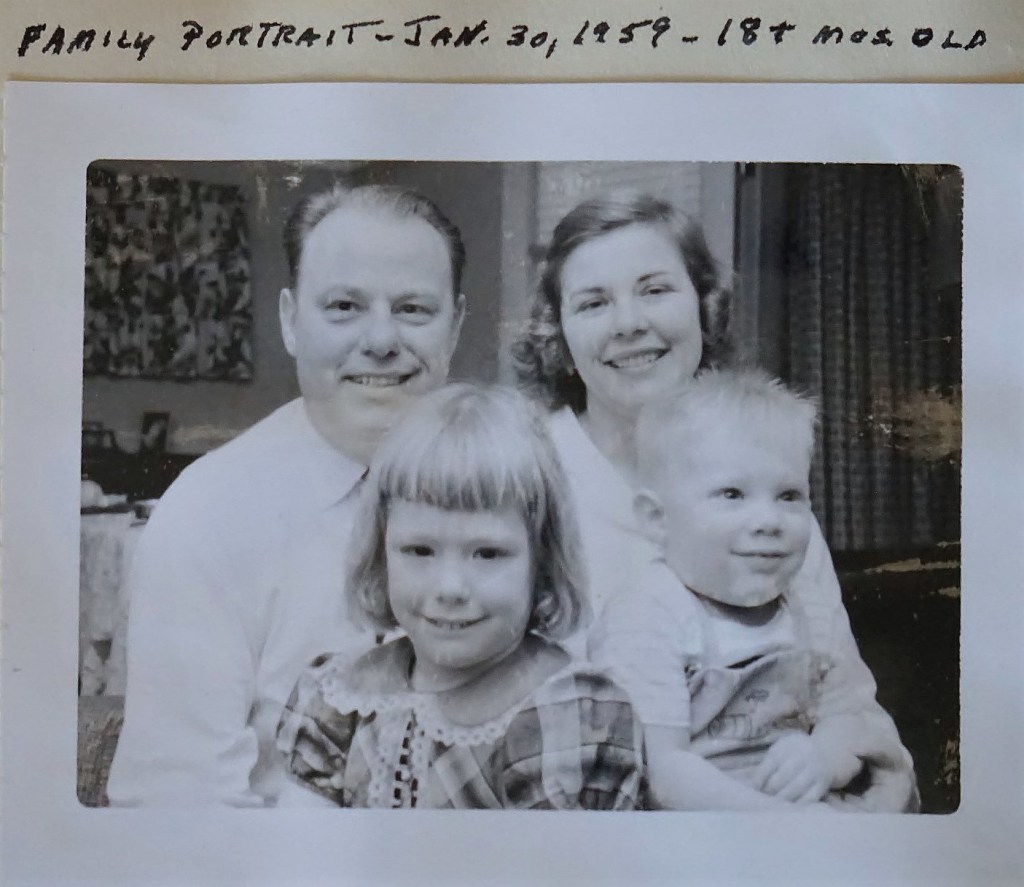
Helen Ferrell at age six in 1929.Helen walking with younger sister Frances in the 1930s.Helen arriving in St. Louis by train outside Union Station in 1945.Helen in Texas in the 1950s.Helen and Walter Johnson in Texas on her twenty-sixth birthday.Helen outside their Texas apartment in the early 1950s.The Johnson family in 1959 in St. Louis.Helen and Maggie in Mount Prospect, Illinois; New Year’s Day 1999.Helen singing Waltzing Matilda on her eightieth birthday in Geneva, Illinois.Helen the gardener in the early 2000s.Helen showing off her manicured nails in Wheaton, Illinois in 2011.Mark and Helen in January 2013, a few weeks before she passed.
I don’t know why it’s taken me so long. Especially because over the past ten years I’ve written extensively about my family, my lineage, and our propensity to seek, find, and carve our own paths. Plus, our impulses to leave behind a trail of our own observations. All of that runs through my DNA.
At any rate, last week I finally bought an Ancestry DNA kit. I opened the cardboard box. Read the directions. Spit my saliva into the provided vial. Put a cap on it. Closed up the box. I sent it away in the mail. I expect to receive the results via email in six to eight weeks.
From my mother’s branch of the family tree, I know I am Scots Irish; from my father’s family, German, Swedish, Norwegian, and French lineage. But maybe there will be a surprise or two.
This additional family research is also prompted by my mother’s one hundredth birthday–coming next week on July 26–and the personal reflection that comes with this significant milestone.
Meanwhile, with nineteen days of 110-plus temperatures under our belts here in the Valley of the Sun, Tom and I are poised for an escape to celebrate Mom’s birthday.
We’re planning a three-day, mountain getaway to Flagstaff, Arizona, where–at an altitude of 7,000 feet–we will be (blissfully) twenty-five degrees cooler than Scottsdale.
Because my mother’s life story (and my associated grief) has served as a catalyst for my writing, I’m offering my first book as a Goodreads Giveaway through July 26th. One hundred readers (chosen randomly) will receive a free download of my book.
Simply enter by July 26. If you’re a lucky recipient of my book, you’ll be notified right after. Then, find a quiet corner away from the heat (I think it’s hot everywhere right now) and get lost in my three-generation story of love, loss, and our family’s passion for writing.
I look forward to hearing your thoughts and would appreciate your rating/review online.
I received a sad text message on July 2 from Lu, my cousin’s wife in North Carolina. She told me Frances, my beloved ninety-one-year-old aunt, is in her final stages of life, suffering with the effects of Alzheimer’s.
Frances is my mother’s smart and sassy younger sister–the only one remaining from that generation of my Ferrell family. Her passing–whenever it occurs–will mark the end of a significant chapter in my life … one I wrote about in From Fertile Ground after my mother’s death ten years ago.
When I last visited Frances in September 2015, I sat beside her on the couch of her Davidson, North Carolina living room. It was an important and healing moment for both of us. The loss of her only sister and my only mother was still relatively fresh.
I realized then that returning to North Carolina (where my mother was born) was my way of putting to rest Helen Ferrell Johnson’s earliest life experiences–and some of mine, which included Frances, her sons, warm summer days, and barefoot adventures exploring my grandparents’ Huntersville, North Carolina farm in the 1960s.
Now–just a day away from my sixty-sixth birthday and three weeks from what would have been my mother’s 100th–the knock of grief in July appears once again on the other side of the door.
It ushers me back to July 6, 1974, (my seventeenth birthday) when I stood beside Frances at my grandmother’s (her mother’s) funeral.
We leaned into one another that day in the Asbury Methodist Church cemetery in Huntersville. I needed to feel her love and reassurance, just as I would in September of 2015.
Back in July 2023, my wish is that my aunt’s transition moves swiftly.
In my mind and heart, Frances Ferrell Rogers Christenbury (forever the first child born in High Point, North Carolina, on New Year’s Day 1932) will always be that spunky adventurer.
Frances loved me for who I am … saw and accepted the handwriting on my gay wall before most of the rest of my family … brought joy to my frolicking on the farm … and ordered extra copies of From Fertile Ground to share.
I think it was because reading it helped her heal after the loss of Helen. More than that, because it tells the story of our family’s survival across the generations.
One that will live forever on the pages with Frances and the fertile ground of grief.
It’s my book of Arizona stories and St. Louis flashbacks, which includes a chapter on The Carol Burnett Show and the positive impact the program had on our family in the 1970s.
There is one other significant and unexpected side effect, which Carol’s letter has prompted: a touch of grief.
If you follow my blog or have read any of my books, you know that my mother–Helen Johnson–was the consummate letter writer.
From the late 1980s (when Mom retired) until 2010, she sent me more than a thousand letters laced with love and wisdom.
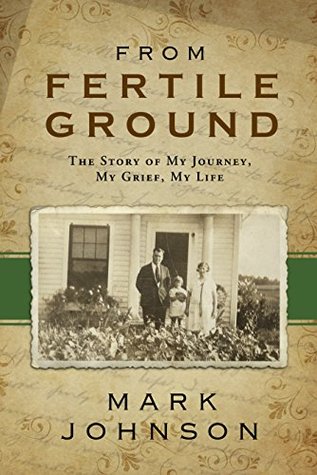
Some of them appear in From Fertile Ground. It is a three-generation writer’s mosaic about love, loss, and grief. I wrote and published the book a few years after my mother died in 2013.
Helen didn’t quite make it to ninety, the milestone Carol Burnett transcended recently. She came up six months short.
So, when Carol’s letter arrived in the mail it cued a few pangs of sadness and a familiar pleasure. One that has been missing from my life … missing from all of our lives … for a long time. That is the personal, human, and lasting connection produced by a handwritten letter.
With all of this as background, yesterday I pulled out the large blue plastic container that holds all of my mother’s letters–sent to Tom, Nick, Kirk, and me over the years. I have them classified by year.
I began to leaf through her 2003 correspondence. That was the year she turned eighty, on July 26, 2003, to be precise. My sister Diane and I hosted a big party for Mom that summer in Geneva, Illinois.
Family and friends traveled from near and far to attend Helen Johnson’s birthday dinner at the Mill Race Inn. We celebrated her first eighty years. Afterwards, we crossed a bridge over the Fox River to continue the party at the Herrington Inn, where many of our guests were staying.
At one point, a gentleman playing violin walked through the lobby. He asked my mother if she would like him to play Waltzing Matilda, her favorite song. (Matilda was her middle name.)
Mom’s eyes sparkled with glee as he stood over her. He slid the bow across the strings, and I watched her spirit soar. In short order, she began to sing … “Waltzing Matilda, waltzing Matilda, you’ll come a waltzing Matilda with me.”
Ordinarily, my mother didn’t enjoy being the center of attention. But, looking back, that moment in a posh hotel on the banks of the Fox River surrounded by loved ones may have been the happiest and most spontaneous moment of Helen Matilda Ferrell Johnson’s life.
If you’ve been doing the math as you read this story, you know that my mother’s 100th birthday is approaching. It’s just two months away. One of the best ways I can celebrate the memories of her is to read her letters, which she mailed to me.
In this one from May 26, 2003–twenty years ago–she recounted for Nick (my older son) and me that she and my dad bought their first new car (a black, four-door Plymouth) in Texas in February 1951.
I must have just told her about Nick’s first car, a used Toyota Camry, which his mom and I had just helped him buy when he was nineteen.
Whether a letter comes from a legend of stage and screen like Carol Burnett or someone who lived a more ordinary (yet still remarkable) life like my extraordinary mother, the words and the movement of the pen on the physical page speak directly from one heart to another … far exceeding the temporary status of a text, email, or phone call.
That’s the context and beauty–the magic, really–of an authentic, handwritten letter.
Losses and stories come in many forms. This one is best told by my husband Tom, today’s guest blogger.
***
Ode to a Fig Tree
by Tom Samp
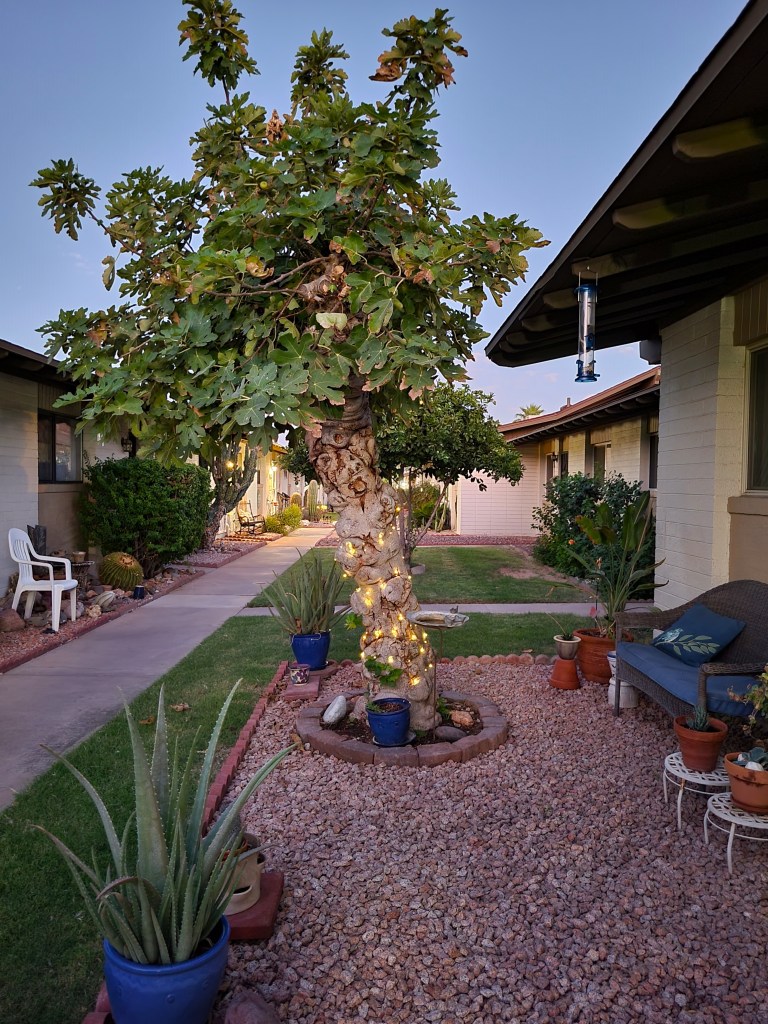
When my grandparents moved in 1972 to the Scottsdale condo where Mark and I now live, my grandfather planted a fig tree.
This tree grew and flourished. It was unique and magnificent. It produced sweet purple figs every summer.
There was never a time when this tree wasn’t a part of the condo, and of my memories of my grandparents and parents. The tree became a part of the lore of our condo complex.
Last Friday, a victim of the carpenter bees that nested and chewed slowly through the bark and the wood inside, the tree had literally cracked in half and fell bent to the ground.
The sadness was immediate and deep.
But why feel this way for a tree? It’s only wood, bark, leaves, and, in the summer, sweet purple fruit.
My mourning certainly could not compare to that felt by our friend and neighbor Aggie, whose husband Bill, also our friend, passed away during the week.
Still, it was the sentimental images and feelings I attached to the fig tree that made its death so emotional for me.
It was a part of our home that I almost took for granted. A splash of green we saw when we opened our blinds every morning.
A place for the small birds–sparrows, finches, lovebirds–to wait their turn at the bird feeder we hung right outside our window.
The shady spot where our neighbors Pat and Gary placed their lawn chairs to read or relax; and where Gary took his last breath on Good Friday, 2021.
A topic of awed comment and conversation from friends and passers-by.
An ingredient in the fig jam that our neighbor Jeannie made for us.
The February morning every year, after the leaves all fell for the winter, when Mark and I trimmed the branches way back.
The excitement each April when we saw the tiniest green buds, signifying that the tree had survived, and would again thrive.
A final remnant from my grandparent’s lives, when they pioneered to Scottsdale from Chicago in retirement.
On Saturday, after the condo landscaping crew kindly and efficiently chopped the broken tree and carried away the pieces, Mark created a container garden in its place, filled with colorful flowerpots which held desert plants and cactus.
It will be an adjustment. Maybe we will plant another tree in the fall. In the meantime, the memories will always linger.
I captured our glorious, gnarled, and storied fig tree just before dusk during the summer of 2022.
Thank you, Carol, for your enduring sense of humanity and a lifetime of laughs.
I’m so glad we had this time together.
***
A Custodian, A Scrub Woman, and Me
At 9 p.m. Central Time on Monday nights in 1970–fifty years before the contagious Covid-19 stunned our world–a kooky comedienne with a toothy smile and infectious laugh captured my twelve-year-old heart and creative imagination. Her name was Carol Burnett.
Born April 26, 1933–in the depths of the Great Depression–this legendary actor of stage and screen first tasted success with her Tony-nominated Broadway performance in Once Upon a Mattress in 1959. Soon after she appeared as a regular on The Gary Moore Show. My exposure to her madcap comedic skills began on September 11, 1967. That’s when The Carol Burnett Show debuted on CBS-TV.
Through the spring of 1971, the network ran the hour-long variety and sketch comedy format opposite two popular programs: NBC’s I Spy; and ABC’s The Big Valley. (Later in the seventies, as the show gained a larger audience and momentum, CBS moved The Carol Burnett Show into its Saturday night lineup following four other prime-time powerhouse comedies: All in the Family, M*A*S*H, The Mary Tyler Moore Show, and The Bob Newhart Show.)
Back in 1970, after I finished my homework on Monday nights, the lights on stage came up around Carol and were transmitted through our Zenith color TV in suburban St. Louis. Long before I first imagined taking flight in my dusty desert time machine, she proceeded to field questions from her studio audience and lead me and thousands of other viewers across the country on a metaphoric and comedic joy ride.
Every week we sat mesmerized. We watched Carol and her creative troop–Harvey Korman, Vicki Lawrence, Lyle Waggoner … and later Tim Conway–perform their magical TV mayhem. Together they represented creative constancy in my life.
At that time, Dad worked the night shift as a custodian for a government agency in St. Louis: sweeping and mopping floors; cleaning toilets and urinals; emptying waste baskets.
It was a life of late-night drudgery my father, the ex-salesman and unfulfilled poet, couldn’t stomach and never dreamed of—especially when the rest of the world had Carol and the hilarity of her As the Stomach Turns weekly soap parody at their disposal from the comfort of their living room couches.
But like clockwork, at 9:30, Dad called during a break from his janitorial job. He craved a creative escape too. He wanted my color commentary on Carol’s show. The ringing on our kitchen phone was my cue to fill in the comedic gaps.
I stretched the curly cord into the living room and translated Carol’s hour-long variety show into something positive that might sustain him….at least for one night.
To put this in its proper personal perspective, Dad felt he was missing the important moments in life: a traditional schedule of evenings at home with his wife and children watching Carol’s shenanigans. All for the sake of a weekly paycheck and a job that clogged his ego like a stopped-up toilet.
As far as Walter Johnson was concerned, there was nothing else remotely funny about 1970. The Vietnam War was raging. Nixon was president. That was awful enough. Especially for a life-long Democrat.
I’d like to think our phone exchange during his break and my play-by-play of Carol’s comedy sketches and crazy Bob Mackie costumes he missed helped transform his melancholy spirit.
Ironically, over the course of Burnett’s career, she frequently reprised the role of a soulful scrub woman, who cleaned up after everyone else went home. It was Burnett’s tattered-but-enduring character, which became her show’s symbol of humor, heart and humanity.
Like the rotary phone that rang on our kitchen wall, I never imagined the show would one day disappear. But on March 29, 1978, after eleven seasons and 279 episodes (notwithstanding another nine episodes that aired in the fall of 1991) the curtain came down on The Carol Burnett Show.
In the mix, the Vietnam War ended. The troops came home. Nixon resigned in 1974. I graduated from high school and went on to college in 1975. Dad did his best to complete his night-shift janitorial duties.
In August of 1976, at sixty-two-years old—the age I am now—he retired from a job he despised but tolerated to contribute what he could to the well-being of our family. Remarkably, my father lived another seventeen years, despite his struggles with heart disease and depression.
“I’m so glad we had this time together, just to have a laugh or sing a song. Seems we just get started and before you know it, comes the time we have to say so long.”
At the close of each of her shows, Carol Burnett sang this familiar tune, tugged on her left earlobe, and signed off. Evidently, it was a signal to her grandmother to let her know she was doing okay.
I loved it all. Carol’s shenanigans, her show, her sidekicks, her song, her signal, her sentiment. Dad did too. Everything she represented … her physical humor, uproarious laughter and wacky demeanor … sustained us through difficult times.
Fortunately, Carol Burnett lives on. So do the best moments from her comedy sketches on her Carol Burnett and Friends shows that appear in syndication.
It was late February of 2020. Todd, a good friend from Chicago (we sang together with the Windy City Gay Chorus for several years), was visiting Tom and me here in the Valley of the Sun.
While he was in town, we enjoyed creative conversations about books, films, and music. Visited Frank Lloyd Wright’s Taliesin West studio/architecture school in north Scottsdale. Hiked in the desert at Papago Park. Saw Beautiful–the musical about Carole King’s life–in Tempe.
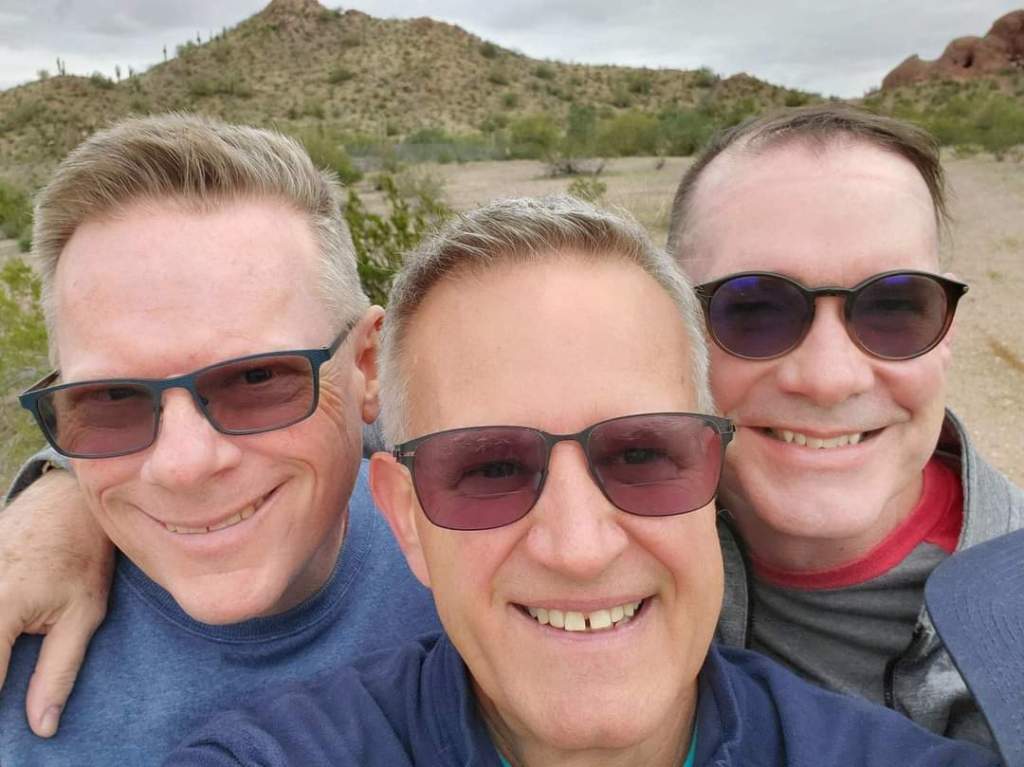
Me, Tom, and Todd hiking at Papago Park in February 2020.
Of course, a few weeks after Todd returned to Chicago, it felt like there was nothing beautiful to celebrate. The world shut down. Thousands died quickly. Waves of fear, disease, uncertainty, and grief inundated all of us.
Friends and families–isolated from each other–found creative ways to pass the time. Some of us wrote books that included stories about the experience. We prayed we would survive.
Now, in March 2023, many elements of our pre-Covid lives have returned thankfully. But my sense is that as a culture we Americans would prefer to pretend Covid-19 never happened, in spite of the mountain of evidence and losses that tell us otherwise.
No doubt, it will take years for all of us–no matter where we live–to recover emotionally.
Still, the good news is most of us did survive. We’re finding ways to reengage with friends and loved ones. To celebrate life. To reignite relationships and make new memories together.
On that score, Todd is returning for another visit next week. Tom and I are excited to spend time with him again. To share new and old movies with him. To discover what’s new in his life since we last hiked together three years ago.
As it happens, Todd’s 2023 visit coincides with the Phoenix Heart Walk on Saturday, March 25. He and Brad (another singing friend who I met performing with the Phoenix Gay Men’s Chorus) will walk with Tom and me.
I’m thrilled that they will both join us for a Saturday stroll in the sun to raise funds for the American Heart Association (AHA). Every dollar will help fund groundbreaking research to keep hearts beating and build longer and fuller lives.
When I told my AHA contact, Karen, that a friend from Chicago would be walking with us to raise money for the cause, she suggested I name our team. As I was jogging on the treadmill yesterday, the name Friends for Life came to me.
After all, it is friends like Todd in all circles–Arizona neighbors, Chicago friends, fellow performers here and there, family members, yoga pals, film enthusiasts, writing colleagues, professional advisors, gym buddies, etc.–who enrich my world.
Many of them (from Arizona, Florida, Illinois, New York, and Tennessee) followed my lead and have already made donations to the Phoenix Heart Walk.
I am eternally grateful for their support, because–as you know if you follow my blog–heart disease is personal for me. I am walking on March 25th as a tribute to my mother and father, who died of heart-related illnesses and, symbolically, to thank the doctors and nurses who saved my life and helped me recover in 2017 after I suffered a heart attack on the way west with Tom.
Please click on the link below and support this worthy cause. Every little bit helps. Because, unfortunately, heart disease is universal. It remains the number one killer in our nation.
Yet it is the love extended from our hearts … and the friendships formed with people all across the country (and with those of you all around the world who have bonded with me through this page) … that make life so meaningful.
Whether you decide to contribute or not, remember this: you can make a difference by giving your time, talent, and money to the people and causes you are most passionate about.
I take a blood thinner; therefore, I bruise easily.
So, for instance, if I’m putting away dishes in our cupboard after dinner and bump the top of my hand on the corner of the cabinet, I am sure to leave that mundane household experience with a souvenir–an immediate red patch that will last a few days in the afflicted area.
I haven’t always been ultra-self-conscious about the condition of my extremities. It’s only lately–in my sixties with thinner skin on my thinner body–that I’ve become aware of my aging hands and, of course, my mortality. They go hand in hand.
Since I’m a writer and rely on my fingers, wrists, and hands to write these sentences on my laptop, I’m fortunate not to have arthritis in my joints–in my hands.
My sister Diane seems to be the one in our family who has inherited that painful component of our mother’s DNA. Particularly in her hips, knees, and feet.
Diane is sixty-eight-years old. She doesn’t read what I write. We live seventeen hundred miles apart. She in Illinois. Me in Arizona.
Even so, I love my sister. I always have and will. Tom and I visited her and Steve (Diane’s husband) for an afternoon last October while we were in the Chicago area. In this age of Covid, we recounted all the things we are thankful for.
Diane will always be my only sibling, my only big sister. We talk and text occasionally. I worry about Diane’s physical wellness and longevity. We’re the only two remaining in our family of origin, since Mom passed away ten years ago.
Diane also is the only other person who remembers the nuances of our St. Louis childhood, our homelife (good, bad, and indifferent), our difficult plight as a family after Dad’s heart attack in 1962, our mother’s resolve in her fifties and fragility in her eighties, our mother’s aging hands.
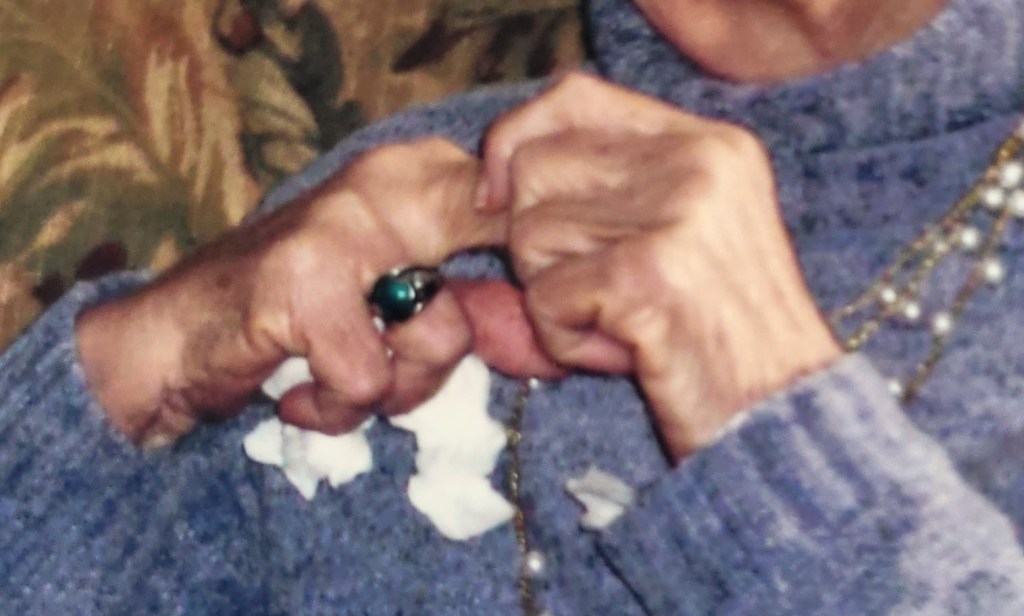
I came across this photo of Mom’s folded hands from Christmas Eve 2008. That night, we gathered at Diane’s home in Illinois to celebrate the holiday and open gifts. Mom would live to share another four Christmases with us.
It’s a cropped image and not the clearest, but when I saw it, I was reminded of Mom’s age spots and blemishes that grew with the passage of time on her fair, loose, thin skin. The rough patches on her hard-working hands go back in time to her rural southern roots in High Point, North Carolina, and fifty years in St. Louis, Missouri, which I chronicle in From Fertile Ground.
In her final nine years living in northern Illinois, our mother had this habit of clutching a tissue in her palms. She often hid an auxiliary one in the arm of her blouse or sweater. If you look closely, you can see it peeking out of the sleeve of her heather-flecked turtleneck.
These are the little personal idiosyncrasies that only a sibling would remember. They don’t matter in the grander scheme of things, but they do when it’s your mother and you still love and miss her after ten years of living without her. And you realize that your own mortality creeps ever closer with every blogpost.
Sure, I stay active–mentally and physically–and will continue to mount the treadmill several times each week to keep my heart strong.
But there is no denying the evolving appearance of my spotted, aging hands. They are looking more like my mother’s every day.







 Mark Johnson Stories