If you follow the weather news in the United States, you know that on Friday, May 16, parts of St. Louis, Missouri–where I was born in 1957 and reborn in 2017–suffered an estimated $1 billion in damages from an EF3 tornado.
The powerful storm tore through central and north St. Louis, killing five people while damaging or destroying 5,000 buildings and countless trees … including many majestic ones in and around one of the city’s gems: Forest Park.
I have no doubt that over the coming days, weeks, months, and years, the citizens of St. Louis will heal and recover. But it will be a tall mountain to climb for many financially and emotionally.
I have made a donation to the American Red Cross disaster relief efforts. But I want to do more for the city I love, which appears in all five of my books. It is hardwired into my prose and poems in large and small ways …
In memories of my hard-working family, our suburban midwestern existence, humid summer days, learning to operator a rollercoaster at Six Flags, working at the top of the Gateway Arch (pictured here) in the late 1970s, rooting for the St. Louis Cardinals, boating on the Mississippi River, visiting the St. Louis Zoo, frequenting the aforementioned Forest Park, and much more.
In addition to making a donation of your own to your favorite relief charity, here’s another way you can help. Buy any of my five books during May and June.
I will donate $10 for each book I sell (paperback, Kindle, or audiobook) during that period to Forest Park Forever. It is a private nonprofit conservancy.
As described on their website, the organization “partners with the City of St. Louis to restore, maintain and sustain Forest Park as one of America’s great urban public parks for a diverse community of visitors to enjoy, now and forever.”
Thank you in advance for your support of my literary efforts and the city of St. Louis … as well as its beautiful urban greenspace in the middle of town, which I still love and remember.
***
Incidentally, Tom and I will travel to St. Louis in September to attend a Class of 1975 reunion with my Affton High School classmates. Yikes, fifty years! More to come on that.
What I share here always comes from my heart and the firing (sometimes misfiring) synapses of my brain.
Lately, I have been drawn to writing more poetry. It helps me to process the pain–personal and national–which I have been wearing like a cape that shrouds my best impulses and intentions.
Today, as Christmas and the end of the year approach, I am taking a different path.
Before I take the stage next weekend for my holiday concert with the Phoenix Gay Men’s Chorus, I want to reflect on bright-and-shiny moments–present and past–which have been tempered by devastating-and-unavoidable losses in 2024.
***
Tom and I are among the dwindling few, who continue to send Christmas cards in the mail to our closest friends and loved ones.
It’s something that brings both of us joy, and in my book that means it’s something worth doing–no matter what other Americans do.
I know that practice places us in the minority (rather like the disastrous outcome of our presidential election), but I don’t care.
Since childhood, I have always identified as “different” or–more specifically–as an outsider. Maybe it was my brain’s subconscious attempt at preparing me for the obstacles I would face as a gay man.
At any rate, conformity is for the faint of heart. It takes courage to stand by your differences, and I have a feeling I will need to muster a boatload of courage as we head into 2025.
Maybe that approaching storm is why I have taken comfort recently in an old Christmas memory.
For several years in the late 1950s and early 1960s, before Dad had his first heart attack, he took Diane (my sister) and me in our old, green Plymouth to search for our family Christmas tree.
We didn’t have much money, so he usually drove us to a tree lot adjacent to a Site filling station. Strangely, I remember the price of gas was 29 cents a gallon on the sign that swayed in winter’s wind.
Dad was a tall man–six feet, two inches. One day I would reach that same stature, but going back sixty-five years, I was a little tyke with a wool stocking cap covering my crew cut.
Dad wanted to select a natural tree (usually balsam, because they were cheaper than Scotch Pine) that was at least his height, so when it was placed in a tree stand all of us (he, Mom, Diane, and I) could gaze up at the beauty of its lights, ornaments, and tinsel hanging on every branch.
In the cold and damp St. Louis air, it usually took us several rounds up and down the aisles of the tree lot to find the best shaped tree. But we always found one to our liking and–with heavy twine–somehow tied it to the roof of our sedan.
When we got home on December 4 or 5, our family practice was to cut a small notch off the bottom of the tree trunk, then deposit it into a metal bucket of water to keep it fresh.
Inevitably, the water in the bucket froze, but with a little heat from the Midwestern sun, around the middle of December we were able to pry it out of the bucket, screw it into our stand, and decorate our family Christmas tree in our living room.
***
Back to reality. We lost a few friends in 2024. Peggy’s passing in mid-November is the most recent.
I was touched and honored when Glenn–our dear friend, neighbor and one of the kindest and most dependable people I know–asked me to write his wife’s obituary.
Peggy’s memorial service last week was a beautiful reflection on her meaningful life as a teacher, wife, mother, grandmother, animal-lover, and upstanding citizen. I will miss her.
In general, I am aware of the “shrinkage” (and greater vulnerability) that comes with age–the loss of friends and family one by one, the institutions that close their doors, the connections that fray (literal or otherwise), the visits to the dentist to replace crowns and teeth that wear down and require repairs.
I experienced all of those in 2024. But there were inspiring moments, too.
Tom and I traveled to Minneapolis in July for the quadrennial GALA chorus festival. The singing, listening, bonding, and carousing with other LGBTQ friends and chorus members filled our cups and our hearts.
It was also a privilege to share England and Scotland with my husband in late September. That week-long tour–from London, to Bath, to Lake Windermere, to Shakespeare’s home, to Liverpool, and the cobblestone streets of Edinburgh–was our tenth wedding anniversary gift to each other.
And 2024 was the year I began to teach again. I had fun in October and November coaching a dozen aspiring and diverse writers in my first memoir writing workshop at the Scottsdale Public Library. I will do it again in January 2025 with a new batch of students.
***
It feels like the best way to end this meandering post is on a high note. So, why not share a photo of the pre-lit artificial Christmas tree Tom and I decorated and adore in our Arizona home?
On Christmas Eve, we will sit together in front of our tree, open our presents, and give thanks for the love we share and the diverse branches of family and friends in our lives who adorn our world.
For me, one of those branches is sharing ideas and stories with all of you.
In January 2014, the fog of grief occupied my brain and body. My mother had been gone one year, but I hadn’t yet found a constructive way to heal and process my grief.
Along the way, my husband Tom and therapist Valerie encouraged me to embark on a new path that would help me recapture my creative spirit.
I decided to leave my communication consulting career. Soon after, I began to write personal stories that mattered to me. Vivid recollections inspired and spawned by grief. Observations about love and loss in my family that helped me chart a new course and publish my first book, From Fertile Ground.
With time and reflection, I wrote four more books about the tender and whimsical ups and downs of childhood, the poignancy of leaving one home and surviving to find another, the adventures of creating a new life in the Arizona desert, and the poetry that has stirred inside me for thirty years and finally escaped to land on a page.
In small and large ways, my mother is in every one of those books and numerous essays. Yet she didn’t live long enough to read any of it, except one poem I gave her on Christmas Eve 2009.
I know now that writing about her in new and different ways has kept her wisdom and generosity alive and accessible for me.
July 26, 2024, would have been Helen F. Johnson’s 101st birthday. I knew I wanted to write about that, but until my fingers hit the keyboard, I wasn’t sure what I would say … because I thought I’d said it all before.
Maybe I haven’t.
How I loved and admired–and still remember–her tenacity. Her legacy of letters. Her devotion to family, friends, and the power of nature.
She would have loved the artistic life Tom and I have created in Arizona among the buttes and cacti. Writing stories, screening movies, singing songs, feeding stray cats.
Making new friends, while remembering old ones. Doing our best to guide and encourage my sons–her beloved grandsons–as they make their way toward the middle of their lives.
Cherishing each moment of our retirement years, without ever knowing where it will lead. Never wanting to know how or when it will end.
On July 26, 2012, we celebrated my mother’s eighty-ninth birthday together. It was her last.
Twelve years have passed. I’m much older, more appreciative and impatient. But also, wiser. Healthier. Gayer. Grayer. More contented with my own life and legacy. More worried about the world’s plight.
Grief is no longer my catalyst, my nemesis, my companion. Of course, I see it in the rearview mirror. But, with the passage of time, I discovered higher ground without the ghost of grief.
I no longer think of my mother every day. But when I do, I am grateful for the moments she and I shared–the gifts of memories and photographs I treasure–and the propensity to write about it.
All of this runs through our DNA.
My mother and me, celebrating her eighty-ninth birthday in Wheaton, Illinois, on July 26, 2012.
I’m back home. Inside the furnace, better known as the Valley of the Sun.
I have begun to reemerge from an affirming, magical, inspiring five days of LGBTQ bonding and music with my chosen family at the 2024 GALA Festival in Minneapolis.
From July 10-14, 7,000 singers (representing nearly 300 choruses and presenters from around the world) inhabited the Twin Cities.
We owned the stages. Occupied the hotels. Flooded the restaurants, bars, shops and streets with gaiety and glee.
But it was more than the magnitude of this quadrennial event that has left an indelible imprint on my creativity and identity. It was the sense of joy, kindness, support, and human possibilities that dazzled me most.
At a time in this country and our world where so much hatred abounds, I was reminded that when love is present–when people truly come together to care for one another and cheer each other on–we can be that Bridge Over Troubled Water (one of the songs my Phoenix Gay Men’s Chorus mates and I performed) of hope for one another.
This was my third GALA. I shared all of them with my husband Tom: 2012 and 2016 in Denver; 2024 in Minneapolis. Each one has nurtured me, deepened my sense of artistry and compassion, and reinforced the importance of rekindling/kindling old and new relationships.
In this 2024 installment, over a five-day period I was able to reconnect and celebrate with friends from Chicago (who perform with the Windy City Gay Chorus and the Chicago Gay Men’s Chorus), Washington, Seattle, and–of course–Phoenix.
A friend and ex-colleague (from my past consulting career) who lives in the Minneapolis area, also surprised and delighted me by attending our performance on July 12. It was a treat seeing her again.
If you follow my blog, you know I have written five books. One is a book of poetry; the other four are memoirs or creative nonfiction. I’ve also written lyrics and librettos for the Phoenix Gay Men’s Chorus.
Already, I have begun to scribble ideas in a spiral notebook that were sparked by my latest GALA experience. Who knows? This may lead me to a stream of poems or lyrics I have yet to compose.
For now, I will leave you with an idea and image that captured my attention on Saturday as Tom and I watched a series of choruses perform inside the auditorium of the Minneapolis Convention Center.
A few rows in front of us, a couple neither of us knows relaxed and leaned in. Away from the heat and fire in the world, they rested their heads against one another. They held each other. They listened to beautiful music in a safe space.
Many of us in the LGBTQ community have spent large portions of our lives searching for answers, longing for love and understanding.
The beauty of the GALA Festival is that–through the power of music, relationships, and community–we can move from longing to belonging.
Moving beyond this amazing and affirming five days in the upper Midwest, we will continue to raise our voices inside our choruses and be our authentic selves outside in the everyday world.
Truly, we are much more than a large collection of singers. Together, we represent a movement of kind, talented, and diverse humans with the power to change hearts, minds, and attitudes.
Numbers–like true stories that capture a moment on a page–are meaningful.
They aren’t merely markers on the shore of life waiting to be washed away with the next high tide.
They measure our progress. They tell us how far we’ve gone; how much we’ve achieved; how many we’ve accumulated.
My dad loved numbers, especially twin digits. On his fifty-second birthday–December 4, 1965–he wrote a poem about their significance in his life as a twin.
I published Unity 66 and the Twin Digits in the context of my first book. It belongs there, embedded alongside and intertwined with the writings of my grandfather, mother, and me. In its purest form, From Fertile Ground is an immersion into our family’s writing DNA.
Despite Dad’s volatility, he could be an exuberant, charming man. He believed in celebrating life’s mundane and magnificent moments as they happened.
On the road of our family vacations in the late 1960s (from his position behind the wheel of our white, four-door, 1965 Chevy Biscayne sedan), he announced to my mother (in front) and my sister and I (in back) when the odometer of our car was about to reach a milestone.
“Hey kids … we’re about to reach 50,000 miles.”
That was our cue to sing with him like circus clowns dancing to a calliope from the backseat.
“Da da da da … da da da da … da da da, da da … da da … da da da!”
Earlier this week–on April 7, 2024, to be precise–I hit the five hundred books sold mark since February 2016 when I first became a published author.
(If you are one of those who have supported my creative writing pursuits, thank you! I’ll bet there are a five hundred more who’ve read my books free through libraries and Goodreads giveaways I’ve sponsored.)
How do I know? First, I keep track of all my book sales on a spreadsheet I update monthly. Second, my Amazon sales dashboard tells me that someone in the United States bought number 500, my book of poetry, that day.
Of course, these aren’t best-selling numbers. Not even close. I’d need to add a few more zeroes to play with the big leaguers. However, numbers–while important–aren’t necessarily equivalent to quality or creative impact. (If you’ve seen the movie American Fiction, you know what I mean.)
At any rate, for an independent writer operating with a paltry budget, my book sales numbers aren’t too shabby.
Somewhere, on the highway of life and in the universe of creative possibilities, I imagine my father smiling at me from the front seat through the rearview mirror with the wind buffeting his combed-back hair.
He’s gripping the wheel with his left hand, while waving an imaginary conductor’s wand with his right. He’s singing along with the crazy circus music from our 60s family vacations.
Like my husband Tom–last night sitting on the fold out couch in our cozy Arizona den–my father Walter–if he were still alive–would be telling me to keep writing about the things I enjoy.
Because writing, telling, and sharing serendipitous stories is what I was meant to do. No matter what the numbers say.
After my mother died on this day in 2013 at age eighty-nine, my grief took root.
With a little time, a lot of reflecting and journaling, and the support of a small circle of family and friends, I found and nurtured my own path from the branches of despair.
By 2015, I had carved out a storyteller’s life Helen Johnson would have loved. Late that year, I flew to North Carolina to visit Frances, her only sister.
Spending time with Frances in the state where both were born–and revisiting childhood memories of my grandparents’ farm in Huntersville, NC–propelled my creativity.
In March of 2016, I completed and published my first book, From Fertile Ground. It is the story of my journey and grief.
If you’ve read this story about three writers (my grandfather, mother, and me) and their love of family, you know this isn’t really the cover.
Today I’ve superimposed this photo of Helen and Frances together (in my sister’s backyard in 2003 or 2004 in northern Illinois) to remember them both.
Why? Because Frances was the last physical vestige of that rural, 1960s world for me. When she died six months ago at age ninety-one, I metaphorically waved goodbye to those years of running amok barefoot on warm summer days in the Tar Heel State.
Of course, I will always have rich memories of my wise-and-frugal mother, who wrote countless letters, and my fun-loving aunt, who traveled the world in her retirement years. In their own ways, they inspired me to tell my story.
Today–as I remember them both–I can walk into the sunroom of the Scottsdale, Arizona condo where Tom and I now live. I can pull my book off the shelf and find this passage.
“What I knew before was that the farm was a place of discovery for me and the fertile ground there was a physical and psychological refuge from the hardships of our family drama in St. Louis. What I know now is that I would need to go back to North Carolina to come to terms with my grief and integrate my southern memories with my present-day, real-life adult existence.”
I can take solace in the fact that I’ve written about Helen and Frances–who they were, who they loved.
Though they are both gone, they live on the pages.
January 1984 felt promising, but exceptionally cold, in the Chicago area.
Jean was due to deliver our first child on January 17. But that day–and several more–passed with no consequential developments. Just a few rounds of snowfall.
Late on January 23, Jean went into labor. When we arrived at Lutheran General Hospital in Park Ridge, Illinois, the nurses examined her. They told us it would be several hours before our child was born.
Jean and I weren’t prepared for the day-and-night-long ordeal that followed. After twenty-three hours of labor, Dr. P pulled me aside.
At that point, he was worried that a traditional delivery would place Jean and our unborn child at risk. He recommended Plan B: an emergency C-section.
Jean was scared; I was worried about her welfare. I insisted on staying during the operation (masked up on the other side of a curtain, away from the medical staff, while they performed the procedure). The doctor agreed it was a good idea for me to be there for emotional support.
A short time later, at 11:37 p.m. on January 24–twenty-three minutes until midnight–our son Nick arrived intact. Jean was okay, too, but totally spent. We both breathed relief.
Our newborn son wailed as the nurses wrapped him in a blanket. His head was slightly misshapen from the birthing process, but they told us not to worry. They laid Nick across Jean’s chest. We had a healthy son.
Jean and Nick stayed at Lutheran General for a few days, which was protocol for the time. Several days later, we signed a few papers, and prepared to leave the hospital.
Jean cradled Nick in a wheelchair that morning. A nurse pushed them down the hall. I pressed the elevator button, carried flowers, and juggled a few possessions as the doors opened.
An older man already onboard smiled as we descended to the ground floor. He wished a good life for our newborn son.
We exited the building. I walked ahead in the cold to bring our car around while Jean and Nick waited with the nurse at the curb. The sun shimmered on a dusting of snow from the night before.
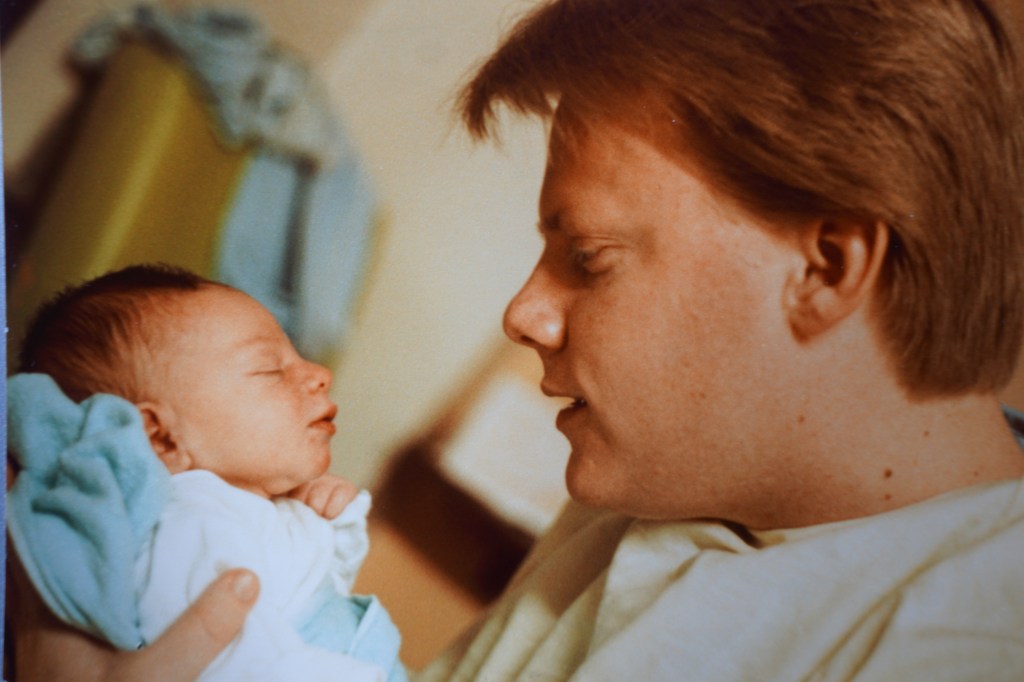
Day-old Nick and me at Lutheran General Hospital on the morning of January 25, 1984.
***
When Nick was born in 1984, I didn’t expect his mom and I would split eight years later. But we did in 1992, just three years after Kirk (his younger brother) was born.
In the aftermath, my sons spent Monday and Wednesday nights–and every other weekend–with me (Tuesday and Thursday nights with their mom) until they were teenagers when they each opted for a home base with Jean. Thanksgivings were with me; Christmases with her. Two vacations occurred every summer. One with her. One with me.
On “Dad nights and weekends” in the early 90s, my boys and I devoured pizza in our cramped apartment in Arlington Heights and on cold, gray days swam in the indoor pool. It was a cheap way to have fun and burn off energy.
During the school year, with their backpacks in tow, we grabbed donuts downstairs in the apartment lobby on the way out the door.
I dropped Nick off at Kids’ Corner (before-and-after-school program), then hustled Kirk off to preschool before I commuted into Chicago’s Loop for work.
Looking back, it was a tumultuous period of disarray, intimacy, and estrangement for all of us. Nonetheless, somehow, we survived. We found our rhythm as a family straddling two homes.
In 1996, I saved enough for a down payment on a modest three-bedroom home nearby. Nick, Kirk and I played catch in the backyard and tossed the football on the open field across the street.
That same year, I met Tom and introduced him to my sons. I know that Nick–particularly as a teenager–felt uncomfortable with having a dad who was different. But, in spite of it, he knew I loved him.
We weren’t your prototypical American family, but with time we found our stride and Nick and Kirk accepted Tom and me.
At first, our basset hound Maggie (we adopted her in 1998) was the comic-relief glue that adhered us.
With time, that connectivity broadened. We found more in common: birthday celebrations; grounding visits with their wise and supportive grandma in St. Louis; fun and thought-provoking movies with Tom and me in the Chicago suburbs.
Not long after Nick–and then Kirk–graduated from college, Maggie died. We all mourned her loss in 2008.
Tom and I knew at the time that our parents wouldn’t be far behind. The nest emptied quickly. They were all gone by 2015.
That same year, at age thirty-one, Nick asked if he could rent our Arizona condo while he looked for a job out west. He needed a change. He wanted to chart his own course, away from the cold, heavy responsibility of the Midwest.
Nick began a new life that January (two years before Tom and I made Scottsdale, Arizona, our permanent home) when he landed a job with a technology company in March.
Over the past nine years, I’ve watched my son’s confidence and self-esteem multiply. He has a good life here.
Of course, during that period, he’s changed jobs and apartments, discovered new loves and suffered a few losses.
But Nick is happier in the sunnier Southwest. And I’m happy that I get to see him occasionally.
After I suffered a heart attack in July 2017 on the way west, Nick helped Tom move some of our bulkier pieces of furniture.
It gave me solace seeing them bond more deeply as I struggled to regain my strength and equilibrium.
Life so far in 2024 is good for all of us. Kirk is planning to visit us in Scottsdale in March. He lives in Chicago and has found a rewarding life as a trauma counselor. He needs a warm escape now and then to stay sharp.
In spite of the vast distance, my younger son and I have managed to deepen our relationship and stay close. As Kirk quarantined in his Chicago apartment during Covid, Tom and I played Scrabble with him online and Zoomed from time to time.
We talk frequently now. Whenever we do, I realize how lucky I am to have two smart and compassionate sons who are contributing members of society.
A few weeks ago, Nick stopped by and watched Oppenheimer with Tom and me. On other occasions, we’ve shared ballgames and dinners or picked ripe citrus fruits off our condo community trees (Nick loves grapefruit).
Next week, Nick and his girlfriend Anastasia will join Tom and me for dinner to celebrate his birthday at a local Scottsdale restaurant he’s been wanting to try.
No doubt, we’ll raise a glass. We’ll toast his first forty years. We’ll recall Nick’s journey west to discover a warmer life of promise.
As a dad, I will always be there for my sons. I’m glad I stuck it out during those trying years in the 90s, because seeing them become who they are–full-fledged adults–is the most gratifying part of fatherhood.
We all endure specific days–or months–that test our best intentions and weigh on our psyches. January is that month for me.
Long before Tom’s father died January 14, 2012, and my mother followed January 26, 2013, the first month of the year represented a period of Midwestern malaise, forced hibernation, and cold, lingering darkness.
Of course, I live in a warmer, brighter climate now (despite freezing temperatures the past few mornings). I am thankful for that, especially as Tom shares images of his sister and brother-in-law snow blowing and shoveling outside their suburban Chicago home.
Since my mother’s death nearly eleven years ago, the years have passed with a gauzy flutter like pages of a book swept away by a winter’s squall.
Yet January’s weary sensations–grief masked in a cocktail of Christmas memories, vanilla lip balm, and her last graceful smiles during breathing treatments designed to ease her congestive heart failure–appear on cue.
Last weekend, Tom and I packed away our Christmas decorations and recounted cherished memories of quiet holiday moments together and the adrenalin rush of my holiday concert. Adjusting to the rise and fall of this season is always a bittersweet process.
But this week I was eager to recoup our less-cluttered space. To move ahead. To read and write new pages. To protect, nurture, and regain a more normal rhythm away from the madness of news that reminds me–frequently–just how fragile our democracy has become.
My mother and father–who survived the Battle of the Bulge in World War II–would be horrified.
In the depths of 2020, my husband and I began a tradition of buying bouquets of flowers to place in a vase in our living room. As the walls and woes of Covid and our political angst closed in, it gave us hope to see a splash of color on our coffee table.
Less than ten days into 2024, like each of you I have my dreams and doubts, wonders and worries.
But writing about this spray of lavender carnations Tom and I brought home (then displayed in a smoky-blue ceramic pitcher my mother left behind, and placed atop a Spring-like, bird-laden runner my sister gave us for Christmas) helps me breathe, reflect, and relax.





 Mark Johnson Stories