Category: Freedom

Early Halloween Treat

Treats come in all sizes and shapes. Chocolate is always welcome, but typically not as intimate or lasting as positive human interaction.

***

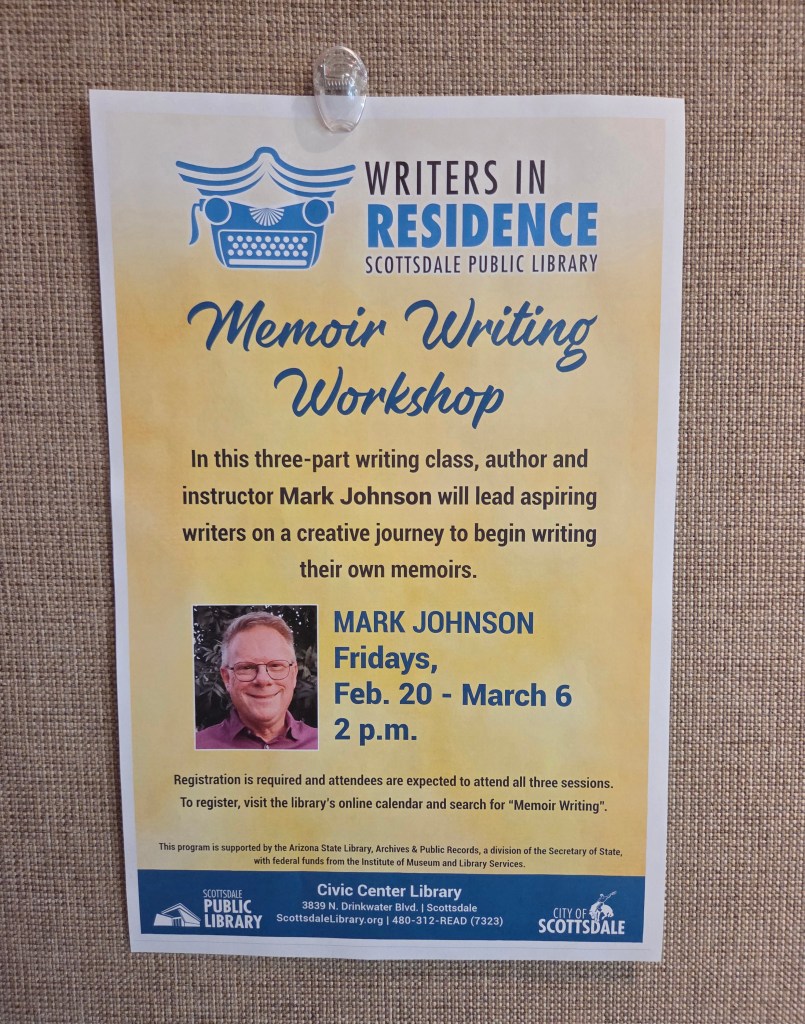
Yesterday I completed another memoir writing workshop at the Scottsdale Public Library. It was the fourth such workshop I’ve led over the past twelve months.

I love facilitating these sessions, because it’s a personal way for me to encourage other writers to nurture their creative ideas and momentum.

This one at Mustang Library included twelve writers–nine women and three men–who wrote and shared their extraordinary, humorous, heartful slice-of-life adventures across the table from one another.

During week one of the three-week workshop, I learned a little about each participant. We spent time building trust. As we began to get comfortable as a group, I assured them that the room we occupy is a safe space for sharing their personal experiences through their writing.

By weeks two and three, we developed an esprit de corps. They sent their stories to me in advance. I offered my encouragement and constructive feedback in person in the following session.

Inevitably, there were contemplative moments and a few tears were shed by one writer on Friday.

As she read her story aloud (a touching, nostalgic reminiscence of watching the joy on her mother’s face as she skated across the ice in the 1960s free of her typical parental responsibilities) the flood gates opened suddenly.

I and everyone in the room verbalized their support for this writer. I also offered her a tissue and a pat on the shoulder.

That was just one of a dozen or more seminal moments shared over a three-week period on Friday afternoons.

In a world otherwise ruled by chaos, we were a community of writers banding together, gliding freely above the fray across the ice of our literary pursuits.

***

This morning, I opened my email to discover this early Halloween treat from a creative husband-and-wife team, who participated in the workshop.

“We enjoyed your memoir class so much; due in large part to your enthusiasm, experience and energy! The content was high quality, and the tone you set of trust was palpable… there is no substitute for that among budding creatives. Thank you so much for your time and care; we’ll hope to cross paths in the new year!”

I don’t expect a ringing endorsement for volunteering my time. But I always appreciate feedback whenever it involves helping other writers find their voices inside the secure walls of a library.

It encourages me to keep giving and confirms my suspicion that I have found a meaningful way to make a true difference in the lives of others.

A New Life

I understand why you feel betrayed,

why you can’t stay any longer,

why you don’t feel safe

in a country ravaged by hate.

It has fallen far beneath the one

you and I once believed was true,

the one you and I thought we knew.

As you fly away to begin anew,

to begin a new adventure,

to begin in a new life in a new country,

those of us who love you,

those of us you leave behind,

hold this gift of friendship high,

as we also hold our breaths.

We wonder what you will learn,

what you will discover in your new land,

what tomorrow will bring

for those of us,

who stay behind

to live each day

in this familiar zone

of divisive uncertainty,

in a country we still love,

as our forefathers

and foremothers did,

all of us that much

closer to midnight.

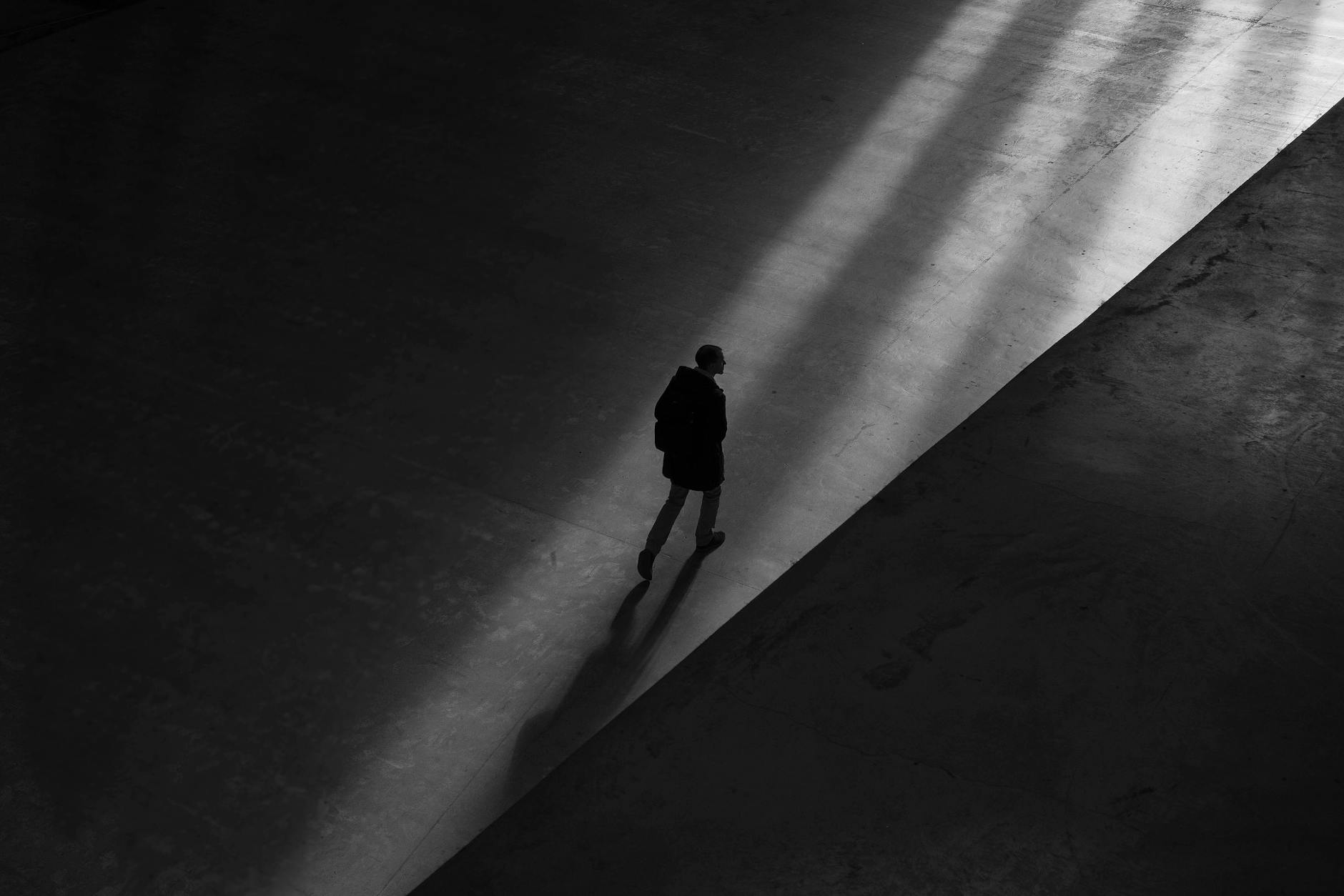
Photo by Bob Price on Pexels.com

For my friend, who is beginning a new life today. He will remain nameless.

Protests and Poetry

Are you guys going to the protests this Saturday?” Nick wondered last Wednesday via a text.

No. We aren’t planning to. It’s just too hot,” I responded to my son.

But as the week wore on, I began to regain my energy following three phenomenal concerts with my Phoenix Gay Men’s Chorus pals.

On Friday, I reconsidered Nick’s question. I told him Tom and I would do it. A few of our chorus friends wanted to join us too at a No Kings protest in Scottsdale.

I should tell you that I don’t consider myself an activist, though I have marched for various causes on several occasions in my life. I prefer to share my voice and perspective through my writing.

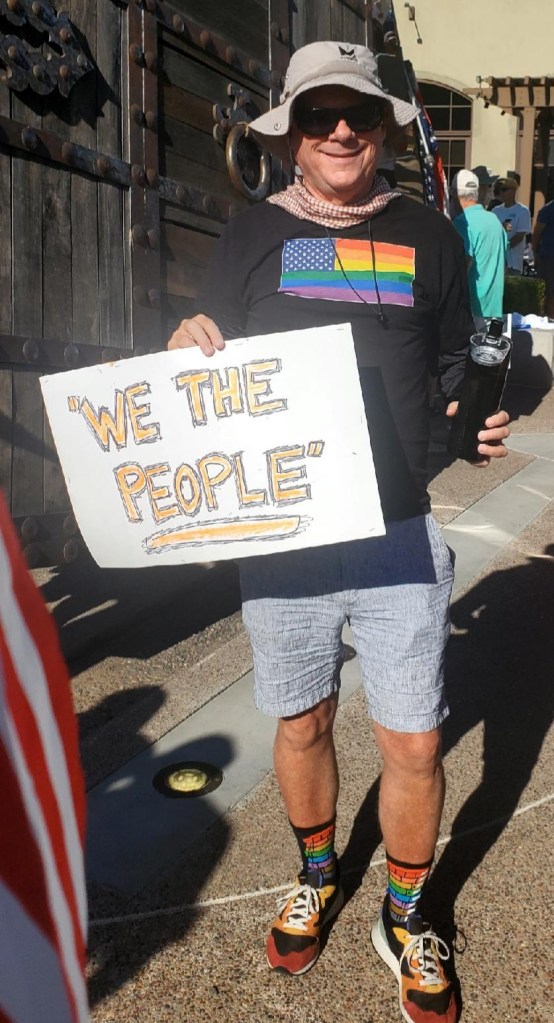
But I also recognize the dire state of our democracy. I decided if my World War II veteran father (he defended democracy in Europe with the allied forces during the Battle of the Bulge in late 1944) could endure frozen feet in foxholes with his buddies and risk his life as an army sergeant, I could certainly endure the 90-plus desert temperatures in Arizona for two hours, wave my American flag and “We the People” sign, and join forces with family and friends to raise my voice. To make sure it was heard.

So, Saturday came, and we did it … Mark, Tom, Nick, Kim, Dougal, George and one to two thousand others represented democracy in Old Town Scottsdale. We were a dot in a map of some five million in the U.S. and abroad who took to the streets in big cities and small towns. All of us deeply concerned.

Locally, it was an inspiring and peaceful No Kings protest consisting of angry but well-behaved women and men. Young and old. A few children with parents and grandparents. Couples. Singles. Straight. Gay. Multi-cultural. Dogs, too. Dare I say diverse?

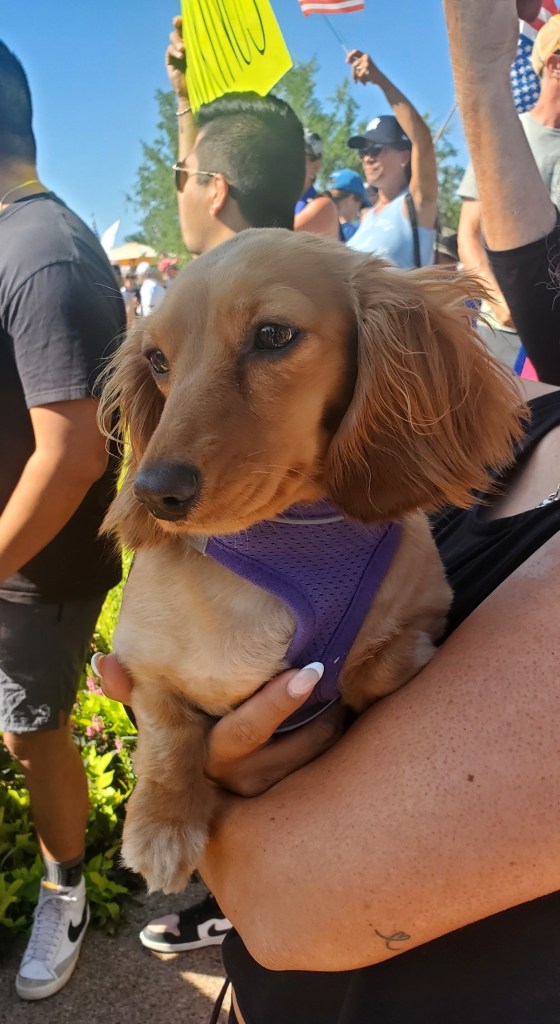
At one point, Tom and I chatted with a fifty-something mother from San Diego. She was visiting her daughter who lives in Scottsdale. They took turns chanting “No Kings” while cradling their adorable, slightly overwhelmed dachshund.

The dog’s benevolent eyes seemed to say, “what are we all doing here?” All I could do was shrug and smile. There is no explaining all we have endured in this country over the past six months. Not to mention the previous eight or nine years.

A short while later, I turned to discover a man holding a profoundly-funny-and-literary sign. A parody of American poet Robert Frost’s The Road Not Taken. I imagine Frost would have loved it, if he had been alive and standing beside me.

I asked the man if I could take his picture. I told him it spoke to my wordsmithing sensibilities. He surprised me by saying he was a math guy.

I’ll likely never cross paths with him again. He’ll never know that my book of poetry, A Path I Might Have Missed, was inspired by my love for Robert Frost’s verses. But on June 14, 2025, we stood on the same page … on the same street corner … on the same shared path.

Together–close friends, like-minded acquaintances, and distant strangers–we proclaimed our desire and hope to rescue American democracy from the clutches of fascism.

I Don’t Pretend

It’s late Friday afternoon in the desert. The mockingbird outside our backdoor is singing his or her heart out. It’s a tender, hopeful, pre-weekend serenade … a chirpy, lyrical refrain coming from the top of a telephone pole that connects our heavier world of technology and dissonant news and noise.

None of us knows what tomorrow will bring … ever. But especially now.

Case in point: early this afternoon as Tom and I devoured a few remaining slices of sausage and veggie pizza from the night before, a military jet zoomed overhead.

The sudden surge of decibels jarred our nerves. Though we live near a military base at Papago Park, we rarely hear that intense noise. Only an occasional squadron of helicopters arriving or departing.

We are a nation of divided people living on the edge of time, sound, and sensibility. Each day when we climb out of bed, we are aware of the dismantling of institutions we have come to know and respect.

Each day we are threatened by another batch of edicts tossed out the sidedoor by an authoritarian regime bringing shame and constant anxiety to those of us raised to believe in a country that once valued high ideals over low morals.

I don’t pretend to have the answers. But I know silence will kill us.

I won’t pretend to be someone I’m not. Or as I have said frequently to friends lately, “I’m not putting this genie back in a bottle.”

What do I mean? I spent too many years as a teenager and young adult (of the 1970s, 80s and early 90s) denying my true gay identity, subverting my whole self to try to fit into a predominantly straight, suburban culture.

That caused me (and others in my life at the time) tremendous personal pain. And, on a larger scale, denying the truth kept our society from advancing to a higher plain of equality, freedom, and human possibilities.

Yet now our federal (and some of our state and local government officials, too) are attempting to wipe away the contributions and accomplishments of our “diverse” people from websites and history books.

For instance, native code talkers who–by virtue of their distinct language–were instrumental in helping to bring an end to World War II.

Did you know that recently pages on the Arlington National Cemetery website–highlighting the graves of Black and female service members–have been removed?

These and other efforts are designed to erase the accomplishments of women and people of color.

How far will this attempt at whitewashing our history go? I don’t pretend to know. But I do know that the best attributes of our diverse culture exist in the past and present and people need to know about these contributions.

My husband Tom, an aficionado of films from the 1960s and 70s, has been leading a film series this winter and spring at the Scottsdale Public Library, titled “Movies That Matter: the 1970s.”

Each Monday afternoon, between 75 and 100 people attend this free series. The audience is mostly white people who love great films.

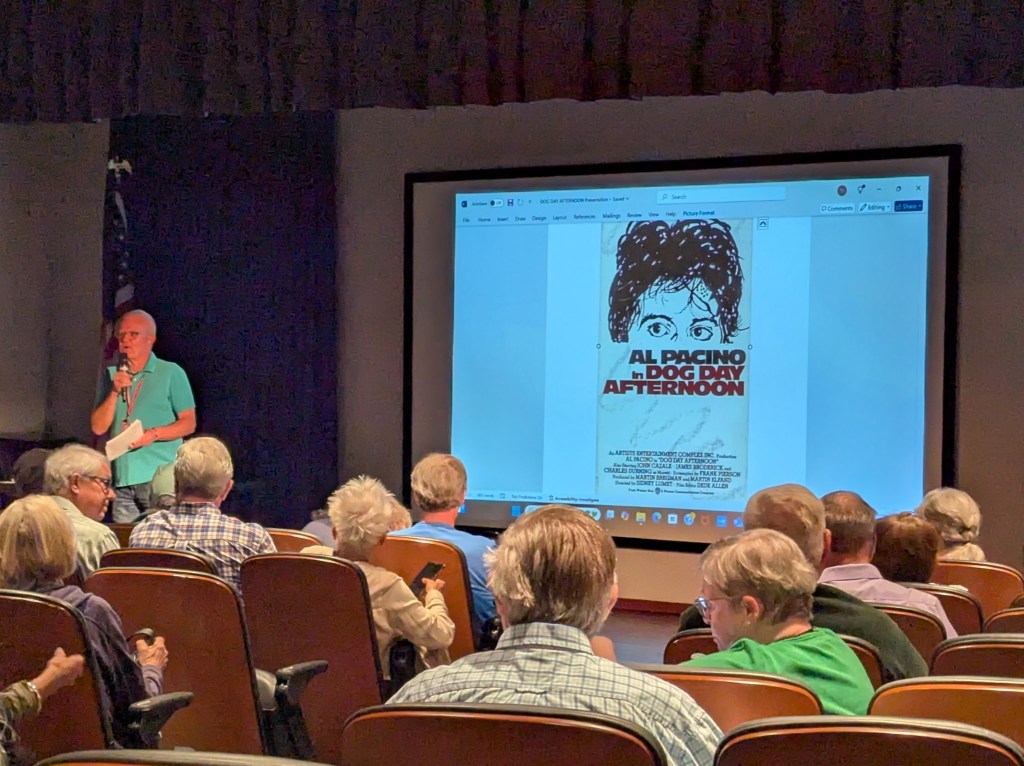
Last week, Tom screened “Dog Day Afternoon”. Directed by Sidney Lumet and starring Al Pacino, the film–based on a true story that occurred in Brooklyn, New York, in the 1970s–chronicles a botched bank robbery in the heat of the summer.

It’s an intense and sometimes funny film early on. Pacino plays Sonny. He’s desperate to get the money his partner needs for a sex change operation. But we don’t know that until more than half the movie has spooled through what once was a movie projector.

It’s a must-see flick. I won’t spoil the outcome if you haven’t seen it. But the most meaningful and important aspect of this story is that 93 people attended. They listened to Tom’s stage-setting intro for historical context. They watched the film, and then they talked about it. Together.

They talked about what it meant. They examined the techniques employed in the film to tell the story effectively. They existed in that space for three hours as a community of people in a shared experience.

I don’t pretend to know all of the political affiliations represented in that room. But I’m certain they left with a greater appreciation for film and how it can shed light on the differences and pressures–like them or not–that have existed in our American society for decades.

Tom delivers his opening remarks at a screening of Dog Day Afternoon at the Scottsdale Public Library on March 17, 2025. Photo by our friend and neighbor Diego.

Wrist-banding Together

When you’re living through a full-blown constitutional crisis–and feeling vulnerable–you need to find ways of coping and caring for the ones you love.

So, I bought two of these beaded rainbow wristbands from the Human Rights Campaign for Tom and me to wear.

We are wrist-banding together.

This is a symbolic gesture. I want the world to know that this gay couple isn’t going anywhere, though it is a period in the United States where some would prefer that those of us who are different would go away.

But I–we–remain visible.

As I write this blogpost, I realize it is number 500 … a true milestone for any writer.

When I began blogging in May 2018, I had no illusions of where it might lead.

I simply wanted to give my books and literary voice more room to grow, more visibility.

For that reason, I suppose it is fitting that today I choose to write about my gay identity and continue to exercise personal aspects of my voice … visibly.

In many respects, the life my husband and I lead is not all that different from any couple.

We shop for groceries together. Go to the gym together. Enjoy quiet moments and meals together. Love and nurture each other.

We do our best to support each other and our family members during highs and lows.

We spend time with our friends. They are young and old, straight and gay, black and white.

We love and respect them, and they love and respect us.

I think it’s accurate to say this about our friends: we enrich each other’s lives, no matter our skin color, religious beliefs, cultural perspectives, gender identities, or sexual orientations.

It is a personal jolt to realize–and read on trusted news sources each day–that our differences are under attack and being eroded in my home country … the country I still love.

I don’t think I’m depressed. But I am definitely sad and angry. Definitely grieving. Me and a boatload of others of all backgrounds and persuasions.

There are times when I want to scream from the top of a mountain. “This is my country, too. How dare you try to take that away from me!” But then I wonder, “Is anybody listening?”

So, I bring this here, instead and I type these words in blogpost number 500.

At any rate, thank you for joining me–possibly even enduring me at times–on this blogging journey since May 2018.

As long as I continue to feel I have something important and relevant to say (to shed light on the topics of the day … to celebrate a literary success or the latest Phoenix Gay Men’s Chorus performance … to pay tribute to those I love … to tell a funny story about our stray cat Poly … to observe and honor the beauty of nature … to share a vivid, meaningful memory about my childhood … or to pen a poem that is in need of artistic space and oxygen) you will find me here.

I hope you have been informed or entertained and will continue to tag along with me on this organic literary odyssey, wherever it may lead.

As I walked the treadmill at the gym this morning–on Abraham Lincoln’s two-hundred-sixteenth birthday–a weird, dark, and discomforting question swirled through my brain.

What if we–all the diverse people in this country, all the people of color, all the LGBTQ folks–were gone?

That fearful quandary led me to write this poem.

****

If We Were Gone

If we were gone,

you would miss

our minds, our hearts,

our beauty, our tenacity,

our sensitivity,

our sensibility,

our kindness, our love,

our compassion, our humor,

our leadership, our style,

our guidance, our wisdom,

our friendship, our support,

our joy, our pain, our truth,

our sun, our moon, our stars,

our books, our movies,

our artistry,

our contributions,

our serendipitous stories.

But, most of all, you

would miss us.

You would miss

the clarity and

strength of our

distinctive lives

and beautiful voices.

That would be

the greatest loss of all.

Laid to Rest

My mother was a collector of fine furniture, ceramic pitchers, and–occasionally–commemorative coins.

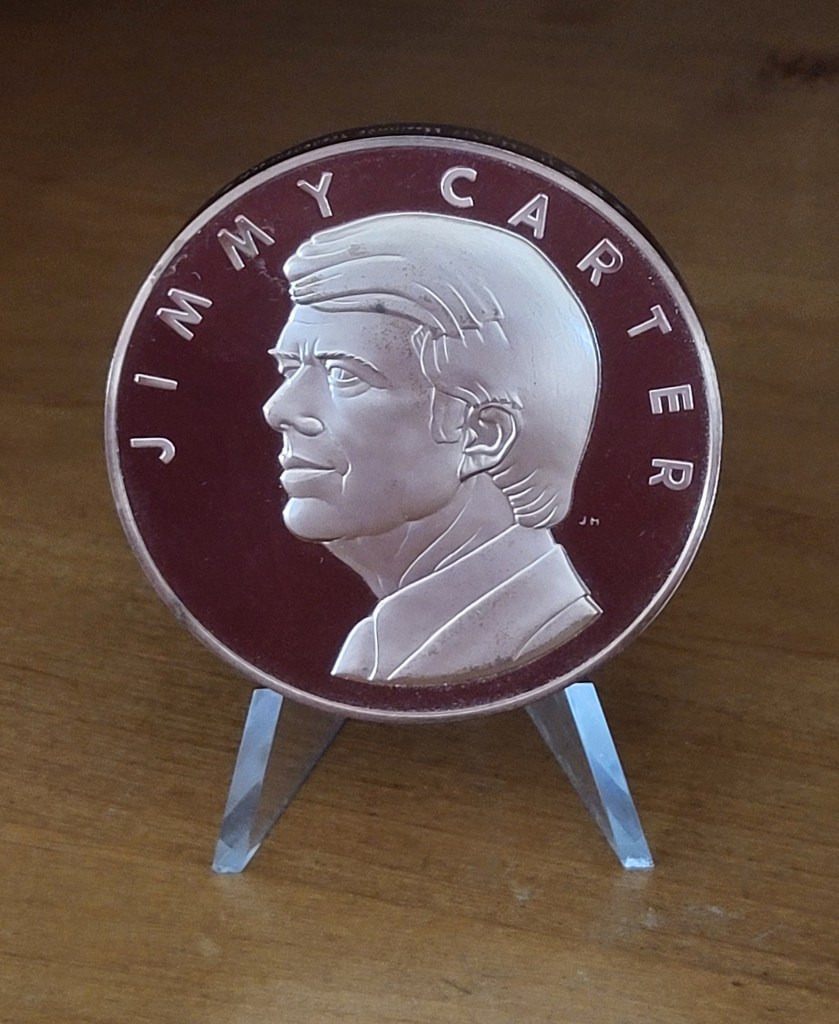
On March 17, 1977, she purchased this Franklin Mint medal. It celebrates the inauguration of Jimmy Carter, the thirty-ninth President of the United States.

This bronze coin has occupied a space inside a box in my father’s WWII army trunk for the past few decades.

I was nineteen and a first-time voter when I cast my ballot for Carter in November 1976.

Most of my college friends at the University of Missouri were Gerald Ford supporters.

I suppose they were willing to forgive him for pardoning Richard Nixon.

I wasn’t. I opted for Carter, the peanut farmer from Plains, Georgia.

As history would have it, Carter’s four years as president (1977 to 1981) included many ups and downs.

For instance, Carter successfully negotiated the Camp David Accords, political agreements signed by then Egyptian president Anwar Sadat and Israeli prime minister Menachem Begin.

Carter also signed into law bills that created the U.S. Department of Energy and Department of Education.

However, the Iran hostage crisis (when fifty-three U.S. diplomats and citizens were held hostage at the U.S. embassy in Tehran by a group of Iranian college students who supported the Iranian Revolution) and related oil crisis led to his unraveling popularity.

In November 1980, Ronald Reagan defeated Jimmy Carter. His loss was punctuated on January 20, 1981, when the hostages were released on the first day of Reagan’s presidency.

Of course, we now know Jimmy Carter wasn’t through yet. He lived another forty-three years and made good use of his century-long (1924-2024) life.

After leaving the White House–with his wife and life partner Rosalynn Carter ever by his side–he established the Carter Center. He worked tirelessly to promote and expand human rights.

That led him to receive the Nobel Peace Prize in 2002.

Jimmy and Rosalynn Carter also became famous for the houses they helped build for Habitat for Humanity and the faithful lives they shared with family and friends in their community and all around the world.

***

This morning, after watching C-SPAN coverage of Jimmy Carter’s funeral at the National Cathedral in Washington, D.C.–and listening to a parade of praise in eulogies given by past Republican and Democratic leaders and grieving family members–I extricated the bronze medallion.

I brought it into the light. I placed it on the shelf of our bureau in our Arizona sunroom. I pondered Jimmy Carter’s astounding legacy of faith, hope, service, and perseverance.

I wondered if–as he was laid to rest–our nation’s democracy might not be far behind.

I hate the trite phrase “only time will tell.” But it certainly applies as inauguration day–January 20, 2025–approaches.

Consider this. Tucked inside the box that normally houses the Carter medallion is a little booklet with information about the tradition of the presidential inaugural medals. Here is an excerpt:

“The Official 1977 Inaugural Medal commemorates the solemn ritual, repeated every four years, through which Americans and their President refresh the nation’s commitment to free government.

During the inauguration, the President, in the presence of Congress, pledges to serve faithfully and to uphold the Constitution to the best of his ability.

Americans have always treated this ceremony as a portentous moment in the life of the republic, a time of celebration and of renewed dedication.”

But we live in 2025. Will the incoming president uphold the Constitution to the best of his ability?

That bit of history–beyond the funereal pageantry of today–has yet to be written.

They Fought So Hard

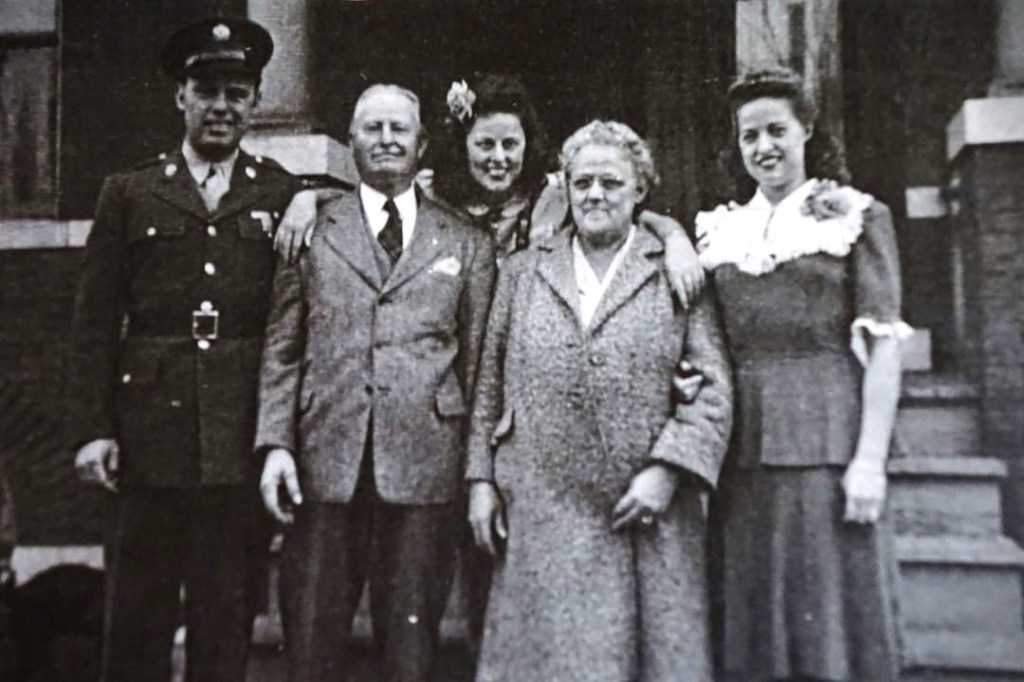
Albert, Louise, and their three adult children–Thelma, Violet, and Walter–led ordinary lives.

In the fall of 1944, they were a big-hearted, hard-working, working-class family–living in a flat on Labadie Avenue on the north side of St. Louis.

To be precise, Thelma and Walter lived with their parents. Violet and her husband Harry lived nearby.

At any rate, they were a close family with strong opinions, loud voices, and a propensity to gather around the radio for FDR’s inspiring Fireside Chats.

Like all patriotic American families of that era, they planted a Victory Garden to grow their own vegetables, rationed household supplies, and bought war bonds to support American troops fighting overseas in Europe and the Pacific.

They did it all for the sake of protecting and maintaining freedom in a war-torn world.

Walter, Albert, Thelma, Louise, and Violet in late 1944.

When Walter was drafted and deployed to Europe (Harry, too) you might say the family had extra skin in the game of war.

He left New York Harbor–aboard the Queen Mary ship with hundreds of other soldiers–on New Year’s Eve 1944.

Five days later, he landed at the Firth of Clyde in Scotland … and, in short order, he found himself on the front lines scurrying from foxhole to foxhole in the Battle of the Bulge in the forested Ardenne region of France.

As the war in Europe wound down in 1945, he marched with the first group of US army personnel who met with the Russian army on the Elbe River on the eastern front of the war.

Walter survived the ordeal–in part because of the regular flow of love letters and encouragement he received from his sisters and parents.

Walter returned to the US on the U.S.S. Monticello in July 1945 … for a thirty-day leave prior to going to fight in the Pacific.

He was supposed to depart in mid-August, but on August 6, the US dropped the first atomic bomb on Japan and the war ended shortly thereafter.

Walter’s fighting days were over. He was discharged from the service on October 11, 1945.

A few years later–sometime after he met his future wife Helen in January 1948 at Westminster Ballroom in St. Louis–he confided that the Russian soldiers were some of the roughest, battle-hardened men.

At any rate, despite the “shellshock”, nightmares, and frozen feet Walter brought home with him, he (and Harry) came home in one piece.

***

I’ve thought a lot about Walter and Helen (my dad and mom), Thelma and Violet (my aunts), Albert and Louise (my grandparents) … the Johnson family … since the election last week.

All of them have been gone a long time, but in a sense–today–I feel I am grieving my own loss of freedom, as well as their legacy. The one they fought so hard to uphold.

I’m not giving up, but that is how I feel on Veterans Day 2024.

Early this afternoon, I pulled out Dad’s World War II army trunk.

It contains pieces of his uniform–including the wool hat and golden medallion he wore eighty years ago as he was preparing to preserve freedom on behalf of his country.

Finding it there with his few remaining possessions gave me strength.

In the coming days, weeks, months, and years, I’m going to do my best to draw from the resiliency in my family’s DNA to find specific ways to uphold democracy in my Arizona community.

You can be sure I also will continue to exercise my voice–through prose and poetry–and influence others in a positive fashion as we head into an uncertain and potentially ominous period in our country’s history.