Category: Grief

Another Orbit

This is my space, but I feel it has eluded me lately in the blur of life.

Like the game of Chutes and Ladders, in this month of April I’ve moved forward a few paces–writing another meaningful libretto for the next Phoenix Gay Men’s Chorus concert, Broadway Lights, in late June–while sliding back to heal from physical and emotional setbacks: two discomforting dermatological surgeries; one momentous funeral for a close cousin.

Grief has a mysterious way of throwing you into another orbit. That is where I live and breathe right now. Part of me stands on the sandy soil of Scottsdale, Arizona. Another piece is spinning somewhere else in the stratosphere.

The loss of Phyllis cut close. Not only because I loved her. But because I know she loved me. And she was a significant part of the fabric of my young life in her proximity to others I loved. Others we loved. All of whom are gone.

Our grandparents, Albert and Louise. Her mother, Violet. My father, Walter. My mother, Helen. Our aunt, Thelma.

Despite my disrupted and sometimes traumatic home life in the 1960s–featuring my father’s bipolar swings and my mother’s evening coping mechanism behind the broadsheet of the St. Louis Post-Dispatch–love existed there in our suburban St. Louis house. Love I felt. Love I excavated. Love I salvaged and carried forward. Love I still feel today.

Phyllis appeared in our home a few times a year. Usually in July to celebrate my birthday in our big backyard and in December in our living room to share Christmas dinner and exchange gifts. She was an integral presence in those moments.

There is one other moment that was purely ours. It happened just once. She must have been twenty. I was ten. She was an undergrad at the University of Missouri in St. Louis (UMSL). We both loved sports. She invited me to join her at an UMSL Rivermen basketball game.

I don’t remember much about it … how we got there, what we said to one another … just that we sat side by side in the stands rooting for the Rivermen. I just remember being proud of her. She was pretty, smart, and fun … and she wanted to spend time with her young cousin. It touched me deeply

As I write this, I realize Phyllis represented a form of stability in my life at that time … an escape to a more even, peaceful place that no one in my family of origin could provide.

Identifying that helps me to realize why this loss has hit so hard.

***

On Wednesday, April 22–Earth Day–my husband and I attended a volunteer recognition event at the Scottsdale Public Library. Alexa, the supervisor of volunteers, recognized Tom for his outstanding-and-popular movie series–and then me for my memoir-writing workshops–at the library in 2025.

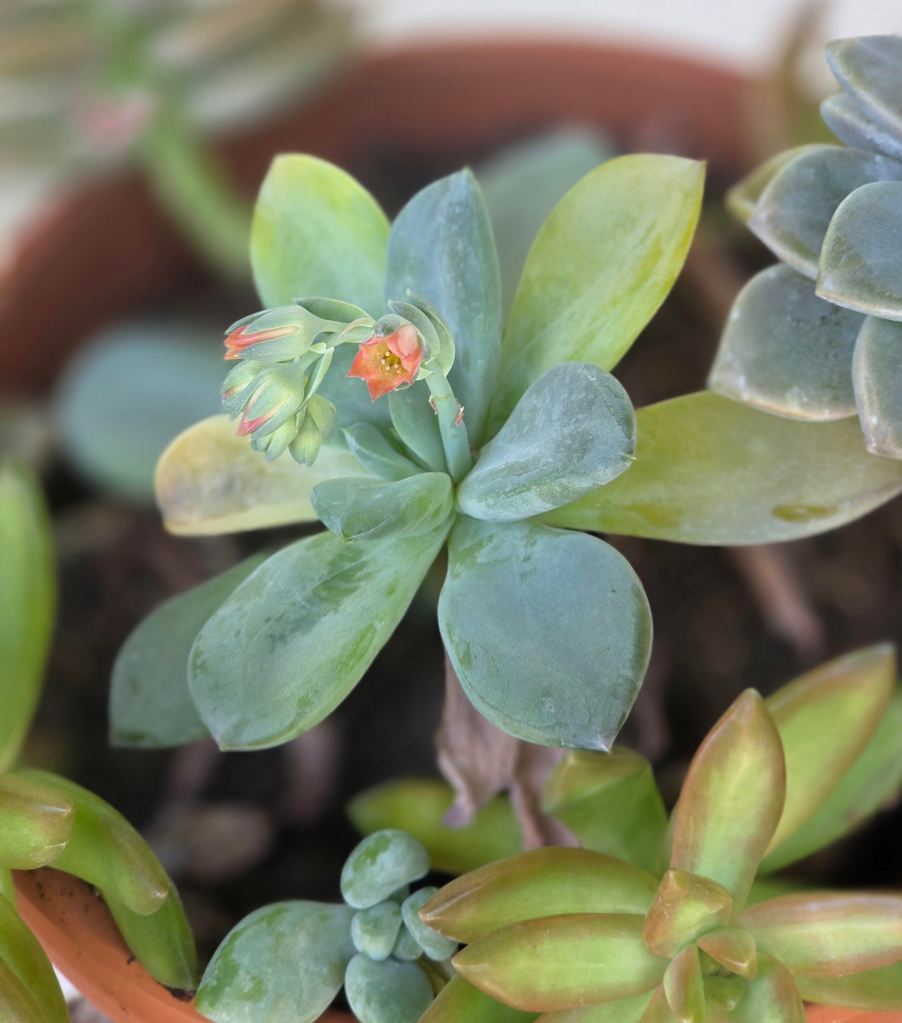
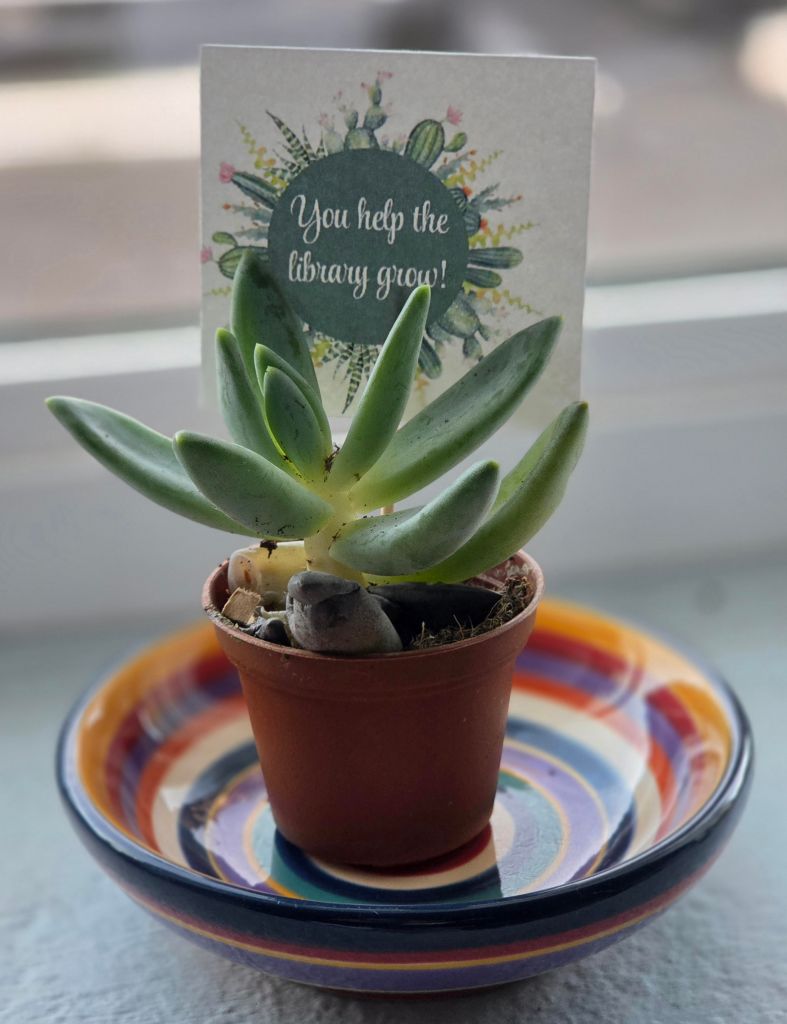
We each brought home a certificate, thanking us for our volunteering efforts, along with a tiny succulent plant bearing an important message. We placed both of them on the windowsill of our south-facing sunroom in Scottsdale.

They will serve as a reminder for me that–even in my late sixties–I’m helping others grow in my community.

I know Phyllis, a life-long educator, valued that, too.
Sensitivity

I pride myself on my sensitivity.

In my book, empathy is an essential quality for writers and human beings in general. It opens the door to developing deep and trusting relationships, but it also exposes us to emotional and physical pain. In this month of April, I have experienced both.

***

On Friday, April 10, Tom and I said goodbye to my cousin Phyllis.

The day before, we flew to St. Louis and enjoyed a nostalgic salad-and-pizza dinner with family in St. Charles, Missouri.

We gathered around a round, wooden table–balancing paper plates piled with food, while sifting through dog-eared photographs of Phyllis with living and deceased members of our Johnson family from the past seventy-five years.

In that space, I felt a meaningful connection with Tom (Phyllis’ husband), Austin and Bryant (her adult sons) and their respective spouses (Amanda and Kelsey).

Meanwhile, Phyllis’ four grandchildren–ranging in age from three to eight years old–danced around the island in Bryant and Kelsey’s kitchen, occasionally patting the head of Bennelli, their large-and-lovable labrador.

Despite the grief associated with the loss of Phyllis, it was a family moment I will cherish. One Phyllis would have loved.

The next morning, Tom and I drove to the funeral at Immanuel Lutheran Church in St. Charles with my sister Diane and brother-in-law Steve.

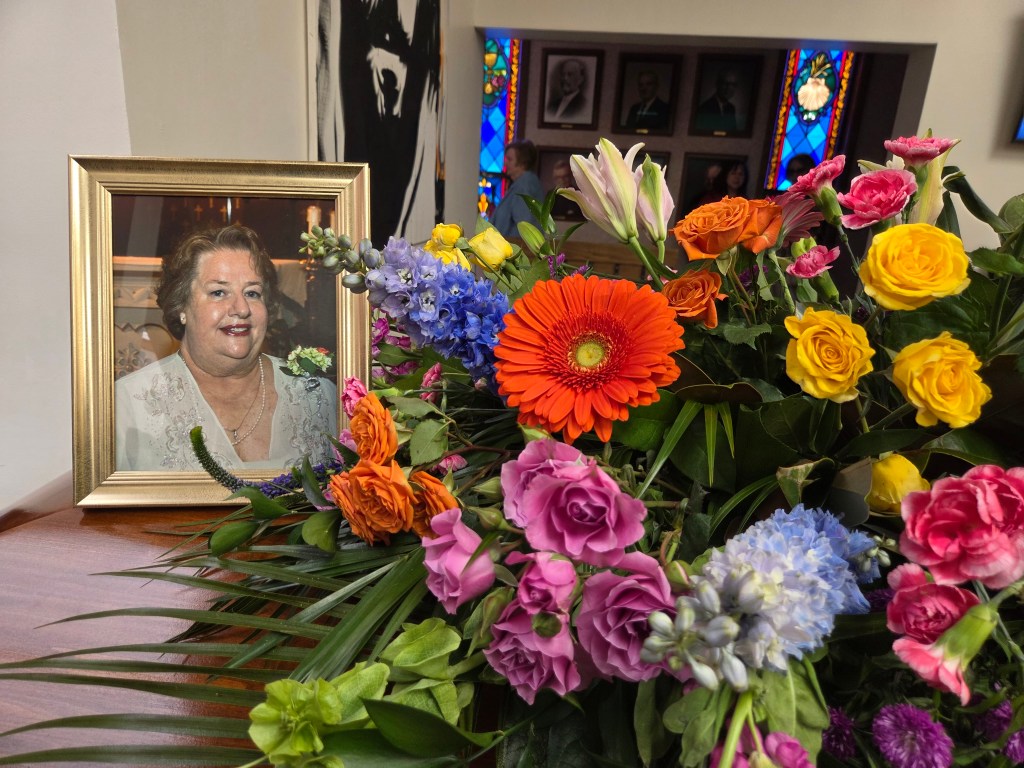
In a large open space connected to the church, Kelsey and Bryant had carefully assembled still photos–from throughout Phyllis’ life–on boards anchored by easels. They placed them beside her closed casket adorned with sprays of colorful blooms.

Overhead, at the other end of the room on a large screen, other images of Phyllis and her family and friends faded in and out on a large screen TV.

As people began moving into the church for the 11:30 funeral service, I felt anxious. Jumpy.

A mix of nostalgia and peace washed over me, as Tom and I found a place to sit at the far-left end of the fourth pew. Diane and Steve joined us there.

I scanned the program and saw that after readings from the old and new testaments–slotted between two church hymns–I would walk to the lectern to share “Words from the Family”. To give a eulogy. To pay tribute to my closest cousin’s life.

I’ve done a lot of public speaking, presenting, and singing on a multitude of stages in my life–but few things as personal as this. I breathed in deeply to quiet my nerves. I unfolded my prepared words and looked out over a congregation of probably two hundred: Phyllis’ family, friends, teaching colleagues, students, caregivers.

In that moment, my anxiety lifted and flew away. “I am honored today to remember Phyllis. She was my cousin. We were born a decade apart in St. Louis,” I began.

The words and phrases flowed effortlessly from there, as I looked into the tearful eyes of immediate family members–three generations side-by-side spread across the first pew.

“I admired Phyllis’ poise, her style, her intellect, her ambition, her sensibility,” I continued. Before I knew it, I was reciting verses from I poem I wrote for Phyllis: The Love We Shared.

I closed my notes. I left the lectern. I paused to pat Austin, Phyllis’ eldest son, on the shoulder for reassurance, kissed him on the forehead, then returned to the fourth pew and sat beside my husband.

I pulled a wrinkled tissue from my suit pocket, dabbed my eyes, and felt sadness and love reverberate throughout the church.

***

Tom and I returned to Arizona last Saturday.

Today I found myself dealing with another form of sensitivity … sensitivity to the sun.

This morning my dermatologist–in an out-patient procedure called MOHS surgery–removed a small patch of cancerous cells from the bicep of my right arm. As I write this, I am taped up with a sizeable patch over that area.

The good news is he removed all of the problematic tissue. There is no pain, just the anxiety (and the pinch of a few needles for numbing) that immediately preceded this morning’s appointment.

In a few weeks, the remnants of that procedure will fade. My dermatologist will extract the stitches.

I will be left with my fourth such scar–one on each limb ironically–from excisions and dermo procedures.

In a sense, these scars are “badges of honor” for having lived nearly sixty-nine years and survived a series of setbacks.

They are proof that as long as I live–as long as I write, sing, slather on sunscreen, and pause to remember the ones I love–I will also remain super sensitive to the blazing Arizona sun.

Anything But Ordinary

On this Easter Sunday, it would be easy to pass by the emerging April blooms of a hidden succulent.

But I forced myself to stop, to welcome, to examine nature’s delicate offering outside my desert door.

Though barely visible beneath the eaves of loss and loud proclamations, it is anything but ordinary.

The Love We Shared

Phyllis was my St. Louis cousin. We were born a decade apart–she in November 1947, me in July 1957. Her mother Violet and my father Walter were twins.

On Tuesday evening, I learned that Phyllis died March 24, 2026. A series of health complications over the past eighteen months ultimately led to her passing. Ironically, she left this world almost exactly twenty-five years to the day after her mother’s passing in March 2001.

When we were children and teens–at every Easter, Thanksgiving, and Christmas gathering from the late 1950s to the 1970s–my sister Diane, Phyllis and I represented the youngest contingent of the Johnson family lineage. We were loved and nurtured by our parents, grandparents, aunts and uncles.

I felt close to Phyllis. As I recount my earliest family memories, I admired her style, her intellect, her ambition. Years later, in the 1980s when my sons (Nick and Kirk) and hers (Austin and Bryant) were all born within a five-year period, the arc of our parallel lives as parents brought us together whenever I visited St. Louis from my home in the Chicago area.

Then, in the 1990s and early 2000s, both of us were consumed by our busy careers. She was a life-long educator. I was a communication consultant. We lost touch a bit as all four of our parents aged and died.

But the beauty of family and longevity is that–if you are willing and able–you can recapture the loving connections hard-wired in your early years.

Ultimately, Phyllis and I did that. In our retirement years, we traded texts frequently. We cheered for our beloved St. Louis Cardinals through the highs and lows. We shared family news and photos. Phyllis absolutely adored her four grandchildren!

Even though I left my St. Louis home in 1980 to build a life and career in Chicago–and later moved to Arizona with my husband Tom in 2017–the love I feel for my cousin remains.

I’m thankful that I was able to see Phyllis four times in the last decade of her life. In 2016, we celebrated her and her husband Tom’s fortieth wedding anniversary. In 2017, Phyllis and her family met Tom and me for dinner at an Italian restaurant on The Hill in St. Louis.

In 2021, we gathered for a family breakfast and reunion at Phyllis and Tom’s home in St. Charles, Missouri. Then, in September 2025, Tom and I visited Phyllis and Tom one final time at Breeze Park where she was convalescing.

Because Phyllis was a dedicated teacher and reading tutor, she enjoyed reading my books. She also followed my blog and supported my writing journey. In fact, she encouraged me to capture nostalgic memories of my paternal St. Louis family on the page. That became my second book, Tales of a Rollercoaster Operator.

So, in a sense, today I not only feel I’ve lost my cousin. I also feel I’ve lost a literary friend.

At one point, I remember Phyllis telling me she hoped to write a children’s book one day. Though that never happened, I am certain my cousin–a devoted teacher–had a positive impact on the lives of hundreds of children in her long and successful career. Her legacy will ripple through their lives and those of her children and grandchildren.

Today is the home opener for the St. Louis Cardinals. The first pitch will be thrown in about an hour. I will be watching the game on TV from my home in Scottsdale.

When the Cardinals take the field, I will be thinking of my cousin. She was a knowledgeable, lifelong, tried-and-true Redbird fan. I will imagine her rooting for them from a heavenly perch.

But, most of all, I will remember the family moments and the love we shared for nearly seventy years.

***

The Love We Shared

Heaviness in my strong heart,

numb with dread,

tells me this chapter has ended.

But I will always know

the love we shared,

the stories we treasured,

the early etchings of memories

with those who came before us,

those who embraced us,

those who left us long ago,

and the ones we shaped and loved later,

who have carved and created

paths, deeds, and destinies

of their own.

Now it is time

for you to rest.

And, as you go, I remember

the person you were,

the gifts you gave,

the lessons you taught.

But, most of all,

I remember the countless ways

your love has touched our lives.

***

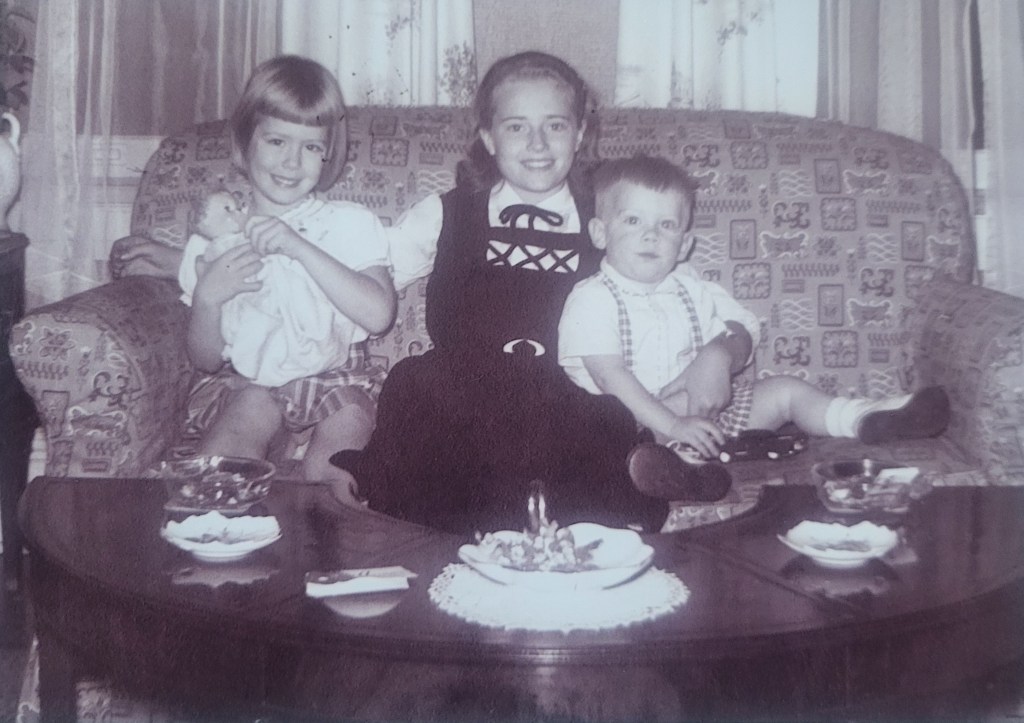
Phyllis (in the center below) was eleven years old–Diane was four, I was one–when the three of us posed on November 26, 1958, at the golden wedding anniversary party for our grandparents, Albert and Louise Johnson.

Looking Over My Shoulder

Back and forth from one end of the pool to the other on this hotter-than-average, magnificent March morning. March 24, 2026, from 9:00 to 9:30 a.m. to be precise. Thirty lengths in the deep end of Eldorado Pool in Scottsdale, Arizona.

Somehow, I wrangled my own lane today. I don’t mind sharing but always feel freer on unobstructed Tuesdays and Thursdays. There are fewer swim-class participants to contend with on those days and–now that the Cactus League baseball games have ended–some of the snowbirds have begun to flock home.

Breathing every eight or ten strokes, looking over my right shoulder, swimming south to north, I spy the blazing sun that threatens my sensitive skin and the wispy-white contrail of a commercial plane flying high above.

Serendipitously, the repetitive swimming motion reminds me what I want to write about today. It is the tenth anniversary of publishing my first book: From Fertile Ground.

On March 24, 2016, Barack Obama was president. I didn’t imagine the waves of what was to come: the growing political insanity, the dismantling of once-reliable American institutions, the general implosion of our democracy in one decade. Who could?

Back then, Tom and I were snowbirds–splitting time between our homes in Mount Prospect, Illinois, and Scottsdale, Arizona.

I wrote most of my inaugural book–a three-generation writer’s mosaic about love and loss in my family–from the suburban flatness of northern Illinois.

But working online–back and forth like a swimmer logging laps between my editor and book designer in Nashville, Tennessee, and me in Scottsdale–I made my final edits in the rugged western landscape of the Grand Canyon State.

I remember the pride of holding the first physical copy of my first book later that week. I know I cried. It was a release of joy and amazement. Most definitely, a seminal moment I shared with my husband.

Sadness crept in, too, because I had written the book to process my grief after my mother’s passing. In a physical sense, I wasn’t able to celebrate that literary moment with her.

But I also know that writing about her and her wisdom-filled letters, my father and his unrealized poetry, my grandfather and fifty-three years of diary entries, and the general sense of freedom I felt visiting my grandparents in the 1960s at their rambling North Carolina farm allowed me to create a healing path out of my grief.

It was–and still is–a story I was meant to write and publish. One I wanted to share with others navigating the devastation of grief.

In the past ten years since From Fertile Ground was born, writing has become that free, unbridled swimming lane that is purely mine. Welcome waves of water and creativity running from my mid-fifties to my late sixties.

Whenever I jump into my writing in the deep end of my emotions, I find a way back to the surface with a new story. Many of them have landed on the pages of my other five books: Tales of a Rollercoaster Operator in 2017; An Unobstructed View in 2018; I Think I’ll Prune the Lemon Tree in 2021; A Path I Might Have Missed in 2023; and Sixty-Something Days in 2025.

Of course, I take pride in that body of work and–more recently–find it tremendously gratifying to share what I have learned with other writers, who need an experienced coach … and a few practical ideas … to tell their own stories.

Today, I also pause and wonder–with a touch of sadness as I write this–how many more stories lie ahead for me. Though I still feel strong, capable, creative, and alive in these golden years swimming back and forth under the Arizona sun, I also feel more vulnerable.

Part of it is the process of aging. The other is the narrowing swim lanes of American society that constrain freedom and the expression of ideas.

Having said that, I choose to end this story on a positive note. Today, I choose to relish the goodness of my life with Tom in this rugged landscape. To give thanks for all the stories that have come from fertile ground over the past ten years … as well as those I have salvaged from the depths of the pool looking over my shoulder to beloved people and places that now live on the page.

Thirteen

It is inevitable that we will lose some of those we love along life’s journey. But all is not lost.

When seminal I’ll-Be-Seeing-You moments, birthdays, anniversaries, songs reappear, we can’t help but acknowledge them.

Over the years, I have chosen to pay tribute to those I love in my memoirs in significant ways. None more than my mother.

These three sentences appear in my first book, From Fertile Ground, which I wrote and published in 2016.

“She died in the wees hours of January 26, 2013, at age eighty-nine and a half. The air was arctic cold and the moon was full. Every time I see a full moon now or experience the change in seasons, I’m reminded of my mother’s undaunted spirit.”

On this — the thirteenth anniversary of her passing — I pause.

I give thanks for Helen Matilda Ferrell Johnson.

I remember her unconditional love, her letters, her wisdom, her level-headedness, her resiliency, her love of nature.

And I do my best to carry on.

I keep writing.

Rolling Out the Dough

Back in the early 1960s, Mom plucked two mounds of dough out of our Philco refrigerator.

She plopped them on the kitchen counter to let them soften and warm to room temperature, then pulled her rolling pin out of the cupboard.

Diane and I took our places on either side of her, holding our primitive cookie cutters. Grey. Flimsy. Metal.

One was a simple star. The second, a classic Christmas tree. The third, a basic bell. The fourth, a reindeer in flight. The last one, a profile of Santa Claus carrying a pack of toys.

Further down the counter, two slightly bent cookie sheets waited, along with green and red sugar sprinkles we would soon shake above our freshly formed Christmas cookies.

But, in this gauzy 60s slice of life featuring baking, rolling out the dough had to come first.

Mom reached into her container of flour and tossed a handful on the counter. Then, dusted the wooden roller with the remains.

She leaned in with the rolling pin and pressed the dough. Back and forth with equal measures of love. The surface expanded with our hearts and imagination.

We took turns dipping the cutters into the flour, creating our shapes in the dough.

Then, we lifted them carefully with a spatula onto the cookie sheets, added the sprinkles, and slid them into the oven for eight to ten minutes.

While the first batch of cookies baked, Mom gathered the bits of dough that remained. She created a smaller ball and flattened it out with the roller. Together, we repeated the process.

It was 1961. I was four years old. Diane was seven. We felt loved, safe in the presence of our mother.

***

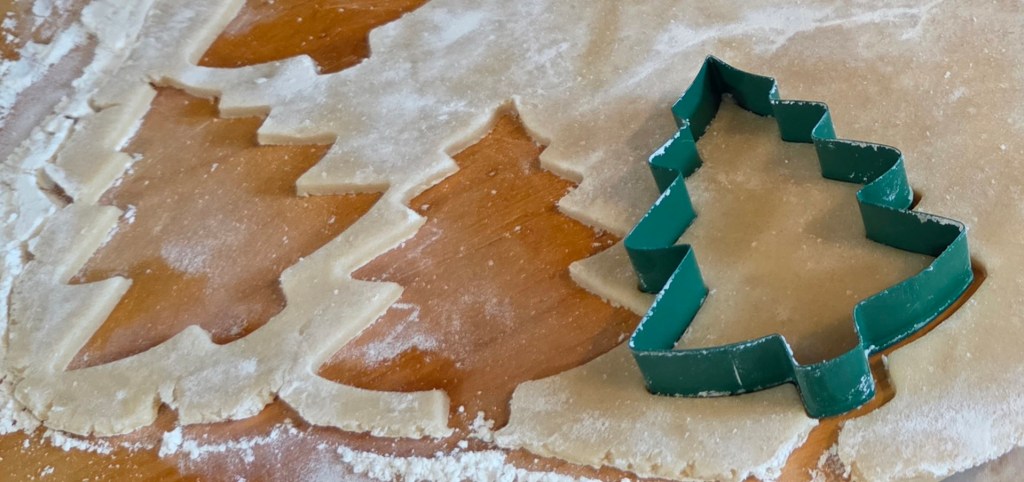
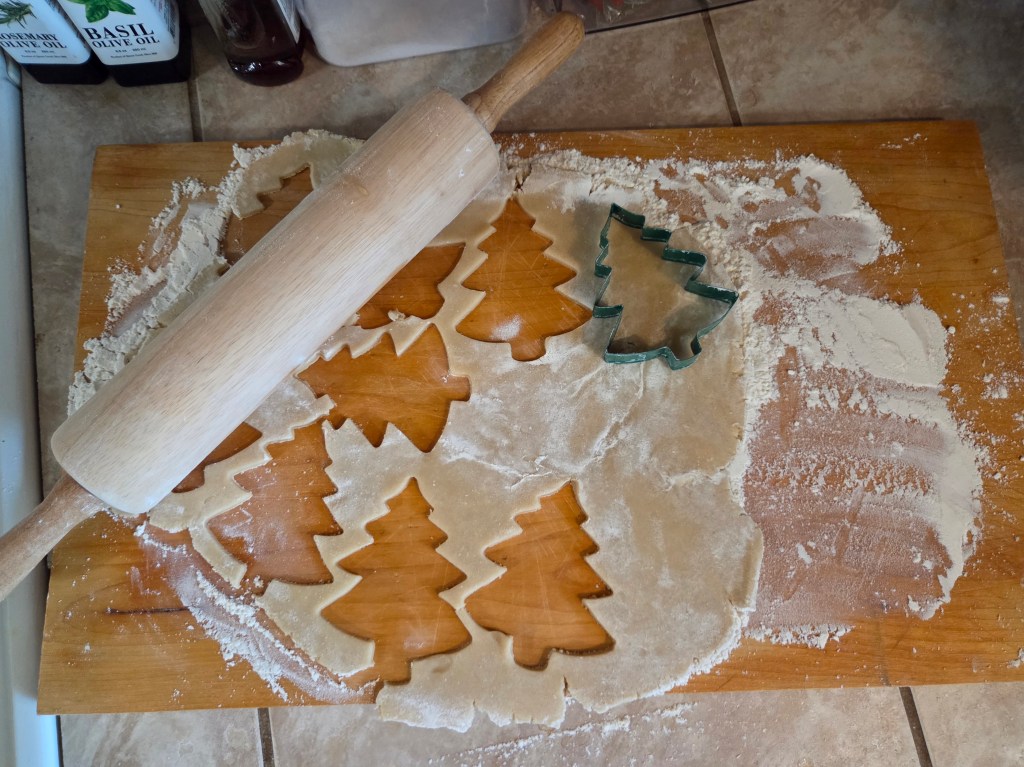
Earlier this week, I found one green Christmas cookie cutter in our kitchen drawer here in Arizona. It was a gift from our friend Jillian a few years ago, but I hadn’t made sugar cookies from scratch since those early days in suburban St. Louis with my long-gone mother.

Tom and I bought a wooden rolling pin, and I found an easy sugar cookie recipe online. I assembled the ingredients to make the dough: butter, sugar, flour, one egg, a teaspoon of vanilla extract, and a dash of salt.

I mixed it all together and let the dough settle in two large discs in the fridge overnight.

On Monday, I rolled out the dough, cut the cookies, and topped my Christmas trees with green and rainbow-colored sprinkles. Then, I slid several trays of cookies into the oven to bake.

Why this year? I don’t really know, except to say it’s been an awful period in our country even though I’m a survivor and somehow have reached new creative heights in my personal life in 2025: several memoir-writing workshops, two joyful holiday concerts, and another book.

And, of course, I still miss my mother. She’s been gone since January 2013, but the grief reappears with the holidays. I suppose I needed to feel her presence again.

I needed to rescue my past Christmas-cookie-cutting memory with Mom. To keep that sweet, simple goodness alive in the stillness of my kitchen. To shepherd it into my present Arizona life with Tom and breathe new life into that tradition.

Merry Christmas, everyone.

The Arc and The Arch: Part One

The arc of life in my sixties–its highs and lows–has proved mostly to be an unexpected artistic one. Yet it is an uneven tapestry of co-existing emotions: fear for our eroding democracy; love for new and old friends; and boundless gratitude currently after returning to St. Louis for my Affton High School Class of ’75 reunion and reconciling my midwestern roots with my southwestern reality.

***

A trip to St. Louis would not be complete without a visit to my parents’ graves at Jefferson Barracks National Cemetery. So, we began there.

On Friday, September 19, Tom and I stopped at Dierberg’s in Creve Coeur near our hotel to buy a handful of burnt orange carnations.

Twenty minutes later, we arrived in the sea of marble stones on rolling hills ten miles south of downtown St. Louis.

We parked our rented Mazda SUV and tiptoed past a veteran’s funeral in progress under a makeshift canopy. A female vocalist sang Amazing Grace. Instantly, my tears began to flow.

Each time I go to Jefferson Barracks, it is a touchstone experience. Tapping one side of the stone and then the other. Remembering the love and best intentions of Helen and Walter Johnson–both long gone but not forgotten.

Minutes later, sitting on a nearby bench with Tom under the sturdy branches of an oak tree that has lost its earliest leaves due to an especially dry Missouri summer.

Friday afternoon was also somber and reflective. We met our friend Mark, a docent at St. Louis Kaplan Feldman Holocaust Museum, for a visit there.

He guided us through horrific-then-hopeful survivor stories, images, and vintage artifacts, curated from proud Jewish St. Louis residents who lived through the awful experience. Only a few remain, but their legacies live on.

All in all, it was a chilling, relevant, immersive few hours. Cautionary evidence of hate and authoritarian evil that inundated the world in the 1930s and 40s, and now–in the US in 2025–threatens the existence of those who are not straight, Christian white men.

After deep breaths and a refreshing Friday nap in our hotel, Tom and I drove to University City for an evening with Mark and his husband David at their home. It was a celebration of our unfolding friendship.

At sunset, they lit candles and recited Shabbat blessings before we shared wine and bread. At their table, I felt our bond of friendship, which began just a few years ago, grow.

We met Mark and David when–as snowbirds living part-time in Arizona–they first attended one of Tom’s free film screenings at the Scottsdale Public Library.

Now, they have become the newest, welcoming community component of our St. Louis connection.

In September’s Stillness

It was a bright September Tuesday morning. Clear skies, mild temperatures, and low humidity. A perfect day in the Chicago suburbs.

At around 7:30 on September 11, 2001, I pulled up to the curb at Lincoln Junior High to drop off Kirk, my twelve-year-old son. He scampered ahead and waved goodbye.

Forty-four-year-old me drove to the nearby RecPlex for a quick swim at the indoor pool. On the way to the locker room to change, I saw a small cluster of folks gathered silently around a TV.

A plane had just struck the north tower of the World Trade Center in New York. Dire images of smoke and debris filled the sky.

Minutes later, a second plane pierced the south tower. It was just the beginning of the madness.

Terror spread quickly through the skies to crash scenes at two other sites: the Pentagon in Washington, D.C., and a field in Shanksville, Pennsylvania.

Captivated and numb in disbelief near the vending machines in the lobby hundreds of miles away, we stood dumbfounded and helpless–gaping in September’s stillness–as ripples of the horrific news and images unfolded.

Ultimately, 2,977 victims died that day, casualties of the September 11 attacks at the hands of eighteen foreign hijackers and many more strategists who infiltrated American skies.

Thousands more were injured and sustained life-long trauma, including citizens and rescue workers exposed to toxins at Ground Zero in Lower Manhattan in New York.

***

It’s been twenty-four years. We are still trying to make sense of how much we lost, how much our lives changed, that day.

I don’t mean the inconveniences of air travel. Yes, that’s a pain.

Much worse, gun violence, school shootings, assassinations, and homegrown terrorism are the norm in the United States. Through it all, we have become as divided as ever.

Just yesterday, the latest two unrelated horrors–one a school shooting near Denver, the other the assassination of a vocal, right-wing protagonist–dominated the news cycle.

The solution is obvious. We need to remember our traumas and learn from them. Institute tighter gun laws in this country, not more thoughts and prayers.

I do believe our leaders have failed us. We have voted the wrong ones into positions of authority. Instead of quieting the storm and pulling us together, they are threatening those who don’t agree with them.

If we don’t make changes soon, our legacy will be continued bloodshed, not the freedom, opportunities, and equality we have espoused as a nation for generations.

***

My twelve-year-old son is now thirty-six and living in Chicago. He is a therapist. Kirk specializes in helping individuals who have experienced some sort of trauma.

I couldn’t be prouder of Kirk and the work he is doing. At a young age, I witnessed his kindness, his empathy toward classmates, neighbors, and family members.

Now he is honing his skills, while providing relief to those who need it most in American society.

I try to do the same through my writing. Telling the stories as I see them but leaving you with a glimmer of insight, relief and hope.

If there was one positive thing that sprang from the 9/11 attacks, it was the way our nation coalesced–at least in the short term–around the victims, their families, their stories in 2001.

As a nation, we were forced to take a breath as we dug through the rubble. We forged ahead to provide a salve to treat the psychological trauma we all felt.

Somehow, in 2025, we have lost our wits. We have forgotten how to love the less fortunate, protect our children, and teach them to be critical thinkers rather than conspiracy theorists.

We had better wake up fast, pass gun laws, rediscover our compassion, and find our better selves soon.

Adrift

I wrote most of my first book ten years ago. I was consumed by the project … in a purely positive way. Connecting the dots of grief and my family’s writing DNA spurred my energy and creativity.

As late summer 2015 approached, my daily creative output accelerated. Chapter after chapter emerged From Fertile Ground.

We didn’t have a printer at home but lived near a FedEx store. Whenever I completed a new, sizeable chunk of my manuscript, Tom and I walked there to print the updated version. Holding my evolving story in hand gave me a sense of pride and tangible proof of progress.

Now, in late summer 2025, I find myself at a vastly different place in the arc of my literary life. As I look back over the past decade, I feel a tremendous sense of creative accomplishment. … knowing I have produced four memoirs, a book of poetry, three librettos, a litany of essays, and a memoir writing workshop.

Yet I feel adrift.

Part of it is an energy thing … or, more accurately, a focus thing … or, even more pointedly, “maybe-this-is-what-it-means-to-be-68-and-a-compassionate-human-being-and-living-in-the-United-States” thing.

Okay, I’m not being totally transparent. I’m trying to avoid the trauma in our country. I’ve turned off the news. My husband and I are helping each other stay sane. In addition, I have been developing occasional pieces of flash fiction and nonfiction essays for literary contests.

I also have written several chapters for a “how to write a compelling memoir” manuscript. And there is another writing opportunity that is percolating … but it’s premature for me to spill those beans.

Anyway, I don’t feel all that jazzed about any of it … at least not on the scale of my first-born book in 2015. The one I felt like I was meant to write.

Is it weird that I’m getting more energy from writing this blogpost than the projects I mentioned a few paragraphs above? Probably not, because I’ve always enjoyed the raw, immediate-but-winding personal connection that comes with this territory … with this writing forum.

So that’s where I am right now … treading late summer metaphorical waters in the desert … bobbing along in a sea of episodic literary possibilities … exercising four or five times a week to keep my heart strong … taking more naps than I used to … longing for the next big wave of creative energy … gazing back to the distant shoreline of past successes and bittersweet memories … squinting ahead (like many of you) into nasty flames of deception, betrayal, and planned confusion that threaten my country’s future.

No wonder I feel adrift.