“Are you guys going to the protests this Saturday?” Nick wondered last Wednesday via a text.
“No. We aren’t planning to. It’s just too hot,” I responded to my son.
But as the week wore on, I began to regain my energy following three phenomenal concerts with my Phoenix Gay Men’s Chorus pals.
On Friday, I reconsidered Nick’s question. I told him Tom and I would do it. A few of our chorus friends wanted to join us too at a No Kings protest in Scottsdale.
I should tell you that I don’t consider myself an activist, though I have marched for various causes on several occasions in my life. I prefer to share my voice and perspective through my writing.
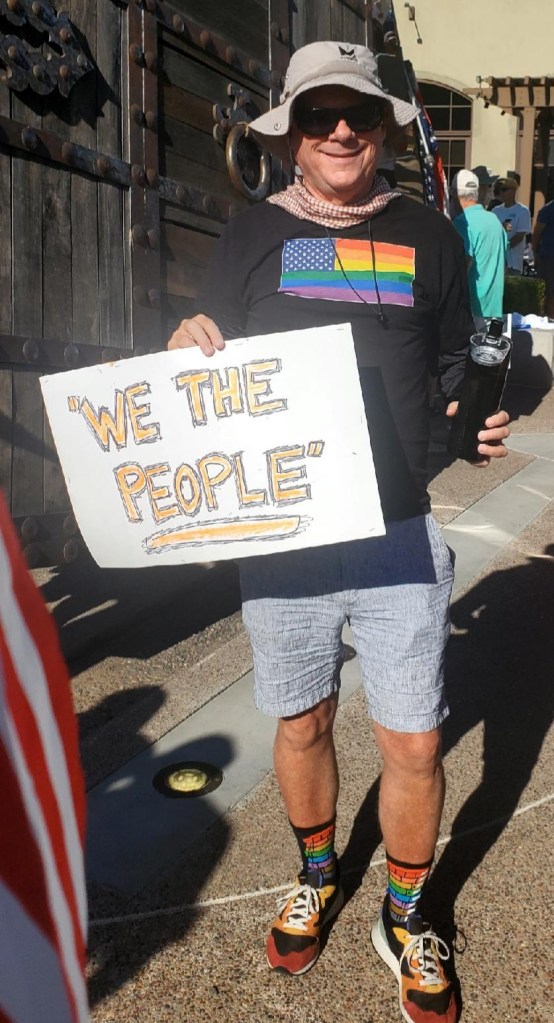
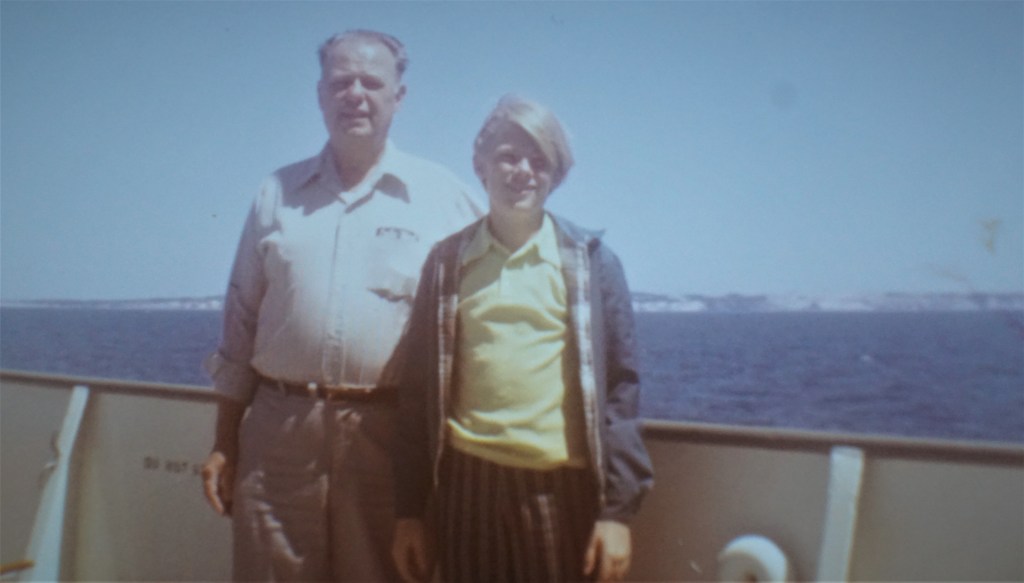
But I also recognize the dire state of our democracy. I decided if my World War II veteran father (he defended democracy in Europe with the allied forces during the Battle of the Bulge in late 1944) could endure frozen feet in foxholes with his buddies and risk his life as an army sergeant, I could certainly endure the 90-plus desert temperatures in Arizona for two hours, wave my American flag and “We the People” sign, and join forces with family and friends to raise my voice. To make sure it was heard.
So, Saturday came, and we did it … Mark, Tom, Nick, Kim, Dougal, George and one to two thousand others represented democracy in Old Town Scottsdale. We were a dot in a map of some five million in the U.S. and abroad who took to the streets in big cities and small towns. All of us deeply concerned.
Locally, it was an inspiring and peaceful No Kings protest consisting of angry but well-behaved women and men. Young and old. A few children with parents and grandparents. Couples. Singles. Straight. Gay. Multi-cultural. Dogs, too. Dare I say diverse?
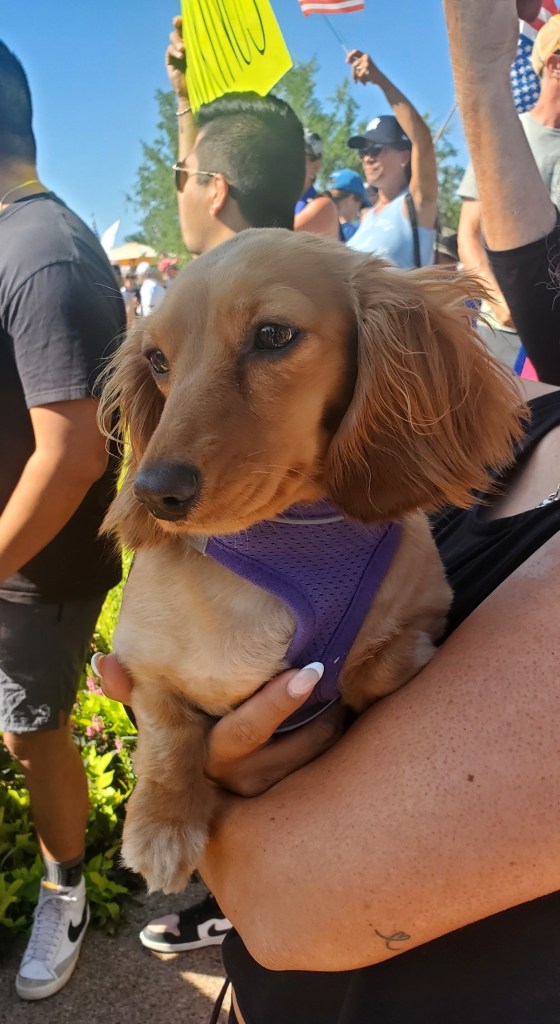
At one point, Tom and I chatted with a fifty-something mother from San Diego. She was visiting her daughter who lives in Scottsdale. They took turns chanting “No Kings” while cradling their adorable, slightly overwhelmed dachshund.
The dog’s benevolent eyes seemed to say, “what are we all doing here?” All I could do was shrug and smile. There is no explaining all we have endured in this country over the past six months. Not to mention the previous eight or nine years.
A short while later, I turned to discover a man holding a profoundly-funny-and-literary sign. A parody of American poet Robert Frost’s The Road Not Taken. I imagine Frost would have loved it, if he had been alive and standing beside me.
I asked the man if I could take his picture. I told him it spoke to my wordsmithing sensibilities. He surprised me by saying he was a math guy.
I’ll likely never cross paths with him again. He’ll never know that my book of poetry, A Path I Might Have Missed, was inspired by my love for Robert Frost’s verses. But on June 14, 2025, we stood on the same page … on the same street corner … on the same shared path.
Together–close friends, like-minded acquaintances, and distant strangers–we proclaimed our desire and hope to rescue American democracy from the clutches of fascism.
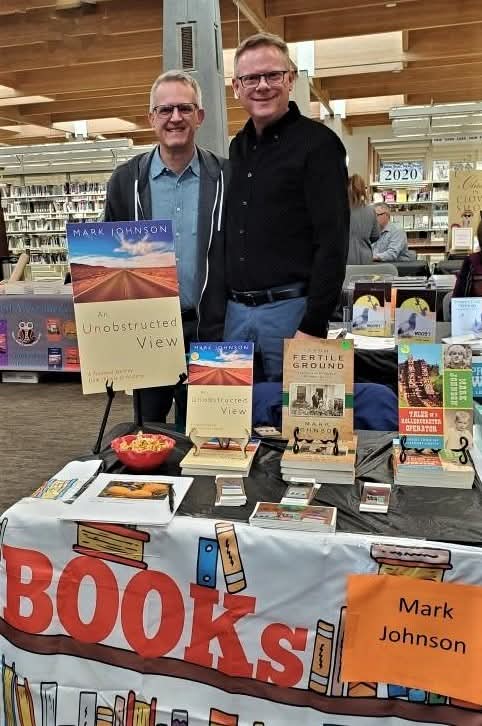
In the old days (the pre-Covid days)–just five years ago this week–I hawked my books with my husband by my side at a local author book fair at the Scottsdale Public Library.
We didn’t know about the dark days ahead. Holed up in our cozy condo. Wondering if we and our closest family and friends would survive. Wondering if the race to create a viable vaccine might save us.
Fortunately, science did produce a vaccine that saved lives (for those of us who had the gumption to protect ourselves and others).
We did survive and Tom and I have gone on to create new chapters at the library … him leading several successful film series; me guiding those intent upon writing their own memoirs.
Strangely, those Covid years feel quaint now as our nation disintegrates daily. Tom and I cling to one other, as our nation turns a blind eye toward anyone who is different.
Yes, we have many friends and family who love us. But, to put it bluntly, I don’t feel safe. This experience of living in 2025 in the United States (we aren’t really united) has cued old tapes in my psyche that remind me that–once again–I am living in a straight, white world of shallow masculinity.
I will keep trudging along. Loving my husband. Guiding my adult sons. Speaking my mind. Telling my stories. Holding my closest friends close. Giving to organizations that might make a difference. Advocating for those less fortunate. Donating my time, talents, and voice to the Scottsdale Public Library and the Phoenix Gay Men’s Chorus.
Most of all–like many of you–I just need to keep breathing today. And, for tomorrow and the next day, I need to save any reserves of energy and sanity I have to fight the good fight.
I am a writer, gardener, and gay man. Yesterday, today, tomorrow, ever after.
Those three dimensions of my life–hardwired into my DNA–aren’t the only attributes that describe me.
But they are the ones I choose to write about today.
***
Eight or ten years ago, when Tom and I were snowbirds splitting time between Illinois and Arizona, we bought a Mexican fire barrel cactus at a Desert Botanical Garden plant sale not far from our condo.
We planted it in a yellow ceramic container. Tom’s grandfather, Sam, left it behind when he passed in the fall of 2001.
(Beginning in the early 1970s, Sam and Lucy–Tom’s grandmother–lived in the condo Tom and I now call home.)
From the start, I loved the way the fire barrel’s red spikes vibrated year-round in the desert sun. Every April, it produced spectacular orange blooms. Plus, it didn’t require much water.
When we became full-time residents in the Grand Canyon State in 2017, I paid closer attention to this cactus.
It was a grounding natural force, stationed outside our backdoor on blazing July afternoons and crisp December mornings.
In 2020, during the height of Covid-19, we passed it every morning on our way to walk the canal.
Those were walks to simply stay sane. To keep our bodies and minds moving. To get lost in the beauty of the buttes near our home.
At one point, I began to notice that our Mexican fire barrel cactus was leaning south toward neighbors who would pass by. It was almost as if our spiky friend was listening to their conversations.
That observation inspired me to write Eavesdropping, an essay that appears in I Think I’ll Prune the Lemon Tree, my book (published in 2021) about Arizona life.
Unfortunately, as it is with all forms of life, there is an ending. A closing of one loop and the beginning of another.
Today was the end of the line for our trusty, prickly friend. The relentless summer and early fall heat of 2024 in the Valley of the Sun decimated it.
This morning, I grabbed my thick gardening gloves and trowel. I pried the decaying cactus out of our yellow pot and deposited it in the dumpster.
The good news? I salvaged (and cleaned up) our vintage container with roots to my husband’s past.
It waits outside our backdoor for a new occupant.
***
Far beyond the gardens of our backdoors, backyards, patios, and public parks, each of us–gay, straight, bi, or trans–has the right to pursue and realize a happy life … ever after.
Today, the day after National Coming Out Day, I have some additional thoughts on this topic beyond what I’ve written before in this space and in my lemon tree book.
As I’ve said in the past, coming out is not a singular process. Of course, the first time you disclose your sexual orientation to family and friends is monumental, because there is always the risk someone important in your life may not accept you for who you are … or who you love.
However–even after you pull off that bandage, feel a sense of relief, and deal with the potential consequences of having risked personal loss simply for being yourself openly–there is the realization that we live in a predominantly straight world where some may not view you in a favorable light.
Every day, we who are gay find ourselves in situations where we need to decide if we will share our authentic selves in the moment.
What I’ve discovered is that when I stifle that authenticity impulse in certain social situations, I feel like I’ve lost my voice. That’s problematic for a writer … and a singer!
Here’s an example. On Day 1 of our recent-and-fabulous tour through the United Kingdom with twenty-two other vacationers and our guide Phil, we met the entire group for a “welcome drink” in the dining room of our London hotel.
As a part of getting acquainted, Phil asked us each to quickly share a little about ourselves and who we are.
Right away, I heard a few other couples–straight, older couples about our age from places like Pennsylvania, North Carolina, Florida, etc.–say the trip was a wedding anniversary celebration for them.
About halfway around the room, it was my turn. I had two choices: to share that Tom and I were celebrating our tenth wedding anniversary; or to stifle that impulse, come up with some sort of alternative response, and withhold the joy I felt about exploring England and Scotland (two places we’d never been) with my husband.
At this stage of my life, it was an easy decision. Because, at age sixty-seven, I’m comfortable with my gay identity–and prepared for all sorts of responses–I chose the first option.
Doing so, freed me up to enjoy the trip on my terms. And you’ll be happy to know, that our fellow travelers–visibly, at least–accepted and embraced us for who we are … a married, gay couple.
Of course, I still remember the arduous times in my thirties and forties. Living in the straight Chicago suburbs. Trying to raise two boys as a single dad after a messy divorce. Coming out to my ex-wife, my mother, my sister, my sons, my coworkers, my neighbors.
The list was long. The process was painful. But I endured. Slowly, I began to love my true self … and so did most of the people around me. A few relationships fell by the wayside, but I have no regrets.
Yesterday, I took a spin through social media. One of my newer friends, who joined the Phoenix Gay Men’s Chorus recently, posted a video of him telling his story about coming out over the past year.
It was a story of pain, transformation, and personal fulfillment. Really, how he (with the help of a gifted counselor and close friends) loved his true self and was ready to share it with the world.
As I watched the video–and heard him say he and his wife divorced and that they and their five children have begun to move forward to find more solid footing–it nearly brought me to tears.
I am so proud of my new acquaintance, my new friend. I told him he is an inspiration for those who have yet to come out … and for those of us who already have.
Because, in this spiky world, I don’t think we can change hearts and minds, live happily ever after, or even simply be content, unless we are visible. Unless we share our whole selves.
I’m back home. Inside the furnace, better known as the Valley of the Sun.
I have begun to reemerge from an affirming, magical, inspiring five days of LGBTQ bonding and music with my chosen family at the 2024 GALA Festival in Minneapolis.
From July 10-14, 7,000 singers (representing nearly 300 choruses and presenters from around the world) inhabited the Twin Cities.
We owned the stages. Occupied the hotels. Flooded the restaurants, bars, shops and streets with gaiety and glee.
But it was more than the magnitude of this quadrennial event that has left an indelible imprint on my creativity and identity. It was the sense of joy, kindness, support, and human possibilities that dazzled me most.
At a time in this country and our world where so much hatred abounds, I was reminded that when love is present–when people truly come together to care for one another and cheer each other on–we can be that Bridge Over Troubled Water (one of the songs my Phoenix Gay Men’s Chorus mates and I performed) of hope for one another.
This was my third GALA. I shared all of them with my husband Tom: 2012 and 2016 in Denver; 2024 in Minneapolis. Each one has nurtured me, deepened my sense of artistry and compassion, and reinforced the importance of rekindling/kindling old and new relationships.
In this 2024 installment, over a five-day period I was able to reconnect and celebrate with friends from Chicago (who perform with the Windy City Gay Chorus and the Chicago Gay Men’s Chorus), Washington, Seattle, and–of course–Phoenix.
A friend and ex-colleague (from my past consulting career) who lives in the Minneapolis area, also surprised and delighted me by attending our performance on July 12. It was a treat seeing her again.
If you follow my blog, you know I have written five books. One is a book of poetry; the other four are memoirs or creative nonfiction. I’ve also written lyrics and librettos for the Phoenix Gay Men’s Chorus.
Already, I have begun to scribble ideas in a spiral notebook that were sparked by my latest GALA experience. Who knows? This may lead me to a stream of poems or lyrics I have yet to compose.
For now, I will leave you with an idea and image that captured my attention on Saturday as Tom and I watched a series of choruses perform inside the auditorium of the Minneapolis Convention Center.
A few rows in front of us, a couple neither of us knows relaxed and leaned in. Away from the heat and fire in the world, they rested their heads against one another. They held each other. They listened to beautiful music in a safe space.
Many of us in the LGBTQ community have spent large portions of our lives searching for answers, longing for love and understanding.
The beauty of the GALA Festival is that–through the power of music, relationships, and community–we can move from longing to belonging.
Moving beyond this amazing and affirming five days in the upper Midwest, we will continue to raise our voices inside our choruses and be our authentic selves outside in the everyday world.
Truly, we are much more than a large collection of singers. Together, we represent a movement of kind, talented, and diverse humans with the power to change hearts, minds, and attitudes.
In the 1960s–when the San Francisco Giants appeared at Busch Memorial Stadium in St. Louis to play the Cardinals–the bleachers were a heavenly place for Dad and me to be.
Because, on many hot summer days and nights, in addition to watching our beloved Cardinals’ legends perform on the field (especially Bob Gibson and Lou Brock), we saw Willie Mays patrol centerfield.
Simply put, there was no one better–before or since–at chasing down line drives and long fly balls. Securing the ball in his mitt with his patented basket catch. Smiling at fans who gravitated to his magnetic personality.
Willie was the face of major league baseball in those days. His affable presence and disarming charm seemed to neutralize the racial prejudice that haunted many other black athletes when they traveled from town to town.
We ALL observed Willie’s greatness and humanity with awe and pride. He was a hero to black and white fans alike.
I won’t recite all of Willie’s remarkable batting statistics and records. I’ll leave that to the experts. Suffice it to say, his lifetime batting average of .301, 660 home runs, 3,293 hits, 1,909 runs batted in, and 339 stolen bases made his election to the Hall of Fame in 1979 a no-brainer.
Willie brought exuberance, fun, and a boatload of hitting and fielding talent to every game he played over more than two decades.
He was a legend off the field, too. For instance, he spent many hours playing stick ball with kids on the streets of New York before the Giants moved their franchise to San Francisco in the late 1950s.
I cried when I learned of Willie’s death on Tuesday at age 93.
Truly, there will never be another Willie Mays.
***
Beyond past ballfields (and my continued propensity to root for the St. Louis Cardinals as I approach my 67th birthday in the scorching summer heat of Arizona), my personal sense of awe and pride lives and breathes in a far different venue: on stage with the Phoenix Gay Men’s Chorus.
This weekend we will be performing our Encore show at the Tempe Center of the Arts. I’m proud of the libretto I’ve written for the show.
Five storytellers–I’m one of them–will connect the music with tales of reflection concerning who and what our chorus is. More than that, what it means to us in 2024.
For the audience and us performers, it will be a high-energy, emotional rollercoaster of favorite musical and choral moments, punctuated with dazzling choreography.
For added emphasis, this will be the final performance for our artistic director, Marc. He will pass the conducting baton to our new director, Antonio, who will usher in a new era of awe and pride for the Phoenix-area LGBTQ community and all our avid supporters and music lovers.
I don’t typically tackle social and political issues in my blog. I prefer to focus on the splendor of love, family, community, nature, and serendipity that runs through our lives.
But over the past weeks and months–years, really–I’ve been ruminating over what it feels like to live in the heaviness and post-Covid-social-upheaval of the United States in 2024.
Even though I am in good health and am fortunate to have the companionship of my husband and a cozy home, I often feel a gnawing, low-level anxiety.
I attribute this to worry. What will happen to disenfranchised members of our community–non-white immigrants, people of color, minority women, all women, all children, elderly people, trans people, gay people (like me), etc.–who would be especially vulnerable if our past president (the one just found guilty on thirty-four felony counts by a jury of his peers) should be elected in November?
I should tell you this blogpost isn’t intended to sway your opinion. I don’t think that is possible. I can’t imagine any American being undecided–not in this us-versus-them world exacerbated by lies and constant media attention.
Yes, I will vote for Joe Biden. It’s pretty simple for me. I’m not naive. Of course, he’s made mistakes, but he’s done a lot of good for our country economically and otherwise. I see him as a decent man–the only decent man whose name will appear on the 2024 Presidential ballot. I think he has the best interests of Americans in mind and sees the presidency as a job designed to serve the people, not his personal agendas.
If you feel differently, you are entitled to that. Just know that the democratic values and rule of law that generations of American men and women have fought for will be flushed down the toilet if enough people in swing states like Arizona vote for the other guy. I won’t include his name here.
Why did I choose to write about this today? Because I suddenly have greater clarity concerning all of the weight, which I’ve been carrying around concerning the potential loss of a safe haven–something all of us are entitled to.
The remarkable thing is my clarity came from an incident outside my front door on Sunday morning … an incident involving a feral animal Tom and I have come to love.
If you follow my blog, you know I’m talking about Poly. For the past three years, on many mornings she has appeared at our front door. Poly lives a reckless life, but at the very least is the beneficiary of food on the cool tile of our entryway (and probably others).
Her visits are a brief escape from the heat of the Sonoran Desert. Maybe her visits are also an escape for Tom and me to leave behind the worries of the world, which I’ve outlined above.
Recently, Poly has moved closer to us. Winding her way around our ankles. Sleeping in our wicker chairs. She has even decided to sleep outside on the gravel underneath our loveseat on occasion… before she moves on to explore other places, porches, and hideaways. Such is the life of a lovable, but forever-feral feline.
Anyway, on Sunday morning one of our neighbors (someone we care about who owns a sweet dog) happened to approach our front door at the same time Poly was eating with our door ajar. Normally, the dog is on a leash, but she wasn’t yesterday–though she should have been.
Poly (and I) were freaked. She ran out our door and down the sidewalk as the dog chased in hot pursuit. I feared for her safety and gave my neighbor an angry earful for not leashing her dog.
As I swam laps this morning in Scottsdale, I realized that my rightful (but intense) anger had roots. Metaphorically, in my mind and heart at least, Poly represented the plight of thousands of vulnerable Americans who might be on the run … whose lives might be in danger if we lose our democracy.
I say that knowing that some of my LGBTQ friends–particularly those in the trans community–are considering alternative plans of where to live if Biden doesn’t win the election. That’s a daunting thought and potential reality, which you may not be aware of if you don’t have gay friends.
One thing I am certain of. It doesn’t have to be Pride month for me to remain authentic and visible. I will continue to care about those less fortunate (humans and animals) … no matter what happens in November and beyond … because we all deserve respect and kindness … no matter who we love … no matter our identity.
Meanwhile, back in our Polynesian Paradise community, my neighbor and I have repaired our relationship and regained our equilibrium. (She apologized for not having her dog on leash and told me she hoped it wouldn’t deter Poly from returning.)
Late yesterday, Poly reappeared–safe and sound–outside our front door. This morning, she had her breakfast on the cool tile of our Sonoran entryway.
An hour later, I found her tucked underneath the loveseat in her safe haven. Peeking through the cacti containers and elephant food succulent on our patio, she allowed me to take this photo.
I am thankful Poly (and I) survived our Sunday scare. I hope our nation and democracy are as fortunate in November.
It’s a rainy, blustery afternoon in Scottsdale, Arizona. Windbreaker weather.
Nothing like the norm. Nothing like this photo I captured two days ago as Tom and I made our way around Chaparral Park.
But measurable rain is welcome here, and–if the weather forecasters are right–more is in the offing this week with heavy snow in Arizona’s higher elevations north and east of us.
Now that I’ve lived here nearly seven years (that anniversary arrives in July), I’ve learned that we will have plenty of blistering hot days between June and September.
So, I will embrace this cool, short-term, winter-in-Arizona anomaly. Maybe it will help build our reserves in the Colorado River basin.
As the raindrops fall, Tom and I celebrate a personal milestone. Today–February 6, 2024–we reached our full retirement age (FRA)–66 years and 7 months for those born in 1957–as defined by Social Security.
Basically, that means we are eligible to receive 100 percent of our Social Security retirement benefits–benefits we each accrued by paying into the system and working all those years, commuting to and from an array of jobs on mostly cloudy, windy and often-snowy Chicago days.
If you are unfamiliar with the U.S. Social Security Administration regulations, the Social Security Act was signed by President Franklin Delano Roosevelt in 1935.
The idea then–and still today, fortunately, though the program is under scrutiny–is that a small portion of Person A’s wages goes toward helping to support senior citizens with a financial lifeline.
Then, when Person A reaches senior status, he or she has earned the right to Social Security retirement benefits. As the rules exist today, those who log at least 40 quarters (the equivalent of 10 years) in the United States workforce are entitled to some sort of retirement benefit.
Those eligible can start taking their benefit as early as age 62 (but receive only about 70 percent of their benefit) or as late as age 70 (and receive more than 100 percent).
Of course, this is a decision laced with all sorts of permutations and “what ifs.” None of us knows how long we will live. But I opted to begin drawing on my accrued benefits–what I earned during all those years–now.
Looking way back in time … when I was in my twenties and thirties … I hoped this day would come. But I was never sure I could rely on it.
So, I did my best along the way to save in other ways to protect myself. It was an awareness that came from my hard-working father and mother, who lived through the Great Depression. They probably cheered when the measure became law.
With time, I imagine the Social Security Administration will need to push the FRA to age 70, because of our aging population–and the sheer number of us Baby Boomers who will receive payouts and deplete the reserves.
But I hope younger Americans in the workforce one day also will realize the same sort of accrued retirement benefit.
Certainly, like me, they will have earned it and will deserve it.



 Mark Johnson Stories