Category: Human Rights

World AIDS Day

Since 1981–the beginning of the epidemic–about 40.4 million people have died of HIV/AIDS, according to the World Health Organization. Another 39 million were living with HIV at the end of 2022.

These are staggering numbers, especially when you consider the emotional and economic ripple effect across all the families and loved ones of the victims, who have suffered along the way.

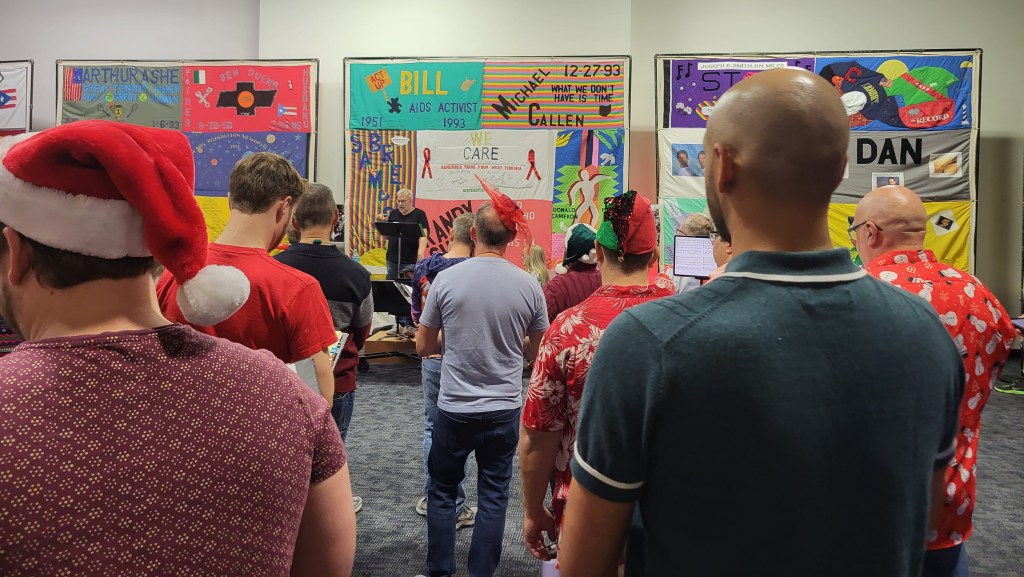
Tonight–on World AIDS Day–I will join other members of the Phoenix Gay Men’s Chorus at the Parsons Center in Phoenix. We will sing as part of a vigil that will remember those lost … and provide encouragement for those who live with HIV every day.

We will be surrounded by the quilts you see here–just a sampling of those created in the 1980s and 1990s–which pay tribute to victims of this horrible disease.

Ironically, this is also the space where we rehearse every Tuesday night, as we continue to prepare for our holiday concert, December 16 and 17 at the Herberger Theater, and a weekend of holiday musical fun and inspiration.

Still today, the quilts prompt a sense of sadness and reverence for lives snuffed out. For people we will never know and never meet. For people we loved and lost. For the beauty they brought and the art they never created.

From my spot on the back row of the tenor two section, I captured fellow members of the Phoenix Gay Men’s Chorus–surrounded by AIDS quilts–rehearsing on November 28, 2023.

My Way Out

In this world of perpetual social upheaval, being who I am-openly gay–isn’t always easy. But I persist.

I decided more than twenty-five years ago that coming out was the only healthy way to live.

With the assistance of two amazing therapists (thank you, Barry and Valerie!) and the love of a small circle of friends and family, I discovered that authenticity was my way out of denial, depression, and anxiety.

Over the years, I’ve written frequently on this topic in my books and here in my blog. Today, on National Coming Out Day in the United States, I’m here to remind you once again that I am a proud gay man.

This one aspect of my identity–the fact that I am attracted to the same sex and married happily to another man–certainly defines the way I see the world. It gives me compassion and empathy for others who are different … no matter their skin color, religious beliefs, economic status, or capabilities.

All my life, I have been protective of those who are disenfranchised and less fortunate. I came from a modest background and have survived personal and family hardships.

As a teenager and young man, I didn’t understand or love myself, but now that I do I feel it is my obligation to remain visible. To pave the way for queer teens and adults who may not yet feel comfortable enough to come out.

In 2023, I think most Americans are supportive of their gay friends, family members, and neighbors. Of course, there is a vocal minority that would prefer we don’t exist. I have no control over their beliefs.

No doubt, a handful of haters will be demonstrating at the end of the Phoenix Pride Parade route on October 22, when I sing and march with my friends in the Phoenix Gay Men’s Chorus.

But they will be overshadowed by the thousands of LGBTQ supporters–gay and straight–who will line the parade route with their parents and children, cheer, and wave their rainbow flags.

We are a country that was founded on the notion of “liberty and justice for all.” At times, we have failed miserably at fulfilling our mission as a democratic society.

But I’m not ready to give up. I still have hope–as a sixty-six-year-old gay man, husband, father, brother, writer, singer, friend, neighbor, voter, and citizen of the United States–that we will find our way out of the political divisiveness that exists.

I’m not sure how we’ll get there, but today–and everyday–all of us who are different must continue to come out, be ourselves, love each other, and remind the world that LGBTQ citizens are valuable, kind, contributing, and responsible Americans. We will not be denied.

Blueberries for the Brave

Life gets messy at times. For instance, Tuesday morning Tom and I were grocery shopping at Fry’s near our home in south Scottsdale. We picked up a pint of blueberries and placed them in our cart.

As we turned the corner and left the produce section, the container popped open. Half of the contents spilled out and tumbled to the floor. Some smashed and splattered. Others rolled fifty feet away.

Of course, accidents happen. We apologized. We helped a few kind Fry’s employees clean up the mess.

On the other end of life’s spectrum, there are spectacular moments that produce a cascade of love and joy. Crescendo moments we imagine and envision on paper, which work out better than we had planned. Seminal moments that transcend our dreams.

Last weekend was filled with those moments–standing on stage at Tempe Center for the Arts with about seventy of my Phoenix Gay Men’s Chorus mates, manufacturing an amazing blend of transformative music and stirring stories for three appreciative, enthusiastic, and occasionally tearful audiences. (They were simply responding to the heartfelt, emotional, honest Born to Be Brave moments that revealed themselves on stage.)

From stage right on the top riser, I sang as a chorus member and watched as a writer. With style, panache, and musicality, five of my chorus friends embodied and embellished a quintet of LGBTQ characters I created months before.

Over the course of the past few months, I’ve observed as they’ve evolved: Bry, a trans character from Idaho who found their voice with the support of friends; Toni, a bisexual artist with an unruly heart of gold; Gregory, a wise-and-resilient survivor of the AIDS-plagued 1980s; Les, an ultra-available, funny and sexy accountant; and Q, a young, flamboyant, energetic, queer leader who owns the stage and won’t be denied.

The premise? In an ode to A Chorus Line, they all audition for the Phoenix Gay Men’s Chorus in Act One. Ultimately, in Act Two, they each grow and join the group. They take the stage. They sing and dance. They find their voices and a new community of friends. In the show’s finale, they perform with the chorus and realize they were born to be brave.

***

Now, a few days have passed. The show is over. The blueberries at Fry’s have been cleaned up. I’m enjoying the high of a successful performance and artistic experience … the creative aftermath … but also recognizing the lull that comes after.

I’m beginning to regain my energy. (I left a lot of it on stage last weekend.) I’m also realizing the power of music and theatre. Friends who attended the concert have told me how much they enjoyed the show, and what a positive emotional impact it had on them–seeing and hearing the triumphant stories of five LGBTQ characters told through music in a world and community that needs love in all its forms … in all its splendor.

It gives me solace to know that — maybe — all of my chorus members and I have helped to create and produce sweet, luscious blueberries for the brave. To help nourish all of us on the rocky road of life.

“Are You Guys Brothers?”

Tom and I get this question a few times a month–sometimes more often. In Arizona, Illinois, or anywhere in between.

We could be at the check-out counter of a grocery store, a restaurant as we wait to be seated, or on the treadmill at the gym we frequent in Scottsdale as we were on Monday.

That’s when a friendly man, wearing a San Francisco Giants ball cap, popped the question. (No, he didn’t ask me to marry him.)

In 2023, I generally smile and respond as I did Monday with “No, we aren’t, though we get that question a lot.” And the conversation ends there.

Depending on my mood–and how much I choose to share my personal story (after all, I am a memoir writer)–I have often gone on to say, “Tom and I are married.” Or “Tom and I are partners.” Or “Tom and I have been together for more than twenty-five years.”

Along the way, we have never received any open backlash concerning our relationship (nor should we). Quite the opposite. We have made more friends of all kinds because of our openness and comfort in our skins. (By the way, it took me decades to get here and I’m not going back.)

With time and reflection, I’ve realized that the question is more of an observation in the world of people we contact who aren’t able to classify the intimacy or closeness they identify between two men standing before them.

Or maybe it’s an acknowledgment on a less significant level that we have picked up some mannerisms from one another that two brothers might have in common. However, we really don’t look alike.

At any rate, I will continue to live my open life as a gay man–proudly–in my community. I will continue writing about my experiences–positive and negative–as a gay man, a husband, a father of two adult sons, a neighbor, a friend.

I will continue singing on stage with the Phoenix Gay Men’s Chorus. As I write this, I have just completed drafting a script about five fictionalized characters living in the Phoenix LGBTQ community in 2023. Their dialogue will be the glue that ties together the music of our next concert: “Born To Be Brave”, June 3 and 4 at Tempe Center for the Arts.

I feel it is my duty to demonstrate that two men–a gay, married couple–don’t have to be blood brothers to love each other.

Especially in a country where some want to remove the books of gay authors from the shelves. Or try to erase the checkered history of our country on race relations because the truth is threatening to some. Or ban drag shows, because they view them as recruitment activities for current or future generations.

Okay, I’ll get off my soapbox now. But Tom and I aren’t brothers. We’re a gay couple living happily in 2023, and there are lots of us out in the world.

We’re making significant contributions. Loving our families. Loving our neighbors. Loving our friends. Loving the legacy, which we are leaving for future generations of children who need to know the truth about the past and the present. That there are all kinds of people in the world loving each other. And that’s just as it should be.

Empty Soles

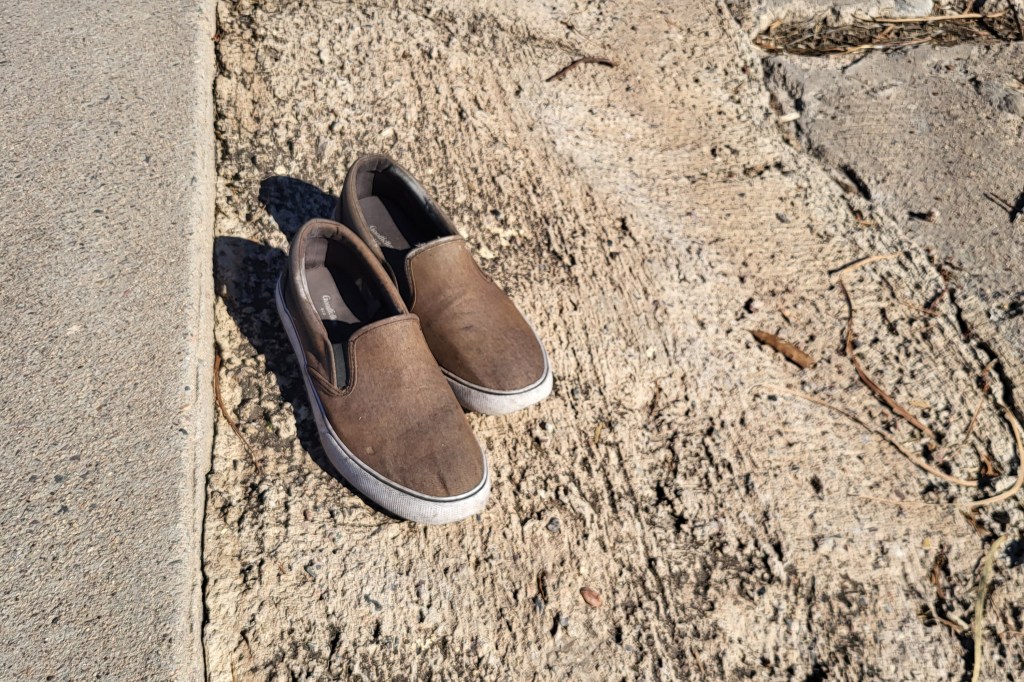
November 3 was a brisk Thursday morning in Scottsdale, Arizona. But when I walked past these empty soles on the edge of Camelback Road after my workout at the gym, I felt an eerie sensation. It was almost like learning a close friend had died or vanished.

My focus shifted immediately away from our cooler-than-average temperatures in the Valley of the Sun. I felt compelled to pay tribute to the remnants of a life well lived. To stop and take this photo and–three days later–write a story about what I saw and felt in those moments. Because that is what I do.

What would provoke someone to leave behind a pair of decent canvas shoes on the side of the road in such an orderly fashion? Did they suddenly outlive their usefulness? Perhaps they were simply an extra pair a homeless person could no longer carry. Or the sensible shoes were forgotten by someone who waited for a bus and was ready to advance to the next station in life.

For my storytelling purposes they are a metaphor for the sense of displacement many of us feel in our country. We’ve been pushed to jump out of our shoes from the criminal escape antics of our past president and the barrage of political ads spewing venom through our devices. Whatever the case, we wait for the next shoe to drop as we anticipate the outcome of the mid-term elections.

If you follow my blog, you know I am a positive person. Generally. I’m thankful for the beauty of nature that surrounds me and the quieter life my husband and I have carved into the desert landscape.

But as a nation we teeter on the precipice of despair. The future of democracy–as I’ve known it for my 65 years and 181 years before that–is definitely on the ballot this coming Tuesday.

Tom and I have already voted. Nearly two weeks ago. I checked the boxes alongside the names of only those who will protect our democracy. Not the high-profile election deniers in Arizona running for senator, governor, secretary of state, and attorney general. We need to believe them when they tell us they wouldn’t necessarily respect and honor the will of the majority of the people.

If you live in the U.S., be sure to vote on or before Tuesday. When you do, I hope you will support those who uphold our beloved U.S. Constitution.

Otherwise, I fear that the close friend who disappeared without their shoes is actually the democracy we once loved before we allowed it to vanish.

Notes from a Lyricist

Nothing is certain, but it appears my debut as a lyricist will actually happen.

In January, I oozed with excitement when I told you about my new creative wrinkle. As background, in the fall of 2021 I teamed with David (another member of the Phoenix Gay Men’s Chorus) to create several original tunes for a Mosaic of Voices concert, scheduled for March 2022.

I wrote the lyrics. David composed the music. I was psyched for the debut of these pieces. Then, the concert was postponed. It was another Covid-related casualty.

Thankfully, the chorus has resurrected the program. On October 8 at the Kroc Center in Phoenix, we will perform the suite of pieces David and I created to capture the essence of original-and-triumphant stories submitted by members of the Phoenix LGBTQ community.

***

On Tuesday evening, as our chorus of seventy or so rehearsed two of the Mosaic of Voices pieces (Hope’s Trail and Our Second Act), I saw a few tears. As I sang in the back row of second tenors, I felt the gravity of emotion rise in the room with our voices.

I was reminded of the healing power of music and the important role that choral communities–first the Windy City Gay Chorus and now the Phoenix Gay Men’s Chorus–have played in my renaissance and in the lives of so many gay men.

Especially now in our chaotic country–divided, threatened, and deconstructed–we need this joyful music, this personal support, this hopeful oasis in the desert.

Without it, many of us would feel trapped and lost.

In the Pink

August has always felt like an insufferably hot way station between the sparkling summer playground of July and autumnal possibilities of September. In short, it is my least favorite time of year.

If this is your birthday month, I apologize. But, after the scorching temperatures of July 2022 in the Northern Hemisphere, we have landed squarely in the dog days of summer. September can’t come soon enough.

Even so–nearly a month after celebrating my sixty-fifth birthday–I am in the pink. I realize this is an old-timey phrase that describes the essence of feeling fit, but I don’t care. I’m a pretty traditional guy with a love of language.

According to Investopedia, “in the pink” first appeared in the late 1500s in a version of Romeo and Juliet as a reference to an excellent example of something.

Somewhere along the way, the expression evolved into a health-and-vitality reference that my parents both used. At any rate, if the phrase was good enough for William Shakespeare to include in his classic play nearly 500 years ago, it’s good enough for me.

I’m not saying I have the vitality of fifteen-year-old me pictured here in pink in 1972. But, aside from typical muscle aches after yoga or an intense workout at the gym, a new-found intolerance for gluten, and the normal forgetfulness that comes with my new Medicare status, I generally feel well for a guy who survived a mild heart attack five years ago.

And I still have a thick head of hair, though it no longer falls in my face. At this stage, I wear it short. Often under a hat to please my dermatologist and protect my fair skin from the intense rays of the Sonoran sun.

I also remember the ribbing I received from classmates for wearing this pink shirt (and other closely related pastels) back in the 60s and 70s.

At that moment in time, I wish the current much-older-and-wiser Mark Johnson could have magically appeared through an adjacent door to counsel fifteen-year-old me.

In my pink fantasy, he would simply have said …

“Never hide. Stand tall. Forget the haters. Be proud of who you are. Wear whatever colors you want. One day you will find your way. You will stand on stage. You will sing songs. The pain of the past will fade. You will raise two sons and live your own definition of masculinity. You will meet a man, fall in love, and marry him one day. The two of you will move west and create a quieter life. You will choose to wear pink again and again–and do it in style. You will survive. You will discover an open, authentic life. You will write books. You will tell stories. You will even write lyrics in your sixties. You will rise above the fray.”

Beaver’s Pigeons

At seven-fifteen in my Monday-morning, Me-TV, Leave It to Beaver universe, older brother Wally delivered sad news to Beaver from the other side of their closed bedroom door.

A mischievous neighborhood cat had killed Miss Canfield and Miss Landers, Beaver’s pigeons named after his favorite teachers. The crisis occurred during Wally’s watch as crestfallen Beaver quarantined with a case of chicken pox.

“Beaver’s Pigeons” (season 2, episode 20 of Leave It to Beaver) first aired on February 12, 1959, in an America long gone and mostly forgotten.

But it still exists as a comfortable escape for Tom and me–a lesson-laden gift from our past civilization that taught children right from wrong and nudged parents toward greater understanding through humor and humility.

Watching it over breakfast today momentarily softened the blow of 2022’s cataclysmic news tsunami: the U.S. Supreme Court’s repeal of Roe v. Wade that turns the clock back fifty years in human rights; the stunning evidence of corruption unearthed by the January 6th committee that dwarfs Watergate; and the devastation of the war in Ukraine that has shaken the world.

Then, as the episode unfolded, I felt the velvet hammer of realization clobber me. What was it about Beaver’s loss of two ordinary pigeons that moved me to tears over my yogurt and granola?

Certainly, it was the kind response of Beaver’s friends Larry and Whitey. They told Wally–and Ward and June, Beaver’s idyllic parents–they knew it would help Beaver deal with the loss of his pets if he could watch from his second-story window as they dug a hole and buried the pigeons in the side yard.

As Beaver glanced down to view the pet funeral, my tears also were prompted by this harsh reality that slaps me in the face daily: I live in a country that has lost its way, dismisses innocence as weakness, and embraces conspiracy theories over truths.

Too many in this nation fight more vehemently to protect their guns than their youngsters, reject books and diversity in favor of fear, and resist proven vaccinations that keep safe our most vulnerable citizens.

I know I’m not alone in my observations, anxieties, and worries. The majority would agree with my assessment. But as I approach my sixty-fifth birthday next week, I wonder if we will find a way to turn the tide for our children and grandchildren.

Like black-and-white Beaver in the late 50s–now more than ever as the losses mount–we need to give our youngest citizens the love, guidance, truth, and protection they deserve to cope in an often-upsetting world.

Fallout

We sat–quietly and obediently–in rows facing the front of the room. Most of the girls wore frilly dresses, bangs, and patent-leather shoes; the boys sported bold-striped shirts, crew cuts, and bright-white Keds.

Our mornings and early afternoons were occupied with simple math, spelling, reading, recess, and cartons of cold milk on lunch trays. The American flag draped over the alphabet border above the blackboard.

Images of George, Abraham, and John–Washington, Lincoln, and Kennedy–stood guard. I suspect they were there to ease our minds and protect our American innocence.

If only it were that simple.

***

I don’t remember feeling fear, when our teacher told us it was time for another drill. We knew the routine and followed instructions.

A voice on the public address system told us when to practice hiding under our desks, when to duck and cover, when to escape to fallout shelters in hallways if a bomb were dropped.

It lasted but a few minutes. We covered our heads and faces until the all-clear signal came from our teacher. We absorbed the fear–the height of the Cold War–without knowing what it was.

This was what we knew in the early 1960s in middle America. We were fortunate these were merely practice drills, false alarms.

I imagine the scenes weren’t much different in schools on the outskirts of Chicago, Cincinnati or Cleveland. At Mesnier School in Affton–ten miles from downtown St. Louis–we aspired to a gleaming symbol. We lived in the shadow of an emerging national monument.

By its completion in 1965, the Gateway Arch would soar, though across the nation the fog of pollution and social issues intensified.

As history would have it, all of the names of St. Louis school children would be stored in a time capsule in the base of the Arch. Mine is among them.

Back in the classroom, between random drills and parent-teacher conferences, we learned to add, subtract, multiply, and divide. We tied our shoes and kept on skipping in a world where rules were prescribed narrowly for girls and boys.

This was the credo for boys: Get good grades in school. Be prepared. Keep your eye on the ball. Run faster. Jump higher. Find a decent job. Don’t be a sissy. Meet and marry a woman. Buy a house. Have kids. Keep your nose to the grindstone. Pass the baton to the next generation.

But what about those of us who are different? Where do we fit into the story? We had to figure that out for ourselves.

***

The sixties weren’t pretty. Assassinations reigned. The Vietnam War raged. Poverty and racism amplified. People felt trapped, ready to shed the remnants of restrictive gender roles and sexuality, sealed in the repressive 1950s.

But the world is exponentially more complicated now. The latest madman is hellbent on ravaging innocent people in Ukraine. Though love appears in abundance in many circles across all continents, ignorance and hate manifest themselves next door and around the world.

Once again, sixty years later, we find ourselves living in fear of the fallout. We must find ways to duck and cover, to speak the truth while standing as tall and mighty as the Gateway Arch.

We owe it to our children and grandchildren to put politics aside, to protect our planet, to uphold individual rights and civil liberties, to teach them about black and white, but also the color and grayness of the world and all its permutations. Pandemic or not, they are watching.

Even if they don’t know it, the youngest members of our society are counting on us to speak the truth, denounce racism and hate, celebrate gay and straight lives, and to teach them that every generation has a responsibility to remember and honor the seminal moments in history, and–hopefully–carry the best of humanity forward.
What I Feel

In addition to writing four memoirs, I’ve been blogging for nearly four years. A few of you have joined me for every twist and turn. I feel humbled by your interest and loyalty.

In my first post (May 4, 2018), I shared ten tips for writing a meaningful memoir. I believed then (as I do today), that each of us has at least one story to tell. If you are an aspiring writer, who is searching for a little inspiration, you may find these tips helpful.

#4 on the list is especially important if you are looking to engage readers, because feelings–fear, disappointment, grief, joy, excitement, anticipation, etc.–are universal:

Write what you feel. Go beyond reporting what you know. The details are important, but not as much as how you were affected by the occurrences that appear in your story. Tell your reader how you feel. Describe your experience—how the positive, negative and unusual happenings in your story touched your life.

Often when I sit down to write a new blogpost–and my fingertips touch the keyboard of my laptop–I’m uncertain what I want to write. But from the beginning of this odyssey, I’ve vowed to follow my own advice to tell and show you what I feel about personal and global issues.

That has included the emotions connected to creating an authentic life as a gay man and father of two sons; recovering from a heart attack; building a new life in the Sonoran Desert with my husband; aging in a predominately youth-focused society; surviving a global pandemic; and simply observing the healing properties of animals and nature.

Even in our uncertain American society–still hamstrung politically and dealing with the ravaging effects of COVID-19–I feel fortunate to have a safe home, good health, enough food to eat, and a community of family and friends nearby.

However, I also feel a strange mix of anger, anxiety, and sadness. I attribute that to the frightening stories and images of what’s happening in Ukraine.

I won’t pretend to understand the politics of it but can imagine the tremendous pain that is occurring as Russian troops invade and thousands of innocent Ukrainian civilians are threatened.

The deceptions and power-hungry antics of certain world leaders–rooted in lies and insatiable egos–are unacceptable to me. So is the growing level of American ignorance and intolerance for the truth of what history and provocative literature can teach us.

Yet we have too many “adults” in communities clamoring for the removal of books, which might help teach our children to become critical thinkers. On that note, what I feel today is the excruciating pain of what our world has become.

Rest assured, I will continue to write and voice my concerns, but I feel it’s best if I set aside my laptop for the moment. Here in the Valley of the Sun, I’m going to lace up my sneakers on a gorgeous Friday afternoon and take a hike to Papago Park.

I’m certain the sun is shining there, and the saguaro cacti are standing tall.