No writer wants to be known as a one-trick pony. Yes, to this point I’ve written mostly creative nonfiction, but each of my four books includes flashes of poetry. And, in my latest book of essays–home grown on the metaphor of pruning a lemon tree in my desert community–I also dabble in fiction.
In other words, I have no problem branching out into the great beyond of fruit trees. Grapefruits, for instance.
Here in our Polynesian Paradise condo community we live among lemon, tangelo, orange, fig, and lime trees … even a lone pomegranate. But we are surrounded by a bumper crop of pink and white grapefruits that will be ready to pick in late December. They are a far cry from the maple, elm, magnolia, oak, and gingko trees of my Midwestern past, which will be bare soon.
I’m not a fan of grapefruits. They’re too tart for my palette. Plus, if I ate them they would counteract the positive effects of the statin medication I take to keep my cholesterol count in the normal range.
However, Nick–my older son who lives near us–craves these tangy softball-size citruses. (I remember my dad loving grapefruits too. In fact, Nick resembles him. It’s funny how certain likes, physical qualities, and personality traits skip a generation.)
This afternoon I texted Nick this photo with a grapefruit update: “You’ll be happy to know the grapefruits are shaping up. They’ll be ripe in a month or so.”
“Oh nice” was Nick’s laconic response.
As the citrus-plucking season draws nearer in Arizona, here’s a snippet from I Think I’ll Prune the Lemon Tree, my book of whimsical and serious essays available in Kindle and paperback on Amazon.
***
Nick is especially enamored with the citrus trees—most notably, the plethora of grapefruits that dominate our condo complex grounds. In December and January each year, Nick the Citrus King contacts me frequently concerning the status of the ripening citrus crops. His texts or phone conversations begin something like this:
“Hey there. Are the grapefruits ripe enough to pick?” There is no preliminary happy talk such as “How are you feeling, Dad?” before the citrus cross-examination.
Aware of Nick’s citrus sensibilities and no-frills communication style, in January 2020—as a belated Christmas present—Tom and I surprised him with his own fiberglass fruit picker. We gave him one with a durable steel trap and extendable arm, which would extend his reach to grab the largest orbs clinging to the highest branches in a galaxy far beyond low-hanging fruits.
Upon receiving his gift, Nick’s smile grew three sizes. With the flexible picker in one hand and a few empty bags in the other, he and I set out to corral a selection of the sweetest and juiciest citrus delicacies we could find in the common areas of our complex.
Twenty minutes later, we returned to the condo with a mix of white and pink grapefruits, tangelos, lemons, and oranges. Harry & David would have been proud to grow, pick, and ship them to Vitamin-C-starved customers in cold-and-gray winter climates.
Without a crystal ball or a notion of where to find a citrus psychic, I have no way of knowing where Nick’s quest for fresh grapefruit will lead. But I am gratified to see him plucking fruits from the sky and flourishing in his Arizona life despite the heat.
Today I will march (and sing) in the Phoenix Pride parade with other members of the Phoenix Gay Men’s Chorus. As an open and relatively healthy sixty-four-year-old man–married to another open and relatively healthy sixty-four-year-old man–I have a lot to be proud of, a lot to be thankful for.
I remember the unactualized, closeted version of me in my thirties, the sense of isolation I felt after my divorce in 1992, the challenges of single parenthood as I sat alone in the bleachers (in a sea of suburban straight couples) watching my sons play ball, the pain and anxiety that ruled my life as I moved from job to job and tried to find my way.
Fortunately, by the mid-90s, I found friends and colleagues who supported me. They cheered when I came out and began to speak my truth.
In hindsight, knowing what it felt like to be ridiculed for who I am sharpened my empathy. It gave me strength and insight that–more than two decades later–I parlayed into my writing. In all four of my books, especially my latest, I Think I’ll Prune the Lemon Tree, I tell the story of my personal and gay evolution.
Telling my truth has proven to be cathartic and healing. I am the happiest when I give voice to my experiences and opinions, whether they relate to my sexual orientation or not.
In 2021, I rarely find myself confronted with blatant homophobia. But there are occasional “teachable” moments when I encounter someone who is ignorant or unaware that gay people seek the same love, understanding, and sense of belonging that straight people receive unconditionally.
I don’t have a problem getting up on my soapbox to defend that right, though I also don’t crave controversy. I prefer simply living honestly and openly, and letting those around me observe how I lead my life … versus the pitfalls of social media exchanges.
The key is visibility. The more of us who are out–and proud–in our daily lives, the more individuals in all circles will realize we have the same hopes and dreams: a loving spouse and family, a safe and secure home, gainful employment, personal freedom, a sense of community and belonging.
As I march in the Phoenix Pride parade today, I’m sure I will see all sorts of people in the crowd: Black, Hispanic, Asian, White, Native American. Many of them will be lesbian or transgendered or gay like me. Others will be straight allies cheering us on. There is power and creativity in our diversity.
Yes, we’ve come a long way in American society since I struggled along in the 1990s. But hatefulness has seen a resurgence. There are still instances of gay teens being kicked out of their homes or individuals losing their jobs, simply for being who they are.
What can we do as a society? Teach our children to love each other and embrace our differences. Because kindness is a choice; sexual orientation is not.
***
Pride postscript. It’s Saturday evening in Arizona. Though the parade is over, I will always remember the sense of freedom and inspiration I felt today. Shouting “Happy Pride” to exuberant strangers three deep along the parade route … all of us survivors of a frightening pandemic. Skipping down Third Street and singing Born This Way with my gay friends.
Rejoicing at the large number of young children in the crowd with gay and straight couples twirling rainbow flags. Waving to my smiling husband wearing his floppy hat. Celebrating the day with a rainbow umbrella that colored my world and protected my fair skin from the blazing sun.
Long after the most cherished and meaningful moments pass, our memories–good, bad, vivid, and foggy–endure like saguaro cacti dotting the terrain of our vast consciousness.
***
Over the weekend, the lone survivor of my mother’s prized African violet plants died. Tom and I discovered it withered on the window sill of our Scottsdale condo. I supposed it succumbed to the heat of the desert’s afternoon sun.
The plants originated in St. Louis in the 1980s or 1990s. They traveled to the Chicago area with Mom when she moved north to be closer to my sister Diane and me in 2004.
When Mom died in January 2013, Diane divided up the remaining African violets–one a shade of pink, the other a purplish blue–for the two of us to carry forward and display in our respective homes.
For the next four years, my cuttings flourished in our Mount Prospect, Illinois home. In early July 2017, Tom and I wedged them in a laundry basket in the back seat of our Hyundai Sonata. We brought them west from Illinois to our new home in Arizona.
On the road, after I suffered a mild heart attack in St. Louis and couldn’t lift anything for a few weeks, I remember my husband carrying the African violets between our car and hotel rooms in Missouri, Oklahoma and New Mexico to protect them from fluctuating temperatures overnight. It’s a memory I will always treasure.
When we arrived in Scottsdale on July 12, 2017, Tom and I deposited the plants on our southern-facing window sill. The pink African violet lived two more years before petering out in 2019. Now the purple one is gone too. It last bloomed ten months ago in January 2021 … eight years after Helen Johnson’s passing.
Of course, I feel a twinge or two of sadness. This marks the end of a long, circuitous chapter, connecting my present life to the past memories of my nature-loving mother.
But, at this point (four-plus years in my Arizona home), Tom and I feel rooted in the desert. We have chosen and nurtured plants that embellish our life in this warm, dry place: bougainvillea, desert roses, succulents, even a bird of paradise.
To be sure, though their physical evidence is gone, the stories of the traveling African violets and the memories of their captivating blooms will be with me as I hike the rises and falls of the Sonoran Desert with Tom.
October is renovation month in our household. We’re remodeling our Sonoran bathroom: installing a walk-in shower to replace our clunky-and-outdated shower/tub combo; raising our ridiculously low ceiling; putting in a new toilet; upgrading the sink, vanity and mirror; laying mosaic tile to accent existing porcelain squares; wiring and connecting contemporary lighting; the works. It will be beautiful when everything is done next week.
The guy Tom and I hired to install and update everything is skilled and thorough, it’s just that the project is taking longer than expected–longer than it should in our book for a variety of reasons I won’t belabor here.
Suffice it to say, that each morning when our remodeling guy arrives we discuss the work ahead with him and what we expect to be completed that day.
This morning, I escaped the mayhem of our modest and ordinarily quiet condo for a few hours. I needed a swim away from our immediate community. (Tom and I are taking turns doing this to keep our sanity.)
Enter Frank. He’s a friend I see at Eldorado Pool (two miles from our home) on occasion. Whenever I see Frank, we have topical and lively conversations … about the state of the world, our past lives in the Midwest, the plight of our favorite sports teams, his job as a nurse in the behavioral health wing of a nearby hospital, my life as a writer. Frank has read at least one of my books.
As I changed into my swim trunks in the locker room this morning, Frank asked “What’s new with you guys?”
“We’re trying to survive our bathroom remodeling project,” I sighed.
“Rich-people problems.” He responded matter-of-factly as he fumbled with the contents of his locker.
What happened next surprised me. I laughed so hard, more loudly than I have in a long time. Why? I suppose it was some sort of release. Also, I realized in a flash that Frank gave me the reality check and perspective I needed.
People are dying of Covid. Others are struggling financially and/or dealing with the untenable and unreasonable demands of work, child-rearing, and elder care in a crazy and politically polarized society.
Through that lens, my life at sixty-four is relatively steady, simple, and manageable … notwithstanding an annoying remodeling project that would fluster you too if you were standing next to me gazing into the disarray of our condo.
Back to Frank. Let me be clear. His “rich-people problems” comment wasn’t referring to my financial status (we live comfortably, but aren’t wealthy), trivializing my concerns about the bathroom inconveniences that Tom and I are living through, forgetting the past challenges we have faced as a same-sex couple who survived a heart attack on the way west, or discounting the numerous other losses and heartaches we have endured.
The nut of this story is this: today Frank crossed my path to remind me I am a “rich” person with a “rich” life … a loving husband, two adult sons who enjoy spending time with their dad, and a “golden” (Frank’s word, not mine) life living in Scottsdale, Arizona in our retirement years.
Yep … “rich-people problems” sums it up nicely. Thank you, my friend, for being so authentic. For being so Frank.
Grief is an insidious and universal human condition. When you love someone–and they leave or die–you need something to fill the space they’ve left behind. Grief enters to fill the void.
If you are in the midst of grieving (as I was in 2013 and 2014 after my mother passed away), it may feel as if you are wandering through a deep fog. Or you might wonder if you are chained to the floor in the middle of an empty room with water pouring in over all four walls and seeping through the floor boards.
That’s how grief can manifest itself, but for each of us the path is different. The loss lightens over the years. Still, we carry it wherever we go. It becomes an extension of us, ingrained in our identities.
In 2014 and 2015, I saved myself from drowning in grief by writing about it. My mother and grandfather helped immensely. They left behind a trail of their thoughts and experiences on paper … in the form of a mountain of letters from Helen (my resilient mother) and diaries from S.R. (my farming grandfather).
After my mother’s demise, reading her handwritten and wisdom-filled memories and her dad’s more stark observations prompted me to tell all three of our stories in one book. From Fertile Ground became my salvation. Yes, in 2015 it consumed me, but it also gave me renewed creative purpose and focus after I left my corporate job.
When I finished and published the book in 2016, I felt it was a story that would alleviate pain for grief-stricken souls. Five years later, I still feel that way. It helps me to revisit my book and my grief from time to time. Readers have taken the time to write reviews like this one online.
“From Fertile Ground” is more than just a terrific read. Johnson is generous in taking the reader into his world, his journey, his family, his emotions. In so doing, the reader obtains a soothing sense of identification of the human condition, particularly how we work through grief and loss. Johnson’s mother’s and grandfather’s letters are interspersed throughout the narrative (and connected) which adds to the reassuring sense of a collective history.
We live in a complicated world. Many of us are suffering through the side effects of loss and searching for answers. It gives me joy knowing that my book is a creative balm for many, possibly even an antidote for grief.
At any rate, as the days grow shorter in the Northern Hemisphere, I hope this personal and universal three-generation story inspires you and brightens your world … no matter who you’ve loved and lost, no matter where you live.
From Fertile Ground is a three-generation memoir and writer’s mosaic of love and loss. Published in 2016, it examines the implications of grief and our quest to make sense of our past so that we can find our path and move ahead.
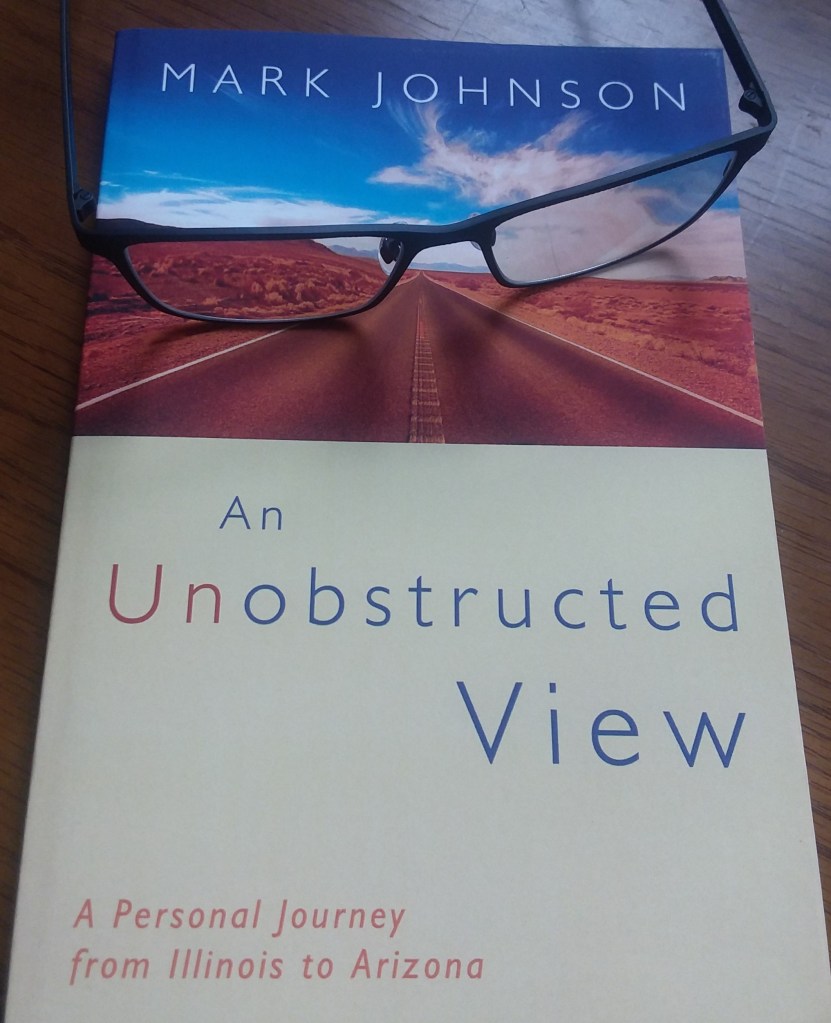
If you need a true, inspiring story of survival to fill you up, pick up An Unobstructed View on Amazon for just a few bucks today. The paperback is less than three dollars. Happy reading!
Our lives are an intricate tapestry of disparate threads. They weave over, around and through us. It is up to us to tie the loose ends.For those who seek and remember, we are on a lifelong quest to integrate the texture, color, and reality of our experiences.We return to our past lives to celebrate and reexamine what we have left behind and to find the greater meaning.
***
In August of 1976, I operated the River King Mine Train controls for the last time. I said goodbye to my rollercoaster crew mates, walked down the asphalt hill, punched the time clock, changed out of my Six Flags Over Mid-America (SFOMA) uniform, and drove my parents’ blue 1970 Chevy Belair four-door sedan from Eureka, Missouri to my childhood home in Affton. I was nineteen years old. I was ready to depart the St. Louis area to begin my sophomore year at the University of Missouri in Columbia.
It would take me forty-five years, but on the evening of September 4, 2021, I returned to Eureka. I went back to revisit my formative-and-repressed teenage years (and the scene of my first job and colleagues) and anchor them to my sixty-four-year-old existence as an openly gay writer, husband, father, son, desert rat, and heart-attack survivor.
The setting for my personal melding was the 50th reunion of SFOMA employees from the 1970s … shiny, bouncy teens and twenty-somethings who had evolved into grayer versions of themselves. In their sixties and seventies, many had gained weight and lost hair. Others had left us entirely. But those who remained had somehow managed to salvage their spark and spirit of adventure.
Tom and I flew together from Phoenix to St. Louis, but this portion of the journey was mine alone. (My husband stayed back at our hotel to read. Though he was 100 percent supportive of me going to the reunion, he had nothing to renew with a Missouri gang that would gather under a covered outdoor picnic area inside a St. Louis-area amusement park. Tom is a native Chicagoan.)
After I parked my rental car at what is now called Six Flags St. Louis in a relatively empty parking lot, I threw on my face mask, zipped up my windbreaker, and pulled up my hood. Yes, it was raining again, but the sky had begun to brighten as I fumbled for my ticket, walked through security, and entered the main gate.
If you had blindfolded and air-lifted me into the space and then removed my eye covering, I wouldn’t have known where I had landed. But I was happy to be there nonetheless. With a little help from a SFOMA map in the park, I found my way to the River King Mine Train, situated on the eastern side of the park. I headed up a steep hill that began to look familiar, past a restaurant, once called Naylor’s. In the 1970s, it served greasy fried chicken. That trail and olfactory memory led me to the entrance of the River King Mine Train.
Back in the 70s, there were two mine train tracks that were pressed into service on the busiest days. Now there is only one. I snapped a quick selfie in front of the ride sign and peeked in to see the 2021 version of the mine train crew at work and a train leaving the station. Then, I headed to the Palace Theatre to see displays of photos and memorabilia from the 1970s, when the park was sparkling new and crowded nearly every day … rain or shine.
When I paused for a quick pic of the Log Flume ride (along with the mine train, one of but a few original attractions that remain), I accidentally dropped my mask. Kevin, another reunion attendee, told me so. I swiped it off the ground and for the next ten minutes we traded stories of working in the park.
I soon discovered Kevin had also operated the mine train a year after I left … then he moved up another rung to the Screamin’ Eagle, which opened in the bi-centennial year. In 1976, it was that death-defying, stomach-dropping rollercoaster kids ran to ride as soon as the park gates opened each morning.
At six o’clock, I walked to the picnic entrance for the reunion. While I was in line, Cindy approached. Long ago, we were mine train pals for three summers; in 1974, we worked the swing shift — 11 a.m. to 8 p.m. Supervisor Larry and foreman Gus (Cindy and Gus would marry a few years later) trained us at the same time to “drive” the rollercoaster and master the controls.
Cindy and I hadn’t seen each other in more than four decades–nor had we shared the up-and-down stories of our lives–but I felt the chemistry of our friendship return as we hugged. When I told her I had no clue of my sexual orientation back then, I realized why I had traveled from Phoenix to St. Louis. I needed to connect another piece of my past, less actualized, rollercoaster life in Missouri with the more even and authentic one I had created with Tom.
Cindy was on the reunion planning committee and needed to check on a few things, but we agreed to talk more once the event got started. After I filled out my name tag and an attendant handed me a 50th anniversary reunion pin, I walked through the crowd of 200 and chit-chatted.
I didn’t know or remember most of the attendees–singles and straight couples with their own stories and reasons for returning–though I could squint and recall younger versions of pretty and handsome cohorts lined up to greet guests nearly fifty years before.
A cooler breeze swept through. The rain stopped. Cindy returned. We stood in line together for a buffet dinner … beef brisket, baked beans, and potato chips. I suppose it qualified as a meal. What else should I have expected? It was amusement park food.
For the next thirty minutes, Cindy and I shared the highlights and lowlights of our past lives — the joys and tragedies that come with living and growing older. To keep the privacy of that moment, I’ll leave it at that.
On cue, the welcoming speeches from past leaders followed, along with a video collage set to music from the 70s. I felt sad more than happy as the images faded in and out. Though it reminded me of the hard-working days and fun-filled nights decades before, it also felt like I was viewing a fantasy land far away from the world we now occupy.
As the evening began to unwind, I pulled a signed copy of Tales of a Rollercoaster Operator out of my backpack and handed it to Cindy. She smiled and thanked me. I invited her to visit Tom and me in the Sonoran Desert one day. Though she’s lived in Germany and speaks several languages, Arizona is a place she has yet to visit.
Before I left, there were door prizes, more hugs, and a small stream of goodbyes. At 9 p.m. I was ready to go. I made my way in the dark back to my rental car. No more rain. The sky was clear. The air was nearly crisp for a September night in Missouri.
I retraced my steps on I-44 to the Hampton Inn in Valley Park. Tom was waiting to hear more about my rollercoaster days, the 50th reunion, and the night I returned to Eureka, Missouri to tie up a few loose ends.
As I write and reflect on this experience, I realize my return to the past playground and promise of my youth–in the middle of a pandemic–placed me outside my comfort zone.
But, with my vaccination and mask protecting me and the creative impulse guiding me, I’m glad I went back there. The bonus was reconnecting with a good friend.
In addition to my memories, I left St. Louis with this souvenir of the 50th reunion of Six Flags Over Mid-America employees of the 1970s. It was held at Six Flags St. Louis in Eureka, Missouri, on September 4, 2021.
It rained most of September 4, 2021, in eastern Missouri. Fortunately, scattered-but-heavy showers didn’t wash away our plans.
At nine a.m., Tom and I drove north thirty minutes from our room at Hampton Inn Valley Park to visit my cousin Phyllis and her family in their St. Charles, Missouri home.
After we exchanged hugs, Phyllis’ husband Tom prepared homemade blueberry-and-apple pancakes. We volleyed catch-up stories between the kitchen and family room, while their golden retriever Truman sidled up to Tom and me on the couch, placed each of his front paws in our laps, and stole our hearts.
For the next two hours eleven of us–spread across three generations–gathered around a rectangular kitchen table framed by angled windows and a lush backyard.
The two Toms, Phyllis and I represented the senior set. Amanda, Austin, Kelsey, and Bryant smiled and shared stories of their thirty-something, heavy-lifting, career-and-child-rearing years. They shepherded and cradled: three-year-old Ava, who danced around the table in her princess gown; adorable one-year-old Violet, who is learning to walk; and baby Brooks born in July with a head of hair.
It was a treat for me to spend time with them all, the entirety of my Johnson family connection that remains in the St. Louis area.
Thankfully, the reunion around Phyllis’ and Tom’s table superseded our previous encounter at an Italian restaurant in St. Louis on July 5, 2017. It was one day before I suffered a mild heart attack as Tom and I walked to Left Bank Books in St. Louis’ central west end to see my book of light-hearted Missouri stories on the shelf.
***
When we left St. Charles just before noon, I pointed our rental car southeast. Tom typed the address for Jefferson Barracks National Cemetery into his smartphone to find the most direct route to my parents’ graves.
Ironically, our most recent visit to the rolling hills of white marble grave markers on the banks of the Mississippi River was four years ago–the same day we last saw Phyllis and Tom. But on this occasion–September 4–we were in town on what would have been Dad’s and Mom’s seventy-third wedding anniversary.
I had hoped to stop somewhere for a small bunch of flowers to leave on their graves. That never happened. Instead, we arrived at the cemetery entrance empty handed, made two right turns and one left, drove past the chapel, traveled up a hill, and parked our rental car under a tree.
About the time we arrived, the rain paused. We walked a hundred steps or so to DD 355, where Dad and Mom are buried near a large oak tree. As Tom and I surveyed the grounds and knelt quietly, he spotted two acorns side-by-side on top of the wet grass on Mom’s side of the marker.
Before we left, I placed the acorns on top of the marker in honor of their wedding anniversary.
I suppose even in the solemn solitude of a cemetery the strength of our family ties endure and life goes on.
My parents, Walter A. Johnson and Helen F. Johnson, are buried at Jefferson Barracks National Cemetery south of St. Louis, Missouri. Walter was a sergeant in the Army, who served in World War II. Mom and Dad met on January 4, 1948 and married on September 4, 1948 in St. Louis. Walter died one week shy of his eightieth birthday, on November 26, 1993. Helen passed away on January 26, 2013. She was eighty-nine years old.
Tom and I are flying to St. Louis tomorrow. On Saturday, I will attend an outdoor reunion of Six Flags Over Mid-America’s circa-1970s employees. About 200 of us will gather to mark the 50th anniversary of the amusement park in the rolling hills of Eureka, Missouri thirty miles southwest of the Gateway Arch that towers over the Mississippi River.
Now called Six Flags St. Louis, the theme park is where I landed my first job in 1974. It’s where I learned to “drive” the River King Mine Train, the park’s first rollercoaster. It’s also where I began to navigate life’s ups and downs. Who knew the experience for three summers would become a metaphor and catalyst for a book I would write more than forty years later?
This will be my first trip to St. Louis since July 2017. I’m overdue to write a new and rejuvenating chapter in my original hometown … one that doesn’t include heart trauma and a personal detour that spawned uncertainty on my sixtieth birthday.
I’m excited and a little anxious about this journey, given the relentlessness of our global pandemic. But Tom and I have been fully vaccinated and will mask up for this adventure.
No doubt, the trip will reignite a flame of familiar faces and memories. I expect there will also be a few surprises and a mix of bittersweet feelings and observations seen through blended bifocals and sixty-four-year-old eyes. We’ll see.
After the Missouri reunion–plus a visit to my parents’ graves at Jefferson Barracks National Cemetery, a few hours reconnecting with my cousin Phyllis in St. Charles, and coffee with a St. Louis friend I haven’t seen for more than twenty-five years–Tom and I will drive to Chicago to see my son Kirk and our sisters Sharon and Diane.
We haven’t visited the Windy City … a place I called home from 1980 to 2017 … or spent time with our siblings in the suburbs there since June of 2019. Of course, the pandemic is the culprit that accounts for that gap.
I wrote the poem that follows five years ago. In 2017, it first appeared in Tales of a Rollercoaster Operator, my book of reflective, light-hearted, growing-up-in-Missouri stories.
Perhaps these words will resonate with you–wherever you were born, wherever you call home. The poem certainly has special meaning for me as I return to visit my homes in Missouri and Illinois that account for most of the first sixty years of my life, before Tom and I created this warmer, lighter, and simpler life in Arizona’s Sonoran Desert.
***
Coming Home
I saw you there day after day. We were together leaving the station. We made our way around the track. But now I don’t see you anymore. Where have you gone familiar ones? Could it be you left the track and vanished? Am I alone looking down from my perch? Are the markers and signs all that remain? What became of the rises and falls? Have you left me in charge to man the controls? Am I enough to carry this forward? Why have you brought me back here? Oh, that’s right. I remember now. I was on a journey. I was coming home.
I wore this badge for three summers (1974-1976) as a rollercoaster operator at Six Flags Over Mid-America in Eureka, Missouri.