In this season of rebirth, I am reminded of my transformative journey that began five Aprils ago.
***
I should have known better. Life had taught me there was nothing certain about any journey.
I had already navigated the ups and downs of my St. Louis childhood, struggled along as a single dad, shed illusions of a straight existence in favor of an authentic life, and retraced the path of my mother’s life from fertile ground.
Yet, I didn’t expect the journey I was about to embark upon with my husband–waving goodbye to one home and resurfacing in another–would prove to be as circuitous.
By the fourth month of 2017, Tom and I had drawn up the details of our dream. We would sell our home in northern Illinois; escape the cold; move to Scottsdale, Arizona; and live in the desert permanently. We wouldn’t be denied.
It all began in April with the physical trappings of certainty. We were locked into a familiar pattern of cool and damp Lake Michigan air with only a ray or two of sun filtering through the clouds. But as we prepared to leave behind the permutations of our past, we also knew there was heavy lifting to be done.
Before we could leave the Midwest and say goodbye to our Illinois family and friends, we needed to sell our home in Chicago’s northwest suburbs.
***
What you just read is a portion of the prologue from An Unobstructed View. If you find yourself intrigued and pondering your own personal transformation, my third book will have special meaning for you. Download a free copy on Amazon through Monday, April 18.
One simple request: once you are through, please take a few moments to post your review.
As I’ve gotten older, I’ve discovered I need more private time. This feels like an odd thing for me to admit, because–at one time–I would have considered myself a strong extrovert.
Now that I’ve been away from my consulting career for more than eight years, I realize I was more of an introvert all along. One who was good at solving problems, facilitating outcomes, and wearing a multitude of hats. I was required to be “on” far more than I wanted.
Finding the magic as a writer has been the result of tunneling in versus extending out. It’s been an exercise in spelunking … getting lost in caves of consciousness … then exploring that space.
This creative cocooning is an activity I love, and one I have become protective of. (Translated, that means I get grumpy when there are too many social demands on my time. I can imagine my husband nodding knowingly as I write this.)
Even so, there have been times over the past two years, when I’ve missed the human connections that many of us took for granted in a pre-pandemic world. For instance, reaching out to engage with readers in person or simply being in the same room with others to experience the impromptu moments of life.
On Friday night, I got a dose of the creative community I craved during the depths of the pandemic. Tom and I attended a Storyline SLAM event at Changing Hands bookstore in Phoenix. The theme of the evening was Magic, so each story needed to include that component in one form or another.
The process was pretty loose. Organic might be a better word. Eight people–four before intermission, four after–took turns telling stories on stage in six-minute segments.
When each storyteller finished, five judges (sprinkled in the audience of one hundred) held up mini tote boards with a score. Thirty points were the most possible, because the highest and lowest scores, raised high by the judges, were tossed out.
Driving there, Tom and I knew there was an outside possibility that members of the audience could volunteer to tell their stories in the moment. So, I brought one of my books, An Unobstructed View, in the car–just in case I summoned the courage to get up on stage. The idea intrigued and petrified me.
I’ll cut to the chase. I wrote my name on a slip of paper when we got to the event. I dropped it into a box, where it might be drawn. And it was. As I chugged a glass of pinot noir and squirmed in my seat, I learned I would be number three on stage to tell a story.
When my turn arrived, the anxiety I felt was palpable. Still, I walked to the stage and stood before the mic. I opened my book to page 41 and began reading from a chapter titled The Best Ears of Our Lives. Here’s an excerpt of what I shared that night.
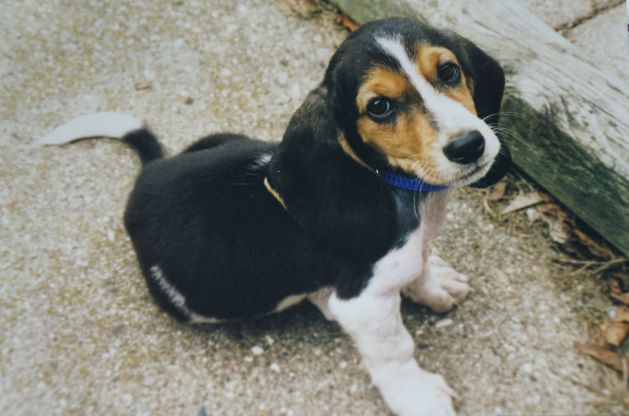
… in October 1998, I became a dog owner again. We found our family dog in an Arlington Heights pet store. A high-pitched bell at the top of the door jingled, signaling our arrival as we pushed through the entrance. Tom and I walked past a wall of cages containing an assortment of critters with doleful eyes tracking our every move. The noisiest of the bunch was a tri-colored basset hound puppy with a white-tipped tail, brown-and-white face, and voluminous black velvet ears. She barked, yelped, and wiggled near the latch of her cage as if to shout, “Look over here. Take me home. You will never find a better dog than me!”… I knew we had turned the page and a dog-eared corner. This tenacious pup had cast a spell on us.
For most of the next decade, Nick, Kirk, Tom, and I would write a chapter together, featuring our shared love for Maggie as the glue that would help us all bond. As Maggie’s body grew, her limbs spread, and her breathing deepened at night, our basset hound further infiltrated our lives. We would never be prepared for the day we’d have to let her go.
The crowd applauded. I smiled, exhaled, walked back to my chair, and sat next to Tom. He kissed me on the cheek. Moments later, my score appeared … 27 out of a possible 30. But the numbers really didn’t matter. It was simply the act of sharing my story and getting an immediate response that fueled happiness and relief.
When the evening ended, an exuberant lady (she told a fun and charismatic story about the magic of motherhood) won the Storyline SLAM event with a perfect score of 30. I finished third out of eight. Not bad for a last-minute decision by an introvert to take the stage.
Most of all, the experience reminded me to live for today in this uncertain world, but also to find the time and space to embrace and remember the magic. It can appear in any form–long velveteen ears on an autumn day or an improbable six minutes on stage in the spring–when we least expect it.
Our magical Maggie, posing in our Illinois backyard in October 1998.
Sherrell Richardson Ferrell, my farming and writing grandfather, posing in the 1930s.
As a writer and gardener, I’ve learned there is constancy and comfort embedded in the rituals of life.
Each time I sit before my laptop to tell another story I feel a sense of grounding. My hard-working grandfather, the North Carolina farmer, must have understood that. He kept a journal every day for fifty-two consecutive years–from 1933 until the day he died in 1985.
Less about his personal reflections, much of what S.R. Ferrell wrote was about the day-in-day-in responsibilities of farm life. For instance, forty-nine years ago on his seventy-second birthday, this is what he had to say:
I did my farm chores in cloudy foggy wet morning. The mud is getting deeper by the day. I mopped the kitchen after I got my outside work done. I changed my clothes and went to Huntersville to get prescriptions filled. My 72nd birthday. Jimmy, Frankie and Frances came and ate lunch with us today. Mamma and Zelma called and talked to me. Cloudy, wet, muddy, mild all day. More rain expected tonight. 54 degree low; 60 degree high.
There is nothing spectacular in these words until you consider that he wrote down his thoughts for more than five decades. Little did he know that–long after he was gone–I would read every page of his journals and (after my mother and his daughter died) write a book about the writing DNA that runs through my blood.
Now that I’m a desert rat, I keep a speckled rock from S.R.’s farm in our Arizona garden. At this moment, it’s wedged in the ground under our fig tree. Every time I water the tree, I see the stone. It reminds me of my southern roots and connection to the earth.
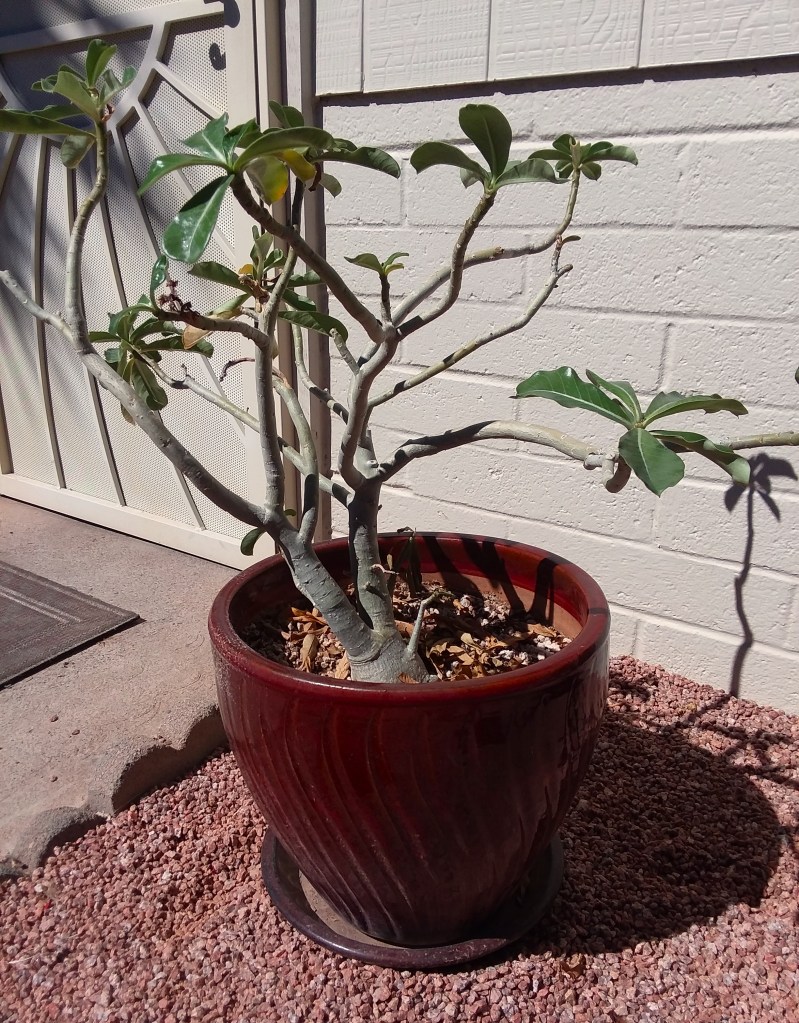
In keeping with the ebb and flow of nature and lineage, I do this ceremonial gardening dance twice a year. In early December, I lug my beloved desert roses (aka, adeniums) inside away from winter’s chill. They hide dormant in the darkest corners of our condo until March, when I haul them back outside to face the world again.
Yesterday morning, one day before S.R.’s 121st birthday, I renewed part two of this desert rose ritual. This year, it also happened to be the day Tom hired Chem Dry to clean our carpet.
Before Drew from Chem Dry arrived, my husband and I hoisted our slumbering desert rose and situated it outside our backdoor. We didn’t want to spill any soil on our freshly manicured carpet.
All of that went without a hitch. Neither of us strained our backs and Drew finished his job in less than an hour. The carpet even dried more quickly than expected.
By early afternoon, we were able to walk on the surface without wearing blue booties. By 3 p.m., we had moved all of our furniture back to where it belonged.
The blooming cycle for our prized adenium will take quite a bit longer. Rest assured, new leaves will appear this spring, prompted by warmer, longer days. Though S.R. never traveled to Arizona, I can imagine him sitting with his sleeves rolled up between farm tasks, nodding in his rocking chair as I write these words.
By June (maybe sooner) when the temperatures have reached 100-plus again here in the Valley of the Sun, this remarkable plant will produce several gorgeous double-red blooms. With it all, once again, I will have physical proof that natural beauty is constant.
Even though it feels like the rest of the world has gone mad, I draw strength from fertile ground and the knowledge that these rituals help me feel hope is always on the horizon.
In addition to writing four memoirs, I’ve been blogging for nearly four years. A few of you have joined me for every twist and turn. I feel humbled by your interest and loyalty.
In my first post (May 4, 2018), I shared ten tips for writing a meaningful memoir. I believed then (as I do today), that each of us has at least one story to tell. If you are an aspiring writer, who is searching for a little inspiration, you may find these tips helpful.
#4 on the list is especially important if you are looking to engage readers, because feelings–fear, disappointment, grief, joy, excitement, anticipation, etc.–are universal:
Write what you feel.Go beyond reporting what you know. The details are important, but not as much as how you were affected by the occurrences that appear in your story. Tell your reader how you feel. Describe your experience—how the positive, negative and unusual happenings in your story touched your life.
Often when I sit down to write a new blogpost–and my fingertips touch the keyboard of my laptop–I’m uncertain what I want to write. But from the beginning of this odyssey, I’ve vowed to follow my own advice to tell and show you what Ifeelabout personal and global issues.
That has included the emotions connected to creating an authentic life as a gay man and father of two sons; recovering from a heart attack; building a new life in the Sonoran Desert with my husband; aging in a predominately youth-focused society; surviving a global pandemic; and simply observing the healing properties of animals and nature.
Even in our uncertain American society–still hamstrung politically and dealing with the ravaging effects of COVID-19–I feel fortunate to have a safe home, good health, enough food to eat, and a community of family and friends nearby.
However, I also feel a strange mix of anger, anxiety, and sadness. I attribute that to the frightening stories and images of what’s happening in Ukraine.
I won’t pretend to understand the politics of it but can imagine the tremendous pain that is occurring as Russian troops invade and thousands of innocent Ukrainian civilians are threatened.
The deceptions and power-hungry antics of certain world leaders–rooted in lies and insatiable egos–are unacceptable to me. So is the growing level of American ignorance and intolerance for the truth of what history and provocative literature can teach us.
Yet we have too many “adults” in communities clamoring for the removal of books, which might help teach our children to become critical thinkers. On that note, what I feel today is the excruciating pain of what our world has become.
Rest assured, I will continue to write and voice my concerns, but I feel it’s best if I set aside my laptop for the moment. Here in the Valley of the Sun, I’m going to lace up my sneakers on a gorgeous Friday afternoon and take a hike to Papago Park.
I’m certain the sun is shining there, and the saguaro cacti are standing tall.
Need a warm escape? Download my latest book–FREE–through February 25.
Set against the rugged Sonoran Desert landscape, it’s an anthology of whimsical and serious stories about a little bit of everything: hot rods, high points, climbing up, growing old, coming out, pruning trees, eavesdropping cacti, pool rules, sand dollars, shrinking men, tiny lizards, literary life, fanciful flights, fresh lemons, pandemic truths, desert fantasies, and much more.
Please post your review online. It will mean a lot to this independent writer.
I’m convinced. Long after the American Southwest has curled to a crisp–scientists reported this week that we are experiencing the driest two decades in 1,200 years–cats will roam the Sonoran Desert and reign supreme.
I have no scientific proof to support my theory. Just a small sampling of feline friends–feral and domestic–in my Polynesian Paradise focus group.
With a flick of their tails and a few meows at our door, they cavort in our community, roll in the rocks, climb the walls and roofs, slink down the sidewalks, and generally get what they need and want to survive–above and below the eaves, but under the radar.
They appear magically each day. Goldy (she lives down the lane), Blanca (she lives kitty corner) and Poly (she lives everywhere in trees, on roofs, and under stars) plot to pounce on unsuspecting doves and finches.
Later they connive and clamor to devour Friskies Party Mix and ramakins of milk offered by we residents (suckers), who enjoy the show and the reasonably-priced (free) admission.
The three (and others yet to be catalogued) twist and glide in independent circles, careful to dodge owners with dogs on leashes that glance and sniff as they stroll by.
Blue-eyed Blanca, the friendliest of the bunch, has been known to hop into this reporter’s lap and purr. This leads me to wonder if she is really a dog trapped in a cat’s body.
Or maybe she is a long-lost relative, desperately trying to communicate. In any case, she enjoys kneading dough on my leg, catnapping on our loveseat, and (I suspect) worming her way into another story.
Poly on the roof, Goldy on the sidewalk, Blanca in my lap.
I was number fifteen or twenty in a line of nearly a hundred local authors. Dragging our supply of books behind us like proud parents ready to push our kids on stage, we snaked outside a side entrance to the Scottsdale Public Library at Civic Center Plaza.
As Tom and I waited for the doors to open at 9 a.m. to set up my table for the Local Author Book Sale, I felt anticipation filter through the cool desert air. It was a moment I cherished, but not as much as I should have.
An hour later, my table was set with my three books in front of me. I brought a sign-up sheet, so readers could provide their contact information. I wanted to keep in touch, so I could tell them when book four was published.
Me hawking my books on February 1, 2020, at the Local Author Book Sale at the Scottsdale Public Library.
At that moment, like most of the world, I was naive, ignorant or unaware. Call it what you like. I didn’t imagine such in-person opportunities would be stripped away by a pandemic for two years and counting.
Through it all, the losses have accumulated for all of us, and I’ve been missing you.
Our library has no immediate plans to reinstitute events of this sort. I understand they’ve cut staff. There have been a few online programs to keep patrons informed of local literary happenings, but nothing can replace actual human interaction.
I’ve been dreading writing about this. But I need to. The pandemic has hit all of us–young and old–hard. It’s sucked the life out of our passions. I’m angry that so many people are opposed to vaccinations and have not taken the proper steps to protect themselves and society. This poor judgment has prolonged the agony of lives lost and hollowed out.
It’s true, I am fortunate to have this platform to air my grievances. For now, I will continue to blog, but I’ve been questioning my commitment to this page lately.
It is common for all of us writers to have doubts. I appreciate those of you who follow this page and comment regularly. I’m not sure which creative path to take at this point, but I know I need something more … something that’s missing.
It’s one of those days when my stream of consciousness is running in many directions. That has prompted this post about everything (or nothing depending on your point of view).
I call it January musings, because that’s the best thematic thread I can find in this ball of yarn and semi-related thoughts.
***
Morning, noon and night the fabric of our winding threads becomes a tapestry. That’s the opening lyrical line from Mighty Mosaic, one of four pieces I wrote for the March 12 Phoenix Gay Men’s Chorus concert.
The song is an LGBTQA anthem of sorts to capture the complicated–and often triumphant–journeys we take to discover who we are and what we believe.
Hearing my lyrics come to life in a room of familiar voices during Tuesday night’s rehearsal brought me personal joy in a month previously laced with grief.
***
I bristle whenever I hear film directors, writers or musicians say in an interview that they don’t ever step back to watch their films, read their books, or listen to their music.
I’ll admit it. I’m a writer, who learns by retracing literary steps. I find myself revisiting themes in my writing all the time (family, love, loss, the beauty of nature, the serendipity of life) or frequently pulling one of my books off the shelf and re-reading certain passages.
Why? Because it keeps the process of telling a particular story fresh in my mind. Each of my four books is a child I have loved and guided from infancy to adulthood. They will live on the page long after I’m gone, even if nobody reads them.
Revisiting my stories also allows me to remember the richness of life: the hows … how far I’ve traveled, how far I still have to go, how much the world has changed, how much I’ve learned, how much I’ve lost, how much I’ve gained, how fortunate I am to love and be loved.
***
The ninth anniversary of my mother’s passing is January 26. Earlier this week, I looked skyward and spotted a full moon. It transported me back to a frigid January morning right after I said goodbye to her–an indelible Illinois moment in 2013–when Tom and I sat with my sister and brother-in-law at a suburban McDonald’s (the only place open for coffee at 5 a.m.) to feel the warmth and close comfort of an enormous full moon illuminating the horizon and the snow-packed streets.
The grief I felt that morning is far less present now. But the welcome sight of a full moon will forever remind me of the journey after Helen Johnson’s passing, her wisdom and undaunted spirit, and the growth that followed. All of it inspired me to chart a new trajectory, write From Fertile Ground and three more books, and even discover a poet and lyricist lurking inside.
I am especially conscious of my age and vulnerability right now. There is nothing worrisome to report. I feel well. It’s just that–early in 2022–Tom and I are focusing on important administrative tasks to protect ourselves and our families.
Specifically, we will move to Medicare later this year, because we turn sixty-five in July. We have begun to do research. We’ve met with a third party. She explained how it works. She has helped to cut through the mystery. (By the way, I used to help organizations communicate about complicated health care and retirement programs, but that background doesn’t make this transition any easier.)
We also are updating our estate plans to make certain they reflect our Arizona status and latest wishes. The pandemic isn’t the driver, but it certainly has amplified our efforts to make sure our affairs are in order. As much as I hate dwelling on my mortality, it makes sense to plan ahead.
All of this technical and legal blather has clogged my brain lately, leaving me feeling a little dim. Is it a coincidence that the light in our refrigerator should go out yesterday? I don’t think so.
We tried replacing the old bulb with a new one, but it appears we have an electrical issue. Fortunately, the appliance is doing its job. It’s keeping our food cold (and frozen in the upper compartment). It’s just that we need a flashlight to find the yogurt, milk, eggs, fruits and vegetables.
I digress. That’s not what this story is about. Ironically, in the relative darkness of early 2022–the pandemic and our refrigerator–there’s a bright and new creative wrinkle to my writing that I want to talk about. One which changes the landscape of my past experience. One that goes beyond my blogging, memoir writing, poetry, and occasional forays into fiction.
About eight months ago, Marc–the artistic director of the Phoenix Gay Men’s Chorus–blindsided me with this question: “Would you be interested in writing lyrics for a suite of songs for one of our concerts in 2022? It will be a celebration of diverse voices.”
Hearing these words, I think my jaw may have dropped. Once I closed my mouth and opened it again, “of course!” was my immediate response.
I could feel my smile grow ten sizes. I never imagined having an opportunity of this sort, especially concerning a topic that is so important and personal … turning the painful, transformative, and triumphant stories of Phoenix-area LGBTQA citizens into something more. Into poetry and music.
Since that early, exploratory conversation with Marc, I’ve collaborated with David (another member of the chorus) who is composing the music. I’ve written lyrics for four songs, which will be performed on March 12, 2022, at the Tempe Center for the Arts. The concert will be part of Tempe’s Pride celebration.
On the evening of Tuesday, January 18, this will all become more real. Marc and David will pass out the music to members of the Phoenix Gay Men’s Chorus (including me sitting in the back row and singing second tenor).
For the first time, we will begin to rehearse the music David and I have created. I know I will feel a surge of pride and energy when I see the words “Lyrics by Mark Johnson” in the upper right corner of the score.
Sometimes life serves up happy surprises. It reminds us that our existence is more than needling administrative responsibilities, the darkness of a pandemic, or the frustrations of a burned-out light bulb.
Sometimes the outcome is brighter, more hopeful; we find ourselves exploring a new creative wrinkle, doing something we are passionate about, taking on a role we never saw coming.
Yes–remarkably at the age of sixty-four–I am a lyricist.