Category: Missouri
Sensitivity
I pride myself on my sensitivity.
In my book, empathy is an essential quality for writers and human beings in general. It opens the door to developing deep and trusting relationships, but it also exposes us to emotional and physical pain. In this month of April, I have experienced both.
***
On Friday, April 10, Tom and I said goodbye to my cousin Phyllis.
The day before, we flew to St. Louis and enjoyed a nostalgic salad-and-pizza dinner with family in St. Charles, Missouri.
We gathered around a round, wooden table–balancing paper plates piled with food, while sifting through dog-eared photographs of Phyllis with living and deceased members of our Johnson family from the past seventy-five years.
In that space, I felt a meaningful connection with Tom (Phyllis’ husband), Austin and Bryant (her adult sons) and their respective spouses (Amanda and Kelsey).
Meanwhile, Phyllis’ four grandchildren–ranging in age from three to eight years old–danced around the island in Bryant and Kelsey’s kitchen, occasionally patting the head of Bennelli, their large-and-lovable labrador.
Despite the grief associated with the loss of Phyllis, it was a family moment I will cherish. One Phyllis would have loved.
The next morning, Tom and I drove to the funeral at Immanuel Lutheran Church in St. Charles with my sister Diane and brother-in-law Steve.
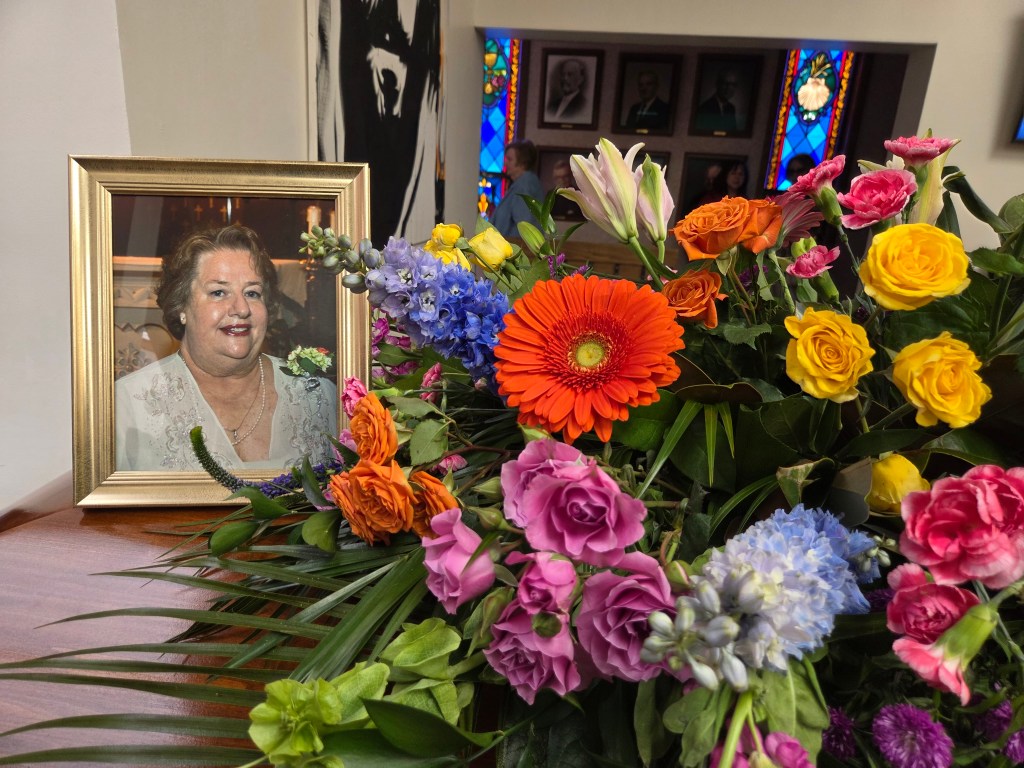
In a large open space connected to the church, Kelsey and Bryant had carefully assembled still photos–from throughout Phyllis’ life–on boards anchored by easels. They placed them beside her closed casket adorned with sprays of colorful blooms.
Overhead, at the other end of the room on a large screen, other images of Phyllis and her family and friends faded in and out on a large screen TV.
As people began moving into the church for the 11:30 funeral service, I felt anxious. Jumpy.
A mix of nostalgia and peace washed over me, as Tom and I found a place to sit at the far-left end of the fourth pew. Diane and Steve joined us there.
I scanned the program and saw that after readings from the old and new testaments–slotted between two church hymns–I would walk to the lectern to share “Words from the Family”. To give a eulogy. To pay tribute to my closest cousin’s life.
I’ve done a lot of public speaking, presenting, and singing on a multitude of stages in my life–but few things as personal as this. I breathed in deeply to quiet my nerves. I unfolded my prepared words and looked out over a congregation of probably two hundred: Phyllis’ family, friends, teaching colleagues, students, caregivers.
In that moment, my anxiety lifted and flew away. “I am honored today to remember Phyllis. She was my cousin. We were born a decade apart in St. Louis,” I began.
The words and phrases flowed effortlessly from there, as I looked into the tearful eyes of immediate family members–three generations side-by-side spread across the first pew.
“I admired Phyllis’ poise, her style, her intellect, her ambition, her sensibility,” I continued. Before I knew it, I was reciting verses from I poem I wrote for Phyllis: The Love We Shared.
I closed my notes. I left the lectern. I paused to pat Austin, Phyllis’ eldest son, on the shoulder for reassurance, kissed him on the forehead, then returned to the fourth pew and sat beside my husband.
I pulled a wrinkled tissue from my suit pocket, dabbed my eyes, and felt sadness and love reverberate throughout the church.
***
Tom and I returned to Arizona last Saturday.
Today I found myself dealing with another form of sensitivity … sensitivity to the sun.
This morning my dermatologist–in an out-patient procedure called MOHS surgery–removed a small patch of cancerous cells from the bicep of my right arm. As I write this, I am taped up with a sizeable patch over that area.
The good news is he removed all of the problematic tissue. There is no pain, just the anxiety (and the pinch of a few needles for numbing) that immediately preceded this morning’s appointment.
In a few weeks, the remnants of that procedure will fade. My dermatologist will extract the stitches.
I will be left with my fourth such scar–one on each limb ironically–from excisions and dermo procedures.
In a sense, these scars are “badges of honor” for having lived nearly sixty-nine years and survived a series of setbacks.
They are proof that as long as I live–as long as I write, sing, slather on sunscreen, and pause to remember the ones I love–I will also remain super sensitive to the blazing Arizona sun.
The Love We Shared
Phyllis was my St. Louis cousin. We were born a decade apart–she in November 1947, me in July 1957. Her mother Violet and my father Walter were twins.
On Tuesday evening, I learned that Phyllis died March 24, 2026. A series of health complications over the past eighteen months ultimately led to her passing. Ironically, she left this world almost exactly twenty-five years to the day after her mother’s passing in March 2001.
When we were children and teens–at every Easter, Thanksgiving, and Christmas gathering from the late 1950s to the 1970s–my sister Diane, Phyllis and I represented the youngest contingent of the Johnson family lineage. We were loved and nurtured by our parents, grandparents, aunts and uncles.
I felt close to Phyllis. As I recount my earliest family memories, I admired her style, her intellect, her ambition. Years later, in the 1980s when my sons (Nick and Kirk) and hers (Austin and Bryant) were all born within a five-year period, the arc of our parallel lives as parents brought us together whenever I visited St. Louis from my home in the Chicago area.
Then, in the 1990s and early 2000s, both of us were consumed by our busy careers. She was a life-long educator. I was a communication consultant. We lost touch a bit as all four of our parents aged and died.
But the beauty of family and longevity is that–if you are willing and able–you can recapture the loving connections hard-wired in your early years.
Ultimately, Phyllis and I did that. In our retirement years, we traded texts frequently. We cheered for our beloved St. Louis Cardinals through the highs and lows. We shared family news and photos. Phyllis absolutely adored her four grandchildren!
Even though I left my St. Louis home in 1980 to build a life and career in Chicago–and later moved to Arizona with my husband Tom in 2017–the love I feel for my cousin remains.
I’m thankful that I was able to see Phyllis four times in the last decade of her life. In 2016, we celebrated her and her husband Tom’s fortieth wedding anniversary. In 2017, Phyllis and her family met Tom and me for dinner at an Italian restaurant on The Hill in St. Louis.
In 2021, we gathered for a family breakfast and reunion at Phyllis and Tom’s home in St. Charles, Missouri. Then, in September 2025, Tom and I visited Phyllis and Tom one final time at Breeze Park where she was convalescing.
Because Phyllis was a dedicated teacher and reading tutor, she enjoyed reading my books. She also followed my blog and supported my writing journey. In fact, she encouraged me to capture nostalgic memories of my paternal St. Louis family on the page. That became my second book, Tales of a Rollercoaster Operator.
So, in a sense, today I not only feel I’ve lost my cousin. I also feel I’ve lost a literary friend.
At one point, I remember Phyllis telling me she hoped to write a children’s book one day. Though that never happened, I am certain my cousin–a devoted teacher–had a positive impact on the lives of hundreds of children in her long and successful career. Her legacy will ripple through their lives and those of her children and grandchildren.
Today is the home opener for the St. Louis Cardinals. The first pitch will be thrown in about an hour. I will be watching the game on TV from my home in Scottsdale.
When the Cardinals take the field, I will be thinking of my cousin. She was a knowledgeable, lifelong, tried-and-true Redbird fan. I will imagine her rooting for them from a heavenly perch.
But, most of all, I will remember the family moments and the love we shared for nearly seventy years.
***
The Love We Shared
Heaviness in my strong heart,
numb with dread,
tells me this chapter has ended.
But I will always know
the love we shared,
the stories we treasured,
the early etchings of memories
with those who came before us,
those who embraced us,
those who left us long ago,
and the ones we shaped and loved later,
who have carved and created
paths, deeds, and destinies
of their own.
Now it is time
for you to rest.
And, as you go, I remember
the person you were,
the gifts you gave,
the lessons you taught.
But, most of all,
I remember the countless ways
your love has touched our lives.
***
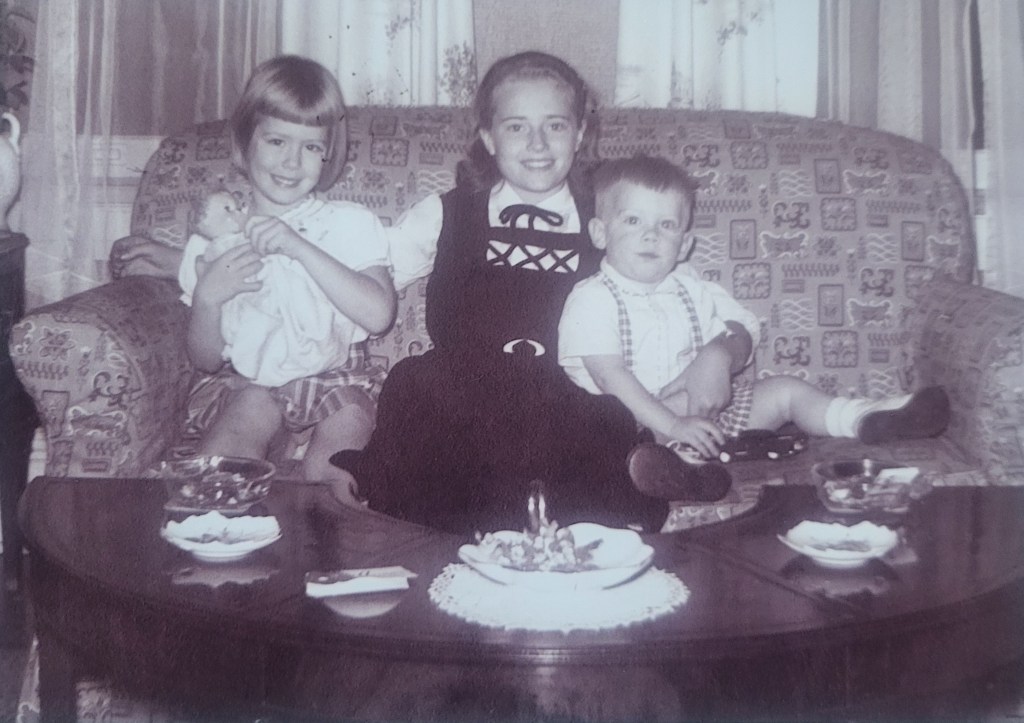
Phyllis (in the center below) was eleven years old–Diane was four, I was one–when the three of us posed on November 26, 1958, at the golden wedding anniversary party for our grandparents, Albert and Louise Johnson.
The Arc and The Arch: Part Three
In February 2024, John, Sharon, Tom, and I sat around a half-moon-shaped booth in Phoenix, devouring yummy, syrup-soaked, gluten-free waffles and nursing hot mugs of coffee at Jewel’s Bakery and Cafe.
They had been in town for a church retreat over a three-day weekend and were about to return their rental car to Sky Harbor Airport. Breakfast together was our sendoff before they flew home to St. Louis.
“Oh, did you see Nancy’s post on Facebook? There’s gonna be a Class of ’75, Affton High School, 50th reunion sometime, somewhere next September in St. Louis,” I reported.
“You guys should definitely do it. ” Sharon chimed in. “The four of us should go together! Don’t worry about Tom and me. We’ll keep each other company.”
“Sure. Why not!?” Tom agreed.
“I’m in if you’re in,” John stared directly at me. He and I were close junior and high school pals in Affton, though his family moved north, away to another St. Louis area school district before our senior year.
“Okay,” I concluded. “The journalist inside me is telling me we should go.”
Our scheme–hatched in Phoenix, to be realized more than a year and a half later in St. Louis–was born.
***
The sometime was 5 to 9 p.m. on September 21, 2025. The somewhere? Grant’s Farm, a rambling, forested 281-acre estate in south suburban St. Louis, named for Ulysses S. Grant and owned by the Busch family.
Specifically, our 50th reunion would occur in the Bauernhof Courtyard area there. It’s an old-world community space where–since its opening in 1954–St. Louisans have gathered to sample Anheuser-Busch products, and amble down hallways of vintage horse carriages past Clydesdale stables. It is an iconic St. Louis destination, draped in mid-twentieth-century nostalgia.
With the threat of showers in the air, John, Sharon, Tom and I arrived in the Grant’s Farm parking lot just before 5 p.m. Immediately, I began to spot familiar faces. I hugged Terri and Beth, two classmates I hadn’t seen in decades. We boarded a tram that would transport us through the woods to the Bauernhof. I inhaled the fresh-yet-familiar, dampness of the lush green forest.
The long-awaited immersion into my past Affton High School life–connecting one leg of my past as a seventeen-year-old, long-haired (remember, it was the 1970s), reserved, enterprising, unactualized gay adolescent with the other leg of my present much older, wiser, grayer, gayer, literary self–was about to commence.
When we arrived at the Bauernhof Courtyard entrance, we stepped out of the tram towards an archway. Nancy, our cheerful, detail-minded Class of ’75 organizer, greeted us with hugs.
We formed a line to check in and pick up drink tickets. Affton attendees (in this case, John and me) received name tags bearing our black-and-white high school yearbook photos. Significant others, such as Sharon and Tom, got tags with an image of a cougar beside their names. (The cougar is the Affton High School mascot.)
John and I proceeded through the line with our “cougar spouses” toward the courtyard. A photographer snapped photos as couples and singles entered. In that moment, as I turned to see the line queuing behind me, I spotted someone significant I had hoped to see. Not a fellow student, but a teacher I admired from my high school years. It was Judy Rethwisch, my drama teacher.
The high school version of me would have faded and stepped back, reticent to make a scene or a visible statement. But the confident me–the sixty-eight-year-old gay man with his husband by his side–stepped forward to reconnect with Judy.
“I want you to know what a positive difference you have made in my artistic life,” I smiled and reached forward to hug her. “With you at the helm, I found my peeps in the theatre program at Affton,” I went on. In a flash, I recounted roles I played in productions of Fiddler on the Roof and Gypsy under Judy’s dedication and tutelage.
Judy smiled and listened intently as Tom captured a few photos of us locked in conversation. She told me she is still teaching drama. Sixty-one years as an educator. Still vibrant. Still making a difference in the lives of other aspiring actors, musicians, and artists. She asked for my card and told me she is interested in reading one of my books. That was just the beginning of a stream of seminal reunion moments.
I quickly rediscovered a parade of classmates coming and going all around me. Some were fuzzy in my memory. Others, like Jon, more meaningful. He was a good friend in high school, who traveled to Colorado with John and me after our junior year of high school.
Suddenly, I was transported to August 1974. Somehow, the three of us had convinced our parents, that we–one seventeen-year-old and two sixteen-year-old boys–would be safe driving and camping together across country in John’s AMC Javelin, pulling a small trailer.
Yes, we were underage and found someone to buy us lots of Coors beer, which we swilled by the campfire at night. But we survived intact. I recall vividly shoveling down steak and eggs for breakfast in a bar somewhere in Wyoming, while in the corner of the tavern, Richard Nixon, was announcing his resignation on a beat-up black-and-white TV.
Back at the reunion, other male and female classmates trailed by to greet each under the courtyard tent. It featured a beautiful crystal chandelier that hung in the center of the space.
Soon a line formed at a barbeque buffet. We juggled our drinks and grabbed plates, before landing at one end of a long rectangular table Tom and Sharon had secured.
At one point, I turned, and Jeff appeared. He and I were pals, who shared a few classes. We ate together frequently in our high school cafeteria. Honestly, these memories are vague for me. But I remembered his handsome face. It hadn’t changed much, given the fifty-year gap in our connection.
When Jeff introduced his long-time partner Lee to Tom and me, I felt my past and present lives coalesce. Neither Jeff nor I were aware of the other’s sexual orientation in high school. Sadly, that was the norm for 1975 for unrealized, unfulfilled, budding gay adolescents.
But knowing that against the tide of social norms we had each found happiness with our male partners and had independently decided to return to the reunion was physical proof why I had come to the Class of 1975 reunion. I needed to fully reconcile my past closeted self with the authentic gay man I had become.
A little later in the evening, Tom returned to our table and said emphatically: “I can’t tell you why, but you need to go to the dessert table right now.”
Of course, I listened to my husband and followed suit. When I arrived there, I discovered Nancy and Jim (the reunion organizer and her husband) had brought two of my books–From Fertile Ground and Tales of a Rollercoaster Operator–to display there for all to see.
I don’t know that I gasped, but it felt like I did. To be appreciated for my writing that way, left me speechless in the moment. It was a lovely gesture, authored by Nancy and Jim. Another phenomenal moment, which connected one leg of my life with another.
Before the reunion came to a close and we boarded the tram, all of the Class of 1975 Affton High School classmates–about 120 of us in attendance–stood on a wobbly set of risers for a group picture. (Earlier in the evening, a large poster bearing the names and photos of our forty-nine classmates who have passed graced a corner of the same stage.)
Certainly, the wrinkles and gray hair for those of us who have survived into our late sixties were apparent on the evening of Sunday, September 21, 2025. But the smiles and fun-loving community spirit superseded all of that. Our hearts were full.
***
After treating John and Sharon to breakfast Monday morning, Tom and I had a few hours on our own before we needed to make our way to the St. Louis airport for the trip home to Arizona. There were a few loose ends for us to tie together.
First, we drove to Left Bank Books in the central west end of St. Louis to browse the stacks. It’s a renowned, LGBTQ-friendly, independent bookstore we had planned to visit on the morning of our shared sixtieth birthday. But after I suffered a mild heart attack that day–in the city where I was born–our lives took a vastly different path. Fortunately, we survived that experience together.
Appropriately, our final stop in St. Louis was the Gateway Arch. In the late 1970s, during my collegiate years, I was a National Park Service history interpreter there. Giving tours of the Museum of Westward Expansion, welcoming visitors to the top of the Arch, and–from time to time–introducing a fascinating documentary film about the construction of the Arch, called Monument to the Dream.
The film chronicles the beauty and simplicity of Eero Saarinen’s winning design, but also the herculean effort required for a diligent crew to erect the monument through all sorts of weather conditions.
On a warm autumn day when the Arch was completed–October 28, 1965–the crew sprayed a steady stream of water on the south leg, which was expanding in the heat, to allow the capstone–the final piece at the top between the two legs–to be wedged in and joined permanently.
In a symbolic sense, that is what this later-in-life St. Louis reunion with friends and family means to me.
Call it the arc of life or the Arch of life. Either way these sixty-something years began in Missouri, brought me to Chicago for a long career and life as a single father, and carried me to Arizona with my husband. There we have discovered a rewarding artistic life together among new and old friends–our chosen family–even as our freedoms and institutions in the America we still love are threatened by fascism.
Along the way, the highs and lows have transported me to a profound place of greater gratitude and understanding, which I have earned.
It is a welcome destination that once felt out of reach.
The Arc and The Arch: Part Two
Spotty storm clouds gathered in the distance on the morning of Saturday, September 20. Tom and I drove northwest twenty miles, across the Missouri River.
Our destination was Breeze Park in Weldon Spring, Missouri. My cousin Phyllis–a retired teacher–is convalescing there, hoping to regain her strength after a series of health complications.
Phyllis’ mother Violet and my father Walter were twins born in St. Louis. It was 1913. More than fifty years later, the Gateway Arch would rise and transform the St. Louis riverfront. Teetering warehouses once stood on cobblestone streets there, in this fur-trading town founded just west of the Mississippi River in 1764.
In the arc of life, Phyllis and I (both Baby Boomers) also arrived–she in 1947, I in 1957–before the historic completion of the Arch, our nation’s tallest monument, on October 28, 1965.
But today I reflect on our personal connection. Like me, Phyllis and her husband Tom also raised two sons born in the 1980s. Austin and Bryant are now in their early forties and late thirties respectively. A touch younger than my son Nick; a shade older than my son Kirk.
Now in their late seventies, Tom and Phyllis are meeting the healthcare challenges of life head on. Negotiating the unpleasantness of aging and inherent losses (their lovable golden retriever Truman passed recently). They are doing their best to push ahead. To stay hopeful. Or as my mother–a child of the Depression–would have said “trying to keep a stiff upper lip.”
Given these developments, I wanted to spend time with them while we were in the St. Louis area. Especially because–beyond my sister Diane who now lives in northern Illinois–they are the closest remaining strands of family from my Missouri years: 1957 to 1980 … my Tales of a Rollercoaster Operator years.
On Saturday, when my husband and I arrived just past 9:30, we wound our way down halls, past friendly staff and other visitors, to Phyllis’ room. She was delighted to see us. So was her Tom. He arrived a few minutes later with a big smile and box of gooey pastries for us to share.
The next two hours were a heart-warming oasis of conversation and listening between the four of us. We spent our time commiserating over the latest news, but–more importantly–strengthening our family bond during a challenging period for them personally.
Phyllis is hoping to return to their home soon in nearby St. Charles. As anyone would, she is missing the familiarity and comfort of her life. Longing for peace away from medical equipment and disruptive procedures. Her kind, caregiving husband is also searching for peace.
Before Tom and I left, we hugged and took photos together outside on a beautiful, flower-laden patio at Breeze Park. I kissed Phyllis on the cheek. A few tears materialized for both of us, not knowing what tomorrow will bring.
At the least, we shared those upbeat Saturday moments, built upon our 1960s memories of our once-vital, long-gone boisterous St. Louis relatives gathering around us every Christmas, Easter, and Independence Day.
To our credit, in our later years, long after our sons became adults, we have formed reciprocal connections. Most notably, Phyllis, Tom and their family joined Tom and me for an Italian dinner in St. Louis in route to our new home in Arizona in July 2017.
Now they share stories and photos via text of their four growing grandchildren, and I write stories about my St. Louis origins, which she has encouraged, helped inspire, read, and followed diligently.
All of this, through a period of uncertainty, sustains us in our sixty-and-seventy-something years across the miles.
***
Just after noon Saturday, Tom and I returned to Creve Coeur. We landed in the driveway of our friends John and Sharon.
We were about to share the rest of the weekend with them and their loyal eight-year-old-shepherd-beagle-mix Nickel at their stylish, mid-century home … hike with John through a dense forested area overlooking Creve Coeur Lake, then get caught in the rain in historic downtown St. Charles … drive into St. Louis for a Cardinals/Brewers game at Busch Stadium Saturday night … and still later, on Sunday evening, attend our Class of 1975 Affton High School reunion together at Grant’s Farm.
The clouds cleared Saturday evening and ushered in cooler temperatures. Seated together with close friends at Busch Stadium, three levels up directly behind home plate, it didn’t seem to matter that my beloved Cardinals lost 3-2.
Yes, it was the latest evidence in a disappointing sub-par year. But on the horizon, beyond the stadium’s outfield walls, the twilight of a blue sky and puffy clouds perfectly framed the Gateway Arch at the center.
Architect Eero Saarinen’s monument to a dream is still standing, rising above the cobblestones and the fray, as it approaches its sixtieth birthday.

The Arc and The Arch: Part One
The arc of life in my sixties–its highs and lows–has proved mostly to be an unexpected artistic one. Yet it is an uneven tapestry of co-existing emotions: fear for our eroding democracy; love for new and old friends; and boundless gratitude currently after returning to St. Louis for my Affton High School Class of ’75 reunion and reconciling my midwestern roots with my southwestern reality.
***
A trip to St. Louis would not be complete without a visit to my parents’ graves at Jefferson Barracks National Cemetery. So, we began there.
On Friday, September 19, Tom and I stopped at Dierberg’s in Creve Coeur near our hotel to buy a handful of burnt orange carnations.
Twenty minutes later, we arrived in the sea of marble stones on rolling hills ten miles south of downtown St. Louis.
We parked our rented Mazda SUV and tiptoed past a veteran’s funeral in progress under a makeshift canopy. A female vocalist sang Amazing Grace. Instantly, my tears began to flow.
Each time I go to Jefferson Barracks, it is a touchstone experience. Tapping one side of the stone and then the other. Remembering the love and best intentions of Helen and Walter Johnson–both long gone but not forgotten.
Minutes later, sitting on a nearby bench with Tom under the sturdy branches of an oak tree that has lost its earliest leaves due to an especially dry Missouri summer.
Friday afternoon was also somber and reflective. We met our friend Mark, a docent at St. Louis Kaplan Feldman Holocaust Museum, for a visit there.
He guided us through horrific-then-hopeful survivor stories, images, and vintage artifacts, curated from proud Jewish St. Louis residents who lived through the awful experience. Only a few remain, but their legacies live on.
All in all, it was a chilling, relevant, immersive few hours. Cautionary evidence of hate and authoritarian evil that inundated the world in the 1930s and 40s, and now–in the US in 2025–threatens the existence of those who are not straight, Christian white men.
After deep breaths and a refreshing Friday nap in our hotel, Tom and I drove to University City for an evening with Mark and his husband David at their home. It was a celebration of our unfolding friendship.
At sunset, they lit candles and recited Shabbat blessings before we shared wine and bread. At their table, I felt our bond of friendship, which began just a few years ago, grow.
We met Mark and David when–as snowbirds living part-time in Arizona–they first attended one of Tom’s free film screenings at the Scottsdale Public Library.
Now, they have become the newest, welcoming community component of our St. Louis connection.
Beyond the Palms

If we live long enough and look beyond the palms, we see the arc of our lives and the hint of a rainbow. We remember where we came from. Who we were. Who we are. How far we’ve come. Our best intentions. Our mistakes. Our progress. Our loves. Our losses. Our lessons learned. The connecting tissue that has made us who we are. All of it.
***
Fifty years ago, in June 1975, I graduated from Affton High School in south suburban St. Louis.
Tom and I travel back to St. Louis tomorrow for a reunion with my class of 1975 mates over the weekend.
I’m excited to see old friends. I also expect a few bittersweet moments.
Either way, the journalist inside me is sure to return with a story or two.
Because I am a writer. That’s not what I do. That’s who I am.
Half a Century Ago

On August 25, 1975–fifty years, five decades, twenty-five pounds thinner, and half a century ago–I was a long-haired, idealistic college freshman hustling across campus in the rain.
It was my first day of classes at the University of Missouri in Columbia. (My mother took this photo during college break a year later.)
This naive, relatively-shy-but-often-fun-and-exuberant eighteen-year-old boy (he was not yet a young man but was an aspiring pre-journalism major) knew little about the world or himself.
But he was determined to find his way one hundred-and-twenty-five miles away from his parents and childhood home in the St. Louis suburbs.
Mom and Dad paid for my tuition, books, and room and board in Hatch Hall on campus. I vaguely recall the total bill was less than one thousand dollars per semester.
Looking back, I think I may have spent half that amount on frivolous expenses like pizza, sub sandwiches, and beer.
That money came out of my pocket. From what I earned and saved during the summer of ’75 as a rollercoaster operator at Six Flags. But I could always count on care packages and frequent small checks, which Mom sent in the mail.
John was my roommate freshman year on the fifth floor of Hatch Hall. We were good buddies, close friends from the late 1960s when we were junior high classmates.
Though we had different career aspirations which dictated non-intersecting class schedules (John was pre-med), we were inseparable in many ways from August 1975 until May 1976.
There wasn’t much to our room. Minimal clothes. Primitive, uncomfortable desks and chairs. Single beds and random posters on opposite walls.
John brought his stereo, turntable and speakers. I brought a small black-and-white TV and popcorn popper. I recall us convincing our parents to split the cost of a mini fridge.
Wearing tube socks and denim cutoffs like all the other guys, we tossed Frisbees in the quad under the columns and played tennis across the street from our dorm. Through it all, we made friends of all sorts who lived up and down our hall and across campus.
After a full week of mostly boring, required classes, fall Friday nights included parties at Hinkson Creek (an abandoned quarry mine close to our dorm) where all the kids drank and many swam.
Football Saturdays in the fall of ’75 were fun, rooting for the Tigers in the student section. More often than not, the final score spelled defeat.
We wandered home to our dorm rooms aimlessly to sleep off the beer and prepare for Saturday nights … disco dancing to Donna Summer and roller keggars (drinking more beer while roller skating).
I remember zooming around a rickety indoor skating rink, dodging wooden pillars and puddles of beer. What a mess and what a stupid idea … and I didn’t even like the taste of beer!
By this time, John had a steady girlfriend … Sharon. (They met soon after John and his family moved to the northern St. Louis suburbs before his senior year of high school.) Sharon attended a different in-state college in Kirksville, Missouri.
I dated lots of girls my freshman year … but never for long. I was trying to live up to some ridiculous notion of masculinity that never felt like the true me.
The one exception was Carol. We were close in high school. She was sweet. That relationship lasted into college, but it quickly fizzled. I needed my freedom and time to learn who I would become.
Operating on a protected, fearful level, I remember feeling attracted to many of the cute boys in my classes and at Hatch Hall. But my gay identity and secret desires lived only in my subconscious.
I remember feeling anxious and alone. Constantly.
It would be three years before I would meet Jean at Mizzou. We were both Journalism students. There were sparks between us that developed into love and marriage in 1980 after she graduated.
Underneath it all, the attraction I felt for men grew stronger. But without a healthy avenue for my personal discovery, my depression deepened.
The reality is that from 1975 through 1979–my college years–there was no productive way for me to experiment with my sexuality and date other men. Whatever happened had to come under the cover of darkness.
***
If we live long enough, time, age, mistakes, and transformation … like the constant tumbling of water over rocks … can produce smoother edges and actual wisdom.
In spite of living a closeted, unfulfilled sexual life in my college years, I got a good education at the University of Missouri. I earned my Bachelor of Journalism degree in 1979. It opened many doors for me professionally.
The good news is I eventually found my way personally in my thirties and forties. Tom and I have been together twenty-nine years. I’m proud of the trusting, loving relationship we have created together.
There is irony in all of this. While he was a freshman trying to find his way–at the University of Iowa in Iowa City in August of 1975–I was doing the same a few hundred miles south of him.
We wouldn’t meet until we were thirty-nine … twenty-one years later … but that would also happen in the midwestern humidity of August.
***
Postscript: Next month, Tom will join me on a trip to St. Louis. We will attend my fiftieth high school reunion, where I will reconnect with a few hundred of my Affton High School classmates … the class of ’75 … most of whom I haven’t seen for at least thirty years.
My college roommate–John–and his wife Sharon will also join us. Somehow, over fifty years, five decades and more than half a century–we have sustained our friendship across the miles and supported each other in the important moments.
Raising children … and, in their case, grandchildren. Being there for my mother’s funeral at Jefferson Barracks National Cemetery in 2013. Coming to Chicago for my marriage to Tom in September 2014.
Each time we see each other (now it’s mostly winter visits here in Arizona), John and I are able to pick up where we left off.
Even though our lives have grown and changed in innumerable ways, we have maintained a mutual sense of love, respect, and continuity.
That’s something I’m proud of.
Loss in St. Louis

If you follow the weather news in the United States, you know that on Friday, May 16, parts of St. Louis, Missouri–where I was born in 1957 and reborn in 2017–suffered an estimated $1 billion in damages from an EF3 tornado.
The powerful storm tore through central and north St. Louis, killing five people while damaging or destroying 5,000 buildings and countless trees … including many majestic ones in and around one of the city’s gems: Forest Park.
I have no doubt that over the coming days, weeks, months, and years, the citizens of St. Louis will heal and recover. But it will be a tall mountain to climb for many financially and emotionally.
I have made a donation to the American Red Cross disaster relief efforts. But I want to do more for the city I love, which appears in all five of my books. It is hardwired into my prose and poems in large and small ways …
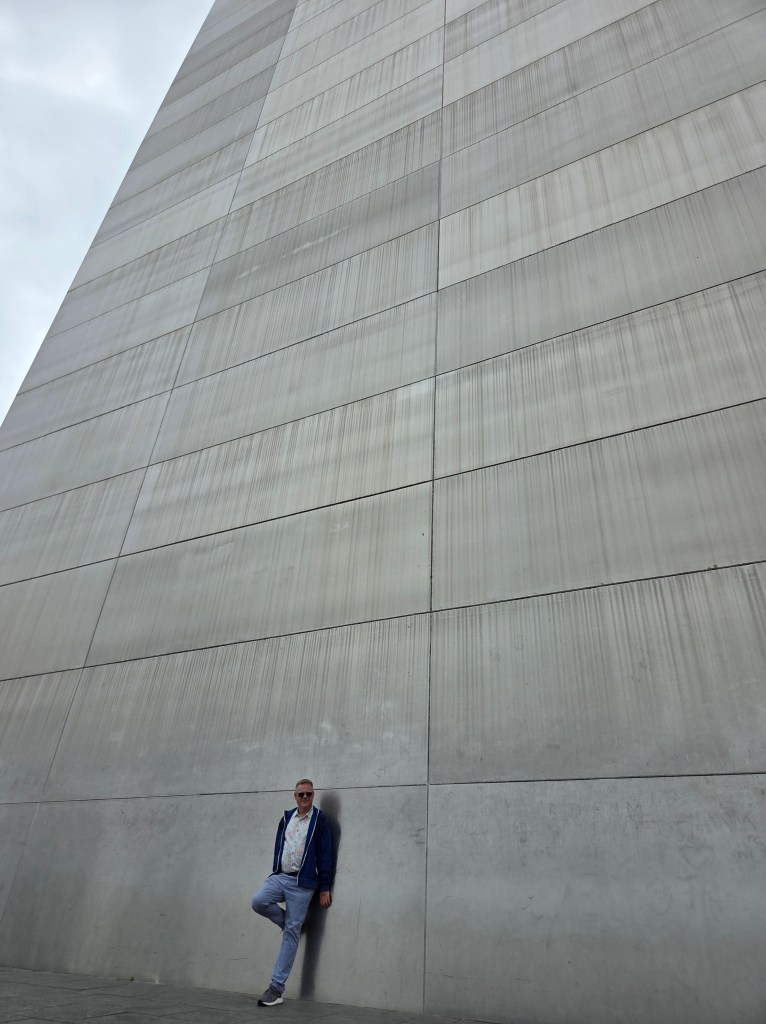
In memories of my hard-working family, our suburban midwestern existence, humid summer days, learning to operator a rollercoaster at Six Flags, working at the top of the Gateway Arch (pictured here) in the late 1970s, rooting for the St. Louis Cardinals, boating on the Mississippi River, visiting the St. Louis Zoo, frequenting the aforementioned Forest Park, and much more.
In addition to making a donation of your own to your favorite relief charity, here’s another way you can help. Buy any of my five books during May and June.
https://www.amazon.com/stores/author/B01DCYIAD4
I will donate $10 for each book I sell (paperback, Kindle, or audiobook) during that period to Forest Park Forever. It is a private nonprofit conservancy.
As described on their website, the organization “partners with the City of St. Louis to restore, maintain and sustain Forest Park as one of America’s great urban public parks for a diverse community of visitors to enjoy, now and forever.”
Thank you in advance for your support of my literary efforts and the city of St. Louis … as well as its beautiful urban greenspace in the middle of town, which I still love and remember.
***
Incidentally, Tom and I will travel to St. Louis in September to attend a Class of 1975 reunion with my Affton High School classmates. Yikes, fifty years! More to come on that.
Recycle the Fruitcake
My mother loved fruitcake. I think making and eating it reminded her of her Carolina roots.
As a teenager and young adult, I remember seeing her and many of my older relatives consume fruitcake.
The thought of munching that dark, rich, moist, nutty, fruity, and rummy consistency repulsed me.
Anyway, she liked having fruitcake around during the holidays. I didn’t.
In the early 1980s, when Jean (my ex) and I lived in the Chicago suburbs, Mom hadn’t caught on to my fruitcake aversion.
Every December, she ordered a rather expensive variety of fruitcake, made by the Trappist monks of the Assumption Abbey, and had it delivered to us.
(Assumption Abbey is a monastery tucked in the foothills of the Missouri Ozarks.)
Jean and I didn’t have the heart to tell Mom to stop sending us fruitcakes. So, every year, we received another tin of it, which sat unopened on the bottom shelf of our refrigerator.
We never found a way to recycle or share it with others, because no one else we knew liked fruitcake either.
Inevitably, year after year–sometime in May, June, or July long after the last presents were unwrapped–Jean or I extricated the fruitcake from the back of our fridge and dumped it in the garbage.
***
If you follow my blog, you know I sing second tenor with a gay chorus–to be precise, the Phoenix Gay Men’s Chorus (PHXGMC)–and have written several librettos for PHXGMC.
For the uninitiated, we are a joyous, talented, and rambunctious LGBTQ-plus organization, comprised of more than one hundred singers and musicians (who also wear multiple hats as artistic consultants, dancers, actors, writers, marketers, costume designers, stagehands, sound technicians, and lighting crew).
At times, the switching of hats from one day, week, or number to the next is a dizzying process. But when you volunteer for an arts’ organization you believe in, it comes with the territory.
As I write this, we are entering the heavy lifting phase of Lights, Camera, Elves!, our holiday show coming December 21 and 22 to the Herberger Theatre in Phoenix.
Anyway, as I swam laps on Tuesday and considered what to write this week, thoughts of my mother’s love of fruitcake and a coincidental plotline in our concert popped into my head.
You see, like my mother, Rudy–a character in our concert–adores fruitcake. He can’t get enough of it, and that obsession leads him into trouble and a terrible trap.
In fact, Act One ends with a hysterical, rousing number–Recycle the Fruitcake.
In the mix, I should back up and tell you that Scott, our choreographer, has asked me to play a bit role in the fruitcake number.
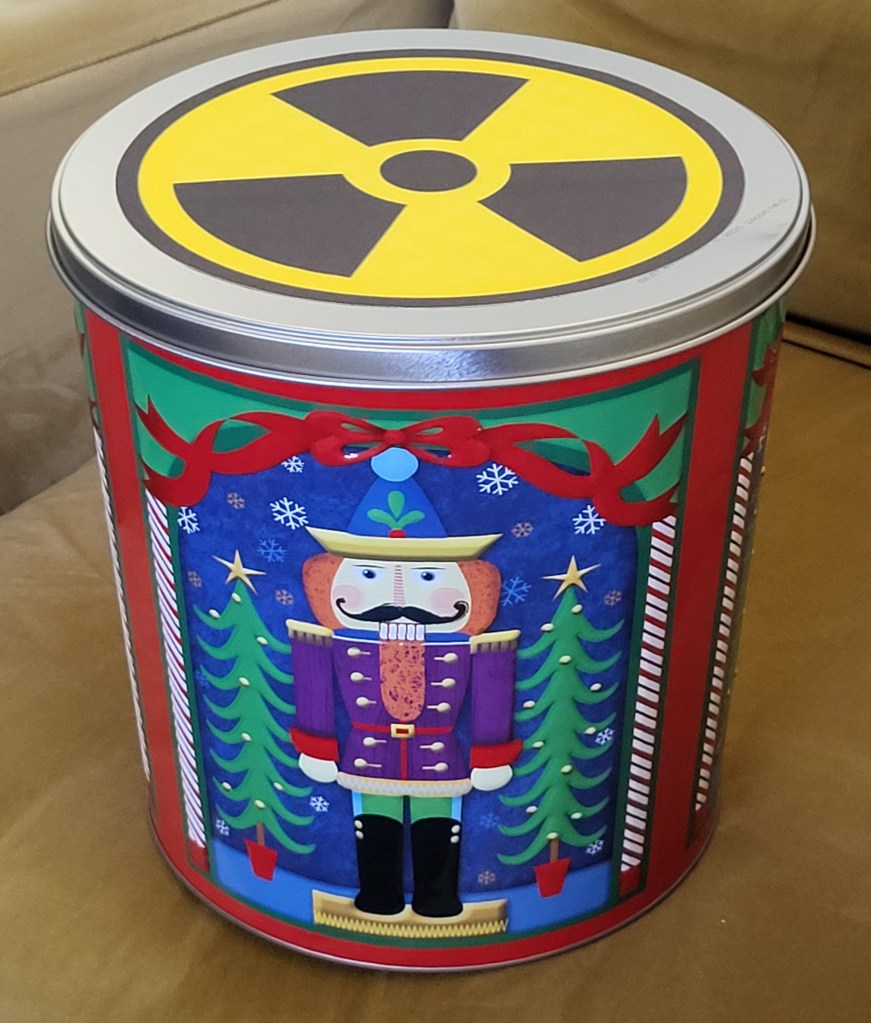
For about 15 seconds, I’ll be crossing the stage wearing an orange hazmat suit, while carrying a toxic fruitcake in this holiday tin. Meanwhile, the chorus will be singing this lyrical line:
“A fruitcake can be wide, a fruitcake can be thin, a fruitcake can be toxic, so they keep it in a tin. So, when you get a fruitcake, never let it touch your skin, ’cause you never really know where fruitcakes might have been.”
Brandon and Mike (two other chorus members) and I had loads of fun co-creating the libretto for Lights, Camera, Elves! … and we are coaching the cast as they prepare for our performances.
The show is a story of redemption, featuring Santa’s love for holiday movies, a misfit security guard named Rudy, and three recalled-and-mischievous elves (Spike, Ginger, and Eddie) … all told against the backdrop of gorgeous and fun holiday music.
We’re excited, because we are expecting full houses for all three of our holiday shows.
Though my mother has been gone for nearly twelve years and was never able to see me perform in any of the fifteen holiday concerts I’ve appeared in since 2010, I know she would have loved the spirit and beautiful music in this show … along with my creative impulse to recycle my fruitcake memories.