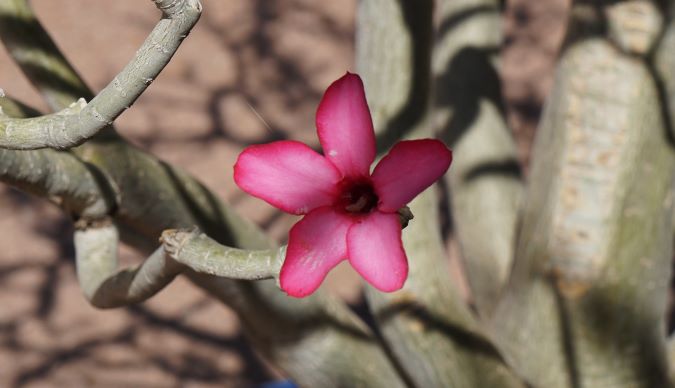
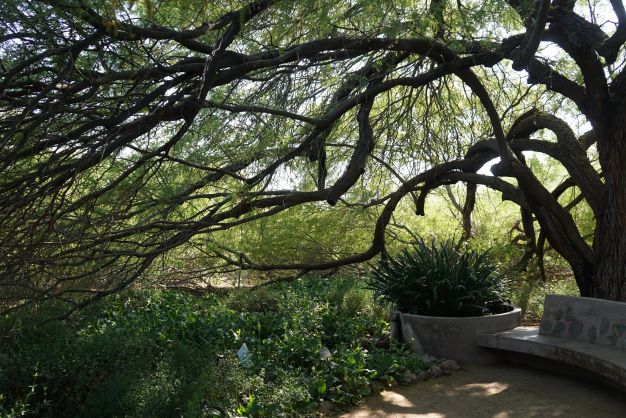
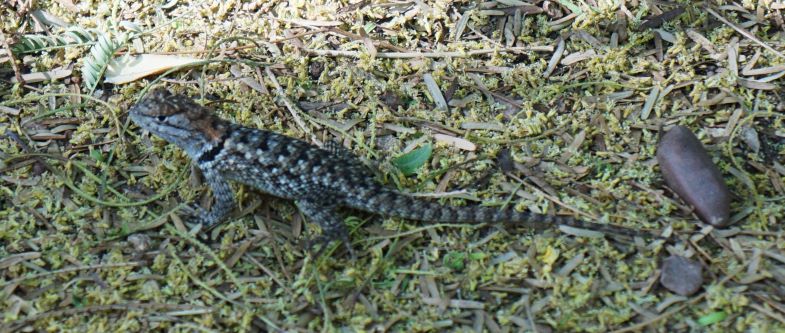
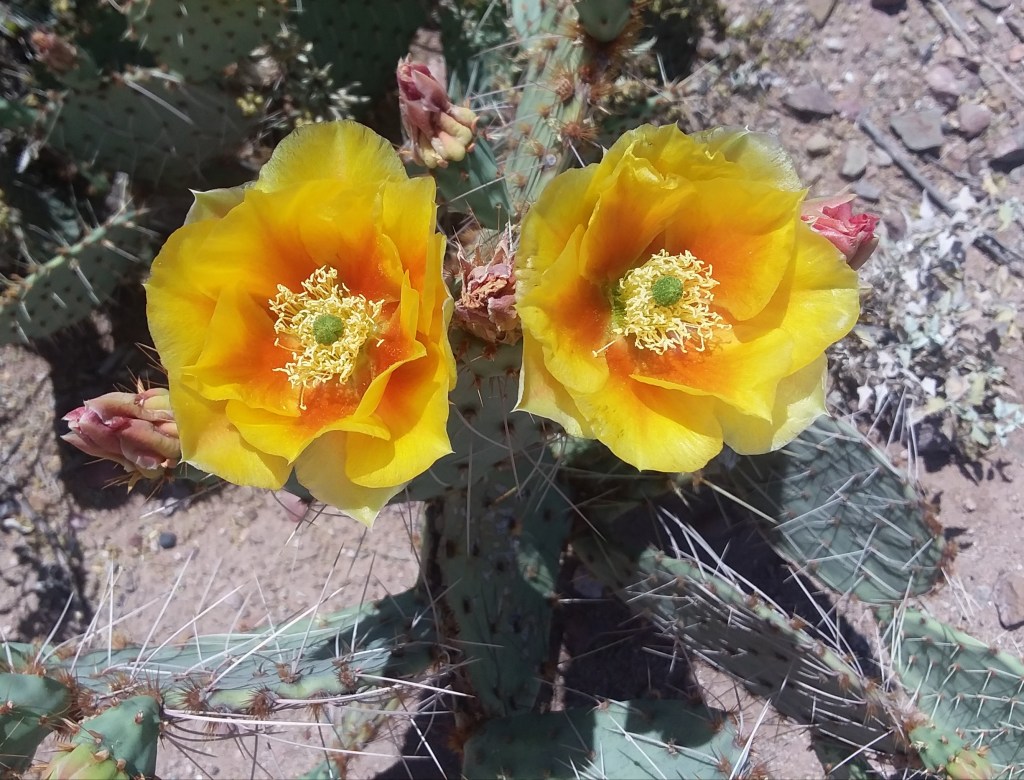
Through the weekend, the Tunnel Fire has burned 21,000 acres just north of Flagstaff, Arizona. But a few hundred miles south, the Valley of the Sun is ablaze in a kaleidoscope of color. In April’s final week, blooming wildflowers, cacti, and desert roses–and a resilient reptile–answer an age-old question. Yes, despite our warming planet, rare beauty remains in the Sonoran Desert.
Warmer, brighter, and dryer than my midwestern memories, the arrival of April in the Sonoran Desert means we are a step closer to the oven.
I’ve come to welcome the regularity of the sun and heat. They define who we are: slimmer survivors, comfortable in shorts and sandals minus the cloud cover and weighty coats of our past lives.
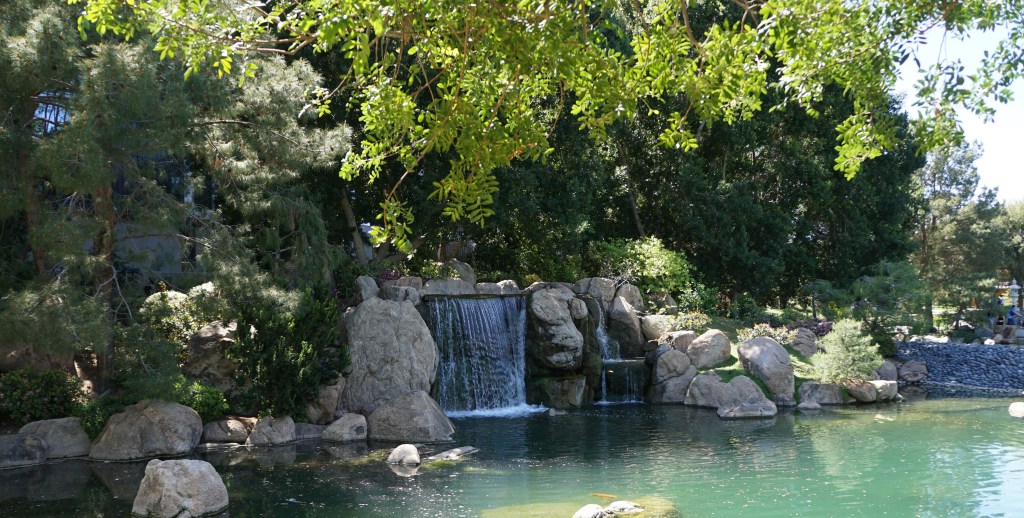
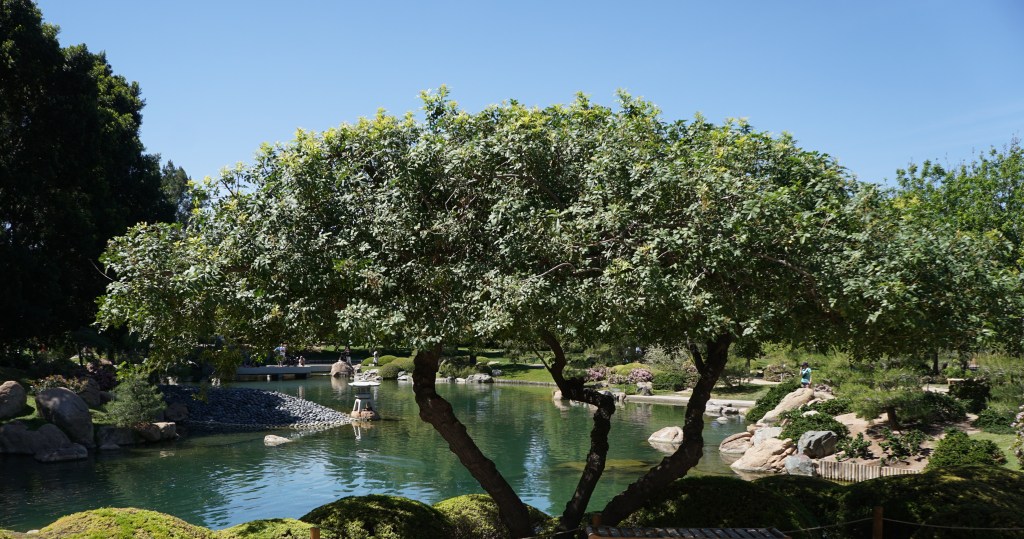
No matter the month, if you’re willing to dig beneath the palms that frame the burgeoning Phoenix skyline, you’ll find the Japanese Friendship Garden (named RoHoEn) coexisting with concrete in an urban setting.
Planted at 1125 N. 3rd Avenue (just west of Central Avenue and south of I-10 on the way to L.A.), this hidden Phoenix gem is an unexpected eastern oasis deposited amidst the flurry of western civilization.
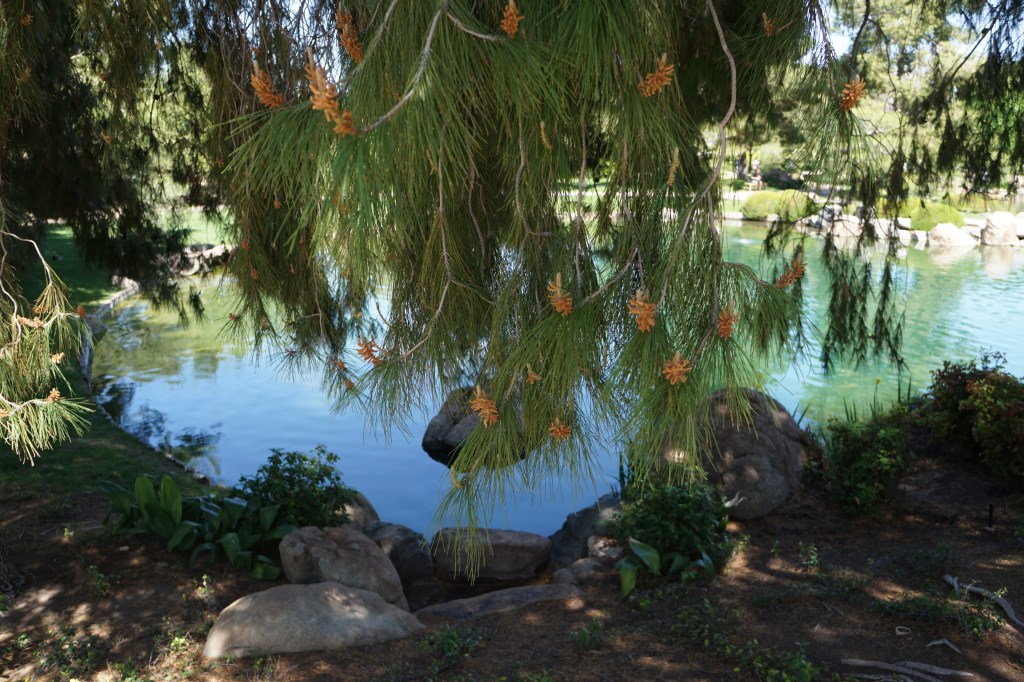
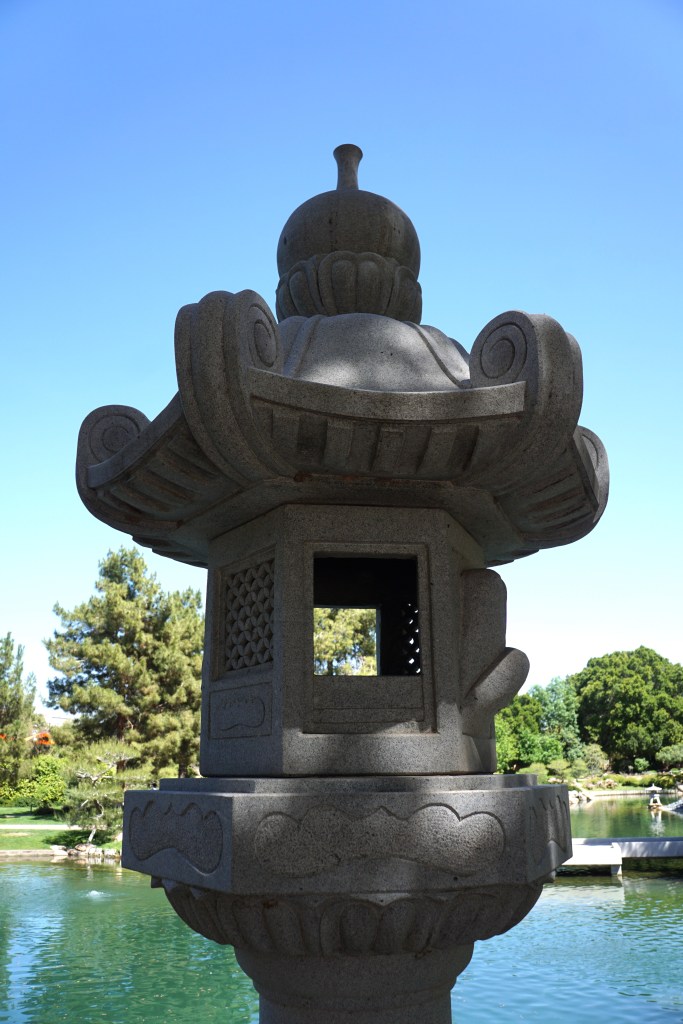
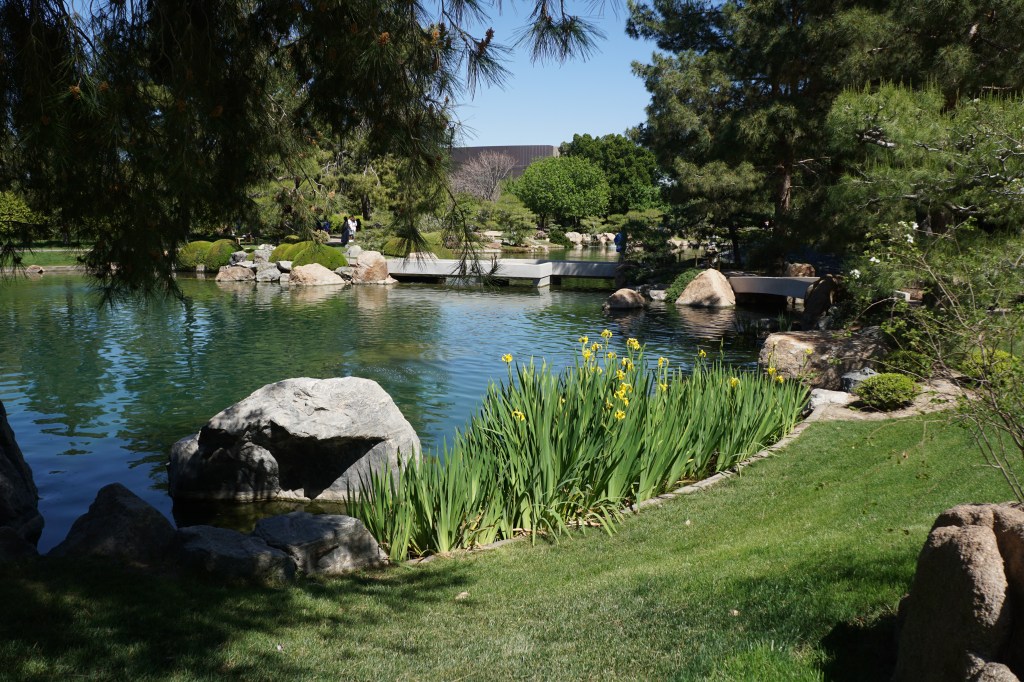
Protected by the shade of a high-rise apartment building, colorful koi dance beneath the surface of a shallow lake, a canopy of pines, sculpted shrubs, gentle waterfalls, and peaceful pagodas.
Of course, many come to the Valley of the Sun to relax by the pool. But if you prefer a different kind of escape, the garden is an ideal place to stroll in the shade, pause on a weekday, feed the fish, and nourish your soul.
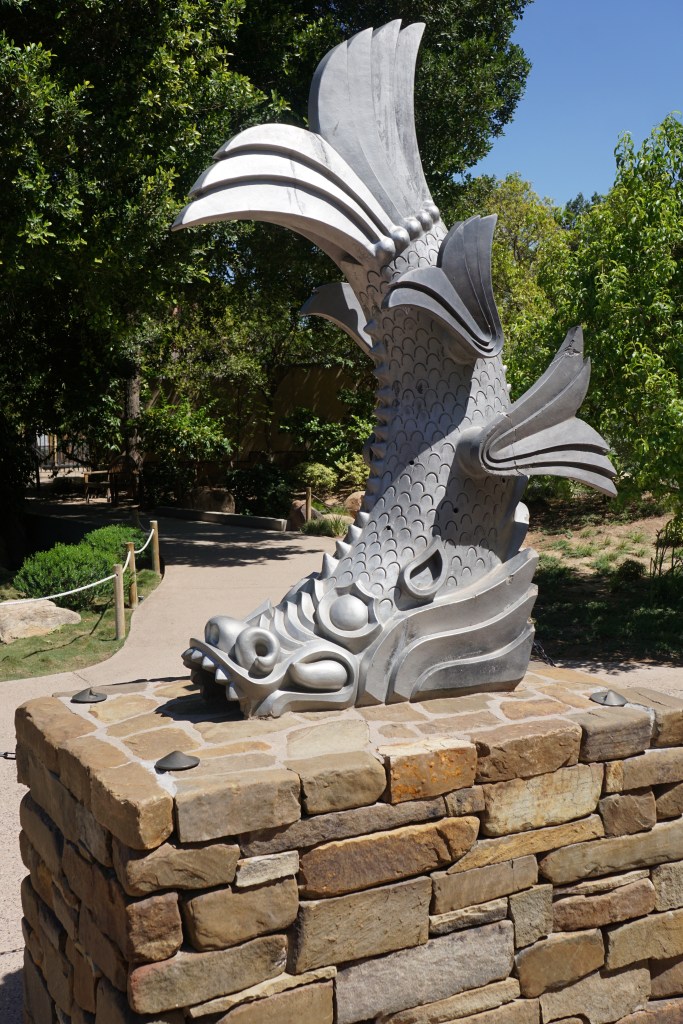
Note: Located in the heart of Phoenix, the 3.5-acre Japanese Friendship Garden is a joint project of the City of Phoenix and its Sister City, Himeji, Japan. I captured these photos during an afternoon visit with Tom on Wednesday, March 30, 2022.
Sherrell Richardson Ferrell, my farming and writing grandfather, posing in the 1930s.
As a writer and gardener, I’ve learned there is constancy and comfort embedded in the rituals of life.
Each time I sit before my laptop to tell another story I feel a sense of grounding. My hard-working grandfather, the North Carolina farmer, must have understood that. He kept a journal every day for fifty-two consecutive years–from 1933 until the day he died in 1985.
Less about his personal reflections, much of what S.R. Ferrell wrote was about the day-in-day-in responsibilities of farm life. For instance, forty-nine years ago on his seventy-second birthday, this is what he had to say:
I did my farm chores in cloudy foggy wet morning. The mud is getting deeper by the day. I mopped the kitchen after I got my outside work done. I changed my clothes and went to Huntersville to get prescriptions filled. My 72nd birthday. Jimmy, Frankie and Frances came and ate lunch with us today. Mamma and Zelma called and talked to me. Cloudy, wet, muddy, mild all day. More rain expected tonight. 54 degree low; 60 degree high.
There is nothing spectacular in these words until you consider that he wrote down his thoughts for more than five decades. Little did he know that–long after he was gone–I would read every page of his journals and (after my mother and his daughter died) write a book about the writing DNA that runs through my blood.
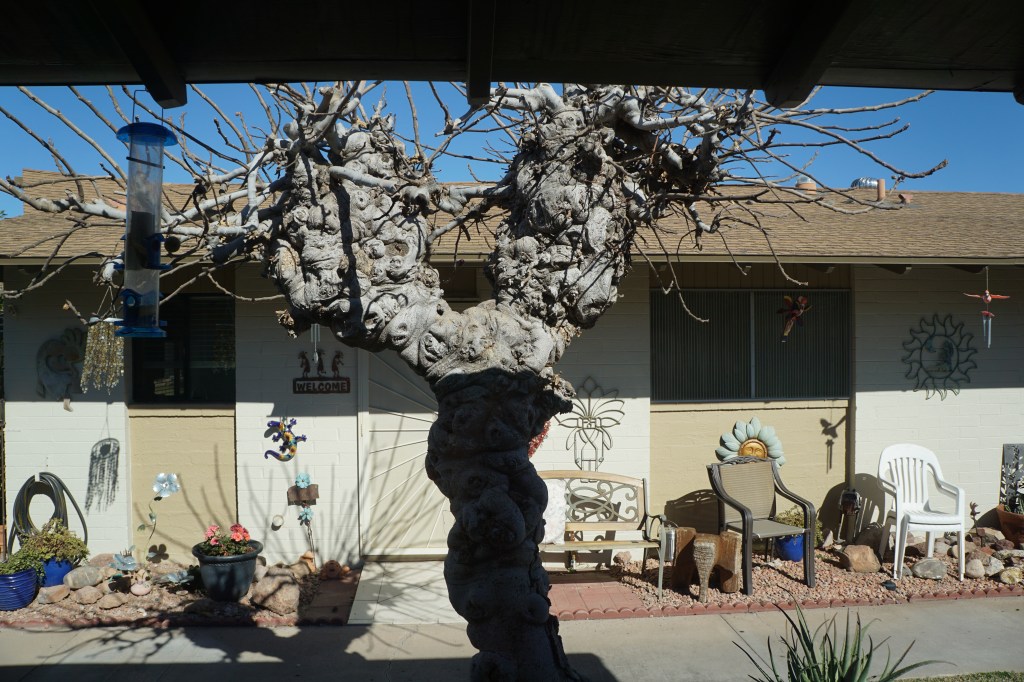
Now that I’m a desert rat, I keep a speckled rock from S.R.’s farm in our Arizona garden. At this moment, it’s wedged in the ground under our fig tree. Every time I water the tree, I see the stone. It reminds me of my southern roots and connection to the earth.
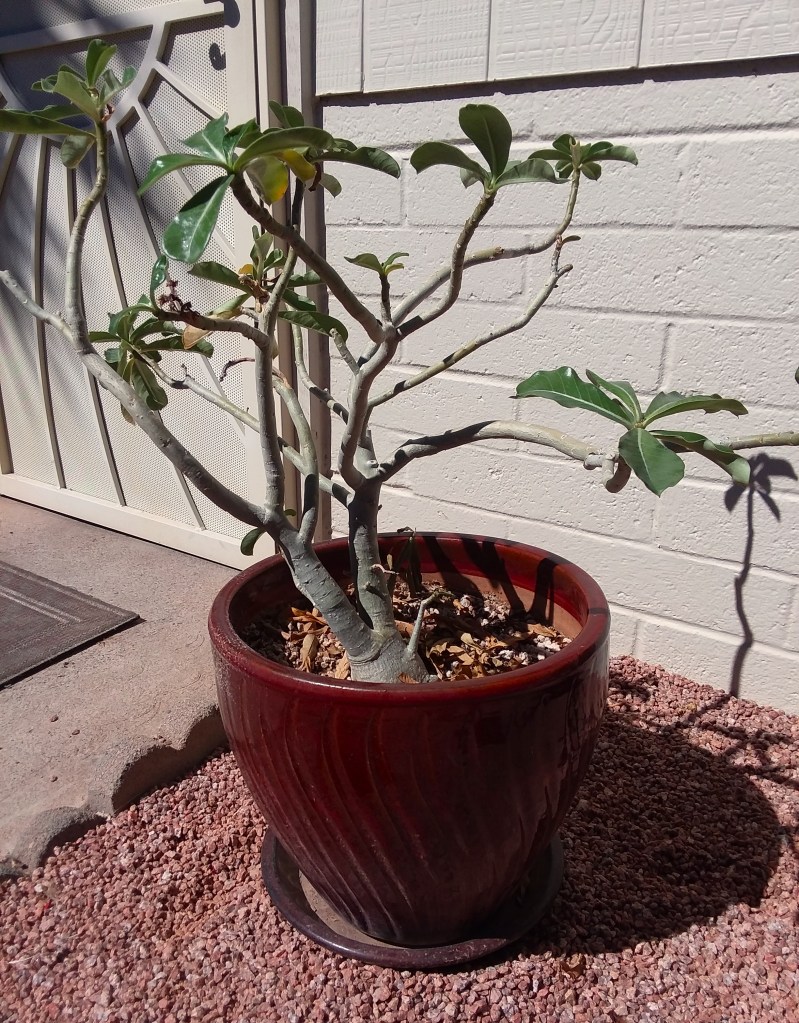
In keeping with the ebb and flow of nature and lineage, I do this ceremonial gardening dance twice a year. In early December, I lug my beloved desert roses (aka, adeniums) inside away from winter’s chill. They hide dormant in the darkest corners of our condo until March, when I haul them back outside to face the world again.
Yesterday morning, one day before S.R.’s 121st birthday, I renewed part two of this desert rose ritual. This year, it also happened to be the day Tom hired Chem Dry to clean our carpet.
Before Drew from Chem Dry arrived, my husband and I hoisted our slumbering desert rose and situated it outside our backdoor. We didn’t want to spill any soil on our freshly manicured carpet.
All of that went without a hitch. Neither of us strained our backs and Drew finished his job in less than an hour. The carpet even dried more quickly than expected.
By early afternoon, we were able to walk on the surface without wearing blue booties. By 3 p.m., we had moved all of our furniture back to where it belonged.
The blooming cycle for our prized adenium will take quite a bit longer. Rest assured, new leaves will appear this spring, prompted by warmer, longer days. Though S.R. never traveled to Arizona, I can imagine him sitting with his sleeves rolled up between farm tasks, nodding in his rocking chair as I write these words.
By June (maybe sooner) when the temperatures have reached 100-plus again here in the Valley of the Sun, this remarkable plant will produce several gorgeous double-red blooms. With it all, once again, I will have physical proof that natural beauty is constant.
Even though it feels like the rest of the world has gone mad, I draw strength from fertile ground and the knowledge that these rituals help me feel hope is always on the horizon.
You are an emerging gentle giant, a loyal Sonoran duchess ready to frolic among the thorns in a land far from your kingdom.
Your soulful eyes tell a simple truth: that the blazing sun rises and sets on every life, every civilization. But we must soldier on.
While the madness in the front yard of life drains us, it is these tender backyard moments that fill our hearts and restore our spirits.
Through it all, nature reigns. You are supreme.
Katie is the inspiration for my poem. She is Glenn’s and Peggy’s lovable Newfoundland puppy. On March 1, 2022, Tom and I stopped by for an hour or so to keep her company while our friends were away.
In addition to writing four memoirs, I’ve been blogging for nearly four years. A few of you have joined me for every twist and turn. I feel humbled by your interest and loyalty.
In my first post (May 4, 2018), I shared ten tips for writing a meaningful memoir. I believed then (as I do today), that each of us has at least one story to tell. If you are an aspiring writer, who is searching for a little inspiration, you may find these tips helpful.
#4 on the list is especially important if you are looking to engage readers, because feelings–fear, disappointment, grief, joy, excitement, anticipation, etc.–are universal:
Write what you feel.Go beyond reporting what you know. The details are important, but not as much as how you were affected by the occurrences that appear in your story. Tell your reader how you feel. Describe your experience—how the positive, negative and unusual happenings in your story touched your life.
Often when I sit down to write a new blogpost–and my fingertips touch the keyboard of my laptop–I’m uncertain what I want to write. But from the beginning of this odyssey, I’ve vowed to follow my own advice to tell and show you what Ifeelabout personal and global issues.
That has included the emotions connected to creating an authentic life as a gay man and father of two sons; recovering from a heart attack; building a new life in the Sonoran Desert with my husband; aging in a predominately youth-focused society; surviving a global pandemic; and simply observing the healing properties of animals and nature.
Even in our uncertain American society–still hamstrung politically and dealing with the ravaging effects of COVID-19–I feel fortunate to have a safe home, good health, enough food to eat, and a community of family and friends nearby.
However, I also feel a strange mix of anger, anxiety, and sadness. I attribute that to the frightening stories and images of what’s happening in Ukraine.
I won’t pretend to understand the politics of it but can imagine the tremendous pain that is occurring as Russian troops invade and thousands of innocent Ukrainian civilians are threatened.
The deceptions and power-hungry antics of certain world leaders–rooted in lies and insatiable egos–are unacceptable to me. So is the growing level of American ignorance and intolerance for the truth of what history and provocative literature can teach us.
Yet we have too many “adults” in communities clamoring for the removal of books, which might help teach our children to become critical thinkers. On that note, what I feel today is the excruciating pain of what our world has become.
Rest assured, I will continue to write and voice my concerns, but I feel it’s best if I set aside my laptop for the moment. Here in the Valley of the Sun, I’m going to lace up my sneakers on a gorgeous Friday afternoon and take a hike to Papago Park.
I’m certain the sun is shining there, and the saguaro cacti are standing tall.
Need a warm escape? Download my latest book–FREE–through February 25.
Set against the rugged Sonoran Desert landscape, it’s an anthology of whimsical and serious stories about a little bit of everything: hot rods, high points, climbing up, growing old, coming out, pruning trees, eavesdropping cacti, pool rules, sand dollars, shrinking men, tiny lizards, literary life, fanciful flights, fresh lemons, pandemic truths, desert fantasies, and much more.
Please post your review online. It will mean a lot to this independent writer.
We all know it when we feel it … love. When it is there, it fills our hearts and lights up the world.
I’m not only referring to romantic and physical love between two human beings–two men, two women, or a woman and man. Most of us need and want some form of that depending on our orientation.
True love goes beyond the jewelry commercials that implore men to buy rings for their sweethearts. It appears in many forms–parental love, neighborly love, pet love, friendship, companionship, etc. In my heart and mind, love is a close cousin of natural beauty, peace, kindness, and human decency.
As Tom and I strolled in the sun this morning along the Crosscut Canal in Scottsdale, I was transported back to grade school in the St. Louis suburbs and the Valentine’s Days of my 1960s childhood.
In those days, we created and decorated our individual holiday mail slots, fashioned out of shoe boxes and adorned with red, pink and white construction paper. Some were simple. Others grandiose, laden with tiny, pastel-colored candy hearts bearing messages. “Be Mine” was my favorite, because it communicated a winning combination of love, playfulness, and commitment.
Each year, our teachers were careful to instruct us to bring a paper valentine for each child in our classroom. Most of us followed the rules and returned with a packet of store-bought cards featuring Looney Tunes cartoon characters, Superman, cuddly puppies and kittens. Then, we went around the room and deposited all of our “love” messages. (Sixty years ago, we also had parties and trays of decorated cupcakes delivered by two or three “room moms” to our classrooms.)
Then and now, I liked the kindness and equity of that valentine distribution plan. Of course, some kids were more popular than others, but this even-handed method leveled the valentine playing field. In practice at least, each child got to feel the love of opening a box filled with valentines from each of his or her classmates.
I confess. I don’t know how schools treat Valentine’s Day now. But I suspect it’s a different animal. At a time when children and adults are bombarded with messages of fear and pandemic uncertainty, we are living in a world with a short supply of love. We need valentines more than ever this year.
It doesn’t cost much to whisper a message of love to a friend. Or to send a text or drop a card in the mailboxes of those in your metaphoric classroom.
Do it today. I’ll start. Won’t you be mine?
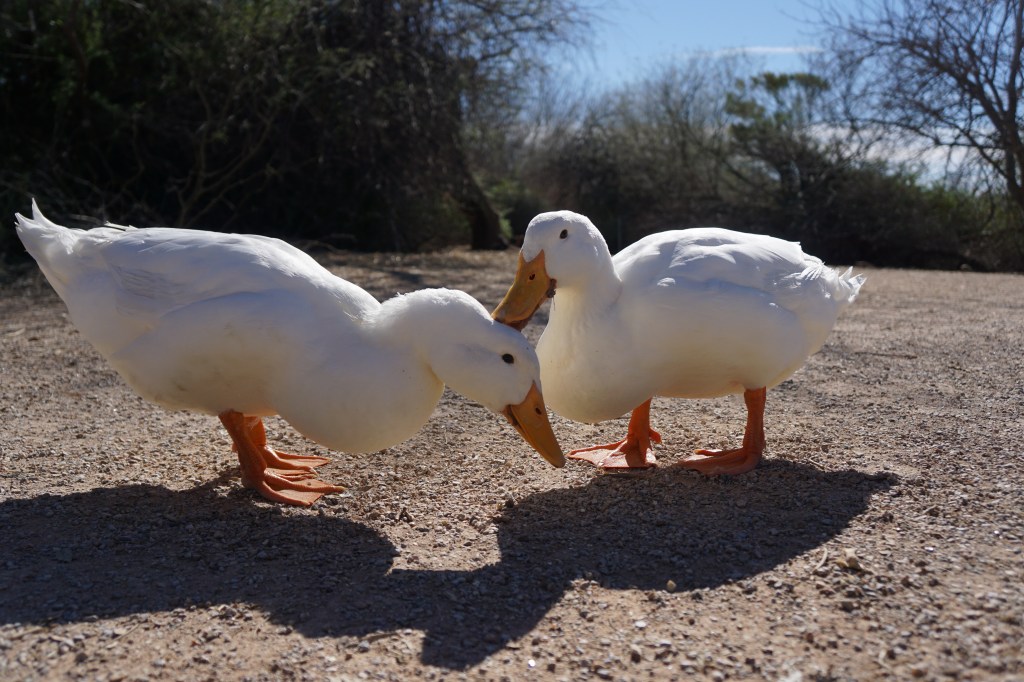
On January 26, 2022, I captured this photo of two geese sharing a tender moment on the path of life at the Riparian Preserve in Gilbert, Arizona.






 Mark Johnson Stories