October is bright and beautiful in central Arizona. The intense heat of summer is gone. Mornings and evenings are cooler.
Back in St. Louis, it was fortuitous that Tom and I decided to visit the Gateway Arch on September 22, because–with the U.S. government shutdown–the Arch and other park facilities across the country staffed by the National Park Service closed October 1. Who knows where this latest setback for the American people will lead?
Still, life goes on.
Beginning October 10, I will teach another memoir writing workshop at Mustang Library in Scottsdale. Tom is leading a film series, called Hollywood Laughs, at the same location on Thursday afternoons until mid-November.
Meanwhile, fall chorus rehearsals are underway for our next Phoenix Gay Men’s Chorus (PHXGMC) concert, Let Your Spirit Sparkle, in December at the Orpheum Theatre. I will wear my blue sparkly vest on stage again. This 2025/2026 concert season is my sixteenth consecutive year singing with gay choruses in Chicago and Phoenix. It is a vital part of my life.
Under the dynamic leadership of Antonio and Darlene–our artistic director and assistant artistic director respectively–PHXGMC has grown to more than 150 diverse members. Our voices will be strong when we march in the Phoenix Pride Parade on October 19.
Next month, Kirk will visit us in Arizona for a few days. Even as the mayhem in our country spreads, Tom and I look forward to gathering with Nick and him. We will enjoy a few quiet hours with both of my sons in our newly remodeled, freshly painted desert home.
We will give thanks for our fortunate lives, good health, and meaningful artistic opportunities in our sixty-something years, which have enabled us to have a positive impact on the lives of others in our community.
In February 2024, John, Sharon, Tom, and I sat around a half-moon-shaped booth in Phoenix, devouring yummy, syrup-soaked, gluten-free waffles and nursing hot mugs of coffee at Jewel’s Bakery and Cafe.
They had been in town for a church retreat over a three-day weekend and were about to return their rental car to Sky Harbor Airport. Breakfast together was our sendoff before they flew home to St. Louis.
“Oh, did you see Nancy’s post on Facebook? There’s gonna be a Class of ’75, Affton High School, 50th reunion sometime, somewhere next September in St. Louis,” I reported.
“You guys should definitely do it. ” Sharon chimed in. “The four of us should go together! Don’t worry about Tom and me. We’ll keep each other company.”
“Sure. Why not!?” Tom agreed.
“I’m in if you’re in,” John stared directly at me. He and I were close junior and high school pals in Affton, though his family moved north, away to another St. Louis area school district before our senior year.
“Okay,” I concluded. “The journalist inside me is telling me we should go.”
Our scheme–hatched in Phoenix, to be realized more than a year and a half later in St. Louis–was born.
***
The sometime was 5 to 9 p.m. on September 21, 2025. The somewhere? Grant’s Farm, a rambling, forested 281-acre estate in south suburban St. Louis, named for Ulysses S. Grant and owned by the Busch family.
Specifically, our 50th reunion would occur in the Bauernhof Courtyard area there. It’s an old-world community space where–since its opening in 1954–St. Louisans have gathered to sample Anheuser-Busch products, and amble down hallways of vintage horse carriages past Clydesdale stables. It is an iconic St. Louis destination, draped in mid-twentieth-century nostalgia.
With the threat of showers in the air, John, Sharon, Tom and I arrived in the Grant’s Farm parking lot just before 5 p.m. Immediately, I began to spot familiar faces. I hugged Terri and Beth, two classmates I hadn’t seen in decades. We boarded a tram that would transport us through the woods to the Bauernhof. I inhaled the fresh-yet-familiar, dampness of the lush green forest.
The long-awaited immersion into my past Affton High School life–connecting one leg of my past as a seventeen-year-old, long-haired (remember, it was the 1970s), reserved, enterprising, unactualized gay adolescent with the other leg of my present much older, wiser, grayer, gayer, literary self–was about to commence.
When we arrived at the Bauernhof Courtyard entrance, we stepped out of the tram towards an archway. Nancy, our cheerful, detail-minded Class of ’75 organizer, greeted us with hugs.
We formed a line to check in and pick up drink tickets. Affton attendees (in this case, John and me) received name tags bearing our black-and-white high school yearbook photos. Significant others, such as Sharon and Tom, got tags with an image of a cougar beside their names. (The cougar is the Affton High School mascot.)
John and I proceeded through the line with our “cougar spouses” toward the courtyard. A photographer snapped photos as couples and singles entered. In that moment, as I turned to see the line queuing behind me, I spotted someone significant I had hoped to see. Not a fellow student, but a teacher I admired from my high school years. It was Judy Rethwisch, my drama teacher.
The high school version of me would have faded and stepped back, reticent to make a scene or a visible statement. But the confident me–the sixty-eight-year-old gay man with his husband by his side–stepped forward to reconnect with Judy.
“I want you to know what a positive difference you have made in my artistic life,” I smiled and reached forward to hug her. “With you at the helm, I found my peeps in the theatre program at Affton,” I went on. In a flash, I recounted roles I played in productions of Fiddler on the Roof and Gypsy under Judy’s dedication and tutelage.
Judy smiled and listened intently as Tom captured a few photos of us locked in conversation. She told me she is still teaching drama. Sixty-one years as an educator. Still vibrant. Still making a difference in the lives of other aspiring actors, musicians, and artists. She asked for my card and told me she is interested in reading one of my books. That was just the beginning of a stream of seminal reunion moments.
I quickly rediscovered a parade of classmates coming and going all around me. Some were fuzzy in my memory. Others, like Jon, more meaningful. He was a good friend in high school, who traveled to Colorado with John and me after our junior year of high school.
Suddenly, I was transported to August 1974. Somehow, the three of us had convinced our parents, that we–one seventeen-year-old and two sixteen-year-old boys–would be safe driving and camping together across country in John’s AMC Javelin, pulling a small trailer.
Yes, we were underage and found someone to buy us lots of Coors beer, which we swilled by the campfire at night. But we survived intact. I recall vividly shoveling down steak and eggs for breakfast in a bar somewhere in Wyoming, while in the corner of the tavern, Richard Nixon, was announcing his resignation on a beat-up black-and-white TV.
Back at the reunion, other male and female classmates trailed by to greet each under the courtyard tent. It featured a beautiful crystal chandelier that hung in the center of the space.
Soon a line formed at a barbeque buffet. We juggled our drinks and grabbed plates, before landing at one end of a long rectangular table Tom and Sharon had secured.
At one point, I turned, and Jeff appeared. He and I were pals, who shared a few classes. We ate together frequently in our high school cafeteria. Honestly, these memories are vague for me. But I remembered his handsome face. It hadn’t changed much, given the fifty-year gap in our connection.
When Jeff introduced his long-time partner Lee to Tom and me, I felt my past and present lives coalesce. Neither Jeff nor I were aware of the other’s sexual orientation in high school. Sadly, that was the norm for 1975 for unrealized, unfulfilled, budding gay adolescents.
But knowing that against the tide of social norms we had each found happiness with our male partners and had independently decided to return to the reunion was physical proof why I had come to the Class of 1975 reunion. I needed to fully reconcile my past closeted self with the authentic gay man I had become.
A little later in the evening, Tom returned to our table and said emphatically: “I can’t tell you why, but you need to go to the dessert table right now.”
Of course, I listened to my husband and followed suit. When I arrived there, I discovered Nancy and Jim (the reunion organizer and her husband) had brought two of my books–From Fertile Ground and Tales of a Rollercoaster Operator–to display there for all to see.
I don’t know that I gasped, but it felt like I did. To be appreciated for my writing that way, left me speechless in the moment. It was a lovely gesture, authored by Nancy and Jim. Another phenomenal moment, which connected one leg of my life with another.
Before the reunion came to a close and we boarded the tram, all of the Class of 1975 Affton High School classmates–about 120 of us in attendance–stood on a wobbly set of risers for a group picture. (Earlier in the evening, a large poster bearing the names and photos of our forty-nine classmates who have passed graced a corner of the same stage.)
Certainly, the wrinkles and gray hair for those of us who have survived into our late sixties were apparent on the evening of Sunday, September 21, 2025. But the smiles and fun-loving community spirit superseded all of that. Our hearts were full.
***
After treating John and Sharon to breakfast Monday morning, Tom and I had a few hours on our own before we needed to make our way to the St. Louis airport for the trip home to Arizona. There were a few loose ends for us to tie together.
First, we drove to Left Bank Books in the central west end of St. Louis to browse the stacks. It’s a renowned, LGBTQ-friendly, independent bookstore we had planned to visit on the morning of our shared sixtieth birthday. But after I suffered a mild heart attack that day–in the city where I was born–our lives took a vastly different path. Fortunately, we survived that experience together.
Appropriately, our final stop in St. Louis was the Gateway Arch. In the late 1970s, during my collegiate years, I was a National Park Service history interpreter there. Giving tours of the Museum of Westward Expansion, welcoming visitors to the top of the Arch, and–from time to time–introducing a fascinating documentary film about the construction of the Arch, called Monument to the Dream.
The film chronicles the beauty and simplicity of Eero Saarinen’s winning design, but also the herculean effort required for a diligent crew to erect the monument through all sorts of weather conditions.
On a warm autumn day when the Arch was completed–October 28, 1965–the crew sprayed a steady stream of water on the south leg, which was expanding in the heat, to allow the capstone–the final piece at the top between the two legs–to be wedged in and joined permanently.
In a symbolic sense, that is what this later-in-life St. Louis reunion with friends and family means to me.
Call it the arc of life or the Arch of life. Either way these sixty-something years began in Missouri, brought me to Chicago for a long career and life as a single father, and carried me to Arizona with my husband. There we have discovered a rewarding artistic life together among new and old friends–our chosen family–even as our freedoms and institutions in the America we still love are threatened by fascism.
Along the way, the highs and lows have transported me to a profound place of greater gratitude and understanding, which I have earned.
It is a welcome destination that once felt out of reach.
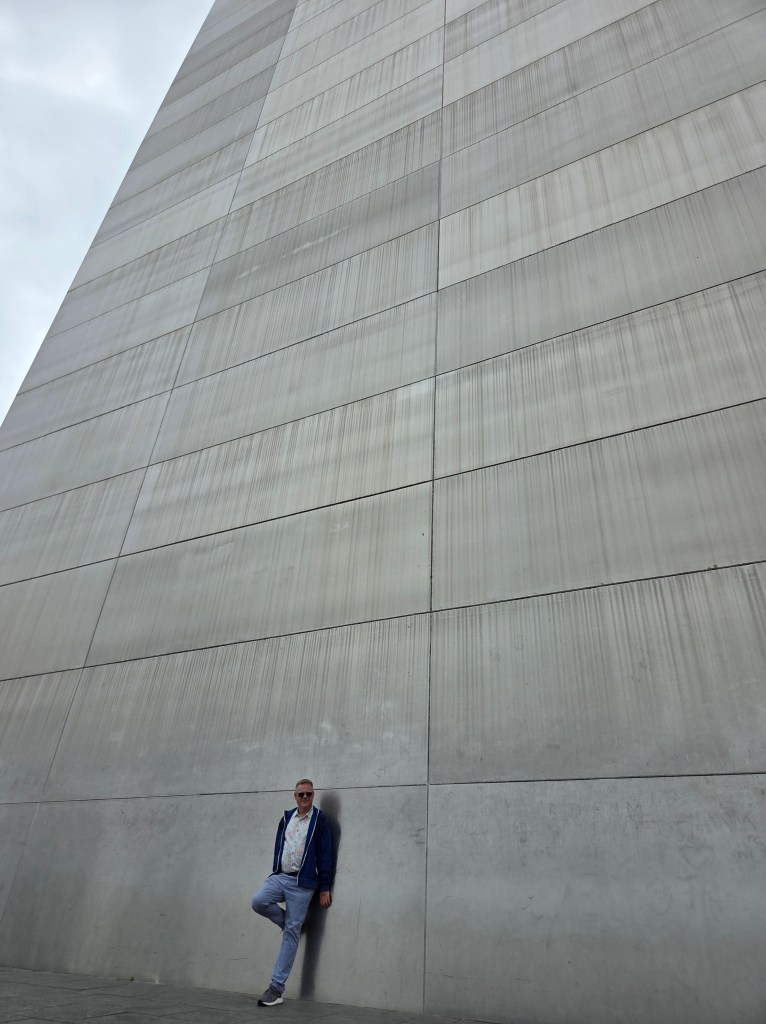
On Monday, September 22, 2025, Tom captured this photo of me leaning against the base of the north leg of the Gateway Arch in St. Louis, Missouri.
Spotty storm clouds gathered in the distance on the morning of Saturday, September 20. Tom and I drove northwest twenty miles, across the Missouri River.
Our destination was Breeze Park in Weldon Spring, Missouri. My cousin Phyllis–a retired teacher–is convalescing there, hoping to regain her strength after a series of health complications.
Phyllis’ mother Violet and my father Walter were twins born in St. Louis. It was 1913. More than fifty years later, the Gateway Arch would rise and transform the St. Louis riverfront. Teetering warehouses once stood on cobblestone streets there, in this fur-trading town founded just west of the Mississippi River in 1764.
In the arc of life, Phyllis and I (both Baby Boomers) also arrived–she in 1947, I in 1957–before the historic completion of the Arch, our nation’s tallest monument, on October 28, 1965.
But today I reflect on our personal connection. Like me, Phyllis and her husband Tom also raised two sons born in the 1980s. Austin and Bryant are now in their early forties and late thirties respectively. A touch younger than my son Nick; a shade older than my son Kirk.
Now in their late seventies, Tom and Phyllis are meeting the healthcare challenges of life head on. Negotiating the unpleasantness of aging and inherent losses (their lovable golden retriever Truman passed recently). They are doing their best to push ahead. To stay hopeful. Or as my mother–a child of the Depression–would have said “trying to keep a stiff upper lip.”
Given these developments, I wanted to spend time with them while we were in the St. Louis area. Especially because–beyond my sister Diane who now lives in northern Illinois–they are the closest remaining strands of family from my Missouri years: 1957 to 1980 … my Tales of a Rollercoaster Operator years.
On Saturday, when my husband and I arrived just past 9:30, we wound our way down halls, past friendly staff and other visitors, to Phyllis’ room. She was delighted to see us. So was her Tom. He arrived a few minutes later with a big smile and box of gooey pastries for us to share.
The next two hours were a heart-warming oasis of conversation and listening between the four of us. We spent our time commiserating over the latest news, but–more importantly–strengthening our family bond during a challenging period for them personally.
Phyllis is hoping to return to their home soon in nearby St. Charles. As anyone would, she is missing the familiarity and comfort of her life. Longing for peace away from medical equipment and disruptive procedures. Her kind, caregiving husband is also searching for peace.
Before Tom and I left, we hugged and took photos together outside on a beautiful, flower-laden patio at Breeze Park. I kissed Phyllis on the cheek. A few tears materialized for both of us, not knowing what tomorrow will bring.
At the least, we shared those upbeat Saturday moments, built upon our 1960s memories of our once-vital, long-gone boisterous St. Louis relatives gathering around us every Christmas, Easter, and Independence Day.
To our credit, in our later years, long after our sons became adults, we have formed reciprocal connections. Most notably, Phyllis, Tom and their family joined Tom and me for an Italian dinner in St. Louis in route to our new home in Arizona in July 2017.
Now they share stories and photos via text of their four growing grandchildren, and I write stories about my St. Louis origins, which she has encouraged, helped inspire, read, and followed diligently.
All of this, through a period of uncertainty, sustains us in our sixty-and-seventy-something years across the miles.
***
Just after noon Saturday, Tom and I returned to Creve Coeur. We landed in the driveway of our friends John and Sharon.
We were about to share the rest of the weekend with them and their loyal eight-year-old-shepherd-beagle-mix Nickel at their stylish, mid-century home … hike with John through a dense forested area overlooking Creve Coeur Lake, then get caught in the rain in historic downtown St. Charles … drive into St. Louis for a Cardinals/Brewers game at Busch Stadium Saturday night … and still later, on Sunday evening, attend our Class of 1975 Affton High School reunion together at Grant’s Farm.
The clouds cleared Saturday evening and ushered in cooler temperatures. Seated together with close friends at Busch Stadium, three levels up directly behind home plate, it didn’t seem to matter that my beloved Cardinals lost 3-2.
Yes, it was the latest evidence in a disappointing sub-par year. But on the horizon, beyond the stadium’s outfield walls, the twilight of a blue sky and puffy clouds perfectly framed the Gateway Arch at the center.
Architect Eero Saarinen’s monument to a dream is still standing, rising above the cobblestones and the fray, as it approaches its sixtieth birthday.
If we live long enough and look beyond the palms, we see the arc of our lives and the hint of a rainbow. We remember where we came from. Who we were. Who we are. How far we’ve come. Our best intentions. Our mistakes. Our progress. Our loves. Our losses. Our lessons learned. The connecting tissue that has made us who we are. All of it.
***
Fifty years ago, in June 1975, I graduated from Affton High School in south suburban St. Louis.
Tom and I travel back to St. Louis tomorrow for a reunion with my class of 1975 mates over the weekend.
I’m excited to see old friends. I also expect a few bittersweet moments.
Either way, the journalist inside me is sure to return with a story or two.
Because I am a writer. That’s not what I do. That’s who I am.
If you follow the weather news in the United States, you know that on Friday, May 16, parts of St. Louis, Missouri–where I was born in 1957 and reborn in 2017–suffered an estimated $1 billion in damages from an EF3 tornado.
The powerful storm tore through central and north St. Louis, killing five people while damaging or destroying 5,000 buildings and countless trees … including many majestic ones in and around one of the city’s gems: Forest Park.
I have no doubt that over the coming days, weeks, months, and years, the citizens of St. Louis will heal and recover. But it will be a tall mountain to climb for many financially and emotionally.
I have made a donation to the American Red Cross disaster relief efforts. But I want to do more for the city I love, which appears in all five of my books. It is hardwired into my prose and poems in large and small ways …
In memories of my hard-working family, our suburban midwestern existence, humid summer days, learning to operator a rollercoaster at Six Flags, working at the top of the Gateway Arch (pictured here) in the late 1970s, rooting for the St. Louis Cardinals, boating on the Mississippi River, visiting the St. Louis Zoo, frequenting the aforementioned Forest Park, and much more.
In addition to making a donation of your own to your favorite relief charity, here’s another way you can help. Buy any of my five books during May and June.
I will donate $10 for each book I sell (paperback, Kindle, or audiobook) during that period to Forest Park Forever. It is a private nonprofit conservancy.
As described on their website, the organization “partners with the City of St. Louis to restore, maintain and sustain Forest Park as one of America’s great urban public parks for a diverse community of visitors to enjoy, now and forever.”
Thank you in advance for your support of my literary efforts and the city of St. Louis … as well as its beautiful urban greenspace in the middle of town, which I still love and remember.
***
Incidentally, Tom and I will travel to St. Louis in September to attend a Class of 1975 reunion with my Affton High School classmates. Yikes, fifty years! More to come on that.
Albert, Louise, and their three adult children–Thelma, Violet, and Walter–led ordinary lives.
In the fall of 1944, they were a big-hearted, hard-working, working-class family–living in a flat on Labadie Avenue on the north side of St. Louis.
To be precise, Thelma and Walter lived with their parents. Violet and her husband Harry lived nearby.
At any rate, they were a close family with strong opinions, loud voices, and a propensity to gather around the radio for FDR’s inspiring Fireside Chats.
Like all patriotic American families of that era, they planted a Victory Garden to grow their own vegetables, rationed household supplies, and bought war bonds to support American troops fighting overseas in Europe and the Pacific.
They did it all for the sake of protecting and maintaining freedom in a war-torn world.
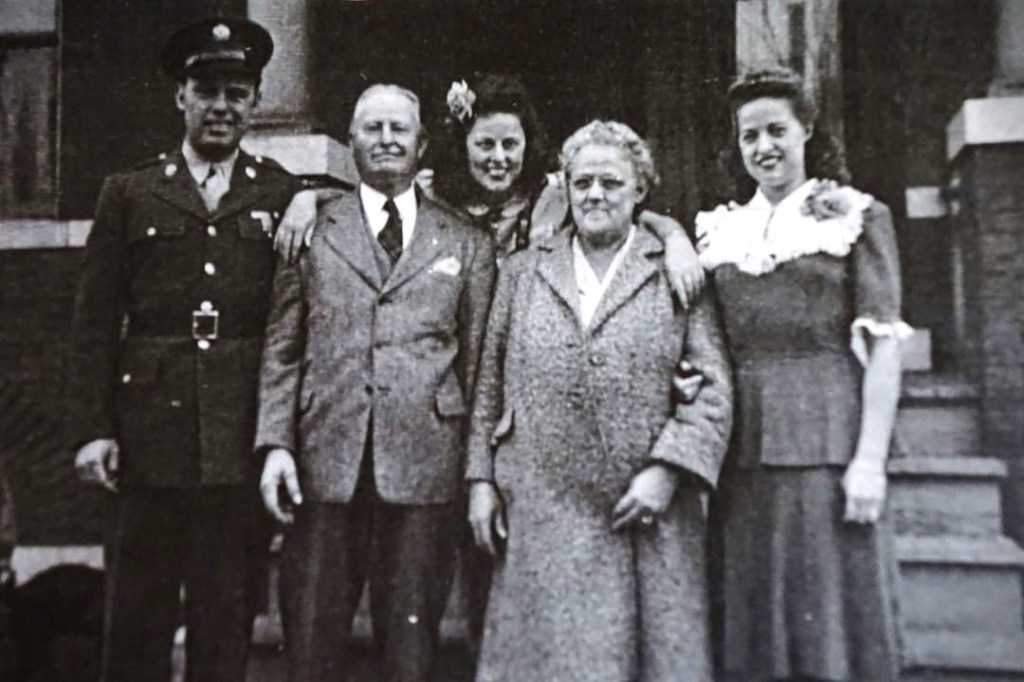
Walter, Albert, Thelma, Louise, and Violet in late 1944.
When Walter was drafted and deployed to Europe (Harry, too) you might say the family had extra skin in the game of war.
He left New York Harbor–aboard the Queen Mary ship with hundreds of other soldiers–on New Year’s Eve 1944.
Five days later, he landed at the Firth of Clyde in Scotland … and, in short order, he found himself on the front lines scurrying from foxhole to foxhole in the Battle of the Bulge in the forested Ardenne region of France.
As the war in Europe wound down in 1945, he marched with the first group of US army personnel who met with the Russian army on the Elbe River on the eastern front of the war.
Walter survived the ordeal–in part because of the regular flow of love letters and encouragement he received from his sisters and parents.
Walter returned to the US on the U.S.S. Monticello in July 1945 … for a thirty-day leave prior to going to fight in the Pacific.
He was supposed to depart in mid-August, but on August 6, the US dropped the first atomic bomb on Japan and the war ended shortly thereafter.
Walter’s fighting days were over. He was discharged from the service on October 11, 1945.
A few years later–sometime after he met his future wife Helen in January 1948 at Westminster Ballroom in St. Louis–he confided that the Russian soldiers were some of the roughest, battle-hardened men.
At any rate, despite the “shellshock”, nightmares, and frozen feet Walter brought home with him, he (and Harry) came home in one piece.
***
I’ve thought a lot about Walter and Helen (my dad and mom), Thelma and Violet (my aunts), Albert and Louise (my grandparents) … the Johnson family … since the election last week.
All of them have been gone a long time, but in a sense–today–I feel I am grieving my own loss of freedom, as well as their legacy. The one they fought so hard to uphold.
I’m not giving up, but that is how I feel on Veterans Day 2024.
Early this afternoon, I pulled out Dad’s World War II army trunk.
It contains pieces of his uniform–including the wool hat and golden medallion he wore eighty years ago as he was preparing to preserve freedom on behalf of his country.
Finding it there with his few remaining possessions gave me strength.
In the coming days, weeks, months, and years, I’m going to do my best to draw from the resiliency in my family’s DNA to find specific ways to uphold democracy in my Arizona community.
You can be sure I also will continue to exercise my voice–through prose and poetry–and influence others in a positive fashion as we head into an uncertain and potentially ominous period in our country’s history.
In the 1960s–when the San Francisco Giants appeared at Busch Memorial Stadium in St. Louis to play the Cardinals–the bleachers were a heavenly place for Dad and me to be.
Because, on many hot summer days and nights, in addition to watching our beloved Cardinals’ legends perform on the field (especially Bob Gibson and Lou Brock), we saw Willie Mays patrol centerfield.
Simply put, there was no one better–before or since–at chasing down line drives and long fly balls. Securing the ball in his mitt with his patented basket catch. Smiling at fans who gravitated to his magnetic personality.
Willie was the face of major league baseball in those days. His affable presence and disarming charm seemed to neutralize the racial prejudice that haunted many other black athletes when they traveled from town to town.
We ALL observed Willie’s greatness and humanity with awe and pride. He was a hero to black and white fans alike.
I won’t recite all of Willie’s remarkable batting statistics and records. I’ll leave that to the experts. Suffice it to say, his lifetime batting average of .301, 660 home runs, 3,293 hits, 1,909 runs batted in, and 339 stolen bases made his election to the Hall of Fame in 1979 a no-brainer.
Willie brought exuberance, fun, and a boatload of hitting and fielding talent to every game he played over more than two decades.
He was a legend off the field, too. For instance, he spent many hours playing stick ball with kids on the streets of New York before the Giants moved their franchise to San Francisco in the late 1950s.
I cried when I learned of Willie’s death on Tuesday at age 93.
Truly, there will never be another Willie Mays.
***
Beyond past ballfields (and my continued propensity to root for the St. Louis Cardinals as I approach my 67th birthday in the scorching summer heat of Arizona), my personal sense of awe and pride lives and breathes in a far different venue: on stage with the Phoenix Gay Men’s Chorus.
This weekend we will be performing our Encore show at the Tempe Center of the Arts. I’m proud of the libretto I’ve written for the show.
Five storytellers–I’m one of them–will connect the music with tales of reflection concerning who and what our chorus is. More than that, what it means to us in 2024.
For the audience and us performers, it will be a high-energy, emotional rollercoaster of favorite musical and choral moments, punctuated with dazzling choreography.
For added emphasis, this will be the final performance for our artistic director, Marc. He will pass the conducting baton to our new director, Antonio, who will usher in a new era of awe and pride for the Phoenix-area LGBTQ community and all our avid supporters and music lovers.
I last visited my father’s grave at Jefferson Barracks National Cemetery in September 2021.
If there is such a thing as beauty to behold in a final resting place for those who served, it exists there just south of St. Louis on the banks of the Mississippi River–fourteen hundred miles east of where I live and write today.
On this Memorial Day, I remember Dad–and the thousands of fallen soldiers gathered around him–with twelve lines I wrote on August 27, 1996 … almost three years after he died.
Thirty Thanksgivings have come and gone. You wouldn’t recognize the world now. It’s not the one you left on November 26, 1993–much less the country you helped defend during World War II.
Despite some steps forward, life in 2023 is far more complicated, contentious, and fragile for most people.
Nonetheless, I count myself as one of the lucky ones. Thankful to be alive. Thankful for the love of family and friends. Thankful to remember you.
I met Tom about three years after you died. In my thirties, I didn’t imagine this sense of companionship and contentment in my later years … able to marry another man with a similar worldview and creative disposition.
Nor did I imagine living and writing in the warmth of the Sonoran Desert. Creating a life far outside the bounds of the Midwest existence I called home for nearly sixty years.
Over the past three decades, I’ve often reflected on your life, your troubles, your good intentions.
Whenever Tom and I watch the film, I Never Sang for My Father, I am reminded of the deep and treacherous waters fathers and sons navigate together.
We had our share of those moments, but I don’t see a huge resemblance between our relationship and the conflicts facing the two lead characters–frail father (Melvyn Douglas) and his writer son (Gene Hackman)–who never find common ground or the language to make their relationship whole.
There is a profound line in the movie that resonates and always leaves me in tears.
“Death ends a life. But it does not end a relationship, which struggles on in the survivor’s mind toward some resolution, which it may never find.”
Thirty years later, I feel at peace as I recall our relationship in some unnamed, spiritual way. I feel it on certain occasions with my sons. Or when Tom and I commiserate over our personal losses.
Or as I consider my book of poems, which I published earlier this year. Or when I sing on stage with the Phoenix Gay Men’s Chorus and sense a ripple of emotion charging through my heart and lungs.
I can imagine how proud you would be to see how far I’ve come. You were always the first one to stand and applaud when I sang in high school and college. Thank you for that.
I never told you that I understood your struggle to be heard, even when your depression caused me pain. I observed both your successes and failures–your hopeful exuberance, love of family, health challenges, and bouts of unhappiness.
They have shaped my odyssey as a writer and given me greater compassion and empathy for the plight of the disenfranchised.
In 2023, I live about fifteen hundred miles west of St. Louis, far away from your grave at Jefferson Barracks National Cemetery. So, I won’t be able to visit your marble slab today, but this letter is better.
Rest assured–long after your final breath the day after that big meal with your sisters on Thanksgiving 1993–our sometimes-messy-sometimes-sweet bond still exists.
We will be father and son forever. That will always matter to me. Because I still remember.
Love, Mark
My father’s final resting place at Jefferson Barracks National Cemetery south of St. Louis.
The St. Louis Cardinals finished with a 71-91 record this year, landing in last place in the National League Central Division. With a thud in early October, my favorite team–rich with winning tradition that decorated my 1960’s childhood memories–ended the season with its worst win-loss record since 1990.
However, as luck would have it, the Arizona Diamondbacks (D-Backs)–my second favorite team now that I live in the Valley of the Sun– blind-sided all prognosticators.
Against all odds, this young, exciting, resilient team defeated the Milwaukee Brewers, Los Angeles Dodgers, and Philadelphia Phillies in previous playoff series and advanced to the World Series to play the Texas Rangers.
As I write this, the Rangers and Diamondbacks have each won a game in this best-of-seven fall classic. Beginning Monday, the teams will play the next three games in Phoenix at Chase Field.
The stadium is about ten miles west of our home in Scottsdale, but Tom and I have no inclination to spend thousands–or even hundreds of dollars–to sit in the stands and cheer for the team. Instead, we will watch the action and results unfold on TV–or the “tube” or “idiot box” as Dad would have called it.
Speaking of Dad, the timing and topic is right for me to share an excerpt from Tales of a Rollercoaster Operator, my book of stories from my Missouri youth. I hope you enjoy this tale about the baseball bond he and I–two Cardinals’ lovers–shared.
***
With Dad as my ever-loving companion, I hoped we would someday see a World Series game together in person. That possibility seemed akin to flying to the moon and back. But, in October 1968, we tried to make that dream a reality.
I was eleven years old. That summer the Cardinals clinched the National League pennant for the third time in five years on the strength of a 97-65 record. They would defend their 1967 World Series crown and face the Detroit Tigers in the Fall Classic.
On a crisp October morning, as I munched on stale Apple Jacks and Dad drained the contents of his saucer back into his coffee cup, I cupped my left ear toward the kitchen radio speaker.
The KMOX announcer provided details of when and where fans could line up that day to buy bleacher tickets for games 1, 2, 6 and 7. The Cardinals would host those four games in St. Louis.
I turned to Dad. He had the same “let’s do it!” look on his face. We were about to embark on an important mission: landing two World Series bleacher tickets.
With a surge of adrenalin and spontaneity that swept us off the front porch, we grabbed our jackets, hopped in our ’65 Chevy Biscayne, and drove ten miles into downtown St. Louis (a few blocks from the Gateway Arch).
I had a grand illusion that we would drive up to the ballpark, step up to the ticket window, plop down some cash, grab our newly minted tickets, and be on our way.
But, when we arrived, a stream of Cardinals fans snaked around Busch Memorial Stadium and down a few blocks. I soon realized this game of standing in line for tickets was likely to go extra innings.
Our first step was to find a parking space. Like a miner searching for gold nuggets, Dad circled the stadium two or three times for that elusive spot. Just as we were about to abort our mission, we hit pay dirt.
Dad landed our boxy craft in an unmarked open space, in the shadow of dingy, abandoned brick warehouse several blocks away. From there, we hoofed it and found our way to the end of the elongated queue of ticket-hungry spectators.
Minutes and hours passed, but the line stood still. As darkness descended, fans all around us unrolled sleeping bags to ride out the night rooted in cement.
Except for our jackets and a few snacks, we were unprepared for the madness, but managed to buddy up with a few of our neighbors. Between sighs and “what if” scenarios, we borrowed a square or two of an old quilt to sit down and wait out the marathon.
Dawn broke after a sleepless night with relative strangers and policemen hovering nearby. So did the veritable ticket-hungry logjam. We moved slowly at first. After a few hours, we could see the progress we were making.
Without warning, line jumpers cascaded in from all directions. We felt our tempers rise and wondered what happened to the cops from the night before. Even so, we were close enough to feel an ending was in sight.
That’s when several ballpark personnel strolled by to announce the most dreaded five words: There are no tickets left. With the ticket window closed, our mission was over.
Our tempers were in tatters. Our spirits were shattered. We crash landed. We left the line ticketless and turned around to make the long walk back to the car.
Maybe the walk was exactly what we needed. Dad and I were able to burn off steam and warm up after our long, empty sojourn on St. Louis streets. But there was one more surprise in store–a reminder of our overnight, urban odyssey.
When we arrived back at our car, we found a St. Louis parking violation flapping in the breeze under the worn wiper blade on the passenger side of our windshield. Technically, we had secured a World Series ticket after all. Just not the kind we imagined.
As it turned out, the Cardinals lost the World Series that year, thanks to Mickey Lolich’s pitching heroics on behalf of the Tigers. So, I suppose Dad and I didn’t miss much in the way of celebrating in October 1968.
***
If you follow my blog, look for part two of this story in the coming week.




 Mark Johnson Stories