My parents labored through much of their forty-five years of marriage. In that sense, it is fitting that their wedding anniversary–September 4–often coincides with Labor Day, as it does this year.
Despite their differences, struggles, and heartaches, by the late 1980s Mom and Dad seemed more content whenever I drove from Chicago to visit them in St. Louis.
Mom had retired from her stressful government job. She spent more time in her beloved garden. Dad’s mental illness had quieted. He found solace, reading his Daily Word in their wing-backed chair.
Ironically, this more even footing in their relationship appeared as their physical frailties–and risk of falling–became more obvious.
They went to church together. They cultivated deeper friendships with neighbors. They dined regularly at nearby Grone’s Cafeteria. Life was much simpler.
Comparatively, Tom and I are far more active in our “retirement” than my parents ever were. But we have discovered a similar contentment. There are fewer demands on us. We spend more time on the things we enjoy with the people–friends and family–who mean the most to us.
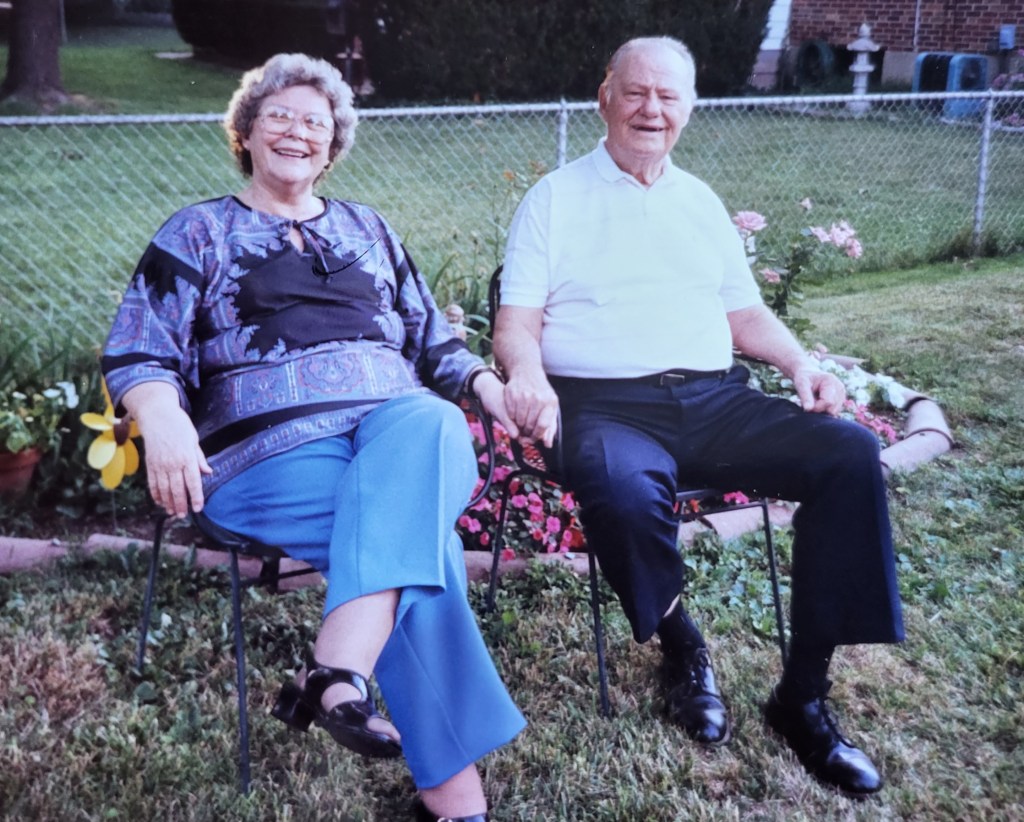
Today–on what would have been Helen and Walter Johnson’s 75th wedding anniversary–the two people holding hands in this photo are the ones I choose to remember.
But, even during the troubles and heavy lifting of their younger years, I’m grateful for the many things they taught me. How to respect the elderly. How to save for a rainy day. How to be kind to neighbors and care for animals. How to put people before material things. How to be a loyal friend. How to work hard and earn my keep. How to show compassion.
Most important of all, how to love my family, warts and all.
Certainly, by watching Helen and Walter struggle, I learned lessons about how to endure in a world that can often feel unendurable. That may feel like a strange way to pay tribute to my parents on their diamond wedding anniversary. But it’s honest and true.
Though Dad has been gone thirty years and Mom ten, the love I feel for them endures.
In the summer of 1988, Helen and Walter Johnson enjoyed their suburban St. Louis backyard. Mom was 65; Dad was 74.
It’s my book of Arizona stories and St. Louis flashbacks, which includes a chapter on The Carol Burnett Show and the positive impact the program had on our family in the 1970s.
There is one other significant and unexpected side effect, which Carol’s letter has prompted: a touch of grief.
If you follow my blog or have read any of my books, you know that my mother–Helen Johnson–was the consummate letter writer.
From the late 1980s (when Mom retired) until 2010, she sent me more than a thousand letters laced with love and wisdom.
Some of them appear in From Fertile Ground. It is a three-generation writer’s mosaic about love, loss, and grief. I wrote and published the book a few years after my mother died in 2013.
Helen didn’t quite make it to ninety, the milestone Carol Burnett transcended recently. She came up six months short.
So, when Carol’s letter arrived in the mail it cued a few pangs of sadness and a familiar pleasure. One that has been missing from my life … missing from all of our lives … for a long time. That is the personal, human, and lasting connection produced by a handwritten letter.
With all of this as background, yesterday I pulled out the large blue plastic container that holds all of my mother’s letters–sent to Tom, Nick, Kirk, and me over the years. I have them classified by year.
I began to leaf through her 2003 correspondence. That was the year she turned eighty, on July 26, 2003, to be precise. My sister Diane and I hosted a big party for Mom that summer in Geneva, Illinois.
Family and friends traveled from near and far to attend Helen Johnson’s birthday dinner at the Mill Race Inn. We celebrated her first eighty years. Afterwards, we crossed a bridge over the Fox River to continue the party at the Herrington Inn, where many of our guests were staying.
At one point, a gentleman playing violin walked through the lobby. He asked my mother if she would like him to play Waltzing Matilda, her favorite song. (Matilda was her middle name.)
Mom’s eyes sparkled with glee as he stood over her. He slid the bow across the strings, and I watched her spirit soar. In short order, she began to sing … “Waltzing Matilda, waltzing Matilda, you’ll come a waltzing Matilda with me.”
Ordinarily, my mother didn’t enjoy being the center of attention. But, looking back, that moment in a posh hotel on the banks of the Fox River surrounded by loved ones may have been the happiest and most spontaneous moment of Helen Matilda Ferrell Johnson’s life.
If you’ve been doing the math as you read this story, you know that my mother’s 100th birthday is approaching. It’s just two months away. One of the best ways I can celebrate the memories of her is to read her letters, which she mailed to me.
In this one from May 26, 2003–twenty years ago–she recounted for Nick (my older son) and me that she and my dad bought their first new car (a black, four-door Plymouth) in Texas in February 1951.
I must have just told her about Nick’s first car, a used Toyota Camry, which his mom and I had just helped him buy when he was nineteen.
Whether a letter comes from a legend of stage and screen like Carol Burnett or someone who lived a more ordinary (yet still remarkable) life like my extraordinary mother, the words and the movement of the pen on the physical page speak directly from one heart to another … far exceeding the temporary status of a text, email, or phone call.
That’s the context and beauty–the magic, really–of an authentic, handwritten letter.
Thank you, Carol, for your enduring sense of humanity and a lifetime of laughs.
I’m so glad we had this time together.
***
A Custodian, A Scrub Woman, and Me
At 9 p.m. Central Time on Monday nights in 1970–fifty years before the contagious Covid-19 stunned our world–a kooky comedienne with a toothy smile and infectious laugh captured my twelve-year-old heart and creative imagination. Her name was Carol Burnett.
Born April 26, 1933–in the depths of the Great Depression–this legendary actor of stage and screen first tasted success with her Tony-nominated Broadway performance in Once Upon a Mattress in 1959. Soon after she appeared as a regular on The Gary Moore Show. My exposure to her madcap comedic skills began on September 11, 1967. That’s when The Carol Burnett Show debuted on CBS-TV.
Through the spring of 1971, the network ran the hour-long variety and sketch comedy format opposite two popular programs: NBC’s I Spy; and ABC’s The Big Valley. (Later in the seventies, as the show gained a larger audience and momentum, CBS moved The Carol Burnett Show into its Saturday night lineup following four other prime-time powerhouse comedies: All in the Family, M*A*S*H, The Mary Tyler Moore Show, and The Bob Newhart Show.)
Back in 1970, after I finished my homework on Monday nights, the lights on stage came up around Carol and were transmitted through our Zenith color TV in suburban St. Louis. Long before I first imagined taking flight in my dusty desert time machine, she proceeded to field questions from her studio audience and lead me and thousands of other viewers across the country on a metaphoric and comedic joy ride.
Every week we sat mesmerized. We watched Carol and her creative troop–Harvey Korman, Vicki Lawrence, Lyle Waggoner … and later Tim Conway–perform their magical TV mayhem. Together they represented creative constancy in my life.
At that time, Dad worked the night shift as a custodian for a government agency in St. Louis: sweeping and mopping floors; cleaning toilets and urinals; emptying waste baskets.
It was a life of late-night drudgery my father, the ex-salesman and unfulfilled poet, couldn’t stomach and never dreamed of—especially when the rest of the world had Carol and the hilarity of her As the Stomach Turns weekly soap parody at their disposal from the comfort of their living room couches.
But like clockwork, at 9:30, Dad called during a break from his janitorial job. He craved a creative escape too. He wanted my color commentary on Carol’s show. The ringing on our kitchen phone was my cue to fill in the comedic gaps.
I stretched the curly cord into the living room and translated Carol’s hour-long variety show into something positive that might sustain him….at least for one night.
To put this in its proper personal perspective, Dad felt he was missing the important moments in life: a traditional schedule of evenings at home with his wife and children watching Carol’s shenanigans. All for the sake of a weekly paycheck and a job that clogged his ego like a stopped-up toilet.
As far as Walter Johnson was concerned, there was nothing else remotely funny about 1970. The Vietnam War was raging. Nixon was president. That was awful enough. Especially for a life-long Democrat.
I’d like to think our phone exchange during his break and my play-by-play of Carol’s comedy sketches and crazy Bob Mackie costumes he missed helped transform his melancholy spirit.
Ironically, over the course of Burnett’s career, she frequently reprised the role of a soulful scrub woman, who cleaned up after everyone else went home. It was Burnett’s tattered-but-enduring character, which became her show’s symbol of humor, heart and humanity.
Like the rotary phone that rang on our kitchen wall, I never imagined the show would one day disappear. But on March 29, 1978, after eleven seasons and 279 episodes (notwithstanding another nine episodes that aired in the fall of 1991) the curtain came down on The Carol Burnett Show.
In the mix, the Vietnam War ended. The troops came home. Nixon resigned in 1974. I graduated from high school and went on to college in 1975. Dad did his best to complete his night-shift janitorial duties.
In August of 1976, at sixty-two-years old—the age I am now—he retired from a job he despised but tolerated to contribute what he could to the well-being of our family. Remarkably, my father lived another seventeen years, despite his struggles with heart disease and depression.
“I’m so glad we had this time together, just to have a laugh or sing a song. Seems we just get started and before you know it, comes the time we have to say so long.”
At the close of each of her shows, Carol Burnett sang this familiar tune, tugged on her left earlobe, and signed off. Evidently, it was a signal to her grandmother to let her know she was doing okay.
I loved it all. Carol’s shenanigans, her show, her sidekicks, her song, her signal, her sentiment. Dad did too. Everything she represented … her physical humor, uproarious laughter and wacky demeanor … sustained us through difficult times.
Fortunately, Carol Burnett lives on. So do the best moments from her comedy sketches on her Carol Burnett and Friends shows that appear in syndication.
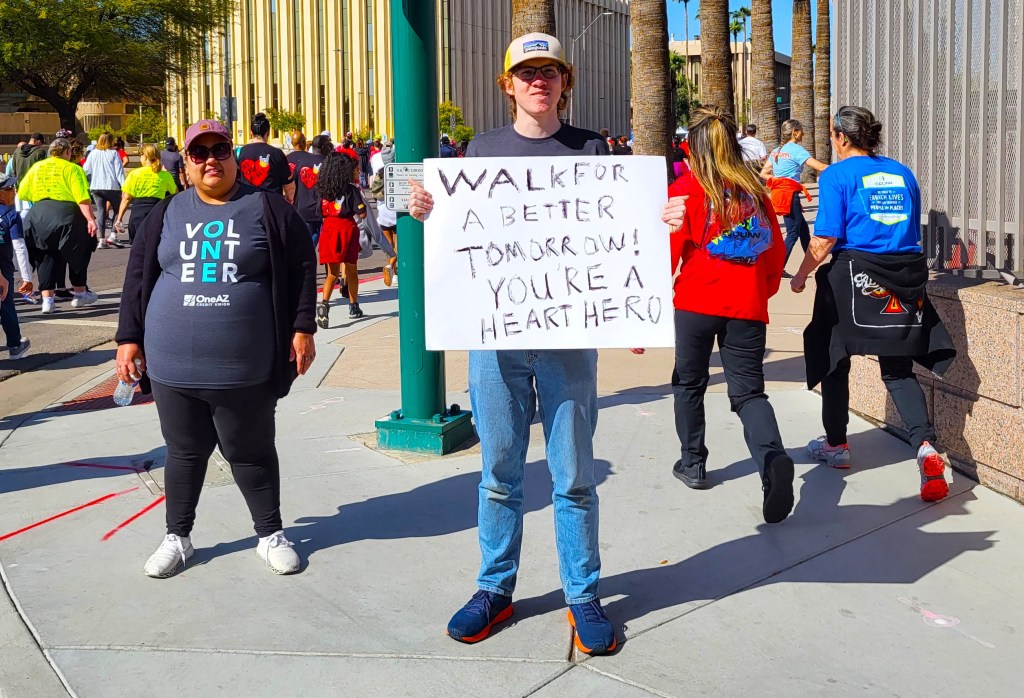
There was a moment on Saturday morning–about two thirds of the way through the Phoenix Heart Walk with my husband Tom, friend Todd, son Nick and his girlfriend Anastasia by my side–when I spotted this young man holding a homemade sign.
His presence and the message along the three-mile route touched me. I stopped to take his picture, hugged him, and thanked him for being there and sharing his heartfelt message.
I don’t really consider myself a heart “hero”, though our Heart Walk 2023 team I “coached” and dubbed “Friends for Life” did raise more than $2,000 in the fight against heart disease and stroke.
Thankful “survivor” feels like a better fit. Especially when I look back on that day nearly six years ago when Tom and I endured our most difficult and frightening moments individually and as a couple.
It was July 6, 2017, our collective sixtieth birthday. After feeling breathless on a humid summer day, I found myself lying on a gurney in the bowels of Barnes-Jewish Hospital in St. Louis.
After suffering a mild heart attack, I waited impatiently for two teams of heart specialists–actual heart heroes–to remove a blockage in the left side of my heart and insert two stents.
Fortunately, since that tumultuous day I have been able to transform my health. With a little luck, thirty fewer pounds to carry, and a lot of hard work, support, and exercise, I’ve lived longer, written more stories, and created a whole new existence in the Valley of the Sun. You can read all about our journey in An Unobstructed View.
Certainly, I’ve come a long way since 2017. Far enough that on Saturday, March 25, 2023–after completing the Phoenix Heart Walk and crossing the finish line–I stood with family and friends on the streets of Phoenix and breathed deep.
Along with the thousands of others in attendance, we “heart heroes” celebrated and embraced a sunnier, more hopeful day.
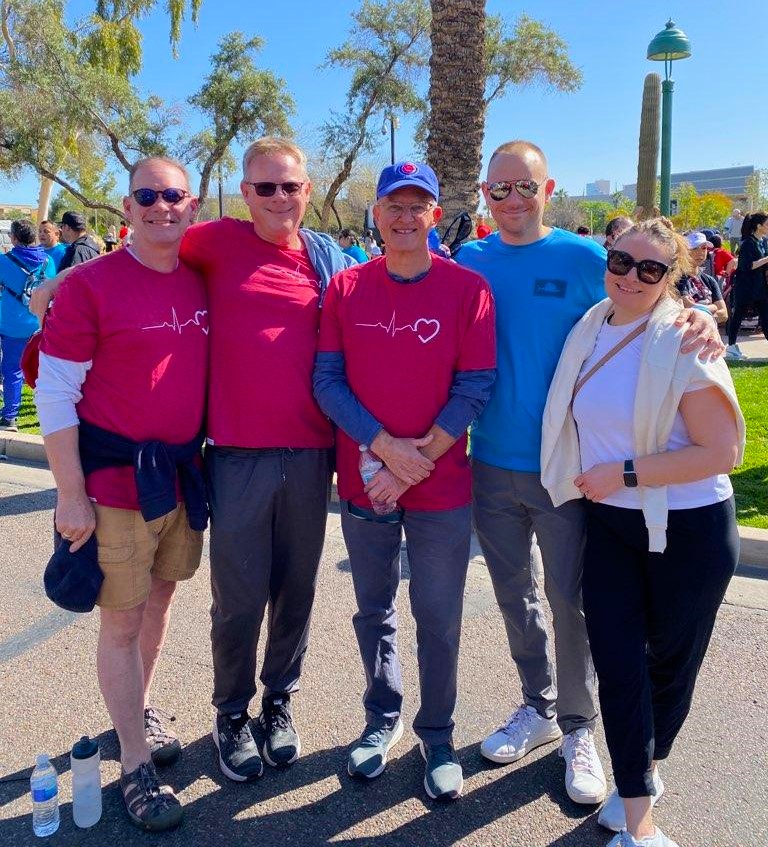
Me preparing to cross the finish line at the Phoenix Heart Walk.Heart Heroes/Survivors: Todd, me, Tom, Nick, and Anastasia
In the early 1960s, the four of us–Dad, Mom, Diane, and I–preferred a natural Christmas tree.
In mid-December, we bundled up, drove to a local tree lot, and picked out a well-shaped balsam.
Money was tight, so our family’s philosophy was the cheaper the better.
One of the men at the lot usually helped Dad tie the tree to the top of our car.
Once we arrived back home, we sawed off a notch of the trunk.
Then, Dad placed the six-footer outside in a metal bucket filled with water to keep it fresh until we trimmed the tree.
In those days, these porcelain candy cane kids adorned the branches of our family Christmas in south suburban St. Louis.
Originally, there was a third sibling, but he or she broke in the years following and couldn’t be repaired.
Thankfully, these two have survived until now … traveling from Missouri to Illinois to Arizona.
This year, Tom and I nestled the remaining candy cane kids near the top of our artificial tree in the sunroom of our Scottsdale condo.
They remind us of the memory magic of Christmas, seen through the bright eyes of an exuberant child.
As 2022 draws to a close, thank you for following me on this journey.
No matter your age or whether you celebrate Christmas, my wish for you and me in 2023 is that we continue to nurture our imaginations and rekindle our sense of possibilities and wonder.
Because it is that spark–and the spirit of the candy cane kids in all of our lives–that helps us create the art to make the world a richer and more joyful place.
Everybody’s waitin’ for the man with the bag, cause Christmas is comin’ again.
I’ll be singing this lyrical line with my Phoenix Gay Men’s Chorus mates this Saturday and Sunday on stage in Tempe, Arizona at the Galvin Playhouse. (Go to http://www.phxgmc.org for tickets.)
“Man With The Bag” is a jazzy, Christmas mash-up, artfully arranged by David Maddux. It’s the second number of Act II, a mix of frolicking, silky, reflective, fun, inspiring, and sometimes-bawdy music in our “Twas the Night Before Christmas” show.
If I sound excited, I am. This will be my thirteenth consecutive holiday concert: seven with Windy City Gay Chorus in Chicago; six here in Phoenix.
Singing Christmas music in my fifties and sixties with two diverse community choruses of gay men has somehow rekindled the wonder and anticipation of my childhood.
Close your eyes and travel back in time. Music or not, you remember that giddy Christmas feeling.
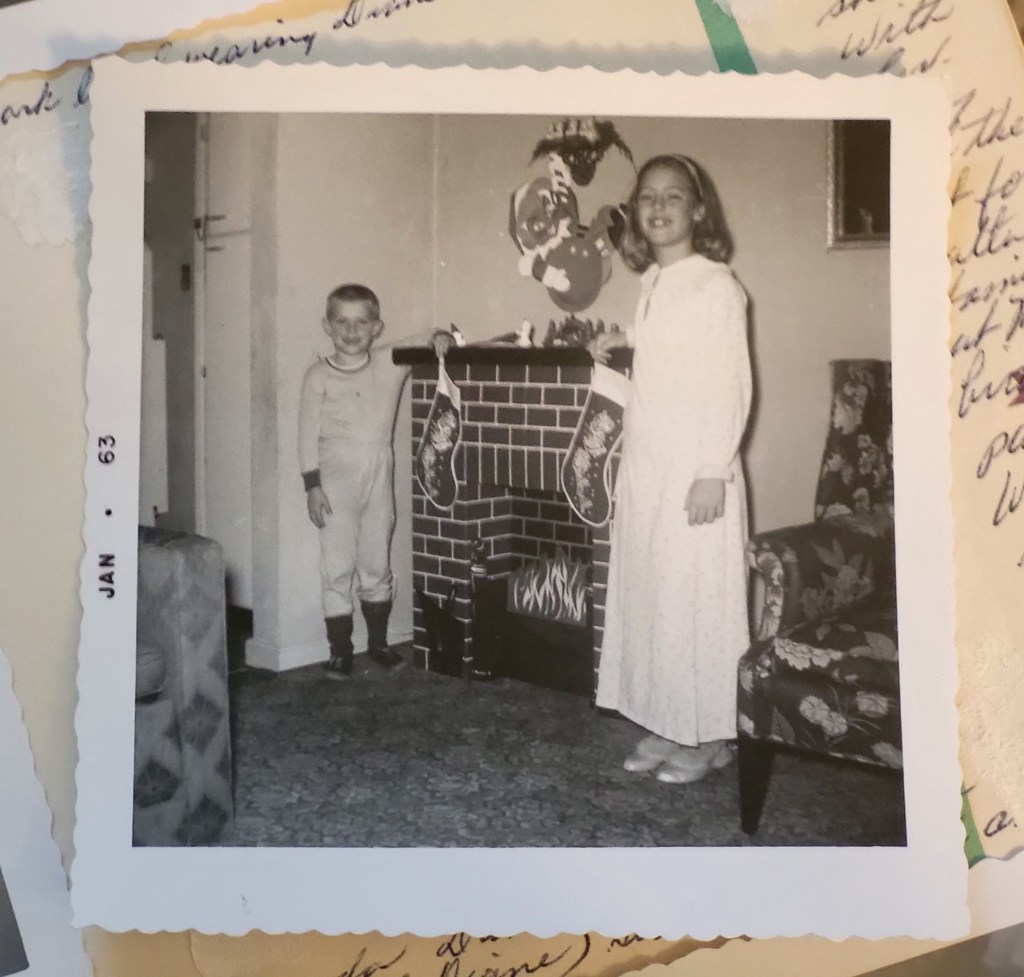
For me, it happened annually with my sister Diane. Decades before the advent of fake news, we stood on opposite ends of our fake, cardboard fireplace in suburban St. Louis. No doubt, as we posed for this photo, Perry Como crooned a holiday tune on the hi-fi.
Anyway, in December 1962–yikes, sixty years ago–we were waitin’ for the man with the bag in the dining room of our modest brick home without an actual fireplace. But that didn’t deter our keen imaginations or exuberance. In fact, it nurtured them.
I don’t know what happened to that fabulous fireplace I leaned against years ago. I doubt that it survived to see 1970.
But Diane and I are still here. Yes, much older and definitely wiser. She lives in Wheaton, Illinois, with her husband; I live in Scottsdale, Arizona, with mine.
I mailed a small box of gifts to her recently, and her package will arrive here before Christmas. But it is the gifts of music and memory that I cherish today … and the thought of just the two of us–way back when–waitin’ for the man with the bag.
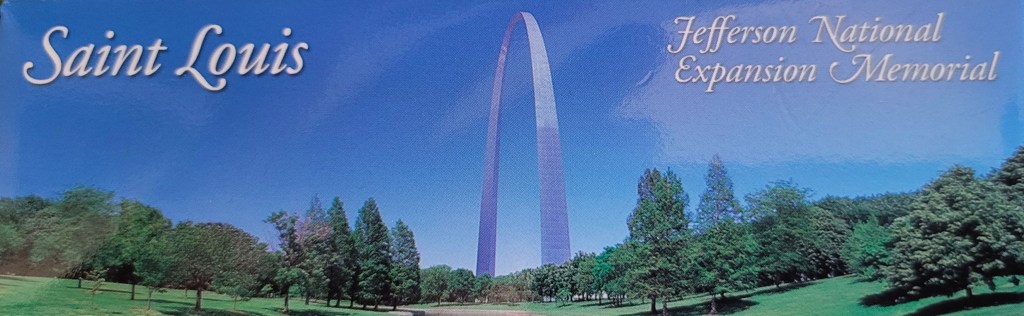
Completed on this day fifty-seven years ago, the Gateway Arch served as a catalyst for St. Louis’ mid-twentieth-century renaissance.
The six-hundred-thirty-foot-tall structure was then, and still is, that gleaming stainless-steel phenomenon and symbol, soaring above and beyond the banks of the Mississippi River. It replaced a sagging riverfront packed with dingy brick warehouses and smokestacks.
It is impossible for me to reflect on this city I love–the place where I was born which now bears little physical resemblance to what I remember half a century ago–without acknowledging the magnificence, continuity, and meaning of the Arch.
In late 1965 shortly after a construction crew finished the project, I stood directly underneath it with my parents, looking straight up from the base, running my palms across its smooth-and-shiny skin. It would be decades before sapling trees would grow tall enough to create this park-like atmosphere you see here.
For three summers–1977, 1978, and 1979–I worked underneath, around, and inside the Arch as a history interpreter for the National Park Service. It was a fabulous job for this then-twenty-year old idealist and history buff.
I gave tours in the Museum of Westward Expansion, talked about the city’s founding as a French fur-trading post in 1764, and played color commentator for wobbly visitors as they gazed across the Missouri and Illinois horizons through tiny windows at the top of the Arch.
In those days that federal landscape was defined as the Jefferson National Expansion Memorial, because the Arch was built as a memorial to Thomas Jefferson and recognized St. Louis’ pivotal role in the westward expansion movement.
Of course, the concept of westward expansion conjures sometimes-controversial overtones in this era. Of white settlers moving west to push Native Americans from their land.
But no matter your point of view about U.S. history, the Gateway Arch constitutes an architectural marvel at the very least and a symbol of pride for St. Louisans past and present.
In 1947, Finnish-American architect Eero Saarinen won a competition with his Gateway Arch design. His concept included reflecting pools on the ground to soften the sharp edges of the monument that carves its path through the sky.
Unfortunately, Saarinen didn’t get to see his masterpiece completed. He died September 1, 1961, in Ann Arbor, Michigan, while undergoing an operation to remove a brain tumor.
But the rest of the world watched with wonder four years later. When construction workers–dancing on the edge of the sky–inserted the capstone piece to connect the north and south legs of the Gateway Arch, St. Louisans breathed a sigh of relief and welcomed their brighter-and-shinier identity.
Fifty-seven years later, I understand the surrounding trees have matured, and the Arch grounds have been connected more seamlessly with the rest of the downtown area.
And the Gateway Arch itself? It’s still standing and an inspiring site to behold.
A delivery man handed me a box at my front door on Thursday. Inside was my new Samsung phone. It includes a lot more memory and features than my previous model.
“Great. No big deal,” you might think. “After all, we live in a world where techie products and capability change every few minutes and many people buy a new device every year or so.”
But I object, your honor. It is a big deal for this guy.
This is not a purchase I make frequently. It’s not so much the cost. It’s the drama and tumultuous change required. And, when I make such a change, I need and expect support to pull me through the uncertainty.
It’s the fear of losing all my contacts and photos that I don’t want to send into the cloud (wherever that is) that amps up my anxiety from “reasonable human being” to “caged animal.”
Let’s peel a few more layers of the emotional onion.
***
On July 9, 2017 (yes, more than five years ago!), Tom and I bought my previous Samsung phone at a Verizon Wireless store in St. Louis, Missouri. We were between homes at the time, on our way west from the Chicago suburbs to Scottsdale, Arizona. I was fresh out of the hospital.
More background. On July 5, 2017, somewhere in Southern Illinois, my previous phone died. Strangely, the next morning–it was our 60th birthday–I suffered a mild heart attack in St. Louis.
My husband and the medical staff at Barnes-Jewish Hospital in St. Louis saved my life. Tom got me to the hospital lickety-split. The cardio team performed an angioplasty. They found an obstruction in the left side of my heart.
The next day, once my blood pressure was stable, the team installed two stents in my heart. Remarkably, I left the hospital two days later with a new lease on life, no cell phone, and a story that would become my third book: An Unobstructed View.
Tom and I bought a functioning phone the following day in the city where I was born in 1957.
***
On Friday, I drove to a nearby Verizon Wireless store in Tempe, Arizona, with my new phone. Two representatives–one in person, another via live chat–had told me Verizon would help me transfer my data and activate my new phone.
But Verizon left me high and dry.
When I walked in the store to describe what I needed, a young representative told me they didn’t/wouldn’t do that. My anxiety and anger soared. After a volley of choice words, I announced “I’m outta here.”
I left the store an emotional wreck.
When I arrived home, Tom tried to console me, but I was inconsolable. He suggested I contact Geek Squad at Best Buy. We have a total tech support plan there. I made an appointment.
On Saturday, I arrived at Best Buy, in the same Tempe Marketplace mall where the Verizon debacle occurred. Over the next hour, the Geek Squad team activated my phone and helped me transfer my data.
All three “blue-shirted” technicians, who assisted me, treated me with respect. Like the medical team at Barnes-Jewish Hospital five years ago, they restored my hope in human care and kindness.
***
Think about it. Like the fragility of our personal health, and the heart that ticks inside us, so much of our world is tied to this one important item we carry in our pockets (instead of our chests).
When that one thing (heart or phone) becomes vulnerable, so are we.
Fortunately, my phone setup is complete now. It feels like I have my life back. Tomorrow (Monday), I see my cardiologist for my annual checkup. My ticker is strong. I’m in much better shape physically than I was five years ago. I expect a good report.
My heart raced and jaw clenched. Like thousands of Americans, on Tuesday I tuned in to watch true patriots from Arizona and Georgia do the right thing.
The 2020 election numbers–votes counted and recounted numerous times–don’t lie. Neither did Arizona House Speaker Rusty Bowers, Georgia Secretary of State Brad Raffensperger and his deputy Gabe Sterling, and Georgia election worker, Shaye Moss.
At a defining moment in American history, on June 21, 2022, they delivered their testimony before the U.S. House Select Committee investigating the January 6, 2021, attack on the U.S. Capitol.
They sat before the nation. They breathed deeply, mopped their brows, and somehow maintained their composure. They told us how they kept their fingers in the dike to keep a corrupt president and his allies from breaking through the dam and cheating the American people. They upheld the law and the letter of the U.S. Constitution.
Over three hours of testimony, we heard heart-stopping stories. Each witness detailed how some of those who still support the ex-president have threatened and targeted their professional and personal lives. All in an effort to illegally change the outcome of the 2020 election.
In this one blog post, it is impossible to address the sense of fear, anxiety, and division that exists in our current culture. But suffice it to say, this insurrection and its related tentacles run wide and deep. It appears there is much more evidence to come. Each day we brace ourselves for more of the ugly truth about the targeting of public servants and slates of fake electors.
What will happen next in this drama? Who knows? But the biggest question of all looms on the horizon: Will the U.S. Department of Justice pursue criminal charges against the forty-fifth President of the United States and others who apparently have violated the rule of law?
Young and old alike, we watch and wait. Our nation’s future is at stake. Our sense of freedom hangs in the balance.
***
Tuesday’s hearing occurred fifty years and four days after five men were arrested for breaking into the Democratic National Committee headquarters at the Watergate Hotel in Washington, D.C.
Soon after, the Watergate political scandal dominated our lives. Our nation was thrust into the pain and complexity of a constitutional crisis and investigation that would expose President Richard Nixon and members of his administration.
I was a teenager at the time. I didn’t understand the gravity of the Watergate scandal. But I remember the anxiety of uncertainty that pervaded our country and how outraged I felt that our president would lie and cheat and do all he could to try to cover up his deceit. That pain has resurfaced today.
I also remember pausing for breakfast with my friends John and Jon in the middle of our western camping adventure on August 9, 1974. It was the day Nixon finally resigned after two years of political denial and trauma.
John, Jon and I chowed down on steak and eggs in a dark tavern/diner somewhere in Wyoming, while on the other side of the room, through the tube of a grainy black-and-white TV, we watched Nixon break the news in an address to the nation.
Before and after that moment, my buddies and I drove through miles and miles of magnificent western landscapes–mostly through the Rocky Mountains in Colorado and Wyoming. But we also ventured through the beauty and desolation of Arizona and New Mexico.
Imagine three sets of parents of three teenagers, permitting one seventeen-year-old and two sixteen-year-old boys to pack up a beat-up AMC Javelin without adult supervision. Somehow, we convinced them to let us go.
Over a ten-day period, the three of us towed a small camper more than a thousand miles each way from St. Louis to the Rockies and back again. We had fun, drank Coors beer, exercised our freedom, cooked over a Coleman stove, slept in a tent, and managed to stay out of trouble. Those were simpler and safer days. That trip wouldn’t happen today.
As a young man about to begin my senior year of high school, the possibilities of life surrounding me traveled as wide and deep as the terrain you see in this photo of Shiprock, New Mexico, which I captured and saved from our 1974 journey.
Little did I know that one day nearly five decades down the road–as I approached my sixty-fifth birthday in this western literary chapter of my life–our nation would face a much darker and historic challenge.
We must find a way to restore some semblance of sanity to our culture and political process … we must punish the perpetrators to resurrect our democracy from the jaws of an insurrection that continue to haunt us.
Though he has been gone since 1993–taken by a second heart attack a week before his eightieth birthday–my dad still appears in fading photos on the walls and shelves of my Scottsdale condo … and in memories I carry.
In July 1959, I celebrated my second birthday with Dad in the basement of our suburban St. Louis home.
Like an earnest anthropologist combing for clues, I’ve kept Walter Johnson’s history and story–his highs and lows–alive. He lingers on the pages of all four of my books. The journalist and the son in me believe I’ve done right by him.
In spite of his traumas (World War II shellshock, bipolar rants, and heartache), I’ve long ago put Walter’s pain to rest. It no longer consumes me in my sixties.
It has been replaced by abundant compassion and appreciation for the man he was in his forties: enthusiastic, fun-loving, loyal, and truly patriotic.
I don’t think I’ve ever uttered or written the following sentence, but it’s time I did: I have never doubted my father’s love for me.
I certainly see and feel it in his eyes in this (now vintage) photograph my mother captured of Dad and me.
More than six decades later–in these desert-dwelling days I never imagined in my Midwestern life–I link the joyous and boundless expression on Dad’s face with a keepsake Tom and I wrapped carefully and brought with us in the backseat of our Hyundai Sonata when we came west in 2017.
It’s an electronic GB Means Good Beer advertising sign, which Walter the salesman salvaged from his days peddling products for Griesedieck Bros. Beer in the 1950s.
In the early 60s before his first heart attack, Dad turned on the sign when company came over and we ventured into our basement. Long after he died, the sign’s magical light-and-color wheel spun and bounced a range of hues on a knotty-pine shelf downstairs in Missouri. Then later, it danced on top of the refrigerator in the kitchen of our suburban Chicago home.
Strangely, the wheel disengaged in 2017–somewhere on the road between Illinois and Arizona as I mended from a heart attack on the passenger side.
I wasn’t sure the sign would ever spin again, but I found a trusty repairman named Bob in Phoenix. He opened the back of the rectangular sign and tinkered with it. He told me he could reconnect the wheel to the track. I left Walter’s beer sign in Bob’s capable hands.
Bob called two days later to say the sign was working again. The following afternoon, Tom and I paid him. I thanked him for his time and trouble. We brought the sign home and found a suitable place to display it on the top of our bookcase in Scottsdale.
I plugged in the sign and turned on the switch. The light-and-color wheel twirled. The blues, reds, greens, and purples bounced, just as Walter had…
***
It comforts me to know that on Father’s Day–or any day–I can flip the switch in one simple motion. I can reignite the love I still feel for my father and remember his best intentions.
In an instant, I can remind myself that Dad is with me on my journey.







 Mark Johnson Stories