As Dad, Mom, Diane and I approached my grandparents’ rambling farm in Huntersville, North Carolina, in 1968 in our four-door Chevy Biscayne, waves of kudzu vine blanketed the trees.
At some point during our July vacation there, I remember my stoic maternal grandfather telling me this invasive plant, this weed, was blocking the sunlight.
Bit by bit, the kudzu was smothering the native plants and large trees in the southeastern United States.
In a metaphorical sense, I feel like one of those older trees–perhaps an oak or pine–that has grown through the seasons and spread its branches only to discover that the censorship and hate of our nation’s government (said kudzu vine) has insidiously wrapped itself around my trunk.
This is not a new development. I have been feeling this way for years. Trying to remain positive in the face of ICE raids, misogynistic slurs, shuttered healthcare programs, disregard for our most vulnerable citizens, the environment, and our right to a free press. The list of losses is endless.
Recently, my husband and I have lived firsthand through the threat of censorship in our community. It is causing us both great pain. It is also prompting me to realize how far we have fallen as a nation and what I am willing to tolerate or accept.
At some point, I will have more to say about this. I don’t know when or how. Suffice it to say, this kudzu vine–the 2026 version of the McCarthy era in the United States–is out of control.
I do believe that, ultimately, historians will shine light on whatever it is we are living through. I hope I live long enough to see the return of truth and reason and the eradication of these smothering vines.
I met a new friend for lunch yesterday. It’s a rather unusual, sweet story. For that reason, I need to write about it.
About three months ago, a young reporter sent me a message via my contact page. He saw a nostalgic piece I wrote about my college years at the University of Missouri.
It included a reference to Hinkson Creek and an abandoned quarry there, which I and many other college freshmen and freshwomen frequented on Friday nights to swim and party.
Apparently, the creek is now polluted–has been for more than thirty years–with an array of contaminants, but there is a push by various environmental groups to salvage it.
In his note, this earnest reporter–a journalism student at the same university I graduated from in 1979–wanted to talk with me to include a few comments about my recollections of Hinkson Creek. He wanted to give the story some texture and a touch of humanity.
As background, I don’t always respond to these sorts of messages. Too many of them are generated by bots or feel exploitive. But this one felt different. So, I responded.
A few days later, we had a pleasant phone conversation. I shared information about the fun I had with friends at Hinkson Creek in the mid 1970s and how sad it was for me to learn that Hinkson Creek is now unsafe due to the presence of E. coli in the water (according to data on the EPA website).
Before I said goodbye to the reporter, he told me how ironic it was that I lived in the Phoenix area, because he would be moving to the Valley of the Sun in July to be with his partner. I suggested he contact me again once he got situated here.
Last week, I received a text from this young man, this recent Mizzou journalism graduate who is forty-eight years younger than me.
He now lives in Phoenix and is looking for a writing job here. He included a link to the story he wrote which appeared in the Columbia Missourian with a few quotes from me.
It’s a thorough, well-researched story, but that’s not the point of my story.
Anyway, I thanked him for sending the link to me. He asked if I was still interested in meeting for lunch. I responded with a definite YES.
Yesterday afternoon–one day before the rain finally arrived to ease our parched earth here–we met in person.
This smart, enterprising, young gay man and I talked about his job search, my writing and my husband’s passion for films, how he and his partner met, his love of writing and music, his early impressions of Phoenix, and my recommendation that he find his place in the LGBTQA community here.
I told him that at this point in my life it is especially meaningful for me to help a younger man–a young gay man–by offering a little guidance in a harsh world.
He smiled when I told him I would pick up the check and–before we parted ways, but after I invited him and his partner to come to the next Phoenix Gay Men’s Chorus concert in December–he said jokingly that meeting me is kind of like having an “elder gay” to talk with.
Ordinarily, I wouldn’t want to be referred to as an “elder” anything. But in this case, it was a term of endearment. So, I laughed and accepted it that way.
***
My wise, sassy, and “elderly” Aunt Thelma once told me when she was in her late sixties, and I was about this young reporter’s age, that “we are all like ships passing in the night.”
I have always taken that to mean that life is fleeting, and that we should try to help each other around every turn. That we should try to do the right thing, because we never know what tomorrow may bring.
I think Thelma would have been proud of me yesterday.
Who could have imagined that a story about a polluted creek would lead to a pleasant lunch?
More important, that I might reach forward to help a young gay man, while looking back to remember that unrealized twenty-one-year-old-gay version of me who most certainly would have loved a little advice from an “elder gay” friend.
Over the weekend, I learned that one of Nick’s (my older son’s) high school buddies from the late 1990s/early 2000s, died recently of an apparent suicide. He was forty-two years old.
The timing of this devastating event for his family and friends has dredged up another dose of September sadness for me.
***
In September 2023, Tom and I received a letter in the mail from a close friend, who–less than a year before–had moved from the Phoenix area to another part of the country. I’ll call this friend Brett.
Brett’s snail-mail message was an eerie, lengthy, desperate, and personal admission–typed and folded meticulously. In it, Brett recounted a series of voluntary testosterone injections that messed with his body and mind.
He told us: ” … I had consulted with several friends in the medical field, all of whom told me there were no side effects to these testosterone injections and it would raise my numbers. Unfortunately, this did not turn out to be true … and it destroyed me forever.”
I know how much Brett cared for Tom and me, and we certainly listened and cared for him. “Our talks on our hikes always inspired me,” he went on to say. He told us he wished he had made better decisions in his new hometown.
When Tom and I finished reading the letter, we both felt dumbfounded. So much so that Tom ran a search on Brett’s full name. Brett’s obituary popped up.
Through a few subsequent texts and phone calls, we discovered Brett had committed suicide.
Evidently, Brett had left a short stack of letters to close friends in his home. Soon after he died, a member of his family mailed them.
In late September 2023, we heard from one of his brothers. He told us Brett had spoken highly of us. We told him how much we cared about Brett, and how frequently he mentioned his love for his family.
We sent him pictures of Brett, Tom and me banging on drums at the Musical Instrument Museum in Scottsdale. It was a fun day in May 2021, though you couldn’t see our smiles. We were wearing masks. It was the height of Covid.
We will never know the full detail of what happened to Brett or why he felt he had no recourse but to take his life. But, with time, Tom and I became acquainted with Brett’s mother and sister, too.
I am certain that talking with us about Brett provided much-needed comfort, but I can’t presume to know the devastation of what they feel when Brett’s birthday appears on the calendar every January … or when this day–September 8–reignites the fire of grief.
It is an endless nightmare.
***
Depression doesn’t only emanate from one man’s worries over his testosterone levels.
The division in our country in 2026 boggles the mind. So many people live in fear and isolation as our nation’s government–and many of the institutions we once trusted–breeds disarray, pain, anxiety, and uncertainty.
If you know someone who is struggling mightily, I encourage you to reach out to them and lend a listening ear.
Or, if that person in pain is you, please know that you matter. Help is available around the clock.
Call or text 988 to be connected to the National Suicide Prevention Lifeline. Do it for yourself. Do it for Brett.
Whether you are facing mental health struggles, emotional distress, alcohol or drug related concerns, or just need to talk with someone, a caring counselor will provide confidential emotional support.
Remember, you are not alone.
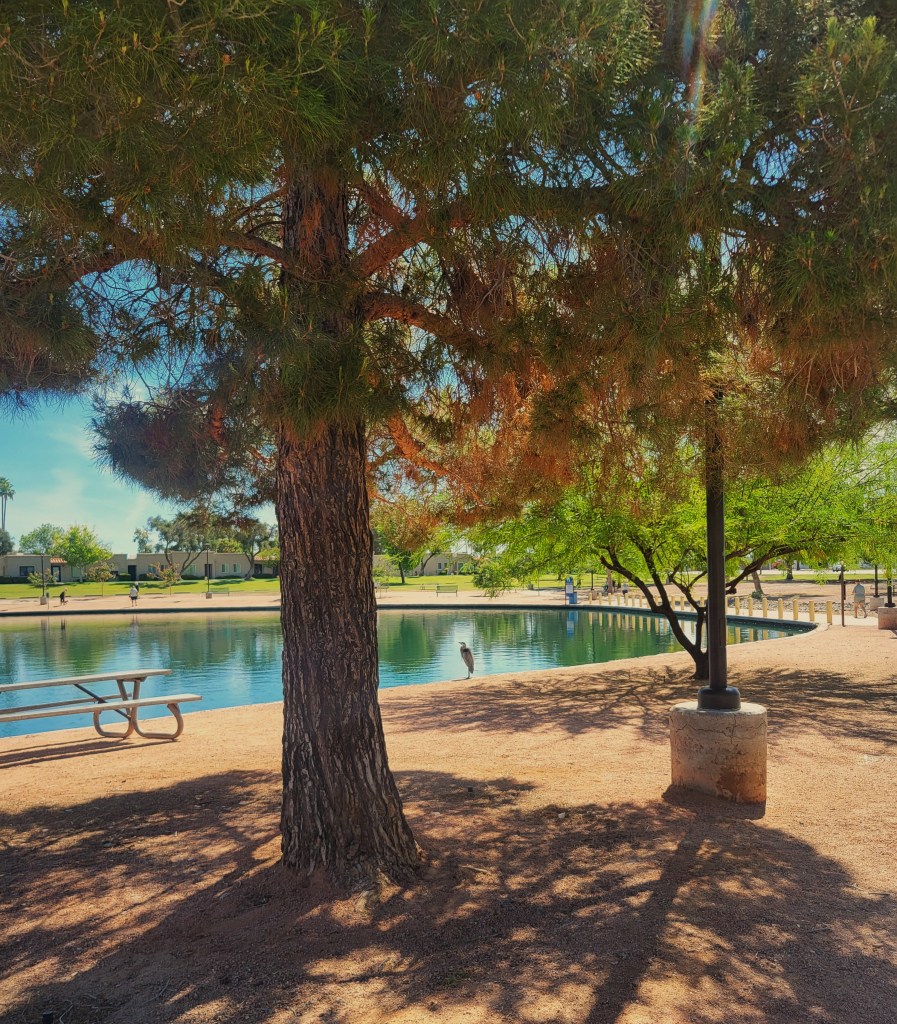
A lone blue heron stands at the water’s edge at Chaparral Lake in Scottsdale, Arizona.
Though nothing is predictable in 2026, the arc of every life includes mostly ordinary activities: going to work; shopping for groceries; filling up the gas tank; navigating small and large challenges that enter unannounced.
But it is the less frequent, extraordinary moments–the rites of passage–that outweigh the mundane tasks of life. Graduations. Weddings. Births. Deaths. They supersede in our psyches. They flicker forever in our memories.
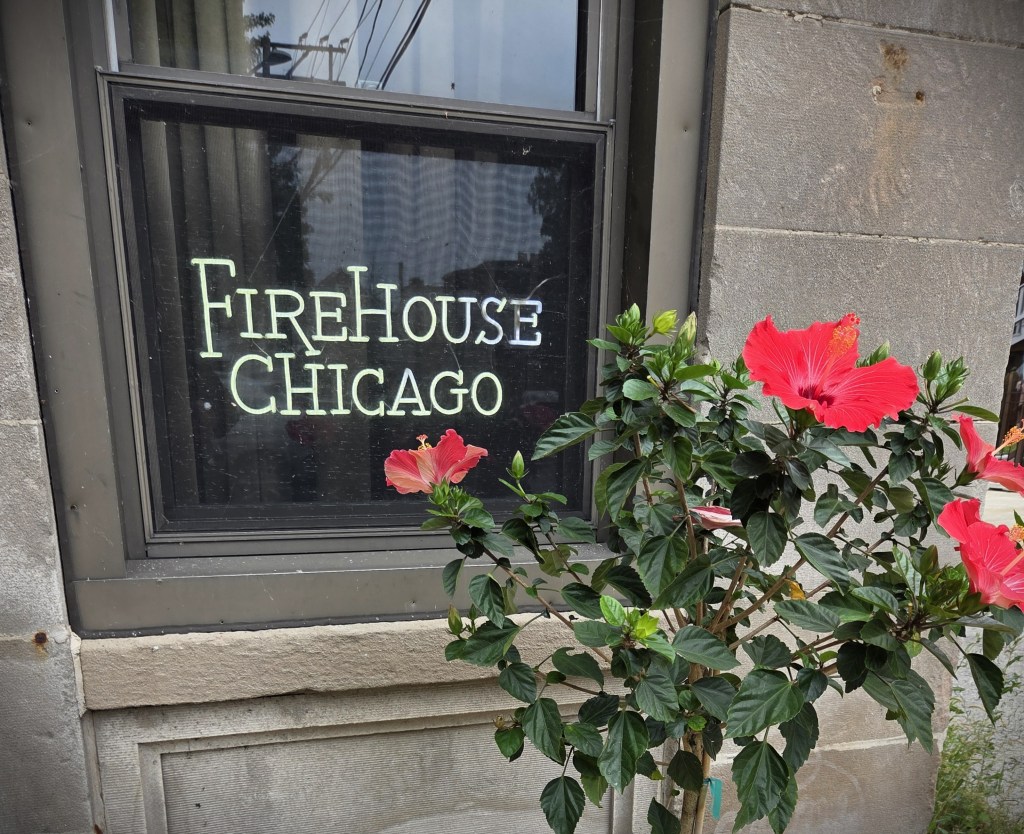
On Saturday, August 29, one hundred and twenty of us gathered at the Firehouse Chicago (a decommissioned firehouse transformed into a wedding venue) in the Edgewater neighborhood of the Second City. We came to witness the marriage of Kirk and Jennifer, my younger son and daughter-in-law.
It is a dream come true for any parent to see their adult child find their own path. To be more specific, this dad survived a heart attack on his sixtieth birthday. So, living to see Kirk marry the one he loves–the one who loves him–is the proverbial cherry on top of a hot fudge sundae.
Jennifer’s and Kirk’s early-evening, outdoor wedding ceremony was a cultural tapestry. It melded elements from their collective Jewish and Catholic upbringing.
For instance, they were married under a chuppah, a rectangular wooden structure laden with flowers. In the Jewish faith, it symbolizes the home they will build together.
After they shared their vows, a proud gay couple (my husband Tom and I) read the couple’s loving intentions for their marriage, for their families, for those who have gone before them, for their community, for the world at large in need of a hefty infusion of love, hope, humanity, equality. In every instance, the response from the congregation came in return: “Hear Our Prayer.”
A brief, unexpected shower in the middle of the ceremony–ushered in by rolling gusts of wind and the steady thrum of chirping cicadas–never dampened our spirits. It only added to the texture of the day.
As I write this, Tom and I are back home in Scottsdale, Arizona. I am fighting off the remnants of a cold. We have unpacked our bags from Chicago but haven’t yet unpacked every indelible moment from this whirlwind family wedding.
I do know in my heart that this was more than a joyous wedding. It was a healing experience to mend fences with my ex. To conjure the spirits of family members gone but still loved. To stand tall beside my husband for all the world to see. To feel true love, palpable and present, beaming between my son and his bride.
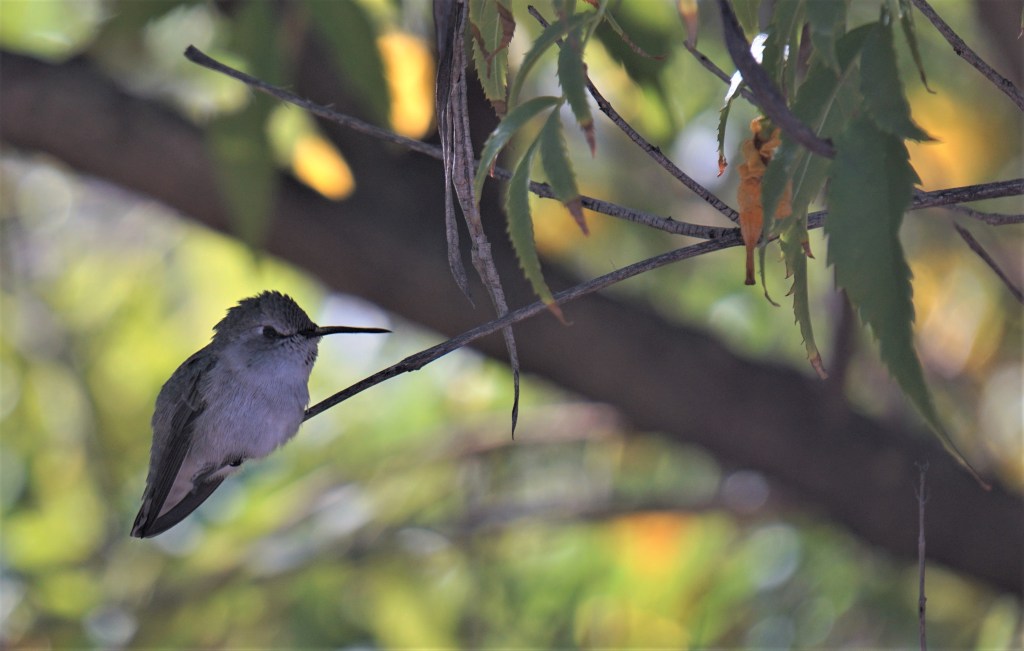
Lately, I feel like an anxious hummingbird, flitting about from one branch to another. Zooming in and out, searching for creative inspiration. Trying to find sweet nectar that will help me link one idea to the next.
Maybe it’s the late-summer desert doldrums. The intense Sonoran heat has worn me down. I don’t feel the impetus to write here as frequently as I once did.
Even so, I have experienced two moments of writing bliss in the past week. Both led me to draft deeply personal poems for members of my family–chosen and otherwise. At some point, I may decide to share them publicly, but not now.
Maybe this is simply what it feels like to be living in my “late sixties going on seventy” (sounds like a parody of a song from The Sound of Music) in a world gone mad.
All the while, I try to nourish myself.
I try to help others I love who have lost jobs or are battling cancer.
I play word games on my phone when I wake up each day.
I recall the stunning scenes and pine scents of western Canada.
I pack for my younger son’s wedding in Chicago this weekend.
I squeeze in another trip to the gym.
I watch the young-and-promising St. Louis Cardinals I root for self-destruct again in the late innings.
I download the music for my December choral concert and prepare for my next rehearsal.
I socialize with friends away from the heat produced in the Valley of the Sun.
I take afternoon naps to reboot my brain.
I prepare to lead another memoir writing workshop in October.
I recoup with my husband at home. We enjoy quieter moments in the confines of our Arizona abode.
Through it all, I wonder when or if I will rediscover the time and energy to complete another book.
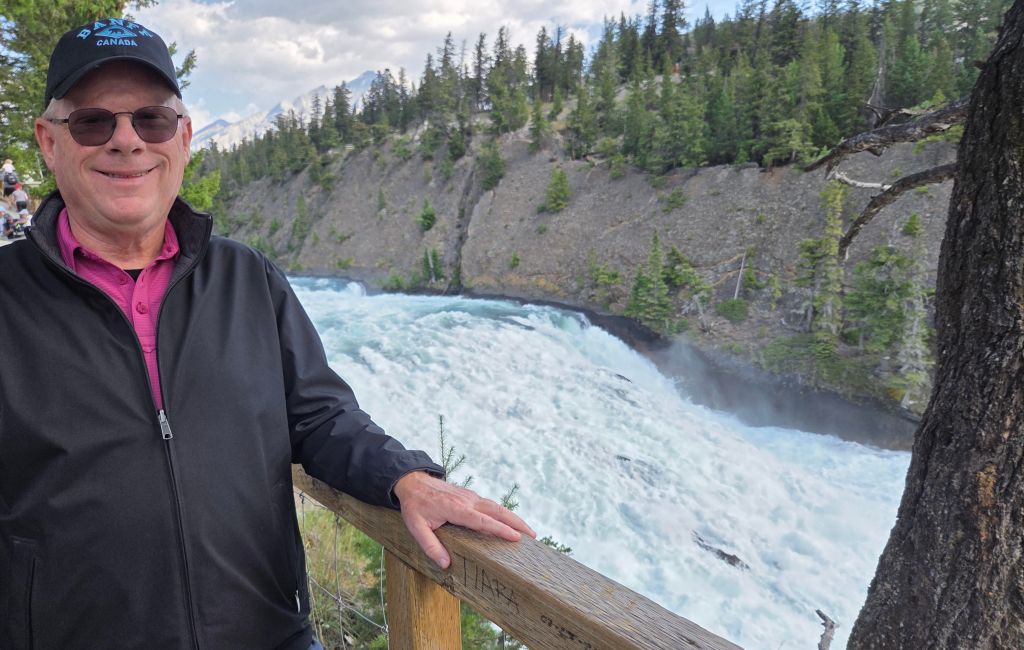
Like the rumbling Bow River rapids of Alberta, Canada, that raced past me in late July in mountainous Banff, life’s quiet and meaningful moments keep rushing by.
There isn’t much any of us can do about that, except to maximize the present. That’s difficult when the human memory teases us to revisit past indelible images that we magnify through our sensory connections.
For instance, smoke-tinged skies from forest fires that shrouded Kamloops, British Columbia, when we arrived at our hotel there on July 24, 2026, will forever be sealed in my consciousness.
As will the joyful feeling of reverence for nature, as we rode on the Rocky Mountaineer train the following day, slicing through deep, green canyons on the way to Jasper.
If there is a God–and sometimes I wonder given the state of the world and American society–perhaps he, she or they reside in Canada.
That would explain the seemingly endless supply of pines, spruces and aspens north of the border.
Perhaps God plucked the trees from a celestial palette, drew them on mountains that rise from the bottom of the Thompson River’s edge to the height of a soaring eagle’s eyes.
If so, the clouds passing over the Canadian Rockies applauded in unison.
Of course, there isn’t a never-ending supply of trees, natural resources, or shared beautiful moments.
We must protect our environment, cling to the best of our days, and endure the mundane–and the madness–that exists.
Right now in the Valley of the Sun, Tom and I live in a warm (no, hot!) way station between significant summer events.
We relish our Canada adventure as we also prepare–later this month–to fly to Chicago for the wedding of my younger son, Kirk, and his future bride, Jennifer.
I’ve already advised them to reside in the magical moments of their wedding day as much as possible.
To embrace the cool waters of love from each other, from family, and from friends. To let all of it wash over them.
It will be a day that they–and I–will remember always.
Somewhere between Jasper and Banff–during the last week of July 2026 in Alberta, Canada, on a coach, on a trail, or in a hotel room–I lost my neon-yellow Phoenix Gay Men’s Chorus cap.
But what I found with my husband in Canada’s astounding scenery and emerald waters is far greater, more meaningful, and certainly more lasting in the flipping pages of my memory.
Tom and I planned our Canada adventure months ago to commemorate thirty years of being together. (We met in the Chicago suburbs in August 1996.) Fresh Tracks, a Canadian tour group, helped us orchestrate our eight-day itinerary.
I told my husband, “I want to spend money in Canada in 2026.” I wanted to see the beauty above us on the map. I wanted to embrace the scenery and people, who are our northern neighbors.
I wanted them to know that many–probably most–Americans love and respect them. We admire their commitment to protect their natural resources.
Over the course of the next week, I was able to see that first-hand in the cleanliness of their national parks. No plastic bottles rattled around in rivers, lakes, or streams.
I have craved a visit to the coastline and mountains of Vancouver for years. So, we started there.
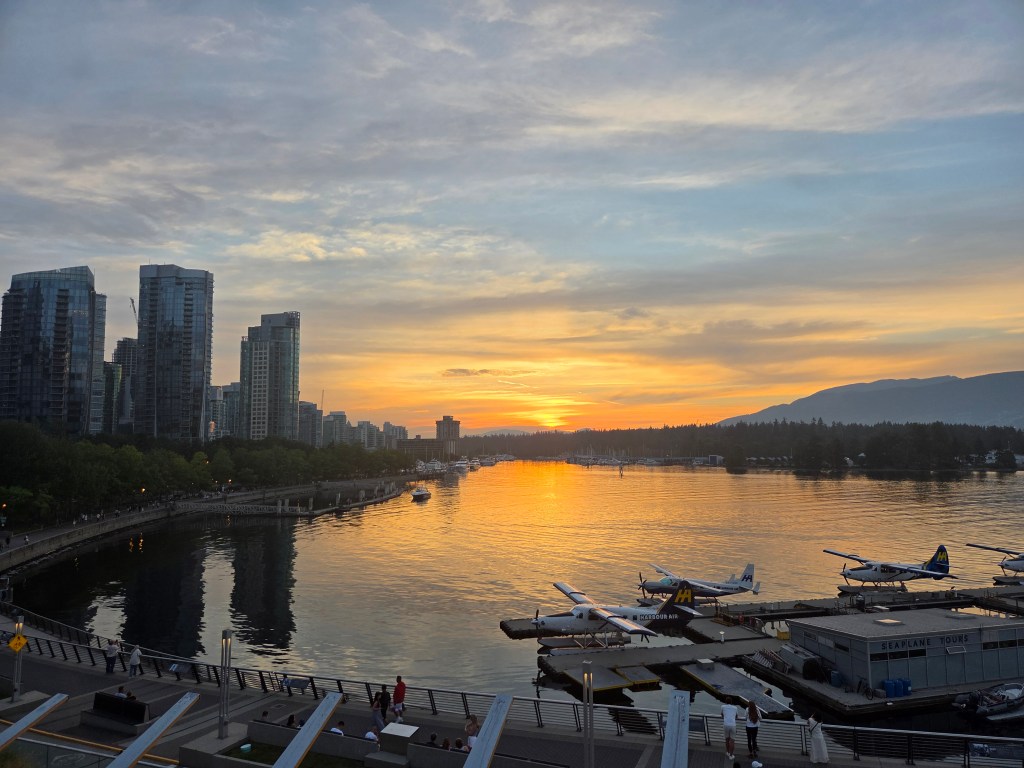
Fresh Tracks arranged an exquisite dinner for us at the Coal Harbour Cactus Club. We toasted each of with a glass of prosecco and watched the sun set over the bay. It painted a tranquil mood across a colorful canvas.
We expected to spend the following few days traveling via train on the Rocky Mountaineer through the Canadian Rockies. But fires in British Columbia limited the rail portion of our excursion to one day.
We made the best of it, traveling from Vancouver to Kamloops via coach with about thirty others. Two kind, upbeat Rocky Mountaineer staffers walked down the aisle handing out water and snacks–packages of chips, cookies, and candy.
Early on the morning of July 24, we climbed onto another coach that escorted us to the Rocky Mountaineer rail station in Kamloops a mere twenty minutes away.
Sifting through the smoke-tinged skies of Kamloops, we boarded the train and arrived on the top deck for a Gold Leaf view through a glass-encased dome.
We introduced ourselves to Mark and Kim, a fun-and-friendly couple from Abilene, Texas, who sat across the aisle. All four of us–and a train full of others–faced forward.
For the following ten hours, the welcoming, service-focused Rocky Mountaineer team entertained us with vivid stories of the landscape we would traverse together and the animals we might encounter.
At scheduled intervals, they invited us to the lower level of the train for a sumptuous, gourmet breakfast … I fell in love with the lemon cranberry bread topped with a decadent glaze.
Several hours later, we returned there for a delicious lunch/dinner, prepared magically by a team of chefs on board. The wine and drinks were free flowing.
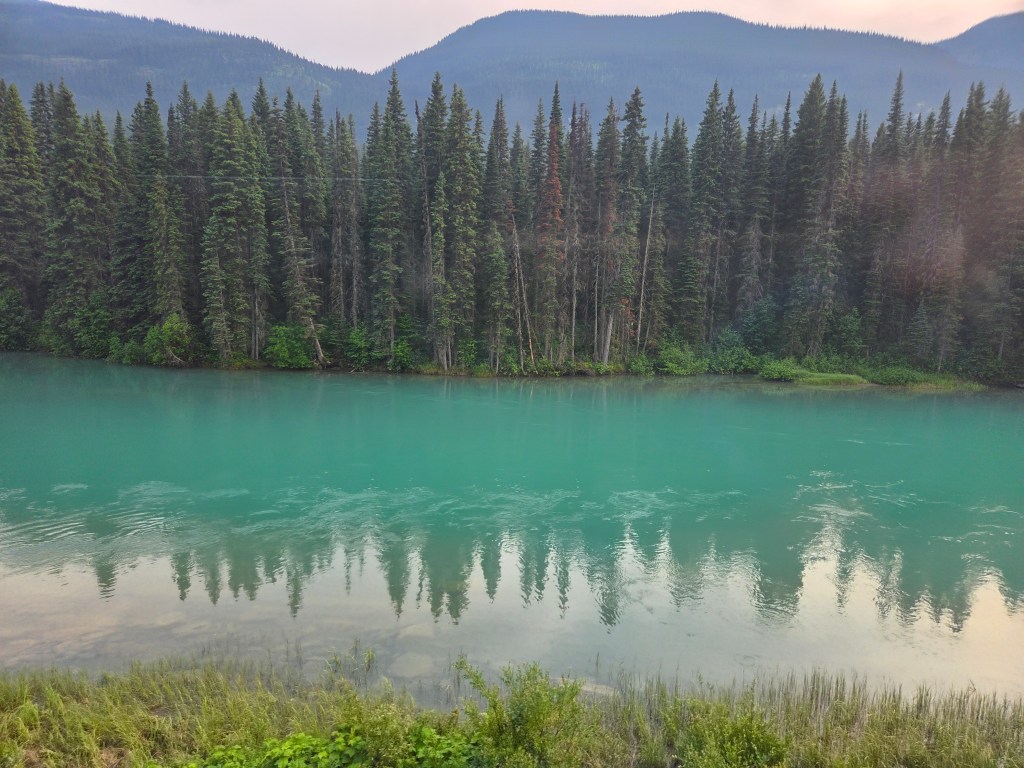
We downed a glass of mimosa–and later pinot noir–as we traded stories with Mark and Kim and gasped at the steep river-laden mountains and canyons that brought us to Jasper … an easy-going ski-town still recovering and rebuilding after a devastating forest fire in 2024.
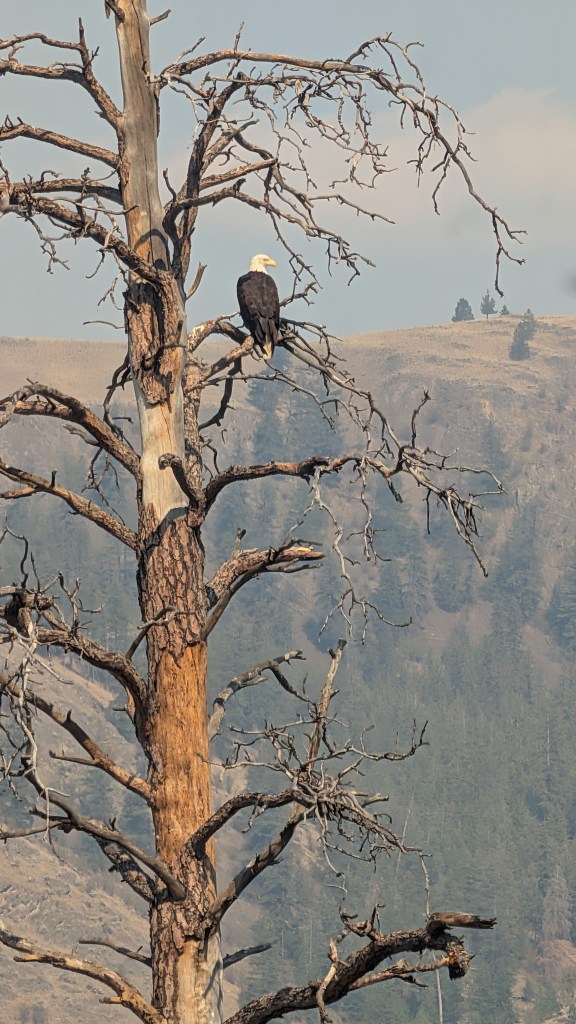
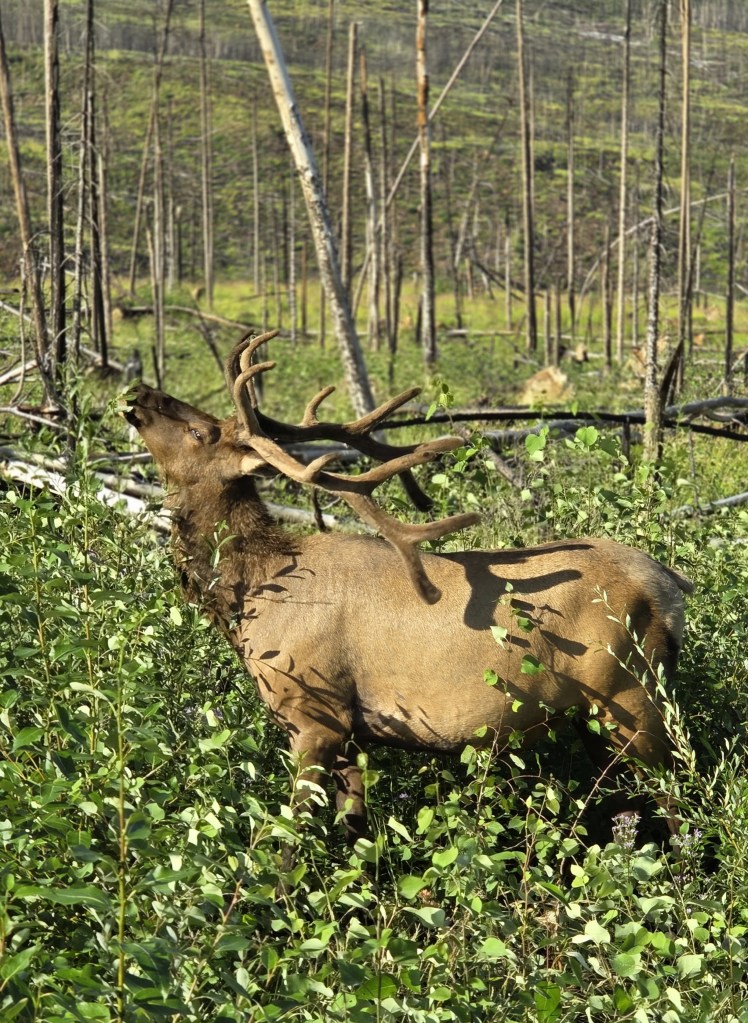
Along the way, eagles, elk, and big horn sheep guided us sparingly. They appeared unimpressed and unconcerned with our presence as we rode by, though we on our train cars and coaches lunged for our cameras and phones in pockets to bring home evidence that we had actually seen wildlife, unjaded and unaware of the news in any day.
Midway on our vacation, after leaving Jasper, we spent a night and morning frolicking at the iconic Chateau Lake Louise. We absorbed the privilege of simply being there and seized the moment by capturing photos of the breathtaking scenery … something Tom’s parents had done when they visited Lake Louise in 1988.
A highlight of our trip was journeying to the Columbia Icefield in Alberta. When we arrived there in our Sundog coach, we donned four layers each, including our easily packed windbreakers. They proved ideal as we ventured out to walk on a glacier.
The temperature on my phone said fifty degrees Fahrenheit. In the icy, pine-scented air it felt more like forty with a biting breeze. Of course, my blood is thinner now, living nearly all of my days in the Sonoran Desert.
By the time we arrived in Banff, it meant we were nearing the end of our Canada adventure. I did my best to “soak up the scenery” as my father said back in the 60s as we rode up and down hairpin turns in the Smoky Mountains of Tennessee and North Carolina.
Well-appointed lodges and snazzy shops line the main streets in Banff. At times we felt the size of overflowing, late-July crowds and traffic there.
None of that deterred my fascination with the Bow River rapids–and ultimately its falls–that raced through town or the eight-minute gondola ride we took on our final Banff day beyond alpine heights to the top of Sulphur Mountain.
Through it all — as I paused to “soak up” breathtaking scenery in the form of still photos and even a few videos of waterfalls and vast mountain ranges stretching far beyond my senses — I realized the most important thing of all: I was blessed to witness the wonder of western Canada in July 2026 and to see all of it with the man I love.
I live in the Sonoran Desert and the Sonoran Desert lives in me. That’s been the case for nine years. My most prolific ones as a writer.
The language of the desert–like grains of sand that blow in through the door–is now part of my creative being.
Shimmering sunsets. Slithering lizards. Skittish quail. Stray cats. Spiky cacti and succulents. Scattering snowbirds. And those are just a sample from the letter “s”.
When I served as a “Writer in Residence” at the Scottsdale Public Library last spring, I prompted the writers in my workshop to explore the role setting plays in the stories of their lives.
I asked them to consider a place in their lives that is or was prominent and how that place might be considered a character in what they have to say. In the stories they want to show and tell.
The places I have lived or frequented have certainly provided texture to my existence and informed my perspective. The orange earth of the Carolinas. The rolling hills of Missouri. The flatlands of Illinois. The rugged buttes of the Arizona desert.
They represent distinct periods in my life, and–in hindsight–I now understand better why they each deserve their proximity across my body of literary work, six books … a lifetime of stories.
The heat here in July is intense. But it is bearable because the Sonoran Desert–even in its most torrid state–is otherworldly.
At times it feels as if I am living on the moon. The astonishing natural beauty and stately saguaros–sentinels that stand tall in valleys and on hillsides here–have led me to a creative destination outside the orbit of my midwestern sensibilities.
One where I “write on” … as I just celebrated my sixty-ninth birthday and begin this final lap in my sixties. Learning and growing. Teaching and influencing.
Standing tall as a gay man, a husband, a father, a writer. Proud as a saguaro despite my visits to the cardiologist and dermatologist to manage my personal frailties. Rooted to this vivid place, the Valley of the Sun, that is my home.
***
Note to those of you who live in the Phoenix metropolitan area: On Thursday, July 16, from 5 to 7 p.m., I will be signing and selling copies of my latest book, Sixty-Something Days, at Grounds on 2nd in Old Town Scottsdale, located at 3703 N. 69th St.
This charming neighborhood place (coffee and wine bar) is one of my favorite spots in our Scottsdale, Arizona, community. It truly is an inclusive, creative space my husband Tom and I frequent to write, read, and chill with friends. In fact, I wrote and edited a considerable portion of my latest book there.
If you are in the area, stop by to sell hello, grab a book and a glass of wine. I also will have a few copies of my other five books–memoirs, poetry, and short fiction–on hand in case you are looking for options to add to your summer reading list.
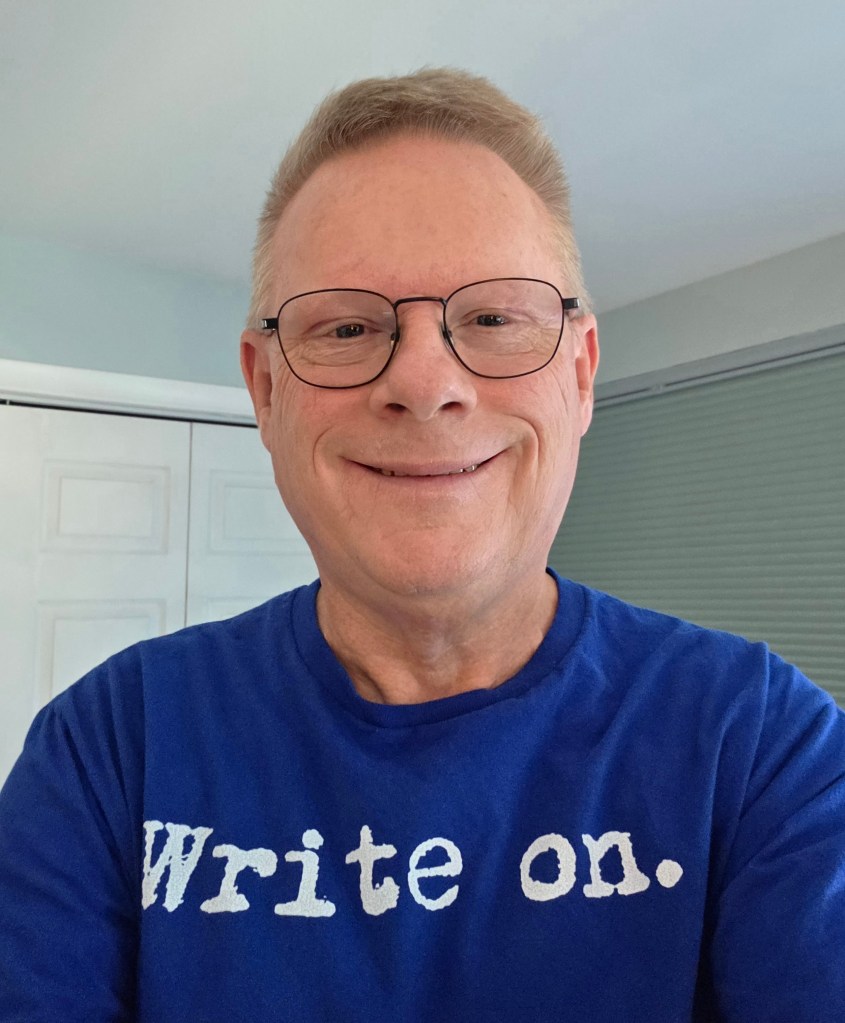
In April 2026, friends at the Scottsdale Public Library gave me this shirt after I completed my “Writer in Residence” stint there.
Uncertainty exists in every day, in every life. I try not to dwell on it, but on this day–the 250th anniversary of the United States adopting our Declaration of Independence–uncertainty is our next-door neighbor.
I certainly remember our 200th anniversary, our bi-centennial celebration, in 1976. I was a bright-eyed, long-haired, eighteen-year-old, idealistic American.
Living in suburban St. Louis, I recall seeing the tall ships grace New York Harbor on our console TV on July 4, 1976.
That summer I worked at Six Flags Over Mid-America near St. Louis. As a tribute to the bicentennial, the Screamin’ Eagle rollercoaster roared across the sky. It was the newest, tallest, fastest ride in the park. Teens rode it again and again just for the thrill of it.
Even though the corruption of Watergate and the devastation of the Vietnam War were still fresh in the American psyche, in 1976 it felt like all Americans lived under and abided by one set of rules. That we aspired to one vision.
That the United States of America–the collective red, white and blue–was one nation and indivisible. A beacon of hope and freedom. That we believed, honored, and protected the notion of life, liberty, the pursuit of happiness, and justice. For all.
Over the past several years, like a rollercoaster that has jumped the tracks, we have been derailed by a malicious force. I don’t need to–or want to–speak their names. They have fostered twenty-four-hour-a-day uncertainty and anxiety in this nation I still love.
What I choose to celebrate today are the American citizens who still hold fast to the principle our nation was founded under: freedom and justice for all Americans, no matter your skin color, ethnicity, religious beliefs, sexual orientation, gender, social or economic status.
That is the memory of the United States of America I am proud of.
That is the country my father and thousands of other true patriots have bravely fought for and defended.
That is the country I knew and lived in yesterday.
That is the country I still dream of and worry over.
That is the country I cling to and pray for on July 4, 2026.
That is the country I want to live in today and tomorrow.
Nine days ago, I wasn’t sure I would be well enough to take the stage with the Phoenix Gay Men’s Chorus for our fabulous Broadway Lightsshow June 27 and 28 at Tempe Center for the Arts.
I contracted some sort of viral infection (not Covid) that pounded my head, ravaged my gut, kept me queasy, and spurred me to take a quick Saturday visit with my husband to an urgent care facility in south Scottsdale.
This all happened while my chorus mates sang and danced their way through an all-day Saturday rehearsal.
But, remarkably, after plenty of fluids and rest, I reemerged a week ago more like myself, five pounds lighter, and ready to embrace another dazzling concert experience.
There is something mysterious about the process of coming together with a group of friends to create a great show. You endure the frustrating moments when the energy isn’t quite there. When the mics aren’t working properly. When the entrances are slow. When you turn the wrong way or sing the wrong note.
But eventually if you work long and hard enough–and all goes well enough–the magic appears. The doubts fade away. The voices and spirits rise. The lights come up and the audience appears in large numbers. They applaud, laugh and cry when they are supposed to. They even stand up and cheer with abandon.
In those moments, as you gaze into the throngs from the top riser you are reminded again why you love to sing. Why you love live theatre. Why you are thankful for Being Alive (a Stephen Sondheim number we performed from his musical, Company).
In addition to singing in this concert, I co-wrote the libretto for Broadway Lights and coached nine storytellers. They channeled their acting chops to fuse the swells of Broadway music with stories that illuminated the joys and heartaches of our LGBTQ+ lives … angsting about a first date, obsessing over a “crush”, remembering a beloved uncle who died of AIDS, returning home for a grandparent’s birthday as the person you were meant to be, celebrating a joyous wedding day, standing up against the injustices of life, and embracing the beacon of Broadway music that soars through our souls.
It’s a lot of work, but a labor of love. Love for the music. Love for the singing. Love for the community of people I perform with. Love for the audience who probably needed to be there to hear beautiful, powerful voices that transcend the ever-present noise of our American lives.
***
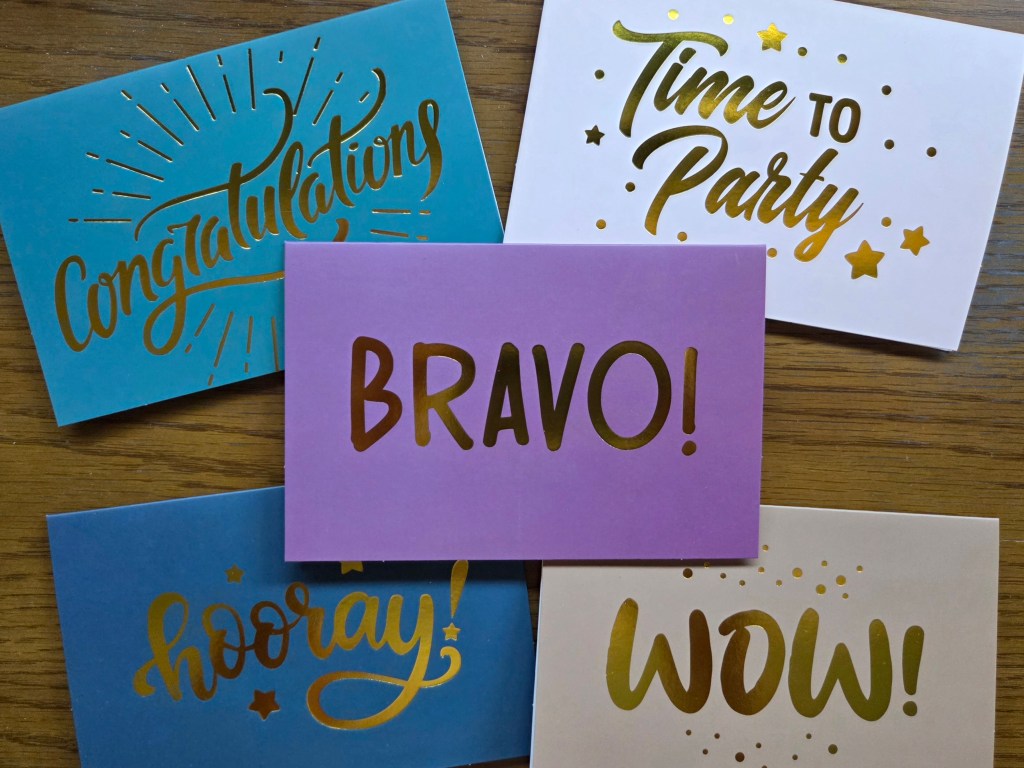
A few years ago, our chorus tried something new. For a small donation to the Phoenix Gay Men’s Chorus, we invited our loyal patrons to write a few words of encouragement on a “Bravo” notecard to be delivered backstage to someone in the chorus they love, or know, or simply want to support.
I was honored to receive several “Bravo” messages over the weekend. The loving, handwritten words from my husband, chosen family, community friends, and new acquaintances touched me deeply.
Today, tomorrow, and beyond I will treasure them and the memory of standing and singing once more … side-by-side … with my chorus friends. My chosen family.