If you follow the weather news in the United States, you know that on Friday, May 16, parts of St. Louis, Missouri–where I was born in 1957 and reborn in 2017–suffered an estimated $1 billion in damages from an EF3 tornado.
The powerful storm tore through central and north St. Louis, killing five people while damaging or destroying 5,000 buildings and countless trees … including many majestic ones in and around one of the city’s gems: Forest Park.
I have no doubt that over the coming days, weeks, months, and years, the citizens of St. Louis will heal and recover. But it will be a tall mountain to climb for many financially and emotionally.
I have made a donation to the American Red Cross disaster relief efforts. But I want to do more for the city I love, which appears in all five of my books. It is hardwired into my prose and poems in large and small ways …
In memories of my hard-working family, our suburban midwestern existence, humid summer days, learning to operator a rollercoaster at Six Flags, working at the top of the Gateway Arch (pictured here) in the late 1970s, rooting for the St. Louis Cardinals, boating on the Mississippi River, visiting the St. Louis Zoo, frequenting the aforementioned Forest Park, and much more.
In addition to making a donation of your own to your favorite relief charity, here’s another way you can help. Buy any of my five books during May and June.
I will donate $10 for each book I sell (paperback, Kindle, or audiobook) during that period to Forest Park Forever. It is a private nonprofit conservancy.
As described on their website, the organization “partners with the City of St. Louis to restore, maintain and sustain Forest Park as one of America’s great urban public parks for a diverse community of visitors to enjoy, now and forever.”
Thank you in advance for your support of my literary efforts and the city of St. Louis … as well as its beautiful urban greenspace in the middle of town, which I still love and remember.
***
Incidentally, Tom and I will travel to St. Louis in September to attend a Class of 1975 reunion with my Affton High School classmates. Yikes, fifty years! More to come on that.
According to the Arizona Forestry and Fire Management Agency, “Mr. Big” is the largest red gum eucalyptus in the U.S. Located in the picturesque desert confines of Boyce Thompson Arboretum in Superior, Arizona, he stands 117 feet tall with a circumference of 22 feet. He was planted here as a three-year-old sapling in 1926.A wooden fence and security camera surrounding the base of the tree are designed to discourage thoughtless people from carving their initials in the trunk. On February 6, 2025, I captured this photo of Mr. Big with my husband Tom during our Boyce Thompson visit. Mr. Big’s presence, threats to nature from global warming, and the upheaval in our country have inspired me to write this poem.
Late April’s breezy interlude and May’s certain pre-heating oven conspire to scare and sweep them from one escaping path to another. As they scatter and vanish into familiar cumulus clouds, space and silence walk with those who remain and remember.
It’s a rainy, blustery afternoon in Scottsdale, Arizona. Windbreaker weather.
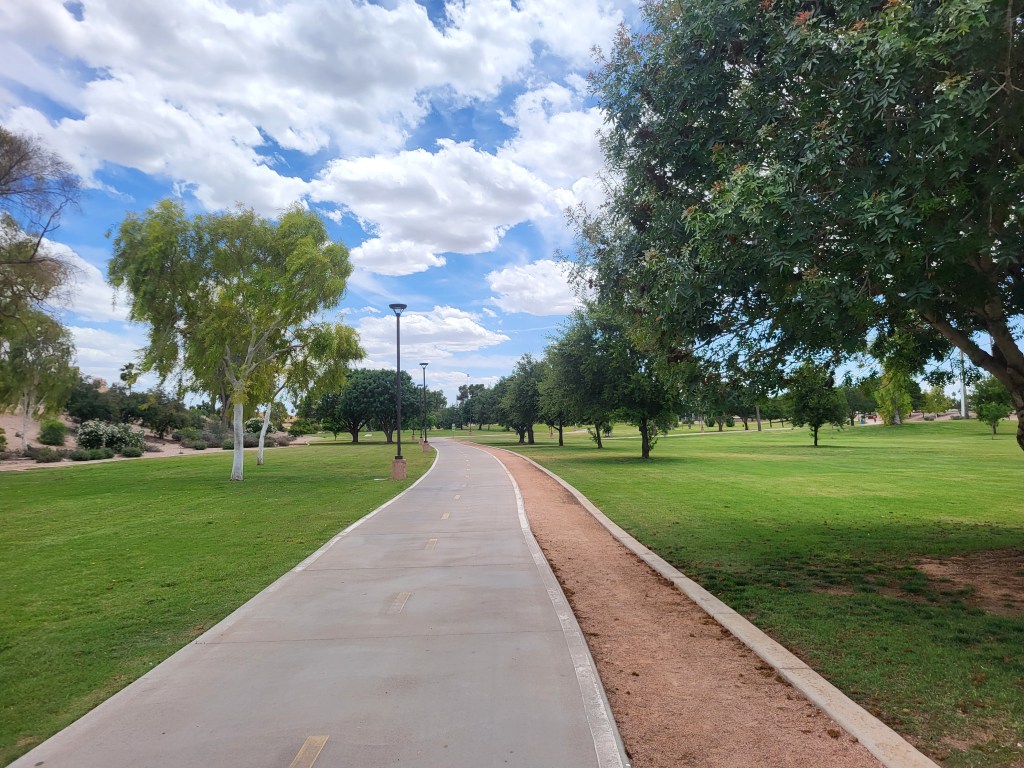
Nothing like the norm. Nothing like this photo I captured two days ago as Tom and I made our way around Chaparral Park.
But measurable rain is welcome here, and–if the weather forecasters are right–more is in the offing this week with heavy snow in Arizona’s higher elevations north and east of us.
Now that I’ve lived here nearly seven years (that anniversary arrives in July), I’ve learned that we will have plenty of blistering hot days between June and September.
So, I will embrace this cool, short-term, winter-in-Arizona anomaly. Maybe it will help build our reserves in the Colorado River basin.
As the raindrops fall, Tom and I celebrate a personal milestone. Today–February 6, 2024–we reached our full retirement age (FRA)–66 years and 7 months for those born in 1957–as defined by Social Security.
Basically, that means we are eligible to receive 100 percent of our Social Security retirement benefits–benefits we each accrued by paying into the system and working all those years, commuting to and from an array of jobs on mostly cloudy, windy and often-snowy Chicago days.
If you are unfamiliar with the U.S. Social Security Administration regulations, the Social Security Act was signed by President Franklin Delano Roosevelt in 1935.
The idea then–and still today, fortunately, though the program is under scrutiny–is that a small portion of Person A’s wages goes toward helping to support senior citizens with a financial lifeline.
Then, when Person A reaches senior status, he or she has earned the right to Social Security retirement benefits. As the rules exist today, those who log at least 40 quarters (the equivalent of 10 years) in the United States workforce are entitled to some sort of retirement benefit.
Those eligible can start taking their benefit as early as age 62 (but receive only about 70 percent of their benefit) or as late as age 70 (and receive more than 100 percent).
Of course, this is a decision laced with all sorts of permutations and “what ifs.” None of us knows how long we will live. But I opted to begin drawing on my accrued benefits–what I earned during all those years–now.
Looking way back in time … when I was in my twenties and thirties … I hoped this day would come. But I was never sure I could rely on it.
So, I did my best along the way to save in other ways to protect myself. It was an awareness that came from my hard-working father and mother, who lived through the Great Depression. They probably cheered when the measure became law.
With time, I imagine the Social Security Administration will need to push the FRA to age 70, because of our aging population–and the sheer number of us Baby Boomers who will receive payouts and deplete the reserves.
But I hope younger Americans in the workforce one day also will realize the same sort of accrued retirement benefit.
Certainly, like me, they will have earned it and will deserve it.
This is not that June I used to know of lush eastern or midwestern gardens in better neighborhoods or blushing brides posing on the covers of magazines that used to be familiar.
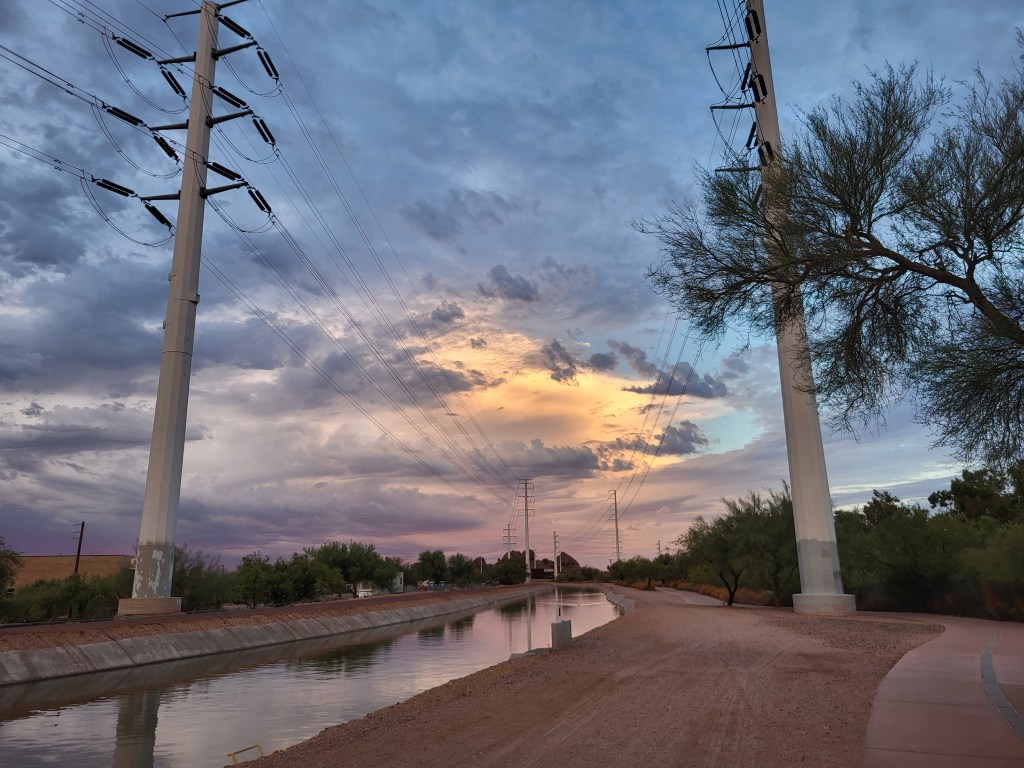
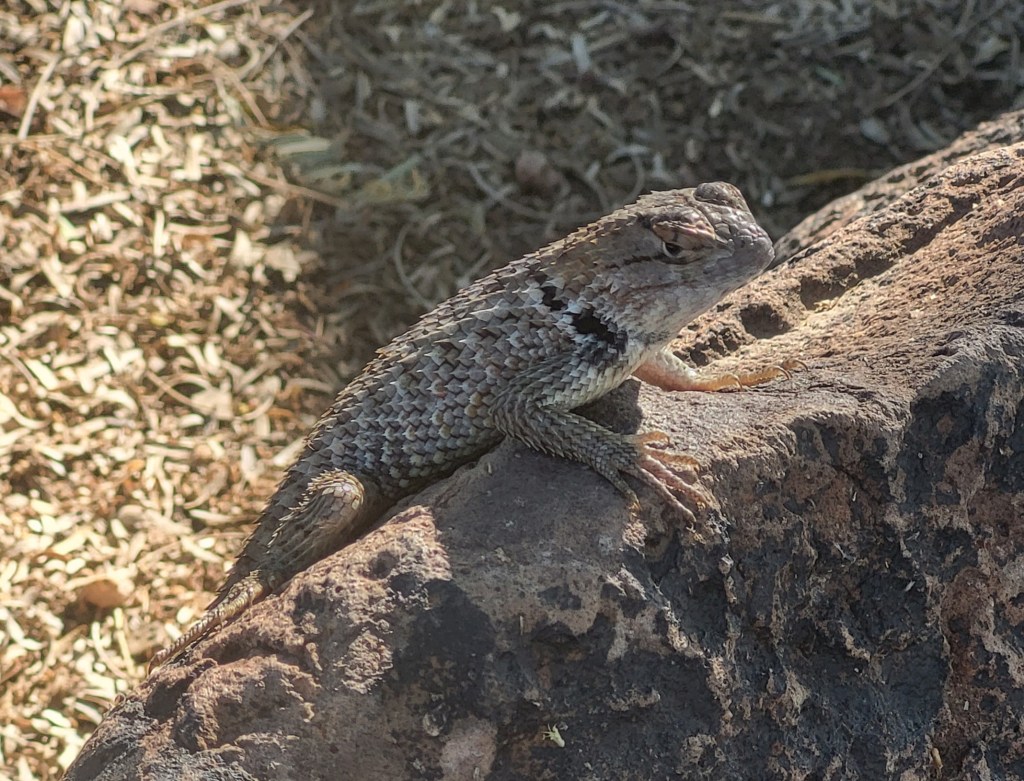
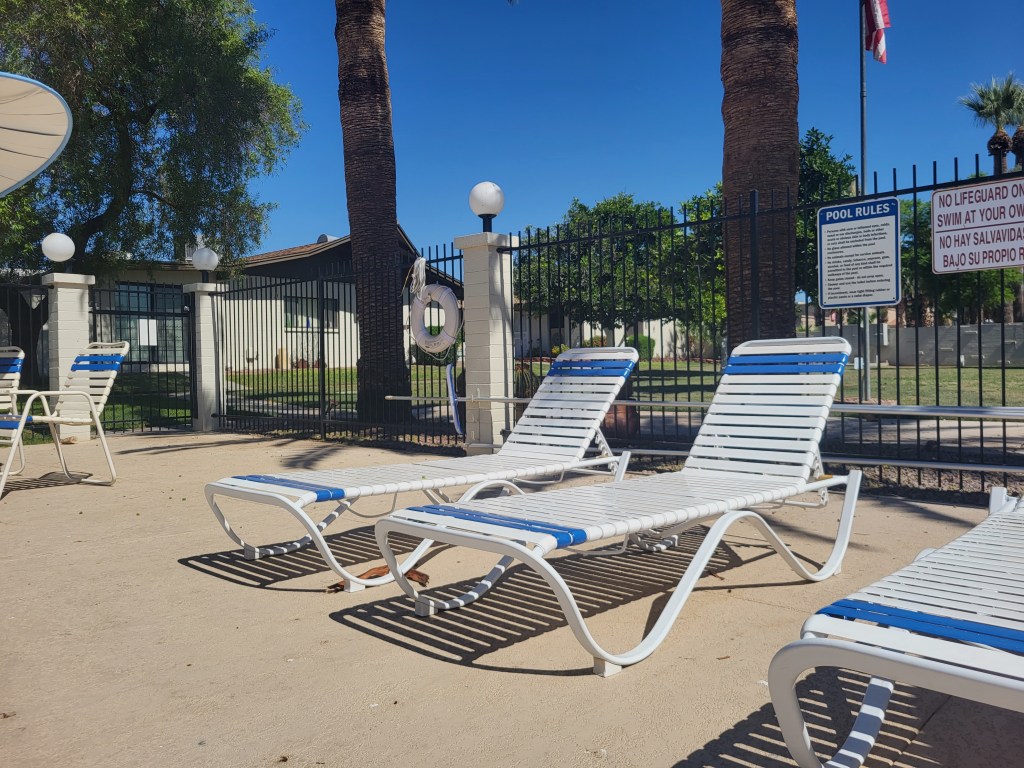
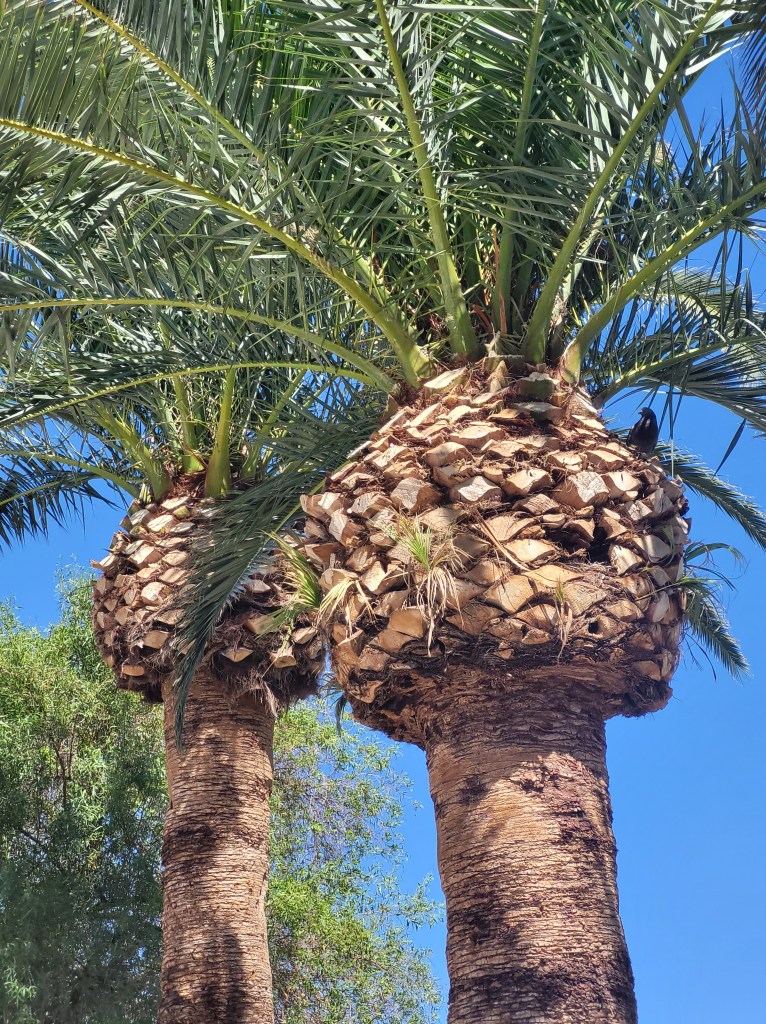
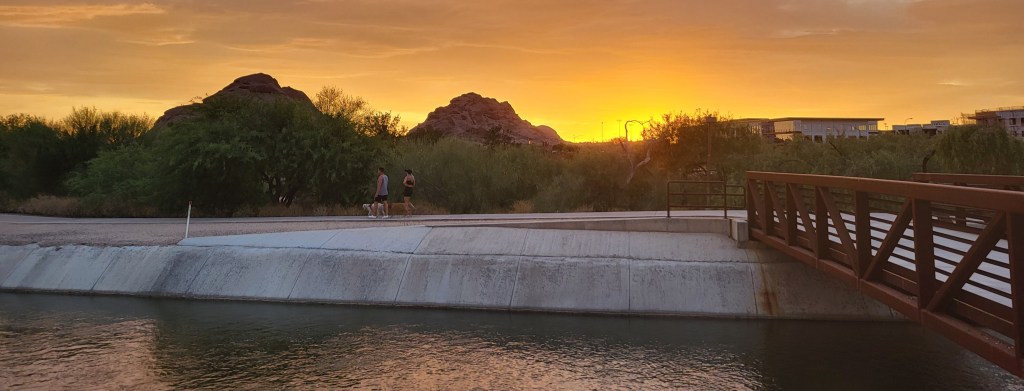
It is an under-the-radar, sun-soaked, almost-summer, alternative universe of early-bird lizards, spiky saguaros, freshly trimmed palms, empty pool chairs, and fiery sunsets.
All of them wait in triple digits for a hint of the season’s first monsoon, an uncertain wet chapter and swirling desert drama that has yet to unfold in a land where the clocks never change.
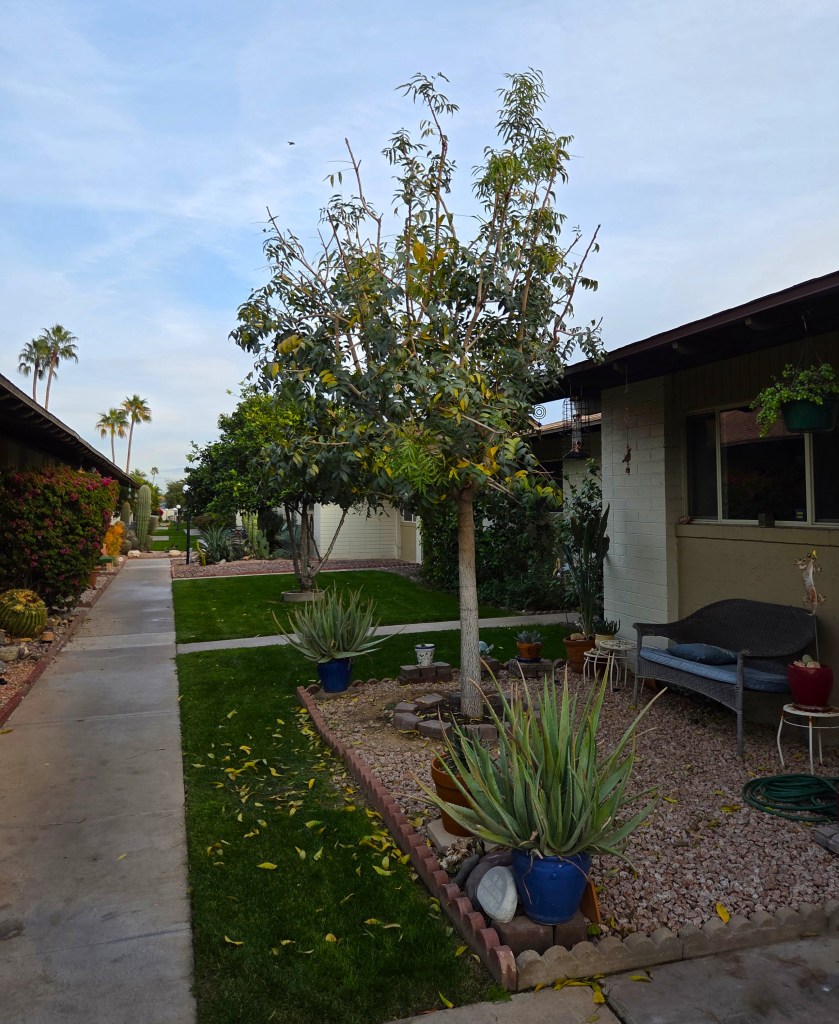
I captured these images in my south Scottsdale-Arizona community between June 17 and 20, 2023.
It’s a sizzling Saturday in the Phoenix area … 97, 98, and climbing. Hats and water bottles for protection and hydration are in order. They are now regulation gear for the next several months.
When Tom and I left the Phoenix Farmer’s Market mid-morning–clutching a clump of chard, a few red peppers, and a bouquet of snapdragons–I could feel the crackle and pop of heat bouncing off the sidewalks. Pulsating through the air.
Tom has since trimmed the pink and magenta snapdragons. He arranged them in a cobalt-blue-glazed ceramic pitcher I treasure. My mother left it behind.
We began buying fresh-cut flowers three years ago as Covid raged and tightened its grip on the world. It was our way of bringing natural beauty into our home, while we worked to avoid the bombardment of fear and disease.
Thirty-six months later, you might say this practice has taken root and grown into a full-fledged tradition.
Certainly, there is beauty outside in the surrounding rugged buttes, startling sunsets, chirping birds, and April cactus blooms.
But this bouquet (featured on a table beneath our Brokeback Mountain poster we bought when we lived in the Chicago area) provides us with a more private splash of color. Tucked away from the heat of the day both meteorologically and metaphorically.
We are human, not robots. So, we all do it to some degree or another. We reflect on seminal moments that have passed rather than living in the present.
In my case, that means occasionally remembering the full moon, which dominated the January horizon the morning my mother died in 2013.
Or–further back in my psyche–the sweet scent of magnolia blossoms, emerging in late March on the front lawn of my suburban St. Louis childhood home. Often, mother nature tricked them with an early April frost that turned the pink petals brown.
Oddly, when we aren’t contemplating the past, many of us focus on the future. We anticipate significant events–personal and social–that approach.
We ponder pressing issues ahead, such as paying the rent or mortgage when it comes due at the end of the month, speculating on the latest batch of troublesome news on the world stage, or waiting impatiently for medical test results.
Though I am a memoir writer–and soon-to-be-published poet (stay tuned)–once-unforeseen yoga sessions (which I now practice frequently on the aqua mat of my sixties) teach me that I am better off focusing on the space in between the memories and the what ifs.
It is the breathing in and out that keeps me whole as I write this sentence on the keys of my laptop. It is the random chirping punctuating my afternoon in the palm tree outside my back door.
It is the rushing water of life, which currently swooshes through the normally dry Salt River gulch in Tempe, thanks to frequent rains in the Valley of the Sun and melting snow from Arizona’s high country.
At this moment in time, I need to remind myself that it is all of these things–happening now–that make life rewarding and meaningful on an otherwise gauzy Wednesday in March.








 Mark Johnson Stories