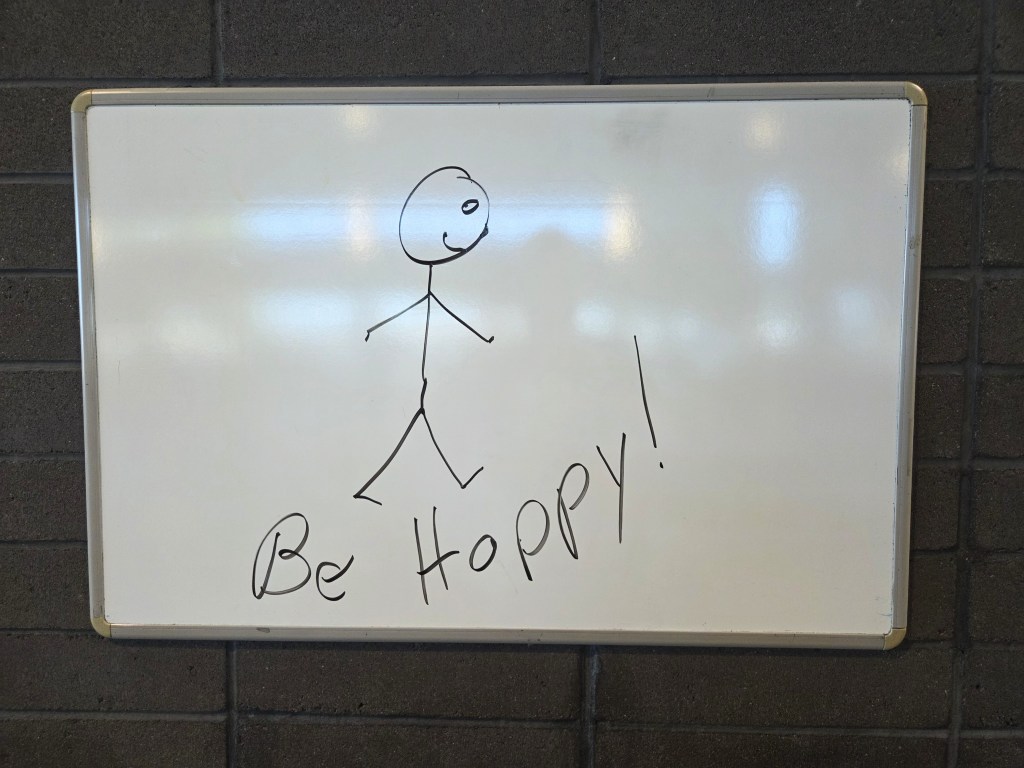
At 10:30 a.m. today, after I dismounted my treadmill at the Scottsdale Community College fitness center, I turned left. This primitive, but meaningful, message scrawled on a nearby whiteboard captured my attention.
Yes, I am relieved and happy about the blue tsunami that made landfall in the United States last Tuesday. (If you squint, you can detect blue glimmers of it in the reflection of my photograph. Well, not really. Actually, those are the blue skies of Arizona bouncing through western-facing windows.)
The full effects of our political sea change–a true mandate from the American people cast across red, blue, and purple states–won’t become clear until January 2027. That’s when a newly elected, eager-and-diverse slate of Democrats take their seats in Washington, D.C., before a mountain of problems to solve.
But in this period of a landmark transition, we should Be Happy as individuals and as a nation. It feels like we finally may be stepping away from the precipice of our demise, like we have turned a treacherous corner, like we have come to our senses and rediscovered our best intentions before the stroke of midnight.
In this month of Thanksgiving, this seismic-and-hopeful political shift is something to celebrate and truly be thankful for.
That day has come. It is the eve of a frightful pivot point in American history. Will we salvage our democracy at the polls or hand over the last keys of liberty with a whimper? I hold my breath and hope for the former.
Like much of America, my husband and I cast our votes early. Now, amidst raging flood waters that swamped much of Arizona over our unusually soggy weekend, I pray for an early November blue wave. To stop the madness. To flip the script. To calm this exhausting social and economic quagmire. To welcome common sense and human decency back in the front door.
Meanwhile, I give thanks for the successful completion of my sixth memoir writing workshop at the Scottsdale Public Library. For three consecutive Fridays in October, I bonded with eleven diverse and talented writers–seven women; four men–around a rectangular table at Mustang Library.
They trusted me to help jumpstart or embellish their literary journeys. To open their hearts. To share their stories and give them voice. Along the way, we shared a few laughs and several cascades of cathartic tears as they collected constructive feedback and encouragement like hungry trick-or-treaters trolling for their favorite candies.
In a nutshell, together we fostered and nurtured an organic community of storytelling. One I imagine they will carry forward with passion and persistence.
As we parted last Friday, one member shepherded the creation of a email contact list, so that they can discuss ways to continue on this literary journey together.
Though I feel I need time to refill my creative tank, I know in my heart I have contributed to the well-being of eleven other lives … eleven who strive to share their pain, their light, their wisdom, their voices with a world desperate for truth and greater goodness.
Sixes are wild. I have written and published six books–most of them in my sixties. Meanwhile, last Friday, I welcomed another group of writers to my sixth memoir-writing workshop at the Scottsdale Public Library.
Each writer arrives in the room with their own suitcase of metaphorical stories to tell. In my role as leader and facilitator, I encourage them to unpack the most meaningful, vivid ones.
There are eleven participants in the current class. We’ll have two more three-hour sessions together. One is tomorrow. The last one is October 30. Though we meet just three times in person, I try to cram as much writing into our time as possible.
My goal is for them to find and develop creative momentum in this temporary writing community, then move ahead independently to write a personal story. I focus on helping them tell ONE story from their lives, rather than THE story of their lives. I think that makes the process less intimidating.
This week’s writing? To describe a setting that is memorable from their lives. It might be a city, town, or something more specific. Perhaps a room in a house where something important occurred. In a worksheet I gave them, I say, “What does this place look, sound, smell, feel, taste like?” Then, I ask them to include these sensory observations in the narrative of their story.
I work with the group to build trust right from the start of the workshop. So, I will keep their story submissions confidential. But suffice it to say, their “settings” stories they submitted run the gamut. The organic and raw nature of memoir writing is what I find my fascinating about the genre.
Last year when I first introduced this “settings” exercise in another of my workshops, I completed my own version of this exercise to see how it felt.
What I’ve written below is a description of one of my favorite cities in my home state … Flagstaff, Arizona. I’d love to know what you think. Send me a comment.
***
Like much of America, downtown Flagstaff lives in transition.
Wooden porches of once-proud homes sag and creak. They speak of generations of heavy snow, extreme temperatures, and familiar faces gone but not forgotten.
Scattered wildflowers bloom through deep cracks in sidewalks and curbs. Occasional murals–born and etched by Arizona artists–adorn avenues. They tell hardscrabble stories of past lives.
North and south of historic Route 66–on both sides of parallel train tracks that dissect and rumble through the town–entrepreneurs have stripped and transformed buildings. Trendy pizza joints, aspiring restaurants, cozy coffee houses, touristy bars, ski shops, reimagined inns, dental offices, healthcare clinics, law practices, and investment firms anchor street corners.
Some have since closed, casualties of the pandemic. The lucky ones endure, connecting bohemian neighborhoods within view of the breathtaking San Francisco Peaks.
The overall effect produces a block-by-block checkerboard of western resiliency, community pride, mountainside retreat, and twenty-first-century regrets.
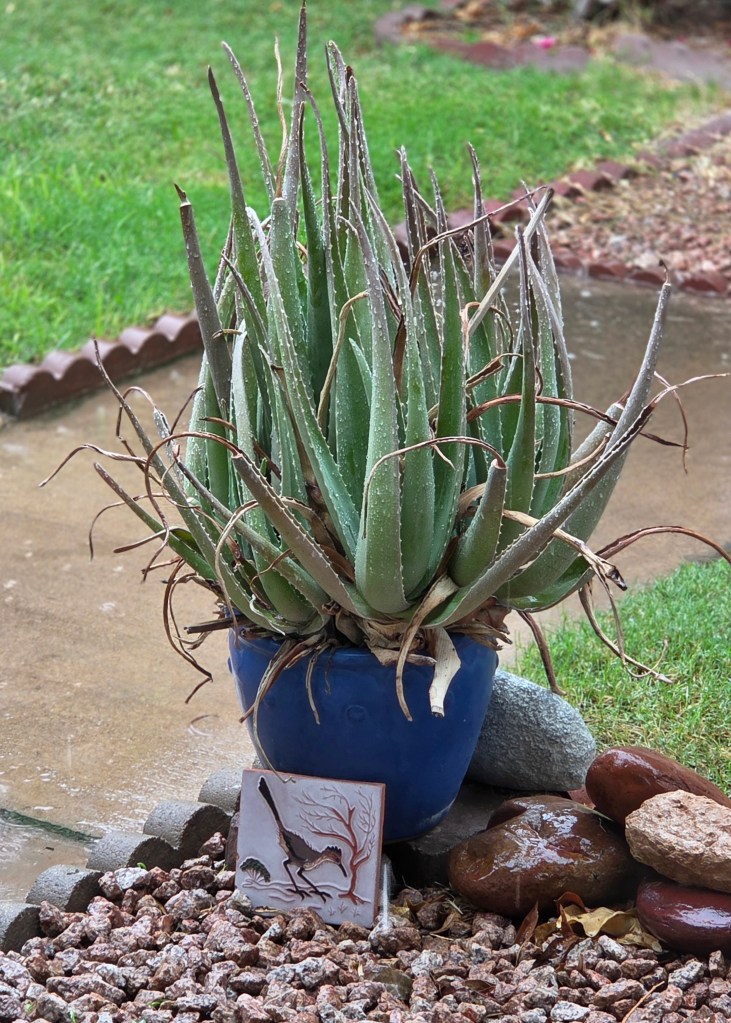
Waves of random showers soak once-parched plants on this wet October day. Some soothe forgotten succulents, while others cue autumnal chapters of bubbling baked apples, laced with sugar and cinnamon, brimming with melted butter, delivered simply and securely, without a dog-eared recipe, directly from her heart and Midwestern oven.
The sweet, fruity aroma stirs my creative spirit, fires my tired fingers, fuels my ever-willing voice, and ignites tomorrow’s best intentions to nurture seedlings of songs and stories that otherwise might never grow, never emerge, never be written.
And nights of our lives angling for the next fish.
We rush from place to place, moment to moment,
Often derailed and distracted by constant noise,
Often unfulfilled as the day’s last light descends.
Maybe, to catch the one we dream of catching,
It’s best to pause in silence at the water’s edge,
To give thanks for what passes before us,
To be still beside the simple silhouette cast.
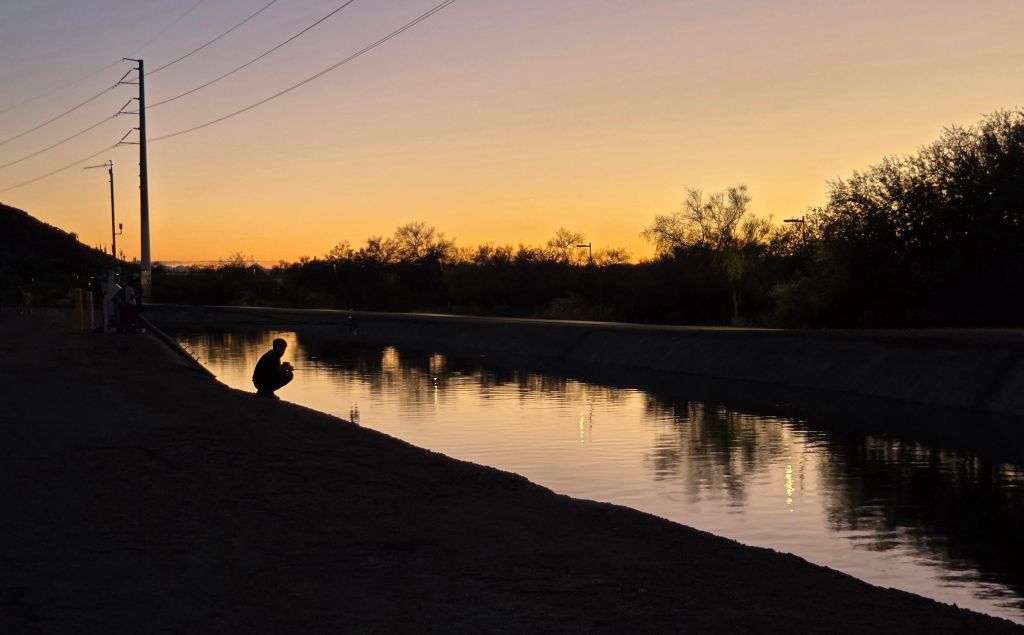
At dusk, on Sunday, October 4, 2026, I captured this silhouette of a boy waiting patiently for his next fish along the Crosscut Canal in Scottsdale, Arizona.
If you enjoyed reading my poem, check out my book of poetry, A Path I Might Have Missed. It (and all six of my books) are available on Amazon.
As Dad, Mom, Diane and I approached my grandparents’ rambling farm in Huntersville, North Carolina, in 1968 in our four-door Chevy Biscayne, waves of kudzu vine blanketed the trees.
At some point during our July vacation there, I remember my stoic maternal grandfather telling me this invasive plant, this weed, was blocking the sunlight.
Bit by bit, the kudzu was smothering the native plants and large trees in the southeastern United States.
In a metaphorical sense, I feel like one of those older trees–perhaps an oak or pine–that has grown through the seasons and spread its branches only to discover that the censorship and hate of our nation’s government (said kudzu vine) has insidiously wrapped itself around my trunk.
This is not a new development. I have been feeling this way for years. Trying to remain positive in the face of ICE raids, misogynistic slurs, shuttered healthcare programs, disregard for our most vulnerable citizens, the environment, and our right to a free press. The list of losses is endless.
Recently, my husband and I have lived firsthand through the threat of censorship in our community. It is causing us both great pain. It is also prompting me to realize how far we have fallen as a nation and what I am willing to tolerate or accept.
At some point, I will have more to say about this. I don’t know when or how. Suffice it to say, this kudzu vine–the 2026 version of the McCarthy era in the United States–is out of control.
I do believe that, ultimately, historians will shine light on whatever it is we are living through. I hope I live long enough to see the return of truth and reason and the eradication of these smothering vines.
I met a new friend for lunch yesterday. It’s a rather unusual, sweet story. For that reason, I need to write about it.
About three months ago, a young reporter sent me a message via my contact page. He saw a nostalgic piece I wrote about my college years at the University of Missouri.
It included a reference to Hinkson Creek and an abandoned quarry there, which I and many other college freshmen and freshwomen frequented on Friday nights to swim and party.
Apparently, the creek is now polluted–has been for more than thirty years–with an array of contaminants, but there is a push by various environmental groups to salvage it.
In his note, this earnest reporter–a journalism student at the same university I graduated from in 1979–wanted to talk with me to include a few comments about my recollections of Hinkson Creek. He wanted to give the story some texture and a touch of humanity.
As background, I don’t always respond to these sorts of messages. Too many of them are generated by bots or feel exploitive. But this one felt different. So, I responded.
A few days later, we had a pleasant phone conversation. I shared information about the fun I had with friends at Hinkson Creek in the mid 1970s and how sad it was for me to learn that Hinkson Creek is now unsafe due to the presence of E. coli in the water (according to data on the EPA website).
Before I said goodbye to the reporter, he told me how ironic it was that I lived in the Phoenix area, because he would be moving to the Valley of the Sun in July to be with his partner. I suggested he contact me again once he got situated here.
Last week, I received a text from this young man, this recent Mizzou journalism graduate who is forty-eight years younger than me.
He now lives in Phoenix and is looking for a writing job here. He included a link to the story he wrote which appeared in the Columbia Missourian with a few quotes from me.
It’s a thorough, well-researched story, but that’s not the point of my story.
Anyway, I thanked him for sending the link to me. He asked if I was still interested in meeting for lunch. I responded with a definite YES.
Yesterday afternoon–one day before the rain finally arrived to ease our parched earth here–we met in person.
This smart, enterprising, young gay man and I talked about his job search, my writing and my husband’s passion for films, how he and his partner met, his love of writing and music, his early impressions of Phoenix, and my recommendation that he find his place in the LGBTQA community here.
I told him that at this point in my life it is especially meaningful for me to help a younger man–a young gay man–by offering a little guidance in a harsh world.
He smiled when I told him I would pick up the check and–before we parted ways, but after I invited him and his partner to come to the next Phoenix Gay Men’s Chorus concert in December–he said jokingly that meeting me is kind of like having an “elder gay” to talk with.
Ordinarily, I wouldn’t want to be referred to as an “elder” anything. But in this case, it was a term of endearment. So, I laughed and accepted it that way.
***
My wise, sassy, and “elderly” Aunt Thelma once told me when she was in her late sixties, and I was about this young reporter’s age, that “we are all like ships passing in the night.”
I have always taken that to mean that life is fleeting, and that we should try to help each other around every turn. That we should try to do the right thing, because we never know what tomorrow may bring.
I think Thelma would have been proud of me yesterday.
Who could have imagined that a story about a polluted creek would lead to a pleasant lunch?
More important, that I might reach forward to help a young gay man, while looking back to remember that unrealized twenty-one-year-old-gay version of me who most certainly would have loved a little advice from an “elder gay” friend.
Though nothing is predictable in 2026, the arc of every life includes mostly ordinary activities: going to work; shopping for groceries; filling up the gas tank; navigating small and large challenges that enter unannounced.
But it is the less frequent, extraordinary moments–the rites of passage–that outweigh the mundane tasks of life. Graduations. Weddings. Births. Deaths. They supersede in our psyches. They flicker forever in our memories.
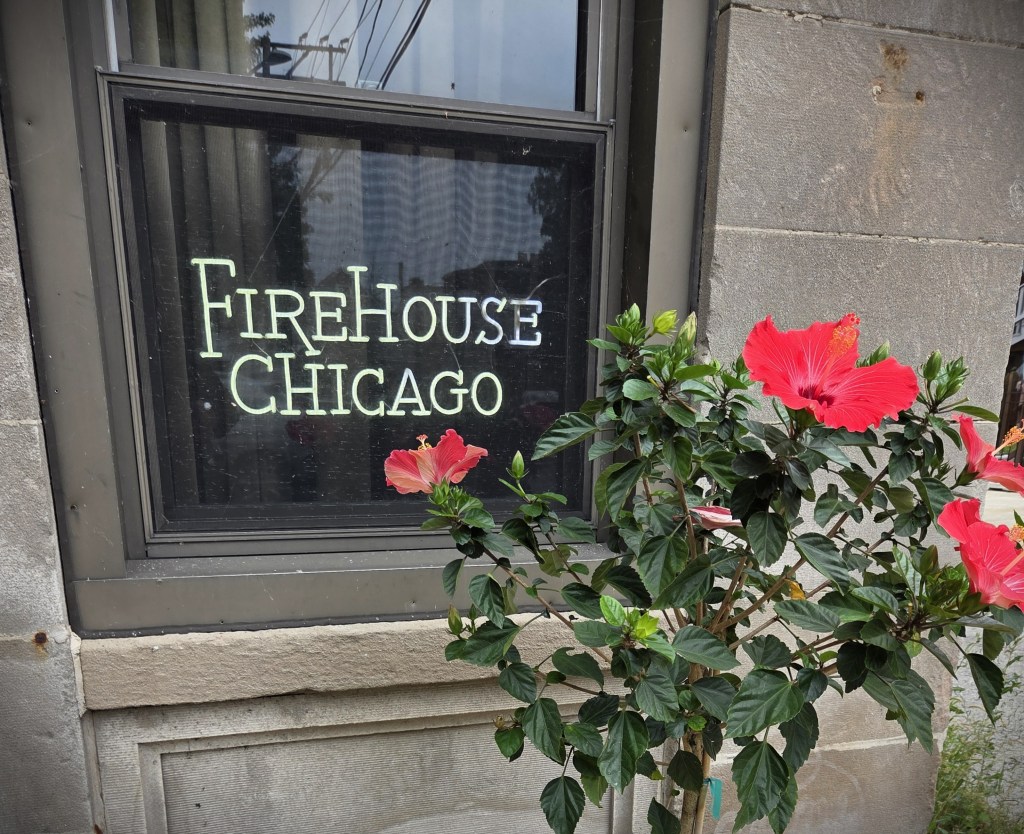
On Saturday, August 29, one hundred and twenty of us gathered at the Firehouse Chicago (a decommissioned firehouse transformed into a wedding venue) in the Edgewater neighborhood of the Second City. We came to witness the marriage of Kirk and Jennifer, my younger son and daughter-in-law.
It is a dream come true for any parent to see their adult child find their own path. To be more specific, this dad survived a heart attack on his sixtieth birthday. So, living to see Kirk marry the one he loves–the one who loves him–is the proverbial cherry on top of a hot fudge sundae.
Jennifer’s and Kirk’s early-evening, outdoor wedding ceremony was a cultural tapestry. It melded elements from their collective Jewish and Catholic upbringing.
For instance, they were married under a chuppah, a rectangular wooden structure laden with flowers. In the Jewish faith, it symbolizes the home they will build together.
After they shared their vows, a proud gay couple (my husband Tom and I) read the couple’s loving intentions for their marriage, for their families, for those who have gone before them, for their community, for the world at large in need of a hefty infusion of love, hope, humanity, equality. In every instance, the response from the congregation came in return: “Hear Our Prayer.”
A brief, unexpected shower in the middle of the ceremony–ushered in by rolling gusts of wind and the steady thrum of chirping cicadas–never dampened our spirits. It only added to the texture of the day.
As I write this, Tom and I are back home in Scottsdale, Arizona. I am fighting off the remnants of a cold. We have unpacked our bags from Chicago but haven’t yet unpacked every indelible moment from this whirlwind family wedding.
I do know in my heart that this was more than a joyous wedding. It was a healing experience to mend fences with my ex. To conjure the spirits of family members gone but still loved. To stand tall beside my husband for all the world to see. To feel true love, palpable and present, beaming between my son and his bride.
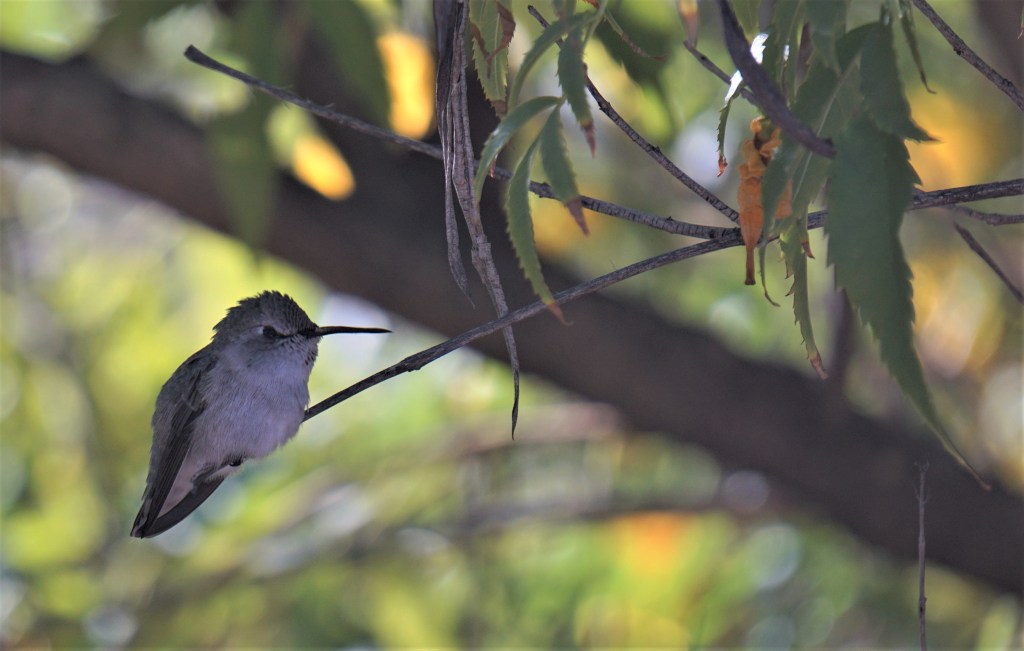
Lately, I feel like an anxious hummingbird, flitting about from one branch to another. Zooming in and out, searching for creative inspiration. Trying to find sweet nectar that will help me link one idea to the next.
Maybe it’s the late-summer desert doldrums. The intense Sonoran heat has worn me down. I don’t feel the impetus to write here as frequently as I once did.
Even so, I have experienced two moments of writing bliss in the past week. Both led me to draft deeply personal poems for members of my family–chosen and otherwise. At some point, I may decide to share them publicly, but not now.
Maybe this is simply what it feels like to be living in my “late sixties going on seventy” (sounds like a parody of a song from The Sound of Music) in a world gone mad.
All the while, I try to nourish myself.
I try to help others I love who have lost jobs or are battling cancer.
I play word games on my phone when I wake up each day.
I recall the stunning scenes and pine scents of western Canada.
I pack for my younger son’s wedding in Chicago this weekend.
I squeeze in another trip to the gym.
I watch the young-and-promising St. Louis Cardinals I root for self-destruct again in the late innings.
I download the music for my December choral concert and prepare for my next rehearsal.
I socialize with friends away from the heat produced in the Valley of the Sun.
I take afternoon naps to reboot my brain.
I prepare to lead another memoir writing workshop in October.
I recoup with my husband at home. We enjoy quieter moments in the confines of our Arizona abode.
Through it all, I wonder when or if I will rediscover the time and energy to complete another book.
Somewhere between Jasper and Banff–during the last week of July 2026 in Alberta, Canada, on a coach, on a trail, or in a hotel room–I lost my neon-yellow Phoenix Gay Men’s Chorus cap.
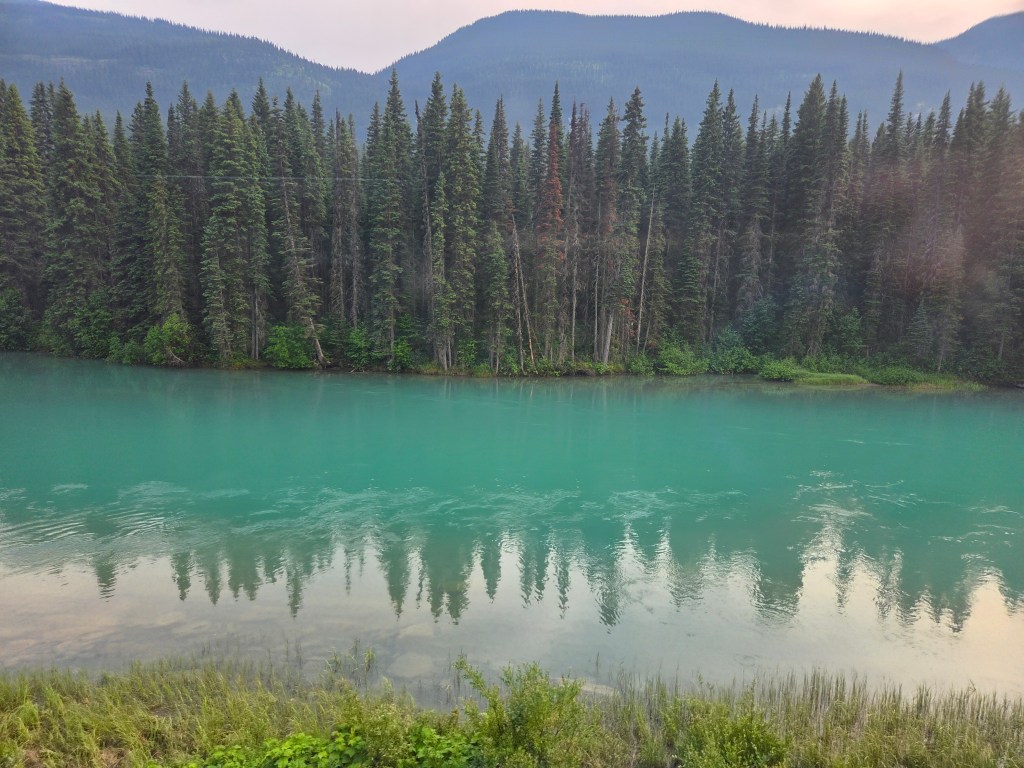
But what I found with my husband in Canada’s astounding scenery and emerald waters is far greater, more meaningful, and certainly more lasting in the flipping pages of my memory.
Tom and I planned our Canada adventure months ago to commemorate thirty years of being together. (We met in the Chicago suburbs in August 1996.) Fresh Tracks, a Canadian tour group, helped us orchestrate our eight-day itinerary.
I told my husband, “I want to spend money in Canada in 2026.” I wanted to see the beauty above us on the map. I wanted to embrace the scenery and people, who are our northern neighbors.
I wanted them to know that many–probably most–Americans love and respect them. We admire their commitment to protect their natural resources.
Over the course of the next week, I was able to see that first-hand in the cleanliness of their national parks. No plastic bottles rattled around in rivers, lakes, or streams.
I have craved a visit to the coastline and mountains of Vancouver for years. So, we started there.
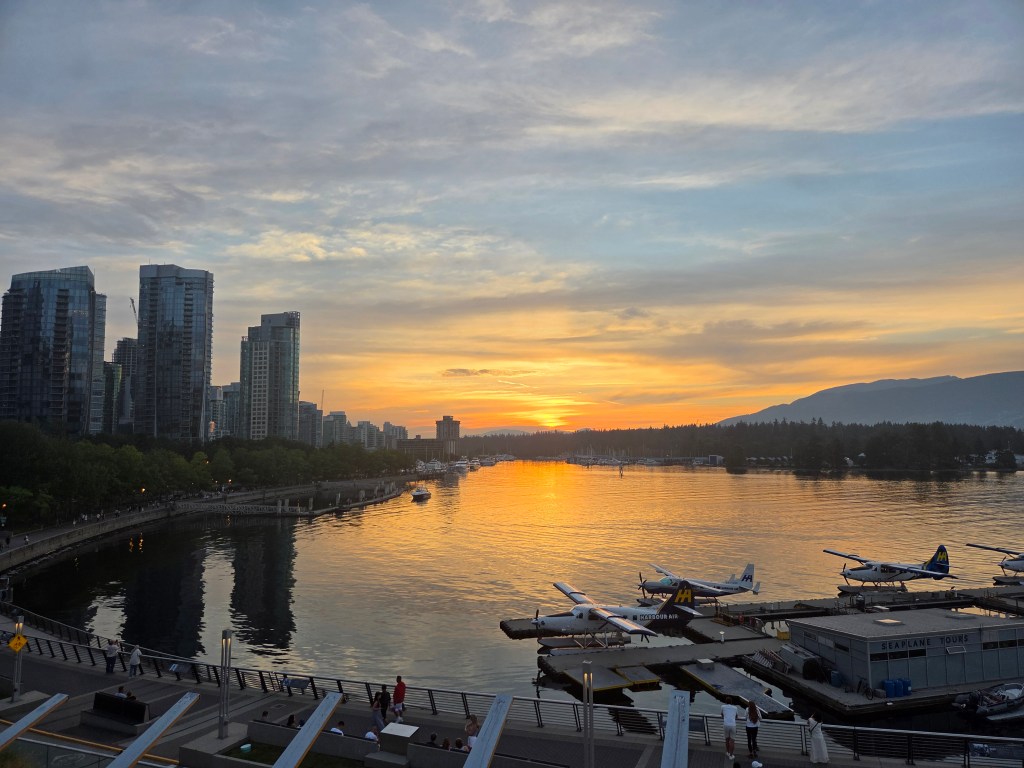
Fresh Tracks arranged an exquisite dinner for us at the Coal Harbour Cactus Club. We toasted each of with a glass of prosecco and watched the sun set over the bay. It painted a tranquil mood across a colorful canvas.
We expected to spend the following few days traveling via train on the Rocky Mountaineer through the Canadian Rockies. But fires in British Columbia limited the rail portion of our excursion to one day.
We made the best of it, traveling from Vancouver to Kamloops via coach with about thirty others. Two kind, upbeat Rocky Mountaineer staffers walked down the aisle handing out water and snacks–packages of chips, cookies, and candy.
Early on the morning of July 24, we climbed onto another coach that escorted us to the Rocky Mountaineer rail station in Kamloops a mere twenty minutes away.
Sifting through the smoke-tinged skies of Kamloops, we boarded the train and arrived on the top deck for a Gold Leaf view through a glass-encased dome.
We introduced ourselves to Mark and Kim, a fun-and-friendly couple from Abilene, Texas, who sat across the aisle. All four of us–and a train full of others–faced forward.
For the following ten hours, the welcoming, service-focused Rocky Mountaineer team entertained us with vivid stories of the landscape we would traverse together and the animals we might encounter.
At scheduled intervals, they invited us to the lower level of the train for a sumptuous, gourmet breakfast … I fell in love with the lemon cranberry bread topped with a decadent glaze.
Several hours later, we returned there for a delicious lunch/dinner, prepared magically by a team of chefs on board. The wine and drinks were free flowing.
We downed a glass of mimosa–and later pinot noir–as we traded stories with Mark and Kim and gasped at the steep river-laden mountains and canyons that brought us to Jasper … an easy-going ski-town still recovering and rebuilding after a devastating forest fire in 2024.
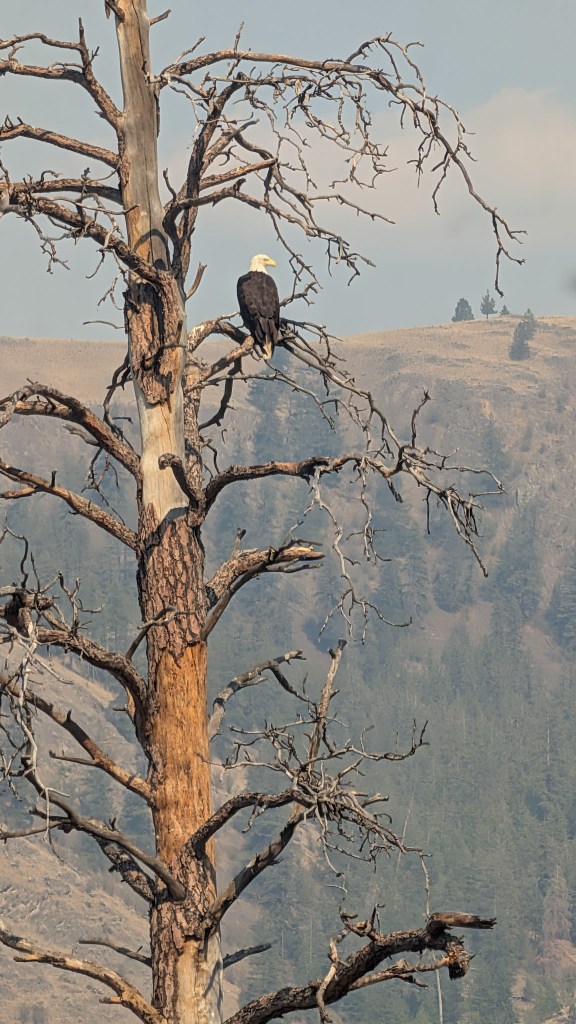
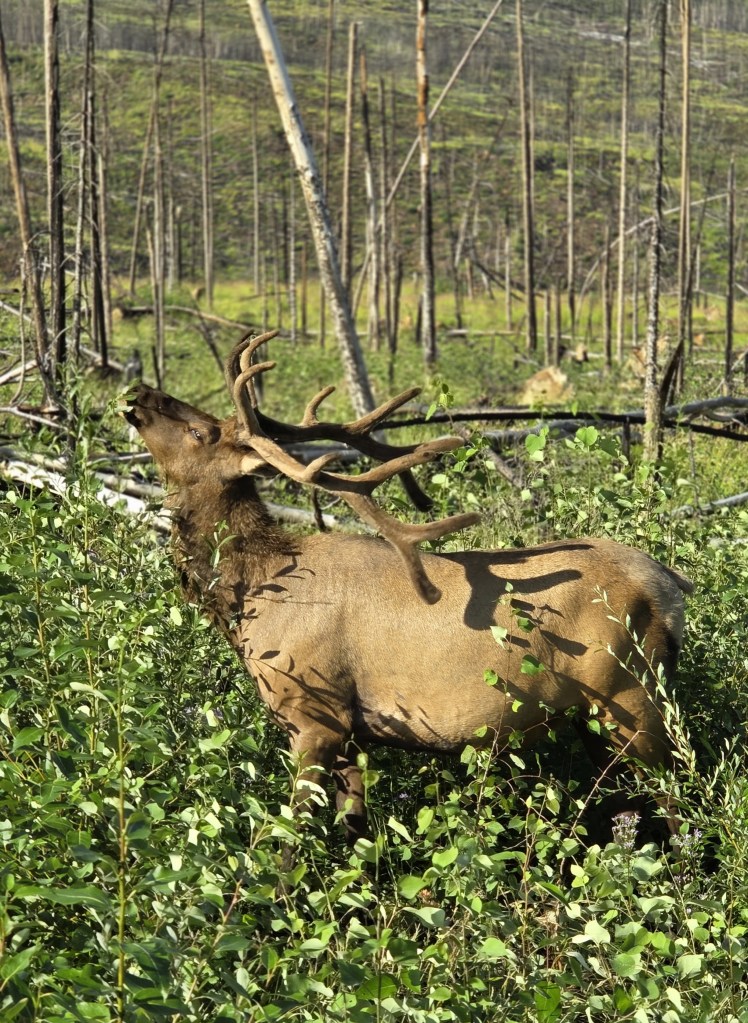
Along the way, eagles, elk, and big horn sheep guided us sparingly. They appeared unimpressed and unconcerned with our presence as we rode by, though we on our train cars and coaches lunged for our cameras and phones in pockets to bring home evidence that we had actually seen wildlife, unjaded and unaware of the news in any day.
Midway on our vacation, after leaving Jasper, we spent a night and morning frolicking at the iconic Chateau Lake Louise. We absorbed the privilege of simply being there and seized the moment by capturing photos of the breathtaking scenery … something Tom’s parents had done when they visited Lake Louise in 1988.
A highlight of our trip was journeying to the Columbia Icefield in Alberta. When we arrived there in our Sundog coach, we donned four layers each, including our easily packed windbreakers. They proved ideal as we ventured out to walk on a glacier.
The temperature on my phone said fifty degrees Fahrenheit. In the icy, pine-scented air it felt more like forty with a biting breeze. Of course, my blood is thinner now, living nearly all of my days in the Sonoran Desert.
By the time we arrived in Banff, it meant we were nearing the end of our Canada adventure. I did my best to “soak up the scenery” as my father said back in the 60s as we rode up and down hairpin turns in the Smoky Mountains of Tennessee and North Carolina.
Well-appointed lodges and snazzy shops line the main streets in Banff. At times we felt the size of overflowing, late-July crowds and traffic there.
None of that deterred my fascination with the Bow River rapids–and ultimately its falls–that raced through town or the eight-minute gondola ride we took on our final Banff day beyond alpine heights to the top of Sulphur Mountain.
Through it all — as I paused to “soak up” breathtaking scenery in the form of still photos and even a few videos of waterfalls and vast mountain ranges stretching far beyond my senses — I realized the most important thing of all: I was blessed to witness the wonder of western Canada in July 2026 and to see all of it with the man I love.