It’s been nearly forty-two years since the American TV sitcom Cheers debuted on September 30, 1982.
In its inaugural season (fall 1982 to spring 1983), Cheers ranked near the bottom in the Neilsen ratings. But by the mid-eighties, it caught fire with audiences and became “Must See” TV for millions–ultimately running for eleven seasons and 275 episodes on NBC.
If you aren’t familiar with the concept of the series, the show was set in a Boston neighborhood bar. Locals–like Norm, Cliff, and Frasier–came there to drink, socialize, unwind, and escape the grind of their day-to-day lives.
The opening theme song written by Gary Portnoy, Where Everybody Knows Your Name, captured the sense of familiarity, comfort, and community bar “regulars” knew was waiting for them every time they walked through the door and descended down the steps for a drink.
But it was the bar banter with Sam, the owner, and the escapades (sometimes sexual) of the Cheers staff over the years–Diane, Carla, Coach, Woody, and Rebecca–that drove the creative content, tickled our funny bones, and warmed the hearts of young and old viewers.
***
I write frequently–in my books and blogposts–about the importance of community connections in our lives.
To feel fulfilled, I believe we need frequent connections to people (animals and plants, too) around us, along with a balance of alone time to recharge our personal batteries.
Of course, singing with the Phoenix Gay Men’s Chorus (PHXGMC) fills a portion of that need for me. (I’m excited for our first rehearsal this Tuesday evening for the 2024/2025 season. We have a new artistic director and 112 singers!)
Each week, I look forward to the musical mayhem, creative camaraderie, and safe haven we share at PHXGMC.
From a writing standpoint, Tom and I have discovered another source of community connection we cherish just a few miles from our condo.
For almost a year–two or three times each week, usually in the afternoon–we have packed up our laptops and driven to Grounds on 2nd in Old Town Scottsdale.
It’s our favorite urban market, coffee shop, wine bar, and local hangout … and a conducive spot for writing. In fact, I’m drafting this post there right now.
The owners and staff are fun, friendly, and welcoming. They and we have become fast friends. They greet us with warm smiles, iced coffee (yes, it’s still hot here!), yummy pastries, and a comfortable place to plug in so we can write our next story or plan our next creative endeavor.
It’s pretty simple. Grounds on 2nd is a welcoming, bright, lofty, contemporary neighborhood watering hole with comfy chairs and rambling plants that green up the room and soften the edges.
Best of all, when Tom and I open the glass doors and walk in … to write, or drink, or just relax with friends … everybody knows our names.
In summer’s flurry of joyful singing, record-breaking heat, Covid resurgence, political revelations, and Olympics coverage, June is gone. July is close behind.
Until now, my Covid recovery, birthday revelry, and travels to and from Minneapolis for the 2024 GALA Festival prevented me from posting highlights from Encore, our Phoenix Gay Men’s Chorus concert in late June.
Suffice it to say Encore was a musical review of favorite chorus moments and tunes (A Million Dreams, Some Nights, What Was I Made For?, Bridge Over Troubled Water, Proud, I’m Still Standing, For Me and ten more.)
Beyond that, it was also a reflective celebration of Marc Gaston’s twenty-two years as our artistic director–laced with storytelling vignettes (I wrote), LGBTQ anthems, and dazzling dance routines.
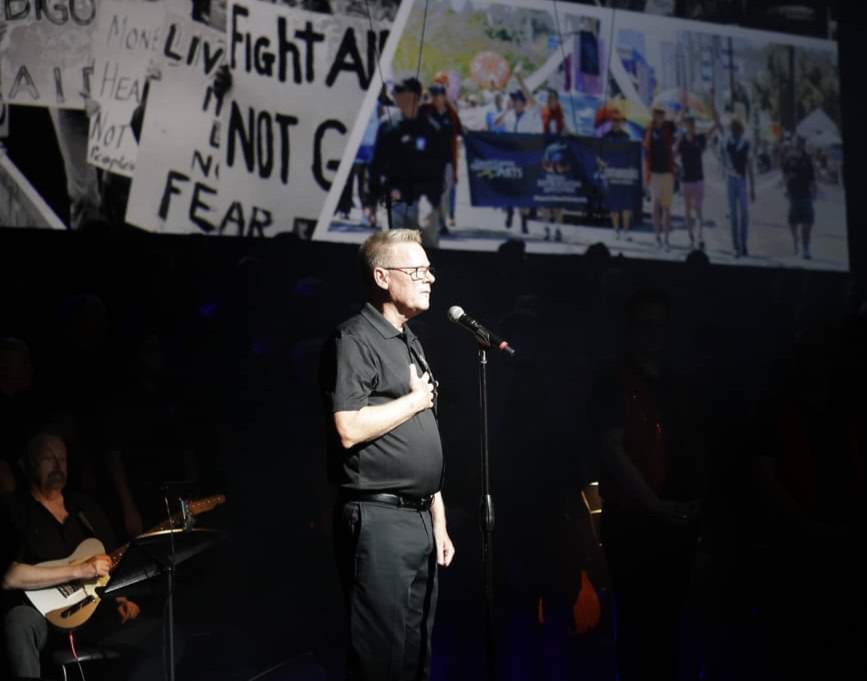
As a singer and one of several storytellers, I couldn’t be prouder of the program we created and performed for three exuberant audiences at Tempe Center for the Arts.
I will leave you with a snippet of dialogue … along with four images from the concert … that represents the joy, energy, rainbow colors, and love, which reverberated in the room away from the summer heat.
“When I sing with this chorus–these amazing people–and I absorb all the music and camaraderie, it feels like the sky is the limit. It feels like I could rule the world.” Mark Johnson, Storyteller #1, in Encore.
In January 2014, the fog of grief occupied my brain and body. My mother had been gone one year, but I hadn’t yet found a constructive way to heal and process my grief.
Along the way, my husband Tom and therapist Valerie encouraged me to embark on a new path that would help me recapture my creative spirit.
I decided to leave my communication consulting career. Soon after, I began to write personal stories that mattered to me. Vivid recollections inspired and spawned by grief. Observations about love and loss in my family that helped me chart a new course and publish my first book, From Fertile Ground.
With time and reflection, I wrote four more books about the tender and whimsical ups and downs of childhood, the poignancy of leaving one home and surviving to find another, the adventures of creating a new life in the Arizona desert, and the poetry that has stirred inside me for thirty years and finally escaped to land on a page.
In small and large ways, my mother is in every one of those books and numerous essays. Yet she didn’t live long enough to read any of it, except one poem I gave her on Christmas Eve 2009.
I know now that writing about her in new and different ways has kept her wisdom and generosity alive and accessible for me.
July 26, 2024, would have been Helen F. Johnson’s 101st birthday. I knew I wanted to write about that, but until my fingers hit the keyboard, I wasn’t sure what I would say … because I thought I’d said it all before.
Maybe I haven’t.
How I loved and admired–and still remember–her tenacity. Her legacy of letters. Her devotion to family, friends, and the power of nature.
She would have loved the artistic life Tom and I have created in Arizona among the buttes and cacti. Writing stories, screening movies, singing songs, feeding stray cats.
Making new friends, while remembering old ones. Doing our best to guide and encourage my sons–her beloved grandsons–as they make their way toward the middle of their lives.
Cherishing each moment of our retirement years, without ever knowing where it will lead. Never wanting to know how or when it will end.
On July 26, 2012, we celebrated my mother’s eighty-ninth birthday together. It was her last.
Twelve years have passed. I’m much older, more appreciative and impatient. But also, wiser. Healthier. Gayer. Grayer. More contented with my own life and legacy. More worried about the world’s plight.
Grief is no longer my catalyst, my nemesis, my companion. Of course, I see it in the rearview mirror. But, with the passage of time, I discovered higher ground without the ghost of grief.
I no longer think of my mother every day. But when I do, I am grateful for the moments she and I shared–the gifts of memories and photographs I treasure–and the propensity to write about it.
All of this runs through our DNA.
My mother and me, celebrating her eighty-ninth birthday in Wheaton, Illinois, on July 26, 2012.
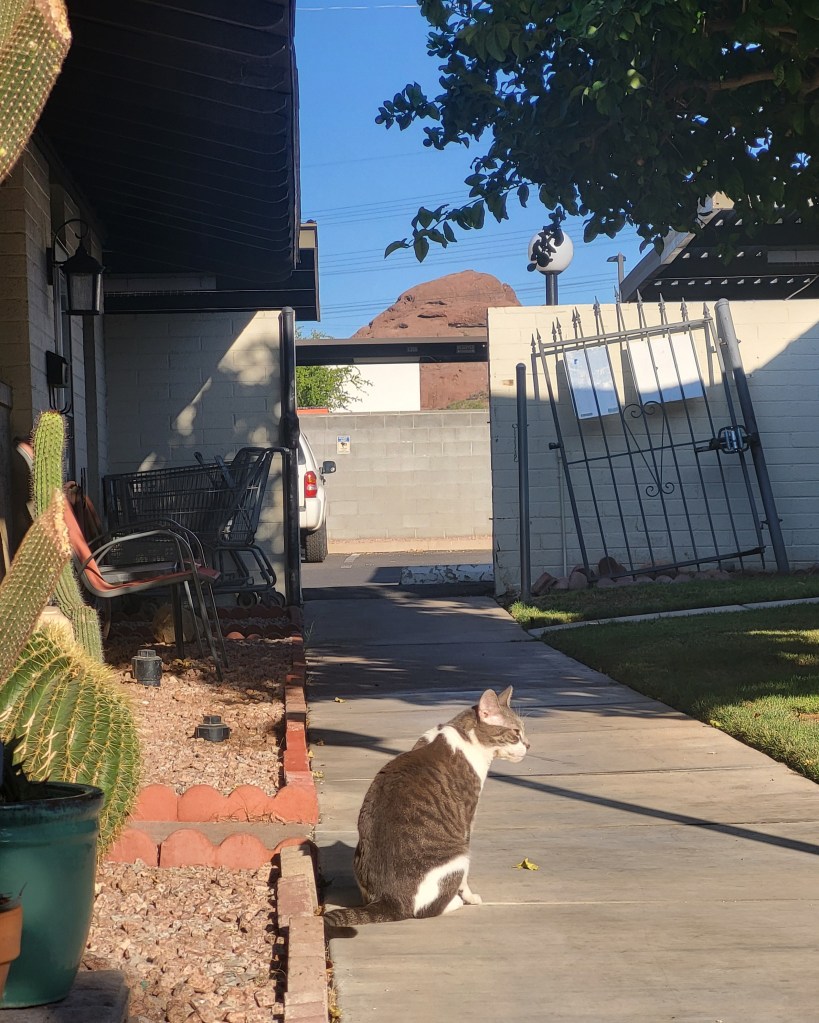
The smaller one opened the door for me this morning … sometimes it’s the taller one. That made me happy … they were happy, too … I needed to feel the cool tile on my parched paws.
I was hungry … I didn’t catch a bird or a rat yesterday. Today I twirled around the taller one’s legs … the smaller one’s legs, too. They gave me something fishy and yummy … a little crunchy, too.
The taller one watched me as I ate … said something about a gold-framed mirror (I think) from his mom (I think)? He was happy he and the smaller one kept it when they came here 7 years ago … I guess, like me, they came from some other place.
They were opening lots of bottles … taking lots of pills … washing them down with water … their voices were scratchy … I think the smaller one and the taller one like each other.
I heard the taller one say that he was happy with the success (I think) of his concerts (I think) … but that it sucks (I think) that both of them (the taller one and smaller one) have to fight off Covid (I think) … again.
Hmmm, what is Covid?
The smaller one said it was like having a vacation (I think) at home together … that doesn’t sound so bad.
The smaller one and the taller one are nice to me every morning … and they keep feeding me. So, I want them to always be here when I stretch out on their mat … or under their bench while I eye the birds.
I want them … the smaller one and the taller one … to never go away.
I will keep coming back as long as they … the smaller one and the taller one … are here to rub my back and feed me.
In the 1960s–when the San Francisco Giants appeared at Busch Memorial Stadium in St. Louis to play the Cardinals–the bleachers were a heavenly place for Dad and me to be.
Because, on many hot summer days and nights, in addition to watching our beloved Cardinals’ legends perform on the field (especially Bob Gibson and Lou Brock), we saw Willie Mays patrol centerfield.
Simply put, there was no one better–before or since–at chasing down line drives and long fly balls. Securing the ball in his mitt with his patented basket catch. Smiling at fans who gravitated to his magnetic personality.
Willie was the face of major league baseball in those days. His affable presence and disarming charm seemed to neutralize the racial prejudice that haunted many other black athletes when they traveled from town to town.
We ALL observed Willie’s greatness and humanity with awe and pride. He was a hero to black and white fans alike.
I won’t recite all of Willie’s remarkable batting statistics and records. I’ll leave that to the experts. Suffice it to say, his lifetime batting average of .301, 660 home runs, 3,293 hits, 1,909 runs batted in, and 339 stolen bases made his election to the Hall of Fame in 1979 a no-brainer.
Willie brought exuberance, fun, and a boatload of hitting and fielding talent to every game he played over more than two decades.
He was a legend off the field, too. For instance, he spent many hours playing stick ball with kids on the streets of New York before the Giants moved their franchise to San Francisco in the late 1950s.
I cried when I learned of Willie’s death on Tuesday at age 93.
Truly, there will never be another Willie Mays.
***
Beyond past ballfields (and my continued propensity to root for the St. Louis Cardinals as I approach my 67th birthday in the scorching summer heat of Arizona), my personal sense of awe and pride lives and breathes in a far different venue: on stage with the Phoenix Gay Men’s Chorus.
This weekend we will be performing our Encore show at the Tempe Center of the Arts. I’m proud of the libretto I’ve written for the show.
Five storytellers–I’m one of them–will connect the music with tales of reflection concerning who and what our chorus is. More than that, what it means to us in 2024.
For the audience and us performers, it will be a high-energy, emotional rollercoaster of favorite musical and choral moments, punctuated with dazzling choreography.
For added emphasis, this will be the final performance for our artistic director, Marc. He will pass the conducting baton to our new director, Antonio, who will usher in a new era of awe and pride for the Phoenix-area LGBTQ community and all our avid supporters and music lovers.





 Mark Johnson Stories