As Dad, Mom, Diane and I approached my grandparents’ rambling farm in Huntersville, North Carolina, in 1968 in our four-door Chevy Biscayne, waves of kudzu vine blanketed the trees.
At some point during our July vacation there, I remember my stoic maternal grandfather telling me this invasive plant, this weed, was blocking the sunlight.
Bit by bit, the kudzu was smothering the native plants and large trees in the southeastern United States.
In a metaphorical sense, I feel like one of those older trees–perhaps an oak or pine–that has grown through the seasons and spread its branches only to discover that the censorship and hate of our nation’s government (said kudzu vine) has insidiously wrapped itself around my trunk.
This is not a new development. I have been feeling this way for years. Trying to remain positive in the face of ICE raids, misogynistic slurs, shuttered healthcare programs, disregard for our most vulnerable citizens, the environment, and our right to a free press. The list of losses is endless.
Recently, my husband and I have lived firsthand through the threat of censorship in our community. It is causing us both great pain. It is also prompting me to realize how far we have fallen as a nation and what I am willing to tolerate or accept.
At some point, I will have more to say about this. I don’t know when or how. Suffice it to say, this kudzu vine–the 2026 version of the McCarthy era in the United States–is out of control.
I do believe that, ultimately, historians will shine light on whatever it is we are living through. I hope I live long enough to see the return of truth and reason and the eradication of these smothering vines.
Over the weekend, I learned that one of Nick’s (my older son’s) high school buddies from the late 1990s/early 2000s, died recently of an apparent suicide. He was forty-two years old.
The timing of this devastating event for his family and friends has dredged up another dose of September sadness for me.
***
In September 2023, Tom and I received a letter in the mail from a close friend, who–less than a year before–had moved from the Phoenix area to another part of the country. I’ll call this friend Brett.
Brett’s snail-mail message was an eerie, lengthy, desperate, and personal admission–typed and folded meticulously. In it, Brett recounted a series of voluntary testosterone injections that messed with his body and mind.
He told us: ” … I had consulted with several friends in the medical field, all of whom told me there were no side effects to these testosterone injections and it would raise my numbers. Unfortunately, this did not turn out to be true … and it destroyed me forever.”
I know how much Brett cared for Tom and me, and we certainly listened and cared for him. “Our talks on our hikes always inspired me,” he went on to say. He told us he wished he had made better decisions in his new hometown.
When Tom and I finished reading the letter, we both felt dumbfounded. So much so that Tom ran a search on Brett’s full name. Brett’s obituary popped up.
Through a few subsequent texts and phone calls, we discovered Brett had committed suicide.
Evidently, Brett had left a short stack of letters to close friends in his home. Soon after he died, a member of his family mailed them.
In late September 2023, we heard from one of his brothers. He told us Brett had spoken highly of us. We told him how much we cared about Brett, and how frequently he mentioned his love for his family.
We sent him pictures of Brett, Tom and me banging on drums at the Musical Instrument Museum in Scottsdale. It was a fun day in May 2021, though you couldn’t see our smiles. We were wearing masks. It was the height of Covid.
We will never know the full detail of what happened to Brett or why he felt he had no recourse but to take his life. But, with time, Tom and I became acquainted with Brett’s mother and sister, too.
I am certain that talking with us about Brett provided much-needed comfort, but I can’t presume to know the devastation of what they feel when Brett’s birthday appears on the calendar every January … or when this day–September 8–reignites the fire of grief.
It is an endless nightmare.
***
Depression doesn’t only emanate from one man’s worries over his testosterone levels.
The division in our country in 2026 boggles the mind. So many people live in fear and isolation as our nation’s government–and many of the institutions we once trusted–breeds disarray, pain, anxiety, and uncertainty.
If you know someone who is struggling mightily, I encourage you to reach out to them and lend a listening ear.
Or, if that person in pain is you, please know that you matter. Help is available around the clock.
Call or text 988 to be connected to the National Suicide Prevention Lifeline. Do it for yourself. Do it for Brett.
Whether you are facing mental health struggles, emotional distress, alcohol or drug related concerns, or just need to talk with someone, a caring counselor will provide confidential emotional support.
Remember, you are not alone.
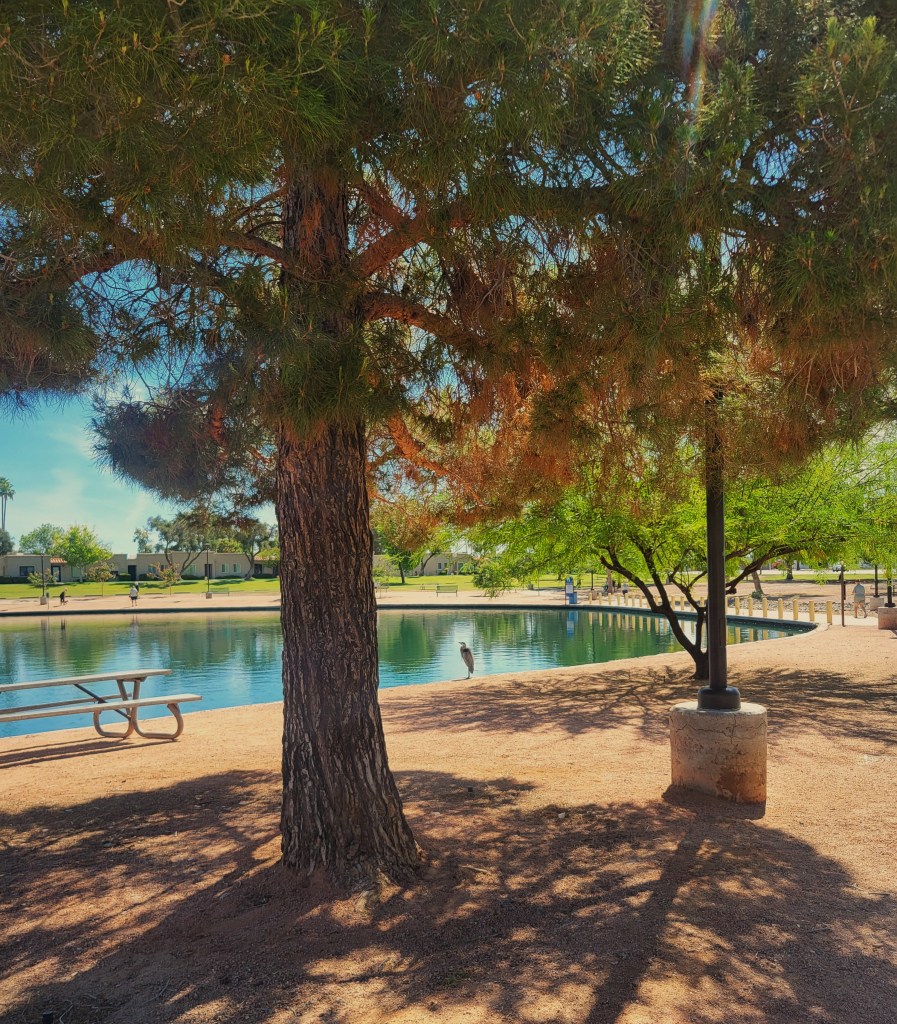
A lone blue heron stands at the water’s edge at Chaparral Lake in Scottsdale, Arizona.
I live in the Sonoran Desert and the Sonoran Desert lives in me. That’s been the case for nine years. My most prolific ones as a writer.
The language of the desert–like grains of sand that blow in through the door–is now part of my creative being.
Shimmering sunsets. Slithering lizards. Skittish quail. Stray cats. Spiky cacti and succulents. Scattering snowbirds. And those are just a sample from the letter “s”.
When I served as a “Writer in Residence” at the Scottsdale Public Library last spring, I prompted the writers in my workshop to explore the role setting plays in the stories of their lives.
I asked them to consider a place in their lives that is or was prominent and how that place might be considered a character in what they have to say. In the stories they want to show and tell.
The places I have lived or frequented have certainly provided texture to my existence and informed my perspective. The orange earth of the Carolinas. The rolling hills of Missouri. The flatlands of Illinois. The rugged buttes of the Arizona desert.
They represent distinct periods in my life, and–in hindsight–I now understand better why they each deserve their proximity across my body of literary work, six books … a lifetime of stories.
The heat here in July is intense. But it is bearable because the Sonoran Desert–even in its most torrid state–is otherworldly.
At times it feels as if I am living on the moon. The astonishing natural beauty and stately saguaros–sentinels that stand tall in valleys and on hillsides here–have led me to a creative destination outside the orbit of my midwestern sensibilities.
One where I “write on” … as I just celebrated my sixty-ninth birthday and begin this final lap in my sixties. Learning and growing. Teaching and influencing.
Standing tall as a gay man, a husband, a father, a writer. Proud as a saguaro despite my visits to the cardiologist and dermatologist to manage my personal frailties. Rooted to this vivid place, the Valley of the Sun, that is my home.
***
Note to those of you who live in the Phoenix metropolitan area: On Thursday, July 16, from 5 to 7 p.m., I will be signing and selling copies of my latest book, Sixty-Something Days, at Grounds on 2nd in Old Town Scottsdale, located at 3703 N. 69th St.
This charming neighborhood place (coffee and wine bar) is one of my favorite spots in our Scottsdale, Arizona, community. It truly is an inclusive, creative space my husband Tom and I frequent to write, read, and chill with friends. In fact, I wrote and edited a considerable portion of my latest book there.
If you are in the area, stop by to sell hello, grab a book and a glass of wine. I also will have a few copies of my other five books–memoirs, poetry, and short fiction–on hand in case you are looking for options to add to your summer reading list.
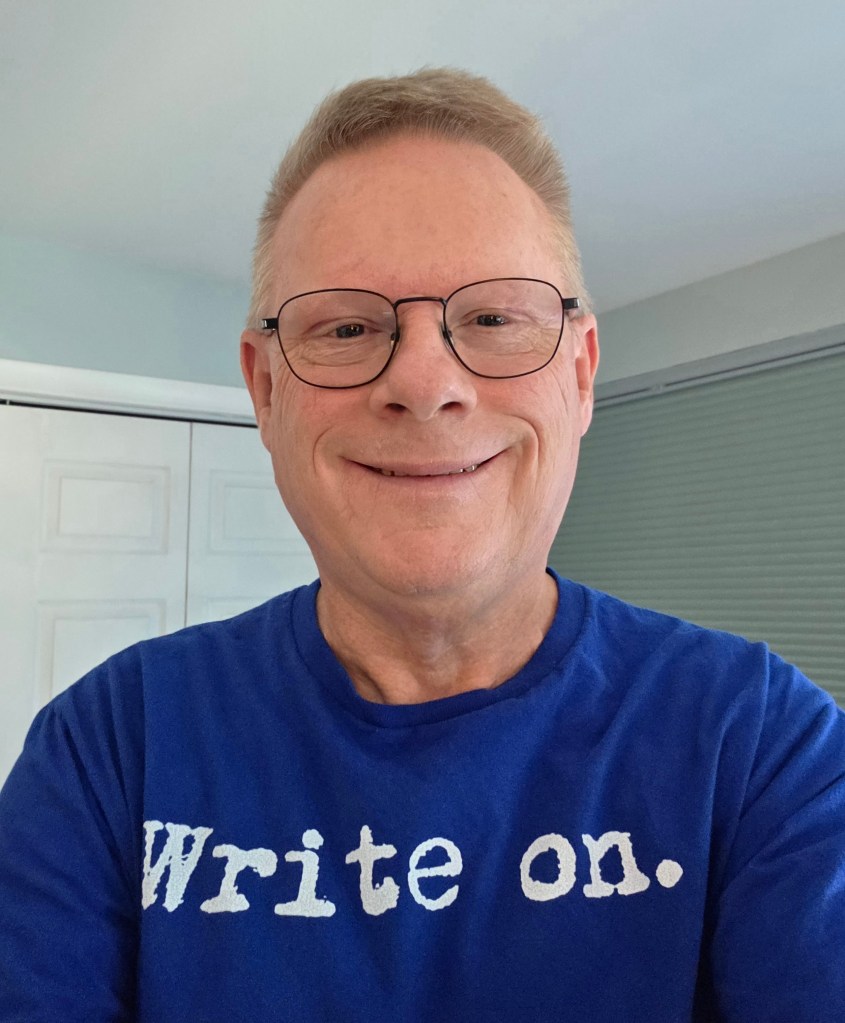
In April 2026, friends at the Scottsdale Public Library gave me this shirt after I completed my “Writer in Residence” stint there.
“But when the thermometer goes way upand the weather is sizzlin’ hot,mister man with a plan is not. ‘Cause it’s too, too, too darn hot.”
***
As the heat rolls into the Valley of the Sun this week–100-plus high temperatures through Saturday–this snappy tune, which Cole Porter wrote in 1948 for his Broadway show Kiss Me Kate, repeats through my brain.
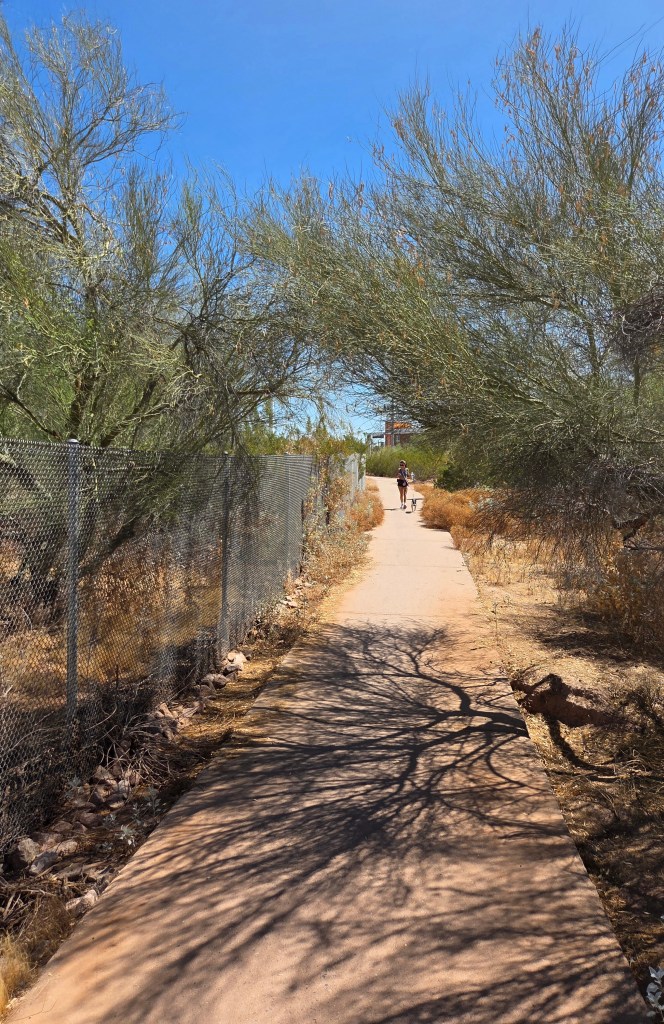
It’s certainly “Too Darn Hot” to hike outside in June here, unless you do it early in the day. That’s what I–and a young woman walking her Boston terrier–did Monday around 9 a.m. Nobody else was on the Papago Park trail near my home.
This morning I opted for swimming thirty lengths in the relative cool of Chapparal Pool. How I’ve missed submerging myself underwater (thanks to a couple of dermatological procedures that kept me at bay).
In the afternoons, you’re better off holding up in the Scottsdale Public Library to escape the heat. That’s where Tom and I have sequestered ourselves today, along with a few dozen others, strategically stationed at square wooden tables, hovering over their books and laptops.
Other than the heat references, why would I be channeling an old Broadway tune? Because my next choral concert with the Phoenix Gay Men’s Chorus–“Broadway Lights”– is fast approaching: June 27 (2 p.m. and 7 p.m.) and June 28 (2 p.m.) at Tempe Center for the Arts.
As described in our promotional materials, “It will be a spectacular celebration of some of Broadway’s most beloved musicals. From the soaring melodies of Wicked and The Sound of Music, to the show-stopping energy of Hamilton, Moulin Rouge!, Hairspray, Into the Woods, The Book of Mormon, The Wiz, and The Greatest Showman, this season finale is packed with music that has captivated audiences around the world.”
Coincidentally, “Too Darn Hot”–timed beautifully with the inevitable onset of our desert heat–is the closing number for Act One.
If you live in the Phoenix metropolitan area, step into one of the coolest concert venues around: the Tempe Center for the Arts. Get your tickets at http://www.phxgmc.org.
You may be wondering “Since it is Pride month, is there a LGBTQ Pride element to this concert?” The answer is a resounding “YES!”
My chorus mate August and I have teamed up to write the libretto for the concert. It features nine storytellers, who will describe how Broadway music has served as a beacon for the LGBTQ+ community in happy and sad times.
Together–the music, the stories, and a slate of hot dance numbers–will combine to create a full theatrical production, which our loyal audience has come to expect.
This will mark the completion of my ninth season (singing and writing for) with the Phoenix Gay Men’s Chorus.
I still recall auditioning for the chorus in August 2017. Tom and I had just moved to Arizona from the Chicago area.
I was depressed and anxious, desperately trying to regain my health, to uncover an unobstructed view after surviving a heart attack on the way west in July 2017 on our sixtieth birthday.
Finding the chorus, nurturing new friendships, and reigniting my passion for singing has been a key element in my recovery. It helped me lighten my mood and smile again.
When I step onto the stage again on June 27, I know I will feel grateful for the music and the nine years of creative discovery. But also, for this safe haven. This supportive community of people.
They have helped me to realize I still have a lot to give. I still have a lot to say. I still have the ability to stand on a stage and raise my voice, especially now as we cling to the hope that–maybe someday–our democracy can be salvaged.
May is a transitional month in the Valley of the Sun.
Snowbirds have flown away to their full-time nests east and north. Tom and I are left to our creative devices.
Despite the higher temperatures coming soon–100-plus next week–I prefer these quieter, hotter days.
There is more room in our favorite coffee shop where we write and socialize. Less maneuvering through traffic merging on and off highway ramps framed by jagged mountains that remind me I am a westerner now … for nearly nine years.
This morning at the Scottsdale Community College gym Tom and I now frequent (free with our Silver Sneakers membership), Rosalind greeted me with a broad smile.
She read and loved Sixty-Something Days, my latest book and told me she is recommending it to all of her sixty-something friends.
Active-retiree Rosalind laughed when she said, “I’m your target audience.” She offered that it reminded her how important it is for all of us to be grateful for the goodness and love in our lives.
In that moment, she shared a photo of her two, beautiful, three-year-old granddaughters who are the children of her twin adult sons.
As we parted to continue our respective exercise regimens, she volunteered that she will be leaving for Flagstaff for the summer–her own transition to the beauty and cooler temps of northern Arizona–but back in the fall to resume her desert life.
Now that May has arrived, I’m shifting creative gears.
I’ve been working with another chorus member–August–to write and finalize the libretto for Broadway Lights, the next Phoenix Gay Men’s Chorus (PHXGMC) concert June 27 and 28 at Tempe Center for the Arts.
It features eight storytelling vignettes that wrap in and around our PHXGMC set of inspiring, fun/funny, and fabulous Broadway tunes.
This evening, August, Darlene (PHXGMC’s assistant artistic director), and I will watch and listen to a stream of chorus members who are auditioning for the nine speaking roles that tell stories (fictionalized ones rooted in reality) of how Broadway music has served as a beacon for our LGBTQ+ community in happy and sad times.
I am proud of my involvement with the chorus as both a second-tenor performer and librettist. At this stage of life, time moves quickly. It’s difficult for me to believe that I have been singing with the chorus for nine years, since Tom and I moved to Arizona in 2017.
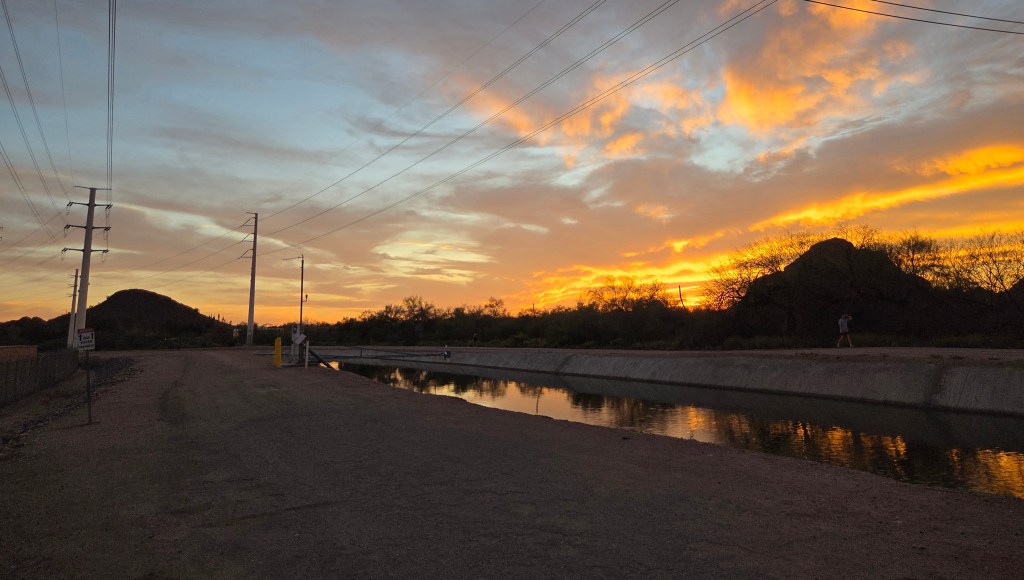
As my sixty-ninth birthday fast approaches in early July, this community of friends–truly a safe haven in our chaotic country–provides an ongoing-and-meaningful oasis during these Sixty-Something Days … ones I am grateful for even on the hottest days that surely loom beyond this stretch of ground Tom and I walk along the Crosscut Canal and Papago Buttes.
Back and forth from one end of the pool to the other on this hotter-than-average, magnificent March morning. March 24, 2026, from 9:00 to 9:30 a.m. to be precise. Thirty lengths in the deep end of Eldorado Pool in Scottsdale, Arizona.
Somehow, I wrangled my own lane today. I don’t mind sharing but always feel freer on unobstructed Tuesdays and Thursdays. There are fewer swim-class participants to contend with on those days and–now that the Cactus League baseball games have ended–some of the snowbirds have begun to flock home.
Breathing every eight or ten strokes, looking over my right shoulder, swimming south to north, I spy the blazing sun that threatens my sensitive skin and the wispy-white contrail of a commercial plane flying high above.
Serendipitously, the repetitive swimming motion reminds me what I want to write about today. It is the tenth anniversary of publishing my first book: From Fertile Ground.
On March 24, 2016, Barack Obama was president. I didn’t imagine the waves of what was to come: the growing political insanity, the dismantling of once-reliable American institutions, the general implosion of our democracy in one decade. Who could?
Back then, Tom and I were snowbirds–splitting time between our homes in Mount Prospect, Illinois, and Scottsdale, Arizona.
I wrote most of my inaugural book–a three-generation writer’s mosaic about love and loss in my family–from the suburban flatness of northern Illinois.
But working online–back and forth like a swimmer logging laps between my editor and book designer in Nashville, Tennessee, and me in Scottsdale–I made my final edits in the rugged western landscape of the Grand Canyon State.
I remember the pride of holding the first physical copy of my first book later that week. I know I cried. It was a release of joy and amazement. Most definitely, a seminal moment I shared with my husband.
Sadness crept in, too, because I had written the book to process my grief after my mother’s passing. In a physical sense, I wasn’t able to celebrate that literary moment with her.
But I also know that writing about her and her wisdom-filled letters, my father and his unrealized poetry, my grandfather and fifty-three years of diary entries, and the general sense of freedom I felt visiting my grandparents in the 1960s at their rambling North Carolina farm allowed me to create a healing path out of my grief.
It was–and still is–a story I was meant to write and publish. One I wanted to share with others navigating the devastation of grief.
In the past ten years since From Fertile Ground was born, writing has become that free, unbridled swimming lane that is purely mine. Welcome waves of water and creativity running from my mid-fifties to my late sixties.
Of course, I take pride in that body of work and–more recently–find it tremendously gratifying to share what I have learned with other writers, who need an experienced coach … and a few practical ideas … to tell their own stories.
Today, I also pause and wonder–with a touch of sadness as I write this–how many more stories lie ahead for me. Though I still feel strong, capable, creative, and alive in these golden years swimming back and forth under the Arizona sun, I also feel more vulnerable.
Part of it is the process of aging. The other is the narrowing swim lanes of American society that constrain freedom and the expression of ideas.
Having said that, I choose to end this story on a positive note. Today, I choose to relish the goodness of my life with Tom in this rugged landscape. To give thanks for all the stories that have come from fertile ground over the past ten years … as well as those I have salvaged from the depths of the pool looking over my shoulder to beloved people and places that now live on the page.
This is not a story about some knock-off DNA test that will help you discover your ancestral roots.
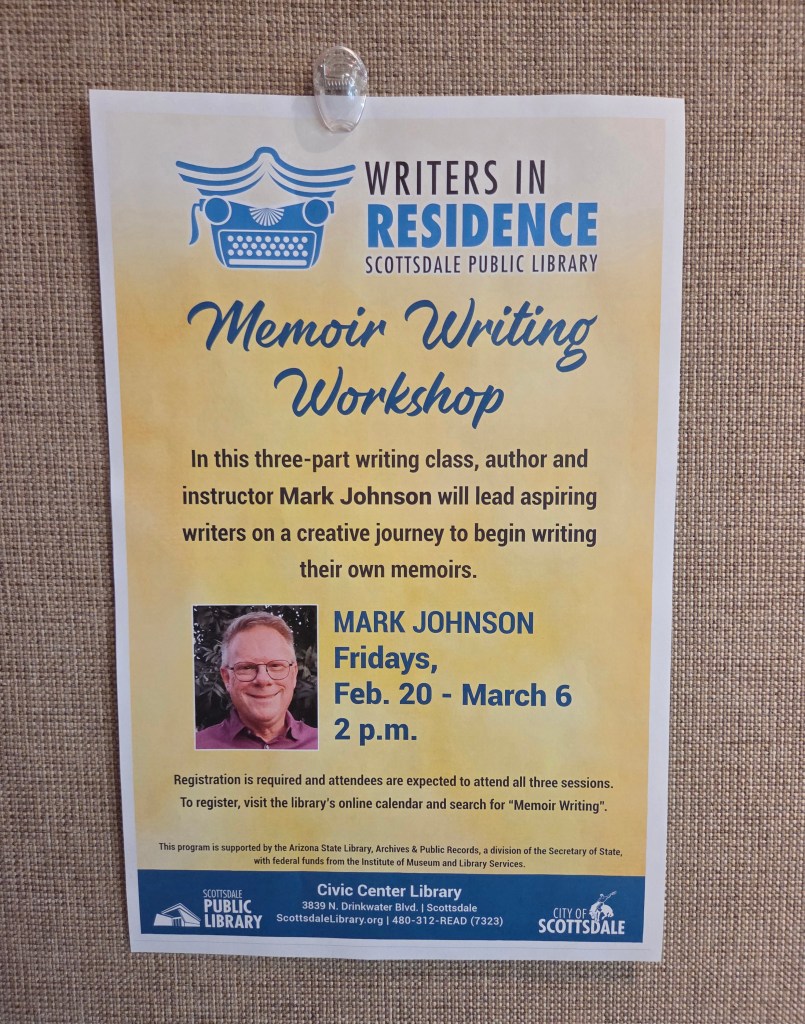
Instead, it is a story with no definite answers. A story that will unfold with memories, ideas, thoughts, feelings, words, and sentences. All to be generated by fourteen writers–eleven women and three men–who have joined me (Writer in Residence in February and March) on a three-week memoir-writing odyssey at the Scottsdale Public Library.
Our journey together began February 20 in the SHC program room, in a wing of the Civic Center Libary devoted to Scottsdale history. Who knows, maybe some literary history is about to be made there.
We spent our first thirty minutes learning about each other. The youngest of our cohort is in her early twenties. The oldest beyond ninety. They and the other twelve (mostly in their fifties and sixties) told me in a few sentences why they were drawn to the workshop.
Some have been writing for years. They are fine-tuning their craft. Others are new and perhaps a little intimidated about the idea of sharing their writing with a group of strangers. But with time they will learn the benefit of bringing voice to the words they will assemble on a page.
From my previous workshops, I have learned that leading a memoir-writing session is deeply personal. So, in our first meeting, I worked to create a trusting, respectful space and asked that they also commit to that. It is essential, because when people tell their stories it is often raw and revealing.
After we settled in, we began writing. I gave the group this prompt: “My most vivid or meaningful February memory is …….”
After fifteen quiet minutes of pens scribbling across paper, eight of the fourteen offered to share what they wrote. I will honor our verbal confidentiality agreement and not share the content here but suffice it to say that an array of diverse stories came from that one prompt.
At the end of that exercise, I told them we had just illustrated that–like each of them–their memories, stories, voices are unique. What they have experienced in their lives is worthy of writing and sharing.
In fact, we–as writers–have a responsibility to do so. Especially now in a country brimming with external pressures designed to constrain a myriad of human thoughts, feelings, and ideas.
The group has an assignment this week: to write one-to-two manuscript pages that paint a picture of a setting–a place replete with vivid memories for them personally.
To help prime the creative pump, I read this passage to them from my third book, An Unobstructed View.
***
In June 1980, I left my parents’ home in the rolling suburbs of St. Louis, Missouri, to launch my career and create my own life in the relative flatness of northern Illinois. Jimmy Carter’s stay in the White House was winding down, but my hopes were high and trending up, and so would the volume of my days and nights in the Chicago area.
Unlike the state’s long and slender physical shape, I didn’t know my Illinois roots would ever extend far and wide. I couldn’t imagine I would live and work in the Chicago area for the next thirty-seven years–that I would occupy Illinois, and it would inhabit me for the most significant portion of my life.
Yet I would marry; divorce; raise two sons; change jobs multiple times; build a lucrative career; bury both of my parents; find my way out of the closet; live openly as a gay man; discover love again; marry a second time; retire from corporate life; begin a second career as an author; and say goodbye to my Cook County neighbors, family, and friends just a few days shy of my sixtieth birthday for a new adventure and warmer climes in the desert southwest.
All of it happened while I was living in the Land of Lincoln.
***
The room was quiet as I read. Compassion danced across their faces.
I can’t wait to listen to these fourteen writers tell their stories and help shape their literary journeys.