Tag: Arizona

Return to Eldorado

Though the title might lead you to believe otherwise, this is not one of those dusty western stories. You know, where the good guy returns to the scene of the crime for revenge against the villain and they duel it out in front of a saloon?

Instead, this is a much simpler, quieter tale about one man–me–beginning to take his shrunken life back a day after the United States surpassed half a million COVID-19-related deaths. (Incidentally, if you are like me, you are wondering if the decline in new cases and hospitalizations are harbingers of the waning days of a global pandemic or a mere lull, a mirage in the desert that has seduced us to believe some of us may actually escape after all.)

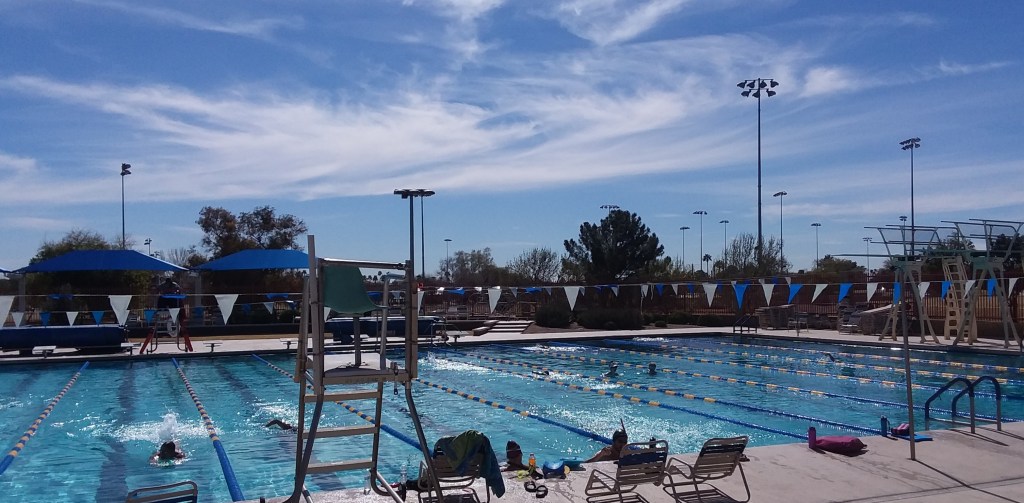
It had been nearly a year since I swam laps at Eldorado Pool in south Scottsdale. It exists about a mile from our condo. Before March 2020, it was a place I frequented three or four times a week. Of course, COVID-19 was the villain or at least the culprit that has kept me from going there for nearly twelve months.

Today, on Tuesday, February 23, 2021 I returned to this place that soothes and energizes my body and spirit. I wrote a new chapter gliding in the water. That consisted of thirty minutes in lane eleven of our thirteen-lane, Olympic-size, community pool.

I was one of about a dozen swimmers in the pool at ten o’clock this morning. We were a lucky twelve, cupping our hands to push through cool water under sixty-five-degree blue skies, far from the snow and bluster that has consumed most of the United States recently.

There were a few familiar faces, like Frank’s. He smiled, asked how my winter has been, and if I’d been working on a new book. His question reminded me how long it had been since we had talked, how much we hadn’t discussed, how little he knew of I Think I’ll Prune the Lemon Tree, and how much I had missed the connected pieces of my life … like swimming in a community pool, trading stories face-to-face with friends, realizing that the few added pounds around my middle can be shed easily by recapturing this strand of my life a few times a week. One lap at a time.

My swimming is over for the day. Now, outside the pool, I hold my breath–like most of the rest of the world–and wait. I am one of those under sixty-fivers (just barely) ready to be vaccinated, ready to schedule it as soon as I can, ready to recapture more strands of my life, ready to return to a world that once felt familiar.

After Our Stories Set Sail

I feel the pain and glory of every writer. We build the frames of our books, chapter by chapter. The process takes years. It is the culmination of time, art, and commitment.

We begin in the darkness in front of an empty page or a blank screen. We write a sentence or two that makes sense. We add and subtract in words. We rinse and repeat. We submerge ourselves to find the deepest meaning in the mundane and the spectacular.

One day, after months of determination and doubt, our rough draft is done. But we pause only briefly. We don’t want to lose our momentum. We dive back in for round after round of edits, because we want our stories to adhere to each other and to every reader who spends time with them.

Finally, the rewriting and polishing reveal the stories we intended. We invite a few trusted professionals, an editor and graphic designer, to join us in the literary chase. They stand by us on shore as we rewrite and polish passages, as we search for and discover the perfect cover, as we tweak phrases one final time, as we launch our true and false stories into the world.

As I watch my latest book, I Think I’ll Prune the Lemon Tree, begin to bob on the waves of the reading world in the middle of a global pandemic, I wonder. What will happen next? Who will read my book? What will it mean to them? What will readers have to say about it?

These are just a few of the questions we independent writers ask after our stories set sail. We are brimming with ideas, but also uncertainties. We have little control over where our stories land. All we can do is breathe life into them, guide them from afar, send a little money their way, push trade winds in their direction, and wait to hear about our creations once they have landed.

Only then is a writer’s journey complete.

Sad Saturday

I don’t normally dive headlong into political and social issues, but I feel a sense of doom and anger percolating inside me tonight after the acquittal of our previous president. I won’t mention his name here. I wish I had the power to encourage every media outlet to do the same, because what he wants more than anything is attention.

Today forty-three pathetic, posturing Republican senators disavowed a mountain of evidence presented by the impeachment managers, who connected the dots. They directly linked his unconscionable actions to an insurrection that caused death and destruction at the U.S. Capitol on January 6. But our unnamed ex-president has slithered away unpunished once again.

I know the past twelve months have been difficult all around the world. Families have lost loved ones: mothers, fathers, sisters, brothers, spouses, grandparents, aunts, uncles, and children. But what we have endured in the United States has been monumentally horrible.

Nearly 500,000 Americans have died from complications of COVID-19. As the numbers continue to mount, we’ve witnessed countless stories of unfortunate souls–many of them minorities–who have lost their lives and their livelihoods. We’ve watched as the evil of racism and hatefulness has surfaced and been fueled by rhetoric from the White House. It was once a hallowed place.

We’ve dodged crazy conversations with neighbors and ex-friends, who believe any number of preposterous conspiracy theories, especially the big lie of a rigged election, when all the facts and evidence tell us otherwise. We’ve shuttered our lives to survive, shrunken our existences to cope, masked our faces to protect ourselves and our neighbors, covered our eyes in horror at news reports, and swallowed hard to salvage any shred of our remaining dignity and sanity.

Now we are required to suck it up once again, and watch the shameful evidence of senior governmental officials who are more concerned with securing their political futures than what they were elected to do on behalf of the American people … to preserve, protect, and defend the Constitution of the United States.

I don’t know if there is a silver lining in any of this. But, at least eighty-one million of us had the gumption to choose a forty-sixth president, who has a heart and good intentions. Joe Biden has already proven he will roll up his sleeves and fight on behalf of all of the American people, even those who didn’t vote for him. He and Kamala Harris are doing what they can to right this sinking ship and ramp up the distribution of vaccines across the country.

But here’s the biggest question of all. Even if we survive this global pandemic physically, what will be left of our democracy if we allow our past president to walk away without ever paying a price for the deep pain and intentional harm he has brought to our nation?

Book Chat

Now that I have published I Think I’ll Prune the Lemon Tree, I feel like an empty-nester. All of the nurturing and sculpting is over. My purpose and attention has shifted from writer to salesman.

There is nothing too surprising about that. The frustrating part is that we are living in the middle of a global pandemic. There are limited opportunities–none, really–for the face-to-face interactions I crave with readers. I don’t have a chance to talk about my books with people. Because I am mostly an extrovert–though much less so as I’ve gotten older–I miss that terribly. The only legitimate opportunities for authors to promote and sell their books are online.

Even so, on Wednesday afternoon, I manufactured a little of my own author interaction. I drove to the Scottsdale Public Library. I donated a copy of my latest book for its Local Author bookshelf. This is something I’ve done three times before.

Previously, this act was followed by a physical Local Author Book Sale, where readers and authors meet. (To replace the in-person fair, there is an online local authors talk series conducted through our library. I missed the deadline for submitting a video to participate. I was focused on finishing and publishing my fourth book.)

While at the library I spoke with Wen-Ling, a pleasant woman who coordinates some of the local author activities for the library. From one side of a glass partition I described my latest book to Wen-Ling and my passion for writing memoirs. She told me the staff hopes to reinstitute the Local Author Book Sale in 2022.

After our interaction, I found my energy. I raced back to the parking lot to my car to find a bookmark for Wen-Ling and postcard with information about my books. I returned to the library information desk, placed my printed materials on the counter, and waved to her. Wen-Ling was helping another patron, but from behind her mask she thanked me for donating my book. I smiled back and said goodbye.

It was a simple exchange, and the kind of thing I used to take for granted in our pre-COVID-19 world. But all of that has changed now. As Tom and I–and most of us in the world–wait to be vaccinated, I will continue to look for small ways to stay engaged. Whether I’m there for a mini book chat or just trying to stay healthy on the treadmill of life, I will always need to find ways to connect with those around me.

From Crab Apples to Lemon Trees

In June 1962, a month before my fifth birthday, I stood alone outside the west wall of my brick childhood home. I wore my high-top Keds and cargo shorts with crazy pockets. The wind raced past my crew cut.

Our three-bedroom ranch in south suburban St. Louis appeared identical to two dozen others in the neighborhood, except ours featured a flowering pink crab apple tree with stair-step limbs I loved to climb.

In the shade of the branches, a clear thought jumped to the forefront of my brain. “I am different. I have important things to say.” The idea lingered and swirled through my consciousness.

As I look back at that vivid memory—one of my earliest—I must have recognized I was unlike most of the other boys. At that young age, I must have known I was gay. I must have begun to identify a need to share my thoughts and tell my stories one day.

Since that moment, I have lived at least four lives—shaped by local geography—and written four books. I have played in the red earth of North Carolina, navigated the rolling hills of Missouri, survived the flatlands of Illinois, and discovered the peaks and valleys of Arizona.

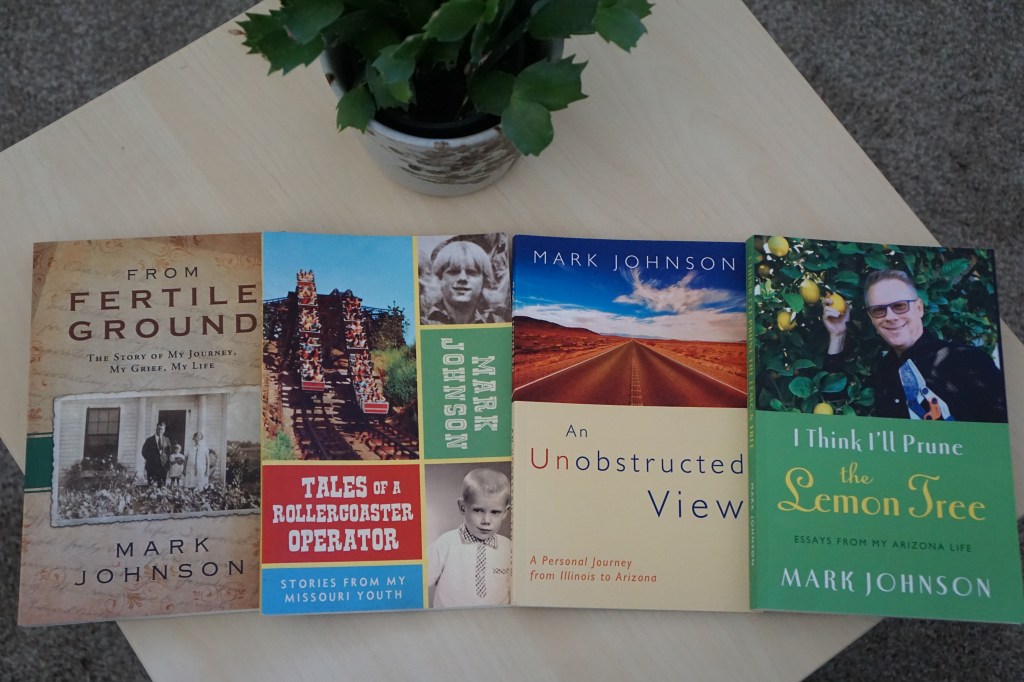
I never imagined I would live and write in my sixties in the rugged landscape of the Sonoran Desert, but the trail of life has led me here to the threshold of publishing my fourth book, I Think I’ll Prune the Lemon Tree. It will appear on Amazon (in paperback and Kindle versions) in late January or early February. Of course, once it is available for purchase, I will let you know.

In the first three years of my Arizona residency—2017 through 2020—the Grand Canyon State has enriched and shaped my life with natural beauty, profound uncertainty, and joyful humor. My goal was to reflect all three in this book, and develop a larger narrative about a gay man and his husband fulfilling their dreams, reflecting on their experiences, hoping to survive a global pandemic, and aging in a bold landscape.

If you are drawn to the themes I explore here on my blog and in my books—nature, family, community, heritage, human rights, humor, love, loss, health, truth, diversity, and creativity—I think you will enjoy reading my latest book.

Of course, nearly six decades have passed since I stood by that flowering pink crab apple tree I loved as a child. It has been replaced by the citrus trees that surround Tom and me in our sixties in our Scottsdale condo community. But the value of memory and storytelling is that I can remember the most important trees, past and present. I can choose to honor each of them.

Little did I know that one day a luscious lemon tree, thirty feet outside my front door, would inspire me to write and share the broader stories of my Arizona life.

The Christmas Star

Jupiter and Saturn owned the winter solstice sky tonight over Phoenix. About 6:30 p.m., Tom and I were fortunate to capture the duo shining side-by-side, forming the Christmas Star between two saguaros in Papago Park.

As we prepare to say goodbye to the pain and heartache of 2020, there is no better way for me to wish you and your family a healthy and happy Christmas and a new year of hope, peace and bright possibilities.

The Cottonwood Trees

Four-thirty on the last Sunday afternoon of November. Sliced turkey breast, roasted root vegetables and ramekins of mashed sweet potatoes and cranberry sauce await in the fridge. Remnants of a holiday weekend.

Neither Tom or I feel like cooking dinner. We exercise and write instead. We will rely on the convenience of leftovers as sun-crafted silhouettes dance across the windowsill of our sunroom.

I just completed an hour-long walk along the Crosscut Canal that winds through Phoenix. I’m one of the lucky ones. Healthy (so far, at least). Thankful for the love and companionship of my husband. Close to a wide open outdoor space.

Today I walked the Crosscut Canal alone. It was just a few bicyclists, joggers, hikers, fishermen, and me. Scattered along the Papago Park trails. Some folks wore masks. Some didn’t. There was plenty of distance between us.

On the way back to our condo I paused to admire a group of cottonwood trees on the other side of the fence. They swayed near a shallow pond inside the Desert Botanical Garden. Brittle from the drought. But still they survive.

The cottonwoods have become a benchmark for Tom and me. Majestic, tall reminders of life on the edge. “Let’s walk to the cottonwood trees and back.”

Today as I strolled past them, their shiny yellow and green leaves flickered in the fading Sonoran sunshine. I shaded my eyes and gazed up looking for reassurance beyond the breadth of their branches. It was the same comfort the cottonwood trees provided in March, May, July, September and October.

I left the canal path with the certainty that the cottonwood trees will be there in December and beyond. Because that’s what nature does. It endures past holidays and pandemics. It reminds us to do the same.

A Gift to Ease Your Grief

As COVID-19 cases climb and shadows of worry and anxiety cast doubts, we stew in our numbness. We attempt to process the depth of our grief. It has no bounds.

Here in the United States, we prepare for a thankless Thanksgiving Day 2020 minus more than a quarter of a million Americans–gone, but not forgotten–who sat at tables beside us a year ago. Our hearts ache for them and their families.

Seven years ago grief consumed me as the first Thanksgiving after my mother’s death approached. Tom and I decided we needed a holiday getaway from our then suburban Chicago home. We needed to shake things up. To begin a new tradition in a place that wouldn’t spark the rawness of Midwestern memories.

Both of my sons loved the idea. They decided to join us for an extended Thanksgiving weekend in the Arizona desert. It felt as if the odds were against us when Tom developed pneumonia after raking leaves on a frosty early-November Illinois morning. But, remarkably, he rebounded quickly. We kept our plans to fly west.

On Thanksgiving Day, Kirk, Nick, his friend Stephanie, Tom and I dined outside at the Tempe Mission Palms Hotel. We enjoyed turkey and stuffing, seated around a courtyard patio table shaded by an orange tree.

Three months after that November 2013 trip, I retired from corporate life and began to feel a calling to write about my grief. I soon discovered that by honoring and answering my creative impulses, I could ride through the waves of tears and numbness and emerge whole on the other side.

As strange as it sounds, grief became the fertile ground for my writing journey. In 2016, I published my first book, From Fertile Ground. It tells the story of three writers–my grandfather, mother and me–and our desires to leave behind a legacy of our own distinctive observations of our family, our loves, our losses, our worlds.

In honor of Thanksgiving and those we’ve loved and lost, you can download a free Kindle copy of my book on Amazon from November 21 through November 25.

I hope reading it will inspire you (or a friend who is grieving) to find your fertile ground. To discover your voice. To channel your creativity. To emerge from the numbness. To tell your unvarnished story. Perhaps even to leave behind a brief review of my book online.

Escaping the Labyrinth

It’s my sister’s birthday. Soon she will open the card and presents we sent her. I will call her later today to wish her well. To tell her I love her.

Like every relationship, ours has had its ebbs and flows. But Diane and I are the only ones left from our family of origin. The only ones who remember the best sounds of our St. Louis childhood–Dad slurping his breakfast beverages through the overflowing Coffee Hound cup we gave him or Mom sifting red and green sprinkles on sugar cookies shaped liked reindeer, candy canes, stars and Santas.

After our mother died in 2013, Diane and I each retreated into our individual darkness. We had worked together closely to care for her during her final years and months, but after Mom was gone I wasn’t sure we would escape the labyrinth of pain and grief or come out the other side whole. It wasn’t that I doubted our love, but we both had to find our personal paths to heal from the devastating loss.

For me that meant writing about it and sharing my observations in From Fertile Ground. Diane wasn’t keen on the idea. She preferred privacy. This difference between us–and the resulting grief-induced friction–was unexpected for me, but with time I realized I needed to respect my sister’s point of view. To this day, she rarely reads what I write.

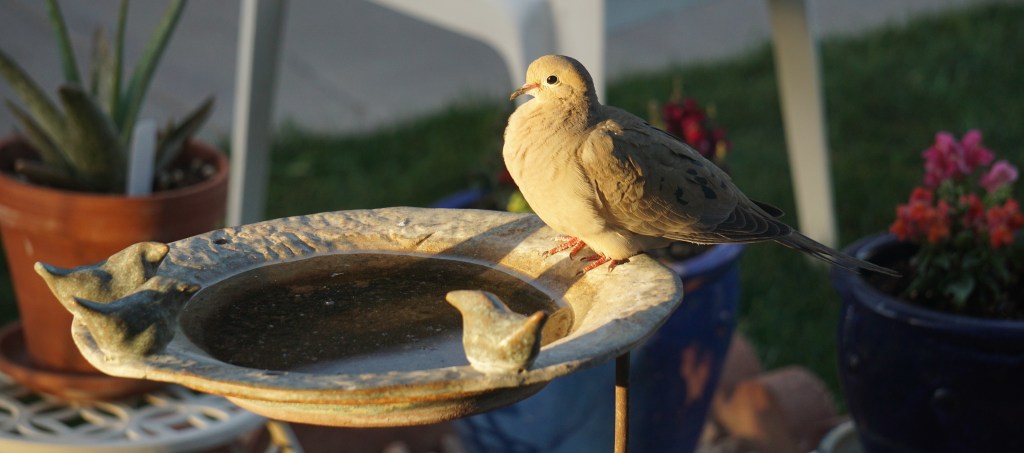
In June of 2017, right before Tom and I left Illinois and moved to Arizona, Diane drove from her suburban Chicago home to visit with us on our backyard deck in Mount Prospect. I decided to give her the concrete birdbath that had been Mom’s, hoping it would remind her of the shared love we had for our nature-loving mother.

A few weeks later–on the way west–I landed in a St. Louis hospital after a heart attack. I called my sister to tell her what had happened. To hear her voice. To hear her love. That conversation was the turning point toward greater understanding.

In early September, Tom and I received a card from the American Heart Association in the mail. To acknowledge Tom’s and my sixth wedding anniversary, it told us Diane and Steve (my brother-in-law) had made a donation to the organization.

After I opened the card and wiped the tears from my eyes, I realized Diane and I had escaped the labyrinth of grief. Our relationship had emerged on the other side of the shadows. There was light on the horizon.

My Cup of Tea

I used to think I was purely a coffee guy. That a cup of tea wasn’t my cup of tea. But I’ve changed. Now I enjoy a cup or two of hot coffee and a cup or two of hot tea every day. Not simultaneously, of course.

Coffee (with non-dairy creamer) is my early morning drink. What Tom typically and Mark less frequently brews to stir our bodies and revive our brains. Whereas tea with honey in the morning, early afternoon or in the evening–like yoga–cues my deepest thoughts, centers my soul, renews my sense of hope, and quiets my agitation.

If it’s the right kind of herbal tea, it also clears my sinuses. Tom and I discovered and bought a great allergy and sinus tea (sold by the SW Herb Shop & Gathering Place in Mesa, Arizona) several months ago while shopping the outdoor aisles of the Scottsdale Farmers Market.

The mild melding of ingredients includes elder, echinacea, peppermint, dandelion, goldenrod, and orange peel … stuff I usually see in a field or orchard, but now they gather and grace themselves in my tea cup.

Recently, I ran out of this special blend, but was able to order it on line. Miraculously, despite the recent United States Postal Service drama, it arrived in the mail a few days later. It’s such a relief, to have my new stash. To enjoy a few cups daily to counteract the latest flair up of allergies. Something I never experienced in the Midwest, but do in the Sonoran Desert.

I’ve decided herbal tea is a more expansive and introspective drink than coffee. While it opens my sinuses I also think it frees my mind, heart and creative sensibilities. If you’ve imagined me drinking a cup as I compose this story, you’re right. In fact, without my cup of tea today, I doubt I would have written anything at all. My focus would have stayed on my stuffy sinuses.

Between sentences and sips of tea, I’m reading Writing Down the Bones by Natalie Goldberg. This tiny-but-mighty book was a gift to Tom and me from a friend. First published in 1986, it’s one of the most accessible, descriptive and personal books I’ve read about committing to a practice of writing, overcoming doubts, and “freeing the writer within.”

It’s also filled with bits of wisdom and humanity. Guidance that I need today to cleanse myself after reading about the latest vitriolic display from the White House. (Tom and I protected our sanity and blood pressure this week by not watching any of the Republican National Convention antics live.)

In an attempt to share some of the goodness from Natalie’s book, here’s a nugget from page 97, where she talks about embracing both the ordinary and extraordinary aspects of life. (For instance, drinking coffee or tea vs. living through a global pandemic.)

“We are all interwoven and create each other’s universes. When one person dies out of his time, it affects us all. We don’t live for ourselves; we are interconnected. We live for the earth, for Texas, for the chicken we ate last night that gave us its life, for our mother, for the highway and the ceiling and the trees. We have a responsibility to treat ourselves kindly; then we will treat the world in the same way.”

Given the state of our world right now, perhaps Natalie’s words will resonate with you as much as me. Whether you’re an aspiring writer, a fully-entrenched-and-sometimes-jaded one or somewhere in between, perhaps her gem of a book will inspire your best creative instincts.

Perhaps it will be your cup of tea.