Tag: Battle of the Bulge

Protests and Poetry

Are you guys going to the protests this Saturday?” Nick wondered last Wednesday via a text.

No. We aren’t planning to. It’s just too hot,” I responded to my son.

But as the week wore on, I began to regain my energy following three phenomenal concerts with my Phoenix Gay Men’s Chorus pals.

On Friday, I reconsidered Nick’s question. I told him Tom and I would do it. A few of our chorus friends wanted to join us too at a No Kings protest in Scottsdale.

I should tell you that I don’t consider myself an activist, though I have marched for various causes on several occasions in my life. I prefer to share my voice and perspective through my writing.

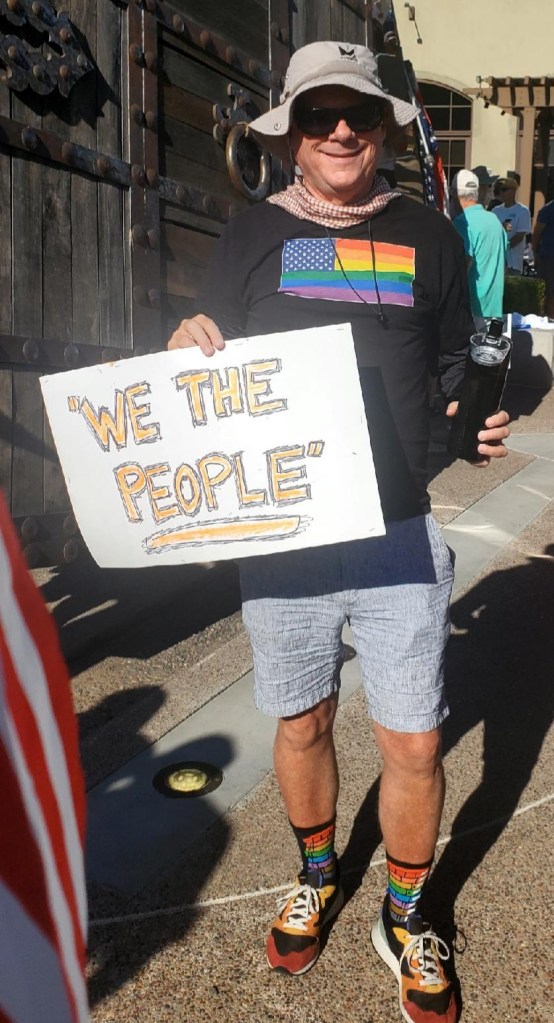
But I also recognize the dire state of our democracy. I decided if my World War II veteran father (he defended democracy in Europe with the allied forces during the Battle of the Bulge in late 1944) could endure frozen feet in foxholes with his buddies and risk his life as an army sergeant, I could certainly endure the 90-plus desert temperatures in Arizona for two hours, wave my American flag and “We the People” sign, and join forces with family and friends to raise my voice. To make sure it was heard.

So, Saturday came, and we did it … Mark, Tom, Nick, Kim, Dougal, George and one to two thousand others represented democracy in Old Town Scottsdale. We were a dot in a map of some five million in the U.S. and abroad who took to the streets in big cities and small towns. All of us deeply concerned.

Locally, it was an inspiring and peaceful No Kings protest consisting of angry but well-behaved women and men. Young and old. A few children with parents and grandparents. Couples. Singles. Straight. Gay. Multi-cultural. Dogs, too. Dare I say diverse?

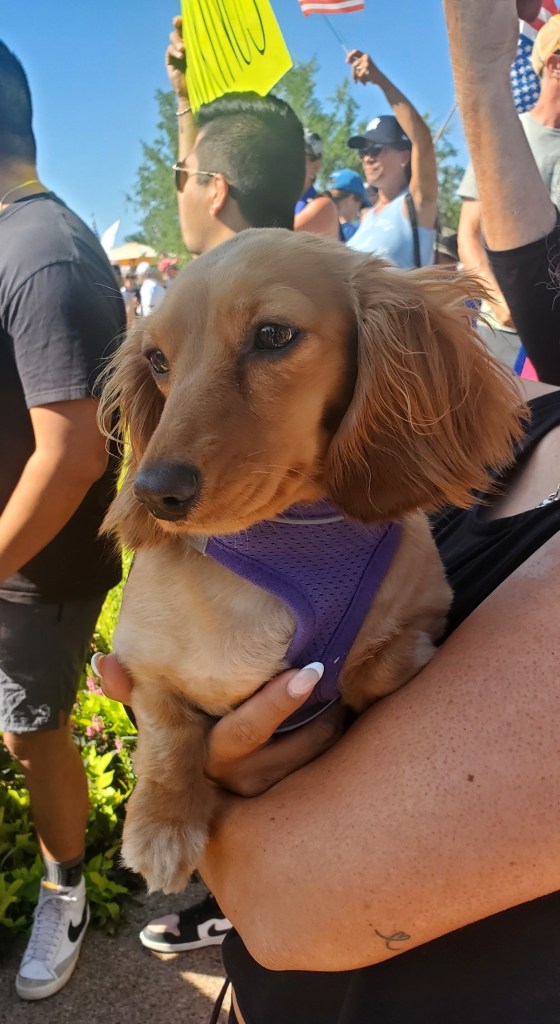
At one point, Tom and I chatted with a fifty-something mother from San Diego. She was visiting her daughter who lives in Scottsdale. They took turns chanting “No Kings” while cradling their adorable, slightly overwhelmed dachshund.

The dog’s benevolent eyes seemed to say, “what are we all doing here?” All I could do was shrug and smile. There is no explaining all we have endured in this country over the past six months. Not to mention the previous eight or nine years.

A short while later, I turned to discover a man holding a profoundly-funny-and-literary sign. A parody of American poet Robert Frost’s The Road Not Taken. I imagine Frost would have loved it, if he had been alive and standing beside me.

I asked the man if I could take his picture. I told him it spoke to my wordsmithing sensibilities. He surprised me by saying he was a math guy.

I’ll likely never cross paths with him again. He’ll never know that my book of poetry, A Path I Might Have Missed, was inspired by my love for Robert Frost’s verses. But on June 14, 2025, we stood on the same page … on the same street corner … on the same shared path.

Together–close friends, like-minded acquaintances, and distant strangers–we proclaimed our desire and hope to rescue American democracy from the clutches of fascism.
They Fought So Hard

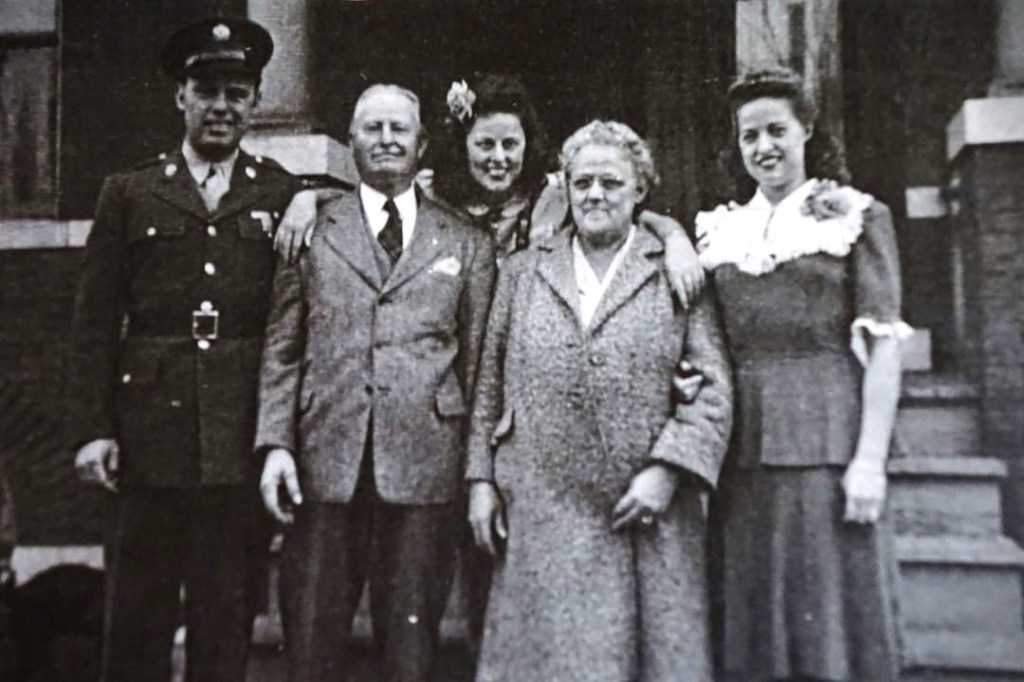
Albert, Louise, and their three adult children–Thelma, Violet, and Walter–led ordinary lives.

In the fall of 1944, they were a big-hearted, hard-working, working-class family–living in a flat on Labadie Avenue on the north side of St. Louis.

To be precise, Thelma and Walter lived with their parents. Violet and her husband Harry lived nearby.

At any rate, they were a close family with strong opinions, loud voices, and a propensity to gather around the radio for FDR’s inspiring Fireside Chats.

Like all patriotic American families of that era, they planted a Victory Garden to grow their own vegetables, rationed household supplies, and bought war bonds to support American troops fighting overseas in Europe and the Pacific.

They did it all for the sake of protecting and maintaining freedom in a war-torn world.

Walter, Albert, Thelma, Louise, and Violet in late 1944.

When Walter was drafted and deployed to Europe (Harry, too) you might say the family had extra skin in the game of war.

He left New York Harbor–aboard the Queen Mary ship with hundreds of other soldiers–on New Year’s Eve 1944.

Five days later, he landed at the Firth of Clyde in Scotland … and, in short order, he found himself on the front lines scurrying from foxhole to foxhole in the Battle of the Bulge in the forested Ardenne region of France.

As the war in Europe wound down in 1945, he marched with the first group of US army personnel who met with the Russian army on the Elbe River on the eastern front of the war.

Walter survived the ordeal–in part because of the regular flow of love letters and encouragement he received from his sisters and parents.

Walter returned to the US on the U.S.S. Monticello in July 1945 … for a thirty-day leave prior to going to fight in the Pacific.

He was supposed to depart in mid-August, but on August 6, the US dropped the first atomic bomb on Japan and the war ended shortly thereafter.

Walter’s fighting days were over. He was discharged from the service on October 11, 1945.

A few years later–sometime after he met his future wife Helen in January 1948 at Westminster Ballroom in St. Louis–he confided that the Russian soldiers were some of the roughest, battle-hardened men.

At any rate, despite the “shellshock”, nightmares, and frozen feet Walter brought home with him, he (and Harry) came home in one piece.

***

I’ve thought a lot about Walter and Helen (my dad and mom), Thelma and Violet (my aunts), Albert and Louise (my grandparents) … the Johnson family … since the election last week.

All of them have been gone a long time, but in a sense–today–I feel I am grieving my own loss of freedom, as well as their legacy. The one they fought so hard to uphold.

I’m not giving up, but that is how I feel on Veterans Day 2024.

Early this afternoon, I pulled out Dad’s World War II army trunk.

It contains pieces of his uniform–including the wool hat and golden medallion he wore eighty years ago as he was preparing to preserve freedom on behalf of his country.

Finding it there with his few remaining possessions gave me strength.

In the coming days, weeks, months, and years, I’m going to do my best to draw from the resiliency in my family’s DNA to find specific ways to uphold democracy in my Arizona community.

You can be sure I also will continue to exercise my voice–through prose and poetry–and influence others in a positive fashion as we head into an uncertain and potentially ominous period in our country’s history.

The Soldier on the Hill

FFG_Photo 4B

When I drafted this poem on August 27, 1996, I wrote it as a tribute to my father, Walter Johnson, who died in 1993. He was an aspiring-but-unfulfilled poet and proud World War II veteran, who fought in the Battle of the Bulge towards the end of the war in Europe.

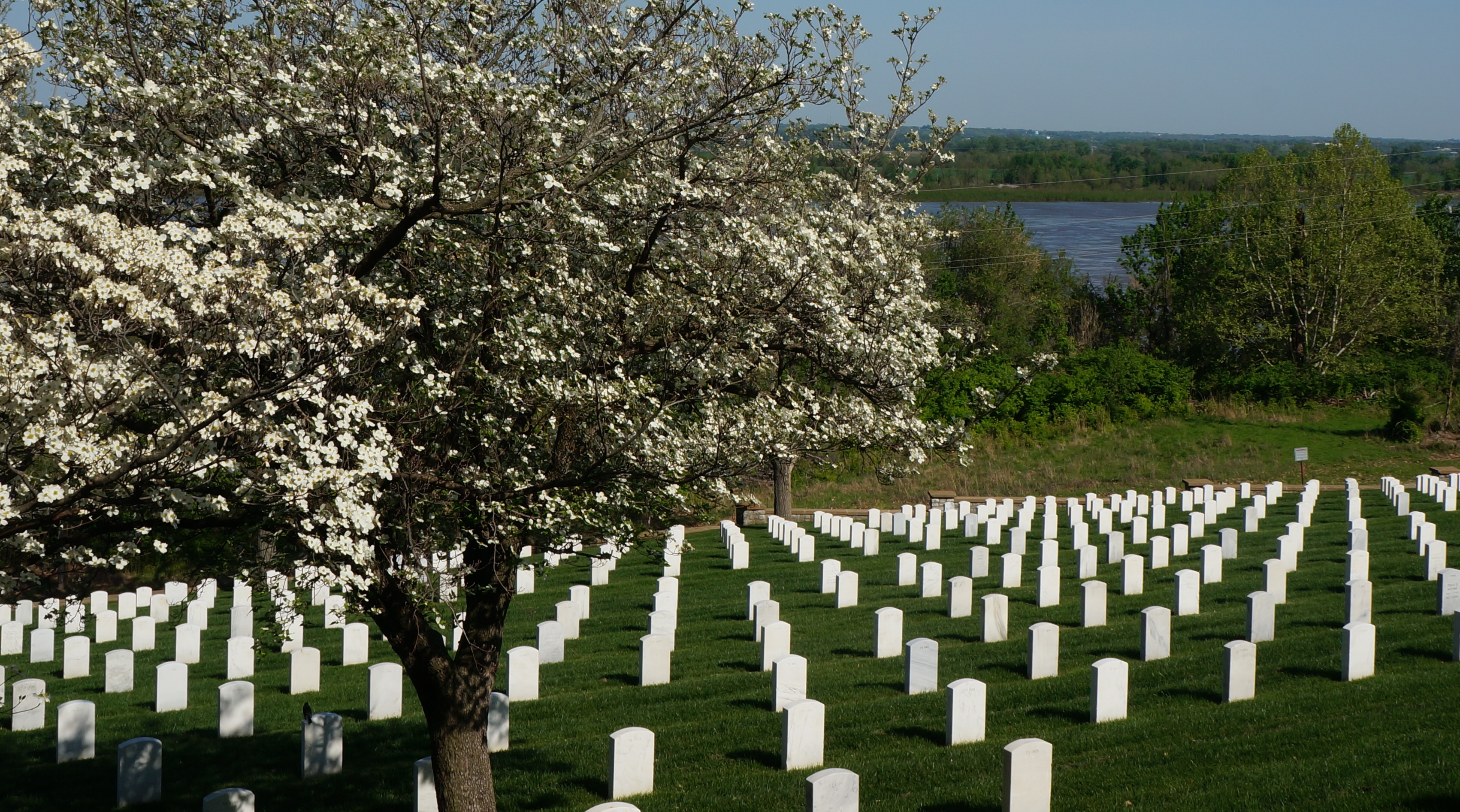
Dad is buried here at Jefferson Barracks National Cemetery–just south of St. Louis, Missouri–alongside thousands of others who served their country and, in many cases, died defending it.

As Memorial Day approaches, I’m posting this to honor Walter and all of the soldiers on the hill, who rest eternally on the banks of the Mississippi River.

***

I talked with the soldier on the hill today.

We sat, we cried, we laughed, we prayed.

The bells rang true, the trees stood free,

A breeze swept past to welcome me.


Shadows filled the landscape then,

Tempers rose without his pen.

Snowflakes fell, the grass turned green,

All without a change of scene.


Now the soldier rests with them,

Hand in hand–all blessed again.

They greet another trailing soul,

Who makes the journey past the knoll.