In the latter half of July, Scottsdale transforms into a forgotten destination for many, who escape triple digits. But this blistering period is my refuge. A few clicks on the calendar beyond another birthday. A quiet space between the high of choral performances and planning for upcoming literary endeavors.
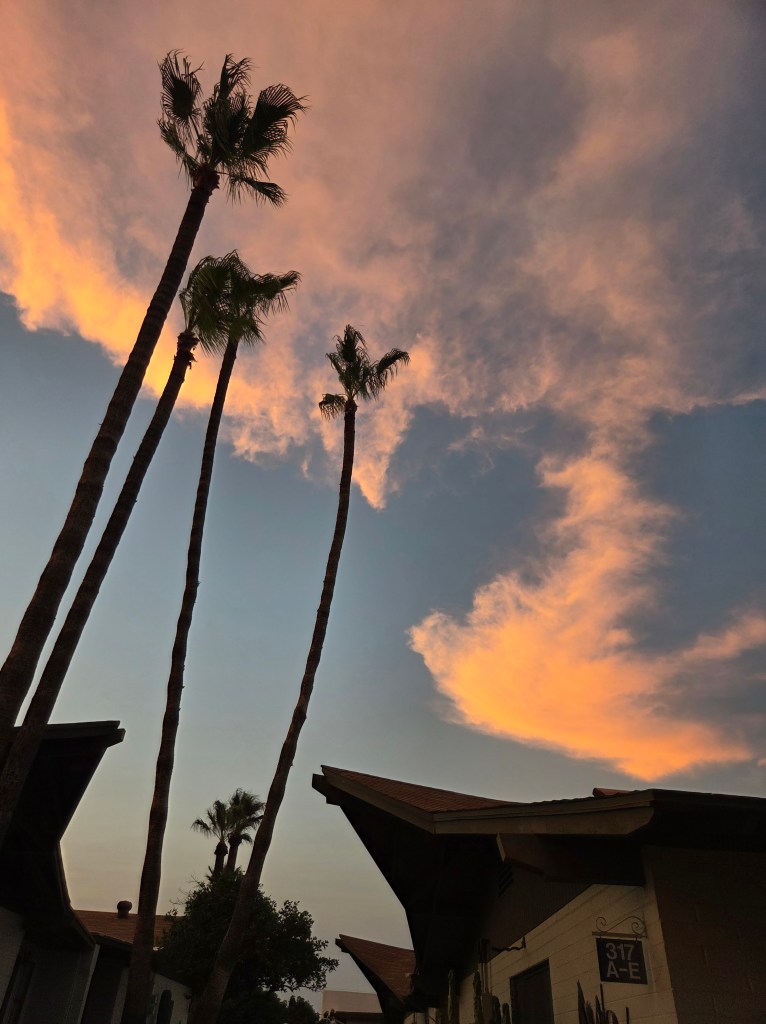
At sixty-eight now, I need this time to recharge and replenish. To submerge body and soul in Chaparral Pool’s cooling waters. To pause for a brief stroll and acknowledge that the rugged scenery and tangerine sunsets where I live are pretty cool, even when summer’s forecast and reality are ridiculously hot.
In January 2014, the fog of grief occupied my brain and body. My mother had been gone one year, but I hadn’t yet found a constructive way to heal and process my grief.
Along the way, my husband Tom and therapist Valerie encouraged me to embark on a new path that would help me recapture my creative spirit.
I decided to leave my communication consulting career. Soon after, I began to write personal stories that mattered to me. Vivid recollections inspired and spawned by grief. Observations about love and loss in my family that helped me chart a new course and publish my first book, From Fertile Ground.
With time and reflection, I wrote four more books about the tender and whimsical ups and downs of childhood, the poignancy of leaving one home and surviving to find another, the adventures of creating a new life in the Arizona desert, and the poetry that has stirred inside me for thirty years and finally escaped to land on a page.
In small and large ways, my mother is in every one of those books and numerous essays. Yet she didn’t live long enough to read any of it, except one poem I gave her on Christmas Eve 2009.
I know now that writing about her in new and different ways has kept her wisdom and generosity alive and accessible for me.
July 26, 2024, would have been Helen F. Johnson’s 101st birthday. I knew I wanted to write about that, but until my fingers hit the keyboard, I wasn’t sure what I would say … because I thought I’d said it all before.
Maybe I haven’t.
How I loved and admired–and still remember–her tenacity. Her legacy of letters. Her devotion to family, friends, and the power of nature.
She would have loved the artistic life Tom and I have created in Arizona among the buttes and cacti. Writing stories, screening movies, singing songs, feeding stray cats.
Making new friends, while remembering old ones. Doing our best to guide and encourage my sons–her beloved grandsons–as they make their way toward the middle of their lives.
Cherishing each moment of our retirement years, without ever knowing where it will lead. Never wanting to know how or when it will end.
On July 26, 2012, we celebrated my mother’s eighty-ninth birthday together. It was her last.
Twelve years have passed. I’m much older, more appreciative and impatient. But also, wiser. Healthier. Gayer. Grayer. More contented with my own life and legacy. More worried about the world’s plight.
Grief is no longer my catalyst, my nemesis, my companion. Of course, I see it in the rearview mirror. But, with the passage of time, I discovered higher ground without the ghost of grief.
I no longer think of my mother every day. But when I do, I am grateful for the moments she and I shared–the gifts of memories and photographs I treasure–and the propensity to write about it.
All of this runs through our DNA.
My mother and me, celebrating her eighty-ninth birthday in Wheaton, Illinois, on July 26, 2012.
It may or may not surprise you to learn that I’m sipping hot herbal tea–lemon and ginger–as I write this.
Ordinarily, that would feel counterintuitive to surviving the summer desert heat. (We are expecting 115-degree temperatures in the Phoenix area again today.)
But I am determined to eradicate the nagging remnants of Covid congestion. Plenty of rest, fluids, hot tea, Sudafed, and throat lozenges are helping me slay this beast. (I am no longer Covid positive or contagious.)
I want to be clear-headed for my sixty-seventh birthday on July 6th. (Actually, it’s OUR sixty-seventh birthday. In a gift from the cosmos, Tom and I are exactly the same age. I’m no mathematician, but what are the odds of that?!)
We will celebrate by seeing a production of Fiddler on the Roof at the Phoenix Theater–it’s getting rave reviews–followed by dinner at a Phoenix restaurant.
Then, early next week, Tom and I will travel to Minneapolis for the quadrennial GALA choral festival. 7,000 LGBTQ singers (representing hundreds of choruses from the US and around the world) will be participating in this massive community choral event.
It will be more than five days of non-stop music, singing, listening, cheering, and applauding. It will be a giant uplifting and affirming dose of camaraderie, which all of us in the LGBTQ community–the entire world really–need right now.
If you aren’t familiar with GALA, it’s a phenomenal program–gay music camp, of sorts–which happens only once every four years. Of course, the 2020 program was Covid-cancelled.
Therefore, GALA 2016 in Denver was the most recent festival. I still have fond memories of standing on stage with my mates from the Windy City Gay Chorus.
We were asked to perform the song I Love You More from Tyler’s Suite at the closing ceremonies in front of 3,000 people. It is a positive moment seared in my memory … and it happened on my 59th birthday.
Evidently, the GALA 2024 organizers were able to repurpose countless stacks of 2020 lanyards, which someone must have purchased four years ago. Look closely, and you’ll understand what I mean.
Anyway, on Friday, July 12th, at 12:30 p.m. (Central Time) I will perform with my Phoenix Gay Men’s Chorus mates on the Minneapolis Convention Center auditorium stage.
We will sing six songs: Bridge Over Troubled Water, You Are Enough, Proud, For Me, I’m Still Standing, and Sing to the World Our Light.
For more information, go to http://www.galachoruses.org. If you love choral music, you can purchase a live stream pass for $35 and see any/all of the chorus performances you like.
Trust me. No matter where you live, the quality, scope, magnitude, magic, and healing power of the music at this exhibition will dazzle you.
January 1984 felt promising, but exceptionally cold, in the Chicago area.
Jean was due to deliver our first child on January 17. But that day–and several more–passed with no consequential developments. Just a few rounds of snowfall.
Late on January 23, Jean went into labor. When we arrived at Lutheran General Hospital in Park Ridge, Illinois, the nurses examined her. They told us it would be several hours before our child was born.
Jean and I weren’t prepared for the day-and-night-long ordeal that followed. After twenty-three hours of labor, Dr. P pulled me aside.
At that point, he was worried that a traditional delivery would place Jean and our unborn child at risk. He recommended Plan B: an emergency C-section.
Jean was scared; I was worried about her welfare. I insisted on staying during the operation (masked up on the other side of a curtain, away from the medical staff, while they performed the procedure). The doctor agreed it was a good idea for me to be there for emotional support.
A short time later, at 11:37 p.m. on January 24–twenty-three minutes until midnight–our son Nick arrived intact. Jean was okay, too, but totally spent. We both breathed relief.
Our newborn son wailed as the nurses wrapped him in a blanket. His head was slightly misshapen from the birthing process, but they told us not to worry. They laid Nick across Jean’s chest. We had a healthy son.
Jean and Nick stayed at Lutheran General for a few days, which was protocol for the time. Several days later, we signed a few papers, and prepared to leave the hospital.
Jean cradled Nick in a wheelchair that morning. A nurse pushed them down the hall. I pressed the elevator button, carried flowers, and juggled a few possessions as the doors opened.
An older man already onboard smiled as we descended to the ground floor. He wished a good life for our newborn son.
We exited the building. I walked ahead in the cold to bring our car around while Jean and Nick waited with the nurse at the curb. The sun shimmered on a dusting of snow from the night before.
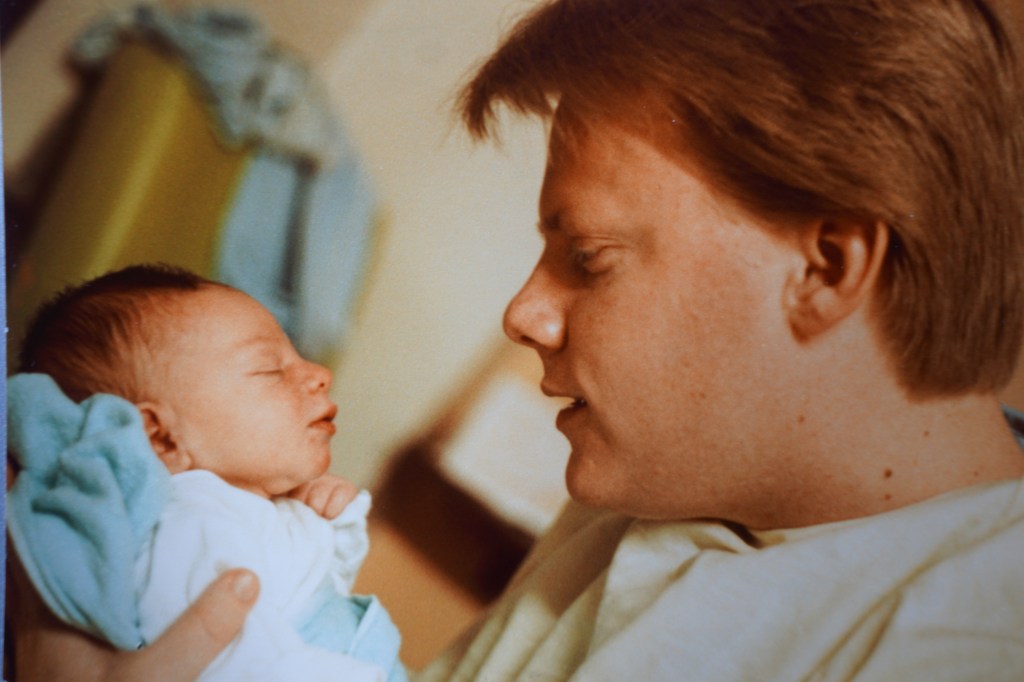
Day-old Nick and me at Lutheran General Hospital on the morning of January 25, 1984.
***
When Nick was born in 1984, I didn’t expect his mom and I would split eight years later. But we did in 1992, just three years after Kirk (his younger brother) was born.
In the aftermath, my sons spent Monday and Wednesday nights–and every other weekend–with me (Tuesday and Thursday nights with their mom) until they were teenagers when they each opted for a home base with Jean. Thanksgivings were with me; Christmases with her. Two vacations occurred every summer. One with her. One with me.
On “Dad nights and weekends” in the early 90s, my boys and I devoured pizza in our cramped apartment in Arlington Heights and on cold, gray days swam in the indoor pool. It was a cheap way to have fun and burn off energy.
During the school year, with their backpacks in tow, we grabbed donuts downstairs in the apartment lobby on the way out the door.
I dropped Nick off at Kids’ Corner (before-and-after-school program), then hustled Kirk off to preschool before I commuted into Chicago’s Loop for work.
Looking back, it was a tumultuous period of disarray, intimacy, and estrangement for all of us. Nonetheless, somehow, we survived. We found our rhythm as a family straddling two homes.
In 1996, I saved enough for a down payment on a modest three-bedroom home nearby. Nick, Kirk and I played catch in the backyard and tossed the football on the open field across the street.
That same year, I met Tom and introduced him to my sons. I know that Nick–particularly as a teenager–felt uncomfortable with having a dad who was different. But, in spite of it, he knew I loved him.
We weren’t your prototypical American family, but with time we found our stride and Nick and Kirk accepted Tom and me.
At first, our basset hound Maggie (we adopted her in 1998) was the comic-relief glue that adhered us.
With time, that connectivity broadened. We found more in common: birthday celebrations; grounding visits with their wise and supportive grandma in St. Louis; fun and thought-provoking movies with Tom and me in the Chicago suburbs.
Not long after Nick–and then Kirk–graduated from college, Maggie died. We all mourned her loss in 2008.
Tom and I knew at the time that our parents wouldn’t be far behind. The nest emptied quickly. They were all gone by 2015.
That same year, at age thirty-one, Nick asked if he could rent our Arizona condo while he looked for a job out west. He needed a change. He wanted to chart his own course, away from the cold, heavy responsibility of the Midwest.
Nick began a new life that January (two years before Tom and I made Scottsdale, Arizona, our permanent home) when he landed a job with a technology company in March.
Over the past nine years, I’ve watched my son’s confidence and self-esteem multiply. He has a good life here.
Of course, during that period, he’s changed jobs and apartments, discovered new loves and suffered a few losses.
But Nick is happier in the sunnier Southwest. And I’m happy that I get to see him occasionally.
After I suffered a heart attack in July 2017 on the way west, Nick helped Tom move some of our bulkier pieces of furniture.
It gave me solace seeing them bond more deeply as I struggled to regain my strength and equilibrium.
Life so far in 2024 is good for all of us. Kirk is planning to visit us in Scottsdale in March. He lives in Chicago and has found a rewarding life as a trauma counselor. He needs a warm escape now and then to stay sharp.
In spite of the vast distance, my younger son and I have managed to deepen our relationship and stay close. As Kirk quarantined in his Chicago apartment during Covid, Tom and I played Scrabble with him online and Zoomed from time to time.
We talk frequently now. Whenever we do, I realize how lucky I am to have two smart and compassionate sons who are contributing members of society.
A few weeks ago, Nick stopped by and watched Oppenheimer with Tom and me. On other occasions, we’ve shared ballgames and dinners or picked ripe citrus fruits off our condo community trees (Nick loves grapefruit).
Next week, Nick and his girlfriend Anastasia will join Tom and me for dinner to celebrate his birthday at a local Scottsdale restaurant he’s been wanting to try.
No doubt, we’ll raise a glass. We’ll toast his first forty years. We’ll recall Nick’s journey west to discover a warmer life of promise.
As a dad, I will always be there for my sons. I’m glad I stuck it out during those trying years in the 90s, because seeing them become who they are–full-fledged adults–is the most gratifying part of fatherhood.
It’s a daunting task, trying to capture a full life–in this case, my mother’s–in one hundred words (and a dozen pictures). But, today, on the one hundredth anniversary of her birth, this is how I choose to remember Helen Matilda Ferrell Johnson, beyond our story that sprang From Fertile Ground.
***
Born July 26, 1923; High Point, North Carolina.
Child of the Depression.
Dutiful daughter. Responsible older sister.
Fine furniture lover.
1945. St. Louis, Missouri, bound.
Patient wife. Long fuse. Quick temper.
Attentive mother. Hard worker.
Loyal friend. Compassionate trailblazer.
Unintended, unidentified feminist.
Reliable next-door neighbor.
Proud mother. Devoted grandmother.
Smart saver and investor.
Advocate for the disabled and needy.
Southern storyteller. Avid letter writer.
Rock and shell hunter.
Animal advocate. Grateful green thumb.
Observant camera bug. Crafty potter.
Contented retiree. Resilient fighter.
Northern Illinois octogenarian.
Wise realist. Chair rocker.
Fading sunset lover.
Gone January 26, 2013; Wheaton, Illinois.
Full moon.
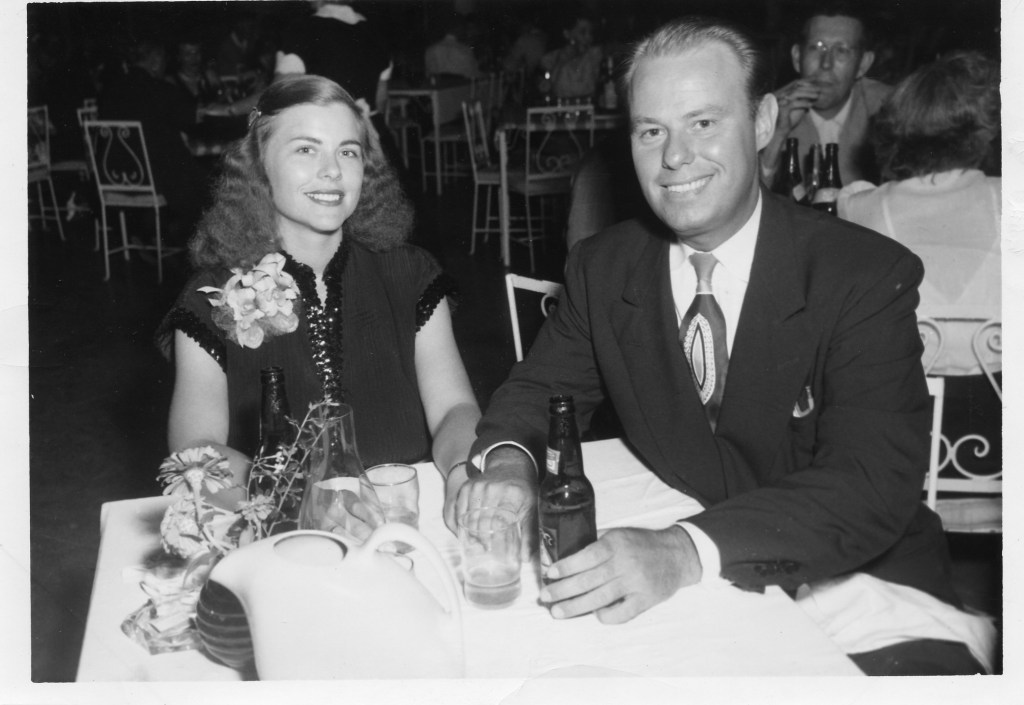
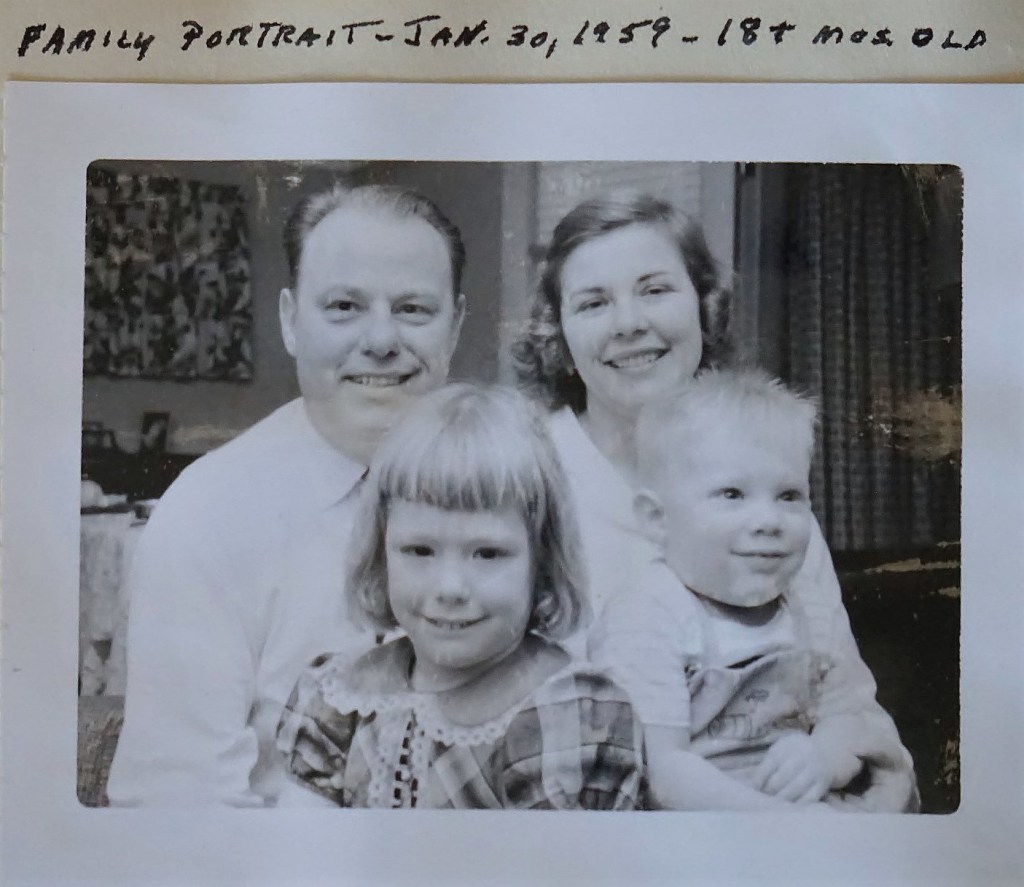
Helen Ferrell at age six in 1929.Helen walking with younger sister Frances in the 1930s.Helen arriving in St. Louis by train outside Union Station in 1945.Helen in Texas in the 1950s.Helen and Walter Johnson in Texas on her twenty-sixth birthday.Helen outside their Texas apartment in the early 1950s.The Johnson family in 1959 in St. Louis.Helen and Maggie in Mount Prospect, Illinois; New Year’s Day 1999.Helen singing Waltzing Matilda on her eightieth birthday in Geneva, Illinois.Helen the gardener in the early 2000s.Helen showing off her manicured nails in Wheaton, Illinois in 2011.Mark and Helen in January 2013, a few weeks before she passed.
I received a sad text message on July 2 from Lu, my cousin’s wife in North Carolina. She told me Frances, my beloved ninety-one-year-old aunt, is in her final stages of life, suffering with the effects of Alzheimer’s.
Frances is my mother’s smart and sassy younger sister–the only one remaining from that generation of my Ferrell family. Her passing–whenever it occurs–will mark the end of a significant chapter in my life … one I wrote about in From Fertile Ground after my mother’s death ten years ago.
When I last visited Frances in September 2015, I sat beside her on the couch of her Davidson, North Carolina living room. It was an important and healing moment for both of us. The loss of her only sister and my only mother was still relatively fresh.
I realized then that returning to North Carolina (where my mother was born) was my way of putting to rest Helen Ferrell Johnson’s earliest life experiences–and some of mine, which included Frances, her sons, warm summer days, and barefoot adventures exploring my grandparents’ Huntersville, North Carolina farm in the 1960s.
Now–just a day away from my sixty-sixth birthday and three weeks from what would have been my mother’s 100th–the knock of grief in July appears once again on the other side of the door.
It ushers me back to July 6, 1974, (my seventeenth birthday) when I stood beside Frances at my grandmother’s (her mother’s) funeral.
We leaned into one another that day in the Asbury Methodist Church cemetery in Huntersville. I needed to feel her love and reassurance, just as I would in September of 2015.
Back in July 2023, my wish is that my aunt’s transition moves swiftly.
In my mind and heart, Frances Ferrell Rogers Christenbury (forever the first child born in High Point, North Carolina, on New Year’s Day 1932) will always be that spunky adventurer.
Frances loved me for who I am … saw and accepted the handwriting on my gay wall before most of the rest of my family … brought joy to my frolicking on the farm … and ordered extra copies of From Fertile Ground to share.
I think it was because reading it helped her heal after the loss of Helen. More than that, because it tells the story of our family’s survival across the generations.
One that will live forever on the pages with Frances and the fertile ground of grief.
At six, I ducked. I covered. When Cronkite broke the news, I grieved for JFK. I wondered what might have been. I watched John-John salute his dad’s horse-drawn casket as it passed by.
At sixteen, I drove and grew. I discovered the stage. My long hair hid my face, but through the blond strands I watched the lies and disgrace of Nixon and Watergate unfold and consume our nation.
At twenty-six, I cradled my first-born son. I played ad man in the tallest building in the world. I watched the AIDS epidemic rage without relief. Reagan stood by to pontificate.
At thirty-six, I grieved for my father and raised two little boys–alone. Clinton signed Don’t Ask, Don’t Tell. In short order, I watched the military expand its closets. Meanwhile, I found a way out of mine.
At forty-six, I climbed the ladder, fed our dog, and paid more child support. I watched my weight escalate. My blood pressure and responsibilities soared as George W fanned the flames in Iraq.
At fifty-six, I grieved for my mother. I shed my corporate skin. I wrote. I sang again. I photographed dragonflies. I watched Obama change course and support marriage equality. I felt hopeful.
Now, six days before my sixty-sixth, I cleave to my husband and pray that the masses will continue to support Biden–our buffer from total mayhem–while insanity lurks on the horizon.
We watch and sigh as another wave of misguided declarations from the misnamed Supremes–and their perpetrators–land on the doorstep of freedom and turn back the clock on once-protected classes.
What has become of our red-white-and-blue country? The country I still love–that beacon of hope–no longer exists. Now we are black and blue. Punch drunk from the previous administration. Bruised from an insurrection that took us to the brink nearly thirty months ago.
Still, we watch and wait for justice and accountability. Will it ever come? Or are we simply poised for another distraction? Another round of fireworks to illuminate our darkness and denial?
It certainly feels like we are one step closer to midnight.
Thank you, Carol, for your enduring sense of humanity and a lifetime of laughs.
I’m so glad we had this time together.
***
A Custodian, A Scrub Woman, and Me
At 9 p.m. Central Time on Monday nights in 1970–fifty years before the contagious Covid-19 stunned our world–a kooky comedienne with a toothy smile and infectious laugh captured my twelve-year-old heart and creative imagination. Her name was Carol Burnett.
Born April 26, 1933–in the depths of the Great Depression–this legendary actor of stage and screen first tasted success with her Tony-nominated Broadway performance in Once Upon a Mattress in 1959. Soon after she appeared as a regular on The Gary Moore Show. My exposure to her madcap comedic skills began on September 11, 1967. That’s when The Carol Burnett Show debuted on CBS-TV.
Through the spring of 1971, the network ran the hour-long variety and sketch comedy format opposite two popular programs: NBC’s I Spy; and ABC’s The Big Valley. (Later in the seventies, as the show gained a larger audience and momentum, CBS moved The Carol Burnett Show into its Saturday night lineup following four other prime-time powerhouse comedies: All in the Family, M*A*S*H, The Mary Tyler Moore Show, and The Bob Newhart Show.)
Back in 1970, after I finished my homework on Monday nights, the lights on stage came up around Carol and were transmitted through our Zenith color TV in suburban St. Louis. Long before I first imagined taking flight in my dusty desert time machine, she proceeded to field questions from her studio audience and lead me and thousands of other viewers across the country on a metaphoric and comedic joy ride.
Every week we sat mesmerized. We watched Carol and her creative troop–Harvey Korman, Vicki Lawrence, Lyle Waggoner … and later Tim Conway–perform their magical TV mayhem. Together they represented creative constancy in my life.
At that time, Dad worked the night shift as a custodian for a government agency in St. Louis: sweeping and mopping floors; cleaning toilets and urinals; emptying waste baskets.
It was a life of late-night drudgery my father, the ex-salesman and unfulfilled poet, couldn’t stomach and never dreamed of—especially when the rest of the world had Carol and the hilarity of her As the Stomach Turns weekly soap parody at their disposal from the comfort of their living room couches.
But like clockwork, at 9:30, Dad called during a break from his janitorial job. He craved a creative escape too. He wanted my color commentary on Carol’s show. The ringing on our kitchen phone was my cue to fill in the comedic gaps.
I stretched the curly cord into the living room and translated Carol’s hour-long variety show into something positive that might sustain him….at least for one night.
To put this in its proper personal perspective, Dad felt he was missing the important moments in life: a traditional schedule of evenings at home with his wife and children watching Carol’s shenanigans. All for the sake of a weekly paycheck and a job that clogged his ego like a stopped-up toilet.
As far as Walter Johnson was concerned, there was nothing else remotely funny about 1970. The Vietnam War was raging. Nixon was president. That was awful enough. Especially for a life-long Democrat.
I’d like to think our phone exchange during his break and my play-by-play of Carol’s comedy sketches and crazy Bob Mackie costumes he missed helped transform his melancholy spirit.
Ironically, over the course of Burnett’s career, she frequently reprised the role of a soulful scrub woman, who cleaned up after everyone else went home. It was Burnett’s tattered-but-enduring character, which became her show’s symbol of humor, heart and humanity.
Like the rotary phone that rang on our kitchen wall, I never imagined the show would one day disappear. But on March 29, 1978, after eleven seasons and 279 episodes (notwithstanding another nine episodes that aired in the fall of 1991) the curtain came down on The Carol Burnett Show.
In the mix, the Vietnam War ended. The troops came home. Nixon resigned in 1974. I graduated from high school and went on to college in 1975. Dad did his best to complete his night-shift janitorial duties.
In August of 1976, at sixty-two-years old—the age I am now—he retired from a job he despised but tolerated to contribute what he could to the well-being of our family. Remarkably, my father lived another seventeen years, despite his struggles with heart disease and depression.
“I’m so glad we had this time together, just to have a laugh or sing a song. Seems we just get started and before you know it, comes the time we have to say so long.”
At the close of each of her shows, Carol Burnett sang this familiar tune, tugged on her left earlobe, and signed off. Evidently, it was a signal to her grandmother to let her know she was doing okay.
I loved it all. Carol’s shenanigans, her show, her sidekicks, her song, her signal, her sentiment. Dad did too. Everything she represented … her physical humor, uproarious laughter and wacky demeanor … sustained us through difficult times.
Fortunately, Carol Burnett lives on. So do the best moments from her comedy sketches on her Carol Burnett and Friends shows that appear in syndication.
She’s been gone nine-and-a-half years. I no longer feel the frequent weightiness of her loss. But on this day–what would have been Helen Johnson’s ninety-ninth birthday–I do.
My mother was a lifelong gardener and nature lover. So, this morning–as a symbolic gesture–Tom and I walked the Desert Botanical Garden. It was quiet and muggy there; just us, a few other couples, and a parade of random reptiles doing push-ups on the concrete path before scampering off.
Grief is a tricky thing. If you’ve lost someone you loved (and who hasn’t?), the discomfort appears as an uninvited clunky extra, who wanders on stage to disrupt a scene … only to vanish until the next anniversary, birthday, favorite song, or serendipitous moment.
As a soothing balm, I have kept the treasure trove of hundreds of letters my mother sent me. They represent a lifetime of her wisdom–her pain, joy, uncertainty, pride, denial, and acceptance. It only became wisdom and the catalyst for my first book, because she had the foresight to share it.
Perhaps the image of her–sitting at her desk or dining room table composing another letter–is her greatest gift of all to me in my literary, later-in-life years.
Out of her death and my grief, I was able to comb the beaches of her life (and mine) and make sense of it. Her letters–like this joyous one from 1999, which I included in From Fertile Ground–are the meaningful shells that washed up on shore and remain.
***
July 11, 1999
Dear Mark,
I really enjoyed your visit! It is good to see you happy and at peace. The fact that you plan to end your group therapy indicates a confidence in your life’s path that is reassuring. I wish for you continued growth and success in every area of your life. The next 20 years should be your best!
The boys are growing up. Nick seems to have recovered some of his old verve and displayed more of the child of old than I had seen in a few years. As he matures and charts his own course as a man, more of that lovely, lovable child nature will return and be revealed to his family members. Kirk is still an adorable rascal and much fun to have around. Enjoy it. Everything can change quickly …
Love to you and the boys. Hello to Tom.
Mom
***
Two years before, in the fall of 1997 while vacationing with her sister Frances, Mom wore a light blue hat in this grainy photo. She scoured the South Carolina shoreline for seashells and shark teeth. She marveled at the way the ocean’s high and low tides polished their sharp edges.
Twenty-five years later, I marvel at the wisdom and intellect my mother shared and left behind. It is her letters and my love for her that linger.
It had been decades since I’d traveled by train for pleasure. All those Illinois years (on and off from 1980 to 2014) riding the Metra to jobs from my homes in the northwest suburbs to Chicago’s Loop don’t count.
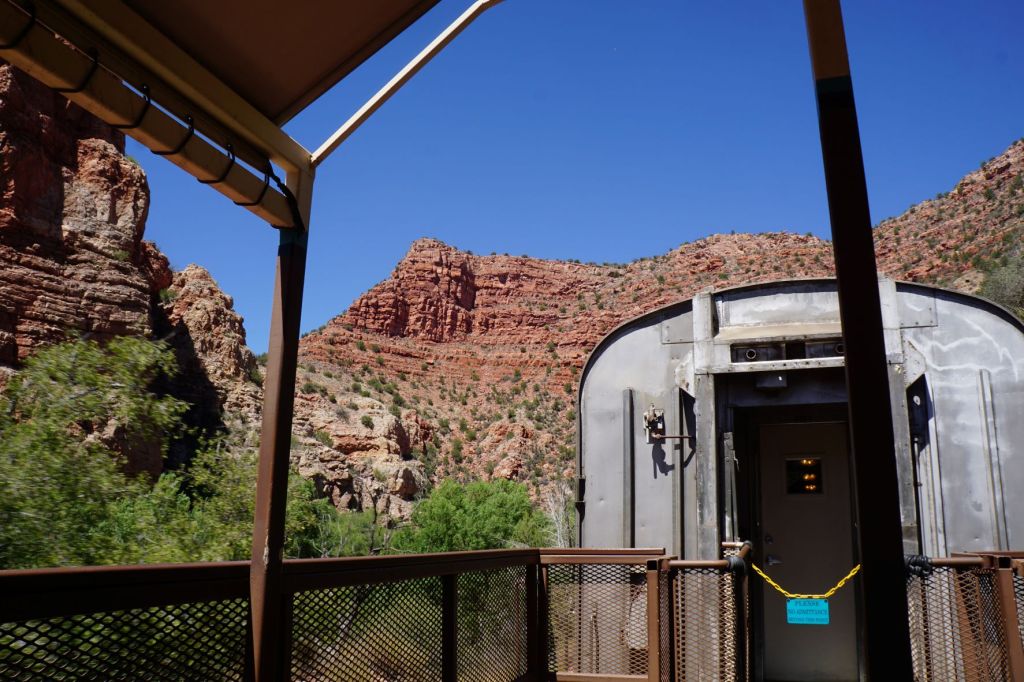
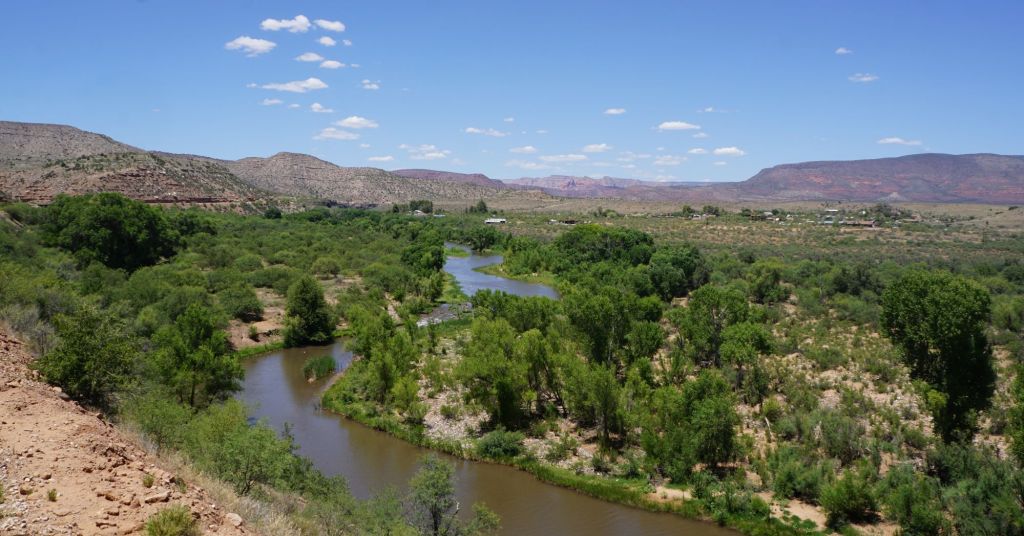
But for four hours on July 6, 2022–our sixty-fifth birthday–Tom and I rode the rails for fun on the Verde Canyon Railroad in central Arizona.
Close your eyes and imagine twenty miles of track, trestles, curves, Cottonwood trees, Verde River bends, one tunnel, and a stretch of close quarters near jagged cliffs between two small towns: Clarkdale and Perkinsville.
Along the way, we moved back and forth from the cool comfort of our coach (featuring a champagne toast in a plastic cup and nifty snack pack of fruits, meats, cheese and crackers) to an open-air car.
The amenities were a nice touch, but not enough to keep us contained. We spent most of our ride outside. That’s where we welcomed unfiltered access to stunning views and stimulating conversation.
Dianne, our assigned interpreter, and Austin, an operations coordinator, provided color commentary as Tom and I guzzled small bottles of water to forestall dehydration in the ninety-plus-degree heat.
With Dianne’s direction, I managed to snap a photo of a Mastodon footprint in the rocks below on my Sony digital camera.
It is evidence of prehistoric life in the old, old west … many centuries before copper smelting and mining, and even longer before one smooth glide through nature carved its initials on the memory of our milestone birthday.










 Mark Johnson Stories