Reflecting and writing meld in my brain. They often occur — in a blur — before I touch my keyboard.
Yesterday, I witnessed a graduation celebration, one table over in an outdoor cafe in Tempe, Arizona.
Today, it has morphed and merged with a blurry family photo, a 1979 memory in Columbia, Missouri.
Graduation day is just the beginning, the departure leading to unknown learnings and destinations.
We can’t really know where we will land, who we will love, or what we will do, until we make our way.
It is less about what we do, more about how we do it and the contributions we make along our journey.
That’s what determines who we become, what we recount decades later miles from where we began.
In May 1979, my extended family joined me in Columbia in front of the University of Missouri columns to celebrate my graduation from the school of journalism.
Numbers–like true stories that capture a moment on a page–are meaningful.
They aren’t merely markers on the shore of life waiting to be washed away with the next high tide.
They measure our progress. They tell us how far we’ve gone; how much we’ve achieved; how many we’ve accumulated.
My dad loved numbers, especially twin digits. On his fifty-second birthday–December 4, 1965–he wrote a poem about their significance in his life as a twin.
I published Unity 66 and the Twin Digits in the context of my first book. It belongs there, embedded alongside and intertwined with the writings of my grandfather, mother, and me. In its purest form, From Fertile Ground is an immersion into our family’s writing DNA.
Despite Dad’s volatility, he could be an exuberant, charming man. He believed in celebrating life’s mundane and magnificent moments as they happened.
On the road of our family vacations in the late 1960s (from his position behind the wheel of our white, four-door, 1965 Chevy Biscayne sedan), he announced to my mother (in front) and my sister and I (in back) when the odometer of our car was about to reach a milestone.
“Hey kids … we’re about to reach 50,000 miles.”
That was our cue to sing with him like circus clowns dancing to a calliope from the backseat.
“Da da da da … da da da da … da da da, da da … da da … da da da!”
Earlier this week–on April 7, 2024, to be precise–I hit the five hundred books sold mark since February 2016 when I first became a published author.
(If you are one of those who have supported my creative writing pursuits, thank you! I’ll bet there are a five hundred more who’ve read my books free through libraries and Goodreads giveaways I’ve sponsored.)
How do I know? First, I keep track of all my book sales on a spreadsheet I update monthly. Second, my Amazon sales dashboard tells me that someone in the United States bought number 500, my book of poetry, that day.
Of course, these aren’t best-selling numbers. Not even close. I’d need to add a few more zeroes to play with the big leaguers. However, numbers–while important–aren’t necessarily equivalent to quality or creative impact. (If you’ve seen the movie American Fiction, you know what I mean.)
At any rate, for an independent writer operating with a paltry budget, my book sales numbers aren’t too shabby.
Somewhere, on the highway of life and in the universe of creative possibilities, I imagine my father smiling at me from the front seat through the rearview mirror with the wind buffeting his combed-back hair.
He’s gripping the wheel with his left hand, while waving an imaginary conductor’s wand with his right. He’s singing along with the crazy circus music from our 60s family vacations.
Like my husband Tom–last night sitting on the fold out couch in our cozy Arizona den–my father Walter–if he were still alive–would be telling me to keep writing about the things I enjoy.
Because writing, telling, and sharing serendipitous stories is what I was meant to do. No matter what the numbers say.
Writing can be gratifying, but it’s not easy. It requires introspection, imagination, and a healthy dose of discipline away from the demands of the day.
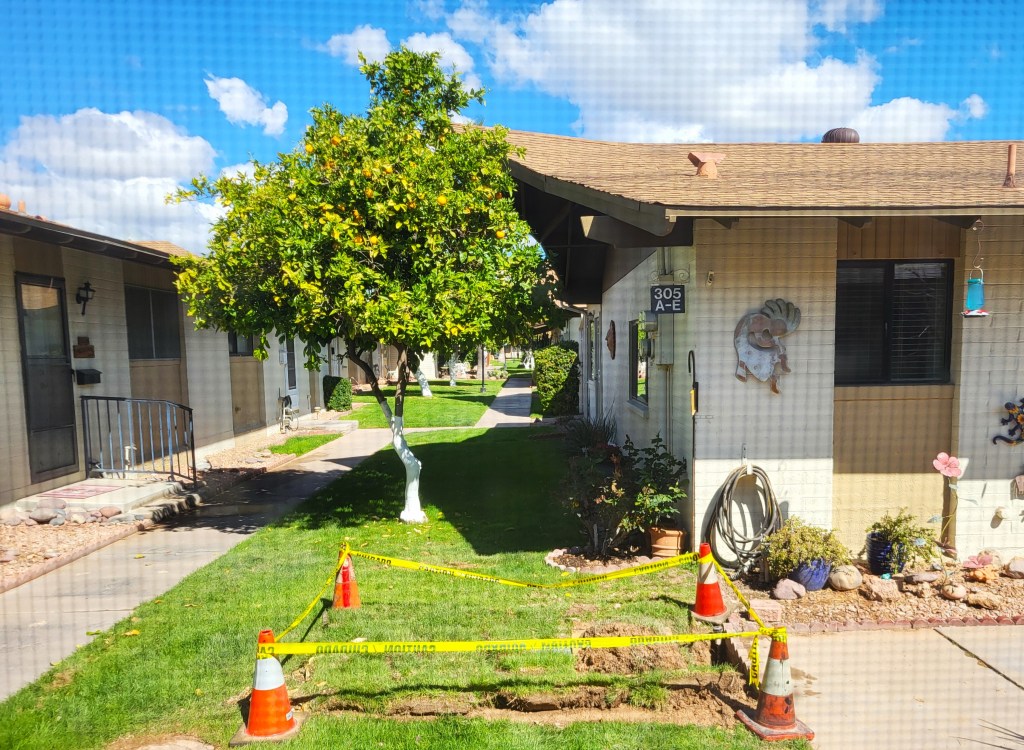
As I write this, my creative inspiration has been less certain and more diffused. Perhaps the construction cones, yellow tape, and jagged chunks of sod–prominent through the screen of our kitchen window after the replacement of a water main valve this week–are a fitting metaphor for the disruption I feel.
I’m living between and among several writing-related projects that deserve attention. The largest of these is a novel I’ve been mining … and drifting in and out of for the past eighteen months or so.
It’s a compelling (I think) fictionalized story of twin brothers navigating the pitfalls of their differences and a significant/sudden loss that muddies their family waters and transforms them.
I’ve written six or eight chapters, spent significant hours developing the back stories of both characters, and have a clear idea of the troubles they will face and how the story will end, but there is at least a year of research, writing and editing ahead. That feels daunting.
In the near term, I’m committed to blogging once a week and working with Marc, the artistic director of the Phoenix Gay Men’s Chorus, on another libretto later this month. This one, called “Encore”, will appear on stage in late June.
I’m also refashioning a retrospective essay about a teen’s emerging gay identity. This is something I’ve submitted to a few literary magazines. So far, no takers. But I’m determined to find a home for it.
Meanwhile, I want to teach a memoir writing class. On Monday, I presented the Scottsdale Public Library with a concept for a workshop I have developed. They like the idea. There are details and timeframes to figure out, but I hope to lead the first session with a small group of attendees this fall.
Yes, there is a lot under construction inside my brain and around me as snowbirds tiptoe to and from the parking lot past the various plots of uneven ground the plumbing crew left in their wake.
At least I’m choosing creative projects that are important to me … doing my best to entice more folks to read my books, while maximizing the slippery slope of my sixties.
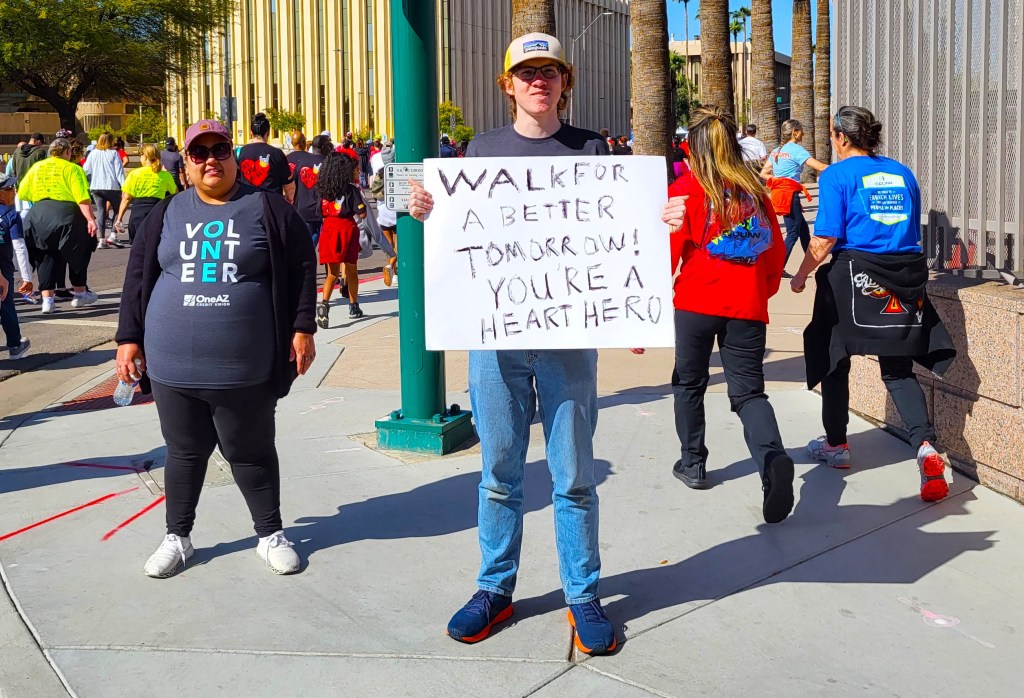
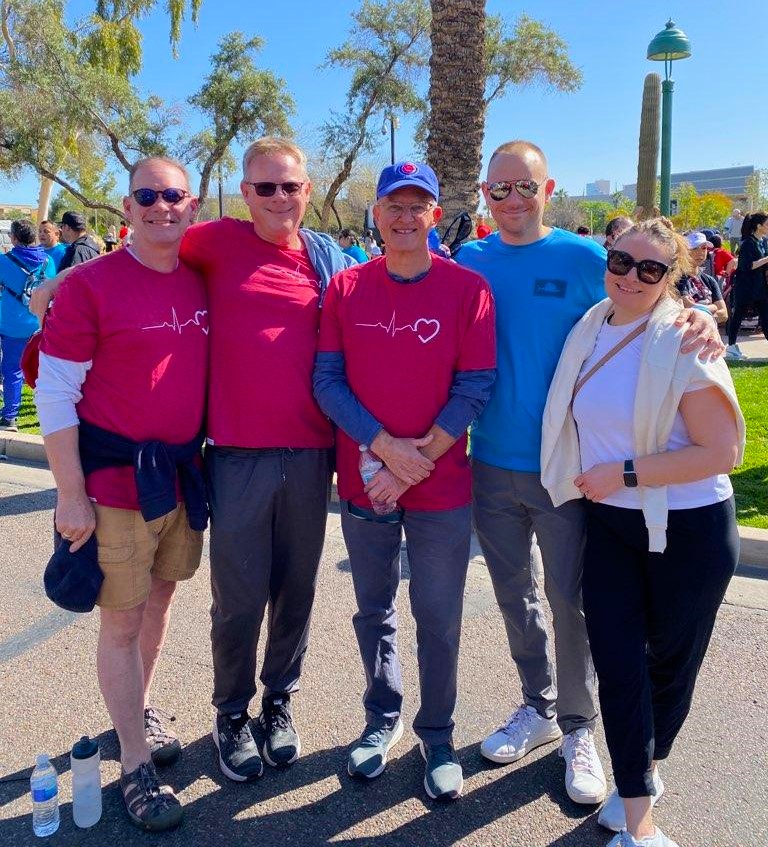
There was a moment on Saturday morning–about two thirds of the way through the Phoenix Heart Walk with my husband Tom, friend Todd, son Nick and his girlfriend Anastasia by my side–when I spotted this young man holding a homemade sign.
His presence and the message along the three-mile route touched me. I stopped to take his picture, hugged him, and thanked him for being there and sharing his heartfelt message.
I don’t really consider myself a heart “hero”, though our Heart Walk 2023 team I “coached” and dubbed “Friends for Life” did raise more than $2,000 in the fight against heart disease and stroke.
Thankful “survivor” feels like a better fit. Especially when I look back on that day nearly six years ago when Tom and I endured our most difficult and frightening moments individually and as a couple.
It was July 6, 2017, our collective sixtieth birthday. After feeling breathless on a humid summer day, I found myself lying on a gurney in the bowels of Barnes-Jewish Hospital in St. Louis.
After suffering a mild heart attack, I waited impatiently for two teams of heart specialists–actual heart heroes–to remove a blockage in the left side of my heart and insert two stents.
Fortunately, since that tumultuous day I have been able to transform my health. With a little luck, thirty fewer pounds to carry, and a lot of hard work, support, and exercise, I’ve lived longer, written more stories, and created a whole new existence in the Valley of the Sun. You can read all about our journey in An Unobstructed View.
Certainly, I’ve come a long way since 2017. Far enough that on Saturday, March 25, 2023–after completing the Phoenix Heart Walk and crossing the finish line–I stood with family and friends on the streets of Phoenix and breathed deep.
Along with the thousands of others in attendance, we “heart heroes” celebrated and embraced a sunnier, more hopeful day.
Me preparing to cross the finish line at the Phoenix Heart Walk.Heart Heroes/Survivors: Todd, me, Tom, Nick, and Anastasia
It’s March. The Christmas cactus adorning our den is definitely a late bloomer–and so am I. I turned 65 in July, but that number hasn’t deterred me from continuing to write, sing, and create.
When I close my eyes, I can still channel 18-year-old unaware me. Tall and thin with long straight blond hair in 1975. Seated in an uncomfortable wooden fold-down chair. Legs crossed in Middlebush Hall on the University of Missouri campus in Columbia.
I was an aspiring journalism major. One of a few hundred freshmen and freshwomen taking a required business course. Bleary-eyed from guzzling too much beer and demolishing late-night Shakespeare’s Pizza, we listened to our Marketing 101 professor.
He waxed on about demographics and American consumption. We doodled in our spiral notebooks.
What I remember most is that he told us the range of consumption occurred between the ages of 18 and 65. That’s when Americans had the most disposable income to spend.
The implication was that life, purpose, and relevance stopped after that. After retirement. After 65.
Of course, these days, life expectancy–for those who live to be 65–is more promising. But nothing is guaranteed.
At any age, “seize the day” is a smart strategy. Especially in your later years when (at times) it feels like you are riding in a runaway wagon racing downhill. Even if on most days you are enjoying the freedom and wisdom that comes with age as the wind rushes through your greying hair.
All of this is preamble to tell you that I am on the cusp of publishing my 5th book. It will be a collection of my best poems. Many of them explore love, loss, identity, discovery, disorientation, transformation, realization, and acceptance–spun through the ever-present influences of time and nature.
I began writing poetry in 1993. I was newly divorced, raising my boys as a single dad, working long hours as a communication consultant for Towers Perrin in Chicago, dashing for commuter trains, grieving the loss of my father, and beginning to understand myself and my emerging gay identity.
I have written dozens of poems over the past 30 years. Stashed them in an ever-expanding Word file. (If you follow me, you know I have shared some of them here over the past four years. The act of doing that has fed the poetry beast inside me. He’s now ready to emerge.)
Yes, at age 65 it thrills me to defy the logic of my marketing professor. To assemble my poetry and share it publicly–all in one place–for anyone who chooses to consume it.
Love and loss are universal human conditions. If we feel the first, we can’t escape the grief associated with the second.
I wrote You Everlasting in December 2009. It was a gift for my eighty-six-year-old mother.
I remember the surprise and delight on her face that Christmas Eve, after she slowly unwrapped the framed contents in tissue paper cradled in her lap.
“You wrote me a poem,” she said quietly.
In 2016, three years after she passed, I published the poem in From Fertile Ground. It is a book inspired and informed by grief.
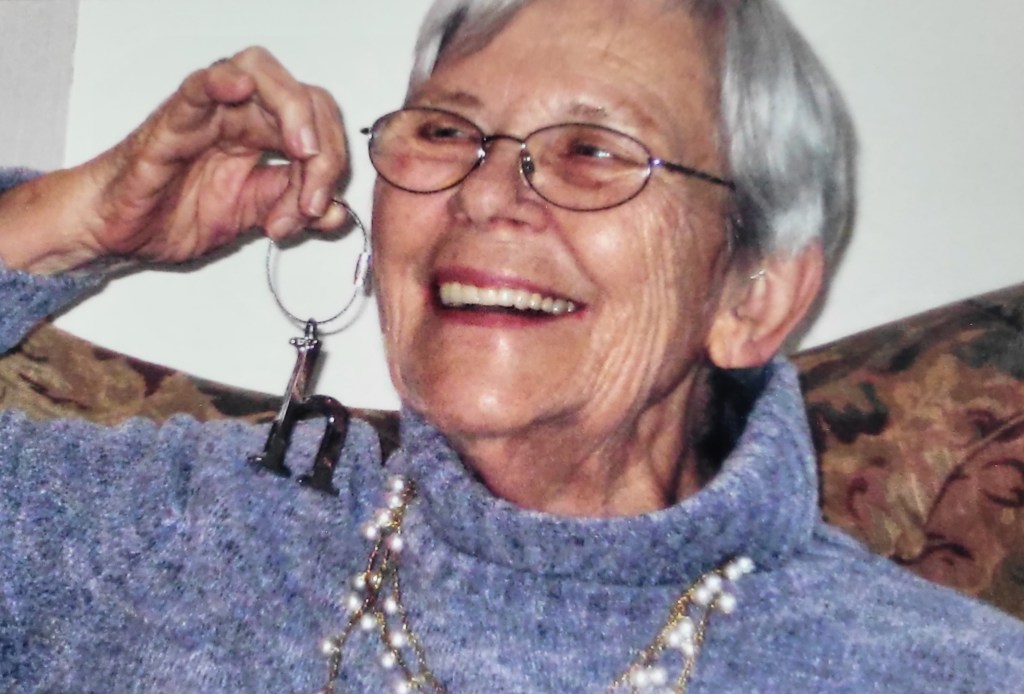
Today, on the tenth anniversary of Helen F. Johnson’s death, the time is right to share it again.
The imagery of flowers, trees, and animals comforts me. The verse provides much-needed continuity from her past existence to the reflections and influences that live on inside me.
The poem reminds me of that wise, nature-loving woman, who carved a resilient path for me to follow.
I still feel her presence today and can smile with the knowledge that, though she left on a frigid-in-Illinois, January morning in 2013, I carry the warm memories of her in my Arizona desert life in 2023.
Perhaps these words will prompt memories of your own loved ones, who are gone but never forgotten.
***
You Everlasting
You are the comfort of nature. Eternally pressed.
The first magnolia petal of spring.
The last gingko leaf of autumn.
The determined orchid that flourishes.
The lingering annual that endures. Perennial.
You are high and low tide. Remarkably present.
The hidden, tranquil meadow.
The crackle and thump of fresh melon.
The dancing firefly in a warm Carolina sky.
The soulful howl of a January hound waiting by the gate. Undeniable.
You are the simplest wisdom. Gracefully proud.
The tender touch of summer days that melt but never fade.
The breaking dawn of blues and greens forever in my memories.
The resilient path carved and captured in my heart.
The polished gem of hopeful dreams. Everlasting.
In December 2008, one year before I gave her the poem, my mother enjoyed another holiday celebration with her family in Illinois.
When Tom and I moved to Arizona in 2017, we were immediately impressed with the library system here in Scottsdale.
It consists of four library locations spread south to north through our community to cover the ever-expanding patronage of transplants from other places. Each is a book lover’s haven with artistic touches built into the architecture to reflect the landscape of the desert southwest.
Closest to us–the main facility–is Civic Center Library in Old Town Scottsdale. It’s a place my husband and I frequent to browse the stacks for something new or familiar to read. In the past, before Covid, it’s also where I participated in the Local Author Book Fairs.
What neither of us anticipated (until last fall) is that on a chilly-for-the-valley Monday–the twenty-third day in the twenty-third year of this millennium and five-and-a-half years since we called Arizona our permanent home–Tom would realize a lifelong dream there.
He would begin to lead a free, eight-week film series and discussion, stand in the Civic Center auditorium in front of sixty attendees (friends, acquaintances, neighbors, relative strangers, and film lovers) and share his deep knowledge and passion for iconic films from 1967-1977.
It’s an era characterized in the American film industry as the New Hollywood. A period of controversial, counterculture attitudes that would personally define and shape his love of film and its ability to combine art form with social statement.
But as I sat in the front row to watch Tom welcome library patrons and see the first installment of the series (A Decade Under the Influence, a provocative documentary chockful of film clips and interviews with directors, writers and actors from that era) it was Tom’s moment that mattered most.
He has always imagined the thrill of owning a small theatre. Of showing films from that era–and classics like the Best Years of Our Lives from our parents’ generation–to inform and entertain those who may or may not be familiar with them.
We don’t have the financial ability to do that. But we do have friends and connections in our community (thank you, Glenn). In this case, they aligned magically to put Tom in touch with library management and help make his dream bloom and grow in the desert.
During and after the program Monday evening, I could feel the buzz in the auditorium. Many came up to thank Tom for sharing his film expertise and personal anecdotes. Not to mention a handy dandy packet of fun facts and background information about the films, which Tom happily prepared and the library staff copied and distributed.
I expect that many of the sixty who attended will be back for the second film on January 30. They’ll certainly be there to see Bonnie and Clyde, the jarring, graphic, and spectacular film about the Barrow gang and Depression-era Texas.
I imagine they will also return to hear Tom’s film insights.
***
Note: If you live in the area and would like to attend, the film series runs from 3 to 6 p.m. on Monday nights until March 20, 2023, at the Civic Center Library, 3839 N. Drinkwater Blvd. Registration not required. Space is limited.
The program is a free eight-week class about original, creative films from the Hollywood renaissance. A look at how filmmaking evolved after relaxed censorship and rating systems gave filmmakers freedom to explore new subject matter and styles of cinematic expression. Discussions and screenings each week are led by Tom Samp. All films are recommended for mature audiences.
Schedule of Films:
A Decade Under the Influence (January 23rd)
Bonnie and Clyde (January 30th)
The Graduate (February 6th)
Easy Rider (February 13th)
Midnight Cowboy (February 27th)
M*A*S*H (March 6th)
Five Easy Pieces (March 13th)
Annie Hall (March 20th)
On Monday, January 23, 2023, Tom Samp welcomed attendees to the first installment of a free eight-week film series–The New Hollywood:1967-1977–at the Civic Center Library in Scottsdale, Arizona.
Ruminating from the threshold of Medicare eligibility, this is how I choose to remember my parents in their later years: content and seated side-by-side, listening to jazz in St. Louis on the banks of the Mississippi River.
If you’ve read my first book, you know Helen and Walter had a complicated and volatile relationship. But by the mid-to-late-80s–after the heavy lifting of jobs, child rearing, and the daily swirl of Dad’s bipolar rants–they found a more peaceful coexistence.
Together they rediscovered a love of Dixieland jazz under the shadow of the Gateway Arch. They tossed their metal folding chairs (latticed with yellow and white nylon strips) into the trunk of their sensible sedan, drove downtown, and evidently walked to this shady spot.
It happened just steps away from the cobblestones that led to the now-defunct Admiral Boat and historic Eads Bridge that still connects Missouri and Illinois. (If you squint, you’ll see them both in the background.)
I remember the faint giddy-up in my fading father’s voice over the phone. He described what he and Mom experienced … together … rousing, organic music played by happy people. Trumpeters, saxophonists, trombonists blaring on a summer’s day.
Best of all, all that glorious music was FREE. Products of the Great Depression, Dad’s and Mom’s frugality was baked into their souls. Thankfully, it transferred magically into mine.
Years later, as I gathered coupons for a trip to the grocery store with her in northern Illinois, my mother would smile with pride at me from under her floppy hat and announce, “You’re a good shopper, honey.”
I imagine my sister Diane took this photo. At the time, she lived near them in the St. Louis suburbs. I had already moved to Chicago in 1980 to launch my communication career and create a life with Jean, then my wife.
Busy in my late twenties and early thirties, I was happy to know of a positive change in my parents’ relationship, but I think I dismissed their newfound glee and meeting of the minds. Digging deeper, maybe I felt sad that I missed this better chapter.
Now that I’ve arrived at the station in life depicted in this photo–greater leisure time, protective hats, contentment, wisdom, and personal vulnerability–I see more clearly how tragic it is that we Americans dismiss the trajectory of our older citizens in favor of youth and vitality.
It seems like it should be the exact opposite. Other cultures figured that out long ago. Why is it we are so hung up on viewing the activities and lives of young people as more valuable? The Kardashians? Please!
It boils down to money, marketing, and economics. Companies know that many seniors–then and now–live on fixed incomes. They don’t have the disposable income they once did. But what a shame to diminish their worth and assign it a dollar amount.
This story–part nostalgic reflection, part rant on agism–was prompted by rejection. No, I wasn’t job hunting. Five months ago, I entered my latest book in a contest with Memoir Magazine. I had high hopes I might at least get some sort of honorable mention.
On Sunday, I received a cordial, strategically written email thanking me for my submission. Then the other shoe dropped. Though my set of whimsical-and-serious Arizona stories and flights of fancy made it through the initial review, it didn’t land on the short list.
I have to admit. I was crestfallen. I think I’m a damn good writer. I also realize the competition was stiff. I lead a relatively ordinary life with my husband. At this point, my life isn’t filled with drama. It’s my calling to write stories about what it means to age, what it means to be gay, what it means to exist and survive in this crazy world.
Yes, as my husband reminds me, there will be other opportunities, other contests to consider. But especially now (three weeks after testing positive for Covid and fortunately recovering) none of us knows what tomorrow will bring.
All of this brings me back to Helen and Walter … and all that jazz they enjoyed under the Arch in the 1980s. I suppose I’m better off just enjoying the moments of life as they appear, singing when I want to sing (I have a brief solo in my June concert with the Phoenix Gay Men’s Chorus), writing what I want to write, and caring less about accolades and awards.
I guess I’m better off giving thanks for the perspective that comes with aging. No matter whether the literary world or the greater universe ever recognizes what I have to say, I have my life. I have my voice. I have my writing.
It’s not unusual for the proximity of neighbors to cause conflicts.
But often the bonds we forge with those next door–or in this case along the back fence–can add more texture and meaning to our lives than we once imagined.
Shortly after Tom and I moved west, I wrote Along the Back Fence about Millie–our Illinois neighbor from 1996 to 2017.
I’ve been thinking of her again recently, because the fifth anniversary of selling my Midwestern home is approaching.
This story first appeared in An Unobstructed View, a book about my personal journey from Illinois to Arizona in 2017 and an unexpected detour that awaited in the city where I was born.
In this world of turmoil and uncertainty, our best neighbors deliver color, comfort, and continuity.
I bet there’s a Millie in your life worth remembering.
***
Long before I arrived at my Mount Prospect home, Millie loved her garden and the hibiscus plants she and her husband had planted on the other side of the back fence.
But when I first met my neighbor Millie in the summer of 1996, her husband had been gone for a few years and the exotic flowers were waning too. She was alone and lonely in her mid-seventies, but not in a quiet and retiring way. There was plenty of fight left in Millie.
It wasn’t an auspicious start for the two of us. I had begun to create a small compost pile in the far corner of my yard. She wasn’t happy about it–too many decomposing grass clippings and small spruce branches in one place she thought. In her view, I had created a mess.
When she complained about the smell that had started brewing there, I scrapped the idea and placed the yard materials by the curb for the next trash pickup. I didn’t want to alienate Millie. I didn’t want to contribute to her unhappiness.
I don’t think we had much to say to one another over the next few months. Only a quick hello here or there as I pushed my mower around my yard, and she tended to her garden that wrapped around her detached garage.
Eventually, we broke the ice. From one side of the fence, she told me about her love of roses. From the other, I introduced her to my sons and then Tom. After that, we found firm footing.
By the fall of 1998, Maggie was in the picture. I remember Millie leaning over to pet our dog’s voluminous ears. Millie would cradle Maggie’s head on either side when the dog placed her paws along the back fence. “How is that Maggie today?” she would ask. Our droopy-eyed pet had won her heart too.
Over time, Millie got to know more members of my family. One summer afternoon, Tom and I decided to invite Millie over for a backyard barbecue. My mother was visiting us from St. Louis.
Both Mom and Millie were gardeners. There was plenty for them to discuss about the flowers they had grown, nurtured, and cherished over the years. Not to mention the yummy three-bean salad Millie had whipped together in a jiffy.
“Next time I’ll bring my ambrosia salad,” Millie told us. “Everyone loves it!”
And there was a next time the following year. Tom’s mom and dad joined us from the other side of Mount Prospect. Sure enough, Millie brought her signature salad of mandarin oranges, maraschino cherries, crushed pineapple, and shredded coconut to compliment the relatively ordinary burgers and hot dogs we grilled that afternoon.
That was the last of our three-bean-and-ambrosia-salad moments with the older set. The seasons passed and so did our parents–Tom’s dad in 2012, my mom in 2013, Tom’s mom in 2015.
But Millie survived them all. She heard about each of our losses along the back fence. It gave me comfort to meet her there, though our encounters became few and far between as her own health–her own surefootedness–declined …
***
Rest assured, I’ll share part two of this story later this week.
Today marks four years since I began my blogging adventure and obsession.
When I launched this website May 4, 2018, I wanted to promote my books and develop a greater literary presence online. Over time, that goal has been superseded by a desire to share topical stories about the extraordinary, meaningful moments and people that cross through one ordinary life.
It’s been no simple task nurturing my creativity in this chaotic world. Blogging has given voice to my memories, ideas, values, observations, and opinions. More than that, in my sixties it has become the organic structure I need to stay sharp, sane, hopeful, and whole.
Most definitely, blogging was my salvation during the height of the pandemic. The whimsical and serious tales I spun at my laptop became fodder for my fourth book about two gay men forging a new life in the Sonoran Desert.
This post is #324. That’s an average of eighty-one stories per year or nearly seven each month. Written at all hours of the day and night. Concocted in all sorts of moods: happy, sad, angry, reflective, devastated, and triumphant.
Thank you for joining me on this circuitous journey. If you follow me, you know I often share poetry. Frequently, I like to include photos that ignite and inspire an idea that might otherwise never have surfaced.
For nearly thirty years, I’ve written poems and stashed them in an expanding file. It’s a body of work that encompasses the highs and lows of six-and-a-half decades and chronicles the profound role nature plays in our everyday existence.
As I approach my 65th birthday in July, I feel an impulse to publish a collection of my most vivid poems. Would such a chapbook interest you? As you ponder that question, I hope you enjoy reading this verse.
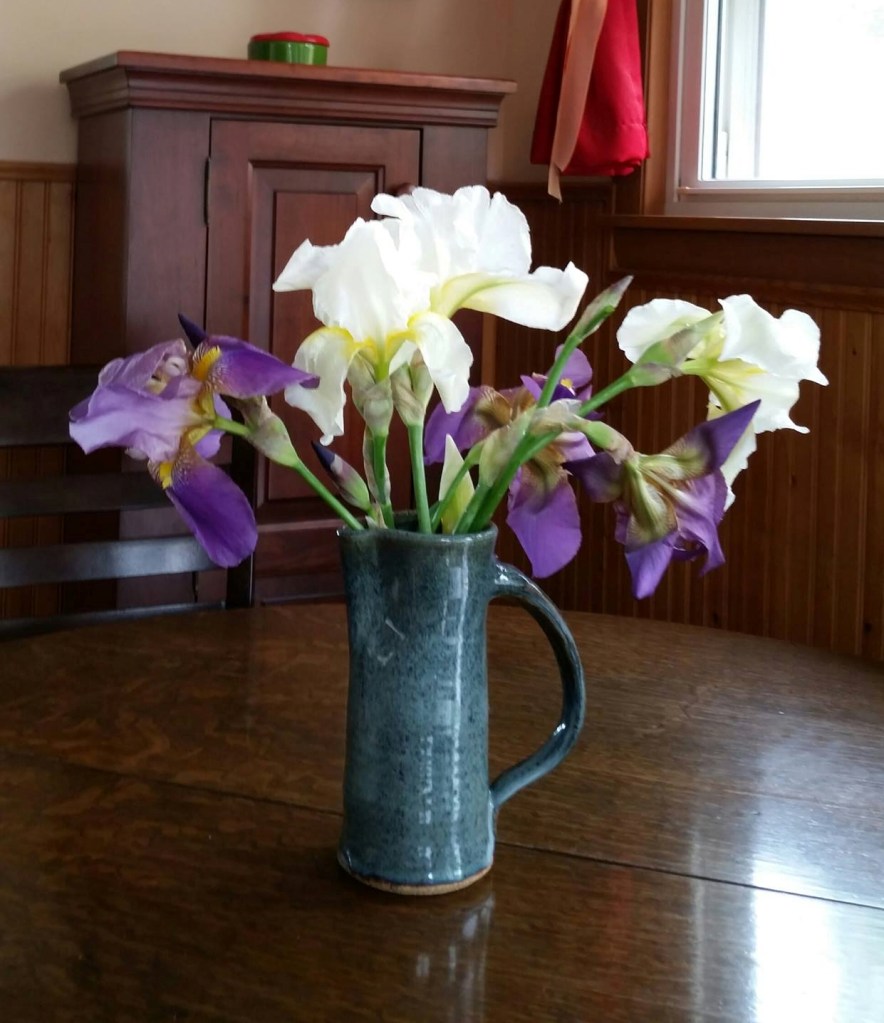
When I wrote it May 7, 2016, Tom and I were Midwesterners–more familiar with blooming iris and peonies than spiky cacti and monsoon rains.
As an Illinois resident on the threshold of more change than I could imagine, I wanted to remember the imagery of past Mays.
My, our world has changed.
***
May’s Bouquet
Arriving welcome, clean and fresh, reflecting skies grow amorous.
Crisp at dawn, bursting through, captured by a mother’s view.
Blooming iris, sweet repose, ducklings lined up in a row.
Bounding blooms, fast and pure, veiled peonies pink allure.
Reaching high, bred for speed, stretching out to take the lead.
Calm til dusk, an even pace, ushered in the rain’s disgrace.






 Mark Johnson Stories