It’s a rainy, blustery afternoon in Scottsdale, Arizona. Windbreaker weather.
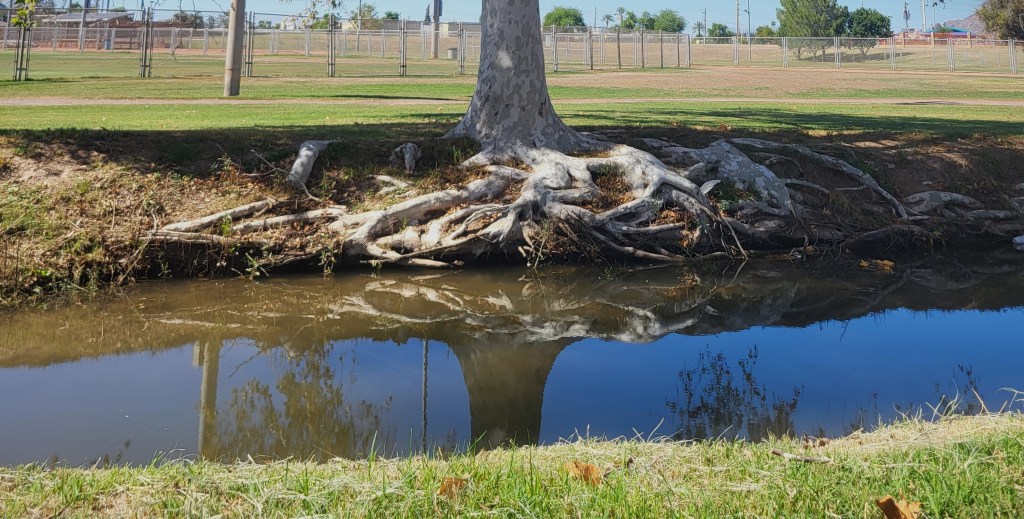
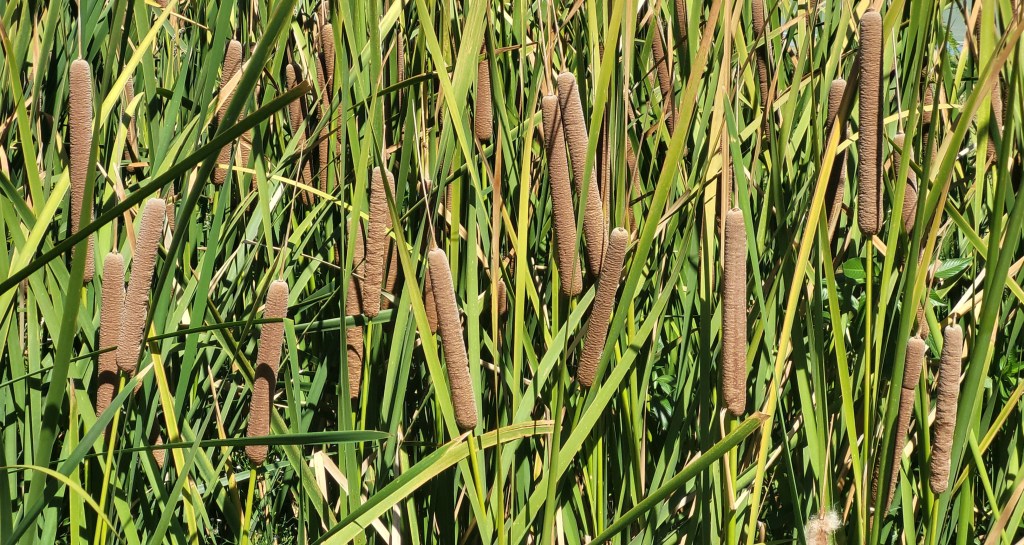
Nothing like the norm. Nothing like this photo I captured two days ago as Tom and I made our way around Chaparral Park.
But measurable rain is welcome here, and–if the weather forecasters are right–more is in the offing this week with heavy snow in Arizona’s higher elevations north and east of us.
Now that I’ve lived here nearly seven years (that anniversary arrives in July), I’ve learned that we will have plenty of blistering hot days between June and September.
So, I will embrace this cool, short-term, winter-in-Arizona anomaly. Maybe it will help build our reserves in the Colorado River basin.
As the raindrops fall, Tom and I celebrate a personal milestone. Today–February 6, 2024–we reached our full retirement age (FRA)–66 years and 7 months for those born in 1957–as defined by Social Security.
Basically, that means we are eligible to receive 100 percent of our Social Security retirement benefits–benefits we each accrued by paying into the system and working all those years, commuting to and from an array of jobs on mostly cloudy, windy and often-snowy Chicago days.
If you are unfamiliar with the U.S. Social Security Administration regulations, the Social Security Act was signed by President Franklin Delano Roosevelt in 1935.
The idea then–and still today, fortunately, though the program is under scrutiny–is that a small portion of Person A’s wages goes toward helping to support senior citizens with a financial lifeline.
Then, when Person A reaches senior status, he or she has earned the right to Social Security retirement benefits. As the rules exist today, those who log at least 40 quarters (the equivalent of 10 years) in the United States workforce are entitled to some sort of retirement benefit.
Those eligible can start taking their benefit as early as age 62 (but receive only about 70 percent of their benefit) or as late as age 70 (and receive more than 100 percent).
Of course, this is a decision laced with all sorts of permutations and “what ifs.” None of us knows how long we will live. But I opted to begin drawing on my accrued benefits–what I earned during all those years–now.
Looking way back in time … when I was in my twenties and thirties … I hoped this day would come. But I was never sure I could rely on it.
So, I did my best along the way to save in other ways to protect myself. It was an awareness that came from my hard-working father and mother, who lived through the Great Depression. They probably cheered when the measure became law.
With time, I imagine the Social Security Administration will need to push the FRA to age 70, because of our aging population–and the sheer number of us Baby Boomers who will receive payouts and deplete the reserves.
But I hope younger Americans in the workforce one day also will realize the same sort of accrued retirement benefit.
Certainly, like me, they will have earned it and will deserve it.
The quietest slices keep us whole and hopeful. If we let the snippets slip past without noticing, we are missing the moments, the essence, the connecting tissue, the story of life itself.
On a regular basis, all of us encounter unexpected small and large obstacles.
One day, they may be as fixable as a “low tire pressure” warning light that illuminates on the dashboard.
The next, something far more unimaginable, unexplainable and unrepairable. Like learning of the apparent suicide of a forty-three-year-old friend, who seemed to embody the definition of vitality.
It was simple to stop at Discount Tire to ask an attendant to increase the air pressure in our tires. (The cooler desert temperatures must have deflated them.)
It will take much longer–time, space, and reflection–for Tom and me to process Chad’s demise.
I’ve often thought that resiliency is one of the most important human characteristics to cultivate.
It is our ability to cope, process, manage, and emote our way through or around life’s setbacks that defines our longevity. This latest loss confirms my belief.
These observations surfaced this morning during a walk in the park in my community. At Chaparral Park in Scottsdale, Arizona to be precise.
My husband and I had just finished our yoga class. Afterwards, he wanted to lift a few weights in the gym.
I opted for stretching my legs on my own under a few puffy clouds that dotted Arizona’s wide-open October sky.
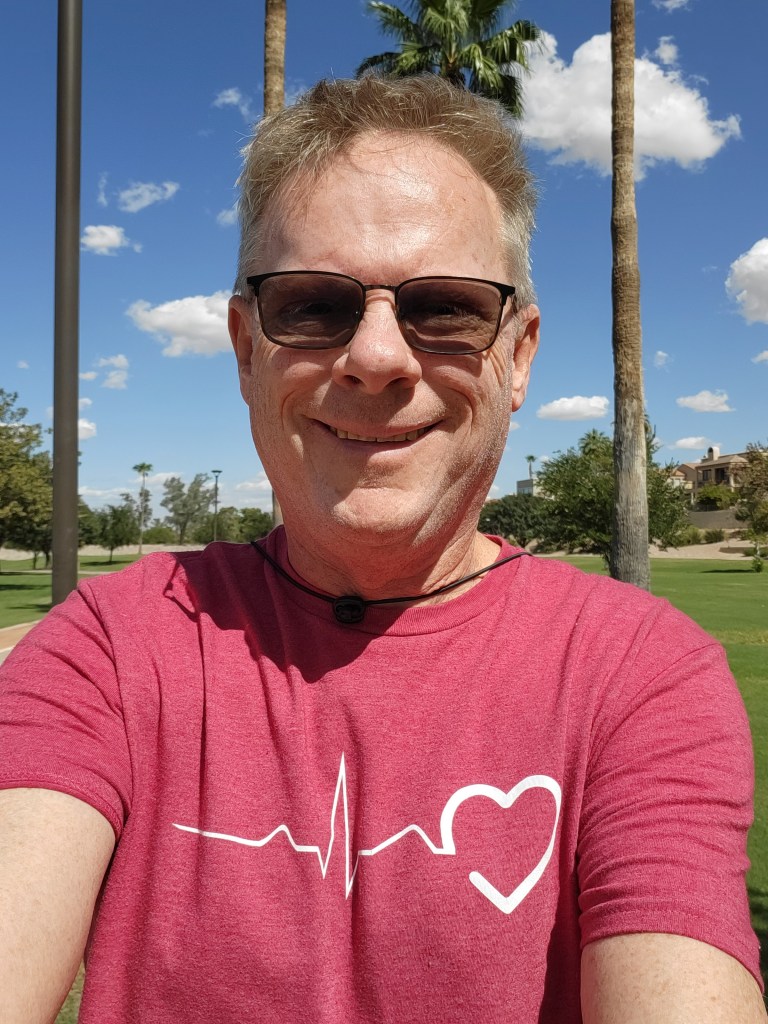
Near the midpoint of my walk a fit couple jogged up as I waited for the light to turn green at Chaparral and Hayden roads. One of them admired my shirt.
“You must be in the medical profession,” he gestured toward the beating heart I wore proudly.
“No, I’m a heart attack survivor,” I explained. “I helped raise money for the American Heart Association.”
They smiled and wished me well. Then, they dashed off when the WALK sign turned white.
It was a simple exchange, a reminder of a trauma I experienced and wrote about which now feels way off in the rearview mirror.
But those few sentences with two sympathetic strangers infused me with a renewed appreciation for my personal resiliency.
No doubt, it’s a quality I observed in my mother, a saver and survivor. She always described herself as a child of the Depression.
It’s also a trait I began to mine in my thirties after my divorce. A strength I’ve fine-tuned on countless treadmills since suffering a mild heart attack six-plus years ago on my sixtieth birthday.
I have no regrets regarding my friendship with Chad, but I wish he would have called Tom or me before he made his worst and most irreversible decision.
I would have told him that while life is no walk in the park, it is always worth the fight. To find a skilled therapist. To dig deep on the darkest days. To survive the pain. To accept our losses.
To embrace each and every day we are granted. To reach out for love and hope. To live to see tomorrow.
“I have no choice. I hear your voice. Feels like flying.”
If you love Madonna or remember who she is–please say you do–these eleven words from Like a Prayer, her 1989 pop hit, may prompt your musical heart to soar.
On June 4 and 5 at the Tempe Center for the Arts, these lyrics also will comprise my solo in the Homecoming concert with the Phoenix Gay Men’s Chorus.
I’m a lifelong lover of the St. Louis Cardinals baseball team and an ardent Arizona admirer of a majestic bald eagle that likes to pose atop a telephone pole along Hayden Road near Chapparal Park in Scottsdale every May.
Still, I don’t know what it feels like to actually fly without the aid of an aircraft.
No matter. Singing has always felt like flying–or what I imagine it to be–with the wind lifting me up as I spread my wings and raise my voice. Particularly the sensation of standing on a stage and harmonizing with a chorus of like-minded, artistic-and-musical souls.
The last time I sang a solo on stage was 1979. I was a senior at the University of Missouri and performed On and On (the way-too-precious-sounding Stephen Bishop tune) with a vocal jazz ensemble of fresh-scrubbed faces and silky-smooth voices. We called ourselves The Singsations. (I know. It was pretty corny.)
Anyway, if you’re a Baby Boomer, you know the lyrics from Bishop’s 1976 song …“Down in Jamaica, they got lots of pretty women. Steal your money, then they break your heart …”
At that point, pretending to be a straight man, I wasn’t in touch with my true orientation. It would be June 2010–long after the birth of my two sons and a failed first marriage–before I would discover the safe haven and friendship of the Windy City Gay Chorus in Chicago.
But from 2010 to 2017, I never auditioned for a solo with Windy City. I was content to be a voice among voices.
In 2022–in the autumn of my life a month before my sixty-fifth birthday, in a city where it feels like summer lasts forever–I will be singing my next solo. I’ll be surrounded by a community of about forty gay friends.
As you might imagine I’m excited and a little nervous … waiting to take the stage on June 4 and 5 with more than a dozen friends and family in the audience.
I know I will savor every note of the experience. No doubt, it will feel like flying.
In May 2021, I captured this photo of a bald eagle on stage along Hayden Road in Scottsdale, Arizona. Last Sunday, as Tom and I walked together, this magnificent creature reappeared and dazzled us by swooping down to the lake below to secure a fish for breakfast in his or her talons.
For as long as I can remember, I’ve been enchanted by the seductive sound of certain nouns and adjectives: amethyst, magenta, grandiose, vivacious, lavender, conundrum, veranda, gardenia, daffodil, chaparral.
I can’t explain it, but feeling the rhythm of these three-syllable descriptors and seeding them in a story lightens my spirit. It must be the same high–a chaparral high (not High Chaparral, the exotic, dusty and remote TV western of my youth)–that a mathematician realizes the moment he or she solves an equation.
Imagine my glee, having the word chaparral appear as the name for a road, pool and nearby park. Home of tanned and true Arizonans. Firm and flabby. Shirtless and sumptuous. Lithe and leathery. Geese and goslings.
During this prolonged pandemic pandemonium, Tom and I have ventured to Chaparral Park to get our steps in on numerous occasions. We like the warm neighborhood atmosphere–singles and couples working out at safe distances framed by both palatial palms and small-leaved evergreen shrubs you might actually see if we lived on a chaparral.
Psychologically, strolling there also reminds us of our diligent days working out just down the street. Mounting the treadmill and elliptical at the local gym, Club SAR, which we typically would frequent if we and it weren’t shuttered by COVID-19.
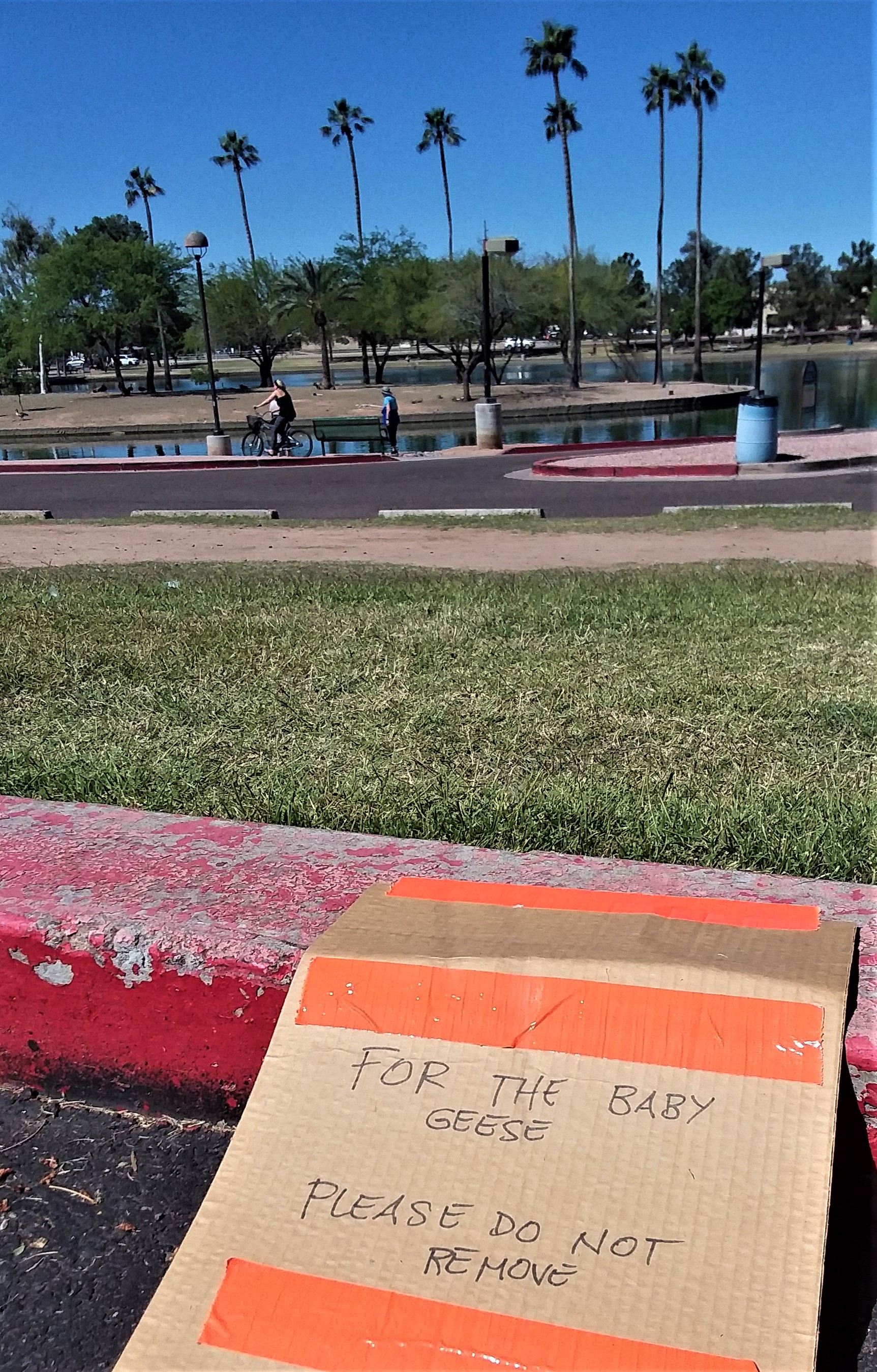
Based on visible signs, adorable ducks and geese also feel fortunate to live in the warmth and kindness of our community. It’s written on cardboard for the world to see that someone certainly cares about our critters.
“For the baby geese … Please do not remove.”
Yes, the young ones that began to appear recently, just east of Hayden Road and the shadows of Camelback Mountain, need a ramp to get there steps in. To achieve their chaparral high.




 Mark Johnson Stories