Tag: Dad

Protests and Poetry

Are you guys going to the protests this Saturday?” Nick wondered last Wednesday via a text.

No. We aren’t planning to. It’s just too hot,” I responded to my son.

But as the week wore on, I began to regain my energy following three phenomenal concerts with my Phoenix Gay Men’s Chorus pals.

On Friday, I reconsidered Nick’s question. I told him Tom and I would do it. A few of our chorus friends wanted to join us too at a No Kings protest in Scottsdale.

I should tell you that I don’t consider myself an activist, though I have marched for various causes on several occasions in my life. I prefer to share my voice and perspective through my writing.

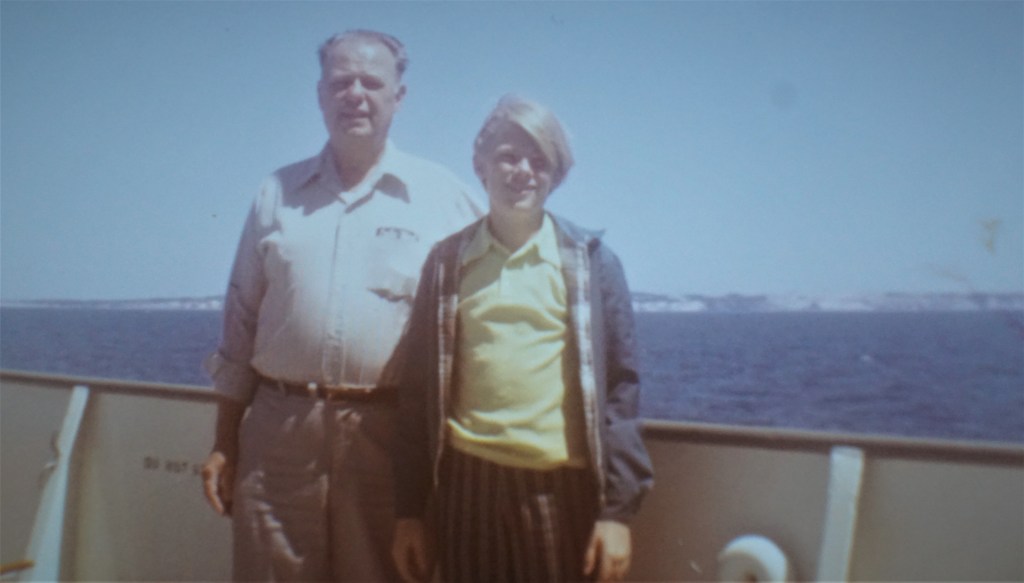
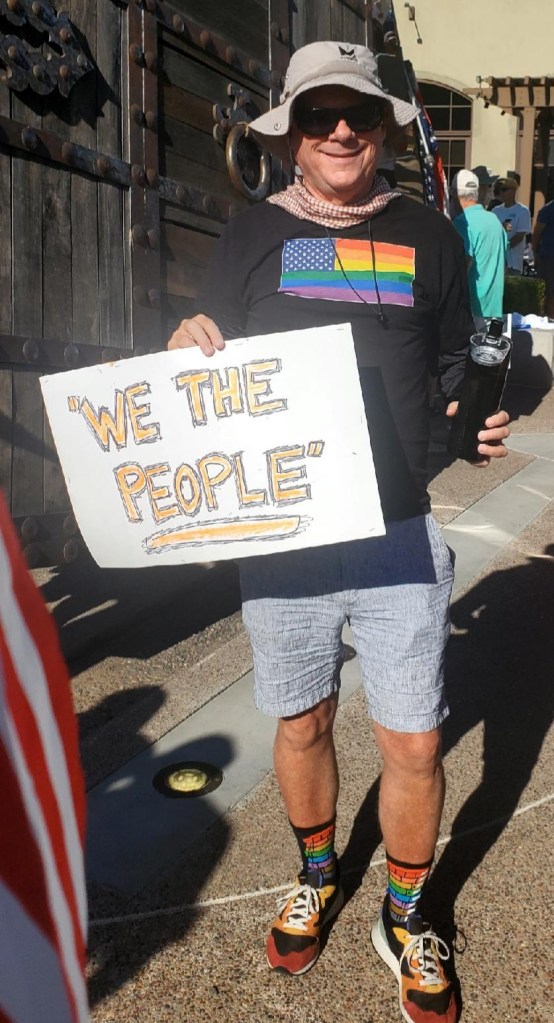
But I also recognize the dire state of our democracy. I decided if my World War II veteran father (he defended democracy in Europe with the allied forces during the Battle of the Bulge in late 1944) could endure frozen feet in foxholes with his buddies and risk his life as an army sergeant, I could certainly endure the 90-plus desert temperatures in Arizona for two hours, wave my American flag and “We the People” sign, and join forces with family and friends to raise my voice. To make sure it was heard.

So, Saturday came, and we did it … Mark, Tom, Nick, Kim, Dougal, George and one to two thousand others represented democracy in Old Town Scottsdale. We were a dot in a map of some five million in the U.S. and abroad who took to the streets in big cities and small towns. All of us deeply concerned.

Locally, it was an inspiring and peaceful No Kings protest consisting of angry but well-behaved women and men. Young and old. A few children with parents and grandparents. Couples. Singles. Straight. Gay. Multi-cultural. Dogs, too. Dare I say diverse?

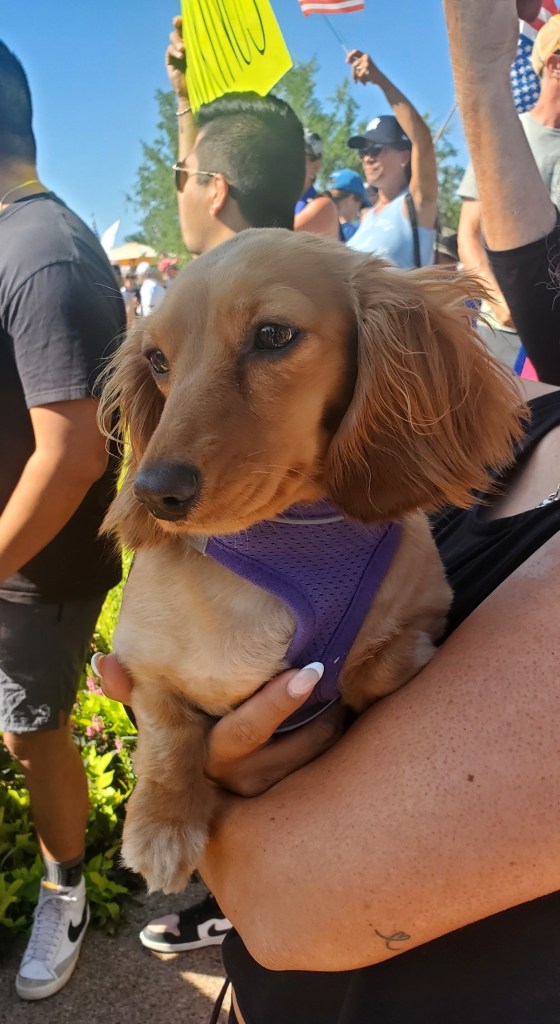
At one point, Tom and I chatted with a fifty-something mother from San Diego. She was visiting her daughter who lives in Scottsdale. They took turns chanting “No Kings” while cradling their adorable, slightly overwhelmed dachshund.

The dog’s benevolent eyes seemed to say, “what are we all doing here?” All I could do was shrug and smile. There is no explaining all we have endured in this country over the past six months. Not to mention the previous eight or nine years.

A short while later, I turned to discover a man holding a profoundly-funny-and-literary sign. A parody of American poet Robert Frost’s The Road Not Taken. I imagine Frost would have loved it, if he had been alive and standing beside me.

I asked the man if I could take his picture. I told him it spoke to my wordsmithing sensibilities. He surprised me by saying he was a math guy.

I’ll likely never cross paths with him again. He’ll never know that my book of poetry, A Path I Might Have Missed, was inspired by my love for Robert Frost’s verses. But on June 14, 2025, we stood on the same page … on the same street corner … on the same shared path.

Together–close friends, like-minded acquaintances, and distant strangers–we proclaimed our desire and hope to rescue American democracy from the clutches of fascism.
You Wouldn’t Believe

Since you’ve been gone, you

wouldn’t believe how the world

and our lives have changed.

You never knew that I married

a man I love, or that we live

in the desert where I can swim

outside in the winter, or that

I survived a heart attack on

my sixtieth birthday, in the

city where both of us

were born, or that

the grandsons you loved as

children are thriving, though

they have nearly reached

middle age, or that some people

now ride in cars with no

actual drivers, or that it’s kind

of a metaphor for our

country, which has lost

its moral compass, or that

the flag you defended and

saluted is no longer yours, or

that I am thankful to write and

sing in my late sixties, because

I was meant to do those all

along. All of this is true, and

it prompts me to worry and

hope–mostly worry–that

even though I am thankful

for good health, my kind and

compassionate husband, my

own boundless empathy, and

the relationships I’ve nurtured

with my sons, and many diverse

friends, I feel heavy uncertainty

in our country, and anticipate

more losses ahead only

to protect myself, and

of course, it reminds me of

other losses I’ve endured,

especially on the anniversary

of your passing the day after

a big Thanksgiving meal

with your sisters. By now,

you can see that the world

you knew is most definitely

gone, but you live in

my memories, and

I still love you, I grieve for you,

I grieve for me, I grieve for us.

Most of all, I still remember the

many monumental moments

–the good and bad–we shared

so long ago, Dad.

The Soldier on the Hill

I last visited my father’s grave at Jefferson Barracks National Cemetery in September 2021.

If there is such a thing as beauty to behold in a final resting place for those who served, it exists there just south of St. Louis on the banks of the Mississippi River–fourteen hundred miles east of where I live and write today.

On this Memorial Day, I remember Dad–and the thousands of fallen soldiers gathered around him–with twelve lines I wrote on August 27, 1996 … almost three years after he died.

This poem and forty-one others appear in my book A Path I Might Have Missed.

***

The Soldier on the Hill

I talked with the soldier on the hill today.

We sat, we cried, we laughed, we prayed.

The bells rang true, the trees stood free.

A breeze swept past to welcome me.

Shadows filled the landscape then.

Tempers rose without his pen.

Snowflakes fell, the grass turned green.

All without a change of scene.

Now the soldier rests with them,

Hand-in-hand–all blessed again.

They greet another trailing soul.

Who makes the journey past the knoll.

Five Hundred

Numbers–like true stories that capture a moment on a page–are meaningful.

They aren’t merely markers on the shore of life waiting to be washed away with the next high tide.

They measure our progress. They tell us how far we’ve gone; how much we’ve achieved; how many we’ve accumulated.

My dad loved numbers, especially twin digits. On his fifty-second birthday–December 4, 1965–he wrote a poem about their significance in his life as a twin.

I published Unity 66 and the Twin Digits in the context of my first book. It belongs there, embedded alongside and intertwined with the writings of my grandfather, mother, and me. In its purest form, From Fertile Ground is an immersion into our family’s writing DNA.

Despite Dad’s volatility, he could be an exuberant, charming man. He believed in celebrating life’s mundane and magnificent moments as they happened.

On the road of our family vacations in the late 1960s (from his position behind the wheel of our white, four-door, 1965 Chevy Biscayne sedan), he announced to my mother (in front) and my sister and I (in back) when the odometer of our car was about to reach a milestone.

“Hey kids … we’re about to reach 50,000 miles.”

That was our cue to sing with him like circus clowns dancing to a calliope from the backseat.

“Da da da da … da da da da … da da da, da da … da da … da da da!”

Earlier this week–on April 7, 2024, to be precise–I hit the five hundred books sold mark since February 2016 when I first became a published author.

(If you are one of those who have supported my creative writing pursuits, thank you! I’ll bet there are a five hundred more who’ve read my books free through libraries and Goodreads giveaways I’ve sponsored.)

How do I know? First, I keep track of all my book sales on a spreadsheet I update monthly. Second, my Amazon sales dashboard tells me that someone in the United States bought number 500, my book of poetry, that day.

Of course, these aren’t best-selling numbers. Not even close. I’d need to add a few more zeroes to play with the big leaguers. However, numbers–while important–aren’t necessarily equivalent to quality or creative impact. (If you’ve seen the movie American Fiction, you know what I mean.)

At any rate, for an independent writer operating with a paltry budget, my book sales numbers aren’t too shabby.

Somewhere, on the highway of life and in the universe of creative possibilities, I imagine my father smiling at me from the front seat through the rearview mirror with the wind buffeting his combed-back hair.

He’s gripping the wheel with his left hand, while waving an imaginary conductor’s wand with his right. He’s singing along with the crazy circus music from our 60s family vacations.

Like my husband Tom–last night sitting on the fold out couch in our cozy Arizona den–my father Walter–if he were still alive–would be telling me to keep writing about the things I enjoy.

Because writing, telling, and sharing serendipitous stories is what I was meant to do. No matter what the numbers say.

Because I Still Remember

Dear Dad,

Thirty Thanksgivings have come and gone. You wouldn’t recognize the world now. It’s not the one you left on November 26, 1993–much less the country you helped defend during World War II.

Despite some steps forward, life in 2023 is far more complicated, contentious, and fragile for most people.

Nonetheless, I count myself as one of the lucky ones. Thankful to be alive. Thankful for the love of family and friends. Thankful to remember you.

I met Tom about three years after you died. In my thirties, I didn’t imagine this sense of companionship and contentment in my later years … able to marry another man with a similar worldview and creative disposition.

Nor did I imagine living and writing in the warmth of the Sonoran Desert. Creating a life far outside the bounds of the Midwest existence I called home for nearly sixty years.

Over the past three decades, I’ve often reflected on your life, your troubles, your good intentions.

Whenever Tom and I watch the film, I Never Sang for My Father, I am reminded of the deep and treacherous waters fathers and sons navigate together.

We had our share of those moments, but I don’t see a huge resemblance between our relationship and the conflicts facing the two lead characters–frail father (Melvyn Douglas) and his writer son (Gene Hackman)–who never find common ground or the language to make their relationship whole.

There is a profound line in the movie that resonates and always leaves me in tears.

“Death ends a life. But it does not end a relationship, which struggles on in the survivor’s mind toward some resolution, which it may never find.”

Thirty years later, I feel at peace as I recall our relationship in some unnamed, spiritual way. I feel it on certain occasions with my sons. Or when Tom and I commiserate over our personal losses.

Or as I consider my book of poems, which I published earlier this year. Or when I sing on stage with the Phoenix Gay Men’s Chorus and sense a ripple of emotion charging through my heart and lungs.

I can imagine how proud you would be to see how far I’ve come. You were always the first one to stand and applaud when I sang in high school and college. Thank you for that.

I never told you that I understood your struggle to be heard, even when your depression caused me pain. I observed both your successes and failures–your hopeful exuberance, love of family, health challenges, and bouts of unhappiness.

They have shaped my odyssey as a writer and given me greater compassion and empathy for the plight of the disenfranchised.

In 2023, I live about fifteen hundred miles west of St. Louis, far away from your grave at Jefferson Barracks National Cemetery. So, I won’t be able to visit your marble slab today, but this letter is better.

Rest assured–long after your final breath the day after that big meal with your sisters on Thanksgiving 1993–our sometimes-messy-sometimes-sweet bond still exists.

We will be father and son forever. That will always matter to me. Because I still remember.

Love, Mark

My father’s final resting place at Jefferson Barracks National Cemetery south of St. Louis.

A Ticket to the World Series: Part Two

Here in Arizona, the Diamondbacks’ dream of winning the World Series in 2023 faded more quickly than a fleeting November sunset. But life goes on in the Valley of the Sun. Congratulations to the Texas Rangers for winning the World Series for the first time in their fifty-two-year history.

In my previous blogpost, Dad and I failed to secure bleacher tickets to the 1968 World Series. However, we did discover a parking ticket flapping on our windshield when we returned to our car. Now, as promised, on to part two of my story, also an excerpt from Tales of a Rollercoaster Operator.

***

Fourteen years later, the 1982 Cardinals returned to the World Series to face the Milwaukee Brewers.

I was living in the Chicago area and working as a copywriter at Sears Tower. My boss Dave–Sears national retail advertising department head–called me into his office late one afternoon. That had never happened before.

He told me he knew I was a die-hard St. Louis Cardinals fan working alongside dozens of Cubs and White Sox fans, who had long since lost interest in the pennant race.

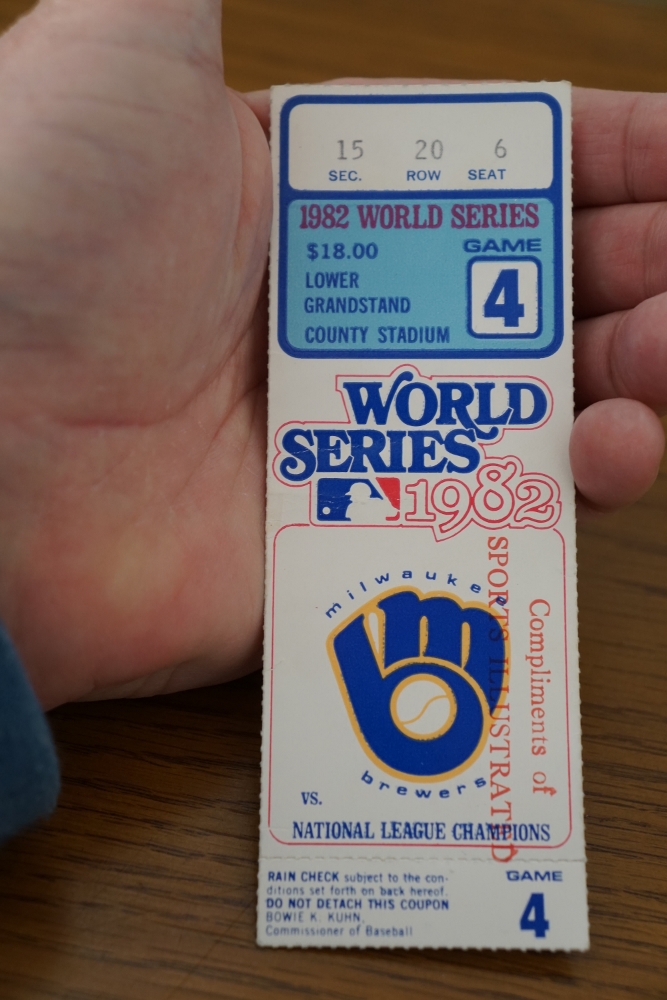
Because of his position and advertising influence, the powers that be at Sports Illustrated had given Dave one complimentary ticket to game four in Milwaukee, which he couldn’t use.

When Dave handed me the ticket, my jaw dropped to the floor and out poured a stammering stream of thank yous. He told me to enjoy myself, but to keep my mouth shut.

I’m sorry Dave. I managed to keep this secret for thirty-four years (note: I wrote this in 2016). Somehow, I feel the statute of limitations on this must have expired. I hope you don’t mind that I’m breaking my vow of silence after all this time.

The following Saturday morning I headed north to Milwaukee and made my way into County Stadium. Of course, I wish Dad could have joined me. He was back at home in St. Louis and ready to watch the game on TV, while I–wearing my Cardinals cap–was seated among a sea of Brewers fans in another beer town four hundred miles north of St. Louis.

The Cardinals lost 7-5 that afternoon. They were the victims of a dramatic seventh-inning surge by Harvey’s Wall Bangers. (Harvey Kuenn was the manager of the Brewers.)

During the rally, I was doused with suds by Brewers fans sitting in the grandstands above me. They were tired of hearing me chirp about the Cardinals. Even so, I finally saw my team play a World Series game in person and a few days later got my revenge.

Led by manager Whitey Herzog, the ’82 Cardinals–Willie McGee, Ozzie Smith, Lonnie Smith, Keith Hernandez, Tom Herr, Bob Forsch, Joaquin Andujar, Bruce Sutter, and the like–won it all in the seventh and deciding game.

Win or lose, after a fourteen-year wait I could finally say I stood in the stands and watched my team play in the World Series on a crisp afternoon in Milwaukee.

Moments before the first pitch, I placed my hand on my heart and sang the national anthem with about fifty thousand Brewers fans I didn’t know … and one weary World War II veteran back at home in St. Louis.

I knew Dad would be standing in his living room, belting out the Star-Spangled Banner in front of his TV. Knowing that made it all the sweeter.

***

After sharing this story from my World Series vault with you, I can now say the 2023 baseball season is over officially. Sports allegiances are like the roots of family trees … they run deep. So, you can be sure I’ll be rooting for the St. Louis Cardinals to rebound in 2024 and add a new chapter to their rich history.

If that isn’t in the cards, maybe the young, talented Arizona Diamondbacks can produce another magical run next year to capture the crown.

A Ticket to the World Series: Part One

The St. Louis Cardinals finished with a 71-91 record this year, landing in last place in the National League Central Division. With a thud in early October, my favorite team–rich with winning tradition that decorated my 1960’s childhood memories–ended the season with its worst win-loss record since 1990.

However, as luck would have it, the Arizona Diamondbacks (D-Backs)–my second favorite team now that I live in the Valley of the Sun– blind-sided all prognosticators.

Against all odds, this young, exciting, resilient team defeated the Milwaukee Brewers, Los Angeles Dodgers, and Philadelphia Phillies in previous playoff series and advanced to the World Series to play the Texas Rangers.

As I write this, the Rangers and Diamondbacks have each won a game in this best-of-seven fall classic. Beginning Monday, the teams will play the next three games in Phoenix at Chase Field.

The stadium is about ten miles west of our home in Scottsdale, but Tom and I have no inclination to spend thousands–or even hundreds of dollars–to sit in the stands and cheer for the team. Instead, we will watch the action and results unfold on TV–or the “tube” or “idiot box” as Dad would have called it.

Speaking of Dad, the timing and topic is right for me to share an excerpt from Tales of a Rollercoaster Operator, my book of stories from my Missouri youth. I hope you enjoy this tale about the baseball bond he and I–two Cardinals’ lovers–shared.

***

With Dad as my ever-loving companion, I hoped we would someday see a World Series game together in person. That possibility seemed akin to flying to the moon and back. But, in October 1968, we tried to make that dream a reality.

I was eleven years old. That summer the Cardinals clinched the National League pennant for the third time in five years on the strength of a 97-65 record. They would defend their 1967 World Series crown and face the Detroit Tigers in the Fall Classic.

On a crisp October morning, as I munched on stale Apple Jacks and Dad drained the contents of his saucer back into his coffee cup, I cupped my left ear toward the kitchen radio speaker.

The KMOX announcer provided details of when and where fans could line up that day to buy bleacher tickets for games 1, 2, 6 and 7. The Cardinals would host those four games in St. Louis.

I turned to Dad. He had the same “let’s do it!” look on his face. We were about to embark on an important mission: landing two World Series bleacher tickets.

With a surge of adrenalin and spontaneity that swept us off the front porch, we grabbed our jackets, hopped in our ’65 Chevy Biscayne, and drove ten miles into downtown St. Louis (a few blocks from the Gateway Arch).

I had a grand illusion that we would drive up to the ballpark, step up to the ticket window, plop down some cash, grab our newly minted tickets, and be on our way.

But, when we arrived, a stream of Cardinals fans snaked around Busch Memorial Stadium and down a few blocks. I soon realized this game of standing in line for tickets was likely to go extra innings.

Our first step was to find a parking space. Like a miner searching for gold nuggets, Dad circled the stadium two or three times for that elusive spot. Just as we were about to abort our mission, we hit pay dirt.

Dad landed our boxy craft in an unmarked open space, in the shadow of dingy, abandoned brick warehouse several blocks away. From there, we hoofed it and found our way to the end of the elongated queue of ticket-hungry spectators.

Minutes and hours passed, but the line stood still. As darkness descended, fans all around us unrolled sleeping bags to ride out the night rooted in cement.

Except for our jackets and a few snacks, we were unprepared for the madness, but managed to buddy up with a few of our neighbors. Between sighs and “what if” scenarios, we borrowed a square or two of an old quilt to sit down and wait out the marathon.

Dawn broke after a sleepless night with relative strangers and policemen hovering nearby. So did the veritable ticket-hungry logjam. We moved slowly at first. After a few hours, we could see the progress we were making.

Without warning, line jumpers cascaded in from all directions. We felt our tempers rise and wondered what happened to the cops from the night before. Even so, we were close enough to feel an ending was in sight.

That’s when several ballpark personnel strolled by to announce the most dreaded five words: There are no tickets left. With the ticket window closed, our mission was over.

Our tempers were in tatters. Our spirits were shattered. We crash landed. We left the line ticketless and turned around to make the long walk back to the car.

Maybe the walk was exactly what we needed. Dad and I were able to burn off steam and warm up after our long, empty sojourn on St. Louis streets. But there was one more surprise in store–a reminder of our overnight, urban odyssey.

When we arrived back at our car, we found a St. Louis parking violation flapping in the breeze under the worn wiper blade on the passenger side of our windshield. Technically, we had secured a World Series ticket after all. Just not the kind we imagined.

As it turned out, the Cardinals lost the World Series that year, thanks to Mickey Lolich’s pitching heroics on behalf of the Tigers. So, I suppose Dad and I didn’t miss much in the way of celebrating in October 1968.

***

If you follow my blog, look for part two of this story in the coming week.

September Morn

Until recently, I didn’t know much about Frances Streumpf Sendke. Only stories my father and aunts shared–passed down through the generations–about my paternal great grandmother.

One is a memory Dad shared about September 1. Apparently, every year on the morning of this day, his Grandma Sendke (she and Grandpa Sendke lived with them when Dad and his sisters Thelma and Violet were children) walked into their bedrooms, pulled back the covers, and shouted “September morn!”

I don’t know the cultural history behind that, but Dad’s “September morn” memory was cast as a celebratory moment long before Neil Diamond wrote his September Morn song.

Instead, I believe my great grandmother was acknowledging the arrival of September’s light and the nip in the air. It was a harbinger of fall days.

Another favorite bit of folklore about Frances Streumpf Sendke came from my Aunt Thelma. She shared a gauzy story about her grandmother, riding horseback in rural Missouri during the Civil War as union soldiers stormed through the countryside.

Today, on this September morn, I’m learning more about my great grandmother thanks to Ancestry DNA. According to census records, she was born in Westphalia, Missouri, in 1857 (exactly one hundred years before me). She died in the St. Louis area in October 1933.

Along the way, she married Charles Ludwig Sendke. He emigrated from Princelau, Germany. (According to Aunt Thelma, he left Germany as a stowaway on a ship at age 13.)

On October 14, 1884, their daughter Anna Louise Sendke Johnson (she went by Louise) was born. I remember the large floral print dresses she wore, the over-powering scent of her powder and perfume, how much she loved her soap operas, and visiting her in the hospital a few days before she died of a heart attack in April 1968. She was my paternal grandmother.

I’m sure I’ll be writing more about genealogy in the coming weeks. But for now, suffice it to say I’m enjoying learning more about my ancestors, all of whom have contributed to the person I am.

***

Incidentally, after submitting my DNA swab several weeks ago, Ancestry DNA says I am comprised of the following heritage:

Sweden and Denmark = 33%

Scotland = 30%

Germanic Europe = 23%

Norway = 14%

The Big Reveal

Hello literary lovers. It’s time for me to stop teasing you about my upcoming book of poetry. Book number five–A Path I Might Have Missed–is alive!

The title and meaning? I chose the title, because it is a reference to the creative odyssey I might have overlooked (but fortunately found late in life and explored through my poetry). Plus, I just like the lyrical sound of these six words strung together.

The concept? It’s a wide-ranging collection of forty-two poems, which I wrote over a period of thirty years (from age thirty-six to nearly sixty-six). My poems cover a host of universal topics–love, loss, pain, discovery, truth, and transformation–with an eye to the ever-present influence of nature in our lives.

The content? The poems run the gamut. Some are reflective, probing, mindful, and deeply personal. Others examine the challenging times we face in contemporary society. I dedicated the book to my father, Walter A. Johnson. He was an unfulfilled poet.

The format? The book is organized into six sections: buds and blooms; fog and fire; magic and music; trials and trails; water and wonder; and stones and sky. I’ve included a photo of nature with each section, images I captured while living in Illinois and Arizona.

Just click on the embedded link below to reveal the cover of the book and purchase a copy on Amazon. Also, please leave your review online. I look forward to your comments and feedback. Thank you for supporting my creative endeavors. Happy reading!


https://www.amazon.com/dp/B0C1HWZ859?ref_=ast_author_dp

Candy Cane Kids

In the early 1960s, the four of us–Dad, Mom, Diane, and I–preferred a natural Christmas tree.

In mid-December, we bundled up, drove to a local tree lot, and picked out a well-shaped balsam.

Money was tight, so our family’s philosophy was the cheaper the better.

One of the men at the lot usually helped Dad tie the tree to the top of our car.

Once we arrived back home, we sawed off a notch of the trunk.

Then, Dad placed the six-footer outside in a metal bucket filled with water to keep it fresh until we trimmed the tree.

In those days, these porcelain candy cane kids adorned the branches of our family Christmas in south suburban St. Louis.

Originally, there was a third sibling, but he or she broke in the years following and couldn’t be repaired.

Thankfully, these two have survived until now … traveling from Missouri to Illinois to Arizona.

This year, Tom and I nestled the remaining candy cane kids near the top of our artificial tree in the sunroom of our Scottsdale condo.

They remind us of the memory magic of Christmas, seen through the bright eyes of an exuberant child.

As 2022 draws to a close, thank you for following me on this journey.

No matter your age or whether you celebrate Christmas, my wish for you and me in 2023 is that we continue to nurture our imaginations and rekindle our sense of possibilities and wonder.

Because it is that spark–and the spirit of the candy cane kids in all of our lives–that helps us create the art to make the world a richer and more joyful place.