I don’t typically tackle social and political issues in my blog. I prefer to focus on the splendor of love, family, community, nature, and serendipity that runs through our lives.
But over the past weeks and months–years, really–I’ve been ruminating over what it feels like to live in the heaviness and post-Covid-social-upheaval of the United States in 2024.
Even though I am in good health and am fortunate to have the companionship of my husband and a cozy home, I often feel a gnawing, low-level anxiety.
I attribute this to worry. What will happen to disenfranchised members of our community–non-white immigrants, people of color, minority women, all women, all children, elderly people, trans people, gay people (like me), etc.–who would be especially vulnerable if our past president (the one just found guilty on thirty-four felony counts by a jury of his peers) should be elected in November?
I should tell you this blogpost isn’t intended to sway your opinion. I don’t think that is possible. I can’t imagine any American being undecided–not in this us-versus-them world exacerbated by lies and constant media attention.
Yes, I will vote for Joe Biden. It’s pretty simple for me. I’m not naive. Of course, he’s made mistakes, but he’s done a lot of good for our country economically and otherwise. I see him as a decent man–the only decent man whose name will appear on the 2024 Presidential ballot. I think he has the best interests of Americans in mind and sees the presidency as a job designed to serve the people, not his personal agendas.
If you feel differently, you are entitled to that. Just know that the democratic values and rule of law that generations of American men and women have fought for will be flushed down the toilet if enough people in swing states like Arizona vote for the other guy. I won’t include his name here.
Why did I choose to write about this today? Because I suddenly have greater clarity concerning all of the weight, which I’ve been carrying around concerning the potential loss of a safe haven–something all of us are entitled to.
The remarkable thing is my clarity came from an incident outside my front door on Sunday morning … an incident involving a feral animal Tom and I have come to love.
If you follow my blog, you know I’m talking about Poly. For the past three years, on many mornings she has appeared at our front door. Poly lives a reckless life, but at the very least is the beneficiary of food on the cool tile of our entryway (and probably others).
Her visits are a brief escape from the heat of the Sonoran Desert. Maybe her visits are also an escape for Tom and me to leave behind the worries of the world, which I’ve outlined above.
Recently, Poly has moved closer to us. Winding her way around our ankles. Sleeping in our wicker chairs. She has even decided to sleep outside on the gravel underneath our loveseat on occasion… before she moves on to explore other places, porches, and hideaways. Such is the life of a lovable, but forever-feral feline.
Anyway, on Sunday morning one of our neighbors (someone we care about who owns a sweet dog) happened to approach our front door at the same time Poly was eating with our door ajar. Normally, the dog is on a leash, but she wasn’t yesterday–though she should have been.
Poly (and I) were freaked. She ran out our door and down the sidewalk as the dog chased in hot pursuit. I feared for her safety and gave my neighbor an angry earful for not leashing her dog.
As I swam laps this morning in Scottsdale, I realized that my rightful (but intense) anger had roots. Metaphorically, in my mind and heart at least, Poly represented the plight of thousands of vulnerable Americans who might be on the run … whose lives might be in danger if we lose our democracy.
I say that knowing that some of my LGBTQ friends–particularly those in the trans community–are considering alternative plans of where to live if Biden doesn’t win the election. That’s a daunting thought and potential reality, which you may not be aware of if you don’t have gay friends.
One thing I am certain of. It doesn’t have to be Pride month for me to remain authentic and visible. I will continue to care about those less fortunate (humans and animals) … no matter what happens in November and beyond … because we all deserve respect and kindness … no matter who we love … no matter our identity.
Meanwhile, back in our Polynesian Paradise community, my neighbor and I have repaired our relationship and regained our equilibrium. (She apologized for not having her dog on leash and told me she hoped it wouldn’t deter Poly from returning.)
Late yesterday, Poly reappeared–safe and sound–outside our front door. This morning, she had her breakfast on the cool tile of our Sonoran entryway.
An hour later, I found her tucked underneath the loveseat in her safe haven. Peeking through the cacti containers and elephant food succulent on our patio, she allowed me to take this photo.
I am thankful Poly (and I) survived our Sunday scare. I hope our nation and democracy are as fortunate in November.
We all endure specific days–or months–that test our best intentions and weigh on our psyches. January is that month for me.
Long before Tom’s father died January 14, 2012, and my mother followed January 26, 2013, the first month of the year represented a period of Midwestern malaise, forced hibernation, and cold, lingering darkness.
Of course, I live in a warmer, brighter climate now (despite freezing temperatures the past few mornings). I am thankful for that, especially as Tom shares images of his sister and brother-in-law snow blowing and shoveling outside their suburban Chicago home.
Since my mother’s death nearly eleven years ago, the years have passed with a gauzy flutter like pages of a book swept away by a winter’s squall.
Yet January’s weary sensations–grief masked in a cocktail of Christmas memories, vanilla lip balm, and her last graceful smiles during breathing treatments designed to ease her congestive heart failure–appear on cue.
Last weekend, Tom and I packed away our Christmas decorations and recounted cherished memories of quiet holiday moments together and the adrenalin rush of my holiday concert. Adjusting to the rise and fall of this season is always a bittersweet process.
But this week I was eager to recoup our less-cluttered space. To move ahead. To read and write new pages. To protect, nurture, and regain a more normal rhythm away from the madness of news that reminds me–frequently–just how fragile our democracy has become.
My mother and father–who survived the Battle of the Bulge in World War II–would be horrified.
In the depths of 2020, my husband and I began a tradition of buying bouquets of flowers to place in a vase in our living room. As the walls and woes of Covid and our political angst closed in, it gave us hope to see a splash of color on our coffee table.
Less than ten days into 2024, like each of you I have my dreams and doubts, wonders and worries.
But writing about this spray of lavender carnations Tom and I brought home (then displayed in a smoky-blue ceramic pitcher my mother left behind, and placed atop a Spring-like, bird-laden runner my sister gave us for Christmas) helps me breathe, reflect, and relax.
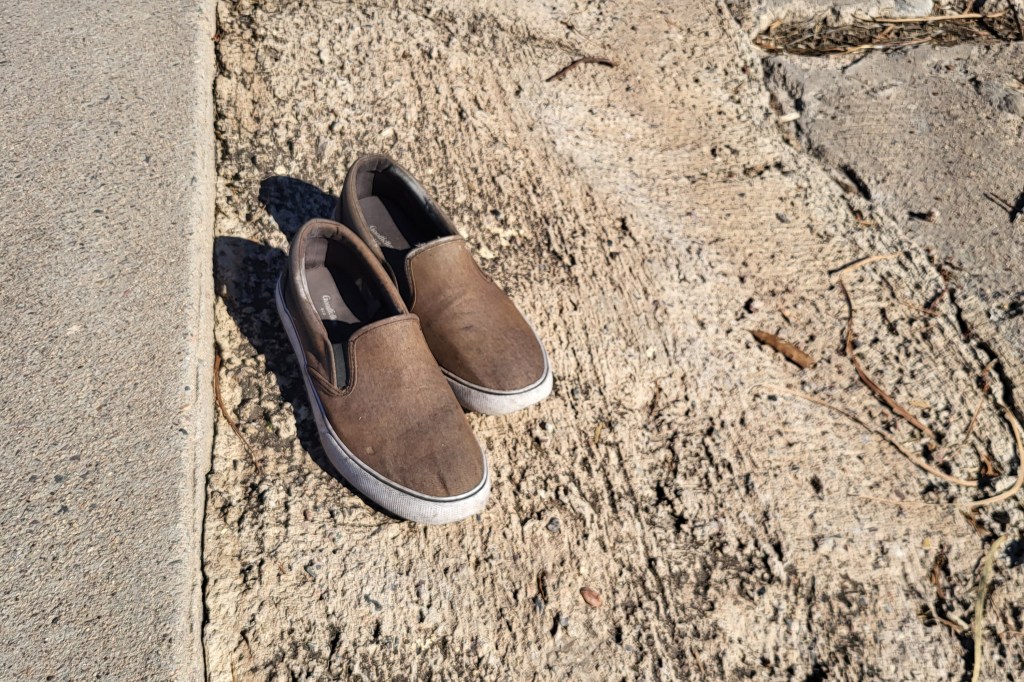
November 3 was a brisk Thursday morning in Scottsdale, Arizona. But when I walked past these empty soles on the edge of Camelback Road after my workout at the gym, I felt an eerie sensation. It was almost like learning a close friend had died or vanished.
My focus shifted immediately away from our cooler-than-average temperatures in the Valley of the Sun. I felt compelled to pay tribute to the remnants of a life well lived. To stop and take this photo and–three days later–write a story about what I saw and felt in those moments. Because that is what I do.
What would provoke someone to leave behind a pair of decent canvas shoes on the side of the road in such an orderly fashion? Did they suddenly outlive their usefulness? Perhaps they were simply an extra pair a homeless person could no longer carry. Or the sensible shoes were forgotten by someone who waited for a bus and was ready to advance to the next station in life.
For my storytelling purposes they are a metaphor for the sense of displacement many of us feel in our country. We’ve been pushed to jump out of our shoes from the criminal escape antics of our past president and the barrage of political ads spewing venom through our devices. Whatever the case, we wait for the next shoe to drop as we anticipate the outcome of the mid-term elections.
If you follow my blog, you know I am a positive person. Generally. I’m thankful for the beauty of nature that surrounds me and the quieter life my husband and I have carved into the desert landscape.
But as a nation we teeter on the precipice of despair. The future of democracy–as I’ve known it for my 65 years and 181 years before that–is definitely on the ballot this coming Tuesday.
Tom and I have already voted. Nearly two weeks ago. I checked the boxes alongside the names of only those who will protect our democracy. Not the high-profile election deniers in Arizona running for senator, governor, secretary of state, and attorney general. We need to believe them when they tell us they wouldn’t necessarily respect and honor the will of the majority of the people.
If you live in the U.S., be sure to vote on or before Tuesday. When you do, I hope you will support those who uphold our beloved U.S. Constitution.
Otherwise, I fear that the close friend who disappeared without their shoes is actually the democracy we once loved before we allowed it to vanish.
My heart raced and jaw clenched. Like thousands of Americans, on Tuesday I tuned in to watch true patriots from Arizona and Georgia do the right thing.
The 2020 election numbers–votes counted and recounted numerous times–don’t lie. Neither did Arizona House Speaker Rusty Bowers, Georgia Secretary of State Brad Raffensperger and his deputy Gabe Sterling, and Georgia election worker, Shaye Moss.
At a defining moment in American history, on June 21, 2022, they delivered their testimony before the U.S. House Select Committee investigating the January 6, 2021, attack on the U.S. Capitol.
They sat before the nation. They breathed deeply, mopped their brows, and somehow maintained their composure. They told us how they kept their fingers in the dike to keep a corrupt president and his allies from breaking through the dam and cheating the American people. They upheld the law and the letter of the U.S. Constitution.
Over three hours of testimony, we heard heart-stopping stories. Each witness detailed how some of those who still support the ex-president have threatened and targeted their professional and personal lives. All in an effort to illegally change the outcome of the 2020 election.
In this one blog post, it is impossible to address the sense of fear, anxiety, and division that exists in our current culture. But suffice it to say, this insurrection and its related tentacles run wide and deep. It appears there is much more evidence to come. Each day we brace ourselves for more of the ugly truth about the targeting of public servants and slates of fake electors.
What will happen next in this drama? Who knows? But the biggest question of all looms on the horizon: Will the U.S. Department of Justice pursue criminal charges against the forty-fifth President of the United States and others who apparently have violated the rule of law?
Young and old alike, we watch and wait. Our nation’s future is at stake. Our sense of freedom hangs in the balance.
***
Tuesday’s hearing occurred fifty years and four days after five men were arrested for breaking into the Democratic National Committee headquarters at the Watergate Hotel in Washington, D.C.
Soon after, the Watergate political scandal dominated our lives. Our nation was thrust into the pain and complexity of a constitutional crisis and investigation that would expose President Richard Nixon and members of his administration.
I was a teenager at the time. I didn’t understand the gravity of the Watergate scandal. But I remember the anxiety of uncertainty that pervaded our country and how outraged I felt that our president would lie and cheat and do all he could to try to cover up his deceit. That pain has resurfaced today.
I also remember pausing for breakfast with my friends John and Jon in the middle of our western camping adventure on August 9, 1974. It was the day Nixon finally resigned after two years of political denial and trauma.
John, Jon and I chowed down on steak and eggs in a dark tavern/diner somewhere in Wyoming, while on the other side of the room, through the tube of a grainy black-and-white TV, we watched Nixon break the news in an address to the nation.
Before and after that moment, my buddies and I drove through miles and miles of magnificent western landscapes–mostly through the Rocky Mountains in Colorado and Wyoming. But we also ventured through the beauty and desolation of Arizona and New Mexico.
Imagine three sets of parents of three teenagers, permitting one seventeen-year-old and two sixteen-year-old boys to pack up a beat-up AMC Javelin without adult supervision. Somehow, we convinced them to let us go.
Over a ten-day period, the three of us towed a small camper more than a thousand miles each way from St. Louis to the Rockies and back again. We had fun, drank Coors beer, exercised our freedom, cooked over a Coleman stove, slept in a tent, and managed to stay out of trouble. Those were simpler and safer days. That trip wouldn’t happen today.
As a young man about to begin my senior year of high school, the possibilities of life surrounding me traveled as wide and deep as the terrain you see in this photo of Shiprock, New Mexico, which I captured and saved from our 1974 journey.
Little did I know that one day nearly five decades down the road–as I approached my sixty-fifth birthday in this western literary chapter of my life–our nation would face a much darker and historic challenge.
We must find a way to restore some semblance of sanity to our culture and political process … we must punish the perpetrators to resurrect our democracy from the jaws of an insurrection that continue to haunt us.
With every TV update of returns or refresh of election news coverage on my smartphone, I hold my breath.
Will this be the moment? Will Joe Biden arrive in the land of two-hundred-seventy electoral votes and officially become president-elect of the United States? Though my anxiety runs laps in my buzzing brain, he waits patiently. Ready to calm the turbulent waters. Steady a sinking ship. Steer our nation out of this dark age. This endless nightmare.
Diligent workers and volunteers in previously mostly disconnected swing states–Georgia, Pennsylvania, Nevada and Arizona–count unprocessed ballots. Anonymous state and local officials sit and stand. Doing their jobs while cameras scrutinize from above.
They are not our healthcare heroes in hospitals. Fighting COVID-19 on the front lines. Working to save lives that teeter as new cases escalate each day. However, they are just as heroic. Unfettered Republican and Democrat openers, scanners and sorters tabulating mailed-in ballots from distinct counties: Chatham, Dekalb, Fulton and Gwinnett in Georgia; Alleghany, Bucks, Chester, and Montgomery in Pennsylvania; Clark in Nevada; and Maricopa in Arizona. The list of counties and ballot counting goes on.
I live in Maricopa County. The gigantic land mass was named after the Maricopa Native American tribe, who originally lived along the banks of the Colorado River.
Maricopa is the fastest growing county in the United States. It encompasses the greater Phoenix metropolitan area and is home to four-and-a-half million diverse people.
Republicans and Democrats. Young and old. Poor and rich. Straight and gay. Employed and jobless. Citizens of all religions or none at all. Hispanic, Asian, white, black, and Native American people living in the vast Sonoran Desert.
As the final votes are tallied and reported in Maricopa County and elsewhere, this process will end some day soon. We must disregard unfounded claims of fraud and distractions from the White House and accept and celebrate the election outcome (whenever it arrives).
I believe all of us in Maricopa are stronger if we embrace our differences in this wide-open space of grand beauty, dry heat, and burgeoning possibilities. The same can be said for every Maricopa, every diverse American community, no matter the climate or terrain.
With Thanksgiving less than three weeks away, it’s time to give thanks to our democratic process, open our hearts and minds to our neighbors, and look forward to writing a new chapter under Joe Biden and Kamala Harris. If we follow their lead, we can unite.



 Mark Johnson Stories