Tag: empathy

Sensitivity

I pride myself on my sensitivity.

In my book, empathy is an essential quality for writers and human beings in general. It opens the door to developing deep and trusting relationships, but it also exposes us to emotional and physical pain. In this month of April, I have experienced both.

***

On Friday, April 10, Tom and I said goodbye to my cousin Phyllis.

The day before, we flew to St. Louis and enjoyed a nostalgic salad-and-pizza dinner with family in St. Charles, Missouri.

We gathered around a round, wooden table–balancing paper plates piled with food, while sifting through dog-eared photographs of Phyllis with living and deceased members of our Johnson family from the past seventy-five years.

In that space, I felt a meaningful connection with Tom (Phyllis’ husband), Austin and Bryant (her adult sons) and their respective spouses (Amanda and Kelsey).

Meanwhile, Phyllis’ four grandchildren–ranging in age from three to eight years old–danced around the island in Bryant and Kelsey’s kitchen, occasionally patting the head of Bennelli, their large-and-lovable labrador.

Despite the grief associated with the loss of Phyllis, it was a family moment I will cherish. One Phyllis would have loved.

The next morning, Tom and I drove to the funeral at Immanuel Lutheran Church in St. Charles with my sister Diane and brother-in-law Steve.

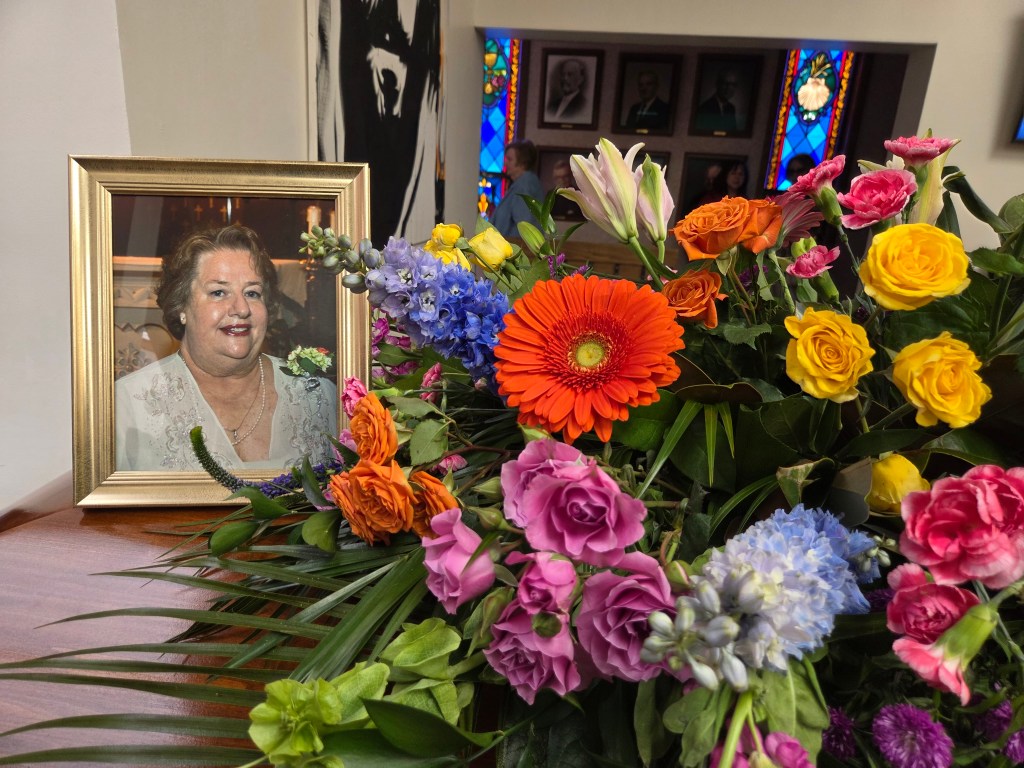
In a large open space connected to the church, Kelsey and Bryant had carefully assembled still photos–from throughout Phyllis’ life–on boards anchored by easels. They placed them beside her closed casket adorned with sprays of colorful blooms.

Overhead, at the other end of the room on a large screen, other images of Phyllis and her family and friends faded in and out on a large screen TV.

As people began moving into the church for the 11:30 funeral service, I felt anxious. Jumpy.

A mix of nostalgia and peace washed over me, as Tom and I found a place to sit at the far-left end of the fourth pew. Diane and Steve joined us there.

I scanned the program and saw that after readings from the old and new testaments–slotted between two church hymns–I would walk to the lectern to share “Words from the Family”. To give a eulogy. To pay tribute to my closest cousin’s life.

I’ve done a lot of public speaking, presenting, and singing on a multitude of stages in my life–but few things as personal as this. I breathed in deeply to quiet my nerves. I unfolded my prepared words and looked out over a congregation of probably two hundred: Phyllis’ family, friends, teaching colleagues, students, caregivers.

In that moment, my anxiety lifted and flew away. “I am honored today to remember Phyllis. She was my cousin. We were born a decade apart in St. Louis,” I began.

The words and phrases flowed effortlessly from there, as I looked into the tearful eyes of immediate family members–three generations side-by-side spread across the first pew.

“I admired Phyllis’ poise, her style, her intellect, her ambition, her sensibility,” I continued. Before I knew it, I was reciting verses from I poem I wrote for Phyllis: The Love We Shared.

I closed my notes. I left the lectern. I paused to pat Austin, Phyllis’ eldest son, on the shoulder for reassurance, kissed him on the forehead, then returned to the fourth pew and sat beside my husband.

I pulled a wrinkled tissue from my suit pocket, dabbed my eyes, and felt sadness and love reverberate throughout the church.

***

Tom and I returned to Arizona last Saturday.

Today I found myself dealing with another form of sensitivity … sensitivity to the sun.

This morning my dermatologist–in an out-patient procedure called MOHS surgery–removed a small patch of cancerous cells from the bicep of my right arm. As I write this, I am taped up with a sizeable patch over that area.

The good news is he removed all of the problematic tissue. There is no pain, just the anxiety (and the pinch of a few needles for numbing) that immediately preceded this morning’s appointment.

In a few weeks, the remnants of that procedure will fade. My dermatologist will extract the stitches.

I will be left with my fourth such scar–one on each limb ironically–from excisions and dermo procedures.

In a sense, these scars are “badges of honor” for having lived nearly sixty-nine years and survived a series of setbacks.

They are proof that as long as I live–as long as I write, sing, slather on sunscreen, and pause to remember the ones I love–I will also remain super sensitive to the blazing Arizona sun.
In September’s Stillness

It was a bright September Tuesday morning. Clear skies, mild temperatures, and low humidity. A perfect day in the Chicago suburbs.

At around 7:30 on September 11, 2001, I pulled up to the curb at Lincoln Junior High to drop off Kirk, my twelve-year-old son. He scampered ahead and waved goodbye.

Forty-four-year-old me drove to the nearby RecPlex for a quick swim at the indoor pool. On the way to the locker room to change, I saw a small cluster of folks gathered silently around a TV.

A plane had just struck the north tower of the World Trade Center in New York. Dire images of smoke and debris filled the sky.

Minutes later, a second plane pierced the south tower. It was just the beginning of the madness.

Terror spread quickly through the skies to crash scenes at two other sites: the Pentagon in Washington, D.C., and a field in Shanksville, Pennsylvania.

Captivated and numb in disbelief near the vending machines in the lobby hundreds of miles away, we stood dumbfounded and helpless–gaping in September’s stillness–as ripples of the horrific news and images unfolded.

Ultimately, 2,977 victims died that day, casualties of the September 11 attacks at the hands of eighteen foreign hijackers and many more strategists who infiltrated American skies.

Thousands more were injured and sustained life-long trauma, including citizens and rescue workers exposed to toxins at Ground Zero in Lower Manhattan in New York.

***

It’s been twenty-four years. We are still trying to make sense of how much we lost, how much our lives changed, that day.

I don’t mean the inconveniences of air travel. Yes, that’s a pain.

Much worse, gun violence, school shootings, assassinations, and homegrown terrorism are the norm in the United States. Through it all, we have become as divided as ever.

Just yesterday, the latest two unrelated horrors–one a school shooting near Denver, the other the assassination of a vocal, right-wing protagonist–dominated the news cycle.

The solution is obvious. We need to remember our traumas and learn from them. Institute tighter gun laws in this country, not more thoughts and prayers.

I do believe our leaders have failed us. We have voted the wrong ones into positions of authority. Instead of quieting the storm and pulling us together, they are threatening those who don’t agree with them.

If we don’t make changes soon, our legacy will be continued bloodshed, not the freedom, opportunities, and equality we have espoused as a nation for generations.

***

My twelve-year-old son is now thirty-six and living in Chicago. He is a therapist. Kirk specializes in helping individuals who have experienced some sort of trauma.

I couldn’t be prouder of Kirk and the work he is doing. At a young age, I witnessed his kindness, his empathy toward classmates, neighbors, and family members.

Now he is honing his skills, while providing relief to those who need it most in American society.

I try to do the same through my writing. Telling the stories as I see them but leaving you with a glimmer of insight, relief and hope.

If there was one positive thing that sprang from the 9/11 attacks, it was the way our nation coalesced–at least in the short term–around the victims, their families, their stories in 2001.

As a nation, we were forced to take a breath as we dug through the rubble. We forged ahead to provide a salve to treat the psychological trauma we all felt.

Somehow, in 2025, we have lost our wits. We have forgotten how to love the less fortunate, protect our children, and teach them to be critical thinkers rather than conspiracy theorists.

We had better wake up fast, pass gun laws, rediscover our compassion, and find our better selves soon.

Turning Stuff into Wisdom

I’ve learned a lot in my sixty-four-plus years. Sometimes it feels like my brain is a swirling repository of “stuff” … data and memories.

On other days, it feels like I’ve found meaningful ways to synthesize my life experiences and relationships. Then–voila–I discover they have morphed magically into wisdom.

I’m not sure exactly when this wisdom thing began to kick into high gear, but probably in my fifties after my mother died. Then, certainly again at sixty when I suffered a mild heart attack. In both cases, I had to find my way back to the surface to breathe again and survive the depths of despair.

Most definitely, it is the challenging aspects of life–loss, fear, anxiety, discrimination–that prompt me to more forcefully explore, verbalize and share my opinions and feelings … not the happier, even moments.

I’ve been thinking about this because I have a few friends/relations who are dealing with difficult stuff. One is grieving the loss of a significant loving relationship while trying to find his way in a new job; the others are navigating the precipitous physical decline of two frail parents.

In both situations, I am there to provide empathy and support. I imagine these individuals feel as if they are lost in a dense forest without a compass. Yet, I suspect, the clouds will lift eventually. On no particular schedule, light will begin to filter through. Hope will reappear.

One day, the internalized aspects of loss and pain will spring from the ground like crocuses emerging from the frozen ground of winter. And, a new batch of wisdom will be born and saved for the next difficult encounter of life.