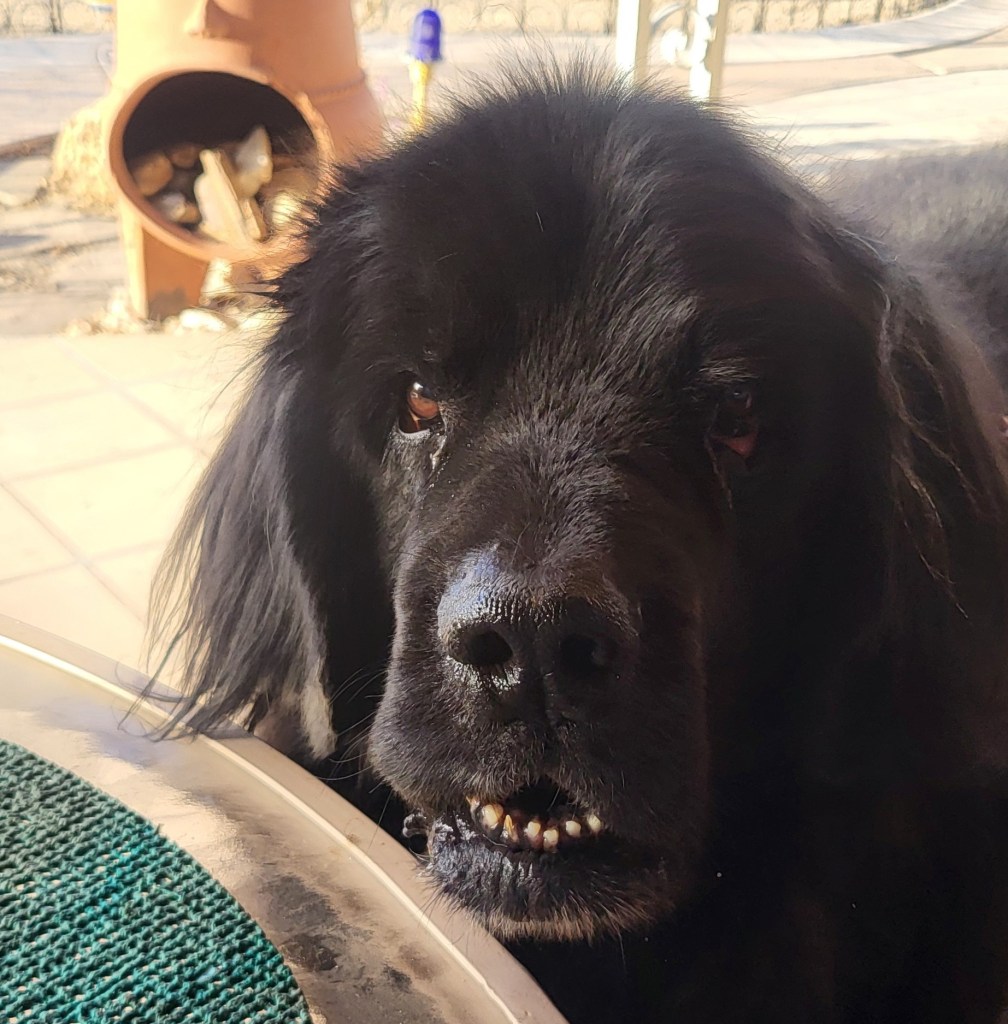
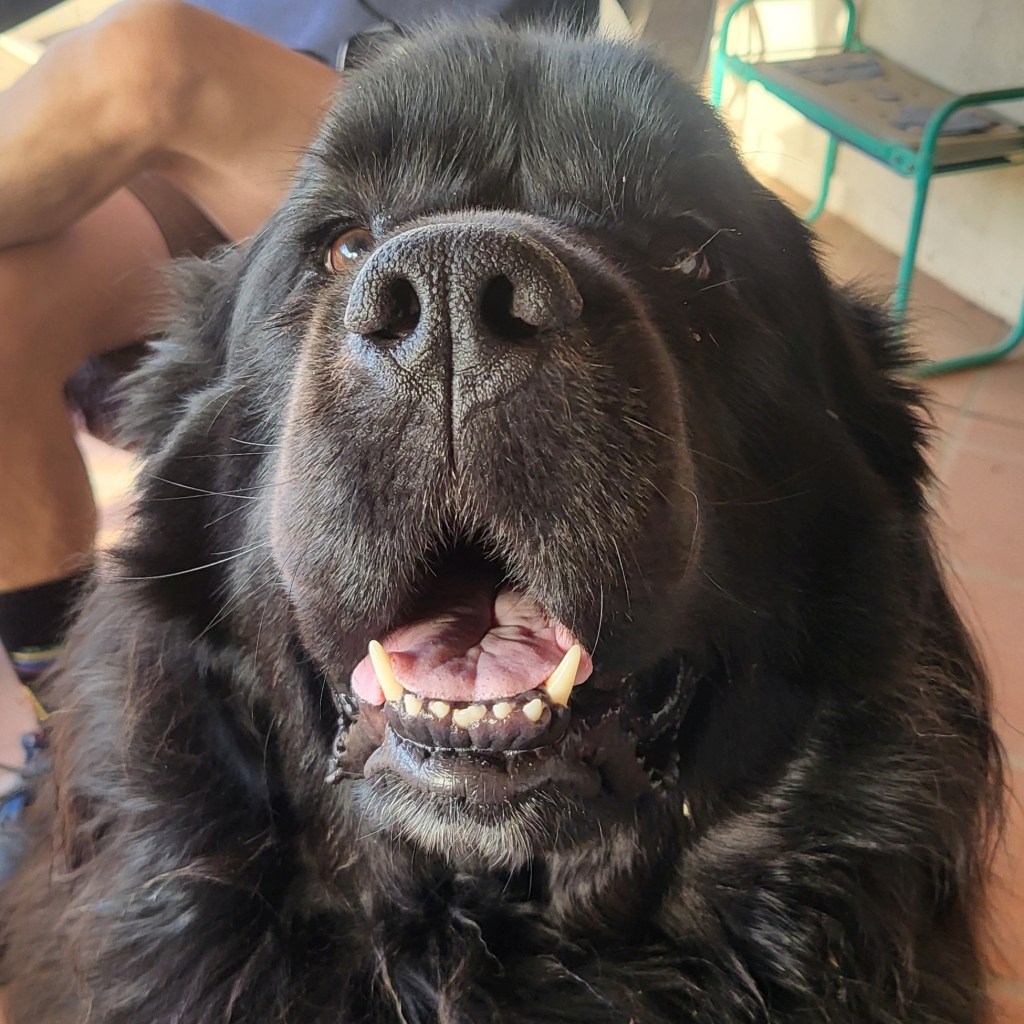
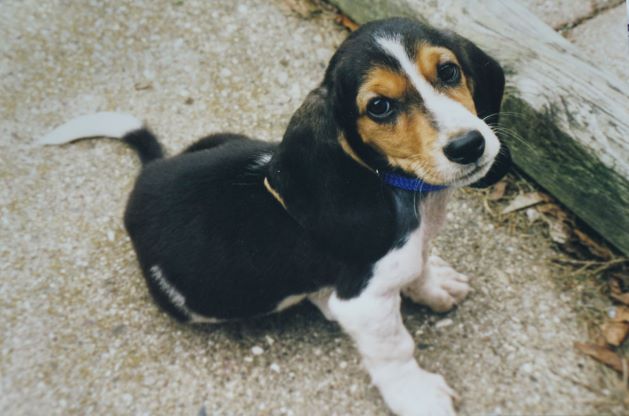
Without words, they supply sounds, scents, and texture to our everyday lives.
Their furry souls exist unconditionally, by our sides, under the table, on the coolest tile, or the warmest trail to nowhere special or somewhere sacred.
While they are present, our ever-lovable companions spread beauty, comedy, continuity, responsibility, laughter, goodness, grace, and wisdom across crowded kitchens, cozy front porches, and boundless backyards.
And, when nature calls and they pad along to another plane, they still remain family, they still inhabit our hearts forever.
***
For Mason, Katie, Poly, Maggie and all our furry friends who have gone before us.
My husband is an excellent cook. He prepares our dinners with love and panache. I am more the pancake-and-egg guy in our relationship. Breakfasts are my thing.
Occasionally, we switch things up. Today is one of those days.
Our friend Jeremy has invited us to his Thanksgiving potluck this evening … a low-key gathering with friends and a few in his family.
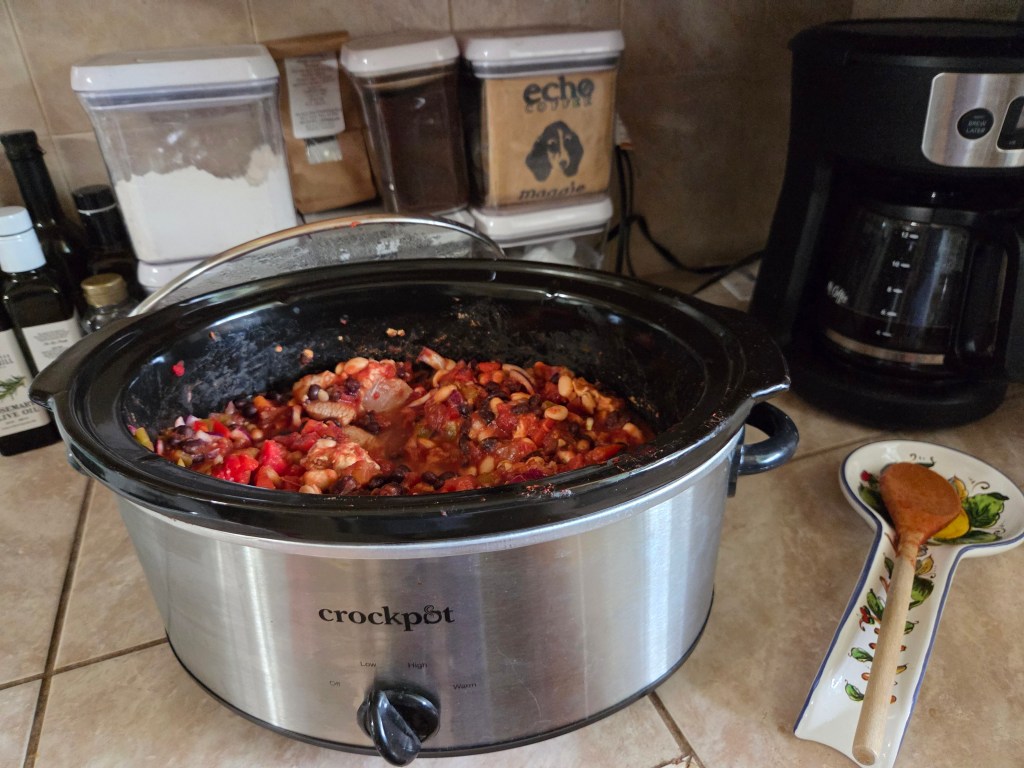
Yesterday, I decided I would make a pot of chicken chili for Jeremy’s Friendsgiving today. It is simmering in our slow cooker as I write this. It’s a delicious, easy, non-traditional dish.
I haven’t made it in years, but the timing is right. The weather is cooler. I want to prepare something meaningful to share with our friend, who is managing his way on the road of life through a monumental year of personal growth mixed with significant detours and setbacks.
As background, Jeremy came out to his friends, family, and the world a little over a year ago. He and his wife are no longer a couple, but they continue to be loving parents to all five of their children. It’s impressive that even during this period of uncertainty they have maintained a respectful relationship.
I know fatherhood is important to Jeremy. He loves and supports his children. I remember how difficult it was for me to balance my fatherhood, demanding career, and “gay awakening” thirty years ago. I suspect it is the same in this moment for Jeremy.
All of this leads me back to this recipe for chicken chili. In the early 1990s, after Jean and I divorced, I felt broken–broke, too–and I existed in a fog, especially in the colder months.
My sons spent half their time with me in my tiny apartment. I needed to find inexpensive, flavorful dishes, which I could prepare for dinner for Nick, Kirk, and me. To feed and nourish us. To keep us close.
This chicken chili recipe is one I made frequently thirty years ago. Not so much lately. But it makes perfect sense to resurrect it today. To bridge the past of balancing my gay identity and single fatherhood with the present of Jeremy’s.
So, I am making chicken chili now for about a dozen (Jeremy’s supportive friends and a few of his children) who will gather on a coolish and likely rainy Saturday evening in the desert.
Together we will give thanks for friendships … the potluck of life that nourishes us and allows us to learn and grow during good times and bad.
This is a momentous day for me. My sixth book just went live on Amazon.
Sixty-Something Days is the story of my post-65 quest to stay relevant creatively. It is a collection of my best essays, poems, and short fiction from 2022 to 2025.
The book is an artistic tapestry of my writing, singing, teaching, learning, growing, and surviving journey … with family and chosen family … connecting one leg of my life (my midwestern past) with another (my western present) during this period of tremendous upheaval in our country.
In my heart, I know this book will resonate with many of you–my loyal followers–who like me continue to strive to nurture and protect the artists, educators, animals and nature, and diverse disenfranchised people in our communities.
I hope you’ll take a few minutes to click the link below and be among the first to buy a copy. Thank you for your support of my creative pursuits!
She’s survived another summer in the Valley of the Sun. Living life on the lam.
Climbing walls and trees. Stalking birds, lizards, and rodents. Dodging haboobs, monsoons, and ICE agents. Ducking in and out of covered patios … sleeping on weathered blue cushions melting into wicker chairs outside our front door.
Poly is her given name. Given by me to her. No doubt, she has other assumed names from other presumed cat lovers in our Polynesian Paradise condo community.
I hardly consider her a stray anymore, because we are three years into our relationship … our parlor game of fancy treats followed by quick goodbyes.
In 2022, she wouldn’t get close enough to touch. Tom and I left kibble outside our door in the same chipped dish you see here. She ate quickly, then darted off … back into her Sonoran neverland.
But in 2025 we have reached a deeper level of closeness, intimacy, love perhaps. Maybe she’s been reading the news and needs comforting. I know I do.
Every morning around 6, Tom or I open the security door and look for her. Nine out of ten days, she hops down from that day’s pre-selected chair, meows as she glides and stretches on the mat in our foyer.
She trails around our legs, marks our shoes and furniture with the scent of her furry face, and shimmies up and down as Tom or I (we take turns) prepare her dish of Sheba cuts in gravy with sustainable salmon.
The frequency and volume of meows increase as the dish comes close to the floor. Poly purrs loudly, then polishes that off in less than a minute. Her eyes sparkle with gratitude.
Lately, she’s been staying longer after her meal. Sometimes returning later in the morning or evening for a second round of treats. Dry savory salmon-flavor Temptations for the cat that deserves the best.
On September 1, at 11:13 a.m., Poly allowed me to sit on the floor and give her love. I patted her head, back, and tail as we talked about her morning … our day.
Then, I placed brunch before her and captured this kitty-calendar portrait of Poly, our cagey Sonoran friend, modeling in the kitchen on our new, natural oak flooring.
After she consumed her meal and licked her paws, she glided and sniffed through our bedroom, den, and sunroom.
Poly then departed through the front door, left ajar for her safe departure (she is a free spirit, after all!) back into the wild of intense sun, hissing sprinklers, spiky cacti, and random critters (animals and humans) … all of us living each day, giving and taking what we can, embracing or deflecting each moment as it comes.
On August 25, 1975–fifty years, five decades, twenty-five pounds thinner, and half a century ago–I was a long-haired, idealistic college freshman hustling across campus in the rain.
It was my first day of classes at the University of Missouri in Columbia. (My mother took this photo during college break a year later.)
This naive, relatively-shy-but-often-fun-and-exuberant eighteen-year-old boy (he was not yet a young man but was an aspiring pre-journalism major) knew little about the world or himself.
But he was determined to find his way one hundred-and-twenty-five miles away from his parents and childhood home in the St. Louis suburbs.
Mom and Dad paid for my tuition, books, and room and board in Hatch Hall on campus. I vaguely recall the total bill was less than one thousand dollars per semester.
Looking back, I think I may have spent half that amount on frivolous expenses like pizza, sub sandwiches, and beer.
That money came out of my pocket. From what I earned and saved during the summer of ’75 as a rollercoaster operator at Six Flags. But I could always count on care packages and frequent small checks, which Mom sent in the mail.
John was my roommate freshman year on the fifth floor of Hatch Hall. We were good buddies, close friends from the late 1960s when we were junior high classmates.
Though we had different career aspirations which dictated non-intersecting class schedules (John was pre-med), we were inseparable in many ways from August 1975 until May 1976.
There wasn’t much to our room. Minimal clothes. Primitive, uncomfortable desks and chairs. Single beds and random posters on opposite walls.
John brought his stereo, turntable and speakers. I brought a small black-and-white TV and popcorn popper. I recall us convincing our parents to split the cost of a mini fridge.
Wearing tube socks and denim cutoffs like all the other guys, we tossed Frisbees in the quad under the columns and played tennis across the street from our dorm. Through it all, we made friends of all sorts who lived up and down our hall and across campus.
After a full week of mostly boring, required classes, fall Friday nights included parties at Hinkson Creek (an abandoned quarry mine close to our dorm) where all the kids drank and many swam.
Football Saturdays in the fall of ’75 were fun, rooting for the Tigers in the student section. More often than not, the final score spelled defeat.
We wandered home to our dorm rooms aimlessly to sleep off the beer and prepare for Saturday nights … disco dancing to Donna Summer and roller keggars (drinking more beer while roller skating).
I remember zooming around a rickety indoor skating rink, dodging wooden pillars and puddles of beer. What a mess and what a stupid idea … and I didn’t even like the taste of beer!
By this time, John had a steady girlfriend … Sharon. (They met soon after John and his family moved to the northern St. Louis suburbs before his senior year of high school.) Sharon attended a different in-state college in Kirksville, Missouri.
I dated lots of girls my freshman year … but never for long. I was trying to live up to some ridiculous notion of masculinity that never felt like the true me.
The one exception was Carol. We were close in high school. She was sweet. That relationship lasted into college, but it quickly fizzled. I needed my freedom and time to learn who I would become.
Operating on a protected, fearful level, I remember feeling attracted to many of the cute boys in my classes and at Hatch Hall. But my gay identity and secret desires lived only in my subconscious.
I remember feeling anxious and alone. Constantly.
It would be three years before I would meet Jean at Mizzou. We were both Journalism students. There were sparks between us that developed into love and marriage in 1980 after she graduated.
Underneath it all, the attraction I felt for men grew stronger. But without a healthy avenue for my personal discovery, my depression deepened.
The reality is that from 1975 through 1979–my college years–there was no productive way for me to experiment with my sexuality and date other men. Whatever happened had to come under the cover of darkness.
***
If we live long enough, time, age, mistakes, and transformation … like the constant tumbling of water over rocks … can produce smoother edges and actual wisdom.
In spite of living a closeted, unfulfilled sexual life in my college years, I got a good education at the University of Missouri. I earned my Bachelor of Journalism degree in 1979. It opened many doors for me professionally.
The good news is I eventually found my way personally in my thirties and forties. Tom and I have been together twenty-nine years. I’m proud of the trusting, loving relationship we have created together.
There is irony in all of this. While he was a freshman trying to find his way–at the University of Iowa in Iowa City in August of 1975–I was doing the same a few hundred miles south of him.
We wouldn’t meet until we were thirty-nine … twenty-one years later … but that would also happen in the midwestern humidity of August.
***
Postscript: Next month, Tom will join me on a trip to St. Louis. We will attend my fiftieth high schoolreunion, where I will reconnect with a few hundred of my Affton High School classmates … the class of ’75 … most of whom I haven’t seen for at least thirty years.
My college roommate–John–and his wife Sharon will also join us. Somehow, over fifty years, five decades and more than half a century–we have sustained our friendship across the miles and supported each other in the important moments.
Raising children … and, in their case, grandchildren. Being there for my mother’s funeral at Jefferson Barracks National Cemetery in 2013. Coming to Chicago for my marriage to Tom in September 2014.
Each time we see each other (now it’s mostly winter visits here in Arizona), John and I are able to pick up where we left off.
Even though our lives have grown and changed in innumerable ways, we have maintained a mutual sense of love, respect, and continuity.
When Tom and I landed permanently in our Scottsdale condo, it was an odd year.
Odd in a meteorological sense; when we pulled into our carport, it was 112 degrees outside on July 12.
Odd in a traumatic sense; I had suffered a minor heart attack six days before on our 60th birthday.
Odd in a serendipitous sense; the cardiac trauma happened in St. Louis (where I was born) in the middle of our move.
Odd in a numerical sense; it was 2017.
That year, we did our best to settle into our new life. We focused on the most essential items: buying a new air conditioning unit and creating a new healthcare regimen to rehab my heart and restore some sense of normalcy to our lives.
We were two mid-century guys, doing our best to settle into our mid-century condo, happy to have survived a scary personal experience, grateful for the chance to write a new chapter in a space that had been home to Tom’s grandparents (and, in a more limited sense, his parents) years before.
Sadly, by 2017, they were all gone. Even so, we had an important remnant of their lives to keep us grounded. It was our turn to–slowly–make it our own.
Under more normal circumstances (i.e., not enduring a heart attack in the middle of our move), we might have pushed more aggressively to transform our condo. But surviving together superseded remodeling and refreshing.
With time, I regained my strength. Tom and I both began to breathe more easily. When a little thing called Covid arrived in 2020, it prompted us to rethink our space, because–of course–we had more time to stare at our condo walls.
In 2021– it was odd again — we hired a paint crew to turn both bedrooms green and serene. We replaced the carpeting there. Later that year, we remodeled our bathroom.
Now it’s another odd year: 2025. Odd (as well as disturbing) in more ways than I care to enumerate in this essay. Let’s just say it’s the perfect time to wave goodbye to dingy off-white walls and adorn our living room and sunroom with a splash of two new colors.
With all of that as my preamble, I’m in the mood to tease you a little. Guess which two colors on this palette will appear inside our home beginning next week.
When the work is done (and we have replaced the tired grey/blue carpeting in our living room and sun room, too), I think it will feel like we have finally created the Arizona space Tom and I imagined eight years ago in April.
That’s when we put our suburban Chicago home on the market as the daffodils bloomed on another chilly midwestern day.
That’s when we began to pack up our most important possessions in Illinois for a chance to create a new life of unforeseen friends, books, blogs, stories, movies, and memories in the Valley of the Sun.
What I share here always comes from my heart and the firing (sometimes misfiring) synapses of my brain.
Lately, I have been drawn to writing more poetry. It helps me to process the pain–personal and national–which I have been wearing like a cape that shrouds my best impulses and intentions.
Today, as Christmas and the end of the year approach, I am taking a different path.
Before I take the stage next weekend for my holiday concert with the Phoenix Gay Men’s Chorus, I want to reflect on bright-and-shiny moments–present and past–which have been tempered by devastating-and-unavoidable losses in 2024.
***
Tom and I are among the dwindling few, who continue to send Christmas cards in the mail to our closest friends and loved ones.
It’s something that brings both of us joy, and in my book that means it’s something worth doing–no matter what other Americans do.
I know that practice places us in the minority (rather like the disastrous outcome of our presidential election), but I don’t care.
Since childhood, I have always identified as “different” or–more specifically–as an outsider. Maybe it was my brain’s subconscious attempt at preparing me for the obstacles I would face as a gay man.
At any rate, conformity is for the faint of heart. It takes courage to stand by your differences, and I have a feeling I will need to muster a boatload of courage as we head into 2025.
Maybe that approaching storm is why I have taken comfort recently in an old Christmas memory.
For several years in the late 1950s and early 1960s, before Dad had his first heart attack, he took Diane (my sister) and me in our old, green Plymouth to search for our family Christmas tree.
We didn’t have much money, so he usually drove us to a tree lot adjacent to a Site filling station. Strangely, I remember the price of gas was 29 cents a gallon on the sign that swayed in winter’s wind.
Dad was a tall man–six feet, two inches. One day I would reach that same stature, but going back sixty-five years, I was a little tyke with a wool stocking cap covering my crew cut.
Dad wanted to select a natural tree (usually balsam, because they were cheaper than Scotch Pine) that was at least his height, so when it was placed in a tree stand all of us (he, Mom, Diane, and I) could gaze up at the beauty of its lights, ornaments, and tinsel hanging on every branch.
In the cold and damp St. Louis air, it usually took us several rounds up and down the aisles of the tree lot to find the best shaped tree. But we always found one to our liking and–with heavy twine–somehow tied it to the roof of our sedan.
When we got home on December 4 or 5, our family practice was to cut a small notch off the bottom of the tree trunk, then deposit it into a metal bucket of water to keep it fresh.
Inevitably, the water in the bucket froze, but with a little heat from the Midwestern sun, around the middle of December we were able to pry it out of the bucket, screw it into our stand, and decorate our family Christmas tree in our living room.
***
Back to reality. We lost a few friends in 2024. Peggy’s passing in mid-November is the most recent.
I was touched and honored when Glenn–our dear friend, neighbor and one of the kindest and most dependable people I know–asked me to write his wife’s obituary.
Peggy’s memorial service last week was a beautiful reflection on her meaningful life as a teacher, wife, mother, grandmother, animal-lover, and upstanding citizen. I will miss her.
In general, I am aware of the “shrinkage” (and greater vulnerability) that comes with age–the loss of friends and family one by one, the institutions that close their doors, the connections that fray (literal or otherwise), the visits to the dentist to replace crowns and teeth that wear down and require repairs.
I experienced all of those in 2024. But there were inspiring moments, too.
Tom and I traveled to Minneapolis in July for the quadrennial GALA chorus festival. The singing, listening, bonding, and carousing with other LGBTQ friends and chorus members filled our cups and our hearts.
It was also a privilege to share England and Scotland with my husband in late September. That week-long tour–from London, to Bath, to Lake Windermere, to Shakespeare’s home, to Liverpool, and the cobblestone streets of Edinburgh–was our tenth wedding anniversary gift to each other.
And 2024 was the year I began to teach again. I had fun in October and November coaching a dozen aspiring and diverse writers in my first memoir writing workshop at the Scottsdale Public Library. I will do it again in January 2025 with a new batch of students.
***
It feels like the best way to end this meandering post is on a high note. So, why not share a photo of the pre-lit artificial Christmas tree Tom and I decorated and adore in our Arizona home?
On Christmas Eve, we will sit together in front of our tree, open our presents, and give thanks for the love we share and the diverse branches of family and friends in our lives who adorn our world.
For me, one of those branches is sharing ideas and stories with all of you.
I am a writer, gardener, and gay man. Yesterday, today, tomorrow, ever after.
Those three dimensions of my life–hardwired into my DNA–aren’t the only attributes that describe me.
But they are the ones I choose to write about today.
***
Eight or ten years ago, when Tom and I were snowbirds splitting time between Illinois and Arizona, we bought a Mexican fire barrel cactus at a Desert Botanical Garden plant sale not far from our condo.
We planted it in a yellow ceramic container. Tom’s grandfather, Sam, left it behind when he passed in the fall of 2001.
(Beginning in the early 1970s, Sam and Lucy–Tom’s grandmother–lived in the condo Tom and I now call home.)
From the start, I loved the way the fire barrel’s red spikes vibrated year-round in the desert sun. Every April, it produced spectacular orange blooms. Plus, it didn’t require much water.
When we became full-time residents in the Grand Canyon State in 2017, I paid closer attention to this cactus.
It was a grounding natural force, stationed outside our backdoor on blazing July afternoons and crisp December mornings.
In 2020, during the height of Covid-19, we passed it every morning on our way to walk the canal.
Those were walks to simply stay sane. To keep our bodies and minds moving. To get lost in the beauty of the buttes near our home.
At one point, I began to notice that our Mexican fire barrel cactus was leaning south toward neighbors who would pass by. It was almost as if our spiky friend was listening to their conversations.
That observation inspired me to write Eavesdropping, an essay that appears in I Think I’ll Prune the Lemon Tree, my book (published in 2021) about Arizona life.
Unfortunately, as it is with all forms of life, there is an ending. A closing of one loop and the beginning of another.
Today was the end of the line for our trusty, prickly friend. The relentless summer and early fall heat of 2024 in the Valley of the Sun decimated it.
This morning, I grabbed my thick gardening gloves and trowel. I pried the decaying cactus out of our yellow pot and deposited it in the dumpster.
The good news? I salvaged (and cleaned up) our vintage container with roots to my husband’s past.
It waits outside our backdoor for a new occupant.
***
Far beyond the gardens of our backdoors, backyards, patios, and public parks, each of us–gay, straight, bi, or trans–has the right to pursue and realize a happy life … ever after.
Today, the day after National Coming Out Day, I have some additional thoughts on this topic beyond what I’ve written before in this space and in my lemon tree book.
As I’ve said in the past, coming out is not a singular process. Of course, the first time you disclose your sexual orientation to family and friends is monumental, because there is always the risk someone important in your life may not accept you for who you are … or who you love.
However–even after you pull off that bandage, feel a sense of relief, and deal with the potential consequences of having risked personal loss simply for being yourself openly–there is the realization that we live in a predominantly straight world where some may not view you in a favorable light.
Every day, we who are gay find ourselves in situations where we need to decide if we will share our authentic selves in the moment.
What I’ve discovered is that when I stifle that authenticity impulse in certain social situations, I feel like I’ve lost my voice. That’s problematic for a writer … and a singer!
Here’s an example. On Day 1 of our recent-and-fabulous tour through the United Kingdom with twenty-two other vacationers and our guide Phil, we met the entire group for a “welcome drink” in the dining room of our London hotel.
As a part of getting acquainted, Phil asked us each to quickly share a little about ourselves and who we are.
Right away, I heard a few other couples–straight, older couples about our age from places like Pennsylvania, North Carolina, Florida, etc.–say the trip was a wedding anniversary celebration for them.
About halfway around the room, it was my turn. I had two choices: to share that Tom and I were celebrating our tenth wedding anniversary; or to stifle that impulse, come up with some sort of alternative response, and withhold the joy I felt about exploring England and Scotland (two places we’d never been) with my husband.
At this stage of my life, it was an easy decision. Because, at age sixty-seven, I’m comfortable with my gay identity–and prepared for all sorts of responses–I chose the first option.
Doing so, freed me up to enjoy the trip on my terms. And you’ll be happy to know, that our fellow travelers–visibly, at least–accepted and embraced us for who we are … a married, gay couple.
Of course, I still remember the arduous times in my thirties and forties. Living in the straight Chicago suburbs. Trying to raise two boys as a single dad after a messy divorce. Coming out to my ex-wife, my mother, my sister, my sons, my coworkers, my neighbors.
The list was long. The process was painful. But I endured. Slowly, I began to love my true self … and so did most of the people around me. A few relationships fell by the wayside, but I have no regrets.
Yesterday, I took a spin through social media. One of my newer friends, who joined the Phoenix Gay Men’s Chorus recently, posted a video of him telling his story about coming out over the past year.
It was a story of pain, transformation, and personal fulfillment. Really, how he (with the help of a gifted counselor and close friends) loved his true self and was ready to share it with the world.
As I watched the video–and heard him say he and his wife divorced and that they and their five children have begun to move forward to find more solid footing–it nearly brought me to tears.
I am so proud of my new acquaintance, my new friend. I told him he is an inspiration for those who have yet to come out … and for those of us who already have.
Because, in this spiky world, I don’t think we can change hearts and minds, live happily ever after, or even simply be content, unless we are visible. Unless we share our whole selves.
It’s been happening under the slanted roof of the Polynesian Paradise clubhouse for decades.
Old and young residents and guests gather a few times each month for old-school, low-tech Arizona fun.
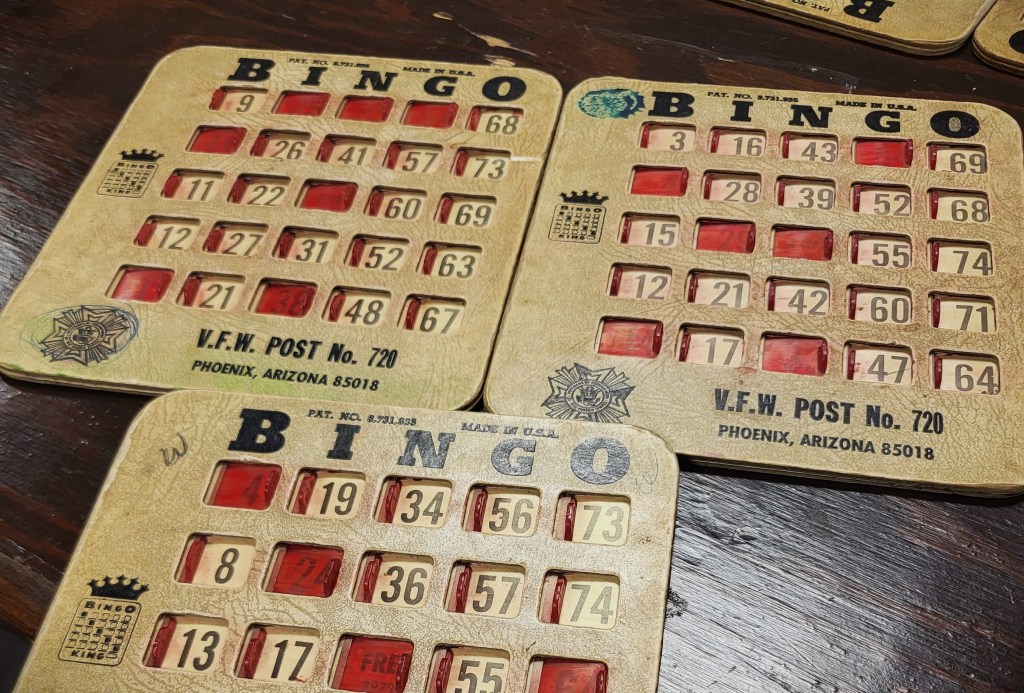
They flock there to play BINGO on Wednesday nights in January, February and March when the snowbirds have returned.
Spirits are high, but stakes are low.
Fifty or sixty friends and neighbors huddle over long metal tables with wooden tops. They scan their BINGO boards with dreams of leaving with fifteen or twenty dollars in their pockets.
Hit the switch and you can hear the hum of the BINGO ball cage as it spins. The caller pulls a number and announces it over the microphone. B-15, O-66, and so on.
Over the years, the number callers have come and gone. Phyllis and Sherry shared the duties admirably on January 31, 2024.
Last night’s first game was dedicated to Bill H. He passed last year. In his honor, you had to cover all the numbers on one of your boards to fill the shape of the letter H to win $10.
After that, each game was more traditional. You needed to get five in a row across, up and down, or diagonally to win $5.
Or–if you were lucky enough to cover the four corners or create a “postage stamp”–a four-square shape in one of the corners–that would suffice too.
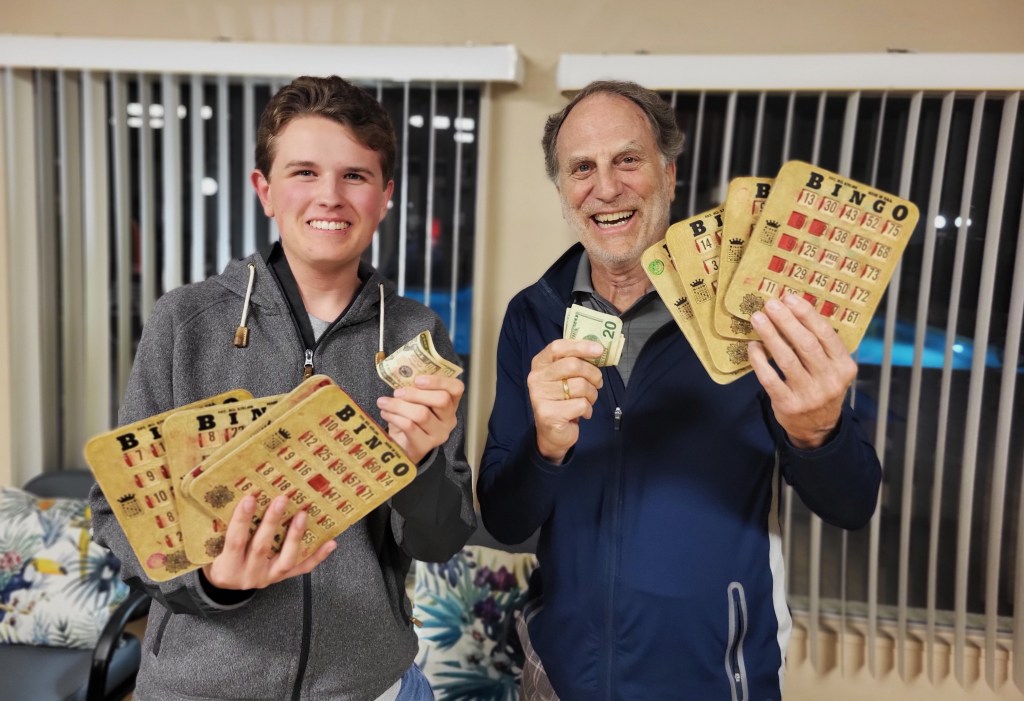
The final game of the night is always “black-out” BINGO. The goal is to cover every space on your card. The first one to do it, shouts BINGO and wins $20.
Last night, two–Theo and John–landed there at the same time and shared the winnings.
But the beauty of BINGO isn’t really the amount of cash you win.
It’s about the shared experience of sitting side-by-side in the same room.
It’s about the kitschy camaraderie, silly laughter, and goofy cross talk before, during, and after each game.
It’s about celebrating the “what ifs” of life … “Oh, if only she’d called I-30. I would have been the big winner!” … no matter your political preferences or social status.
It’s about the realization that the small, yummy square of lemon cake Jean baked for consumption at the half-way point contained a splash of zesty lemon from one of our luscious community citrus trees.
It’s about the reminiscing with friends as you walk back home to your respective condos at the end of the day on a mild desert evening.
It’s about hugging and bidding each other a good night … until the next game of BINGO.
My three BINGO cards. I didn’t win.Our fun table causing a ruckus.Theo and John won several games.
After my mother died on this day in 2013 at age eighty-nine, my grief took root.
With a little time, a lot of reflecting and journaling, and the support of a small circle of family and friends, I found and nurtured my own path from the branches of despair.
By 2015, I had carved out a storyteller’s life Helen Johnson would have loved. Late that year, I flew to North Carolina to visit Frances, her only sister.
Spending time with Frances in the state where both were born–and revisiting childhood memories of my grandparents’ farm in Huntersville, NC–propelled my creativity.
In March of 2016, I completed and published my first book, From Fertile Ground. It is the story of my journey and grief.
If you’ve read this story about three writers (my grandfather, mother, and me) and their love of family, you know this isn’t really the cover.
Today I’ve superimposed this photo of Helen and Frances together (in my sister’s backyard in 2003 or 2004 in northern Illinois) to remember them both.
Why? Because Frances was the last physical vestige of that rural, 1960s world for me. When she died six months ago at age ninety-one, I metaphorically waved goodbye to those years of running amok barefoot on warm summer days in the Tar Heel State.
Of course, I will always have rich memories of my wise-and-frugal mother, who wrote countless letters, and my fun-loving aunt, who traveled the world in her retirement years. In their own ways, they inspired me to tell my story.
Today–as I remember them both–I can walk into the sunroom of the Scottsdale, Arizona condo where Tom and I now live. I can pull my book off the shelf and find this passage.
“What I knew before was that the farm was a place of discovery for me and the fertile ground there was a physical and psychological refuge from the hardships of our family drama in St. Louis. What I know now is that I would need to go back to North Carolina to come to terms with my grief and integrate my southern memories with my present-day, real-life adult existence.”
I can take solace in the fact that I’ve written about Helen and Frances–who they were, who they loved.
Though they are both gone, they live on the pages.









 Mark Johnson Stories