It’s late Friday afternoon in the desert. The mockingbird outside our backdoor is singing his or her heart out. It’s a tender, hopeful, pre-weekend serenade … a chirpy, lyrical refrain coming from the top of a telephone pole that connects our heavier world of technology and dissonant news and noise.
None of us knows what tomorrow will bring … ever. But especially now.
Case in point: early this afternoon as Tom and I devoured a few remaining slices of sausage and veggie pizza from the night before, a military jet zoomed overhead.
The sudden surge of decibels jarred our nerves. Though we live near a military base at Papago Park, we rarely hear that intense noise. Only an occasional squadron of helicopters arriving or departing.
We are a nation of divided people living on the edge of time, sound, and sensibility. Each day when we climb out of bed, we are aware of the dismantling of institutions we have come to know and respect.
Each day we are threatened by another batch of edicts tossed out the sidedoor by an authoritarian regime bringing shame and constant anxiety to those of us raised to believe in a country that once valued high ideals over low morals.
I don’t pretend to have the answers. But I know silence will kill us.
I won’t pretend to be someone I’m not. Or as I have said frequently to friends lately, “I’m not putting this genie back in a bottle.”
What do I mean? I spent too many years as a teenager and young adult (of the 1970s, 80s and early 90s) denying my true gay identity, subverting my whole self to try to fit into a predominantly straight, suburban culture.
That caused me (and others in my life at the time) tremendous personal pain. And, on a larger scale, denying the truth kept our society from advancing to a higher plain of equality, freedom, and human possibilities.
Yet now our federal (and some of our state and local government officials, too) are attempting to wipe away the contributions and accomplishments of our “diverse” people from websites and history books.
For instance, native code talkers who–by virtue of their distinct language–were instrumental in helping to bring an end to World War II.
Did you know that recently pages on the Arlington National Cemetery website–highlighting the graves of Black and female service members–have been removed?
These and other efforts are designed to erase the accomplishments of women and people of color.
How far will this attempt at whitewashing our history go? I don’t pretend to know. But I do know that the best attributes of our diverse culture exist in the past and present and people need to know about these contributions.
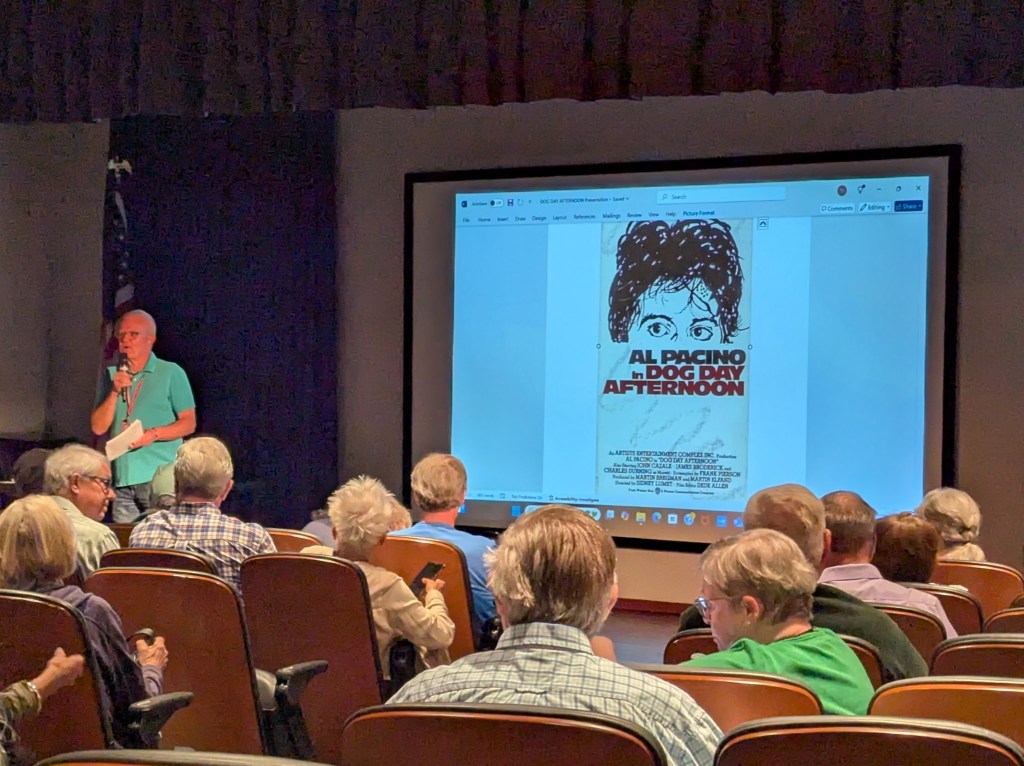
My husband Tom, an aficionado of films from the 1960s and 70s, has been leading a film series this winter and spring at the Scottsdale Public Library, titled “Movies That Matter: the 1970s.”
Each Monday afternoon, between 75 and 100 people attend this free series. The audience is mostly white people who love great films.
Last week, Tom screened “Dog Day Afternoon”. Directed by Sidney Lumet and starring Al Pacino, the film–based on a true story that occurred in Brooklyn, New York, in the 1970s–chronicles a botched bank robbery in the heat of the summer.
It’s an intense and sometimes funny film early on. Pacino plays Sonny. He’s desperate to get the money his partner needs for a sex change operation. But we don’t know that until more than half the movie has spooled through what once was a movie projector.
It’s a must-see flick. I won’t spoil the outcome if you haven’t seen it. But the most meaningful and important aspect of this story is that 93 people attended. They listened to Tom’s stage-setting intro for historical context. They watched the film, and then they talked about it. Together.
They talked about what it meant. They examined the techniques employed in the film to tell the story effectively. They existed in that space for three hours as a community of people in a shared experience.
I don’t pretend to know all of the political affiliations represented in that room. But I’m certain they left with a greater appreciation for film and how it can shed light on the differences and pressures–like them or not–that have existed in our American society for decades.

 Mark Johnson Stories