October is bright and beautiful in central Arizona. The intense heat of summer is gone. Mornings and evenings are cooler.
Back in St. Louis, it was fortuitous that Tom and I decided to visit the Gateway Arch on September 22, because–with the U.S. government shutdown–the Arch and other park facilities across the country staffed by the National Park Service closed October 1. Who knows where this latest setback for the American people will lead?
Still, life goes on.
Beginning October 10, I will teach another memoir writing workshop at Mustang Library in Scottsdale. Tom is leading a film series, called Hollywood Laughs, at the same location on Thursday afternoons until mid-November.
Meanwhile, fall chorus rehearsals are underway for our next Phoenix Gay Men’s Chorus (PHXGMC) concert, Let Your Spirit Sparkle, in December at the Orpheum Theatre. I will wear my blue sparkly vest on stage again. This 2025/2026 concert season is my sixteenth consecutive year singing with gay choruses in Chicago and Phoenix. It is a vital part of my life.
Under the dynamic leadership of Antonio and Darlene–our artistic director and assistant artistic director respectively–PHXGMC has grown to more than 150 diverse members. Our voices will be strong when we march in the Phoenix Pride Parade on October 19.
Next month, Kirk will visit us in Arizona for a few days. Even as the mayhem in our country spreads, Tom and I look forward to gathering with Nick and him. We will enjoy a few quiet hours with both of my sons in our newly remodeled, freshly painted desert home.
We will give thanks for our fortunate lives, good health, and meaningful artistic opportunities in our sixty-something years, which have enabled us to have a positive impact on the lives of others in our community.
In February 2024, John, Sharon, Tom, and I sat around a half-moon-shaped booth in Phoenix, devouring yummy, syrup-soaked, gluten-free waffles and nursing hot mugs of coffee at Jewel’s Bakery and Cafe.
They had been in town for a church retreat over a three-day weekend and were about to return their rental car to Sky Harbor Airport. Breakfast together was our sendoff before they flew home to St. Louis.
“Oh, did you see Nancy’s post on Facebook? There’s gonna be a Class of ’75, Affton High School, 50th reunion sometime, somewhere next September in St. Louis,” I reported.
“You guys should definitely do it. ” Sharon chimed in. “The four of us should go together! Don’t worry about Tom and me. We’ll keep each other company.”
“Sure. Why not!?” Tom agreed.
“I’m in if you’re in,” John stared directly at me. He and I were close junior and high school pals in Affton, though his family moved north, away to another St. Louis area school district before our senior year.
“Okay,” I concluded. “The journalist inside me is telling me we should go.”
Our scheme–hatched in Phoenix, to be realized more than a year and a half later in St. Louis–was born.
***
The sometime was 5 to 9 p.m. on September 21, 2025. The somewhere? Grant’s Farm, a rambling, forested 281-acre estate in south suburban St. Louis, named for Ulysses S. Grant and owned by the Busch family.
Specifically, our 50th reunion would occur in the Bauernhof Courtyard area there. It’s an old-world community space where–since its opening in 1954–St. Louisans have gathered to sample Anheuser-Busch products, and amble down hallways of vintage horse carriages past Clydesdale stables. It is an iconic St. Louis destination, draped in mid-twentieth-century nostalgia.
With the threat of showers in the air, John, Sharon, Tom and I arrived in the Grant’s Farm parking lot just before 5 p.m. Immediately, I began to spot familiar faces. I hugged Terri and Beth, two classmates I hadn’t seen in decades. We boarded a tram that would transport us through the woods to the Bauernhof. I inhaled the fresh-yet-familiar, dampness of the lush green forest.
The long-awaited immersion into my past Affton High School life–connecting one leg of my past as a seventeen-year-old, long-haired (remember, it was the 1970s), reserved, enterprising, unactualized gay adolescent with the other leg of my present much older, wiser, grayer, gayer, literary self–was about to commence.
When we arrived at the Bauernhof Courtyard entrance, we stepped out of the tram towards an archway. Nancy, our cheerful, detail-minded Class of ’75 organizer, greeted us with hugs.
We formed a line to check in and pick up drink tickets. Affton attendees (in this case, John and me) received name tags bearing our black-and-white high school yearbook photos. Significant others, such as Sharon and Tom, got tags with an image of a cougar beside their names. (The cougar is the Affton High School mascot.)
John and I proceeded through the line with our “cougar spouses” toward the courtyard. A photographer snapped photos as couples and singles entered. In that moment, as I turned to see the line queuing behind me, I spotted someone significant I had hoped to see. Not a fellow student, but a teacher I admired from my high school years. It was Judy Rethwisch, my drama teacher.
The high school version of me would have faded and stepped back, reticent to make a scene or a visible statement. But the confident me–the sixty-eight-year-old gay man with his husband by his side–stepped forward to reconnect with Judy.
“I want you to know what a positive difference you have made in my artistic life,” I smiled and reached forward to hug her. “With you at the helm, I found my peeps in the theatre program at Affton,” I went on. In a flash, I recounted roles I played in productions of Fiddler on the Roof and Gypsy under Judy’s dedication and tutelage.
Judy smiled and listened intently as Tom captured a few photos of us locked in conversation. She told me she is still teaching drama. Sixty-one years as an educator. Still vibrant. Still making a difference in the lives of other aspiring actors, musicians, and artists. She asked for my card and told me she is interested in reading one of my books. That was just the beginning of a stream of seminal reunion moments.
I quickly rediscovered a parade of classmates coming and going all around me. Some were fuzzy in my memory. Others, like Jon, more meaningful. He was a good friend in high school, who traveled to Colorado with John and me after our junior year of high school.
Suddenly, I was transported to August 1974. Somehow, the three of us had convinced our parents, that we–one seventeen-year-old and two sixteen-year-old boys–would be safe driving and camping together across country in John’s AMC Javelin, pulling a small trailer.
Yes, we were underage and found someone to buy us lots of Coors beer, which we swilled by the campfire at night. But we survived intact. I recall vividly shoveling down steak and eggs for breakfast in a bar somewhere in Wyoming, while in the corner of the tavern, Richard Nixon, was announcing his resignation on a beat-up black-and-white TV.
Back at the reunion, other male and female classmates trailed by to greet each under the courtyard tent. It featured a beautiful crystal chandelier that hung in the center of the space.
Soon a line formed at a barbeque buffet. We juggled our drinks and grabbed plates, before landing at one end of a long rectangular table Tom and Sharon had secured.
At one point, I turned, and Jeff appeared. He and I were pals, who shared a few classes. We ate together frequently in our high school cafeteria. Honestly, these memories are vague for me. But I remembered his handsome face. It hadn’t changed much, given the fifty-year gap in our connection.
When Jeff introduced his long-time partner Lee to Tom and me, I felt my past and present lives coalesce. Neither Jeff nor I were aware of the other’s sexual orientation in high school. Sadly, that was the norm for 1975 for unrealized, unfulfilled, budding gay adolescents.
But knowing that against the tide of social norms we had each found happiness with our male partners and had independently decided to return to the reunion was physical proof why I had come to the Class of 1975 reunion. I needed to fully reconcile my past closeted self with the authentic gay man I had become.
A little later in the evening, Tom returned to our table and said emphatically: “I can’t tell you why, but you need to go to the dessert table right now.”
Of course, I listened to my husband and followed suit. When I arrived there, I discovered Nancy and Jim (the reunion organizer and her husband) had brought two of my books–From Fertile Ground and Tales of a Rollercoaster Operator–to display there for all to see.
I don’t know that I gasped, but it felt like I did. To be appreciated for my writing that way, left me speechless in the moment. It was a lovely gesture, authored by Nancy and Jim. Another phenomenal moment, which connected one leg of my life with another.
Before the reunion came to a close and we boarded the tram, all of the Class of 1975 Affton High School classmates–about 120 of us in attendance–stood on a wobbly set of risers for a group picture. (Earlier in the evening, a large poster bearing the names and photos of our forty-nine classmates who have passed graced a corner of the same stage.)
Certainly, the wrinkles and gray hair for those of us who have survived into our late sixties were apparent on the evening of Sunday, September 21, 2025. But the smiles and fun-loving community spirit superseded all of that. Our hearts were full.
***
After treating John and Sharon to breakfast Monday morning, Tom and I had a few hours on our own before we needed to make our way to the St. Louis airport for the trip home to Arizona. There were a few loose ends for us to tie together.
First, we drove to Left Bank Books in the central west end of St. Louis to browse the stacks. It’s a renowned, LGBTQ-friendly, independent bookstore we had planned to visit on the morning of our shared sixtieth birthday. But after I suffered a mild heart attack that day–in the city where I was born–our lives took a vastly different path. Fortunately, we survived that experience together.
Appropriately, our final stop in St. Louis was the Gateway Arch. In the late 1970s, during my collegiate years, I was a National Park Service history interpreter there. Giving tours of the Museum of Westward Expansion, welcoming visitors to the top of the Arch, and–from time to time–introducing a fascinating documentary film about the construction of the Arch, called Monument to the Dream.
The film chronicles the beauty and simplicity of Eero Saarinen’s winning design, but also the herculean effort required for a diligent crew to erect the monument through all sorts of weather conditions.
On a warm autumn day when the Arch was completed–October 28, 1965–the crew sprayed a steady stream of water on the south leg, which was expanding in the heat, to allow the capstone–the final piece at the top between the two legs–to be wedged in and joined permanently.
In a symbolic sense, that is what this later-in-life St. Louis reunion with friends and family means to me.
Call it the arc of life or the Arch of life. Either way these sixty-something years began in Missouri, brought me to Chicago for a long career and life as a single father, and carried me to Arizona with my husband. There we have discovered a rewarding artistic life together among new and old friends–our chosen family–even as our freedoms and institutions in the America we still love are threatened by fascism.
Along the way, the highs and lows have transported me to a profound place of greater gratitude and understanding, which I have earned.
It is a welcome destination that once felt out of reach.
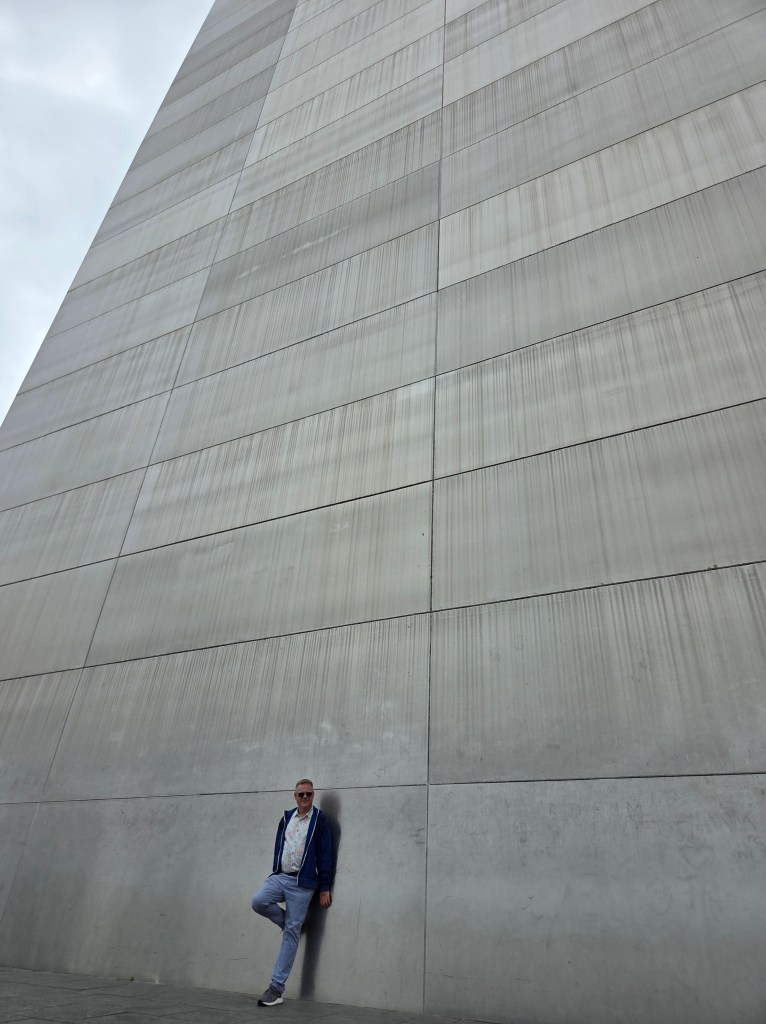
On Monday, September 22, 2025, Tom captured this photo of me leaning against the base of the north leg of the Gateway Arch in St. Louis, Missouri.
Spotty storm clouds gathered in the distance on the morning of Saturday, September 20. Tom and I drove northwest twenty miles, across the Missouri River.
Our destination was Breeze Park in Weldon Spring, Missouri. My cousin Phyllis–a retired teacher–is convalescing there, hoping to regain her strength after a series of health complications.
Phyllis’ mother Violet and my father Walter were twins born in St. Louis. It was 1913. More than fifty years later, the Gateway Arch would rise and transform the St. Louis riverfront. Teetering warehouses once stood on cobblestone streets there, in this fur-trading town founded just west of the Mississippi River in 1764.
In the arc of life, Phyllis and I (both Baby Boomers) also arrived–she in 1947, I in 1957–before the historic completion of the Arch, our nation’s tallest monument, on October 28, 1965.
But today I reflect on our personal connection. Like me, Phyllis and her husband Tom also raised two sons born in the 1980s. Austin and Bryant are now in their early forties and late thirties respectively. A touch younger than my son Nick; a shade older than my son Kirk.
Now in their late seventies, Tom and Phyllis are meeting the healthcare challenges of life head on. Negotiating the unpleasantness of aging and inherent losses (their lovable golden retriever Truman passed recently). They are doing their best to push ahead. To stay hopeful. Or as my mother–a child of the Depression–would have said “trying to keep a stiff upper lip.”
Given these developments, I wanted to spend time with them while we were in the St. Louis area. Especially because–beyond my sister Diane who now lives in northern Illinois–they are the closest remaining strands of family from my Missouri years: 1957 to 1980 … my Tales of a Rollercoaster Operator years.
On Saturday, when my husband and I arrived just past 9:30, we wound our way down halls, past friendly staff and other visitors, to Phyllis’ room. She was delighted to see us. So was her Tom. He arrived a few minutes later with a big smile and box of gooey pastries for us to share.
The next two hours were a heart-warming oasis of conversation and listening between the four of us. We spent our time commiserating over the latest news, but–more importantly–strengthening our family bond during a challenging period for them personally.
Phyllis is hoping to return to their home soon in nearby St. Charles. As anyone would, she is missing the familiarity and comfort of her life. Longing for peace away from medical equipment and disruptive procedures. Her kind, caregiving husband is also searching for peace.
Before Tom and I left, we hugged and took photos together outside on a beautiful, flower-laden patio at Breeze Park. I kissed Phyllis on the cheek. A few tears materialized for both of us, not knowing what tomorrow will bring.
At the least, we shared those upbeat Saturday moments, built upon our 1960s memories of our once-vital, long-gone boisterous St. Louis relatives gathering around us every Christmas, Easter, and Independence Day.
To our credit, in our later years, long after our sons became adults, we have formed reciprocal connections. Most notably, Phyllis, Tom and their family joined Tom and me for an Italian dinner in St. Louis in route to our new home in Arizona in July 2017.
Now they share stories and photos via text of their four growing grandchildren, and I write stories about my St. Louis origins, which she has encouraged, helped inspire, read, and followed diligently.
All of this, through a period of uncertainty, sustains us in our sixty-and-seventy-something years across the miles.
***
Just after noon Saturday, Tom and I returned to Creve Coeur. We landed in the driveway of our friends John and Sharon.
We were about to share the rest of the weekend with them and their loyal eight-year-old-shepherd-beagle-mix Nickel at their stylish, mid-century home … hike with John through a dense forested area overlooking Creve Coeur Lake, then get caught in the rain in historic downtown St. Charles … drive into St. Louis for a Cardinals/Brewers game at Busch Stadium Saturday night … and still later, on Sunday evening, attend our Class of 1975 Affton High School reunion together at Grant’s Farm.
The clouds cleared Saturday evening and ushered in cooler temperatures. Seated together with close friends at Busch Stadium, three levels up directly behind home plate, it didn’t seem to matter that my beloved Cardinals lost 3-2.
Yes, it was the latest evidence in a disappointing sub-par year. But on the horizon, beyond the stadium’s outfield walls, the twilight of a blue sky and puffy clouds perfectly framed the Gateway Arch at the center.
Architect Eero Saarinen’s monument to a dream is still standing, rising above the cobblestones and the fray, as it approaches its sixtieth birthday.
If you follow the weather news in the United States, you know that on Friday, May 16, parts of St. Louis, Missouri–where I was born in 1957 and reborn in 2017–suffered an estimated $1 billion in damages from an EF3 tornado.
The powerful storm tore through central and north St. Louis, killing five people while damaging or destroying 5,000 buildings and countless trees … including many majestic ones in and around one of the city’s gems: Forest Park.
I have no doubt that over the coming days, weeks, months, and years, the citizens of St. Louis will heal and recover. But it will be a tall mountain to climb for many financially and emotionally.
I have made a donation to the American Red Cross disaster relief efforts. But I want to do more for the city I love, which appears in all five of my books. It is hardwired into my prose and poems in large and small ways …
In memories of my hard-working family, our suburban midwestern existence, humid summer days, learning to operator a rollercoaster at Six Flags, working at the top of the Gateway Arch (pictured here) in the late 1970s, rooting for the St. Louis Cardinals, boating on the Mississippi River, visiting the St. Louis Zoo, frequenting the aforementioned Forest Park, and much more.
In addition to making a donation of your own to your favorite relief charity, here’s another way you can help. Buy any of my five books during May and June.
I will donate $10 for each book I sell (paperback, Kindle, or audiobook) during that period to Forest Park Forever. It is a private nonprofit conservancy.
As described on their website, the organization “partners with the City of St. Louis to restore, maintain and sustain Forest Park as one of America’s great urban public parks for a diverse community of visitors to enjoy, now and forever.”
Thank you in advance for your support of my literary efforts and the city of St. Louis … as well as its beautiful urban greenspace in the middle of town, which I still love and remember.
***
Incidentally, Tom and I will travel to St. Louis in September to attend a Class of 1975 reunion with my Affton High School classmates. Yikes, fifty years! More to come on that.
Completed on this day fifty-seven years ago, the Gateway Arch served as a catalyst for St. Louis’ mid-twentieth-century renaissance.
The six-hundred-thirty-foot-tall structure was then, and still is, that gleaming stainless-steel phenomenon and symbol, soaring above and beyond the banks of the Mississippi River. It replaced a sagging riverfront packed with dingy brick warehouses and smokestacks.
It is impossible for me to reflect on this city I love–the place where I was born which now bears little physical resemblance to what I remember half a century ago–without acknowledging the magnificence, continuity, and meaning of the Arch.
In late 1965 shortly after a construction crew finished the project, I stood directly underneath it with my parents, looking straight up from the base, running my palms across its smooth-and-shiny skin. It would be decades before sapling trees would grow tall enough to create this park-like atmosphere you see here.
For three summers–1977, 1978, and 1979–I worked underneath, around, and inside the Arch as a history interpreter for the National Park Service. It was a fabulous job for this then-twenty-year old idealist and history buff.
I gave tours in the Museum of Westward Expansion, talked about the city’s founding as a French fur-trading post in 1764, and played color commentator for wobbly visitors as they gazed across the Missouri and Illinois horizons through tiny windows at the top of the Arch.
In those days that federal landscape was defined as the Jefferson National Expansion Memorial, because the Arch was built as a memorial to Thomas Jefferson and recognized St. Louis’ pivotal role in the westward expansion movement.
Of course, the concept of westward expansion conjures sometimes-controversial overtones in this era. Of white settlers moving west to push Native Americans from their land.
But no matter your point of view about U.S. history, the Gateway Arch constitutes an architectural marvel at the very least and a symbol of pride for St. Louisans past and present.
In 1947, Finnish-American architect Eero Saarinen won a competition with his Gateway Arch design. His concept included reflecting pools on the ground to soften the sharp edges of the monument that carves its path through the sky.
Unfortunately, Saarinen didn’t get to see his masterpiece completed. He died September 1, 1961, in Ann Arbor, Michigan, while undergoing an operation to remove a brain tumor.
But the rest of the world watched with wonder four years later. When construction workers–dancing on the edge of the sky–inserted the capstone piece to connect the north and south legs of the Gateway Arch, St. Louisans breathed a sigh of relief and welcomed their brighter-and-shinier identity.
Fifty-seven years later, I understand the surrounding trees have matured, and the Arch grounds have been connected more seamlessly with the rest of the downtown area.
And the Gateway Arch itself? It’s still standing and an inspiring site to behold.
Ruminating from the threshold of Medicare eligibility, this is how I choose to remember my parents in their later years: content and seated side-by-side, listening to jazz in St. Louis on the banks of the Mississippi River.
If you’ve read my first book, you know Helen and Walter had a complicated and volatile relationship. But by the mid-to-late-80s–after the heavy lifting of jobs, child rearing, and the daily swirl of Dad’s bipolar rants–they found a more peaceful coexistence.
Together they rediscovered a love of Dixieland jazz under the shadow of the Gateway Arch. They tossed their metal folding chairs (latticed with yellow and white nylon strips) into the trunk of their sensible sedan, drove downtown, and evidently walked to this shady spot.
It happened just steps away from the cobblestones that led to the now-defunct Admiral Boat and historic Eads Bridge that still connects Missouri and Illinois. (If you squint, you’ll see them both in the background.)
I remember the faint giddy-up in my fading father’s voice over the phone. He described what he and Mom experienced … together … rousing, organic music played by happy people. Trumpeters, saxophonists, trombonists blaring on a summer’s day.
Best of all, all that glorious music was FREE. Products of the Great Depression, Dad’s and Mom’s frugality was baked into their souls. Thankfully, it transferred magically into mine.
Years later, as I gathered coupons for a trip to the grocery store with her in northern Illinois, my mother would smile with pride at me from under her floppy hat and announce, “You’re a good shopper, honey.”
I imagine my sister Diane took this photo. At the time, she lived near them in the St. Louis suburbs. I had already moved to Chicago in 1980 to launch my communication career and create a life with Jean, then my wife.
Busy in my late twenties and early thirties, I was happy to know of a positive change in my parents’ relationship, but I think I dismissed their newfound glee and meeting of the minds. Digging deeper, maybe I felt sad that I missed this better chapter.
Now that I’ve arrived at the station in life depicted in this photo–greater leisure time, protective hats, contentment, wisdom, and personal vulnerability–I see more clearly how tragic it is that we Americans dismiss the trajectory of our older citizens in favor of youth and vitality.
It seems like it should be the exact opposite. Other cultures figured that out long ago. Why is it we are so hung up on viewing the activities and lives of young people as more valuable? The Kardashians? Please!
It boils down to money, marketing, and economics. Companies know that many seniors–then and now–live on fixed incomes. They don’t have the disposable income they once did. But what a shame to diminish their worth and assign it a dollar amount.
This story–part nostalgic reflection, part rant on agism–was prompted by rejection. No, I wasn’t job hunting. Five months ago, I entered my latest book in a contest with Memoir Magazine. I had high hopes I might at least get some sort of honorable mention.
On Sunday, I received a cordial, strategically written email thanking me for my submission. Then the other shoe dropped. Though my set of whimsical-and-serious Arizona stories and flights of fancy made it through the initial review, it didn’t land on the short list.
I have to admit. I was crestfallen. I think I’m a damn good writer. I also realize the competition was stiff. I lead a relatively ordinary life with my husband. At this point, my life isn’t filled with drama. It’s my calling to write stories about what it means to age, what it means to be gay, what it means to exist and survive in this crazy world.
Yes, as my husband reminds me, there will be other opportunities, other contests to consider. But especially now (three weeks after testing positive for Covid and fortunately recovering) none of us knows what tomorrow will bring.
All of this brings me back to Helen and Walter … and all that jazz they enjoyed under the Arch in the 1980s. I suppose I’m better off just enjoying the moments of life as they appear, singing when I want to sing (I have a brief solo in my June concert with the Phoenix Gay Men’s Chorus), writing what I want to write, and caring less about accolades and awards.
I guess I’m better off giving thanks for the perspective that comes with aging. No matter whether the literary world or the greater universe ever recognizes what I have to say, I have my life. I have my voice. I have my writing.
We sat–quietly and obediently–in rows facing the front of the room. Most of the girls wore frilly dresses, bangs, and patent-leather shoes; the boys sported bold-striped shirts, crew cuts, and bright-white Keds.
Our mornings and early afternoons were occupied with simple math, spelling, reading, recess, and cartons of cold milk on lunch trays. The American flag draped over the alphabet border above the blackboard.
Images of George, Abraham, and John–Washington, Lincoln, and Kennedy–stood guard. I suspect they were there to ease our minds and protect our American innocence.
If only it were that simple.
***
I don’t remember feeling fear, when our teacher told us it was time for another drill. We knew the routine and followed instructions.
A voice on the public address system told us when to practice hiding under our desks, when to duck and cover, when to escape to fallout shelters in hallways if a bomb were dropped.
It lasted but a few minutes. We covered our heads and faces until the all-clear signal came from our teacher. We absorbed the fear–the height of the Cold War–without knowing what it was.
This was what we knew in the early 1960s in middle America. We were fortunate these were merely practice drills, false alarms.
I imagine the scenes weren’t much different in schools on the outskirts of Chicago, Cincinnati or Cleveland. At Mesnier School in Affton–ten miles from downtown St. Louis–we aspired to a gleaming symbol. We lived in the shadow of an emerging national monument.
By its completion in 1965, the Gateway Arch would soar, though across the nation the fog of pollution and social issues intensified.
As history would have it, all of the names of St. Louis school children would be stored in a time capsule in the base of the Arch. Mine is among them.
Back in the classroom, between random drills and parent-teacher conferences, we learned to add, subtract, multiply, and divide. We tied our shoes and kept on skipping in a world where rules were prescribed narrowly for girls and boys.
This was the credo for boys: Get good grades in school. Be prepared. Keep your eye on the ball. Run faster. Jump higher. Find a decent job. Don’t be a sissy. Meet and marry a woman. Buy a house. Have kids. Keep your nose to the grindstone. Pass the baton to the next generation.
But what about those of us who are different? Where do we fit into the story? We had to figure that out for ourselves.
***
The sixties weren’t pretty. Assassinations reigned. The Vietnam War raged. Poverty and racism amplified. People felt trapped, ready to shed the remnants of restrictive gender roles and sexuality, sealed in the repressive 1950s.
But the world is exponentially more complicated now. The latest madman is hellbent on ravaging innocent people in Ukraine. Though love appears in abundance in many circles across all continents, ignorance and hate manifest themselves next door and around the world.
Once again, sixty years later, we find ourselves living in fear of the fallout. We must find ways to duck and cover, to speak the truth while standing as tall and mighty as the Gateway Arch.
We owe it to our children and grandchildren to put politics aside, to protect our planet, to uphold individual rights and civil liberties, to teach them about black and white, but also the color and grayness of the world and all its permutations. Pandemic or not, they are watching.
Even if they don’t know it, the youngest members of our society are counting on us to speak the truth, denounce racism and hate, celebrate gay and straight lives, and to teach them that every generation has a responsibility to remember and honor the seminal moments in history, and–hopefully–carry the best of humanity forward.



 Mark Johnson Stories