Tag: Gay Life

Potluck

My husband is an excellent cook. He prepares our dinners with love and panache. I am more the pancake-and-egg guy in our relationship. Breakfasts are my thing.

Occasionally, we switch things up. Today is one of those days.

Our friend Jeremy has invited us to his Thanksgiving potluck this evening … a low-key gathering with friends and a few in his family.

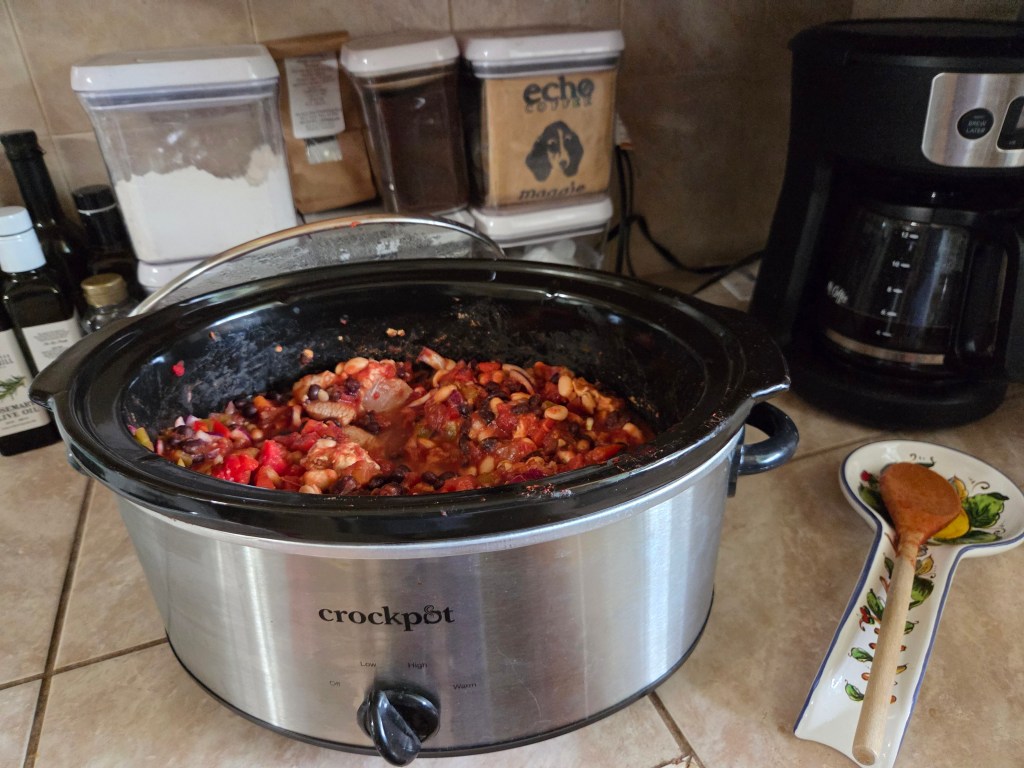
Yesterday, I decided I would make a pot of chicken chili for Jeremy’s Friendsgiving today. It is simmering in our slow cooker as I write this. It’s a delicious, easy, non-traditional dish.

I haven’t made it in years, but the timing is right. The weather is cooler. I want to prepare something meaningful to share with our friend, who is managing his way on the road of life through a monumental year of personal growth mixed with significant detours and setbacks.

As background, Jeremy came out to his friends, family, and the world a little over a year ago. He and his wife are no longer a couple, but they continue to be loving parents to all five of their children. It’s impressive that even during this period of uncertainty they have maintained a respectful relationship.

I know fatherhood is important to Jeremy. He loves and supports his children. I remember how difficult it was for me to balance my fatherhood, demanding career, and “gay awakening” thirty years ago. I suspect it is the same in this moment for Jeremy.

All of this leads me back to this recipe for chicken chili. In the early 1990s, after Jean and I divorced, I felt broken–broke, too–and I existed in a fog, especially in the colder months.

My sons spent half their time with me in my tiny apartment. I needed to find inexpensive, flavorful dishes, which I could prepare for dinner for Nick, Kirk, and me. To feed and nourish us. To keep us close.

This chicken chili recipe is one I made frequently thirty years ago. Not so much lately. But it makes perfect sense to resurrect it today. To bridge the past of balancing my gay identity and single fatherhood with the present of Jeremy’s.

So, I am making chicken chili now for about a dozen (Jeremy’s supportive friends and a few of his children) who will gather on a coolish and likely rainy Saturday evening in the desert.

Together we will give thanks for friendships … the potluck of life that nourishes us and allows us to learn and grow during good times and bad.

We’re Sold Out

In the theatrical world, it’s a good problem to have.

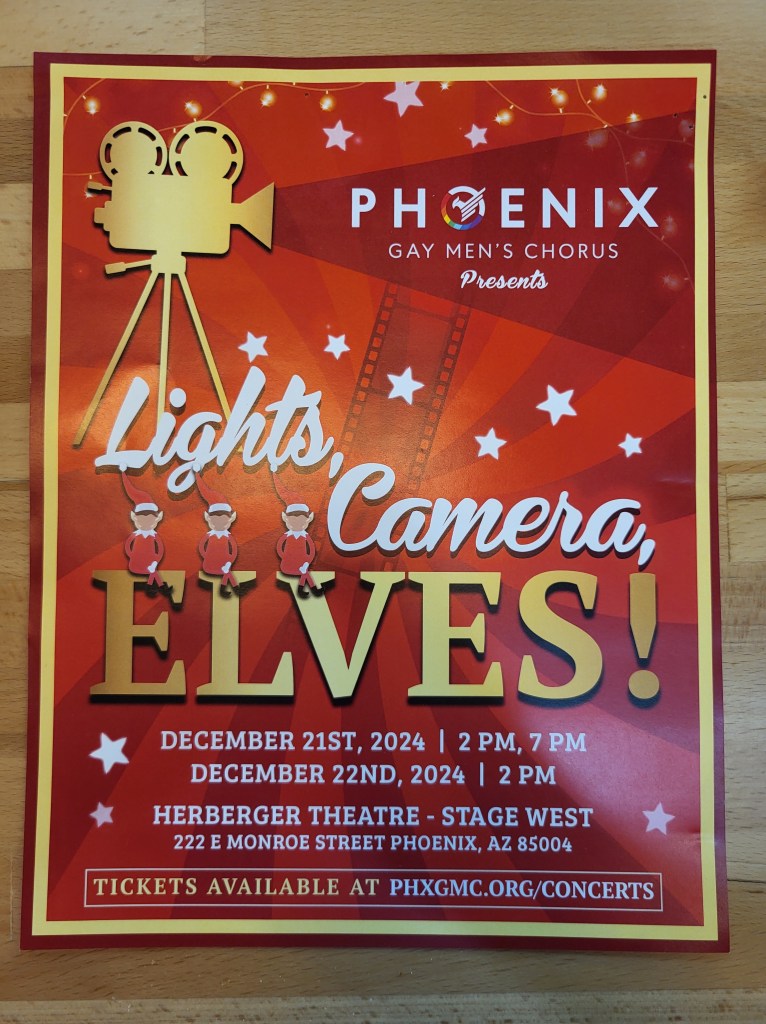
Every seat for all three of our Phoenix Gay Men’s Chorus performances of Lights, Camera, Elves!, December 21 and 22 at the Herberger Theatre, has been sold.

While we are turning people away who might have bought additional tickets, we are also turning up the emotions, music, mayhem, excitement, and energy for two final rehearsals Thursday and Friday night.

***

This will be my fifteenth consecutive year singing in holiday concerts with my LGBTQ friends: 2010-2016 in Chicago with the Windy City Gay Chorus; and 2017-2024 with the Phoenix Gay Men’s Chorus.

Of course, I don’t remember every holiday tune, wondrous moment, or distinctive venue relating to those performances. But the net effect is the sense of belonging–the ever-widening space that occupies my heart, which is rooted in this collective community experience.

It’s difficult to explain, even for a wordsmith like me. If you have sung with a chorus, you understand.

If you haven’t, there is something inherently magical and healing that comes with standing side by side and contributing your voice to the greater good of a beautifully blended piece of choral music.

Nearly one hundred of us will sing, laugh and dance on stage this weekend. I will probably cry a little too as we perform captivating arrangements of Do You Hear What I Hear? and Pure Imagination.

But the tears will be mostly joyous and thankful ones as I channel the smiles on the faces of friends and family–past and present–who have surrounded and supported me on the risers and in the audience for fifteen glorious years.

Under Construction

Writing can be gratifying, but it’s not easy. It requires introspection, imagination, and a healthy dose of discipline away from the demands of the day.

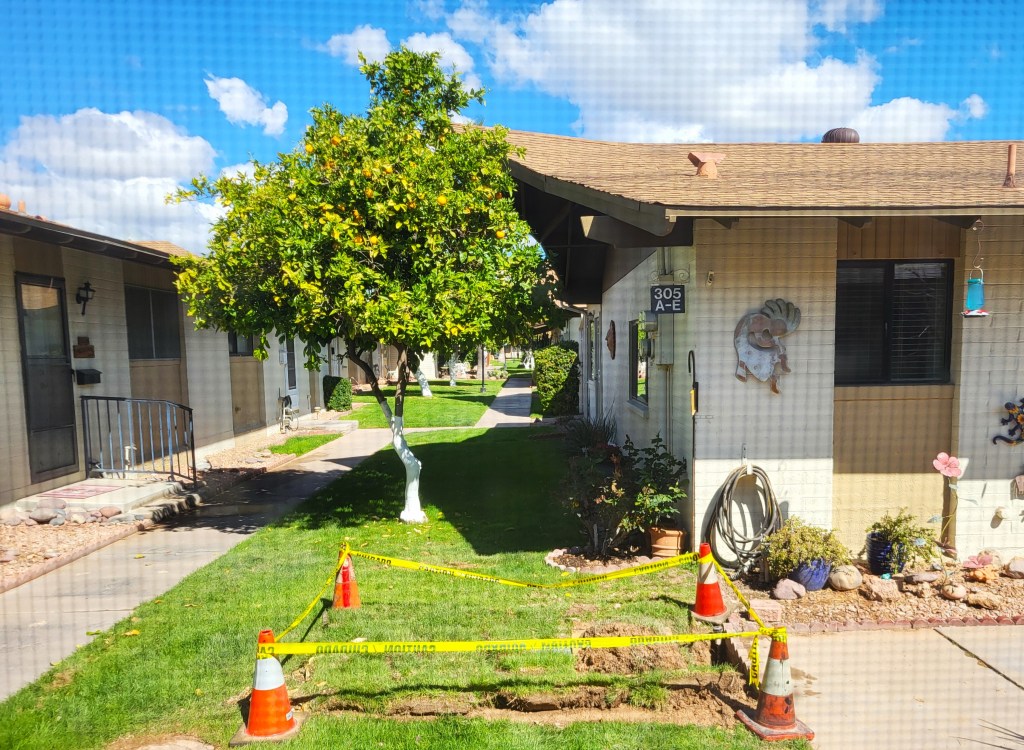
As I write this, my creative inspiration has been less certain and more diffused. Perhaps the construction cones, yellow tape, and jagged chunks of sod–prominent through the screen of our kitchen window after the replacement of a water main valve this week–are a fitting metaphor for the disruption I feel.

I’m living between and among several writing-related projects that deserve attention. The largest of these is a novel I’ve been mining … and drifting in and out of for the past eighteen months or so.

It’s a compelling (I think) fictionalized story of twin brothers navigating the pitfalls of their differences and a significant/sudden loss that muddies their family waters and transforms them.

I’ve written six or eight chapters, spent significant hours developing the back stories of both characters, and have a clear idea of the troubles they will face and how the story will end, but there is at least a year of research, writing and editing ahead. That feels daunting.

In the near term, I’m committed to blogging once a week and working with Marc, the artistic director of the Phoenix Gay Men’s Chorus, on another libretto later this month. This one, called “Encore”, will appear on stage in late June.

I’m also refashioning a retrospective essay about a teen’s emerging gay identity. This is something I’ve submitted to a few literary magazines. So far, no takers. But I’m determined to find a home for it.

Meanwhile, I want to teach a memoir writing class. On Monday, I presented the Scottsdale Public Library with a concept for a workshop I have developed. They like the idea. There are details and timeframes to figure out, but I hope to lead the first session with a small group of attendees this fall.

Yes, there is a lot under construction inside my brain and around me as snowbirds tiptoe to and from the parking lot past the various plots of uneven ground the plumbing crew left in their wake.

At least I’m choosing creative projects that are important to me … doing my best to entice more folks to read my books, while maximizing the slippery slope of my sixties.

It all feels exhilarating and overwhelming.

The Wonder of Purple Summer

In popular American culture, there is boundless emphasis on achieving success, material wealth, and happiness before you turn thirty.

That’s not a recent phenomenon. Consider every car ad you’ve ever seen that plays on a loop during the holidays with a cooing couple in love and big bow tied outside on the latest red, silver or black luxury sedan or SUV.

Yet, for most people, the premise is fraudulent and anxiety producing. In reality, it takes much longer (sometimes your entire life) to find your path, push your head above water financially and (if you’re lucky) discover some level of creative contentment.

For me, the monetary success didn’t come until my forties. Creative contentment came later. In my fifties. But it didn’t appear in an office or a cubicle. With a client or a colleague.

It began to surface ten years ago today … on June 19, 2010 … at the Hoover-Leppen Theatre at the Center on Halsted in Chicago.

That night, as we prepared for two performances of Summer Lovin’ (our Pride concert), I found myself surrounded on stage by fifty new friends (with Windy City Gay Chorus and Aria) in Chicago’s thriving gay community. Diverse and talented people I had known for a mere three months.

At that moment, I didn’t know these kind cohorts–instrumental in my personal renaissance–would carry me across the creative threshold that night and become some of my most enduring friends. But that’s what happened for this member of the Windy City Gay Chorus for the next seven years.

I was smitten and felt my spring awakening (we were still a few days short of summer) when a circle enveloped us newbies, a stirring song (Walk Hand in Hand) swirled over and around me, and a red rose landed magically in my hand minutes before our 5 p.m. performance.

Then, on cue in the first act, we performed The Song of Purple Summer (written by Duncan Sheik and Steven Sater) from the musical Spring Awakening.

It still makes me cry. It holds me captive.

***

And all shall fade
The flowers of spring
The world and all the sorrow
At the heart of everything
But still it stays
The butterfly sings
And opens purple summer
With the flutter of its wings
The earth will wave with corn
The gray-fly choir will mourn
And mares will neigh with
Stallions that they mate, foals they’ve borne
And all shall know the wonder of purple summer
And yet I wait
The swallow brings
A song too hard to follow
That no one else can sing
The fences sway
The porches swing
The clouds begin to thunder
Crickets wander, murmuring
The earth will wave with corn
The gray-fly choir will mourn
And mares will neigh with
Stallions that they mate, foals they’ve borne
And all shall know the wonder
I will sing the song of purple summer
All shall know the wonder
I will sing the song of purple summer
All shall know the wonder of purple summer
***

On this night ten years later … in this age of tumult and fear … I feel the sadness and longing in this song.

But there is also comfort in this memory and the soaring voices of my Windy City friends.

In the spring of 2010, they ushered me to the wonder of purple summer.


Oh, Very Young and Less Fortunate Men

Camelback_Oct2019

At this stage of life, I have more time and space to reflect on the fragility and inequities of life. When I hit the trail for a hike or catch a glimpse of the jagged edges of Camelback Mountain, I sometimes ponder the plights of less fortunate men and less developed versions of the man I’ve become.

Recently, without notice, a Sonoran time machine swooped down and transported me from the desert. Back to south suburban St. Louis and my blue-denim-bell-bottom memories. Jerry and Joey (not their real names) lived near me on the same cul-de-sac street and the Oh Very Young prognostications of Cat Stevens looped through my brain.

Oh very young, what will you leave us this time?
You’re only dancin’ on this earth for a short while …

It was a weekend morning in the spring of 1974. I sat at the kitchen table, finishing up my last few bites of scrambled eggs and toast. My over-worked and under-appreciated mother washed the breakfast dishes. Over one shoulder, she blurted a provocative and unexpected question in my direction: “Mark, did you know Jerry is a practicing homosexual?”

Like most teens, I was bound up with insecurity. If I’d been less repressed, more freewheeling—or at sixteen had an ounce of awareness or comfort with my budding gayness—the idea of “practice” sex with an older boy down the street would have intrigued me. But at that moment I had no clue how to respond to my mother’s audacious question. I just shrugged my shoulders and muttered something like “Yeah, I think I’ve heard he might be.”

It didn’t occur to me that she might be fishing to learn about my sexuality. I just knew Jerry’s mother had died when he was young and his father, brothers and sisters had been left to make sense of her early exit. Whenever I walked by the front of their home, I saw the heaviness of their hearts had caused the foundation and the trees around it to sag.

I’ve written a lot about my mother. She was smart, resilient and courageous. Many years later, she left me with her legacy of wise letters. But back in the 1970s, we weren’t approaching that. We were nearly three decades away from the profound sense of respect and understanding we would construct during her eighties and I would witness  the love and deep regard she felt for my future husband and me.

Anyway, in the 1970s I was a withdrawn teen and she hadn’t yet sharpened her sensitivity. More specifically, like most parents then (and sadly many now), the implications of homosexuality and the image of two men engaged in mutually satisfying love frightened her. The word homosexual cast a shadow of shame, discomfort, darkness and isolation. Of course, without knowing it, I was absorbing the uninformed views about gay people coming through all sorts of channels–parents and neighbors, aunts and uncles, classmates and coaches, media and popular culture, etc. 

I will never forget that trauma. Pushed and bullied down middle school hallways. Labeled a faggot for wearing my favorite purple sweater vest, a gift from my mother. As you might surmise, I learned it was best not to wear purple or pink or challenge society’s narrow mold of masculinity in the 1970s. It would take decades for me to love myself and create an unapologetic life as a gay man comfortable in pastels.

This is a prelude to tell you that, in addition to my personal sexual identity struggles, I felt sad and angry hearing and seeing Jerry and other young gay men ostracized for their nature, mannerisms and social awkwardness.

I don’t know where Jerry lives or anything about his adult life in 2019. But I now realize Jerry was a trailblazer. I owe a lot to the Jerrys of that time. Despite neighborhood chatter and suspicions, they were courageous enough to risk ridicule. To be true to themselves in the 1970s.

***

The story of Joey has nothing to do with societal pressures, sexuality or suburban mores. It’s a cataclysmic tragedy.

Joey was the blonde boy who lived next door. We were the same age. As youngsters, from kindergarten through fifth grade we waited for the same bus at the end of our street. He loved to roughhouse with his golden retriever when he came home from school. In sixth grade—lunch boxes in hand—we walked together to a new elementary school, built to handle the overflow of Baby Boomers.

Throughout the 1960s, once school ended in June, Joey and I raced to the top of the street with our  neighborhood crew to play baseball in a vacant cemetery lot. We stayed there until our mothers or fathers stood on their front porches, cupped their hands to their mouths, and called our names for dinner.

In high school, Joey and I went our separate ways. I didn’t feel our connection any more. He was a mechanical guy. I wasn’t. I had a knack for stringing words together. He didn’t. He loved tinkering under cars. I loved singing on stage. While he developed a passion for playing the drums, my interest in the clarinet waned. In August of 1975, we continued down divergent paths. We left home for college at different Missouri schools.

Through it all, I felt no physical attraction for Joey, but I envied his apparently idyllic Please-Don’t-Eat-the-Daisies family life. Complete with the faux-wood-paneled Country Squire station wagon parked in their driveway, which I watched them load annually for summer vacations. Joey’s family seemed to embody the ideal of suburban happiness:  two friendly and well-liked parents, two popular daughters who went on to become cheerleaders, two masculine and mechanically-inclined sons.

On a horrific Saturday in May 1976, everything changed. I came home from my seasonal job as a roller coaster operator at Six Flags and found my mother sobbing on the living room couch. She told me Joey had been killed in an accident. He was riding shotgun without a seat belt on the way home from his first year at college when the car he was in collided with another vehicle.

Spring flowers were blooming outside that day, but inside I was numb and devastated like everyone on our block. One cruel moment had ended Joey’s life and transformed his family’s home from the center of happiness into the epicenter of grief.

A few days later my mother, father, sister and I attended Joey’s wake. I didn’t know what to say to his bereaved father and mother. But I summoned a few inadequate words and gripped their brittle arms as we passed a pair of drum mallets stretched across Joey’s closed casket. It was frightening evidence of teenage mortality.

In 1980, I moved to the Chicago area. Whenever I returned to St. Louis to visit my parents and boyhood home, I thought of Joey and his family. Scampering in their yard with their dog as they prepared to load up their station wagon for the next trip. When Joey died, that era ended. Soon after, the rest of the family moved away.

Forty years have come and gone. Joey is on my mind again.  Perhaps because he didn’t live long enough to pursue the next path at the base of rugged buttes. His Oh Very Young life ended back in the rolling Missouri hills without any chance to explore the west or have a spouse to share it.

Somehow, through good fortune, I’ve lapped his lifespan more than three times. After surviving a heart attack on my sixtieth birthday, I’m rounding the bend on the fourth lap here in Arizona.

For all the Jerrys and Joeys who have come and gone, I must keep telling my stories. I must make the most of the extra time I’ve been granted.

Oh very young, what will you leave us this time?