In a natural sense, it produces turmoil in the Northern Hemisphere … growth and beauty laced with intense storms and wild swings in temperatures.
Of course, those meteorological transitions pale when you compare them with the societal turmoil, which I feel daily living in the United States in 2025.
My only recourse is to try to make a difference in my own way: stay visible, protest beside like-minded friends …”Hands OFF our Social Security” … all the while remodeling my home with Tom, singing, writing, and leading my memoir writing workshops. (Twelve aspiring writers are meeting with me later today in the middle of three workshop sessions at the Scottsdale Public Library.)
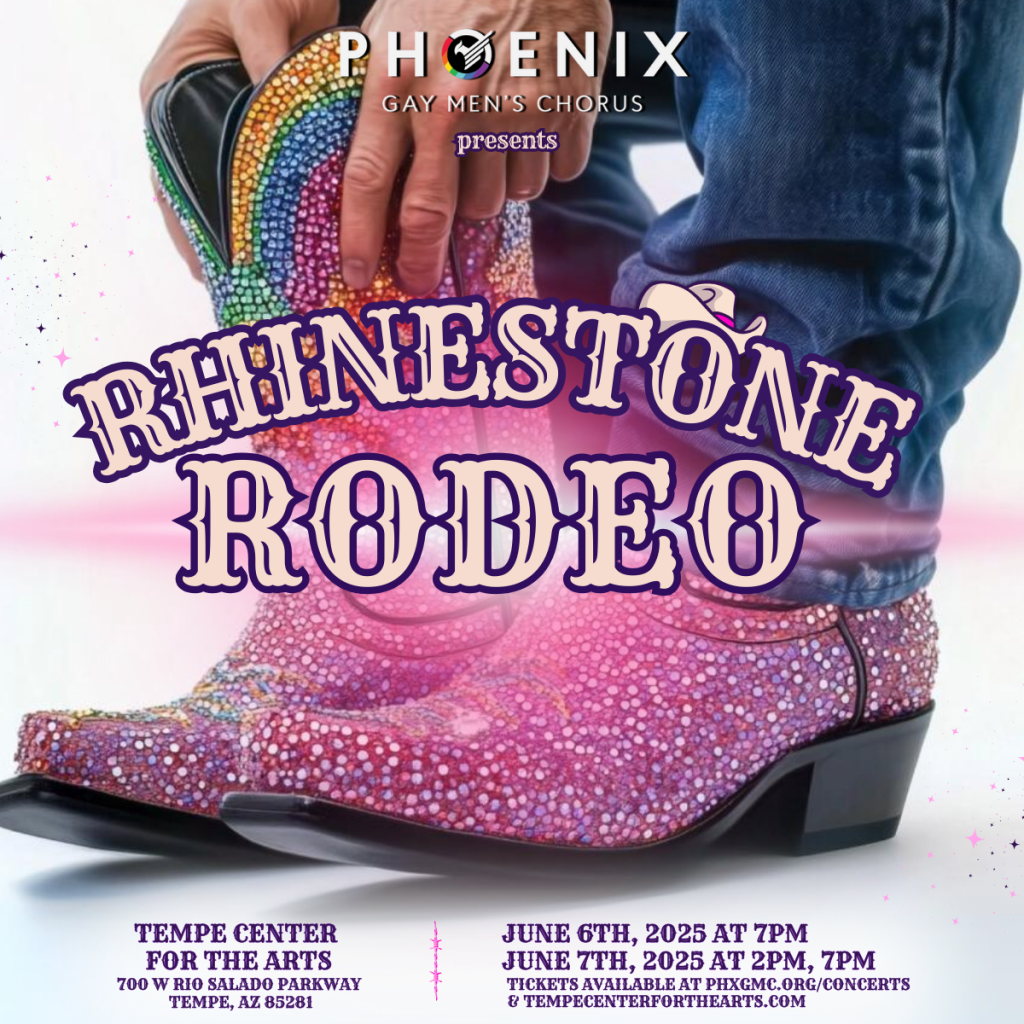
It’s appropriate that my Phoenix Gay Men’s Chorus comrades and I will perform an inspiring arrangement of Bob Dylan’s The Times They Are A-Changin’ at our Rhinestone Rodeo concert on June 6 and 7 at Tempe Center for the Arts.
Because they most definitely are … and you better start swimmin’, or you’ll sink like a stone, for the times, they are a-changin’ …
On to more personal transitions that fly under the radar. It is the grimy stuff of life. A friend’s mother dies. Another grieves the loss of his wife. A third deals with a cancer diagnosis. I will do my best to continue to be there for all of them.
If you live in the Phoenix area, come in from the heat and attend one of our June concerts. We will entertain and energize you … make you smile, laugh, shed a few tears, too … as we lift our voices.
No one can stop me from being who I am … who I love … who I care for … who I sing with.
When you’re living through a full-blown constitutional crisis–and feeling vulnerable–you need to find ways of coping and caring for the ones you love.
So, I bought two of these beaded rainbow wristbands from the Human Rights Campaign for Tom and me to wear.
We are wrist-banding together.
This is a symbolic gesture. I want the world to know that this gay couple isn’t going anywhere, though it is a period in the United States where some would prefer that those of us who are different would go away.
But I–we–remain visible.
As I write this blogpost, I realize it is number 500 … a true milestone for any writer.
When I began blogging in May 2018, I had no illusions of where it might lead.
I simply wanted to give my books and literary voice more room to grow, more visibility.
For that reason, I suppose it is fitting that today I choose to write about my gay identity and continue to exercise personal aspects of my voice … visibly.
In many respects, the life my husband and I lead is not all that different from any couple.
We shop for groceries together. Go to the gym together. Enjoy quiet moments and meals together. Love and nurture each other.
We do our best to support each other and our family members during highs and lows.
We spend time with our friends. They are young and old, straight and gay, black and white.
We love and respect them, and they love and respect us.
I think it’s accurate to say this about our friends: we enrich each other’s lives, no matter our skin color, religious beliefs, cultural perspectives, gender identities, or sexual orientations.
It is a personal jolt to realize–and read on trusted news sources each day–that our differences are under attack and being eroded in my home country … the country I still love.
I don’t think I’m depressed. But I am definitely sad and angry. Definitely grieving. Me and a boatload of others of all backgrounds and persuasions.
There are times when I want to scream from the top of a mountain. “This is my country, too. How dare you try to take that away from me!” But then I wonder, “Is anybody listening?”
So, I bring this here, instead and I type these words in blogpost number 500.
At any rate, thank you for joining me–possibly even enduring me at times–on this blogging journey since May 2018.
As long as I continue to feel I have something important and relevant to say (to shed light on the topics of the day … to celebrate a literary success or the latest Phoenix Gay Men’s Chorus performance … to pay tribute to those I love … to tell a funny story about our stray cat Poly … to observe and honor the beauty of nature … to share a vivid, meaningful memory about my childhood … or to pen a poem that is in need of artistic space and oxygen) you will find me here.
I hope you have been informed or entertained and will continue to tag along with me on this organic literary odyssey, wherever it may lead.
As I walked the treadmill at the gym this morning–on Abraham Lincoln’s two-hundred-sixteenth birthday–a weird, dark, and discomforting question swirled through my brain.
What if we–all the diverse people in this country, all the people of color, all the LGBTQ folks–were gone?
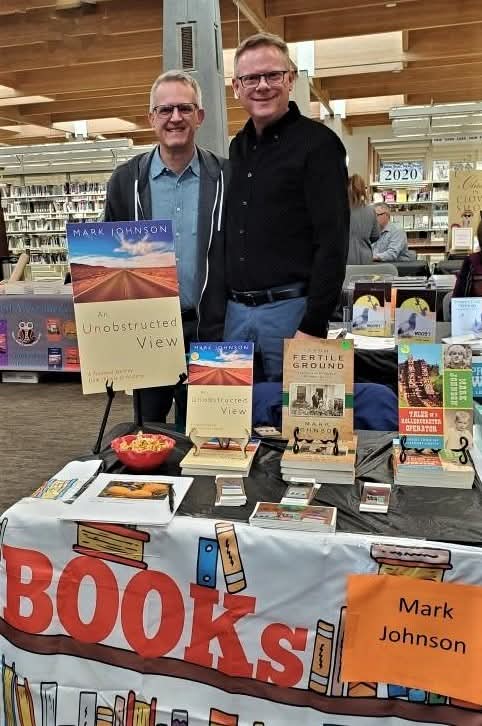
In the old days (the pre-Covid days)–just five years ago this week–I hawked my books with my husband by my side at a local author book fair at the Scottsdale Public Library.
We didn’t know about the dark days ahead. Holed up in our cozy condo. Wondering if we and our closest family and friends would survive. Wondering if the race to create a viable vaccine might save us.
Fortunately, science did produce a vaccine that saved lives (for those of us who had the gumption to protect ourselves and others).
We did survive and Tom and I have gone on to create new chapters at the library … him leading several successful film series; me guiding those intent upon writing their own memoirs.
Strangely, those Covid years feel quaint now as our nation disintegrates daily. Tom and I cling to one other, as our nation turns a blind eye toward anyone who is different.
Yes, we have many friends and family who love us. But, to put it bluntly, I don’t feel safe. This experience of living in 2025 in the United States (we aren’t really united) has cued old tapes in my psyche that remind me that–once again–I am living in a straight, white world of shallow masculinity.
I will keep trudging along. Loving my husband. Guiding my adult sons. Speaking my mind. Telling my stories. Holding my closest friends close. Giving to organizations that might make a difference. Advocating for those less fortunate. Donating my time, talents, and voice to the Scottsdale Public Library and the Phoenix Gay Men’s Chorus.
Most of all–like many of you–I just need to keep breathing today. And, for tomorrow and the next day, I need to save any reserves of energy and sanity I have to fight the good fight.
What ailed me for three years–2013 to 2016–was grief spawned by the loss of my mother.
Listening to Annie Lennox’ soaring voice–her Nostalgia--pulled me through and beckoned me to complete my first book From Fertile Ground.
You see, Annie’s rendition of twelve stirring and mostly southern-sometimes-smoldering tunes written in the 1930s and 1940s primed the pump of my southern sensory memories.
Sometime in 2015, I unearthed a tender memory of making homemade peach ice cream with my grandmother Georgia on the rickety porch of my grandparents’ North Carolina farm.
It was Annie who reminded me that I had Georgia on My Mind. Sherrell Richardson Ferrell, too–S.R. for short. He was my farming grandfather who left behind more than fifty years of diary entries.
Annie’s music, Georgia’s love, S.R.’s spartan stories (primitive blog entries really), and Helen’s litany of letters (she was my wise mother) gave me all the creative inspiration I needed to finish and publish my first book in 2016.
Why is this all relevant today? Because I have Helen on my mind. She died twelve years ago on January 26, 2013.
For the most part, my writing and the constant love and support from my husband Tom have helped soften the grief as the years continue to roll by.
Helen would have been happy for me on both counts. She suspected Tom and I would retire in Arizona one day.
However, I doubt she would have imagined the entirety of this literary chapter for me, which lately includes teaching memoir writing at our local library. (I’ve been asked to lead a third workshop in April.)
Or the growing community of loyal followers Tom has inspired with every immersive movie series he hosts (also at the Scottsdale Public Library). His next series–Movies That Matter: The 1970s (a tribute to six film directors)–begins tomorrow and continues on most Mondays until early April.
I firmly believe it is the arts and the artists–like Annie Lennox, even the less renowned ones like Mark Johnson and Tom Samp–who through their music, writing, painting, poetry, and true cultural perspectives will help pull us through this dark and uber-turbulent period in our once-proud country.
For now, that is the hope I cling to. Along with the memories of love and gratitude–the nostalgia–framed by indelible moments with family and friends past and present, who I love dearly.
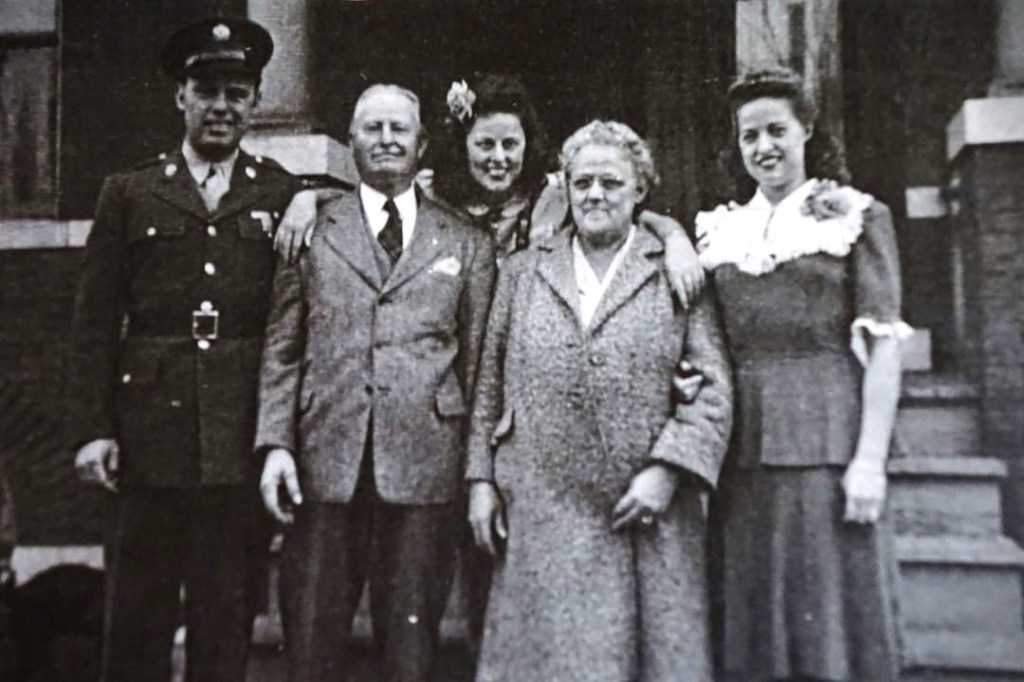
Albert, Louise, and their three adult children–Thelma, Violet, and Walter–led ordinary lives.
In the fall of 1944, they were a big-hearted, hard-working, working-class family–living in a flat on Labadie Avenue on the north side of St. Louis.
To be precise, Thelma and Walter lived with their parents. Violet and her husband Harry lived nearby.
At any rate, they were a close family with strong opinions, loud voices, and a propensity to gather around the radio for FDR’s inspiring Fireside Chats.
Like all patriotic American families of that era, they planted a Victory Garden to grow their own vegetables, rationed household supplies, and bought war bonds to support American troops fighting overseas in Europe and the Pacific.
They did it all for the sake of protecting and maintaining freedom in a war-torn world.
Walter, Albert, Thelma, Louise, and Violet in late 1944.
When Walter was drafted and deployed to Europe (Harry, too) you might say the family had extra skin in the game of war.
He left New York Harbor–aboard the Queen Mary ship with hundreds of other soldiers–on New Year’s Eve 1944.
Five days later, he landed at the Firth of Clyde in Scotland … and, in short order, he found himself on the front lines scurrying from foxhole to foxhole in the Battle of the Bulge in the forested Ardenne region of France.
As the war in Europe wound down in 1945, he marched with the first group of US army personnel who met with the Russian army on the Elbe River on the eastern front of the war.
Walter survived the ordeal–in part because of the regular flow of love letters and encouragement he received from his sisters and parents.
Walter returned to the US on the U.S.S. Monticello in July 1945 … for a thirty-day leave prior to going to fight in the Pacific.
He was supposed to depart in mid-August, but on August 6, the US dropped the first atomic bomb on Japan and the war ended shortly thereafter.
Walter’s fighting days were over. He was discharged from the service on October 11, 1945.
A few years later–sometime after he met his future wife Helen in January 1948 at Westminster Ballroom in St. Louis–he confided that the Russian soldiers were some of the roughest, battle-hardened men.
At any rate, despite the “shellshock”, nightmares, and frozen feet Walter brought home with him, he (and Harry) came home in one piece.
***
I’ve thought a lot about Walter and Helen (my dad and mom), Thelma and Violet (my aunts), Albert and Louise (my grandparents) … the Johnson family … since the election last week.
All of them have been gone a long time, but in a sense–today–I feel I am grieving my own loss of freedom, as well as their legacy. The one they fought so hard to uphold.
I’m not giving up, but that is how I feel on Veterans Day 2024.
Early this afternoon, I pulled out Dad’s World War II army trunk.
It contains pieces of his uniform–including the wool hat and golden medallion he wore eighty years ago as he was preparing to preserve freedom on behalf of his country.
Finding it there with his few remaining possessions gave me strength.
In the coming days, weeks, months, and years, I’m going to do my best to draw from the resiliency in my family’s DNA to find specific ways to uphold democracy in my Arizona community.
You can be sure I also will continue to exercise my voice–through prose and poetry–and influence others in a positive fashion as we head into an uncertain and potentially ominous period in our country’s history.
After my mother died on this day in 2013 at age eighty-nine, my grief took root.
With a little time, a lot of reflecting and journaling, and the support of a small circle of family and friends, I found and nurtured my own path from the branches of despair.
By 2015, I had carved out a storyteller’s life Helen Johnson would have loved. Late that year, I flew to North Carolina to visit Frances, her only sister.
Spending time with Frances in the state where both were born–and revisiting childhood memories of my grandparents’ farm in Huntersville, NC–propelled my creativity.
In March of 2016, I completed and published my first book, From Fertile Ground. It is the story of my journey and grief.
If you’ve read this story about three writers (my grandfather, mother, and me) and their love of family, you know this isn’t really the cover.
Today I’ve superimposed this photo of Helen and Frances together (in my sister’s backyard in 2003 or 2004 in northern Illinois) to remember them both.
Why? Because Frances was the last physical vestige of that rural, 1960s world for me. When she died six months ago at age ninety-one, I metaphorically waved goodbye to those years of running amok barefoot on warm summer days in the Tar Heel State.
Of course, I will always have rich memories of my wise-and-frugal mother, who wrote countless letters, and my fun-loving aunt, who traveled the world in her retirement years. In their own ways, they inspired me to tell my story.
Today–as I remember them both–I can walk into the sunroom of the Scottsdale, Arizona condo where Tom and I now live. I can pull my book off the shelf and find this passage.
“What I knew before was that the farm was a place of discovery for me and the fertile ground there was a physical and psychological refuge from the hardships of our family drama in St. Louis. What I know now is that I would need to go back to North Carolina to come to terms with my grief and integrate my southern memories with my present-day, real-life adult existence.”
I can take solace in the fact that I’ve written about Helen and Frances–who they were, who they loved.
Though they are both gone, they live on the pages.
With Thanksgiving 2013 approaching, Tom and I knew we needed to change things up after my mother’s slow-and-painful exit the previous January. We decided to escape our suburban Chicago home.
In the wake of our significant loss, we wanted to create a new tradition and plan a week-long Thanksgiving holiday in the desert (in our cozy Scottsdale condo) with my twenty-something sons Kirk and Nick, and Nick’s girlfriend Stephanie.
Early November came. Each of us cleared our schedules. About ten days before our flight from Chicago to Phoenix, Tom developed pneumonia. He was hospitalized for a few days, but insisted he would be well enough to make the trip.
Remarkably, Tom recovered enough for his doctor to clear us for take-off. When we landed at Sky Harbor Airport in Phoenix just west of the Papago buttes, I felt relief.
Over the next few days, Tom’s health continued to improve. We even climbed a portion of “A” Mountain in Tempe near the ASU (Arizona State University) campus.
On Thanksgiving Day 2013, Tom, Nick, Stephanie, Kirk and I dined outside under an orange tree on the patio of Mission Palms hotel, also in Tempe.
In those cool-but-sun-soaked moments–still a year before Tom and I would marry and four before we would move to Arizona permanently–I realized that the space created by my mother’s passing would mean more than a horizon shrouded in tears.
It would mean new possibilities … new chapters … for all of us.
I’m still on a high, channeling ripples of joy from my musical weekend on stage with the Phoenix Gay Men’s Chorus.
It feels as if the decision to step out of my comfort zone and into the spotlight for a solo has dislodged something. I feel freer to explore new things. To be more open to possibilities in the world.
I’m not talking about an entirely new me that appeared in an instant. I believe this progression began when Tom and I left Illinois nearly five years ago. The act of living, writing, and singing in a vastly different landscape has spurred my creativity.
After having a heart attack in 2017, I’ve gotten better at living in the moment, rather than postponing my dreams. We may never get tomorrow.
In the words of Jim Seals, we may never pass this way again. Seals–the singer, songwriter and guitarist of the popular Seals and Crofts duo–died June 6. He was eighty years old.
The tunes of Seals and Crofts–Summer Breeze, Hummingbird, Diamond Girl, East of Ginger Trees, I’ll Play for You, Ruby Jean and Billie Lee, We May Pass This Way (Again)– were the mellow wallpaper of the 1970s. Their distinctive, ethereal sound filled the air and the hearts of young people with hope and possibilities.
When I close my eyes and listen to this CD (yes, Tom and I still listen–proudly–to CDs on an old boom box), I am transported to 1975.
It was my freshman year at the University of Missouri in Columbia. Walking around campus in cut-off jeans and tube socks. Playing tennis with John, my roommate. Feeling the late summer breeze rush through my long, straight blond hair, which trailed down over my face.
Released in October 1974, Seals and Crofts Greatest Hits has left an indelible imprint on my past and present. Whether I remember the young Mark Johnson who tossed a Frisbee with friends in the shade of Mizzou’s iconic columns or the older version who took a chance on a stage in Tempe, Arizona in June 2022, I’ll always be a hopeful dreamer.
Thank you, Jim Seals, for all the beautiful music you created and left us. I’ll keep listening to it … no matter what this crazy universe brings.
***
Life–so they say
Is but a game and they let it slip away
Love–like the Autumn sun
Should be dying but it’s only just begun
Like the twilight in the road up ahead
They don’t see just where we’re goin’
And all the secrets in the Universe
Whisper in our ears and all the years will come and go
And take us up, always up
We may never pass this way again, we may never pass this way again, we may never pass this way again.
This season of triple digits in Arizona–followed by a few days of overdue, soaking monsoon rains–is the perfect time to rummage indoors through personal, vintage photos.
The best of them, like peering into the Grand Canyon, leave me with a mix of joy and insignificance. They tell stories about humanity before I entered the picture.
I’m fortunate to have accumulated photographic treasures from both sides of my family. Some of them, tattered and faded, date back to the early 1900s.
I don’t recall seeing this image from July 1955 before. I imagine one of my maternal grandparents captured it on their Huntersville, North Carolina farm. Sixty-six years later, I stumbled across it in a forgotten album. Today, on July 26, 2021, it is speaking loudly through the sepia tone.
If she were alive, the woman on the left (my mother, Helen Ferrell Johnson) would be celebrating her ninety-eighth birthday today. In 1955, she held my sister Diane on her lap and celebrated her thirty-second birthday with her sister Frances (cradling her first born, Michael) and brother Jim by her side in her original home state.
Mom has been gone since 2013. Grief has taught me there will be days like today when I miss her smile, wisdom, perspective and resolve. Fortunately, thanks to the passage of time, the abyss of grief–the Grand Canyon of loss–subsided in 2015 as I wrote.
When you love someone, grief is the price you pay. It is everlasting, sometimes surprising, but often predictable. Photos, birthdays, anniversaries, and specific songs (I’ll Be Seeing You sung by Peggy Lee) provide the cues.
What makes this photo a rare find is that I have just a few images of my mother and her adult siblings together. Helen left North Carolina right after World War II to begin a new life in a bigger city … St. Louis, Missouri … where she and Dad met, married, settled, raised Diane and me, and discovered their share of happy, challenging, and unbearable moments together.
Jim and Frances stayed to build their lives in the Tar Heel State. They were teenagers on the farm in the late 40s. In the 50s, Jim and Frances (born in 1930 and 1932 respectively) left the nest, but returned frequently to this front porch that faced west. They met and married partners, traveled a few miles down the road to raise their families, and remained near their parents.
What I love most about this photo is the sense of possibilities and optimism in the eyes of Helen, Frances, and Jim. The wear and worry of life hadn’t yet entered the picture. By the mid 60s, Helen had two children. Frances had three. Jim had two. My grandparents loved all seven of us grandchildren. We now lead disparate lives.
Mom loved her brother. He was a friendly, handsome man, who loved to fish, hunt, drink beer, and smoke cigarettes. Unfortunately, the harsh realities and complexities of life had a way of catching up with Jim. In 1987, he died of lung cancer at age fifty-six. When she learned of Jim’s passing, it frightened her. Mom saw his demise as a harbinger of her own mortality. She retired immediately after returning from his funeral.
Frances still lives in North Carolina. She is the most significant personal connection I have to my southern roots. I spoke with her a few months ago. She isn’t the spitfire she once was, but is content with her husband in their Davidson, North Carolina home.
Like all of us who remain, Frances is thankful to have survived the pandemic. She is looking forward to her ninetieth birthday, which she will celebrate January 1, 2022. In 2015, two years after Mom died, I traveled south to see Frances. At that time, we needed to see and hug each other to escape the throes of grief.
My quest to rediscover my southern family and find comfort with Frances ultimately became fodder for From Fertile Ground, my first book. It’s the story of my journey and grief told in part through the writings my grandfather and mother left behind. If you’ve lost someone close recently and are living with the fog of grief, I hope you’ll pick up a copy of my book. Reading it may soothe you.
With each passing year, I continue to find more fertile ground from the photos and writings my mother and father left behind. Reexamining them and rediscovering their importance reactivates the love I feel for imperfect–yet beloved–family members. They shaped my past and the memories of them still inform my present.






 Mark Johnson Stories