My mother was a collector of fine furniture, ceramic pitchers, and–occasionally–commemorative coins.
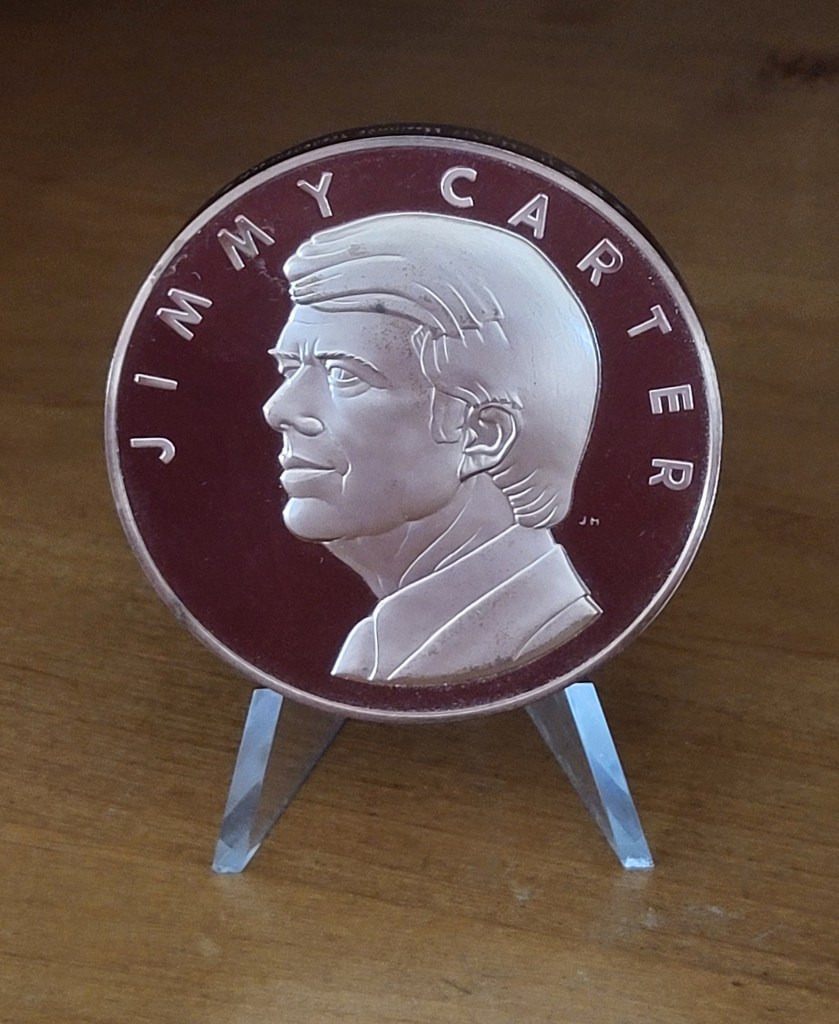
On March 17, 1977, she purchased this Franklin Mint medal. It celebrates the inauguration of Jimmy Carter, the thirty-ninth President of the United States.
This bronze coin has occupied a space inside a box in my father’s WWII army trunk for the past few decades.
I was nineteen and a first-time voter when I cast my ballot for Carter in November 1976.
Most of my college friends at the University of Missouri were Gerald Ford supporters.
I suppose they were willing to forgive him for pardoning Richard Nixon.
I wasn’t. I opted for Carter, the peanut farmer from Plains, Georgia.
As history would have it, Carter’s four years as president (1977 to 1981) included many ups and downs.
For instance, Carter successfully negotiated the Camp David Accords, political agreements signed by then Egyptian president Anwar Sadat and Israeli prime minister Menachem Begin.
Carter also signed into law bills that created the U.S. Department of Energy and Department of Education.
However, the Iran hostage crisis (when fifty-three U.S. diplomats and citizens were held hostage at the U.S. embassy in Tehran by a group of Iranian college students who supported the Iranian Revolution) and related oil crisis led to his unraveling popularity.
In November 1980, Ronald Reagan defeated Jimmy Carter. His loss was punctuated on January 20, 1981, when the hostages were released on the first day of Reagan’s presidency.
Of course, we now know Jimmy Carter wasn’t through yet. He lived another forty-three years and made good use of his century-long (1924-2024) life.
After leaving the White House–with his wife and life partner Rosalynn Carter ever by his side–he established the Carter Center. He worked tirelessly to promote and expand human rights.
That led him to receive the Nobel Peace Prize in 2002.
Jimmy and Rosalynn Carter also became famous for the houses they helped build for Habitat for Humanity and the faithful lives they shared with family and friends in their community and all around the world.
***
This morning, after watching C-SPAN coverage of Jimmy Carter’s funeral at the National Cathedral in Washington, D.C.–and listening to a parade of praise in eulogies given by past Republican and Democratic leaders and grieving family members–I extricated the bronze medallion.
I brought it into the light. I placed it on the shelf of our bureau in our Arizona sunroom. I pondered Jimmy Carter’s astounding legacy of faith, hope, service, and perseverance.
I wondered if–as he was laid to rest–our nation’s democracy might not be far behind.
I hate the trite phrase “only time will tell.” But it certainly applies as inauguration day–January 20, 2025–approaches.
Consider this. Tucked inside the box that normally houses the Carter medallion is a little booklet with information about the tradition of the presidential inaugural medals. Here is an excerpt:
“The Official 1977 Inaugural Medal commemorates the solemn ritual, repeated every four years, through which Americans and their President refresh the nation’s commitment to free government.
During the inauguration, the President, in the presence of Congress, pledges to serve faithfully and to uphold the Constitution to the best of his ability.
Americans have always treated this ceremony as a portentous moment in the life of the republic, a time of celebration and of renewed dedication.”
But we live in 2025. Will the incoming president uphold the Constitution to the best of his ability?
That bit of history–beyond the funereal pageantry of today–has yet to be written.
As a memoir writer, I usually look for clues from the past to enlighten the present. Or signs from nature, such as the cottonwood trees, which I gravitate toward on my walks on the edge of the Desert Botanical Garden. Even in mid-winter here in Arizona, they cling to their brown autumn leaves as they touch another blue Sonoran sky.
No matter what happened yesterday or the day before — or which leaves hold on, fall, or decompose in the desert sun — January 20, 2021 is a day unto itself. It is a twenty-four-hour period filled with residual pain and new possibilities.
Despite the intense security required in Washington, D.C. to stage the inauguration of our forty-sixth president, the deed is done. Joe Biden is now our president; Kamala Harris our vice president. She is the first woman — the first woman of color — to hold this high office. That is something grand to celebrate.
Yes, the years, months and days leading up to this have been marred by a failed presidency, political upheaval, social distress, a January 6 insurrection, and the awful reckoning of more than four hundred thousand lives lost in the United States in one year to this pandemic.
But the light flickering in the sky above the cottonwood trees on this day feels different to me. The atmosphere on the steps of the U.S. Capitol is also new. There is unity in the messages, diversity in the images, and poetry in the air.
Finally, at least for one day, we have something to be proud of again as a nation. It is a new day in history.

 Mark Johnson Stories