Tag: Inspiration

Remembering the Magic

As I’ve gotten older, I’ve discovered I need more private time. This feels like an odd thing for me to admit, because–at one time–I would have considered myself a strong extrovert.

Now that I’ve been away from my consulting career for more than eight years, I realize I was more of an introvert all along. One who was good at solving problems, facilitating outcomes, and wearing a multitude of hats. I was required to be “on” far more than I wanted.

Finding the magic as a writer has been the result of tunneling in versus extending out. It’s been an exercise in spelunking … getting lost in caves of consciousness … then exploring that space.

This creative cocooning is an activity I love, and one I have become protective of. (Translated, that means I get grumpy when there are too many social demands on my time. I can imagine my husband nodding knowingly as I write this.)

Even so, there have been times over the past two years, when I’ve missed the human connections that many of us took for granted in a pre-pandemic world. For instance, reaching out to engage with readers in person or simply being in the same room with others to experience the impromptu moments of life.

On Friday night, I got a dose of the creative community I craved during the depths of the pandemic. Tom and I attended a Storyline SLAM event at Changing Hands bookstore in Phoenix. The theme of the evening was Magic, so each story needed to include that component in one form or another.

The process was pretty loose. Organic might be a better word. Eight people–four before intermission, four after–took turns telling stories on stage in six-minute segments.

When each storyteller finished, five judges (sprinkled in the audience of one hundred) held up mini tote boards with a score. Thirty points were the most possible, because the highest and lowest scores, raised high by the judges, were tossed out.

Driving there, Tom and I knew there was an outside possibility that members of the audience could volunteer to tell their stories in the moment. So, I brought one of my books, An Unobstructed View, in the car–just in case I summoned the courage to get up on stage. The idea intrigued and petrified me.

I’ll cut to the chase. I wrote my name on a slip of paper when we got to the event. I dropped it into a box, where it might be drawn. And it was. As I chugged a glass of pinot noir and squirmed in my seat, I learned I would be number three on stage to tell a story.

When my turn arrived, the anxiety I felt was palpable. Still, I walked to the stage and stood before the mic. I opened my book to page 41 and began reading from a chapter titled The Best Ears of Our Lives. Here’s an excerpt of what I shared that night.

… in October 1998, I became a dog owner again. We found our family dog in an Arlington Heights pet store. A high-pitched bell at the top of the door jingled, signaling our arrival as we pushed through the entrance. Tom and I walked past a wall of cages containing an assortment of critters with doleful eyes tracking our every move. The noisiest of the bunch was a tri-colored basset hound puppy with a white-tipped tail, brown-and-white face, and voluminous black velvet ears. She barked, yelped, and wiggled near the latch of her cage as if to shout, “Look over here. Take me home. You will never find a better dog than me!”… I knew we had turned the page and a dog-eared corner. This tenacious pup had cast a spell on us.

For most of the next decade, Nick, Kirk, Tom, and I would write a chapter together, featuring our shared love for Maggie as the glue that would help us all bond. As Maggie’s body grew, her limbs spread, and her breathing deepened at night, our basset hound further infiltrated our lives. We would never be prepared for the day we’d have to let her go.

The crowd applauded. I smiled, exhaled, walked back to my chair, and sat next to Tom. He kissed me on the cheek. Moments later, my score appeared … 27 out of a possible 30. But the numbers really didn’t matter. It was simply the act of sharing my story and getting an immediate response that fueled happiness and relief.

When the evening ended, an exuberant lady (she told a fun and charismatic story about the magic of motherhood) won the Storyline SLAM event with a perfect score of 30. I finished third out of eight. Not bad for a last-minute decision by an introvert to take the stage.

Most of all, the experience reminded me to live for today in this uncertain world, but also to find the time and space to embrace and remember the magic. It can appear in any form–long velveteen ears on an autumn day or an improbable six minutes on stage in the spring–when we least expect it.
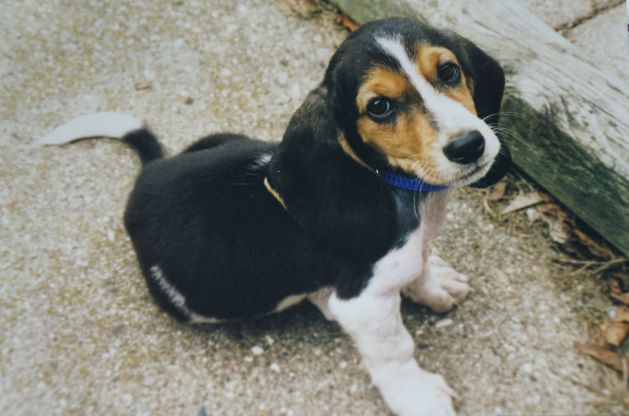
Our magical Maggie, posing in our Illinois backyard in October 1998.

Get Happy

Today, I’m lost in thought about screen-and-stage legend Judy Garland, a film she starred in that sparked my early imagination, a recent experience that renewed my love for live theater, and a song, Get Happy, she made famous.

Forget your troubles, come on get happy, you better chase all your cares away.
Shout hallelujah, come on get happy, get ready for the judgement day.

***

Beginning in 1959, and throughout the 60s, it happened only once a year: CBS aired a special TV broadcast of The Wizard of Oz, the magical MGM film released in 1939.

Like thousands of Baby Boomers across the U.S., my sister Diane and I waited impatiently for the annual ritual. We sat cross-legged, mesmerized in front of our RCA console. We squealed with delight and fear when a ferocious cyclone swept Dorothy into the Kansas sky. In short order, she, Toto (her loyal dog) and their house landed with a thud somewhere over the rainbow.

For those precious hours, Diane and I absorbed and memorized every fanciful song, image and character–the Scarecrow, the Tin Man, the Cowardly Lion, the Munchkins, the Flying Monkeys–Dorothy encountered along the yellow brick road. Though our TV projected black-and-white images only, our imaginations manufactured the scenes in vivid color.

As the years passed, we recited every iconic line of dialogue–“I’ll get you, my pretty … and your little dog, too”–uttered by the Wicked Witch of the West. Whenever she appeared in a puff of smoke, it shook us to the core. But we always knew she would melt in the end, thanks to a handy bucket of water on a ledge and Dorothy’s resourceful decision to grab it in a crucial moment.

Knowing that delicious outcome, and that Dorothy and Toto would ultimately make it back home to Kansas safely, made watching the film one of the happiest and most enduring memories of my childhood.

Looking back, I think it was Judy Garland, playing Dorothy, who captivated me most. Her sense of wonder, innocence, tenacity, good citizenship, pizzazz, and beautiful voice filled the frame. I don’t think there is a more stirring, iconic moment in film than Judy singing Somewhere Over the Rainbow.

Of course, children and adults can watch The Wizard of Oz whenever they want now. But, in the 1960s, the film’s relative inaccessibility, imagination, and message … that it was possible to find happiness and peace “right in my own backyard” … was a shared experience and sense of idealism that no longer exists.

Isn’t it ironic that, in an age when virtually any film or music is available anytime, we are barraged with a mountain of images and problematic news–pandemics, politics, and Putin–that shock our sensibilities and clog our ability to bolster our happiness?

***

2022 marks the centennial celebration of Judy Garland’s life. (She was born June 10, 1922; died June 22, 1969, at age 47.)

To remember and relive her remarkable film, stage and song legacy–amassed in less than five decades–crooner Michael Feinstein has produced a masterful ninety-minute show, called Get Happy!

On Sunday, March 20, Tom and I were in the audience for Feinstein’s dazzling evening performance and multi-media program at the Scottsdale Center for the Performing Arts. It included renditions of many of Judy’s favorite tunes, along with seldom-seen-or-heard images and stories from her life.

About midway through Feinstein’s stellar performance, he paused to tell a story about Judy Garland in 1941. That year, at age nineteen, she bought her parents (who came from modest means in Grand Rapids, Minnesota) a home.

Judy recorded tapes of herself singing to her family in their home, but for years after her death mysteriously those recordings couldn’t be found. Remarkably, Feinstein had the opportunity to visit the home and discovered them in a hollow wall. He played one of those for us as a black-and-white image of a teenage Judy Garland, posing in a tailored suit, filled the screen above the stage.

The song Judy was singing, I’ll Be Seeing You, brought me to tears as I held Tom’s hand. We were seated on the aisle in row Q. Judy never recorded it professionally, but the tune was one of my mother’s favorites. So much so, that Diane and I chose a version of it to play at Mom’s memorial service in 2013.

As Judy Garland’s bright and soaring voice filled the auditorium Sunday night, I was transported back to the early 1960s and the happiness I felt watching The Wizard of Oz.

Mom was curled up on the couch. Diane and I were glued to the floor in front of our RCA. Together we followed Judy’s voice and steps stride for stride.

We were on our annual adventure somewhere over the rainbow.

Fallout

We sat–quietly and obediently–in rows facing the front of the room. Most of the girls wore frilly dresses, bangs, and patent-leather shoes; the boys sported bold-striped shirts, crew cuts, and bright-white Keds.

Our mornings and early afternoons were occupied with simple math, spelling, reading, recess, and cartons of cold milk on lunch trays. The American flag draped over the alphabet border above the blackboard.

Images of George, Abraham, and John–Washington, Lincoln, and Kennedy–stood guard. I suspect they were there to ease our minds and protect our American innocence.

If only it were that simple.

***

I don’t remember feeling fear, when our teacher told us it was time for another drill. We knew the routine and followed instructions.

A voice on the public address system told us when to practice hiding under our desks, when to duck and cover, when to escape to fallout shelters in hallways if a bomb were dropped.

It lasted but a few minutes. We covered our heads and faces until the all-clear signal came from our teacher. We absorbed the fear–the height of the Cold War–without knowing what it was.

This was what we knew in the early 1960s in middle America. We were fortunate these were merely practice drills, false alarms.

I imagine the scenes weren’t much different in schools on the outskirts of Chicago, Cincinnati or Cleveland. At Mesnier School in Affton–ten miles from downtown St. Louis–we aspired to a gleaming symbol. We lived in the shadow of an emerging national monument.

By its completion in 1965, the Gateway Arch would soar, though across the nation the fog of pollution and social issues intensified.

As history would have it, all of the names of St. Louis school children would be stored in a time capsule in the base of the Arch. Mine is among them.

Back in the classroom, between random drills and parent-teacher conferences, we learned to add, subtract, multiply, and divide. We tied our shoes and kept on skipping in a world where rules were prescribed narrowly for girls and boys.

This was the credo for boys: Get good grades in school. Be prepared. Keep your eye on the ball. Run faster. Jump higher. Find a decent job. Don’t be a sissy. Meet and marry a woman. Buy a house. Have kids. Keep your nose to the grindstone. Pass the baton to the next generation.

But what about those of us who are different? Where do we fit into the story? We had to figure that out for ourselves.

***

The sixties weren’t pretty. Assassinations reigned. The Vietnam War raged. Poverty and racism amplified. People felt trapped, ready to shed the remnants of restrictive gender roles and sexuality, sealed in the repressive 1950s.

But the world is exponentially more complicated now. The latest madman is hellbent on ravaging innocent people in Ukraine. Though love appears in abundance in many circles across all continents, ignorance and hate manifest themselves next door and around the world.

Once again, sixty years later, we find ourselves living in fear of the fallout. We must find ways to duck and cover, to speak the truth while standing as tall and mighty as the Gateway Arch.

We owe it to our children and grandchildren to put politics aside, to protect our planet, to uphold individual rights and civil liberties, to teach them about black and white, but also the color and grayness of the world and all its permutations. Pandemic or not, they are watching.

Even if they don’t know it, the youngest members of our society are counting on us to speak the truth, denounce racism and hate, celebrate gay and straight lives, and to teach them that every generation has a responsibility to remember and honor the seminal moments in history, and–hopefully–carry the best of humanity forward.

The Reckoning

Kirk and I talked this morning. Every few weeks–usually on Sunday mornings–we connect via phone.

My thirty-three-year-old son is a kind counselor, who lives in Chicago. He lives a full, demanding life. He has navigated the Covid years on his own. I continue to do my best to bolster him from afar.

I always look forward to our conversations. Kirk tells me what’s happening in his world. I tell him what’s happening in mine. He’s planning a trip to Portugal at the end of March with a friend. The trip has been postponed twice due to the global pandemic. We both hope the third time is the charm.

Kirk is the adventurer in our family. He volunteered with the Peace Corps–taught English to children in Vanuatu on the island of Tanna in the South Pacific–in 2014 and 2015. He hasn’t traveled abroad since then due to Covid and career demands.

I admire Kirk’s sense of wonder. He told me he’s missed the opportunity to explore new worlds; to get lost in unfamiliar cultures. I could hear the loss in his voice.

While news of the war in Ukraine rages on, and we global citizens are catapulted into the uncertainty of another international drama, I think it’s likely that many will deny or try to forget the pain of the past two years. But we can’t and we shouldn’t.

At the very least, each of us must have a personal reckoning to account for the pain, anxiety, disruption, and multitude of losses. This is something I’ve contemplated for a while. This weekend it has surfaced more clearly.

During my conversation with Kirk, I recounted my Saturday with Tom. I told him I sang with my Phoenix Gay Men’s Chorus pals at the Melrose Street Fair. It’s a lively community event in Phoenix that has gone missing for two years–for obvious reasons.

As I stood on the stage yesterday on a partly sunny and breezy morning–with Tom and a group of our close friends watching and listening–the last two years came flooding back.

Why? Because our chorus performed at the same event two years ago. It was right before the world stopped spinning and we all retreated. I will always remember the pain of that. None of us knew the magnitude and length of the tidal wave of fear and uncertainty that was coming. Somehow, we endured.

Yesterday’s moment was one to embrace and celebrate. Like a long, lost friend missing in action, the world felt suddenly alive as we sang. I wasn’t sure when or if I would feel that free again. But I did.

As I retold this story to Kirk on the phone, my tears appeared out of nowhere. The full emotion of Saturday’s reawakening arrived on Sunday morning with my younger son listening attentively seventeen hundred miles away.

Though it wasn’t in person, I am thankful that Kirk and I had a few moments of reckoning together. Like all of us who have lived through the darkness, we have earned the time and space to reflect and process all of the madness.

I hope my son is able to re-ignite his passion for travel in Portugal and find a little solace … maybe even realize a dream in an unfamiliar place in late March.

Ironic or not, one of the songs our chorus sang yesterday was Come Alive from The Greatest Showman. Let the lyrics wash over you and rekindle your best instincts. We have all earned the reckoning.

***

And the world becomes a fantasy, and you’re more than you could ever be,

’cause you’re dreamin’ with your eyes wide open.

And you know you can’t go back again to the world that you were livin’ in,

’cause you’re dreamin’ with your eyes wide open.

So come alive!

Tom captured this moment as the Phoenix Gay Men’s Chorus prepared to perform at the Melrose Street Fair on March 5, 2022.

FREE Through Friday

Need a warm escape? Download my latest book–FREE–through February 25.

Set against the rugged Sonoran Desert landscape, it’s an anthology of whimsical and serious stories about a little bit of everything: hot rods, high points, climbing up, growing old, coming out, pruning trees, eavesdropping cacti, pool rules, sand dollars, shrinking men, tiny lizards, literary life, fanciful flights, fresh lemons, pandemic truths, desert fantasies, and much more.

Please post your review online. It will mean a lot to this independent writer.

2-2-22

Dad was a twin, who loved twin digits. Today’s lineup of numerals would have sent him into orbit.

I don’t often think of my father; he’s been gone since 1993. But, whenever I remember the best of him–his numerology fascination, the proud way he stood at attention and saluted the American flag when it passed at parades, his WWII trunk and possessions I keep–it makes me smile.

In spite of what’s happening in the news–growing unrest and tension in eastern Europe, a pandemic that has dominated our lives for two years, and another Midwestern winter storm on Ground Hog Day that’s causing havoc–there is evenness and continuity in today’s numbers, 2-2-22.

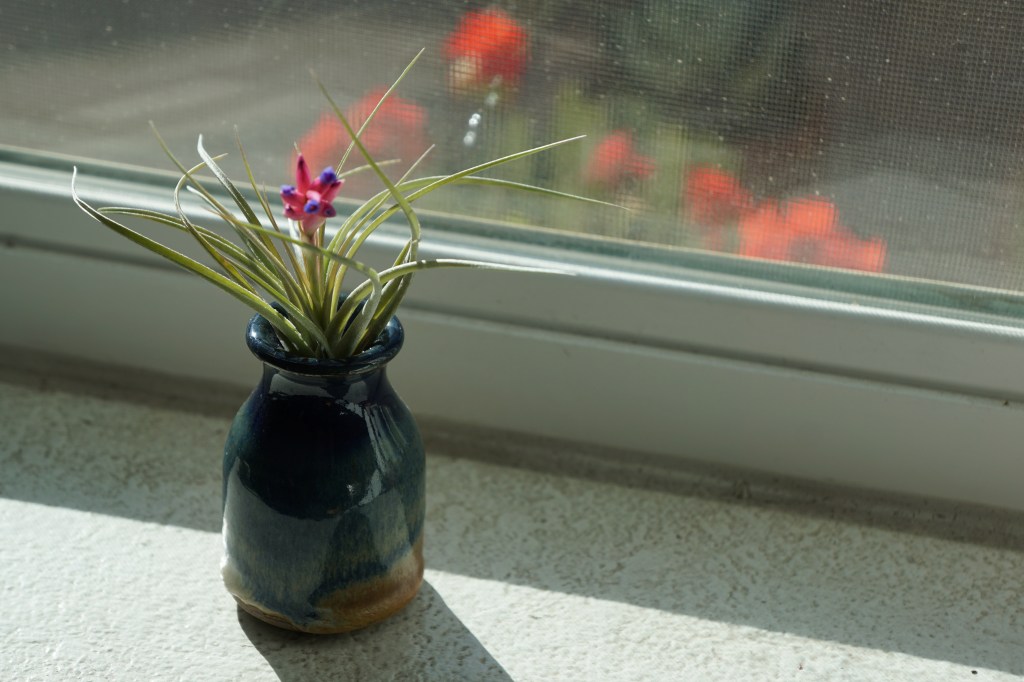
Just as there is peace and beauty blooming in two forms in my home in mid-winter; in an air plant inside, stationed on our Arizona windowsill; and in a red geranium outside, soaking in the morning sun on our southern-facing patio.

January Musings

It’s one of those days when my stream of consciousness is running in many directions. That has prompted this post about everything (or nothing depending on your point of view).

I call it January musings, because that’s the best thematic thread I can find in this ball of yarn and semi-related thoughts.

***

Morning, noon and night the fabric of our winding threads becomes a tapestry. That’s the opening lyrical line from Mighty Mosaic, one of four pieces I wrote for the March 12 Phoenix Gay Men’s Chorus concert.

The song is an LGBTQA anthem of sorts to capture the complicated–and often triumphant–journeys we take to discover who we are and what we believe.

Hearing my lyrics come to life in a room of familiar voices during Tuesday night’s rehearsal brought me personal joy in a month previously laced with grief.

***

I bristle whenever I hear film directors, writers or musicians say in an interview that they don’t ever step back to watch their films, read their books, or listen to their music.

I’ll admit it. I’m a writer, who learns by retracing literary steps. I find myself revisiting themes in my writing all the time (family, love, loss, the beauty of nature, the serendipity of life) or frequently pulling one of my books off the shelf and re-reading certain passages.

Why? Because it keeps the process of telling a particular story fresh in my mind. Each of my four books is a child I have loved and guided from infancy to adulthood. They will live on the page long after I’m gone, even if nobody reads them.

Revisiting my stories also allows me to remember the richness of life: the hows … how far I’ve traveled, how far I still have to go, how much the world has changed, how much I’ve learned, how much I’ve lost, how much I’ve gained, how fortunate I am to love and be loved.

***

The ninth anniversary of my mother’s passing is January 26. Earlier this week, I looked skyward and spotted a full moon. It transported me back to a frigid January morning right after I said goodbye to her–an indelible Illinois moment in 2013–when Tom and I sat with my sister and brother-in-law at a suburban McDonald’s (the only place open for coffee at 5 a.m.) to feel the warmth and close comfort of an enormous full moon illuminating the horizon and the snow-packed streets.

The grief I felt that morning is far less present now. But the welcome sight of a full moon will forever remind me of the journey after Helen Johnson’s passing, her wisdom and undaunted spirit, and the growth that followed. All of it inspired me to chart a new trajectory, write From Fertile Ground and three more books, and even discover a poet and lyricist lurking inside.

A New Creative Wrinkle

I am especially conscious of my age and vulnerability right now. There is nothing worrisome to report. I feel well. It’s just that–early in 2022–Tom and I are focusing on important administrative tasks to protect ourselves and our families.

Specifically, we will move to Medicare later this year, because we turn sixty-five in July. We have begun to do research. We’ve met with a third party. She explained how it works. She has helped to cut through the mystery. (By the way, I used to help organizations communicate about complicated health care and retirement programs, but that background doesn’t make this transition any easier.)

We also are updating our estate plans to make certain they reflect our Arizona status and latest wishes. The pandemic isn’t the driver, but it certainly has amplified our efforts to make sure our affairs are in order. As much as I hate dwelling on my mortality, it makes sense to plan ahead.

All of this technical and legal blather has clogged my brain lately, leaving me feeling a little dim. Is it a coincidence that the light in our refrigerator should go out yesterday? I don’t think so.

We tried replacing the old bulb with a new one, but it appears we have an electrical issue. Fortunately, the appliance is doing its job. It’s keeping our food cold (and frozen in the upper compartment). It’s just that we need a flashlight to find the yogurt, milk, eggs, fruits and vegetables.

I digress. That’s not what this story is about. Ironically, in the relative darkness of early 2022–the pandemic and our refrigerator–there’s a bright and new creative wrinkle to my writing that I want to talk about. One which changes the landscape of my past experience. One that goes beyond my blogging, memoir writing, poetry, and occasional forays into fiction.

About eight months ago, Marc–the artistic director of the Phoenix Gay Men’s Chorus–blindsided me with this question: “Would you be interested in writing lyrics for a suite of songs for one of our concerts in 2022? It will be a celebration of diverse voices.”

Hearing these words, I think my jaw may have dropped. Once I closed my mouth and opened it again, “of course!” was my immediate response.

I could feel my smile grow ten sizes. I never imagined having an opportunity of this sort, especially concerning a topic that is so important and personal … turning the painful, transformative, and triumphant stories of Phoenix-area LGBTQA citizens into something more. Into poetry and music.

Since that early, exploratory conversation with Marc, I’ve collaborated with David (another member of the chorus) who is composing the music. I’ve written lyrics for four songs, which will be performed on March 12, 2022, at the Tempe Center for the Arts. The concert will be part of Tempe’s Pride celebration.

On the evening of Tuesday, January 18, this will all become more real. Marc and David will pass out the music to members of the Phoenix Gay Men’s Chorus (including me sitting in the back row and singing second tenor).

For the first time, we will begin to rehearse the music David and I have created. I know I will feel a surge of pride and energy when I see the words “Lyrics by Mark Johnson” in the upper right corner of the score.

Sometimes life serves up happy surprises. It reminds us that our existence is more than needling administrative responsibilities, the darkness of a pandemic, or the frustrations of a burned-out light bulb.

Sometimes the outcome is brighter, more hopeful; we find ourselves exploring a new creative wrinkle, doing something we are passionate about, taking on a role we never saw coming.

Yes–remarkably at the age of sixty-four–I am a lyricist.

The Past Eight Years

Eight years ago this month, I left my communication consulting job at Aon Hewitt. Technically, I retired in January 2014, though I’ve hardly dropped off the face of the earth since then. I’ve simply escaped to the desert.

It feels strange for me to admit this: some details of my thirty-four-year communication career in Chicago–especially the most daunting moments with impossible clients–have faded. What I remember most are the creative accomplishments and closest colleagues.

Ironically, while our country has moved into a period of darkness and upheaval during the past eight years, I’ve transformed my life into one that more closely resembles who I am and what I value.

I’ve gotten married, moved cross country, survived a heart attack, dropped about forty pounds, found a new home with my husband, nurtured the artist inside, written four books and nearly 300 blog entries, coached both of my sons as they’ve navigated life and career changes, made a bunch of new friends in a warm climate, and evolved into a more contented person.

In that sense, trading my corporate life for that of an emerging, independent writer has felt more like shedding the weight of a familiar suit of armor to discover a more light-hearted, personal, and sometimes vulnerable existence underneath.

To mark the anniversary of my retirement–and subsequent literary emergence–I’m discounting the paperback version of my latest book, I Think I’ll Prune the Lemon Tree, on Amazon during the month of January.

Hopefully, this will be just the incentive you need to devote a little more time to reading in the new year.

Pocatello Moments

Nearly six months ago, Tom and I were driving south through the plains of Idaho after a pleasant visit with friends in Bozeman, Montana.

A green road sign told us we were approaching the town of Pocatello. Late on the morning of June 28, we pulled off the road to explore. I wanted to see a place I had never been, though–in an alternative universe–it might have become my world. Let me explain.

In the early 1970s, Mom was a staffing specialist for the Defense Mapping Agency in St. Louis. One day she came home from work (she was the bread winner in our family after Dad suffered a heart attack) to tell us her job might be transferred to Pocatello, Idaho. If so, we might be moving west.

As it turns out, we didn’t come close to moving to Pocatello. We stayed in St. Louis. But, as a teenager, I believed for a few months that an Idaho existence was a real possibility; that we would leave; that I would need to make new friends in an unfamiliar, remote state. That mindset was my motivation for wanting to examine Pocatello with my husband fifty years later.

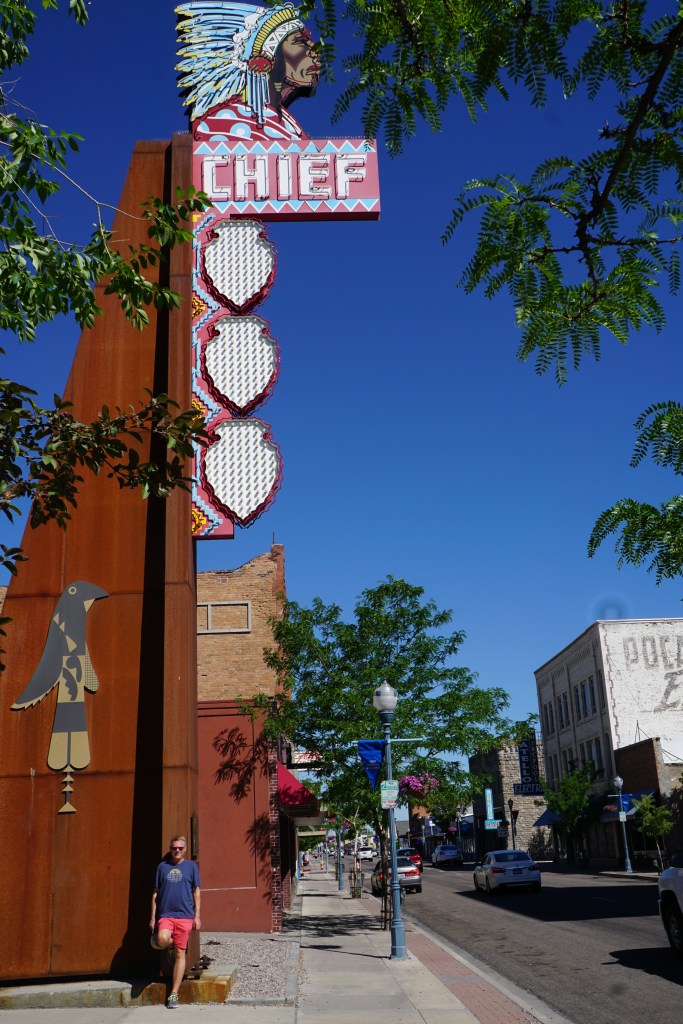
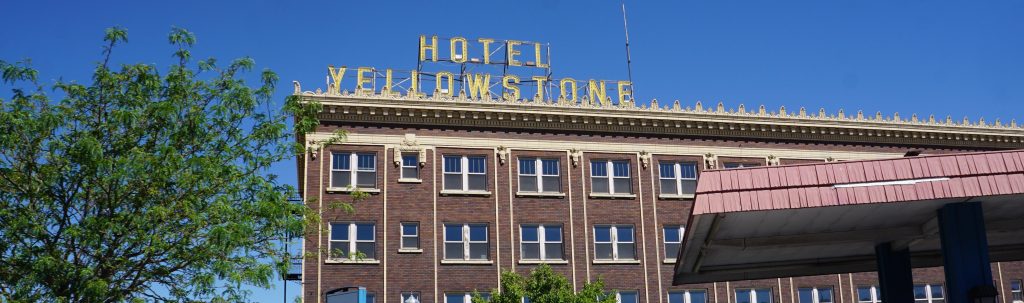
For the next few hours, Tom and I roamed the streets of Pocatello. We took photos outside the local high school, paused at the site of the Chief movie theater (it burned in 1993), inquired about the repurposed status of the Hotel Yellowstone, and gazed through the windows of an abandoned Greyhound bus depot.

In front of a thrift store with a rainbow flag in the window, we had the nerve to stop two young men (one was wearing a Schitt’s Creek T-shirt) to ask them what it was like to be gay and grow up in Pocatello. They hesitated for a moment but discovered Tom and I … a couple and a couple of writers … had no ulterior motives. We simply wanted to know what it was like to live there; I was mining future story ideas.

So, they obliged. They told us they had carved out decent lives, gone to a local college, and made friends in their community, though–they confessed–it was tough being openly gay in predominantly Mormon Idaho and Utah. We thanked them for stopping to say hello and sharing their insights. We wished them well and said goodbye.

Before Tom and I walked back to our rented SUV to continue on our journey, we made a final stop in a local art gallery. That’s where I spotted a speckled-blue glazed mug, made by a local potter. It bears the shape of the state of Idaho. I couldn’t leave without buying it. I needed a physical souvenir of the spontaneous moments Tom and I shared in a town that might have been mine, but never was.

Since that unforeseen experience in June, I have consumed dozens of cups of coffee and tea from my Idaho mug–many while writing the next blog post or poem. In a sense, the sight of the mug stirs my creativity, especially when I need a jolt.

As Christmas approaches and 2021 draws to a close, this artful mug reminds me how important it is for all of us–writers or not–to leave the highway of life from time to time. To keep our minds open to diverse people and unfamiliar worlds. To explore the “what ifs” that keep us wondering where the next story will come from. To seize the Pocatello moments when they appear and imagine the possibilities of what they may inspire in 2022 and beyond.