It is inevitable that we will lose some of those we love along life’s journey. But all is not lost.
When seminal I’ll-Be-Seeing-You moments, birthdays, anniversaries, songs reappear, we can’t help but acknowledge them.
Over the years, I have chosen to pay tribute to those I love in my memoirs in significant ways. None more than my mother.
These three sentences appear in my first book, From Fertile Ground, which I wrote and published in 2016.
“She died in the wees hours of January 26, 2013, at age eighty-nine and a half. The air was arctic cold and the moon was full. Every time I see a full moon now or experience the change in seasons, I’m reminded of my mother’s undaunted spirit.”
On this — the thirteenth anniversary of her passing — I pause.
I give thanks for Helen Matilda Ferrell Johnson.
I remember her unconditional love, her letters, her wisdom, her level-headedness, her resiliency, her love of nature.
Eight years and four books ago, it was January 20, 2018.
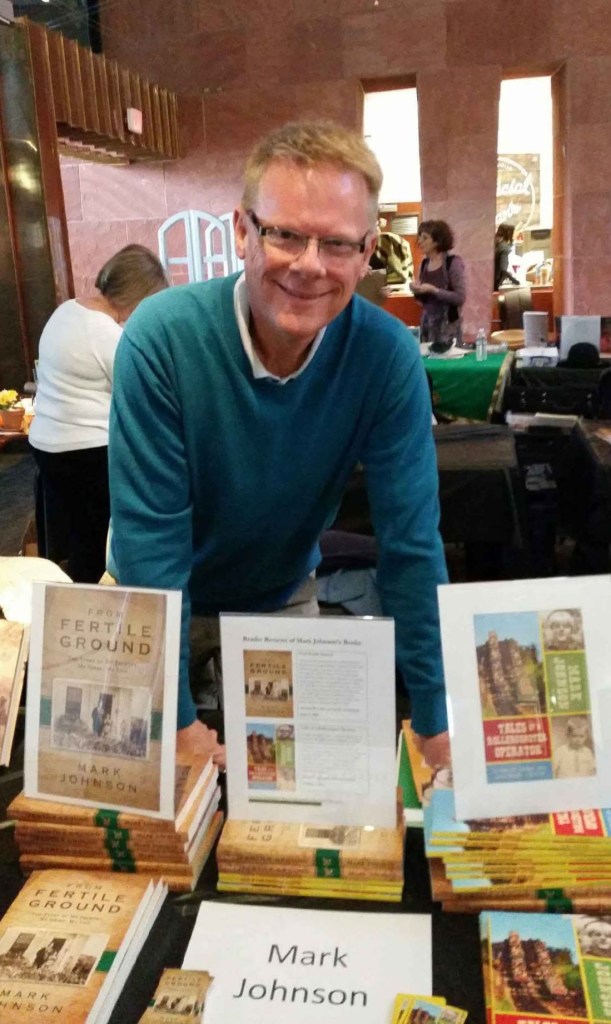
I hawked my first two books–From Fertile Ground and Tales of a Rollercoaster Operator–in the vestibule of the Civic Center location of the Scottsdale Public Library with dozens of other Arizona writers at a popular local author book fair.
It was a fun, exhilarating Saturday. I greeted book lovers, exchanged ideas with other creative writers, and even sold a half dozen books.
When Covid came along two years later, right after the February 2020 local author event, library management decided to nix the annual gathering permanently.
It was one of many personal losses in a world where we were all forced to retreat to save ourselves. We had to discover new ways (thank you, technology) of being together without really being together.
I can tell you this. I wasn’t sure Tom and I would survive the Covid ordeal. But, like you, we did … with the help of in-home creative strategies and life-saving vaccines.
I certainly didn’t imagine I would write and publish four more books between 2018 and 2026. But that happened, too.
Isn’t it remarkable, how life has a way of sending us a mix of ominous clouds and sunny skies? Often, we don’t know which will appear next on the horizon. Or in what form.
Case in point. Even now as the walls of democracy feel as if they are caving in upon us in the United States, the Scottsdale Public Library has asked me to be a Writer in Residence in February and March at the same location depicted in this photo.
Eight years ago, I didn’t have this moment on my Bingo card or expect it would become a new chapter in my life journey. But it will. My role will include two components:
I have developed and will lead a 2.0 version of my Memoir-Writing Workshop (which I facilitated four times in 2024 and 2025) on three consecutive Friday afternoons: February 20, February 27, and March 6. Up to sixteen writers will participate.
Separate from the workshop, I also will offer thirty-minute, one-on-one writing coaching sessions between 1 and 2 p.m. on Mondays in February and March (in an office near the workshop location).
This will give folks who aren’t able to make the workshop a chance to receive feedback on their writing. (The library is creating a process to register for the individual sessions in advance. I will ask writers to bring just a page or two of their writing to make the experience productive and manageable.)
At any rate, I am thrilled and honored to be a Writer in Residence at the Scottsdale Public Library. It is a creative haven I have come to love in the eight and a half years Tom and I have lived in Arizona … where my movie-loving husband has created quite a following with every one of his film series.
The next one (Movies That Matter: Hollywood Families 1970-1996) begins next Monday at 3 p.m. Tom will lead film discussions and screenings, beginning with a cultural primer on the American family on January 26. Then, for the following eight Monday afternoons, he will show these fabulous eight films: Moonstruck, I Never Sang for My Father, Breaking Away, Kramer vs. Kramer, Ordinary People, Terms of Endearment, The World According to Garp, and The Birdcage.
Hopefully, this story is giving you the impetus to rediscover the programs offered at your local library … no matter where you live.
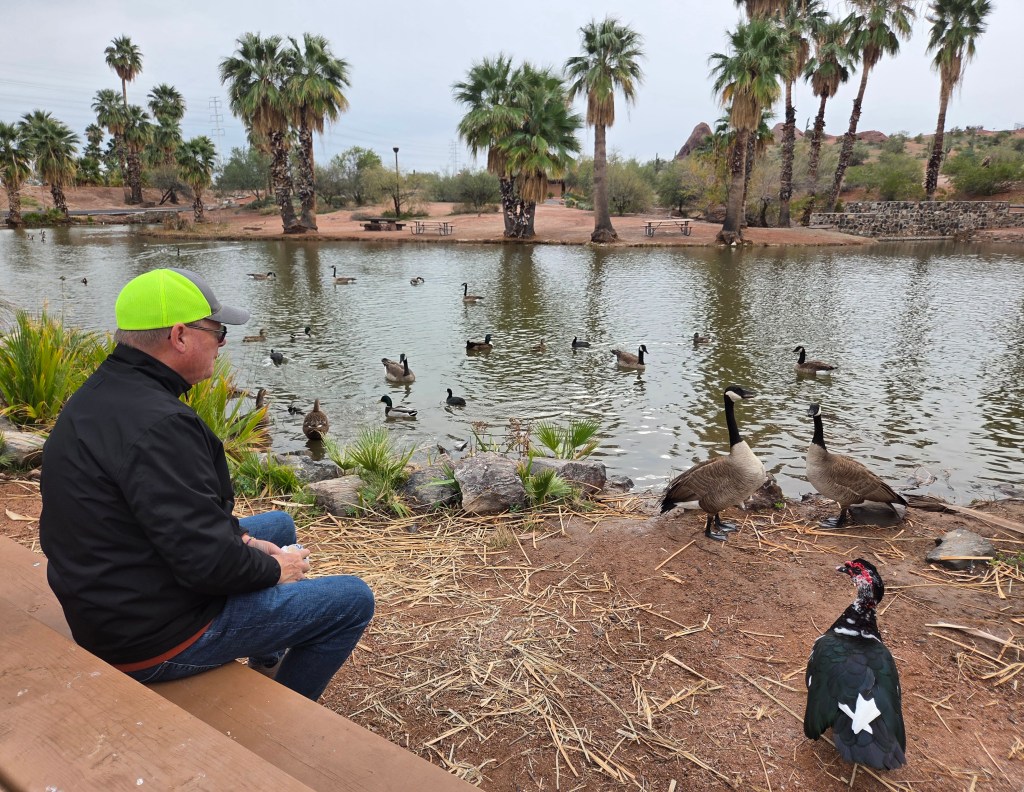
While we box up our flickering, ever-tangled holiday lights, compartmentalize them with our fading democracy, shove them into insanity’s dusty attic beside our president’s latest lawless actions streaming 24/7, we also attempt to climb above and beyond accumulating ominous clouds, by feeding old-year bread to new-year geese, by examining each piece of life’s puzzle with bleary-but-thoughtful eyes, by loving ourselves, each other, and all animals, by emulating kind lives under fleeting desert candlelight, by resuming our daily quest for survivorship and unflappable wisdom, even as every institution, every once-reliable media conglomerate or teetering motherboard (like the dying one on Tom’s old phone) signals the end is near and must be replaced. So, we replace it. We move on. We give thanks. We cherish every labor of love and every hidden oasis. We welcome every petite, heartful bouquet. We marvel at one rare, exquisite, night-blooming cereus, paint-plus-provenance. It is the perfect gift on canvas from a dear friend.
The downstream darkness of January is real, but in our upstream hearts, in the serenity of nature (and now framed in splendor on our living room wall thanks to Dougal) there is a profound, constant, but private reminder: there is always beauty and hope, even when there is darkness.
My mother was a collector of fine furniture, ceramic pitchers, and–occasionally–commemorative coins.
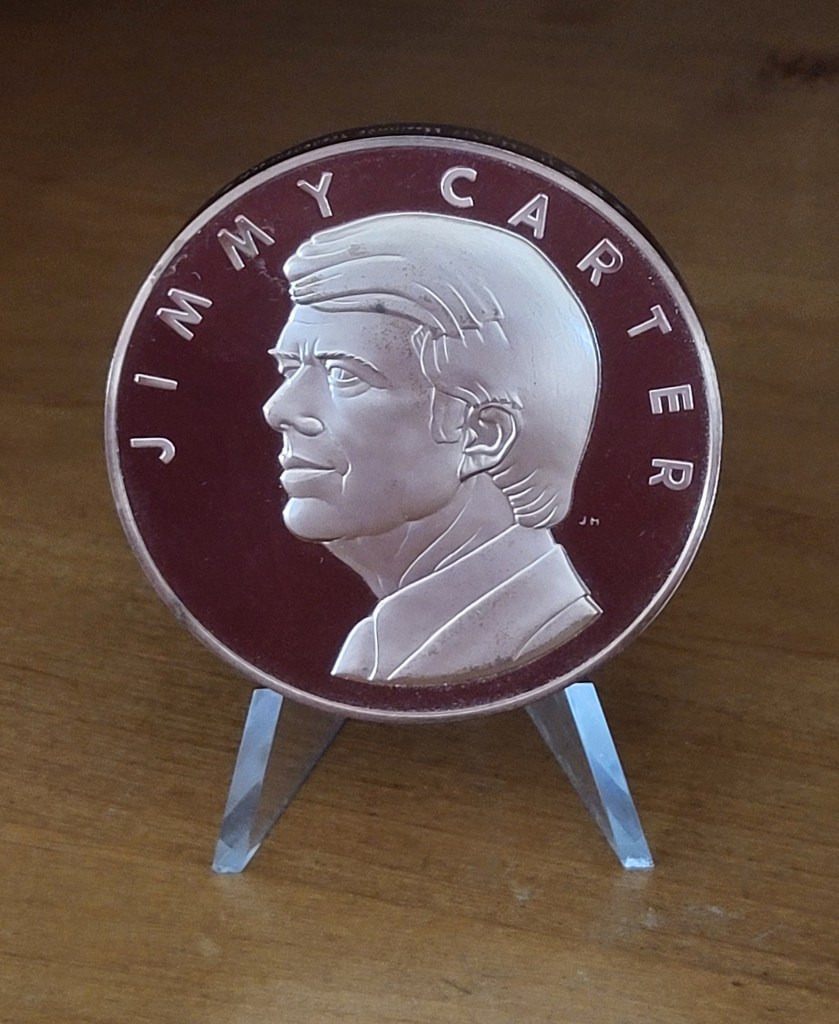
On March 17, 1977, she purchased this Franklin Mint medal. It celebrates the inauguration of Jimmy Carter, the thirty-ninth President of the United States.
This bronze coin has occupied a space inside a box in my father’s WWII army trunk for the past few decades.
I was nineteen and a first-time voter when I cast my ballot for Carter in November 1976.
Most of my college friends at the University of Missouri were Gerald Ford supporters.
I suppose they were willing to forgive him for pardoning Richard Nixon.
I wasn’t. I opted for Carter, the peanut farmer from Plains, Georgia.
As history would have it, Carter’s four years as president (1977 to 1981) included many ups and downs.
For instance, Carter successfully negotiated the Camp David Accords, political agreements signed by then Egyptian president Anwar Sadat and Israeli prime minister Menachem Begin.
Carter also signed into law bills that created the U.S. Department of Energy and Department of Education.
However, the Iran hostage crisis (when fifty-three U.S. diplomats and citizens were held hostage at the U.S. embassy in Tehran by a group of Iranian college students who supported the Iranian Revolution) and related oil crisis led to his unraveling popularity.
In November 1980, Ronald Reagan defeated Jimmy Carter. His loss was punctuated on January 20, 1981, when the hostages were released on the first day of Reagan’s presidency.
Of course, we now know Jimmy Carter wasn’t through yet. He lived another forty-three years and made good use of his century-long (1924-2024) life.
After leaving the White House–with his wife and life partner Rosalynn Carter ever by his side–he established the Carter Center. He worked tirelessly to promote and expand human rights.
That led him to receive the Nobel Peace Prize in 2002.
Jimmy and Rosalynn Carter also became famous for the houses they helped build for Habitat for Humanity and the faithful lives they shared with family and friends in their community and all around the world.
***
This morning, after watching C-SPAN coverage of Jimmy Carter’s funeral at the National Cathedral in Washington, D.C.–and listening to a parade of praise in eulogies given by past Republican and Democratic leaders and grieving family members–I extricated the bronze medallion.
I brought it into the light. I placed it on the shelf of our bureau in our Arizona sunroom. I pondered Jimmy Carter’s astounding legacy of faith, hope, service, and perseverance.
I wondered if–as he was laid to rest–our nation’s democracy might not be far behind.
I hate the trite phrase “only time will tell.” But it certainly applies as inauguration day–January 20, 2025–approaches.
Consider this. Tucked inside the box that normally houses the Carter medallion is a little booklet with information about the tradition of the presidential inaugural medals. Here is an excerpt:
“The Official 1977 Inaugural Medal commemorates the solemn ritual, repeated every four years, through which Americans and their President refresh the nation’s commitment to free government.
During the inauguration, the President, in the presence of Congress, pledges to serve faithfully and to uphold the Constitution to the best of his ability.
Americans have always treated this ceremony as a portentous moment in the life of the republic, a time of celebration and of renewed dedication.”
But we live in 2025. Will the incoming president uphold the Constitution to the best of his ability?
That bit of history–beyond the funereal pageantry of today–has yet to be written.
It’s a beautiful Friday in Scottsdale, Arizona. The weather is sunny and mild–warm enough for me to swim laps outside a few hours ago–and my brain is firing creatively.
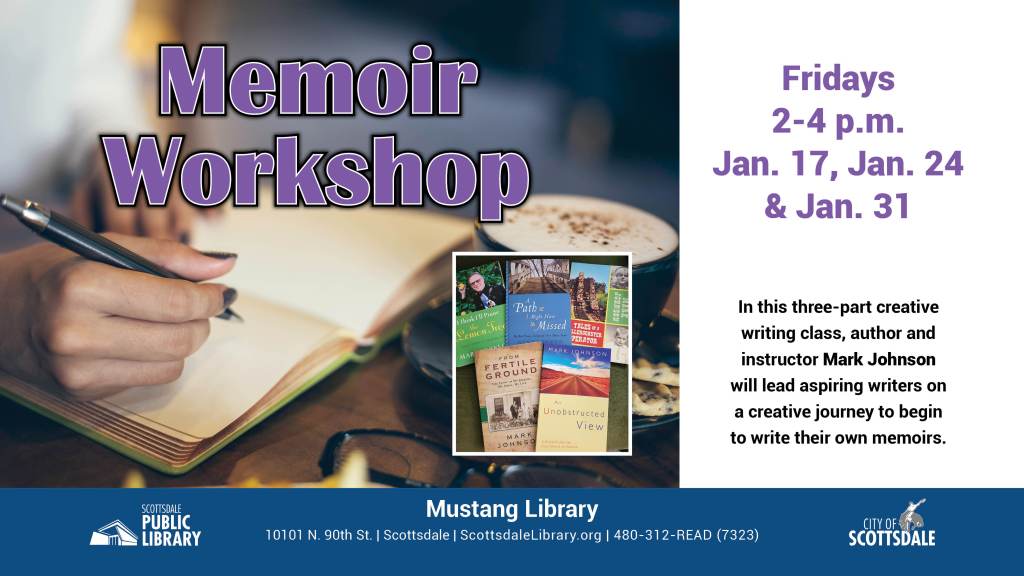
I’m preparing to lead my next memoir writing workshop later this month at the Scottsdale Public Library (Mustang location).
I expect a dozen aspiring writers will file into a large conference room on January 17 for session #1.
I will welcome them with a smile and a commitment to prompt and guide them as they move ahead on their memoir writing journeys.
It will be a free-and-safe space to begin to dislodge vivid memories, write a few pages, share respectful feedback across a table with other writers, develop a writing practice, and (hopefully) leave on the last day (January 31) with a little momentum to tell their stories.
I know how much work, time, and commitment is required to make it happen. But when you are a writer, it’s worth it. It’s what you are meant to do.
You tell stories of all kinds. Simple. Complicated. Painful. Joyful. Unbelievable true-and-false stories.
The best memoirs are filled with emotional and sensory details: visuals, smells, tastes, sounds, personal touches.
I think that is one of my strong suits … not only telling but showing readers the story, so that they must keep reading to find out what happens at the end of the story.
It’s rather like sitting with a friend in front of a cozy fireplace. That is what I will tell my workshop attendees to imagine as they begin to write their memoirs.
I don’t think you need to be famous to write a great memoir. It’s really the story that must be compelling, not the namedropping that some celebrities like to smear over every page.
You simply must be authentic and artful in the way you approach your story–whether it’s a story of love and loss, transformation, redemption, survival, success, or a recollection of a vivid place, time or person that makes your heart swell.
In addition to writing memoirs (somehow, I’ve written and published four since 2016) and encouraging others to bring their stories to the page, I enjoy reading memoirs.
January is a good time of year to assemble a recommended reading list.
Here are ten memoirs (written by famous and ordinary people) I have read over the past ten years that have moved me, entertained me, spoken to me, and broadened my appreciation for creative, true storytelling in the world of nonfiction.
By the way, I will share this same list with my memoir writing workshop attendees later this month. So, in a sense, you are getting an insider’s preview.
(Note: I have included one of my books–From Fertile Ground–on this list … because I feel it is an unusual creative concept/structure for a memoir about a family of writers sharing their diverse voices across three generations.)
Happy memoir reading (and writing), everyone!
***
My Recommended Memoir Reading List
The Year of Magical Thinking (by Joan Didion; 2005) … possibly the best book I’ve read about grief.
Ever By My Side: A Memoir in Eight Pets (by Nick Trout; 2011) … perfect if you are an animal lover.
From Fertile Ground: The Story of My Journey, My Grief, My Life (by Mark Johnson; 2016) … a writer’s mosaic about love and loss.
Between Them: Remembering My Parents (by Richard Ford; 2017) … revealing portrait of parents.
Insomniac City: New York, Oliver, and Me (by Bill Hayes; 2017) … gripping, personal, New York study.
The Best of Us (by Joyce Maynard; 2017) … finding true love late in life, then losing it to pancreatic cancer.
Pops: Fatherhood in Pieces (by Michael Chabon; 2018) … poetic snippets about a son’s love for his father.
All the Young Men (by Ruth Coker Burks; 2020) … a woman comes to the rescue for dying AIDS patients in the 1980s.
My Name is Barbra (by Barbra Streisand; 2023) … if you love Barbra, a must read.
My Mama, Cass: A Memoir (by Owen Elliot-Kugell; 2024) … revealing odyssey of a daughter constructing her life after the death of her famous mother.
It’s been happening under the slanted roof of the Polynesian Paradise clubhouse for decades.
Old and young residents and guests gather a few times each month for old-school, low-tech Arizona fun.
They flock there to play BINGO on Wednesday nights in January, February and March when the snowbirds have returned.
Spirits are high, but stakes are low.
Fifty or sixty friends and neighbors huddle over long metal tables with wooden tops. They scan their BINGO boards with dreams of leaving with fifteen or twenty dollars in their pockets.
Hit the switch and you can hear the hum of the BINGO ball cage as it spins. The caller pulls a number and announces it over the microphone. B-15, O-66, and so on.
Over the years, the number callers have come and gone. Phyllis and Sherry shared the duties admirably on January 31, 2024.
Last night’s first game was dedicated to Bill H. He passed last year. In his honor, you had to cover all the numbers on one of your boards to fill the shape of the letter H to win $10.
After that, each game was more traditional. You needed to get five in a row across, up and down, or diagonally to win $5.
Or–if you were lucky enough to cover the four corners or create a “postage stamp”–a four-square shape in one of the corners–that would suffice too.
The final game of the night is always “black-out” BINGO. The goal is to cover every space on your card. The first one to do it, shouts BINGO and wins $20.
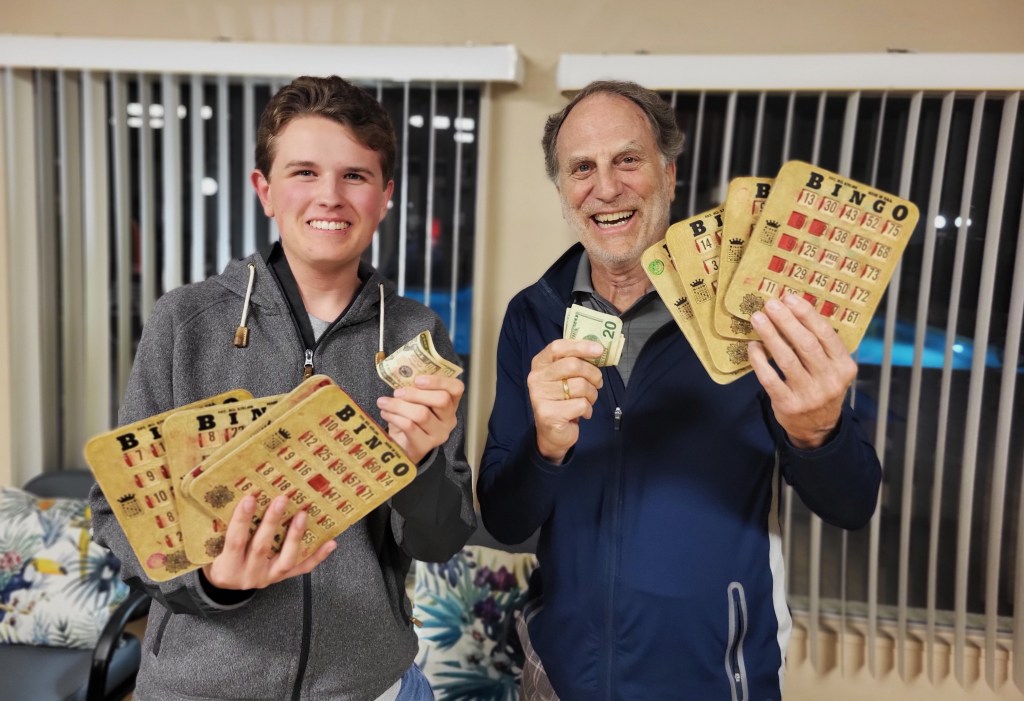
Last night, two–Theo and John–landed there at the same time and shared the winnings.
But the beauty of BINGO isn’t really the amount of cash you win.
It’s about the shared experience of sitting side-by-side in the same room.
It’s about the kitschy camaraderie, silly laughter, and goofy cross talk before, during, and after each game.
It’s about celebrating the “what ifs” of life … “Oh, if only she’d called I-30. I would have been the big winner!” … no matter your political preferences or social status.
It’s about the realization that the small, yummy square of lemon cake Jean baked for consumption at the half-way point contained a splash of zesty lemon from one of our luscious community citrus trees.
It’s about the reminiscing with friends as you walk back home to your respective condos at the end of the day on a mild desert evening.
It’s about hugging and bidding each other a good night … until the next game of BINGO.
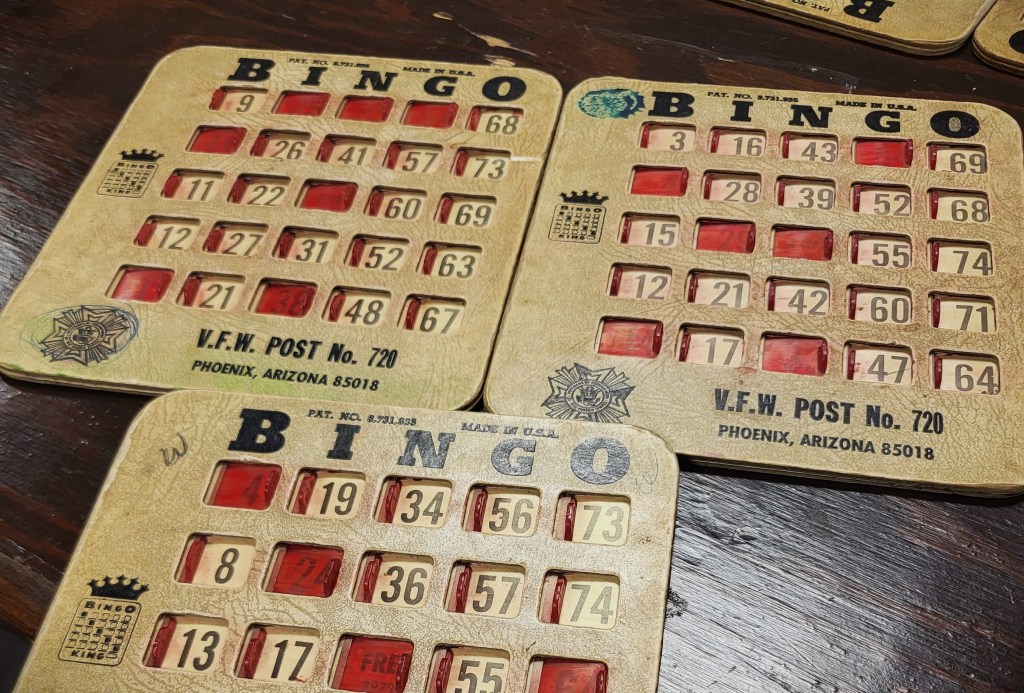
My three BINGO cards. I didn’t win.Our fun table causing a ruckus.Theo and John won several games.
After my mother died on this day in 2013 at age eighty-nine, my grief took root.
With a little time, a lot of reflecting and journaling, and the support of a small circle of family and friends, I found and nurtured my own path from the branches of despair.
By 2015, I had carved out a storyteller’s life Helen Johnson would have loved. Late that year, I flew to North Carolina to visit Frances, her only sister.
Spending time with Frances in the state where both were born–and revisiting childhood memories of my grandparents’ farm in Huntersville, NC–propelled my creativity.
In March of 2016, I completed and published my first book, From Fertile Ground. It is the story of my journey and grief.
If you’ve read this story about three writers (my grandfather, mother, and me) and their love of family, you know this isn’t really the cover.
Today I’ve superimposed this photo of Helen and Frances together (in my sister’s backyard in 2003 or 2004 in northern Illinois) to remember them both.
Why? Because Frances was the last physical vestige of that rural, 1960s world for me. When she died six months ago at age ninety-one, I metaphorically waved goodbye to those years of running amok barefoot on warm summer days in the Tar Heel State.
Of course, I will always have rich memories of my wise-and-frugal mother, who wrote countless letters, and my fun-loving aunt, who traveled the world in her retirement years. In their own ways, they inspired me to tell my story.
Today–as I remember them both–I can walk into the sunroom of the Scottsdale, Arizona condo where Tom and I now live. I can pull my book off the shelf and find this passage.
“What I knew before was that the farm was a place of discovery for me and the fertile ground there was a physical and psychological refuge from the hardships of our family drama in St. Louis. What I know now is that I would need to go back to North Carolina to come to terms with my grief and integrate my southern memories with my present-day, real-life adult existence.”
I can take solace in the fact that I’ve written about Helen and Frances–who they were, who they loved.
Though they are both gone, they live on the pages.




 Mark Johnson Stories