Tag: LGBTQA

Visible Signs


HoleintheRock_040420 (2)

We can’t deny the numbers, the visible signs of pain. As I write this, there are upwards of 1.2 million documented COVID-19 cases globally (64,580 dead … 246,110 recovered). More than 311,000 cases here in the United States (8,452 dead … 14,471 recovered). Endless stories of inadequate supplies and presidential lies.

Though I live in a less populated area of Arizona and have been fortunate (so far) to dodge this global pandemic in a physical sense, the emotional challenge is more problematic.

On a daily basis, I worry about the welfare of my husband, my sons, my friends, my neighbors, myself. I feel my anger, anxiety and sadness abound as the gaps in social distancing widen. All of my churning emotions live close to the surface like the Hole-in-the-Rock buttes that pile upon each other in Papago Park. Trails there are now closed indefinitely. As is the normally crowded outdoor pool in the center of our condo community. That expected, but new, wrinkle in the stay-at-home order from Governor Ducey took effect tonight at 5 p.m.

Though with each passing day our normally vibrant community becomes more desolate and cordoned off, Tom and I realize we’re luckier than most Americans. We live in a warm, wide open space. We’re finding creative ways to communicate, cope and release the negative energy.

Free weights and yoga in our sun room to replace past workouts at the community gym. A jigsaw puzzle of neon hotel signs constructed on a large piece of cardboard on our kitchen table. Daily walks and conversations along the canal or at a nearby Scottsdale park. Endless home-cooked meals. Today, that included a batch of chocolate chip and oatmeal cookies.

So, not all of our visible signs tell stories of death or inactivity (2,000 COVID-19 cases in Arizona so far, including another 250 today). Nature sets the best example. Hawks and ospreys still soar unrestrained high above the rugged Sonoran Desert landscape. Lizards scamper in the afternoon sun. Cactus blooms burst with April color.

A mourning dove nests with her newborn in the crux of a neighbor’s bush. A gaggle of Gambel’s quail skitter down the sidewalk. I wonder what could prompt them to be in such a hurry. Perhaps they’ve discovered a ready supply of masks and ventilators.

It helps calm my nerves to see these signs of nature, these visible truths mixed with my own creative storytelling. Because I know the alternative. What it meant to spend a significant portion of my adult life in my twenties, thirties and early forties … inauthentic and  invisible to the world as a closeted gay man.

Of course, that’s all ancient history now. I’ve been happily living out of the closet for quite some time now. But it helps to remind myself of my truth and the visible signs that got me here.

Like a moment about fifteen years ago here in Arizona. Tom and I were visiting Scottsdale in May. Staying at the Fire Sky resort (which no longer exists). My kind and generous husband reserved a room for us there for several nights because the pool near our condo (the one we usually enjoy and now live near permanently) was closed for repairs.

Magically, it seemed, we found ourselves sipping frilly drinks in lounge chairs by the luxurious Fire Sky pool. Without much notice, two rather gregarious, somewhat attractive and smartly accessorized women with sex in their eyes approached us. One leaned in with her husky Suzanne Pleshette voice and offered this inquiry … “Where are your wives?”

It felt as if I pondered her question for a considerable time. Perhaps fifteen minutes? Eventually, I smiled up at her and replied … “He’s sitting next to me.”

“Oh, you’re a couple,” she acknowledged without judgement. A few moments later, we concluded our brief, yet authentic, conversation. Suzanne and her friend Daphne (not their names) walked away. Perhaps to pursue another possibility or two.

After they left … proud of my May outing … I smiled at my future husband seated at my left. I sipped on the sweet nectar of my Pina Colada, astonished at the words I had blurted more boldly than I could have imagined.

With fire in the sky and love in my heart, I had somehow mustered the courage to set the record straight. There was no doubt. I was most definitely gay. It was a positive visible sign. I hadn’t allowed another inauthentic opportunity to pass uncorrected.
 

Express Yourself

DiscPark_031820

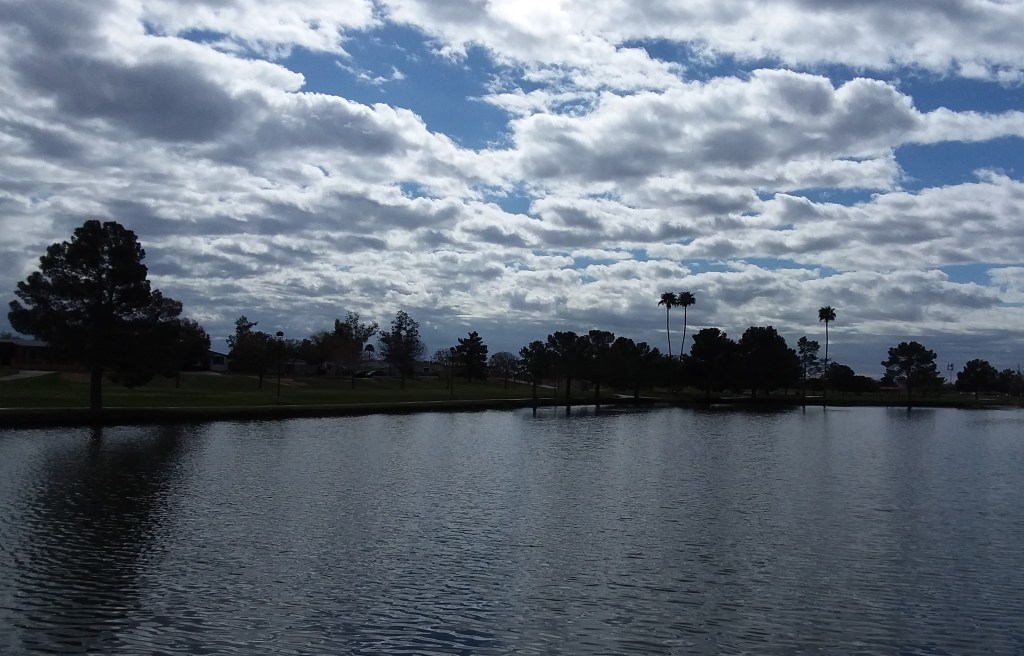
Wednesday, March 18, 2020, was a quiet morning at disc park in south Scottsdale. Vista del Camino Park is its official name, but Tom and I prefer this less formal identifier. It’s more like the scruffy disc golfers and white egrets who play and troll there.

This is the same park we walked (slowly and gingerly for me) in August 2017, just a month after my mild heart attack, when darkness descended and science produced a confirming solar eclipse for a short while.

Now the darkness is back for a more lengthy stay it appears, under global pandemic circumstances, but (despite our growing anxiety and the reported numbers of COVID-19 cases) we try to focus on the brightness in the southern sky peeking through the clouds after a morning shower.

All of us are living within newly defined parameters. The headliner is social distancing, characterized by taps of the elbow with people we would rather embrace. At worst, it feels as if we are existing in a Petri dish in some vast and diabolical experiment. At best, these new rules and regulations challenge us to find new ways to connect and express ourselves.

Last night was a perfect example. My Tuesday evenings are normally devoted to rehearsing with friends in the Phoenix Metropolitan Men’s Chorus (PMMC). It’s a community of sixty or seventy diverse and talented gay men. Given the threats of the present pandemic, our regular, in-person singing sessions have been cancelled for the next few  weeks. Possibly longer. We don’t know what the future will bring.

But on St. Patrick’s Day 2020, what would normally have been a raucous Tuesday of singing and mingling, became an online vocal experiment. Our choral leaders hatched a scheme to rehearse through Facebook Live.

In the face of social distancing we’re using social media to assemble first and second tenors on Tuesday evenings–baritones and basses on Thursday nights–to fine-tune and polish our selection of twenty-two, gay-anthem tunes for our still-planned Born This Way performances in June. We’re also attempting to maintain our sense of community in these uncertain times.

Last night at 7 o’clock we began to travel and sing down this new virtual road together. I sat in front of my laptop in Scottsdale with my music close at hand. The other tenors did the same from their respective homes. Marc, our artistic director, and three other PMMC leaders took turns singing the music. They asked us to do the same from our remote locations.

Don’t go for second best baby; put your love to the test. You know, you know you got to make him express how he feels and maybe then you’ll know your love is real … 

If you love Madonna (and, honestly, who doesn’t?), you’ll recognize these lyrics from Express Yourself, her 1989 smash hit. It was the first song we sang together in our virtual vocal experiment.

By the time rehearsal ended at 9:30, we had run through another six or seven other numbers and exchanged countless constructive and snarky comments online. All that really matters is the experiment worked. We stayed connected. We kept our voices oiled. Our spirits soothed.

This morning on my walk with Tom, I wasn’t ready to let St. Patrick’s Day 2020 go just yet. As we stepped out of our car, I decided it was perfectly fine and appropriate–within social distancing guidelines–to unveil my shamrock socks for all the pandemic world to see.

To express myself. To keep my voice and spirit alive here in the Valley of the Sun.

ShamrockSocks_031820


The Island of Misfit Boys

I’m not a sociologist, psychologist, psychiatrist or cultural anthropologist. Just an observant, sensitive and reasonably intelligent sixty-two-year-old gay American male author, who is concerned about the plight of our boys and young men.

I should also tell you I am an ardent supporter of gender equality. Equal rights. Equal opportunity. Equal pay for the same job. In fact, I think women are at least as qualified as men to capably fulfill the requirements of most any position… including that of President of the United States, though–regrettably–we have yet to elect our first female Commander-in-Chief.

During the course of my thirty-four-year communication career, many of my best bosses and mentors were smart, savvy and successful women. I had a few decent male managers too, but looking back, it’s the women from who I learned the most. They were the ones who encouraged me to take on projects that enhanced my skills, rewarded me for my contributions, and made the greatest positive difference in my career.

I don’t have any empirical data to draw from, but now that I have more time to ponder the “what ifs” of life, I’m seeing a disturbing trend. In the past few years, I’ve encountered a disproportionate number of bright young men (straight and gay) in their twenties and thirties, who are lonely, disenfranchised and struggling. Fighting for their lives as they face their addictions. Trying to launch and differentiate authentic lives in a society that still clings to narrow views of masculinity and offers few accessible male role models.

What worries me is the lack of meaningful structure and focus I see in the lives of young American males. (By the way, in my mind, a passion for fantasy football leagues, video games or binge drinking doesn’t count. As a rule, I don’t view these activities as life affirming or mind expanding, though they can be fun diversions.)

I was discussing this topic with my husband and a close male friend recently, and suddenly found myself transported back to sixth grade in suburban St. Louis. I had just received a writing award from the Daughters of the American Revolution for a piece I had written about the Stamp Act. I don’t recall the focus of my paper. Just the fact that I received recognition for my writing.

I remember that most of the other award recipients were girls. Somewhere in a dog-eared scrapbook from 1968, there is a photograph of all of us standing with our adoring teacher. She, my parents and the female students were proud of our accomplishments. But the other boys? Not so much. The feeling I got from them was:

“Writing is for girls. It’s not something a real boy should be proud of. What really matters is your athletic prowess, your ability to tie Boy Scout knots or cut and polish hard wood with your hands in shop class.”

I realize how ridiculous this sounds, but the feelings that stung my ten-year-old psyche were real. They were also never heard or validated.

As a sixth-grader, what price did I pay for internalizing the notion that writing was a less-than-masculine endeavor? Did this and other similar experiences discourage me from pursuing a literary life until my mid fifties? When did it become uncool for boys to be smart?

In 2020, could it be that as we’re beginning to realize and remedy all the ways American girls have been undervalued in our society, we’re still duping our boys and young men into believing that reading and writing are “softer skills” that might lead someone to suspect they are gay?

Are we sending the message to our boys that it isn’t acceptable within our masculinity framework to be smart, creative and artistic in the United States? Have we boxed our boys into believing some sort of myopic masculine mythology? Is this why some of them are lost or adrift? Is this why some of them snap?

I don’t have answers to any of these difficult questions. But I think we could start by listening to our boys, letting them voice their fears, loving them for their strengths and frailties, and encouraging them to follow their dreams whether it leads to refining the inner workings of an airplane engine, nursing a segment of our aging population or writing the next great American novel.

Have we created a metaphorical place for our young men, which they are desperately trying to escape?

What more can we do to help guide, challenge and mentor the young men in American society so that they can find their bliss and leave the island of misfit boys?


February, Fathers and Sons

Pops_020420

I am forever a father. A son too, though the earthly connections to my parents ended seven years ago. Still, I choose to embed the themes of both father and son dynamics in my writing. I believe those roles and identities are rich with possibilities and pitfalls. They remind us of our past, our present, our place in the world.

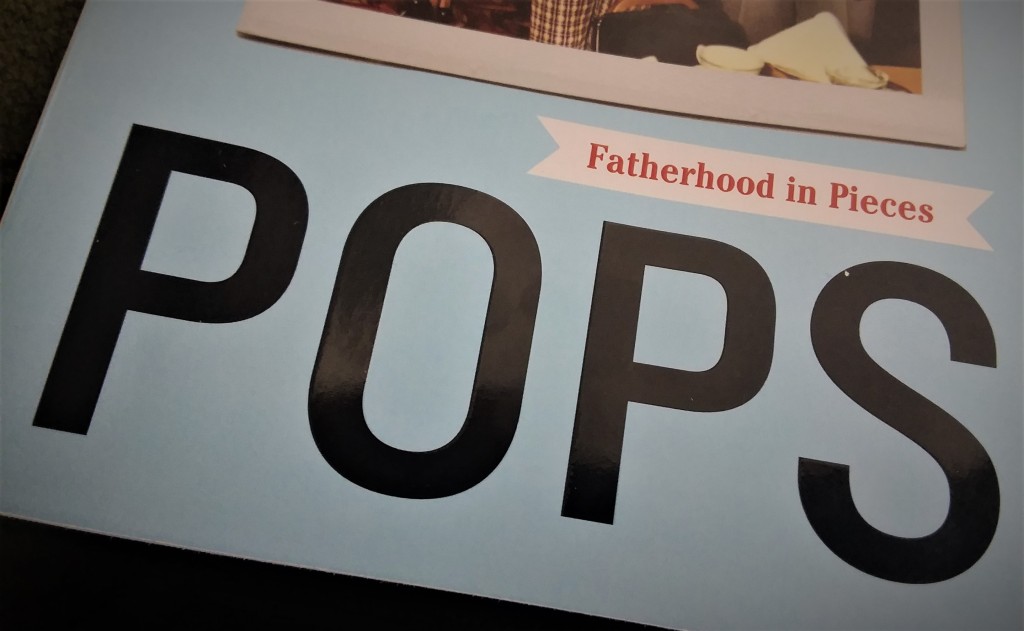
Knowing my thematic propensities, recently Tom gave me a thoughtful, funny book that explores both sides of the equation. I’ll confess Michael Chabon’s stories Pops: Fatherhood in Pieces captivated me from the start–chronicling the escapades with his style-conscious, adolescent son Abe on their Paris Men’s Fashion Week odyssey–until the end when we learn of Pops, the doctor, and the author’s observations of his dad. That left me in tears.

It reminded me of my own father, Walter. How he coaxed me to tag along in 1962 when he got his hair cut. I was his number one son. At least that’s the way he introduced me to waiting patrons at the cosmetology college. Each time we went I feared Walter would force me to agree to a buzz cut from a boisterous barber, who snapped his cape like a matador and plucked black combs from tall jars of blue disinfectant.

I went along with Dad’s scheme anyway. I cowered behind his high-waisted, pleated pants before he stepped up into a swiveling chair for a cheap trim, a quick shave, and a dose of baseball banter between square-headed men wearing starched white shirts and boxy black-framed glasses.

In reality, I was Walter’s only son–four-year-old Bosco. It was an endearment he bestowed upon me, because I painstakingly pumped and stirred chocolate syrup of the same name into tall glasses of cold milk. In exchange, I sat in awe of my gregarious father as he gulped his coffee and savored his soggy Shredded Wheat. We loved each other, our playfulness, and kitchen table excesses.

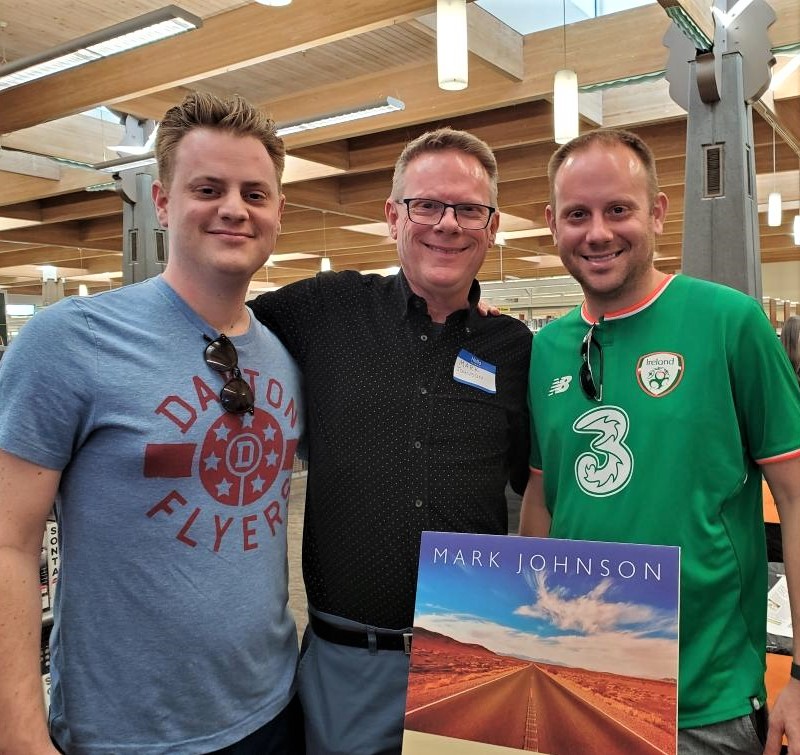
Though Walter has been gone for more than twenty six years, I was thinking of him as I finished reading Michael Chabon’s book last weekend. Then, in the same two-day period, along came a fresh chapter of my own fatherhood. Both of my sons, Kirk from Chicago and Nick from Tempe, came to support me on Saturday in my literary life at the 7th Annual Local Author book sale in Scottsdale.

Behind the scenes, they’ve been there since 2014 when I waved goodbye to corporate life. Rooting me on to explore this late-in-life literary fantasy that has become a reality. But Saturday was different.

I stood before Tom. First he took my photo in front of my table. Behind my three books. Later when Kirk and Nick arrived, I stood between my two adult sons. I remembered how far we’ve come since February 1992 … when my own fatherhood felt it had shattered in pieces … when their mother and I told them we were divorcing. I was moving into a new home. They would spend half of their lives with each of us.

Fortunately, in 1992 I had the gumption to stay in their lives and love them. We built a life together. Then Tom came along in 1996 and, over time, they learned to love him too. Together we stood by Kirk and Nick as they grew.

And then, suddenly on Saturday, they were standing by me.

KirkMarkNick_020120


Recasting Life’s Resume

StoryFest1_060119

I’m boarding my dusty desert time machine again. Back a mere six years to the end of another odd-numbered year. 2013 was the last full year of my gainfully employed life. When I still claimed consulting colleagues and commuted to a confining cube in Chicago’s Loop.

Though I now earn a pittance stringing words together, I don’t miss the corporate skin I shed. In my sixties, storytelling from the desk of my cozy Scottsdale condo or a nearby coffee shop is a better fit. It quenches my quest for creativity. It placates my sense of purpose. It validates my voice. Plus doing it on my terms means I don’t have to kowtow to a boss and a set of corporate standards.

That got me thinking about how we Americans define ourselves on resumes. Often, the words we use describe things we’ve accomplished or labels we’ve become accustomed to. Certainly not who we are. Not what makes us tick. Not what we dream of or what nightmares we’ve endured.

Let’s face it. Most of us have survived significant traumas. Maybe we’d be better off if we touted our tenacity. If we recounted our rebounds from setbacks. If we honored our innate interests and abilities.

The biggest events on my trauma resume read something like this: divorced in 1992; fatherless in 1993; motherless in 2013; survived a mild heart attack in 2017. Of course, those seismic events don’t account for the day-in-day-out stress of single parenthood and a thirty-four-year corporate career juggling assignments and clients.

The good news is I’ve cleared all of those hurdles and discovered a fair amount of positive energy to counterbalance the traumas: finding and nurturing a committed twenty-three-year relationship with my husband; parenting two boys into their thirty-something adulthood; singing on stage with other gay men from 2010 to 2019; realizing a second career as an author beginning in 2015; writing and publishing three books since; and continuing to tell my stories from the wide-and-warm space of Arizona’s Sonoran Desert.

All of this is a giant preamble to tell you that I ran across my circa-2013 resume this week from my days as a consultant. I found it on one of my many flash drives. Near the top, under the “Career Overview” heading, it reads:

Results-oriented, strategic consultant with deep expertise in organizational change, employment branding, talent and rewards communication, diversity and philanthropy.

This is how I described myself on paper as an associate partner with Aon Hewitt six years ago. There’s nothing technically wrong with the words here. They accurately described my work experience and knowledge as a consultant who ran between meetings, collaborated on countless conference calls, and massaged executive egos.

It’s just that the statement is gobbledygook. It didn’t describe the man I was then. Certainly not the man I’ve become. So, even though I’m not in the market for a new job in 2020, I decided to take a crack at recasting my resume. How would I describe myself today in real-life terms in the same number of words? Maybe it would read something like this:

Sixtyish survivor, storyteller and truth-seeking author, who writes about the magnificent, mundane, messy and meaningful moments of life.

Ah. That’s much better.

December, Dermo and Dormancy

DesertRoses_120319.JPG

You might think that excellent reports on a Monday from my cardiologist (“your blood pressure is good; your heart is strong; come back to see me in eight or nine months”) and gastroenterologist (“the polyps we removed during your colonoscopy were benign”) would be cause for celebration. You would be wrong.

At the end of the first Monday in December, I didn’t feel happy or relieved. I found myself in a funk. That’s because my dermatologist called on the same 3D-December Monday (cardio, gastro and dermo, oh my!) to confirm “the biopsy showed that you have  a patch of invasive squamous cell carcinoma on your left hand.”

Oh well, two out of three ain’t bad.

After I got off the phone with a skin cancer specialist, who explained the treatment options and assured me that my condition isn’t life threatening, Tom held my hand. He told me more of what I needed to hear. That everything will be okay. That we will get through this latest blip together. That it’s nothing compared with what happened in St. Louis on July 6, 2017. All for the chance to start a new life in a warmer home. To explore our sixties in the wide-open west of possibilities.

After all of this Monday mayhem, I needed to salvage some semblance of normalcy to the day. I needed to feel the fresh, creosote-laced air racing through my lungs. So I took a long walk alone. Along the cross-cut canal. Past the Papago buttes. Five thousand steps on a sunny-but-gauzy day restored my hope. It gave me comfort to see that none of the elements (not sun, not wind or rain) had affected these giant boulders. They were here long before me. Skin cancer or not, they will stand long after I’m gone.

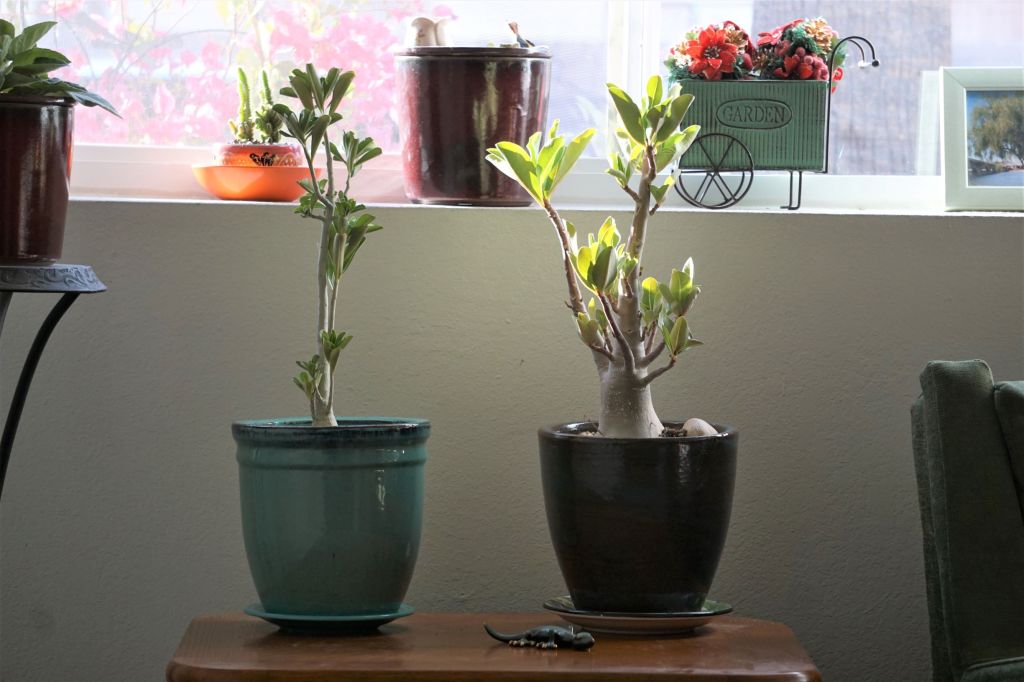
In a separate attempt to rescue my day, I returned home to move our desert roses (aka adeniums). It was time to bring them inside to prepare for dormancy. I do this every December. I suppose, unlike the buttes, all of us living creatures need a little protection from the elements on certain days. Time to retreat. No water. No sun. Time to rest. Time to heal and rejuvenate.

Now it’s Tuesday. December continues in the Sonoran Desert. The sun is casting long shadows at sharp December angles. The adeniums are beginning their winter slumber in our sun room. Their leaves will fall soon and their branches will be bare. But new leaves will reappear in the spring after I carry my favorite desert flowers back outside to feel the warmth of the sun. To grow and bloom again.

Next Monday I will begin my own version of winter dormancy. It will be flecked with cancer treatments and holiday gatherings. Rather than surgery, I’ve opted for twenty pain-free sessions of superficial radiotherapy over the next several weeks. The procedure has a ninety-five-plus percent cure rate.

This course of action will allow me to continue my normal day-to-day activities … writing and exercising … and sing in two holiday concerts with the Phoenix Gay Men’s Chorus on December 14 and 15. Being on stage and performing alongside my gay friends will bring me joy. Tom will be in the audience. My son Nick will be too, along with his girlfriend Aida, her two children and about a dozen other friends I didn’t know in 2017.

Late in January 2020, I expect to receive good news from my dermatologist. Something positive and life affirming. Something like what the cardio and gastro folks have already told me. Perhaps that the Superficial Radiotherapy Treatments (SRT) have fully eradicated the skin cancer cells on my left hand.

Whatever transpires, I am a fortunate guy. Tom and I will begin a new decade in our Arizona home. Faithfully smearing on sunscreen and wearing broad-brimmed hats. Continuing to follow all of our doctors’ orders. Writing, healing and growing together. Watching our desert roses bloom and fade in our less-than-certain sixties.

What more could I ask for?

Oh, Very Young and Less Fortunate Men

Camelback_Oct2019

At this stage of life, I have more time and space to reflect on the fragility and inequities of life. When I hit the trail for a hike or catch a glimpse of the jagged edges of Camelback Mountain, I sometimes ponder the plights of less fortunate men and less developed versions of the man I’ve become.

Recently, without notice, a Sonoran time machine swooped down and transported me from the desert. Back to south suburban St. Louis and my blue-denim-bell-bottom memories. Jerry and Joey (not their real names) lived near me on the same cul-de-sac street and the Oh Very Young prognostications of Cat Stevens looped through my brain.

Oh very young, what will you leave us this time?

You’re only dancin’ on this earth for a short while …

It was a weekend morning in the spring of 1974. I sat at the kitchen table, finishing up my last few bites of scrambled eggs and toast. My over-worked and under-appreciated mother washed the breakfast dishes. Over one shoulder, she blurted a provocative and unexpected question in my direction: “Mark, did you know Jerry is a practicing homosexual?”

Like most teens, I was bound up with insecurity. If I’d been less repressed, more freewheeling—or at sixteen had an ounce of awareness or comfort with my budding gayness—the idea of “practice” sex with an older boy down the street would have intrigued me. But at that moment I had no clue how to respond to my mother’s audacious question. I just shrugged my shoulders and muttered something like “Yeah, I think I’ve heard he might be.”

It didn’t occur to me that she might be fishing to learn about my sexuality. I just knew Jerry’s mother had died when he was young and his father, brothers and sisters had been left to make sense of her early exit. Whenever I walked by the front of their home, I saw the heaviness of their hearts had caused the foundation and the trees around it to sag.

I’ve written a lot about my mother. She was smart, resilient and courageous. Many years later, she left me with her legacy of wise letters. But back in the 1970s, we weren’t approaching that. We were nearly three decades away from the profound sense of respect and understanding we would construct during her eighties and I would witness  the love and deep regard she felt for my future husband and me.

Anyway, in the 1970s I was a withdrawn teen and she hadn’t yet sharpened her sensitivity. More specifically, like most parents then (and sadly many now), the implications of homosexuality and the image of two men engaged in mutually satisfying love frightened her. The word homosexual cast a shadow of shame, discomfort, darkness and isolation. Of course, without knowing it, I was absorbing the uninformed views about gay people coming through all sorts of channels–parents and neighbors, aunts and uncles, classmates and coaches, media and popular culture, etc. 

I will never forget that trauma. Pushed and bullied down middle school hallways. Labeled a faggot for wearing my favorite purple sweater vest, a gift from my mother. As you might surmise, I learned it was best not to wear purple or pink or challenge society’s narrow mold of masculinity in the 1970s. It would take decades for me to love myself and create an unapologetic life as a gay man comfortable in pastels.

This is a prelude to tell you that, in addition to my personal sexual identity struggles, I felt sad and angry hearing and seeing Jerry and other young gay men ostracized for their nature, mannerisms and social awkwardness.

I don’t know where Jerry lives or anything about his adult life in 2019. But I now realize Jerry was a trailblazer. I owe a lot to the Jerrys of that time. Despite neighborhood chatter and suspicions, they were courageous enough to risk ridicule. To be true to themselves in the 1970s.

***

The story of Joey has nothing to do with societal pressures, sexuality or suburban mores. It’s a cataclysmic tragedy.

Joey was the blonde boy who lived next door. We were the same age. As youngsters, from kindergarten through fifth grade we waited for the same bus at the end of our street. He loved to roughhouse with his golden retriever when he came home from school. In sixth grade—lunch boxes in hand—we walked together to a new elementary school, built to handle the overflow of Baby Boomers.

Throughout the 1960s, once school ended in June, Joey and I raced to the top of the street with our  neighborhood crew to play baseball in a vacant cemetery lot. We stayed there until our mothers or fathers stood on their front porches, cupped their hands to their mouths, and called our names for dinner.

In high school, Joey and I went our separate ways. I didn’t feel our connection any more. He was a mechanical guy. I wasn’t. I had a knack for stringing words together. He didn’t. He loved tinkering under cars. I loved singing on stage. While he developed a passion for playing the drums, my interest in the clarinet waned. In August of 1975, we continued down divergent paths. We left home for college at different Missouri schools.

Through it all, I felt no physical attraction for Joey, but I envied his apparently idyllic Please-Don’t-Eat-the-Daisies family life. Complete with the faux-wood-paneled Country Squire station wagon parked in their driveway, which I watched them load annually for summer vacations. Joey’s family seemed to embody the ideal of suburban happiness:  two friendly and well-liked parents, two popular daughters who went on to become cheerleaders, two masculine and mechanically-inclined sons.

On a horrific Saturday in May 1976, everything changed. I came home from my seasonal job as a roller coaster operator at Six Flags and found my mother sobbing on the living room couch. She told me Joey had been killed in an accident. He was riding shotgun without a seat belt on the way home from his first year at college when the car he was in collided with another vehicle.

Spring flowers were blooming outside that day, but inside I was numb and devastated like everyone on our block. One cruel moment had ended Joey’s life and transformed his family’s home from the center of happiness into the epicenter of grief.

A few days later my mother, father, sister and I attended Joey’s wake. I didn’t know what to say to his bereaved father and mother. But I summoned a few inadequate words and gripped their brittle arms as we passed a pair of drum mallets stretched across Joey’s closed casket. It was frightening evidence of teenage mortality.

In 1980, I moved to the Chicago area. Whenever I returned to St. Louis to visit my parents and boyhood home, I thought of Joey and his family. Scampering in their yard with their dog as they prepared to load up their station wagon for the next trip. When Joey died, that era ended. Soon after, the rest of the family moved away.

Forty years have come and gone. Joey is on my mind again.  Perhaps because he didn’t live long enough to pursue the next path at the base of rugged buttes. His Oh Very Young life ended back in the rolling Missouri hills without any chance to explore the west or have a spouse to share it.

Somehow, through good fortune, I’ve lapped his lifespan more than three times. After surviving a heart attack on my sixtieth birthday, I’m rounding the bend on the fourth lap here in Arizona.

For all the Jerrys and Joeys who have come and gone, I must keep telling my stories. I must make the most of the extra time I’ve been granted.

Oh very young, what will you leave us this time?

For All the Soldiers on the Hill

FFG_Photo 6

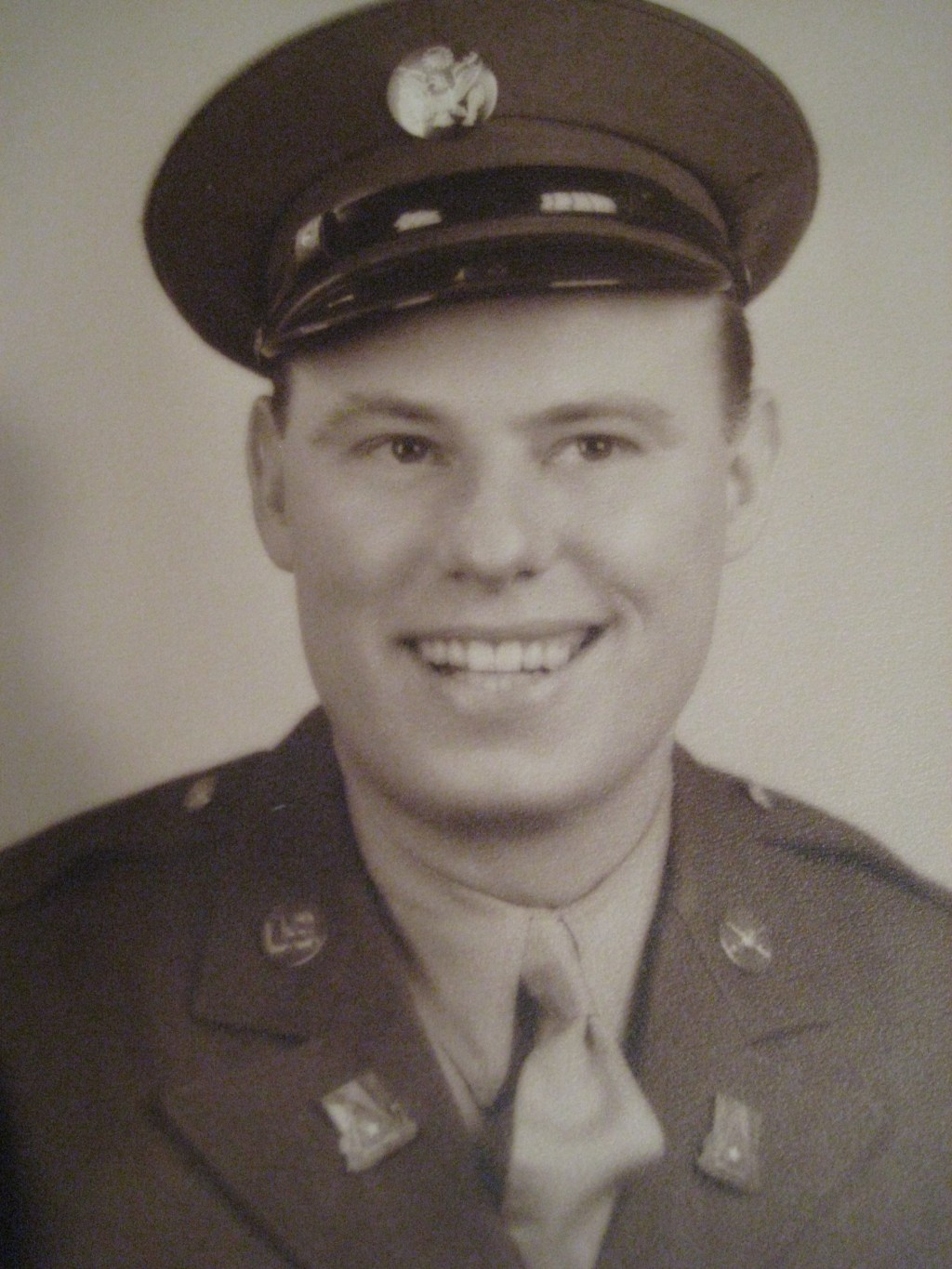
Every year at this time thoughts of my father resurface. Mostly because Veterans Day is drawing near. Dad served during World War II in the Battle of the Bulge. But also because he died in the eleventh month of the year. A second heart attack took him on November 26, 1993. It was the day after Thanksgiving nearly twenty-six years ago.

Now that I live in Arizona, it’s less convenient for me to visit Walter Johnson’s grave at Jefferson Barracks National Cemetery south of St. Louis. But I have no difficulty summoning vivid recollections of him from afar.

I remember a tender moment between us sometime in the 1980s when he asked me if I liked the idea of him one day being buried in a national cemetery alongside other soldiers who’d served during the Civil War, World War I, World War II, and the Vietnam War. (Unfortunately, the list goes on.) I told him I thought it would be the perfect, peaceful resting place for him. A proud patriot. A man who loved his country. A citizen who served it to the best of his ability.

Over the years, I’ve been inspired to tell Dad’s story. This unfulfilled poet of good intentions–this complicated, compassionate and troubled comrade, deeply affected by the horrors of war and bipolar disorder–appears in all three of my books in various forms.

Recently, I came across a poem in a file of prose I’ve written over the past thirty years. At the time I penned this one in 1996, my grief for Walter Johnson was fresh. I had just visited his grave. I was searching for answers. Still reeling from my failed first marriage. Doing my best to raise two young sons. Finally coming out of the closet. Beginning to connect the disparate strands of my emerging life.

As it turns out, the passage of time (along with greater understanding, acceptance and forgiveness) helped me heal my wounds, find my path, and build an integrated life. I’m thankful for that eventual transformation. Walter wouldn’t have understood all of it, but he would have kissed me on the forehead and loved me anyway. He would have cheered me on during these late-in-life writing years I’ve been fortunate to find.

I’m grateful for the poetic propensity that came from this one particular soldier. Yes, he is long gone. His physical remains rest under the shade of a large tree not far from the banks of the Mississippi River. But his imperfect imprint will always appear in my writing. This is for him.

***

The Soldier on the Hill

I talked with the soldier on the hill today,

We sat, we cried, we laughed, we prayed.

The bells rang true, the trees stood free,

A breeze swept past to welcome me.


Shadows filled the landscape then,

Tempers rose without his pen.

Snowflakes fell, the grass turned green,

All without a change of scene.


Now the soldier rests with them,

Hand in hand—all blessed again.

They greet another trailing soul,

Who makes the journey past the knoll.


August 27, 1996

***

More broadly, I’m thankful for all of the soldiers on the hill. Many of them lost their lives in battle and had little or no time to discover a path or realize their dreams. We must always honor their service and sacrifices, past and present.

How Do You Spell Grateful?

ScrabbleSunday_110319

S-C-R-A-B-B-L-E … and it’s been that way for Tom and me for the past twenty-three years.

***

Back in the fall of 1996, I was a single dad. At the time, Nick was twelve; Kirk was seven. The divorce decree called for my boys to spend half of their time with their mother at her home and half with me at mine. Both of us lived in Mount Prospect, Illinois.

It was far from the perfect parenting scenario for my sons, but at least I was able to see them regularly, attend school and sports events, and have an influence on their lives. I’m thankful for those years and my life as a dad, though it was a tumultuous time for all of us. It’s difficult for me to believe my sons are now thirty-five and thirty,  but I’m forced to realize it’s true. When I pass a mirror, I see the 2019 version of me. (By the way, if you’re a parent, you may have an interest in reading my book An Unobstructed View.)

Meanwhile, also in late 1996, Tom and I were beginning to build our relationship. We realized we needed to have at least one time a week when we could count on seeing each other … while juggling two independent demanding careers and honoring my desire and commitment to be there for my sons.

So, we concocted a scheme. On most Sunday mornings, we left our respective homes. They were seven or eight miles apart. We met at a coffee shop in Chicago’s northwest suburbs for a few hours of creative wordplay. We devoted our Sunday mornings to each other and Scrabble. Each week we formed new combinations of words on our portable game board while cradling hot cups of coffee. It was our time then and it’s our time now. We’ve been repeating this refrain for twenty-three years in Illinois, Arizona and places in between.

***

Scrabble will always be our magnificent obsession. On bright days and dark ones, our creative oasis is our escape from the traumas of our world and Breaking News. Just the two of us producing endless combinations of vowels and consonants and laying them out across a compact board.

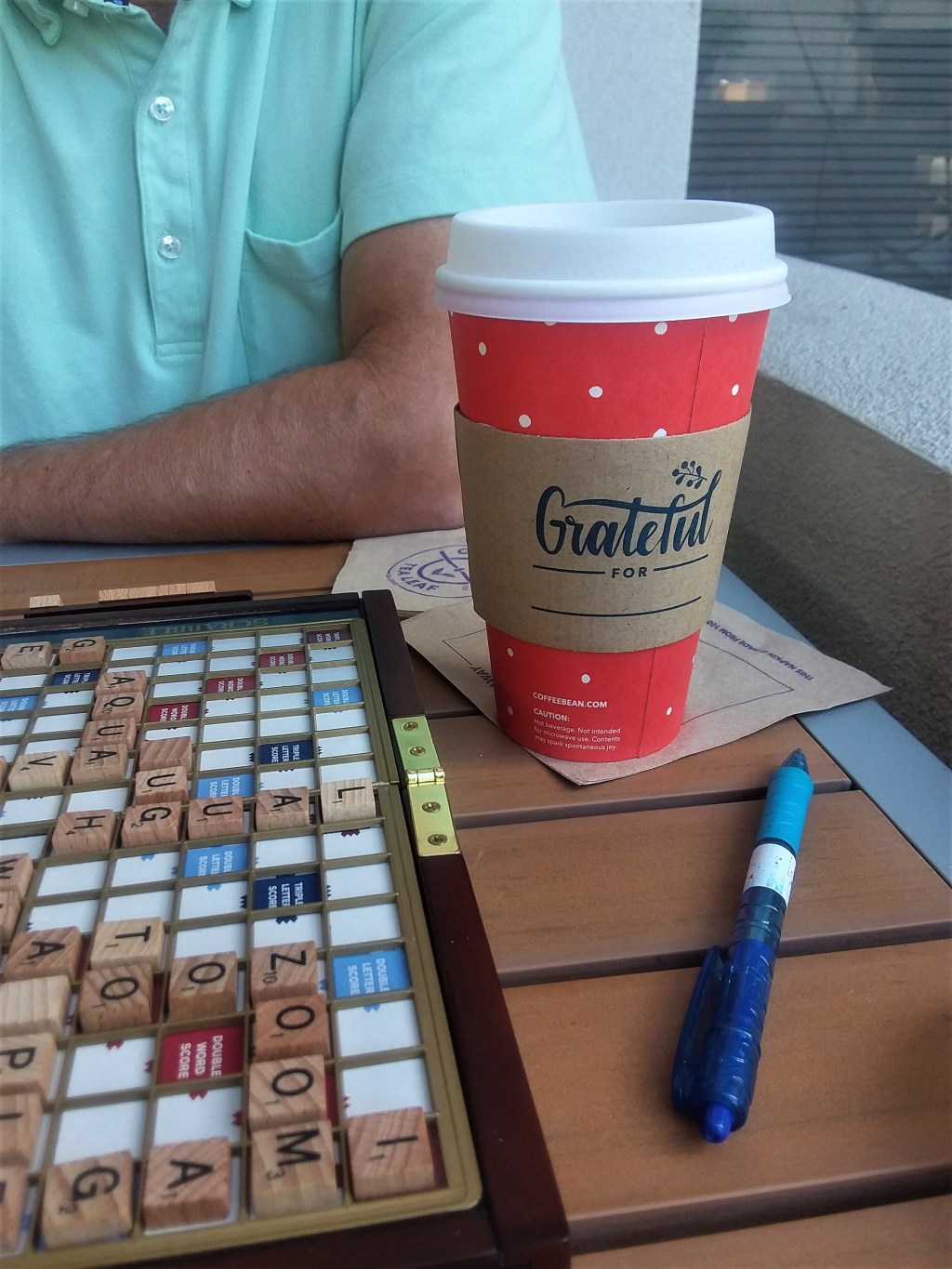
Yesterday was no exception. We drove to The Coffee Bean in Scottsdale and carried our portable Scrabble. With the game midway between us, we consumed two cups of coffee and shared a blueberry scone at a table outside on an eighty-degree, autumn-in-Arizona morning.

Unfortunately for me, Tom was victorious as he is at least fifty percent of the time. On this occasion, his thirty points (a double word score on the word pique near the end of the game) sealed the deal. The final score? 294 points for him; 278 for me.

But the outcome really never matters. What counts is that on good days and bad ones we’re keeping our brains nimble and our Scrabble tradition alive. Our weekly propensity to manipulate tiny wooden letters in a tray will always be ours … and I’ll be forever grateful for the memories of our Scrabble Sundays. From A to Z.


After Grief Swallowed Me Whole

FFG_Photo 20

In October 2015, I was a fixture in front of my laptop. I spent endless hours painstakingly polishing the final draft of my first book, From Fertile Ground. It’s the story of my journey after my mother’s death in 2013.

With help from a trail of letters and diary entries my mother and grandfather left behind, writing renewed my spirit. It led me out of the darkness and propelled me forward. After grief swallowed me whole, I finally reemerged and rediscovered sunlight at the end of a numb and winding road.

Intuitively, I realized I needed to share my story openly with the world. That of a gay man, loving husband, devoted father and grateful son searching for answers. I dreamed it would help others find a new path and navigate their way through grief.

Not long after I published From Fertile Ground in February 2016, friends and strangers began to post reviews online. They described how they were moved by the book and its lessons of love and loss. My dream was coming true.

By the end of 2017, things had gotten rather quiet. That’s what happens with books and creative accomplishments. They come and go no matter how much you want them to linger. They flash across the sky like shooting stars and then fall off the radar.

Fortunately, every once in a while, there is a glimmer or twinkle to remind you of their importance long after they first appear. That happened last week when I read a new review posted on Goodreads and Amazon … a review that reminded me why I decided to publish the book in the first place:

“This book is a life compass if you are experiencing loss or disruption in your family.

From Fertile Ground came to me at precisely the right time in my life. Mark’s perspective and reflection helped me to navigate loss and disruption in my own life. I pulled from his examples and experiences to temper my feelings and expectations. I ultimately gained a great deal of comfort and reassurance from his novel, and I continue to think back on it often as my life continues to evolve.

Throughout the book, I enjoyed getting to know Mark and his family. They are relatable people demonstrating courage, compassion, and love. The poem he wrote and included that was a tribute to his mom was one of my favorites. I also really enjoyed seeing his relationship with his children evolve from childhood to adulthood.”

This is the kind of glorious feedback that motivates me to keep sharing stories. To shine a light on truths … both personal and universal. To bring a little love, inspiration, comfort and reassurance to a world that really needs it. To devote time each day to my literary passion. To pen the next poem and dust off that fictionalized piece that I keep going back to. To live the life of a writer. It’s what I was meant to do. It is my fertile ground.