We all endure specific days–or months–that test our best intentions and weigh on our psyches. January is that month for me.
Long before Tom’s father died January 14, 2012, and my mother followed January 26, 2013, the first month of the year represented a period of Midwestern malaise, forced hibernation, and cold, lingering darkness.
Of course, I live in a warmer, brighter climate now (despite freezing temperatures the past few mornings). I am thankful for that, especially as Tom shares images of his sister and brother-in-law snow blowing and shoveling outside their suburban Chicago home.
Since my mother’s death nearly eleven years ago, the years have passed with a gauzy flutter like pages of a book swept away by a winter’s squall.
Yet January’s weary sensations–grief masked in a cocktail of Christmas memories, vanilla lip balm, and her last graceful smiles during breathing treatments designed to ease her congestive heart failure–appear on cue.
Last weekend, Tom and I packed away our Christmas decorations and recounted cherished memories of quiet holiday moments together and the adrenalin rush of my holiday concert. Adjusting to the rise and fall of this season is always a bittersweet process.
But this week I was eager to recoup our less-cluttered space. To move ahead. To read and write new pages. To protect, nurture, and regain a more normal rhythm away from the madness of news that reminds me–frequently–just how fragile our democracy has become.
My mother and father–who survived the Battle of the Bulge in World War II–would be horrified.
In the depths of 2020, my husband and I began a tradition of buying bouquets of flowers to place in a vase in our living room. As the walls and woes of Covid and our political angst closed in, it gave us hope to see a splash of color on our coffee table.
Less than ten days into 2024, like each of you I have my dreams and doubts, wonders and worries.
But writing about this spray of lavender carnations Tom and I brought home (then displayed in a smoky-blue ceramic pitcher my mother left behind, and placed atop a Spring-like, bird-laden runner my sister gave us for Christmas) helps me breathe, reflect, and relax.
This morning, Tom and I learned of the loss of a dear friend. He was only forty-three years old.
The circumstances that prompted Chad’s death are sketchy and unfathomable. All we really know is that he died September 8 or 9.
The person we loved has become a memory.
***
We met Chad several years ago at our community gym in Scottsdale. He was a strong man with a broad chest and an even broader smile and zest for life.
In short order, we began to take long hikes together at Papago Park near our home. Chad would tell us about his work adventures, his previous chapters in Wisconsin and Texas, his love for the Green Bay Packers, and his greater love for his family–particularly his mother and father.
Along the trail, we shared our life philosophies: speaking our truths, doing the right thing, following our passions, telling our stories, living for today.
I know he appreciated the listening ears Tom and I provided. I also know that Chad loved us. And we most definitely loved Chad.
Chad loved music too. One day in May a few years ago, the three of us visited the Musical Instrument Museum in north Scottsdale. We had a blast playing the drums together at an interactive exhibit.
On another occasion, Tom and I helped Chad prepare to move from one Scottsdale apartment to another when his lease was up.
Chad traveled a lot in his job and was meticulous about his car. Once–when he was out of town and his car was repaired at a body shop after an accident–he asked Tom and me to drive it to our home until he returned.
We were happy to help him. I think Tom and I were his only friends in Scottsdale he trusted enough not to hot rod on the way home.
During Covid, Chad came to visit us outside our condo. We sat across from each other at safe distances. It wasn’t ideal but seeing each other and talking in person mattered. It gave us comfort.
In 2022, Chad left Arizona. He moved to Nashville, Tennessee, for a new career opportunity. Tom and I were thrilled for him, but we missed him and our hikes together. Nonetheless, we had the sense that he was happy in his new home.
In early May of 2023, Chad visited Scottsdale again to renew his friendships here. Tom and I enjoyed talking with him for an hour or so in the chairs outside our condo. We didn’t know it would be the last time we would see our friend.
Now, four months later, we are stunned. Numb. Devastated. With time, we hope to get answers to what happened to our friend.
All we really know is that in an instant he went from being a person to becoming a memory.
I received a sad text message on July 2 from Lu, my cousin’s wife in North Carolina. She told me Frances, my beloved ninety-one-year-old aunt, is in her final stages of life, suffering with the effects of Alzheimer’s.
Frances is my mother’s smart and sassy younger sister–the only one remaining from that generation of my Ferrell family. Her passing–whenever it occurs–will mark the end of a significant chapter in my life … one I wrote about in From Fertile Ground after my mother’s death ten years ago.
When I last visited Frances in September 2015, I sat beside her on the couch of her Davidson, North Carolina living room. It was an important and healing moment for both of us. The loss of her only sister and my only mother was still relatively fresh.
I realized then that returning to North Carolina (where my mother was born) was my way of putting to rest Helen Ferrell Johnson’s earliest life experiences–and some of mine, which included Frances, her sons, warm summer days, and barefoot adventures exploring my grandparents’ Huntersville, North Carolina farm in the 1960s.
Now–just a day away from my sixty-sixth birthday and three weeks from what would have been my mother’s 100th–the knock of grief in July appears once again on the other side of the door.
It ushers me back to July 6, 1974, (my seventeenth birthday) when I stood beside Frances at my grandmother’s (her mother’s) funeral.
We leaned into one another that day in the Asbury Methodist Church cemetery in Huntersville. I needed to feel her love and reassurance, just as I would in September of 2015.
Back in July 2023, my wish is that my aunt’s transition moves swiftly.
In my mind and heart, Frances Ferrell Rogers Christenbury (forever the first child born in High Point, North Carolina, on New Year’s Day 1932) will always be that spunky adventurer.
Frances loved me for who I am … saw and accepted the handwriting on my gay wall before most of the rest of my family … brought joy to my frolicking on the farm … and ordered extra copies of From Fertile Ground to share.
I think it was because reading it helped her heal after the loss of Helen. More than that, because it tells the story of our family’s survival across the generations.
One that will live forever on the pages with Frances and the fertile ground of grief.
Losses and stories come in many forms. This one is best told by my husband Tom, today’s guest blogger.
***
Ode to a Fig Tree
by Tom Samp
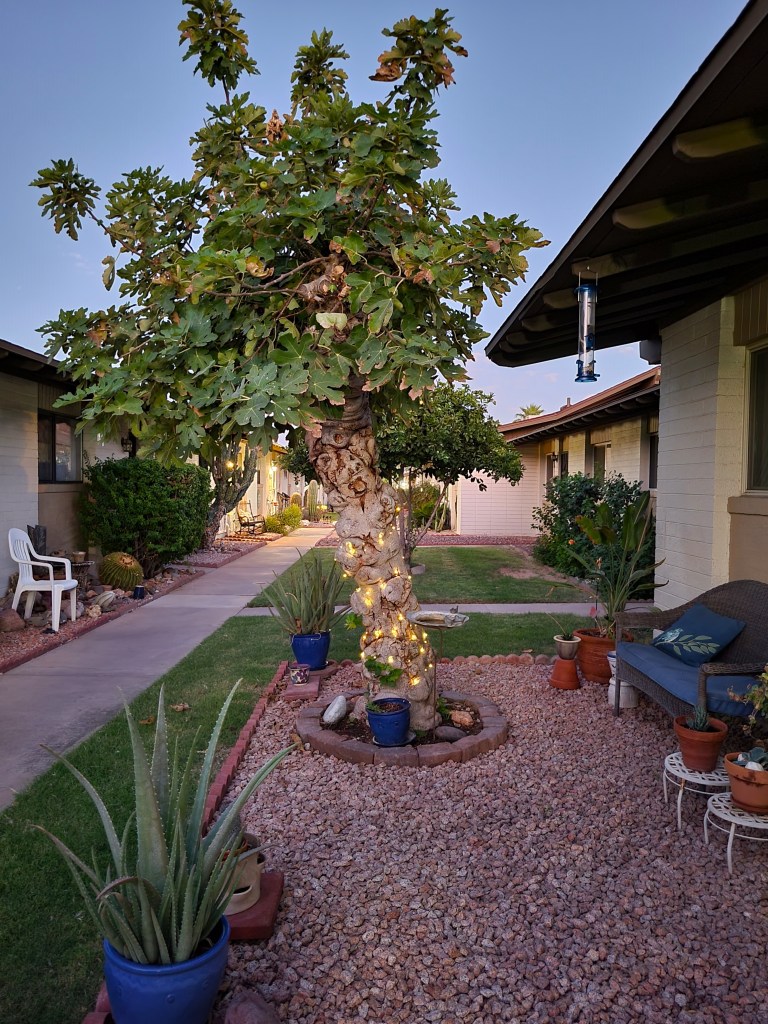
When my grandparents moved in 1972 to the Scottsdale condo where Mark and I now live, my grandfather planted a fig tree.
This tree grew and flourished. It was unique and magnificent. It produced sweet purple figs every summer.
There was never a time when this tree wasn’t a part of the condo, and of my memories of my grandparents and parents. The tree became a part of the lore of our condo complex.
Last Friday, a victim of the carpenter bees that nested and chewed slowly through the bark and the wood inside, the tree had literally cracked in half and fell bent to the ground.
The sadness was immediate and deep.
But why feel this way for a tree? It’s only wood, bark, leaves, and, in the summer, sweet purple fruit.
My mourning certainly could not compare to that felt by our friend and neighbor Aggie, whose husband Bill, also our friend, passed away during the week.
Still, it was the sentimental images and feelings I attached to the fig tree that made its death so emotional for me.
It was a part of our home that I almost took for granted. A splash of green we saw when we opened our blinds every morning.
A place for the small birds–sparrows, finches, lovebirds–to wait their turn at the bird feeder we hung right outside our window.
The shady spot where our neighbors Pat and Gary placed their lawn chairs to read or relax; and where Gary took his last breath on Good Friday, 2021.
A topic of awed comment and conversation from friends and passers-by.
An ingredient in the fig jam that our neighbor Jeannie made for us.
The February morning every year, after the leaves all fell for the winter, when Mark and I trimmed the branches way back.
The excitement each April when we saw the tiniest green buds, signifying that the tree had survived, and would again thrive.
A final remnant from my grandparent’s lives, when they pioneered to Scottsdale from Chicago in retirement.
On Saturday, after the condo landscaping crew kindly and efficiently chopped the broken tree and carried away the pieces, Mark created a container garden in its place, filled with colorful flowerpots which held desert plants and cactus.
It will be an adjustment. Maybe we will plant another tree in the fall. In the meantime, the memories will always linger.
I captured our glorious, gnarled, and storied fig tree just before dusk during the summer of 2022.
Love and loss are universal human conditions. If we feel the first, we can’t escape the grief associated with the second.
I wrote You Everlasting in December 2009. It was a gift for my eighty-six-year-old mother.
I remember the surprise and delight on her face that Christmas Eve, after she slowly unwrapped the framed contents in tissue paper cradled in her lap.
“You wrote me a poem,” she said quietly.
In 2016, three years after she passed, I published the poem in From Fertile Ground. It is a book inspired and informed by grief.
Today, on the tenth anniversary of Helen F. Johnson’s death, the time is right to share it again.
The imagery of flowers, trees, and animals comforts me. The verse provides much-needed continuity from her past existence to the reflections and influences that live on inside me.
The poem reminds me of that wise, nature-loving woman, who carved a resilient path for me to follow.
I still feel her presence today and can smile with the knowledge that, though she left on a frigid-in-Illinois, January morning in 2013, I carry the warm memories of her in my Arizona desert life in 2023.
Perhaps these words will prompt memories of your own loved ones, who are gone but never forgotten.
***
You Everlasting
You are the comfort of nature. Eternally pressed.
The first magnolia petal of spring.
The last gingko leaf of autumn.
The determined orchid that flourishes.
The lingering annual that endures. Perennial.
You are high and low tide. Remarkably present.
The hidden, tranquil meadow.
The crackle and thump of fresh melon.
The dancing firefly in a warm Carolina sky.
The soulful howl of a January hound waiting by the gate. Undeniable.
You are the simplest wisdom. Gracefully proud.
The tender touch of summer days that melt but never fade.
The breaking dawn of blues and greens forever in my memories.
The resilient path carved and captured in my heart.
The polished gem of hopeful dreams. Everlasting.
In December 2008, one year before I gave her the poem, my mother enjoyed another holiday celebration with her family in Illinois.
On Saturday and Sunday, I stood on stage at the Galvin Playhouse in Tempe, Arizona, with about forty fellow members of the Phoenix Gay Men’s Chorus.
From the tenor two section of the top riser, I was dressed in black pants and my snazzy, solid-red holiday sweater. I was ready to raise my voice, have fun, open my heart, and bear my soul for two large, enthusiastic audiences there to see and hear us perform our ‘Twas the Night Before Christmas show.
As you might expect, I was amped up. My energy and emotions were running high. On stage or not, the holiday season can spur a range of feelings–from joy, hope, and peace to sorrow–for each of us.
Often, the music we hear or create is the catalyst for our state of being. It reminds us of who we are, who we love, who we’ve lost, where we’ve been, where we are, and maybe even foretells where we’re going.
Like life, this was a holiday concert that included a little of everything: luscious chords, soaring solos, a tribute to Hannukah, hot men wearing sparkly vests, a surprise tap dance underneath the tree (in the ‘Twas the Night Before Christmas parody I wrote for the show), a caped gay superhero, a Christmas Can-Can not to be believed, sexy Santa Baby, assorted musical mash ups, and inspirational tunes.
The program was a delight to perform, and the crowds loved it. I felt thrilled and honored that about thirty family members and friends attended. One of them was Jeff.
Over the past three years, he and his husband Dave have become close friends for Tom and me. We’ve met for dinner frequently. Watched movies and played games together. Laughed and swam in their backyard pool. Shared funny stories from our past lives.
In March, Tom and I were honored to join Jeff and Dave and about thirty other friends to celebrate their fortieth anniversary. In October, they drove to Barnes & Noble in Mesa to be there for my book signing. Dave was a regular reader of my blog. He brought up my writing frequently. Each time, I was touched.
On Sunday morning, between the two holiday concerts, Jeff texted to tell Tom and me that Dave passed away Saturday night. He succumbed to complications of muscular dystrophy–a disease he lived with for many years. It confined him to a wheelchair, but–in the time I knew Dave–his disability never dampened his kind spirit, playful energy or warm smile.
I’m sad and stunned. I will miss my friend. On Sunday, as I sang Grown Up Christmas List on stage, I thought of Dave and all he must have endured. That song usually makes me cry anyway, but when I saw others in the audience tearing up, I fought hard to hold it together.
Of course, Jeff knows Tom and I are there for him as he grieves the loss of his long-time husband and loving companion. We will check in on him frequently.
This is just the latest personal reminder to sing and dance. Hug and kiss the ones you love. Fight hard for your convictions. Stand tall in the face of adversity. Raise your voice. And, if you are dealt a difficult hand, find a way to accept the unacceptable.
As a tribute to Dave, what follows is the full text of ‘Twas the Night Before Christmas (A Gay Love Story), which I wrote for the Phoenix Gay Men’s Chorus in July 2022.
It’s a parody, which Tony Crane and Tim Gorka (who played Uncle Gabe and Nephew Jay respectively) performed masterfully during our show in Tempe over the weekend.
Had he seen it, Dave would have laughed out loud and loved it.
Rest in peace, my friend.
***
‘Twas the Night Before Christmas (A Gay Love Story)
Grief is an insidious and universal human condition. When you love someone–and they leave or die–you need something to fill the space they’ve left behind. Grief enters to fill the void.
If you are in the midst of grieving (as I was in 2013 and 2014 after my mother passed away), it may feel as if you are wandering through a deep fog. Or you might wonder if you are chained to the floor in the middle of an empty room with water pouring in over all four walls and seeping through the floor boards.
That’s how grief can manifest itself, but for each of us the path is different. The loss lightens over the years. Still, we carry it wherever we go. It becomes an extension of us, ingrained in our identities.
In 2014 and 2015, I saved myself from drowning in grief by writing about it. My mother and grandfather helped immensely. They left behind a trail of their thoughts and experiences on paper … in the form of a mountain of letters from Helen (my resilient mother) and diaries from S.R. (my farming grandfather).
After my mother’s demise, reading her handwritten and wisdom-filled memories and her dad’s more stark observations prompted me to tell all three of our stories in one book. From Fertile Ground became my salvation. Yes, in 2015 it consumed me, but it also gave me renewed creative purpose and focus after I left my corporate job.
When I finished and published the book in 2016, I felt it was a story that would alleviate pain for grief-stricken souls. Five years later, I still feel that way. It helps me to revisit my book and my grief from time to time. Readers have taken the time to write reviews like this one online.
“From Fertile Ground” is more than just a terrific read. Johnson is generous in taking the reader into his world, his journey, his family, his emotions. In so doing, the reader obtains a soothing sense of identification of the human condition, particularly how we work through grief and loss. Johnson’s mother’s and grandfather’s letters are interspersed throughout the narrative (and connected) which adds to the reassuring sense of a collective history.
We live in a complicated world. Many of us are suffering through the side effects of loss and searching for answers. It gives me joy knowing that my book is a creative balm for many, possibly even an antidote for grief.
At any rate, as the days grow shorter in the Northern Hemisphere, I hope this personal and universal three-generation story inspires you and brightens your world … no matter who you’ve loved and lost, no matter where you live.
From Fertile Ground is a three-generation memoir and writer’s mosaic of love and loss. Published in 2016, it examines the implications of grief and our quest to make sense of our past so that we can find our path and move ahead.
Life is a mysterious mish mash of beginnings and endings, wins and losses. Lately, the losses have been more prominent and painful for me and many of you. Yet we do what we can to endure in 2020.
Last night, Bob Gibson–one of the greatest pitchers ever and undoubtedly the most dominant of the 1960s–died of cancer at age eighty-four. Serendipitously, his team–the St. Louis Cardinals–ended their frantic, COVID-19-filled 2020 season the same night with a 4-0 playoff loss to the San Diego Padres.
As a kid growing up in St. Louis in the sixties, I followed every angle of Gibson’s story. He was a local hero, a one-time player for the Harlem Globetrotters, a flame-throwing right hander who still holds the ERA (earned runs average) record in Major League Baseball–1.12 for the 1968 season. It’s a record that will likely never be broken.
But this versatile athlete and fierce competitor was also a gifted writer. I remember browsing the local library as a kid and reading From Ghetto to Glory, his story about growing up poor in Omaha, Nebraska, and fighting his way to the top. “Gibby” was an inspiration and role model.
Bob Gibson passed away less than a month after Lou Brock, the legendary base stealer, fellow Hall of Famer and his St. Louis Cardinals teammate. The duo of Bob and Lou dazzled a generation of St. Louis fans on the field and appeared in three World Series–winning in 1964 and 1967.
Ironically, Gibson died on October 2, 2020. Exactly fifty-two years after striking out seventeen batters in Game 1 of the 1968 World Series against the Detroit Tigers. To date, his record still stands.
If you enjoy reading stories about baseball, check out my book Tales of a Rollercoaster Operator. It includes a story about my dad and me watching Bob Gibson pitch on July 15, 1967 from the bleachers of Busch Memorial Stadium. That day, the crack of Roberto Clemente’s bat (another Hall of Famer), booming through my transistor radio, changed everything.
It’s my sister’s birthday. Soon she will open the card and presents we sent her. I will call her later today to wish her well. To tell her I love her.
Like every relationship, ours has had its ebbs and flows. But Diane and I are the only ones left from our family of origin. The only ones who remember the best sounds of our St. Louis childhood–Dad slurping his breakfast beverages through the overflowing Coffee Hound cup we gave him or Mom sifting red and green sprinkles on sugar cookies shaped liked reindeer, candy canes, stars and Santas.
After our mother died in 2013, Diane and I each retreated into our individual darkness. We had worked together closely to care for her during her final years and months, but after Mom was gone I wasn’t sure we would escape the labyrinth of pain and grief or come out the other side whole. It wasn’t that I doubted our love, but we both had to find our personal paths to heal from the devastating loss.
For me that meant writing about it and sharing my observations in From Fertile Ground. Diane wasn’t keen on the idea. She preferred privacy. This difference between us–and the resulting grief-induced friction–was unexpected for me, but with time I realized I needed to respect my sister’s point of view. To this day, she rarely reads what I write.
In June of 2017, right before Tom and I left Illinois and moved to Arizona, Diane drove from her suburban Chicago home to visit with us on our backyard deck in Mount Prospect. I decided to give her the concrete birdbath that had been Mom’s, hoping it would remind her of the shared love we had for our nature-loving mother.
A few weeks later–on the way west–I landed in a St. Louis hospital after a heart attack. I called my sister to tell her what had happened. To hear her voice. To hear her love. That conversation was the turning point toward greater understanding.
In early September, Tom and I received a card from the American Heart Association in the mail. To acknowledge Tom’s and my sixth wedding anniversary, it told us Diane and Steve (my brother-in-law) had made a donation to the organization.
After I opened the card and wiped the tears from my eyes, I realized Diane and I had escaped the labyrinth of grief. Our relationship had emerged on the other side of the shadows. There was light on the horizon.
It’s become one of our beloved desert traditions. For the past three years on July 26th, Tom and I have walked to the Desert Botanical Garden.
Actually, we visit this physical and psychological oasis, tucked inside the easternmost edge of the Phoenix city limits, a few dozen times in a typical year. Because of the pandemic, only recently have we been able to return.
Twice in the past month–early on Sunday mornings–we arrived at a reserved time, stood as an electric eye scanned my phone confirming our tickets and membership, and entered behind our protective masks.
We love the stillness of the garden. The proximity to our home. The majesty of the saguaros and cardon cacti. The exotic succulents. The spiky boojum trees. The dazzling desert roses. The prickly pears in bloom. The tranquility and color of the wildflowers in spring. The harvest of the herb garden in summer.
The chatter of desert wrens, thrashers, woodpeckers and hummingbirds. The playfulness of the ground squirrels. Lizards pausing to do push ups on the trails. Bullfrogs croaking from a pond. Plentiful cottontails in the thicket. Occasional coyotes, long-eared jackrabbits, and road runners scurrying by to say hello and goodbye. Yesterday we spotted the latter two.
Most of all, it’s the connection to the natural desert landscape–and memories of those we’ve loved and lost–that draws us back. That’s where July 26th becomes significant. Yesterday would have been my mother’s ninety-seventh birthday.
Helen, a lifelong gardener and lover of nature, never joined us here. But it was a place she would have enjoyed for all of the reasons I’ve listed.
It’s a natural choice for Tom and I to come here each year on her birthday to acknowledge her past place in the world. To remember her shadow. Her legacy. The love and lasting positive impact she had on my life. Tom’s life. My sons’ lives. My sister’s life. All of our lives.
Of course, her physical shadow disappeared seven-and-a-half years ago. But Tom and I have carried the gardening mantle forward here in Arizona. Just as my sister Diane does at her home in Illinois. At this point, it’s our turn to appear at the front of the line in longevity, visibility and vulnerability.
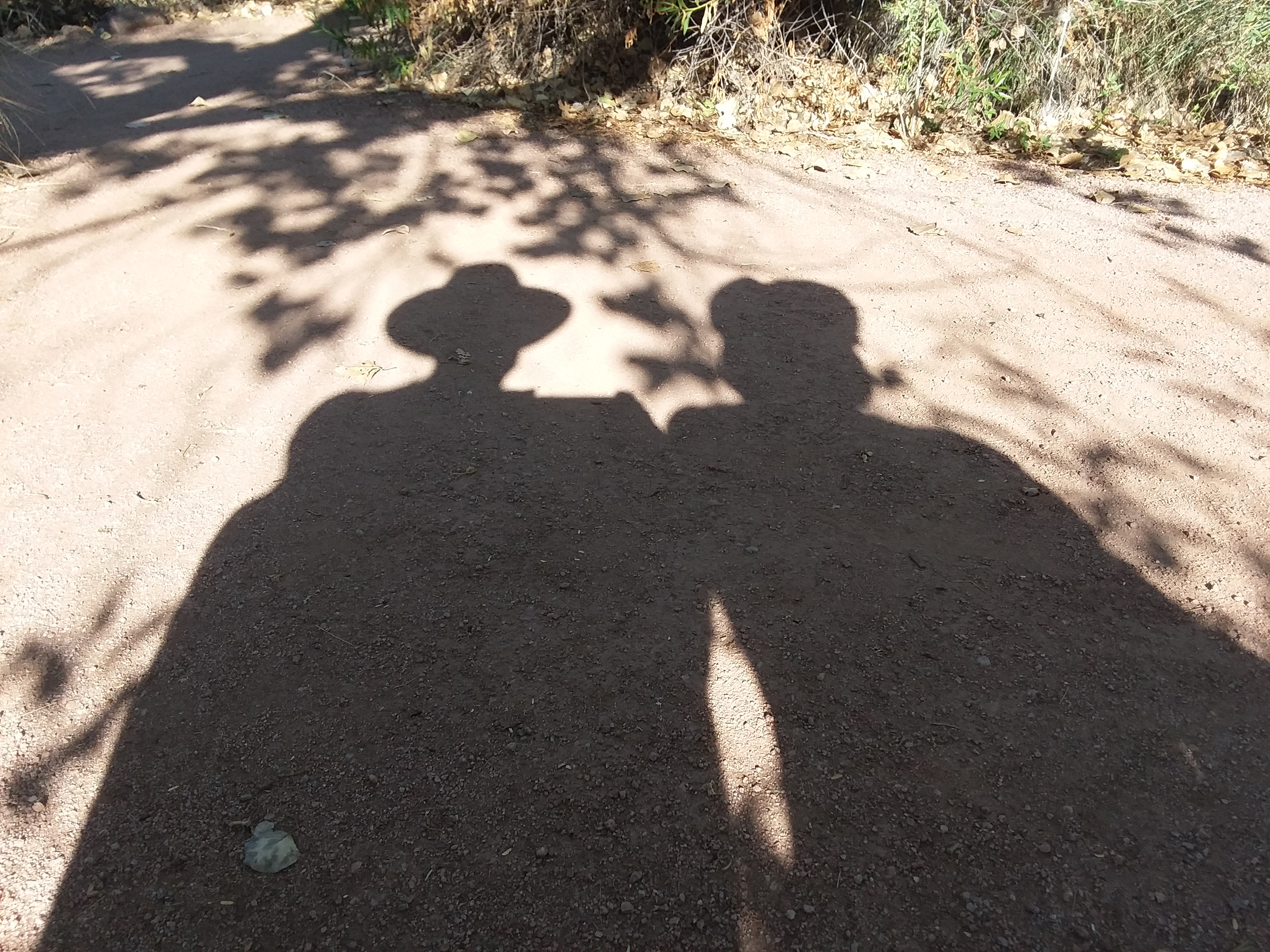
So there Tom and I sat on Sunday. Casting our shadows in the garden on July 26, 2020. Pausing under the trees to reflect on how many we’ve loved and lost … four parents … and how far we’ve come together.
Doing our best to enjoy each day in spite of the turmoil that surrounds us. Taking cover from the pandemic under the shade of our broad-brimmed hats. Absorbing the comfort and magic of nature just outside our door.




 Mark Johnson Stories