In the base of nature’s jagged bowl, weighty wings of clouds gather and descend. Endless cascades of cleansing tears appear to wash tangled unsuspecting souls.
“Fly away” they shout. “Show us those we knew are lasting. Bathe us in revealing light and budding promise. Help us replenish and remember what has gone.”
***
This poem is dedicated to all those who have gone before us. To enjoy more of my poetry, buy my latest book–A Path I Might Have Missed–on Amazon.
After my mother died on this day in 2013 at age eighty-nine, my grief took root.
With a little time, a lot of reflecting and journaling, and the support of a small circle of family and friends, I found and nurtured my own path from the branches of despair.
By 2015, I had carved out a storyteller’s life Helen Johnson would have loved. Late that year, I flew to North Carolina to visit Frances, her only sister.
Spending time with Frances in the state where both were born–and revisiting childhood memories of my grandparents’ farm in Huntersville, NC–propelled my creativity.
In March of 2016, I completed and published my first book, From Fertile Ground. It is the story of my journey and grief.
If you’ve read this story about three writers (my grandfather, mother, and me) and their love of family, you know this isn’t really the cover.
Today I’ve superimposed this photo of Helen and Frances together (in my sister’s backyard in 2003 or 2004 in northern Illinois) to remember them both.
Why? Because Frances was the last physical vestige of that rural, 1960s world for me. When she died six months ago at age ninety-one, I metaphorically waved goodbye to those years of running amok barefoot on warm summer days in the Tar Heel State.
Of course, I will always have rich memories of my wise-and-frugal mother, who wrote countless letters, and my fun-loving aunt, who traveled the world in her retirement years. In their own ways, they inspired me to tell my story.
Today–as I remember them both–I can walk into the sunroom of the Scottsdale, Arizona condo where Tom and I now live. I can pull my book off the shelf and find this passage.
“What I knew before was that the farm was a place of discovery for me and the fertile ground there was a physical and psychological refuge from the hardships of our family drama in St. Louis. What I know now is that I would need to go back to North Carolina to come to terms with my grief and integrate my southern memories with my present-day, real-life adult existence.”
I can take solace in the fact that I’ve written about Helen and Frances–who they were, who they loved.
Though they are both gone, they live on the pages.
On a regular basis, all of us encounter unexpected small and large obstacles.
One day, they may be as fixable as a “low tire pressure” warning light that illuminates on the dashboard.
The next, something far more unimaginable, unexplainable and unrepairable. Like learning of the apparent suicide of a forty-three-year-old friend, who seemed to embody the definition of vitality.
It was simple to stop at Discount Tire to ask an attendant to increase the air pressure in our tires. (The cooler desert temperatures must have deflated them.)
It will take much longer–time, space, and reflection–for Tom and me to process Chad’s demise.
I’ve often thought that resiliency is one of the most important human characteristics to cultivate.
It is our ability to cope, process, manage, and emote our way through or around life’s setbacks that defines our longevity. This latest loss confirms my belief.
These observations surfaced this morning during a walk in the park in my community. At Chaparral Park in Scottsdale, Arizona to be precise.
My husband and I had just finished our yoga class. Afterwards, he wanted to lift a few weights in the gym.
I opted for stretching my legs on my own under a few puffy clouds that dotted Arizona’s wide-open October sky.
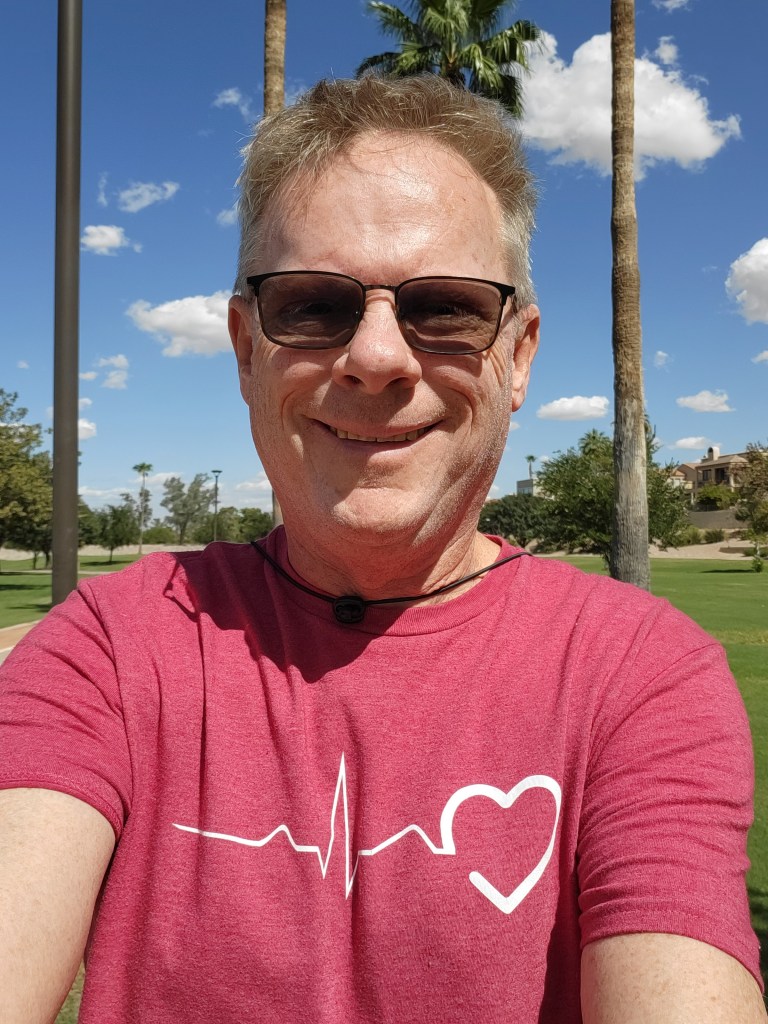
Near the midpoint of my walk a fit couple jogged up as I waited for the light to turn green at Chaparral and Hayden roads. One of them admired my shirt.
“You must be in the medical profession,” he gestured toward the beating heart I wore proudly.
“No, I’m a heart attack survivor,” I explained. “I helped raise money for the American Heart Association.”
They smiled and wished me well. Then, they dashed off when the WALK sign turned white.
It was a simple exchange, a reminder of a trauma I experienced and wrote about which now feels way off in the rearview mirror.
But those few sentences with two sympathetic strangers infused me with a renewed appreciation for my personal resiliency.
No doubt, it’s a quality I observed in my mother, a saver and survivor. She always described herself as a child of the Depression.
It’s also a trait I began to mine in my thirties after my divorce. A strength I’ve fine-tuned on countless treadmills since suffering a mild heart attack six-plus years ago on my sixtieth birthday.
I have no regrets regarding my friendship with Chad, but I wish he would have called Tom or me before he made his worst and most irreversible decision.
I would have told him that while life is no walk in the park, it is always worth the fight. To find a skilled therapist. To dig deep on the darkest days. To survive the pain. To accept our losses.
To embrace each and every day we are granted. To reach out for love and hope. To live to see tomorrow.
This morning, Tom and I learned of the loss of a dear friend. He was only forty-three years old.
The circumstances that prompted Chad’s death are sketchy and unfathomable. All we really know is that he died September 8 or 9.
The person we loved has become a memory.
***
We met Chad several years ago at our community gym in Scottsdale. He was a strong man with a broad chest and an even broader smile and zest for life.
In short order, we began to take long hikes together at Papago Park near our home. Chad would tell us about his work adventures, his previous chapters in Wisconsin and Texas, his love for the Green Bay Packers, and his greater love for his family–particularly his mother and father.
Along the trail, we shared our life philosophies: speaking our truths, doing the right thing, following our passions, telling our stories, living for today.
I know he appreciated the listening ears Tom and I provided. I also know that Chad loved us. And we most definitely loved Chad.
Chad loved music too. One day in May a few years ago, the three of us visited the Musical Instrument Museum in north Scottsdale. We had a blast playing the drums together at an interactive exhibit.
On another occasion, Tom and I helped Chad prepare to move from one Scottsdale apartment to another when his lease was up.
Chad traveled a lot in his job and was meticulous about his car. Once–when he was out of town and his car was repaired at a body shop after an accident–he asked Tom and me to drive it to our home until he returned.
We were happy to help him. I think Tom and I were his only friends in Scottsdale he trusted enough not to hot rod on the way home.
During Covid, Chad came to visit us outside our condo. We sat across from each other at safe distances. It wasn’t ideal but seeing each other and talking in person mattered. It gave us comfort.
In 2022, Chad left Arizona. He moved to Nashville, Tennessee, for a new career opportunity. Tom and I were thrilled for him, but we missed him and our hikes together. Nonetheless, we had the sense that he was happy in his new home.
In early May of 2023, Chad visited Scottsdale again to renew his friendships here. Tom and I enjoyed talking with him for an hour or so in the chairs outside our condo. We didn’t know it would be the last time we would see our friend.
Now, four months later, we are stunned. Numb. Devastated. With time, we hope to get answers to what happened to our friend.
All we really know is that in an instant he went from being a person to becoming a memory.
My parents labored through much of their forty-five years of marriage. In that sense, it is fitting that their wedding anniversary–September 4–often coincides with Labor Day, as it does this year.
Despite their differences, struggles, and heartaches, by the late 1980s Mom and Dad seemed more content whenever I drove from Chicago to visit them in St. Louis.
Mom had retired from her stressful government job. She spent more time in her beloved garden. Dad’s mental illness had quieted. He found solace, reading his Daily Word in their wing-backed chair.
Ironically, this more even footing in their relationship appeared as their physical frailties–and risk of falling–became more obvious.
They went to church together. They cultivated deeper friendships with neighbors. They dined regularly at nearby Grone’s Cafeteria. Life was much simpler.
Comparatively, Tom and I are far more active in our “retirement” than my parents ever were. But we have discovered a similar contentment. There are fewer demands on us. We spend more time on the things we enjoy with the people–friends and family–who mean the most to us.
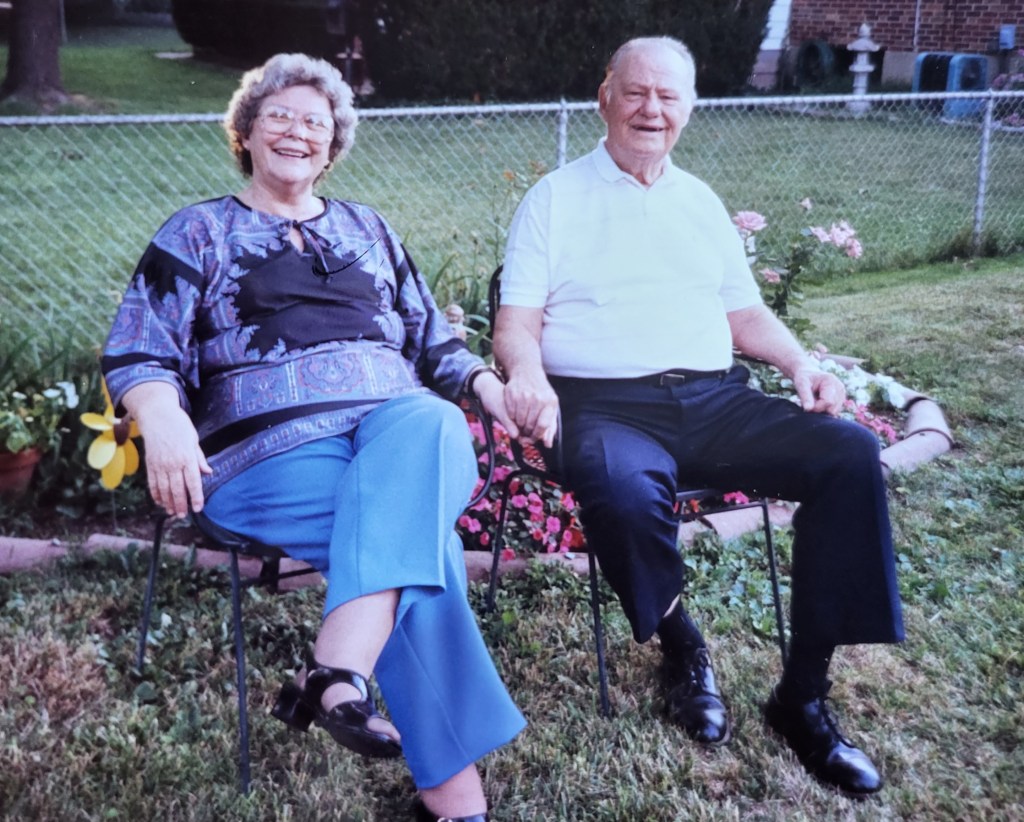
Today–on what would have been Helen and Walter Johnson’s 75th wedding anniversary–the two people holding hands in this photo are the ones I choose to remember.
But, even during the troubles and heavy lifting of their younger years, I’m grateful for the many things they taught me. How to respect the elderly. How to save for a rainy day. How to be kind to neighbors and care for animals. How to put people before material things. How to be a loyal friend. How to work hard and earn my keep. How to show compassion.
Most important of all, how to love my family, warts and all.
Certainly, by watching Helen and Walter struggle, I learned lessons about how to endure in a world that can often feel unendurable. That may feel like a strange way to pay tribute to my parents on their diamond wedding anniversary. But it’s honest and true.
Though Dad has been gone thirty years and Mom ten, the love I feel for them endures.
In the summer of 1988, Helen and Walter Johnson enjoyed their suburban St. Louis backyard. Mom was 65; Dad was 74.
I received a sad text message on July 2 from Lu, my cousin’s wife in North Carolina. She told me Frances, my beloved ninety-one-year-old aunt, is in her final stages of life, suffering with the effects of Alzheimer’s.
Frances is my mother’s smart and sassy younger sister–the only one remaining from that generation of my Ferrell family. Her passing–whenever it occurs–will mark the end of a significant chapter in my life … one I wrote about in From Fertile Ground after my mother’s death ten years ago.
When I last visited Frances in September 2015, I sat beside her on the couch of her Davidson, North Carolina living room. It was an important and healing moment for both of us. The loss of her only sister and my only mother was still relatively fresh.
I realized then that returning to North Carolina (where my mother was born) was my way of putting to rest Helen Ferrell Johnson’s earliest life experiences–and some of mine, which included Frances, her sons, warm summer days, and barefoot adventures exploring my grandparents’ Huntersville, North Carolina farm in the 1960s.
Now–just a day away from my sixty-sixth birthday and three weeks from what would have been my mother’s 100th–the knock of grief in July appears once again on the other side of the door.
It ushers me back to July 6, 1974, (my seventeenth birthday) when I stood beside Frances at my grandmother’s (her mother’s) funeral.
We leaned into one another that day in the Asbury Methodist Church cemetery in Huntersville. I needed to feel her love and reassurance, just as I would in September of 2015.
Back in July 2023, my wish is that my aunt’s transition moves swiftly.
In my mind and heart, Frances Ferrell Rogers Christenbury (forever the first child born in High Point, North Carolina, on New Year’s Day 1932) will always be that spunky adventurer.
Frances loved me for who I am … saw and accepted the handwriting on my gay wall before most of the rest of my family … brought joy to my frolicking on the farm … and ordered extra copies of From Fertile Ground to share.
I think it was because reading it helped her heal after the loss of Helen. More than that, because it tells the story of our family’s survival across the generations.
One that will live forever on the pages with Frances and the fertile ground of grief.
Tom and I get this question a few times a month–sometimes more often. In Arizona, Illinois, or anywhere in between.
We could be at the check-out counter of a grocery store, a restaurant as we wait to be seated, or on the treadmill at the gym we frequent in Scottsdale as we were on Monday.
That’s when a friendly man, wearing a San Francisco Giants ball cap, popped the question. (No, he didn’t ask me to marry him.)
In 2023, I generally smile and respond as I did Monday with “No, we aren’t, though we get that question a lot.” And the conversation ends there.
Depending on my mood–and how much I choose to share my personal story (after all, I am a memoir writer)–I have often gone on to say, “Tom and I are married.” Or “Tom and I are partners.” Or “Tom and I have been together for more than twenty-five years.”
Along the way, we have never received any open backlash concerning our relationship (nor should we). Quite the opposite. We have made more friends of all kinds because of our openness and comfort in our skins. (By the way, it took me decades to get here and I’m not going back.)
With time and reflection, I’ve realized that the question is more of an observation in the world of people we contact who aren’t able to classify the intimacy or closeness they identify between two men standing before them.
Or maybe it’s an acknowledgment on a less significant level that we have picked up some mannerisms from one another that two brothers might have in common. However, we really don’t look alike.
At any rate, I will continue to live my open life as a gay man–proudly–in my community. I will continue writing about my experiences–positive and negative–as a gay man, a husband, a father of two adult sons, a neighbor, a friend.
I will continue singing on stage with the Phoenix Gay Men’s Chorus. As I write this, I have just completed drafting a script about five fictionalized characters living in the Phoenix LGBTQ community in 2023. Their dialogue will be the glue that ties together the music of our next concert: “Born To Be Brave”, June 3 and 4 at Tempe Center for the Arts.
I feel it is my duty to demonstrate that two men–a gay, married couple–don’t have to be blood brothers to love each other.
Especially in a country where some want to remove the books of gay authors from the shelves. Or try to erase the checkered history of our country on race relations because the truth is threatening to some. Or ban drag shows, because they view them as recruitment activities for current or future generations.
Okay, I’ll get off my soapbox now. But Tom and I aren’t brothers. We’re a gay couple living happily in 2023, and there are lots of us out in the world.
We’re making significant contributions. Loving our families. Loving our neighbors. Loving our friends. Loving the legacy, which we are leaving for future generations of children who need to know the truth about the past and the present. That there are all kinds of people in the world loving each other. And that’s just as it should be.
You and your buoyant love, deep caress, soothing sparkle.
You are my quiet cove, splashing symphony, ever-gliding channel.
With every stroke, you steal me away from the din of demands.
Your flow–lapping up and racing by with no questions–surrounds me.
With each passing whoosh, you lead me by the hand and whisper.
“Float with me now in these reassuring moments.
This is where peace, promise, and repetition reside.”
On February 5, 2023–after nearly a three-month hiatus due to cooler-than-normal weather in the Valley of the Sun and a litany of other interruptions–I swam laps outdoors once again in our community pool at Polynesian Paradise in Scottsdale, Arizona.
Love and loss are universal human conditions. If we feel the first, we can’t escape the grief associated with the second.
I wrote You Everlasting in December 2009. It was a gift for my eighty-six-year-old mother.
I remember the surprise and delight on her face that Christmas Eve, after she slowly unwrapped the framed contents in tissue paper cradled in her lap.
“You wrote me a poem,” she said quietly.
In 2016, three years after she passed, I published the poem in From Fertile Ground. It is a book inspired and informed by grief.
Today, on the tenth anniversary of Helen F. Johnson’s death, the time is right to share it again.
The imagery of flowers, trees, and animals comforts me. The verse provides much-needed continuity from her past existence to the reflections and influences that live on inside me.
The poem reminds me of that wise, nature-loving woman, who carved a resilient path for me to follow.
I still feel her presence today and can smile with the knowledge that, though she left on a frigid-in-Illinois, January morning in 2013, I carry the warm memories of her in my Arizona desert life in 2023.
Perhaps these words will prompt memories of your own loved ones, who are gone but never forgotten.
***
You Everlasting
You are the comfort of nature. Eternally pressed.
The first magnolia petal of spring.
The last gingko leaf of autumn.
The determined orchid that flourishes.
The lingering annual that endures. Perennial.
You are high and low tide. Remarkably present.
The hidden, tranquil meadow.
The crackle and thump of fresh melon.
The dancing firefly in a warm Carolina sky.
The soulful howl of a January hound waiting by the gate. Undeniable.
You are the simplest wisdom. Gracefully proud.
The tender touch of summer days that melt but never fade.
The breaking dawn of blues and greens forever in my memories.
The resilient path carved and captured in my heart.
The polished gem of hopeful dreams. Everlasting.
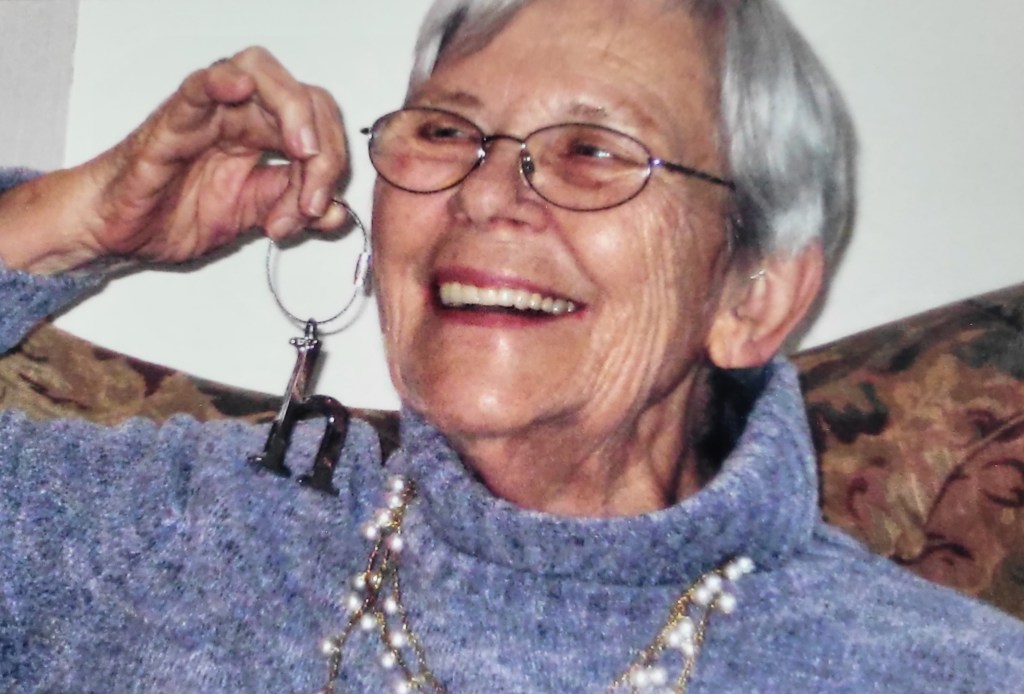
In December 2008, one year before I gave her the poem, my mother enjoyed another holiday celebration with her family in Illinois.
I take a blood thinner; therefore, I bruise easily.
So, for instance, if I’m putting away dishes in our cupboard after dinner and bump the top of my hand on the corner of the cabinet, I am sure to leave that mundane household experience with a souvenir–an immediate red patch that will last a few days in the afflicted area.
I haven’t always been ultra-self-conscious about the condition of my extremities. It’s only lately–in my sixties with thinner skin on my thinner body–that I’ve become aware of my aging hands and, of course, my mortality. They go hand in hand.
Since I’m a writer and rely on my fingers, wrists, and hands to write these sentences on my laptop, I’m fortunate not to have arthritis in my joints–in my hands.
My sister Diane seems to be the one in our family who has inherited that painful component of our mother’s DNA. Particularly in her hips, knees, and feet.
Diane is sixty-eight-years old. She doesn’t read what I write. We live seventeen hundred miles apart. She in Illinois. Me in Arizona.
Even so, I love my sister. I always have and will. Tom and I visited her and Steve (Diane’s husband) for an afternoon last October while we were in the Chicago area. In this age of Covid, we recounted all the things we are thankful for.
Diane will always be my only sibling, my only big sister. We talk and text occasionally. I worry about Diane’s physical wellness and longevity. We’re the only two remaining in our family of origin, since Mom passed away ten years ago.
Diane also is the only other person who remembers the nuances of our St. Louis childhood, our homelife (good, bad, and indifferent), our difficult plight as a family after Dad’s heart attack in 1962, our mother’s resolve in her fifties and fragility in her eighties, our mother’s aging hands.
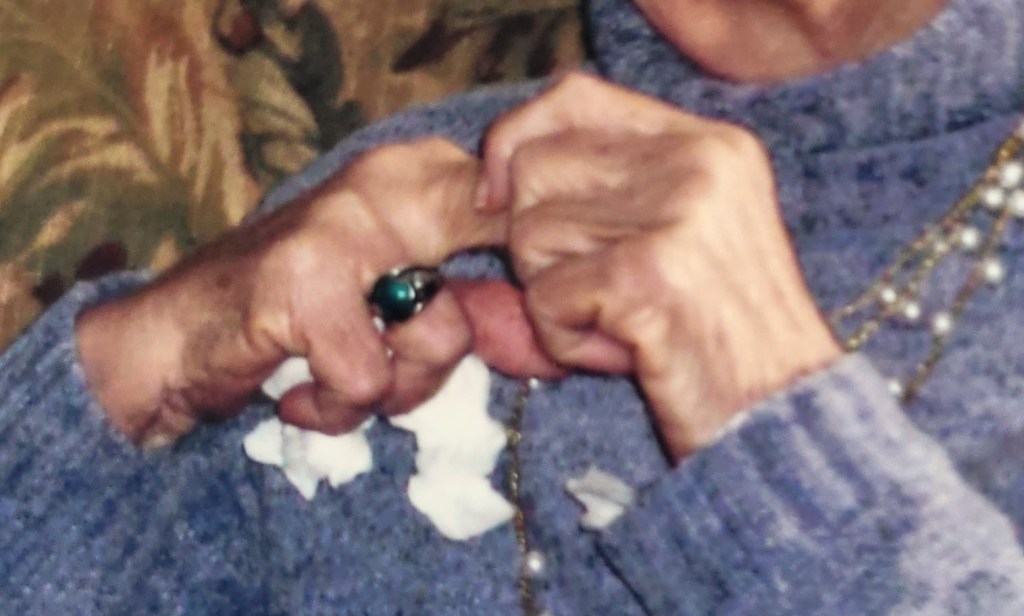
I came across this photo of Mom’s folded hands from Christmas Eve 2008. That night, we gathered at Diane’s home in Illinois to celebrate the holiday and open gifts. Mom would live to share another four Christmases with us.
It’s a cropped image and not the clearest, but when I saw it, I was reminded of Mom’s age spots and blemishes that grew with the passage of time on her fair, loose, thin skin. The rough patches on her hard-working hands go back in time to her rural southern roots in High Point, North Carolina, and fifty years in St. Louis, Missouri, which I chronicle in From Fertile Ground.
In her final nine years living in northern Illinois, our mother had this habit of clutching a tissue in her palms. She often hid an auxiliary one in the arm of her blouse or sweater. If you look closely, you can see it peeking out of the sleeve of her heather-flecked turtleneck.
These are the little personal idiosyncrasies that only a sibling would remember. They don’t matter in the grander scheme of things, but they do when it’s your mother and you still love and miss her after ten years of living without her. And you realize that your own mortality creeps ever closer with every blogpost.
Sure, I stay active–mentally and physically–and will continue to mount the treadmill several times each week to keep my heart strong.
But there is no denying the evolving appearance of my spotted, aging hands. They are looking more like my mother’s every day.



 Mark Johnson Stories