This is a momentous day for me. My sixth book just went live on Amazon.
Sixty-Something Days is the story of my post-65 quest to stay relevant creatively. It is a collection of my best essays, poems, and short fiction from 2022 to 2025.
The book is an artistic tapestry of my writing, singing, teaching, learning, growing, and surviving journey … with family and chosen family … connecting one leg of my life (my midwestern past) with another (my western present) during this period of tremendous upheaval in our country.
In my heart, I know this book will resonate with many of you–my loyal followers–who like me continue to strive to nurture and protect the artists, educators, animals and nature, and diverse disenfranchised people in our communities.
I hope you’ll take a few minutes to click the link below and be among the first to buy a copy. Thank you for your support of my creative pursuits!
In January 2014, the fog of grief occupied my brain and body. My mother had been gone one year, but I hadn’t yet found a constructive way to heal and process my grief.
Along the way, my husband Tom and therapist Valerie encouraged me to embark on a new path that would help me recapture my creative spirit.
I decided to leave my communication consulting career. Soon after, I began to write personal stories that mattered to me. Vivid recollections inspired and spawned by grief. Observations about love and loss in my family that helped me chart a new course and publish my first book, From Fertile Ground.
With time and reflection, I wrote four more books about the tender and whimsical ups and downs of childhood, the poignancy of leaving one home and surviving to find another, the adventures of creating a new life in the Arizona desert, and the poetry that has stirred inside me for thirty years and finally escaped to land on a page.
In small and large ways, my mother is in every one of those books and numerous essays. Yet she didn’t live long enough to read any of it, except one poem I gave her on Christmas Eve 2009.
I know now that writing about her in new and different ways has kept her wisdom and generosity alive and accessible for me.
July 26, 2024, would have been Helen F. Johnson’s 101st birthday. I knew I wanted to write about that, but until my fingers hit the keyboard, I wasn’t sure what I would say … because I thought I’d said it all before.
Maybe I haven’t.
How I loved and admired–and still remember–her tenacity. Her legacy of letters. Her devotion to family, friends, and the power of nature.
She would have loved the artistic life Tom and I have created in Arizona among the buttes and cacti. Writing stories, screening movies, singing songs, feeding stray cats.
Making new friends, while remembering old ones. Doing our best to guide and encourage my sons–her beloved grandsons–as they make their way toward the middle of their lives.
Cherishing each moment of our retirement years, without ever knowing where it will lead. Never wanting to know how or when it will end.
On July 26, 2012, we celebrated my mother’s eighty-ninth birthday together. It was her last.
Twelve years have passed. I’m much older, more appreciative and impatient. But also, wiser. Healthier. Gayer. Grayer. More contented with my own life and legacy. More worried about the world’s plight.
Grief is no longer my catalyst, my nemesis, my companion. Of course, I see it in the rearview mirror. But, with the passage of time, I discovered higher ground without the ghost of grief.
I no longer think of my mother every day. But when I do, I am grateful for the moments she and I shared–the gifts of memories and photographs I treasure–and the propensity to write about it.
All of this runs through our DNA.
My mother and me, celebrating her eighty-ninth birthday in Wheaton, Illinois, on July 26, 2012.
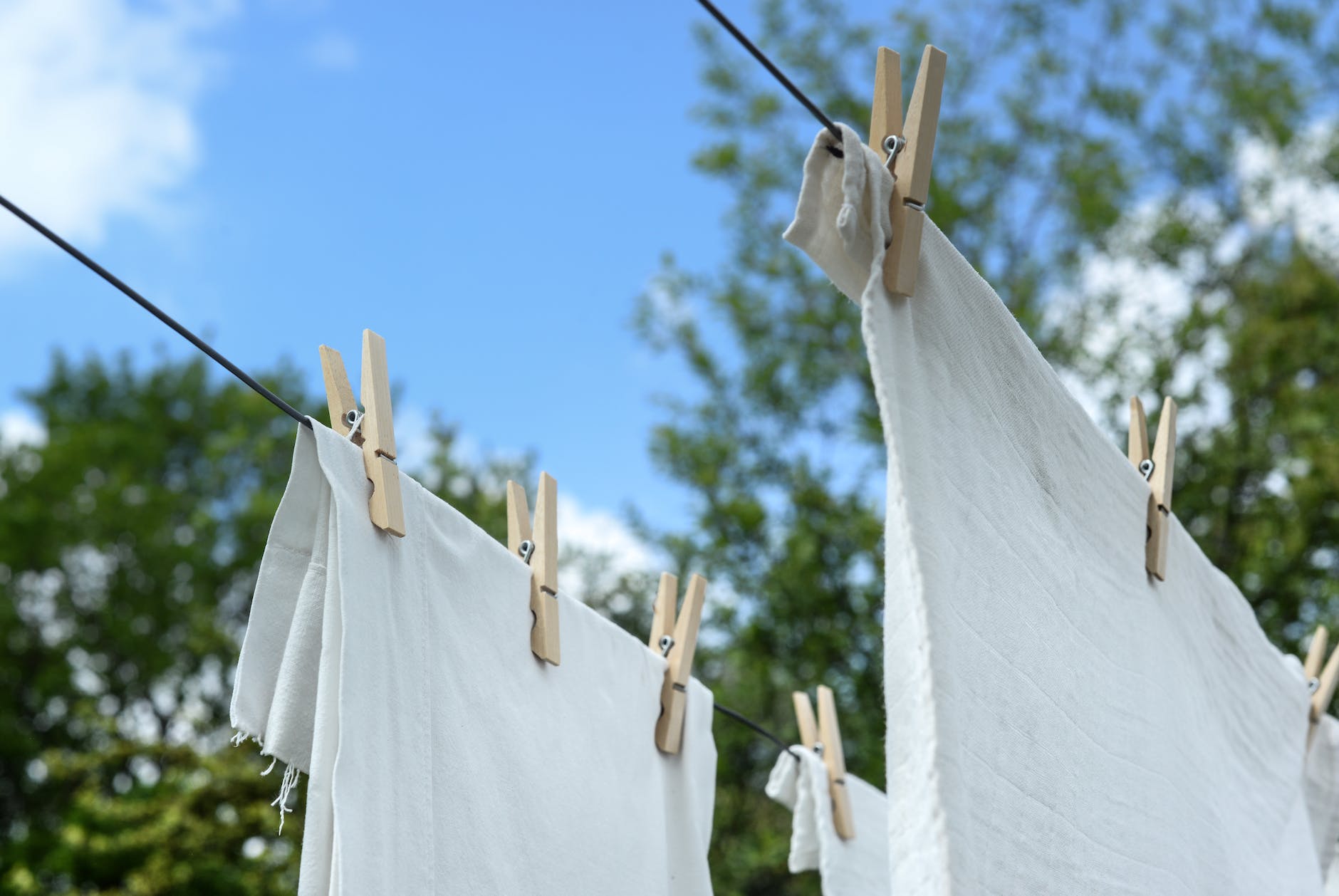
It was laundry day. So, this morning, Tom and I grabbed our pouch of wooden clothespins and walked five hundred steps or so to the landing behind our condo clubhouse.
For the next five minutes–shielding our eyes from the penetrating sun–we stood on the concrete there, hanging our just-washed, delicate shorts and shirts on the community clothesline to dry in the desert breeze.
Call me old fashioned. But I don’t mind doing this. In fact, I enjoy it. Especially as fall approaches and the air begins to cool.
More important, the plastic-coated clothesline connects my present life to my past. It represents the resiliency I’ve watched, absorbed, and carried forward.
It reminds me of the family members I’ve lost, but still love, and the survival instincts they instilled in me sixty years ago. What follows are excerpts from my book, Tales of a Rollercoaster Operator.
***
It was my second week of kindergarten, and I was just beginning to adjust to a new routine. On a warm and breezy mid-September afternoon in 1962–September 13 to be exact–I left my Mesnier School classroom and stepped aboard my regular bus for the trip home.
Within ten minutes, the driver arrived at the top of South Yorkshire Drive. She opened the door and several of us scampered down the stairs. I waved goodbye to a few remaining classmates still on board.
The driver closed the louvered door and pushed ahead. I meandered home. It was no more than a five-minute walk up our block and our driveway. Then, in an instant, a breathtaking late summer day transformed into an early fall for our family.
I saw my mother standing just beyond the backyard gate. She was wearing a sundress, lost in thought, uncoiling clean, damp towels and sheets from a laundry basket. Happy, our beagle-mixed hound, was out of reach too. He was sniffing the ground and frolicking miles away, it seemed, along the back fence.
“Your father’s had a heart attack.” Mom recited her words slowly and deliberately, like a woman treading deep water searching for a longer breath.
I didn’t comprehend what she had to say. But it couldn’t be good news, I thought as she plucked wooden clothespins from a pouch. She was working to keep her ragged emotions and the flapping sheets in check, preparing to clip wet linens to parallel plastic-encased clotheslines that stretched east and west across our yard.
Soon we walked into the house with our empty white-lattice basket, and I learned more. Dad had become ill on day two of his new job as a porter at McDonnell-Douglas. He was helping a coworker lift an airplane nosecone. Suddenly, he felt a sharp pain in his chest. He was rushed to Deaconess Hospital on Oakland Avenue near Forest Park. That’s where he would recuperate for the next month …
Each time we visited Dad, he was bedridden. I couldn’t comprehend what could keep my father lying in one location for so long–unable to toss horseshoes, fly kites, or drive us to parades or ballgames. But Dad insisted he would rebound.
Like the popular song from Bye Bye Birdie that played on the transistor radio near his bedside, Dad told me, “Son, I’ve Got a Lot of Living to Do.”
***
The next decade was difficult for our family. Watching Dad drift away physically and emotionally, filled me with anxiety. He never recovered fully, though the man who fought in World War II and the Battle of the Bulge soldiered on until his death in 1993.
Meanwhile, my mother kept our family afloat financially. She went back to work in March 1963 and did her best to balance life at home and in the office. When she died in 2013, she left behind a legacy of wisdom that I cherish and share.
Watching my parents toil produced a silver lining. Seeing them tread deep water for all those years gave me something I never imagined: the will to face my own personal challenges, standing tall as a proud gay man, and surviving my own heart attack on my sixtieth birthday.
Of course, it all began in the suburbs of St. Louis in September 1962. That sagging clothesline swayed. But it never snapped.
And, here in the Sonoran Desert in 2022, another clothesline sways 1,400 miles west.
What have I missed most over the past year? The spontaneous moments that spring from nowhere. And, let’s face it, going nowhere pretty much describes what we have all experienced from last March to this one.
But, like the daffodils of March which I imagine are aching to bloom again in Illinois, the feeling of going nowhere is turning into the possibility of going somewhere as flickers of normalcy return.
My cousin Phyllis, who lives in Missouri, texted me a fun Happy St. Patrick’s Day message yesterday afternoon. It always brightens my day to hear from Phyllis. Her mother and my father were twins. We share lots of fond, long-ago, St. Louis memories.
Over the past nearly-four years, Phyllis and I have stayed in touch (via text mostly) since Tom and I last saw her and her family in person in St. Louis. Strangely, I suffered a heart attack in St. Louis the day after we dined with my cousin and her family. Tom and I were on our way west to our new home in Scottsdale when our entire world turned upside down.
Anyway, the texts back and forth between Phyllis and me are bursts of positive energy: wellness check-ins; holiday greetings; news and photos of her adorable granddaughters; snippets of stories about our beloved St. Louis Cardinals; exchanges about the weather in the St. Louis area and Scottsdale; and anecdotes about the latest developments in my writing universe. But, over the past four years, we have rarely spoken on the phone.
Yesterday, after our latest text exchange began, I decided to change things up a bit. I needed more. I needed to hear Phyllis’ voice. So I called her. We shared stories of our recent vaccinations and our grown sons. We laughed a little. We also complained about the state of the world that worries us. Our conversation felt deeper and more complete than the text exchanges. I realized after the fact how much I’ve been missing these kinds of conversations.
As all of us have retreated during twelve months of a global pandemic for our own protection, perhaps we have retreated too much. Perhaps, though we live in a world where we have the ability to text each other, we have created too much social distance between us and those we love. After all, we are human beings. We are social creatures. Even if we can’t touch each other, we need to feel as if we can. Our voices are instruments for making that happen.
A second example of me trying to recapture some spontaneity in my life happened this morning. I drove to Eldorado Pool for my morning swim. The pool was rather busy, but I spotted my friend Frank. He offered to share his lane. I thanked him and jumped in.
Before March 2020, Frank is someone I saw two or three times a week at the pool. We always traded random stories. This usually consisted of our favorite Scottsdale restaurants or our past lives on different trajectories in the Chicago area. Frank and I frequently connected on the fly in the stream of life. It was never planned. If it were, I think it would have felt less human, less important.
Of course, when our world shrank in 2020, there were no Frank-and-Mark encounters. When the pool was closed and the winter weather lingered longer than expected, that passing-friendship aspect of my life evaporated. Now that the weather is warming up, I expect to see Frank more regularly. We will share more of our foodie stories, pounds we need to relinquish from our pandemic doldrums, and the burgeoning construction activity in south Scottsdale that is growing up around us.
Yes, the thousands of lives lost due to COVID-19 are the worst of all. But the little moments, which comprise the mosaic of our lives, have been missing for far too long.
While we continue to wear our masks and shout with joy at the realization that the pace of vaccinations is increasing rapidly, it’s time we paused, breathed deeply, and began to recapture the texture of our lives.


 Mark Johnson Stories