Tag: Nostalgia

The Gist of Past Augusts

Wagon_080214

Securing pink and white hollyhocks that sagged across suburban lawns.

Devouring fresh melons and spitting out seeds at barefoot picnics.

Chasing patrolling peacocks to capture feathers for the trip home.

Cornering grasshoppers that jumped and landed from nowhere.

Dodging dragonflies that flitted, then perched in shallow waters.

Tiptoeing back to school over fading July-to-September bridges.

Discovering an old empty wagon laden with summer memories.

Remembering Man’s First Lunar Landing

Apollo11Medal_July2019 001 (1000x946)

Like millions around the world, on July 20, 1969, I was glued to the Apollo 11 coverage. We strained to watch American astronauts Neil Armstrong and “Buzz” Aldrin become the first humans to land on the moon. It was nothing less than moonlight madness on CBS as my sister and I sat transfixed, cross-legged and sleepy-eyed in front of our grainy, black-and-white TV console.

We were all thirsty for every nuance of Walter Cronkite’s televised play-by-play, because it was a collective glorious moment for all Americans. Looking back, it was also strange redemption for the trauma we had endured less than six years before when — with a lump in his throat — Walter (the same trusted newsman) had the most painful task of all. To deliver the unfathomable news to a nation that John F. Kennedy had been assassinated. That our president with the lofty goal of landing a man on the moon would never see it realized.

When Christmas 1969 arrived, one of the presents under the tree from my mother and father was this Apollo 11/John F. Kennedy medal commemorating man’s first lunar landing. On the back it reads:

“I believe that this nation should commit itself to achieving the goal before this decade is out of landing a man on the moon and returning him safely to earth.”

John F. Kennedy, May 25, 1961

It may not surprise you to learn that at the time I received this gift, I was an unimpressed twelve year old. But fifty years later, it’s one of the items I treasure most from my parents. Not just for the sake of owning this beautiful and rare piece, designed by renowned sculptor Karen Worth.

But also because having the medal helps me to relive and cherish the memory of a remarkable moment in American history … when we reveled in a positive shared experience and were universally proud of our accomplishments as a nation.

Get Well Soon, Bob Gibson

TORO_Photo4 (1000x783)

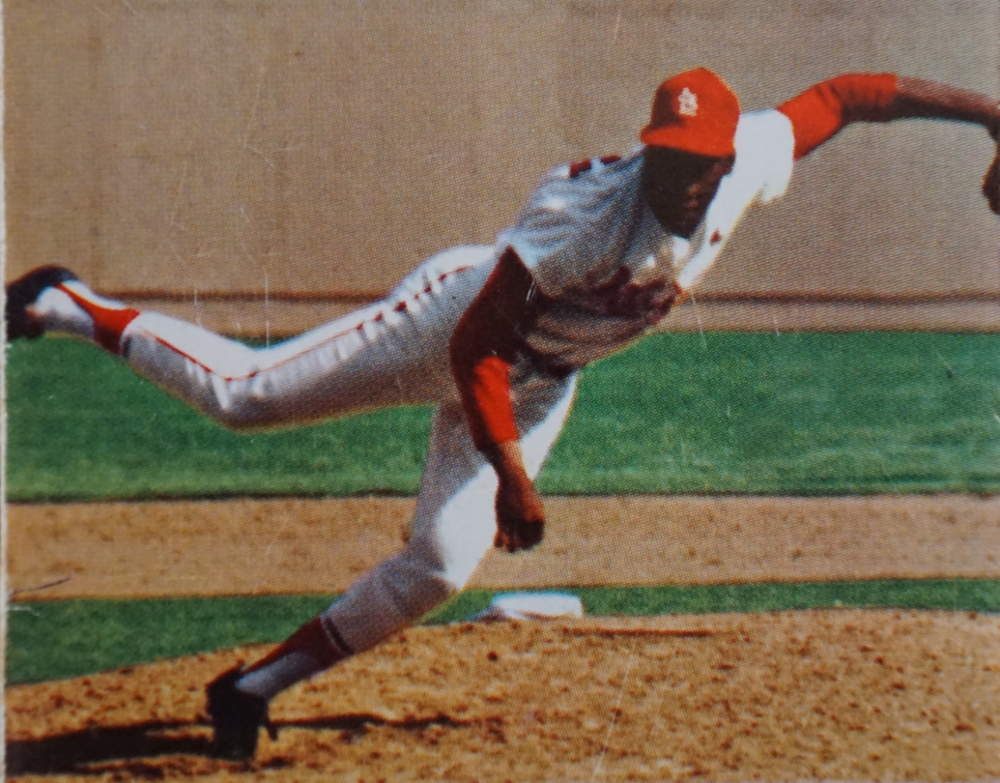
Over the weekend, the St. Louis Post-Dispatch reported Bob Gibson is battling pancreatic cancer. The flame-throwing, right-handed, Hall of Fame pitcher–who spent his entire seventeen-year career with the St. Louis Cardinals–is eighty-three years old. He is likely to begin chemotherapy this week. (This photo of the acrobatic and intimidating delivery of the Cardinals’ ace pitcher came from the cover of one of my 1960s scorecards.)

In 2017, as a tribute to the most dominant pitcher of the 1960s, I wrote and published the following story about “Gibby” and an historic, astounding moment my dad and I witnessed. The full piece, titled The Transistor Radio and the Crack of a Bat appears in Tales of a Rollercoaster Operator, a book of twenty-six true stories about my Missouri youth.

***

Many of my memories are forever embedded as sounds. Of course, there was “That’s one small step for man. One giant leap for mankind”–that profound yet tinny phrase Neil Armstrong uttered on July 20, 1969, when he became the first person to step on the surface of the moon. That sound and a few sketchy images broke through our black-and-white TV.

But two years before Armstrong’s historic moon walk, there was another sound that echoed through my childhood. This one emanated from my portable, pocket-sized transistor radio. It was July 15,1967. Bob Gibson was on the mound pitching for the St. Louis Cardinals that day at Busch Memorial Stadium. He was facing the Pittsburgh Pirates. Dad and I were sitting in the right field bleachers. I had my baseball mitt on my left hand and my transistor radio in its tattered leather case blaring away in my right …

Together Dad and I had the good fortune of watching Gibson pitch at least twenty different times in my childhood. I’ll bet he won seventeen or eighteen of those games. But on this particular hot summer day, all of us in attendance were in store for something stunning, unimaginable, and apparently catastrophic–and the transistor radio would play a big role in a shocking St. Louis moment that is forever sealed in my memory.

Roberto Clemente, the Pirates’ legendary right fielder, stepped to the plate to face Gibson. I remember the crack of Clemente’s bat, booming across the field and through my transistor radio. (Harry Caray and Jack Buck–arguably the best baseball broadcast team ever–provided the color commentary on KMOX Radio.) Clemente had smacked a line drive off Gibson’s leg, just above his ankle.

In spite of the warm temperature, the fans went stone-cold silent. The Cardinals’ trainer rushed to the mound to attend to the perennial all-star pitcher. After the trainer applied a freezing agent to the area, Gibby took a few soft tosses from the mound and then waved off the trainer. He was ready to resume pitching. A collective exhale filtered through the crowd and my transistor radio.

But the relief was short lived. After walking Willie Stargell and retiring Bill Mazeroski on a pop up, Gibson swung into his pitching motion and delivered a 3-2 pitch to Donn Clendenon. That’s when he collapsed in a heap on the mound.

A palpable hush blanketed the ballpark. It echoed and hung in the smoky bleacher air as vendors–suspended in slow motion–passed peanuts, beer, and hot dogs into waiting hands. Overriding the silence, the only sounds I can recall were the concerned voices of Buck and Caray cascading through my transistor and those of countless other fans muttering around their squawk boxes throughout the ballpark. After the Cardinals’ medical team removed Gibson from the field on a stretcher, we soon learned he had suffered a compound fracture. Caray and Buck told us through our transistor radios. It was devastating news.

As you would expect, Bob Gibson was sidelined for much of the year, but a young, unproven right-handed pitcher named Nelson Briles took his place in the rotation for the remainder of the regular season. Briles led the National League that year with a .737 win-loss percentage and a 14-5 record. His performance silenced the skeptics, who insisted the Cardinals wouldn’t recover from Gibson’s debilitating mid-season injury.

Remarkably, Gibson returned to the Cardinals in time to face Carl Yastrzemski and the Boston Red Sox in the 1967 World Series. According to the 20th Century Baseball Chronicle, “In the end, Gibson was clearly the difference, winning three complete games 2-1, 6-0, and 7-2 while striking out twenty-six and walking only five.” That included the deciding game 7.

Though Dad and I weren’t in the crowd to see any of the 1967 World Series games in St. Louis, we were there to hear the crack of Clemente’s bat reverberate throughout Busch Memorial Stadium. We witnessed an unlikely moment shared by two of major league baseball’s future Hall of Famers.

Ironically, four years later on August 14, 1971, Bob Gibson was on the mound against the Pirates again. This time the tables were turned. On this night, pitching at Three Rivers Stadium in Pittsburgh, Gibson achieved something that had escaped him previously. He recorded the only no-hitter of his illustrious career. I wasn’t in Pittsburgh that night to witness Gibson’s historic moment in person, but I listened intently from my bedroom in south suburban St. Louis. Propped up on my elbow, I heard exuberant Jack Buck exclaim, “Gibson’s thrown a no-hitter!” Best of all, I heard the man do it. I heard every pitch on my trusty transistor radio.

***

Ironic postscript: this evening–exactly fifty-two years since the Gibson-Clemente moment–the Cardinals and Pirates will renew their long-standing rivalry. It will the first of a three-game series at Busch Stadium (the Cardinals’ current home, which opened in downtown St. Louis in 2006).

In the off chance that Gibby reads this, there’s only one more thing to say. Get well soon, Bob Gibson. Just as I did in 1967, I’m rooting for your speedy recovery.


Heating Up and Cooling Off

TORO_Photo13 (1000x586)

Here in the Valley of the Sun, 100-degree temperatures have returned. This is not a revelation. Now that I’ve become a desert rat, I’ve learned to expect they’ll be with us for the next few months.

There’s no need to worry about me. I’ve adapted to living in the heat. Early morning walks and swims before the heat sets in. Daily and repeat applications of sunscreen. Plenty of water. Broad-brimmed hats. Pop-up monsoon storms. Biannual visits to the dermatologist. A few weekend getaways to the majestic mountains and fragrant pines of northern Arizona. A trusty sunshade to cover the dashboard of our car when its parked. These are the norm in the Sonoran Desert.

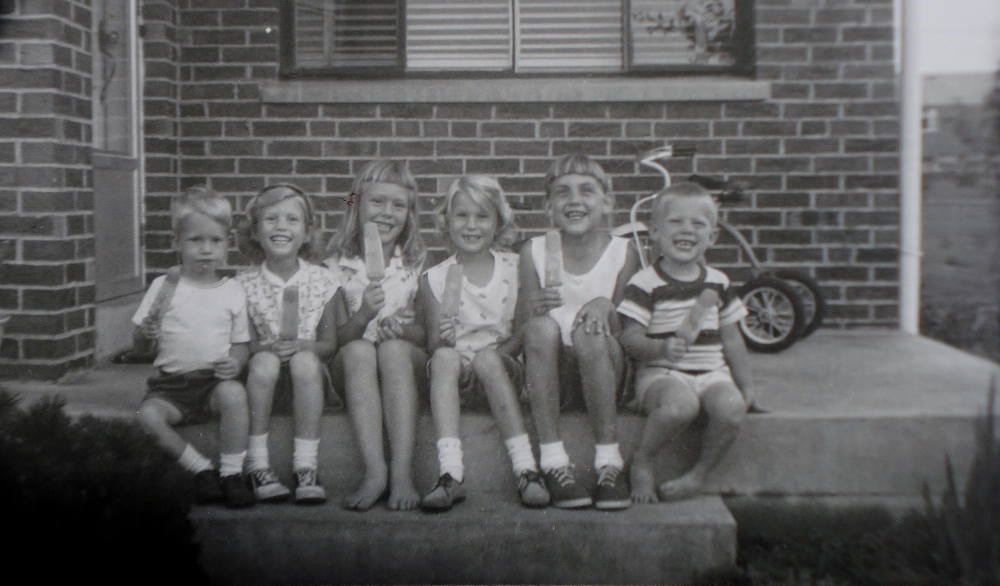
I find strange comfort in all of this, because the return of triple digits reminds me of the scorching summers that defined my suburban St. Louis childhood. This 1960 image always makes me smile. It features the neighborhood kids and me (on the far right) devouring popsicles on the front porch of my home. As a tribute to the blazing days of summer, I hope you’ll enjoy this cooling excerpt from Tales of a Rollercoaster Operator, my book of twenty-six, up-and-down stories about my Missouri youth.

***

The oppressive heat and humidity in St. Louis can wear you down. At times, it’s like carrying around a moist ten-pound cape on your shoulders. Or having your dental hygienist take x-rays and forget to remove the protective flak jacket before you leave the office.

One solution is a three-letter word: ice. In the 1960s, a Pevely Dairy truck driver would deliver milk and other dairy products to homes at the top of our street in the cul-de-sac. About a half dozen of us kids would scurry to catch the truck up the street screaming “ICE!” at the top of our lungs.

On occasion, the driver would pause and drop a big block of ice off the back of his truck onto the pulsating concrete, where it broke into smaller pieces. We’d grab a chunk and apply it to our skin as a soothing balm. We were in heaven.

Truth be told, the iceman didn’t cometh to deliver the goods that often, but he winked and dropped a block of ice into our path a few times each summer–just enough to give us hope that we could carry on the chase and renew the ritual.

The ice cream truck also visited our neighborhood. My sister and I begged our parents for change to buy an ice cream sandwich or dreamsicle from the Good Humor man. He even sold a “bomb pop” popsicle. It was red, white and blue and shaped like an actual bomb with a round top and fins coming out the sides.

Of course, in the Vietnam War era, we didn’t grasp the horror of buying a refreshing treat that was shaped like a weapon. We just knew it kept us cool.


Ode to the D-Day Generation

TORO_Photo19 (1000x938)

One hundred years ago,

You didn’t know what would happen in twenty-five.

You didn’t know what battles you’d fight or letters you’d write.

You only knew that school was out and the heat was rolling in.

You are gone now, but never far away in the stories we tell.

You live on the pages with your sepia-stained insights.

You will always be the ones who raised the flag high.

You will always be the ones we will never deny.

_____________________________________

Written by Mark Johnson on June 6, 2019

Photo of Violet, Thelma and Walter Johnson

1919 Bryan Hill Elementary School Picnic

St. Louis, Missouri


Twilight by the Pool


PolynesianParadisePool4_050215

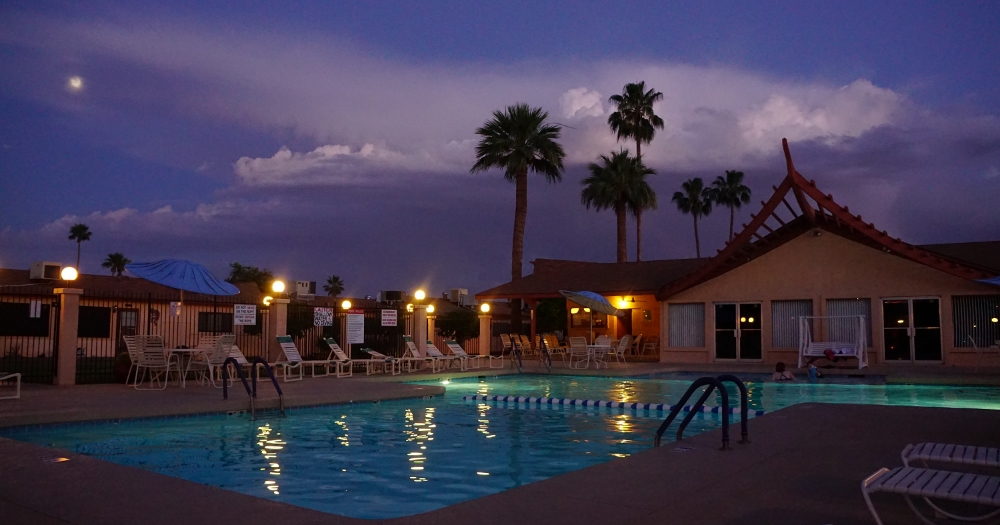
I’m fortunate to live in a charming, mid-century condo community in South Scottsdale with a gorgeous pool and rich history. Traditions and ripples run deep here at Polynesian Paradise. From memories of grandparents, close cousins, great aunts and uncles living under the slanted-and-peaked roofs of their Googie-style architecture.

Many early residents, Chicagoans with Italian heritage, discovered their desert hideaways in the 1960s and 70s. Others came from Wisconsin, Minnesota, South Dakota and Canada. They all traveled south or west to escape brutal winters and forge a new life in their twilight years.

During the day, Lucy (my husband’s soft-spoken grandmother) and her friends gathered by the pool to soak up the sun, unwind on a lounge chair, read a book under a kitschy umbrella, sip a cool drink or play cards in the clubhouse while their laundry flapped on the clothesline in the dry breeze.

At night, as palm trees painted sunsets over western skies, these westward-ho pilgrims dined on pasta and cannolis lovingly prepared by good-hearted neighbors like Sam (my husband’s grandfather). He spent his working years making cookies at the Nabisco factory back in Chicago and needed an outlet for his boundless energy. He found it in the condo clubhouse kitchen.

From January through April each year, as the rest of the world shivered on frosty Wednesday nights, the warmest stars aligned over the desert. Delighted residents and their guests shouted BINGO, collected their winnings, and sauntered home down sidewalks to their modest desert dwellings illuminated by porch lights.

Of course, Lucy and Sam are gone. So are most of their friends and neighbors. Like Connie and Sam who lived a few doors away. They were surrogate parents who coached us on the dos and don’ts of closing down our desert home when we were still fresh snowbirds straddling two worlds: one in Illinois; one in Arizona. Both of them died a few years ago, though their last name still hangs on a wall plaque outside what was once their door.

And Anita, another long-time resident, who passed away early in April. She was a familiar-and-friendly fixture at the pool. Tanning on her lounge chair with her extended, manicured nails. Listening contentedly to her favorite oldies on her transistor radio. Though I didn’t know her well, I miss her presence. I miss her connection to all the others.

Sadly, the soaring prow on the clubhouse façade is gone too. The condo association decided to remove it a few years ago, because the wood had begun to rot. It posed a safety concern for those walking beneath and the cost was too prohibitive to repair it.

Fortunately, though, all is not lost. Life goes on at Polynesian Paradise. With a fresh coat of exterior paint and a new generation of residents (grandsons and granddaughters, nieces and nephews, singles and couples) the community spirit lives on. There are still social gatherings in the clubhouse each month. Donut and hot dog days. Holiday parties. Yoga on occasional mornings. Bingo has moved from Wednesday to Tuesday nights when the snowbirds are in town.

Many in our community are over sixty, like my husband Tom and me. Living our twilight years in a pleasant condo community with an inviting pool. But there are a growing number of younger, full-time residents living here too. Infusing the community with new energy. Remodeling and updating their condos. Heading to work and school each day. Walking to their cars past cooing doves that nest under our eaves.

We’re all neighbors. Some of us enjoy a regular dip in the pool. Some of us don’t. But we’re all in the same boat. Finding our way in the world as new condo communities rise up around us in South Scottsdale. Doing what we can to live the best versions of our own lives in the Sonoran Desert. Just like the Sams, Lucys, Connies and Anitas who’ve come and gone before us.


Free Rollercoaster Rides Through April 8

TalesBookCover

In April 1974, I became a rollercoaster operator. It was my first job. I was sixteen years old.

Like most teenagers, I didn’t have a clue about life. But, more than four decades later, “driving” the River King Mine Train at Six Flags Over Mid-America near St. Louis became the creative catalyst for twenty-six, up-and-down stories from my Missouri childhood. I call them MOstalgic tales of American culture in the 1960s and 70s, when children had far more freedom to grow, play and run amok.

From April 5 through April 8, you can download a free Kindle copy of Tales of a Rollercoaster Operator on Amazon worldwide. It’s my way of celebrating the forty-fifth anniversary of my amusing amusement park experience and other vivid Baby Boomer recollections, including: discovering the joys of a first pet; loading up the car and heading to the drive-in theatre; embarking on a quest to wrangle World Series tickets with my dad; working at the top of the Gateway Arch; and witnessing the wonder in a brand new year after a chance encounter with a mysterious stranger.

Perhaps my stories will make you smile and light your desire to post a review online. But, at the very least, I hope they prompt you to remember a simpler time and the twists, turns and thrills from your own childhood. Wherever you were born. Wherever you grew up. Wherever you called home.