Tag: politics

Today and Tomorrow

Uncertainty exists in every day, in every life. I try not to dwell on it, but on this day–the 250th anniversary of the United States adopting our Declaration of Independence–uncertainty is our next-door neighbor.

I certainly remember our 200th anniversary, our bi-centennial celebration, in 1976. I was a bright-eyed, long-haired, eighteen-year-old, idealistic American.

Living in suburban St. Louis, I recall seeing the tall ships grace New York Harbor on our console TV on July 4, 1976.

That summer I worked at Six Flags Over Mid-America near St. Louis. As a tribute to the bicentennial, the Screamin’ Eagle rollercoaster roared across the sky. It was the newest, tallest, fastest ride in the park. Teens rode it again and again just for the thrill of it.

Even though the corruption of Watergate and the devastation of the Vietnam War were still fresh in the American psyche, in 1976 it felt like all Americans lived under and abided by one set of rules. That we aspired to one vision.

That the United States of America–the collective red, white and blue–was one nation and indivisible. A beacon of hope and freedom. That we believed, honored, and protected the notion of life, liberty, the pursuit of happiness, and justice. For all.

Over the past several years, like a rollercoaster that has jumped the tracks, we have been derailed by a malicious force. I don’t need to–or want to–speak their names. They have fostered twenty-four-hour-a-day uncertainty and anxiety in this nation I still love.

What I choose to celebrate today are the American citizens who still hold fast to the principle our nation was founded under: freedom and justice for all Americans, no matter your skin color, ethnicity, religious beliefs, sexual orientation, gender, social or economic status.

That is the memory of the United States of America I am proud of.

That is the country my father and thousands of other true patriots have bravely fought for and defended.

That is the country I knew and lived in yesterday.

That is the country I still dream of and worry over.

That is the country I cling to and pray for on July 4, 2026.

That is the country I want to live in today and tomorrow.
Hope Is Never Silent

Photo by RDNE Stock project on Pexels.com

Today–May 22–is Harvey Milk Day.

On what would have been his ninety-sixth birthday, I want to remind the world that Harvey Milk’s spirit of compassion, authenticity, equality, and hope still lives within each of us in the LGBTQ community … nearly fifty years after his assassination in November 1978.

In 1977, Harvey Milk was the first openly gay man to be elected to public office in California as a member of the San Francisco Board of Supervisors. Despite his short political career, he quickly became an icon in San Francisco and a galvanizing force and inspiration for the LGBTQ community for his unbridled commitment to civil rights.

We will never know what Harvey Milk might have said if he had lived to see the dream of national marriage equality become a reality in the United States in 2015 and now–eleven years later on the other end of the spectrum–to witness the rapid, daily decay of American democracy, American institutions, and American civil liberties.

But I’m a hopeful person and so was Harvey.

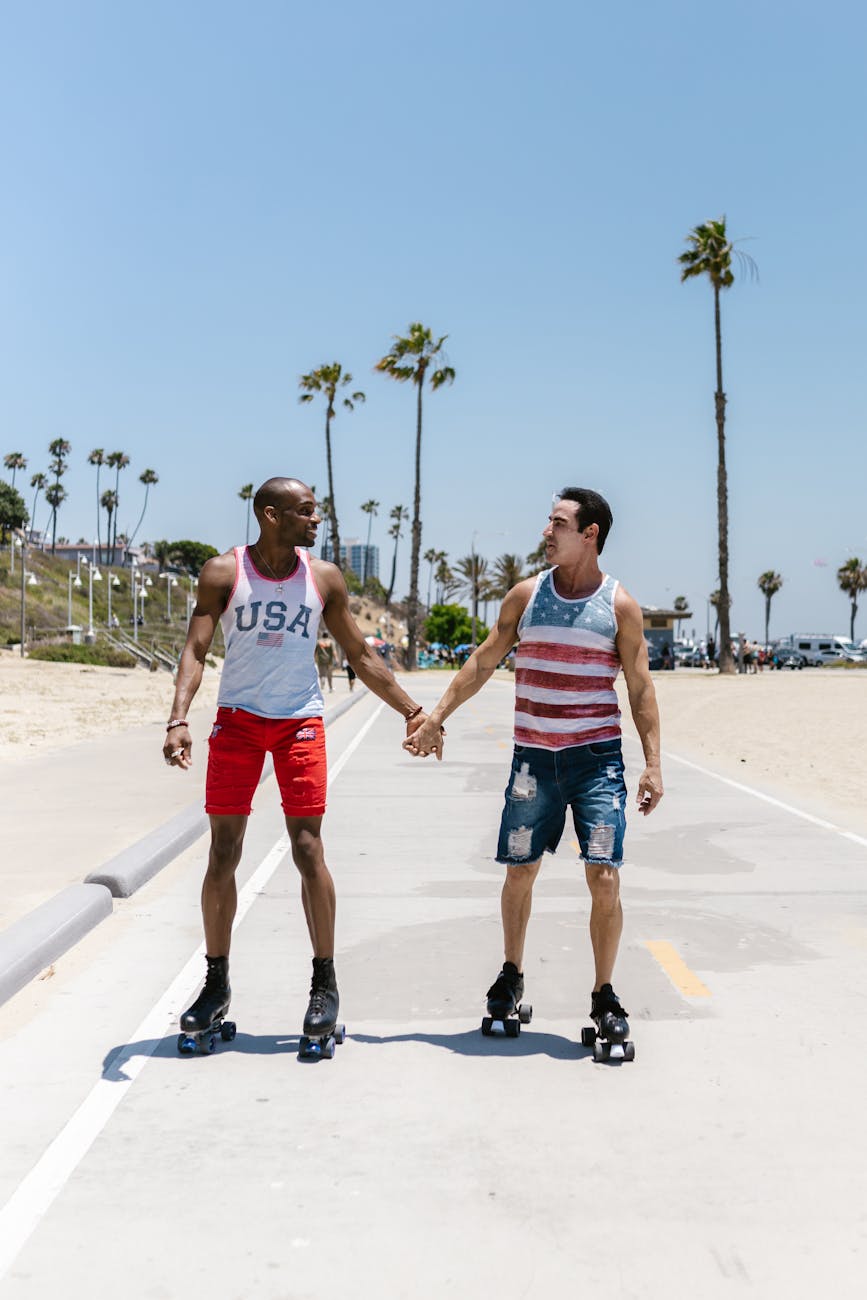
He believed “hope is never silent.” He also believed in visibility, whether it means two men holding hands while roller-skating under the palms or standing in protest … raising our voices in solidarity … and living openly on days that aren’t nearly as sunny.

In these frightening times, the impulse for some might be to take a step or two back into the closet. But Harvey would have encouraged all of us–gay and straight–to do the opposite. To step forward with conviction.

Take a moment to read some of Harvey’s encouraging words.

Harvey’s hope and memory is a salve for all of us–gay and straight–who believe in truth and decency.

Though Harvey is long gone, his legacy of authenticity and hope still lives.

***

“I know you can’t live on hope alone; but without hope, life is not worth living. So you, and you and you: you got to give them hope; you got to give them hope.” Harvey Milk

“Every gay person must come out. As difficult as it is, you must tell your immediate family. You must tell your relatives. You must tell your friends if indeed they are your friends. You must tell the people you work with. You must tell the people in the stores you shop in. Once they realize that we are indeed their children, that we are indeed everywhere, every myth, every lie, every innuendo will be destroyed once and for all. And once you do, you will feel so much better.” Harvey Milk

Laid to Rest

My mother was a collector of fine furniture, ceramic pitchers, and–occasionally–commemorative coins.

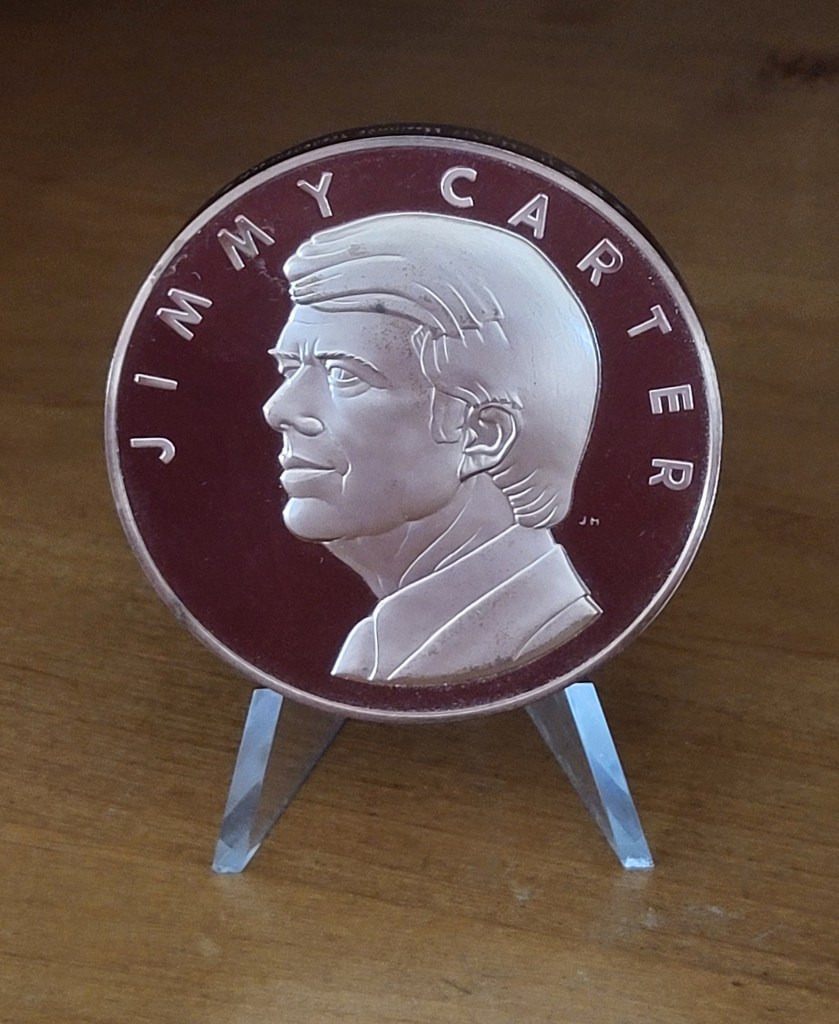
On March 17, 1977, she purchased this Franklin Mint medal. It celebrates the inauguration of Jimmy Carter, the thirty-ninth President of the United States.

This bronze coin has occupied a space inside a box in my father’s WWII army trunk for the past few decades.

I was nineteen and a first-time voter when I cast my ballot for Carter in November 1976.

Most of my college friends at the University of Missouri were Gerald Ford supporters.

I suppose they were willing to forgive him for pardoning Richard Nixon.

I wasn’t. I opted for Carter, the peanut farmer from Plains, Georgia.

As history would have it, Carter’s four years as president (1977 to 1981) included many ups and downs.

For instance, Carter successfully negotiated the Camp David Accords, political agreements signed by then Egyptian president Anwar Sadat and Israeli prime minister Menachem Begin.

Carter also signed into law bills that created the U.S. Department of Energy and Department of Education.

However, the Iran hostage crisis (when fifty-three U.S. diplomats and citizens were held hostage at the U.S. embassy in Tehran by a group of Iranian college students who supported the Iranian Revolution) and related oil crisis led to his unraveling popularity.

In November 1980, Ronald Reagan defeated Jimmy Carter. His loss was punctuated on January 20, 1981, when the hostages were released on the first day of Reagan’s presidency.

Of course, we now know Jimmy Carter wasn’t through yet. He lived another forty-three years and made good use of his century-long (1924-2024) life.

After leaving the White House–with his wife and life partner Rosalynn Carter ever by his side–he established the Carter Center. He worked tirelessly to promote and expand human rights.

That led him to receive the Nobel Peace Prize in 2002.

Jimmy and Rosalynn Carter also became famous for the houses they helped build for Habitat for Humanity and the faithful lives they shared with family and friends in their community and all around the world.

***

This morning, after watching C-SPAN coverage of Jimmy Carter’s funeral at the National Cathedral in Washington, D.C.–and listening to a parade of praise in eulogies given by past Republican and Democratic leaders and grieving family members–I extricated the bronze medallion.

I brought it into the light. I placed it on the shelf of our bureau in our Arizona sunroom. I pondered Jimmy Carter’s astounding legacy of faith, hope, service, and perseverance.

I wondered if–as he was laid to rest–our nation’s democracy might not be far behind.

I hate the trite phrase “only time will tell.” But it certainly applies as inauguration day–January 20, 2025–approaches.

Consider this. Tucked inside the box that normally houses the Carter medallion is a little booklet with information about the tradition of the presidential inaugural medals. Here is an excerpt:

“The Official 1977 Inaugural Medal commemorates the solemn ritual, repeated every four years, through which Americans and their President refresh the nation’s commitment to free government.

During the inauguration, the President, in the presence of Congress, pledges to serve faithfully and to uphold the Constitution to the best of his ability.

Americans have always treated this ceremony as a portentous moment in the life of the republic, a time of celebration and of renewed dedication.”

But we live in 2025. Will the incoming president uphold the Constitution to the best of his ability?

That bit of history–beyond the funereal pageantry of today–has yet to be written.

What I’ve Learned, What I’ve Earned

It’s a rainy, blustery afternoon in Scottsdale, Arizona. Windbreaker weather.

Nothing like the norm. Nothing like this photo I captured two days ago as Tom and I made our way around Chaparral Park.

But measurable rain is welcome here, and–if the weather forecasters are right–more is in the offing this week with heavy snow in Arizona’s higher elevations north and east of us.

Now that I’ve lived here nearly seven years (that anniversary arrives in July), I’ve learned that we will have plenty of blistering hot days between June and September.

So, I will embrace this cool, short-term, winter-in-Arizona anomaly. Maybe it will help build our reserves in the Colorado River basin.

As the raindrops fall, Tom and I celebrate a personal milestone. Today–February 6, 2024–we reached our full retirement age (FRA)–66 years and 7 months for those born in 1957–as defined by Social Security.

Basically, that means we are eligible to receive 100 percent of our Social Security retirement benefits–benefits we each accrued by paying into the system and working all those years, commuting to and from an array of jobs on mostly cloudy, windy and often-snowy Chicago days.

If you are unfamiliar with the U.S. Social Security Administration regulations, the Social Security Act was signed by President Franklin Delano Roosevelt in 1935.

The idea then–and still today, fortunately, though the program is under scrutiny–is that a small portion of Person A’s wages goes toward helping to support senior citizens with a financial lifeline.

Then, when Person A reaches senior status, he or she has earned the right to Social Security retirement benefits. As the rules exist today, those who log at least 40 quarters (the equivalent of 10 years) in the United States workforce are entitled to some sort of retirement benefit.

Those eligible can start taking their benefit as early as age 62 (but receive only about 70 percent of their benefit) or as late as age 70 (and receive more than 100 percent).

Of course, this is a decision laced with all sorts of permutations and “what ifs.” None of us knows how long we will live. But I opted to begin drawing on my accrued benefits–what I earned during all those years–now.

Looking way back in time … when I was in my twenties and thirties … I hoped this day would come. But I was never sure I could rely on it.

So, I did my best along the way to save in other ways to protect myself. It was an awareness that came from my hard-working father and mother, who lived through the Great Depression. They probably cheered when the measure became law.

With time, I imagine the Social Security Administration will need to push the FRA to age 70, because of our aging population–and the sheer number of us Baby Boomers who will receive payouts and deplete the reserves.

But I hope younger Americans in the workforce one day also will realize the same sort of accrued retirement benefit.

Certainly, like me, they will have earned it and will deserve it.