Tag: retirement

While We Are Away

Tom and I are heading to Chicago to celebrate two family milestones:

Kirk’s and Jen’s (my son and future daughter-in-law) engagement and Sharon’s (my sister-in-law) retirement from teaching.

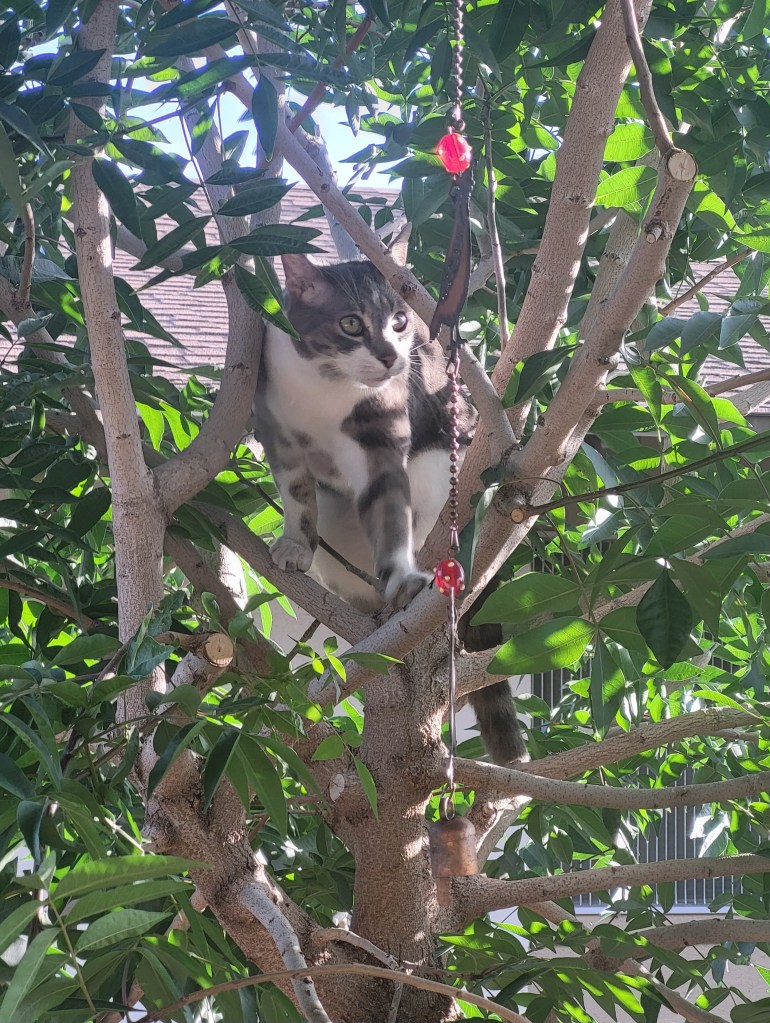
While we are away, Poly is sure to keep an eye on things.

See you in June with more stories.

What I’ve Learned, What I’ve Earned

It’s a rainy, blustery afternoon in Scottsdale, Arizona. Windbreaker weather.

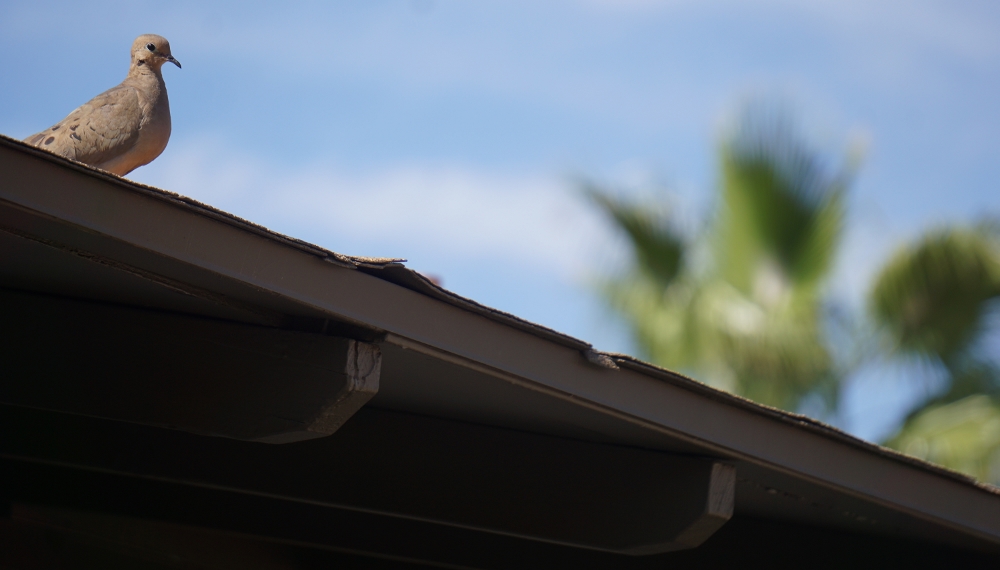
Nothing like the norm. Nothing like this photo I captured two days ago as Tom and I made our way around Chaparral Park.

But measurable rain is welcome here, and–if the weather forecasters are right–more is in the offing this week with heavy snow in Arizona’s higher elevations north and east of us.

Now that I’ve lived here nearly seven years (that anniversary arrives in July), I’ve learned that we will have plenty of blistering hot days between June and September.

So, I will embrace this cool, short-term, winter-in-Arizona anomaly. Maybe it will help build our reserves in the Colorado River basin.

As the raindrops fall, Tom and I celebrate a personal milestone. Today–February 6, 2024–we reached our full retirement age (FRA)–66 years and 7 months for those born in 1957–as defined by Social Security.

Basically, that means we are eligible to receive 100 percent of our Social Security retirement benefits–benefits we each accrued by paying into the system and working all those years, commuting to and from an array of jobs on mostly cloudy, windy and often-snowy Chicago days.

If you are unfamiliar with the U.S. Social Security Administration regulations, the Social Security Act was signed by President Franklin Delano Roosevelt in 1935.

The idea then–and still today, fortunately, though the program is under scrutiny–is that a small portion of Person A’s wages goes toward helping to support senior citizens with a financial lifeline.

Then, when Person A reaches senior status, he or she has earned the right to Social Security retirement benefits. As the rules exist today, those who log at least 40 quarters (the equivalent of 10 years) in the United States workforce are entitled to some sort of retirement benefit.

Those eligible can start taking their benefit as early as age 62 (but receive only about 70 percent of their benefit) or as late as age 70 (and receive more than 100 percent).

Of course, this is a decision laced with all sorts of permutations and “what ifs.” None of us knows how long we will live. But I opted to begin drawing on my accrued benefits–what I earned during all those years–now.

Looking way back in time … when I was in my twenties and thirties … I hoped this day would come. But I was never sure I could rely on it.

So, I did my best along the way to save in other ways to protect myself. It was an awareness that came from my hard-working father and mother, who lived through the Great Depression. They probably cheered when the measure became law.

With time, I imagine the Social Security Administration will need to push the FRA to age 70, because of our aging population–and the sheer number of us Baby Boomers who will receive payouts and deplete the reserves.

But I hope younger Americans in the workforce one day also will realize the same sort of accrued retirement benefit.

Certainly, like me, they will have earned it and will deserve it.

Labor of Love

My parents labored through much of their forty-five years of marriage. In that sense, it is fitting that their wedding anniversary–September 4–often coincides with Labor Day, as it does this year.

Despite their differences, struggles, and heartaches, by the late 1980s Mom and Dad seemed more content whenever I drove from Chicago to visit them in St. Louis.

Mom had retired from her stressful government job. She spent more time in her beloved garden. Dad’s mental illness had quieted. He found solace, reading his Daily Word in their wing-backed chair.

Ironically, this more even footing in their relationship appeared as their physical frailties–and risk of falling–became more obvious.

They went to church together. They cultivated deeper friendships with neighbors. They dined regularly at nearby Grone’s Cafeteria. Life was much simpler.

Comparatively, Tom and I are far more active in our “retirement” than my parents ever were. But we have discovered a similar contentment. There are fewer demands on us. We spend more time on the things we enjoy with the people–friends and family–who mean the most to us.

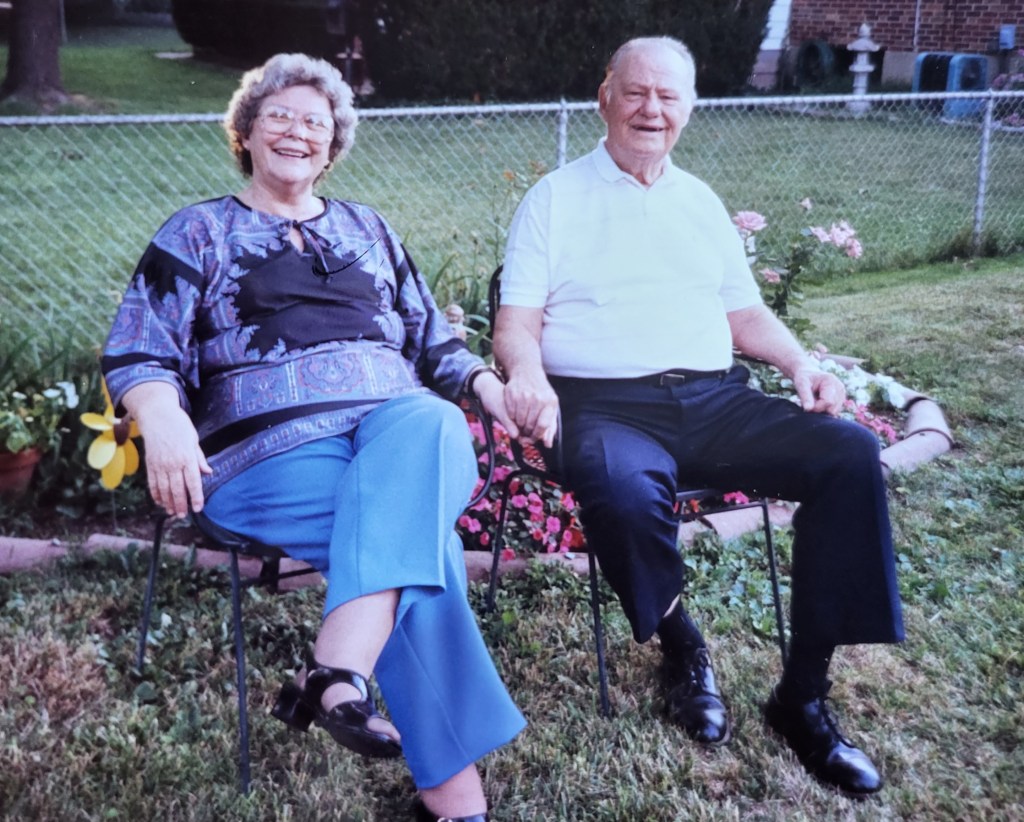
Today–on what would have been Helen and Walter Johnson’s 75th wedding anniversary–the two people holding hands in this photo are the ones I choose to remember.

But, even during the troubles and heavy lifting of their younger years, I’m grateful for the many things they taught me. How to respect the elderly. How to save for a rainy day. How to be kind to neighbors and care for animals. How to put people before material things. How to be a loyal friend. How to work hard and earn my keep. How to show compassion.

Most important of all, how to love my family, warts and all.

Certainly, by watching Helen and Walter struggle, I learned lessons about how to endure in a world that can often feel unendurable. That may feel like a strange way to pay tribute to my parents on their diamond wedding anniversary. But it’s honest and true.

Though Dad has been gone thirty years and Mom ten, the love I feel for them endures.

In the summer of 1988, Helen and Walter Johnson enjoyed their suburban St. Louis backyard. Mom was 65; Dad was 74.

Wood, Bark, Leaves, and …

Losses and stories come in many forms. This one is best told by my husband Tom, today’s guest blogger.

***

Ode to a Fig Tree

by Tom Samp

When my grandparents moved in 1972 to the Scottsdale condo where Mark and I now live, my grandfather planted a fig tree.

This tree grew and flourished. It was unique and magnificent. It produced sweet purple figs every summer.

There was never a time when this tree wasn’t a part of the condo, and of my memories of my grandparents and parents. The tree became a part of the lore of our condo complex.

Last Friday, a victim of the carpenter bees that nested and chewed slowly through the bark and the wood inside, the tree had literally cracked in half and fell bent to the ground.

The sadness was immediate and deep.

But why feel this way for a tree? It’s only wood, bark, leaves, and, in the summer, sweet purple fruit.

My mourning certainly could not compare to that felt by our friend and neighbor Aggie, whose husband Bill, also our friend, passed away during the week.

Still, it was the sentimental images and feelings I attached to the fig tree that made its death so emotional for me.

It was a part of our home that I almost took for granted. A splash of green we saw when we opened our blinds every morning.

A place for the small birds–sparrows, finches, lovebirds–to wait their turn at the bird feeder we hung right outside our window.

The shady spot where our neighbors Pat and Gary placed their lawn chairs to read or relax; and where Gary took his last breath on Good Friday, 2021.

A topic of awed comment and conversation from friends and passers-by.

An ingredient in the fig jam that our neighbor Jeannie made for us.

The February morning every year, after the leaves all fell for the winter, when Mark and I trimmed the branches way back.

The excitement each April when we saw the tiniest green buds, signifying that the tree had survived, and would again thrive.

A final remnant from my grandparent’s lives, when they pioneered to Scottsdale from Chicago in retirement.

On Saturday, after the condo landscaping crew kindly and efficiently chopped the broken tree and carried away the pieces, Mark created a container garden in its place, filled with colorful flowerpots which held desert plants and cactus.

It will be an adjustment. Maybe we will plant another tree in the fall. In the meantime, the memories will always linger.

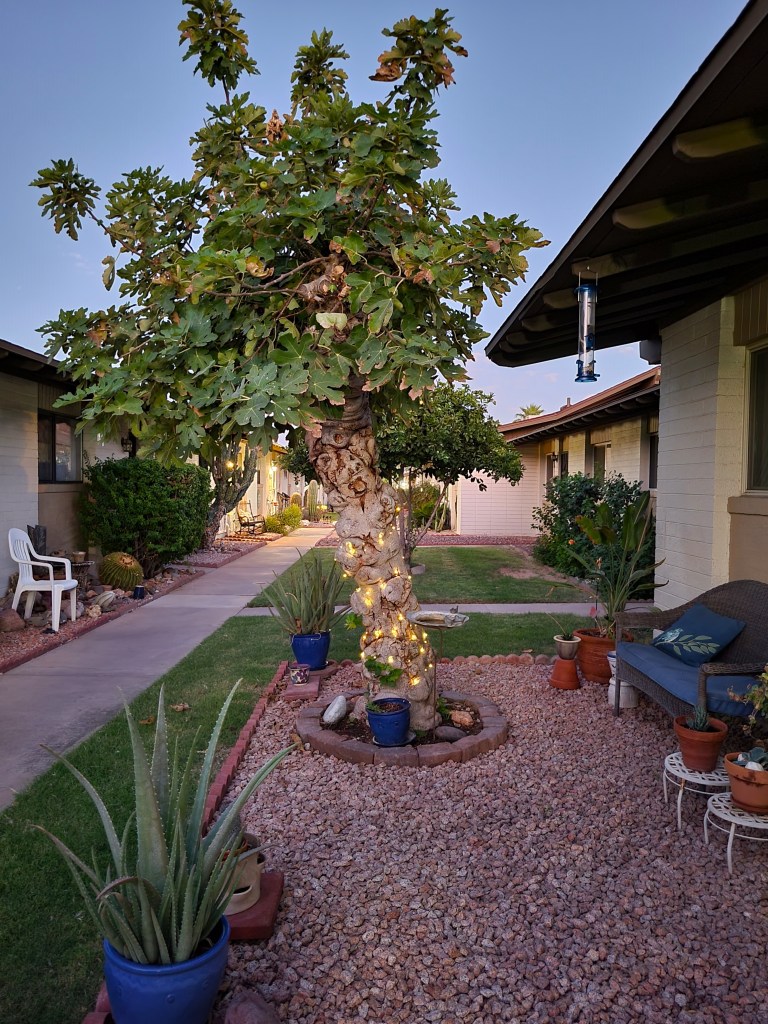
I captured our glorious, gnarled, and storied fig tree just before dusk during the summer of 2022.

Late Bloomer

It’s March. The Christmas cactus adorning our den is definitely a late bloomer–and so am I. I turned 65 in July, but that number hasn’t deterred me from continuing to write, sing, and create.

When I close my eyes, I can still channel 18-year-old unaware me. Tall and thin with long straight blond hair in 1975. Seated in an uncomfortable wooden fold-down chair. Legs crossed in Middlebush Hall on the University of Missouri campus in Columbia.

I was an aspiring journalism major. One of a few hundred freshmen and freshwomen taking a required business course. Bleary-eyed from guzzling too much beer and demolishing late-night Shakespeare’s Pizza, we listened to our Marketing 101 professor.

He waxed on about demographics and American consumption. We doodled in our spiral notebooks.

What I remember most is that he told us the range of consumption occurred between the ages of 18 and 65. That’s when Americans had the most disposable income to spend.

The implication was that life, purpose, and relevance stopped after that. After retirement. After 65.

Of course, these days, life expectancy–for those who live to be 65–is more promising. But nothing is guaranteed.

At any age, “seize the day” is a smart strategy. Especially in your later years when (at times) it feels like you are riding in a runaway wagon racing downhill. Even if on most days you are enjoying the freedom and wisdom that comes with age as the wind rushes through your greying hair.

All of this is preamble to tell you that I am on the cusp of publishing my 5th book. It will be a collection of my best poems. Many of them explore love, loss, identity, discovery, disorientation, transformation, realization, and acceptance–spun through the ever-present influences of time and nature.

I began writing poetry in 1993. I was newly divorced, raising my boys as a single dad, working long hours as a communication consultant for Towers Perrin in Chicago, dashing for commuter trains, grieving the loss of my father, and beginning to understand myself and my emerging gay identity.

I have written dozens of poems over the past 30 years. Stashed them in an ever-expanding Word file. (If you follow me, you know I have shared some of them here over the past four years. The act of doing that has fed the poetry beast inside me. He’s now ready to emerge.)

Yes, at age 65 it thrills me to defy the logic of my marketing professor. To assemble my poetry and share it publicly–all in one place–for anyone who chooses to consume it.

Stay tuned!

The Past Eight Years

Eight years ago this month, I left my communication consulting job at Aon Hewitt. Technically, I retired in January 2014, though I’ve hardly dropped off the face of the earth since then. I’ve simply escaped to the desert.

It feels strange for me to admit this: some details of my thirty-four-year communication career in Chicago–especially the most daunting moments with impossible clients–have faded. What I remember most are the creative accomplishments and closest colleagues.

Ironically, while our country has moved into a period of darkness and upheaval during the past eight years, I’ve transformed my life into one that more closely resembles who I am and what I value.

I’ve gotten married, moved cross country, survived a heart attack, dropped about forty pounds, found a new home with my husband, nurtured the artist inside, written four books and nearly 300 blog entries, coached both of my sons as they’ve navigated life and career changes, made a bunch of new friends in a warm climate, and evolved into a more contented person.

In that sense, trading my corporate life for that of an emerging, independent writer has felt more like shedding the weight of a familiar suit of armor to discover a more light-hearted, personal, and sometimes vulnerable existence underneath.

To mark the anniversary of my retirement–and subsequent literary emergence–I’m discounting the paperback version of my latest book, I Think I’ll Prune the Lemon Tree, on Amazon during the month of January.

Hopefully, this will be just the incentive you need to devote a little more time to reading in the new year.

Rich-People Problems

October is renovation month in our household. We’re remodeling our Sonoran bathroom: installing a walk-in shower to replace our clunky-and-outdated shower/tub combo; raising our ridiculously low ceiling; putting in a new toilet; upgrading the sink, vanity and mirror; laying mosaic tile to accent existing porcelain squares; wiring and connecting contemporary lighting; the works. It will be beautiful when everything is done next week.

The guy Tom and I hired to install and update everything is skilled and thorough, it’s just that the project is taking longer than expected–longer than it should in our book for a variety of reasons I won’t belabor here.

Suffice it to say, that each morning when our remodeling guy arrives we discuss the work ahead with him and what we expect to be completed that day.

This morning, I escaped the mayhem of our modest and ordinarily quiet condo for a few hours. I needed a swim away from our immediate community. (Tom and I are taking turns doing this to keep our sanity.)

Enter Frank. He’s a friend I see at Eldorado Pool (two miles from our home) on occasion. Whenever I see Frank, we have topical and lively conversations … about the state of the world, our past lives in the Midwest, the plight of our favorite sports teams, his job as a nurse in the behavioral health wing of a nearby hospital, my life as a writer. Frank has read at least one of my books.

As I changed into my swim trunks in the locker room this morning, Frank asked “What’s new with you guys?”

“We’re trying to survive our bathroom remodeling project,” I sighed.

“Rich-people problems.” He responded matter-of-factly as he fumbled with the contents of his locker.

What happened next surprised me. I laughed so hard, more loudly than I have in a long time. Why? I suppose it was some sort of release. Also, I realized in a flash that Frank gave me the reality check and perspective I needed.

People are dying of Covid. Others are struggling financially and/or dealing with the untenable and unreasonable demands of work, child-rearing, and elder care in a crazy and politically polarized society.

Through that lens, my life at sixty-four is relatively steady, simple, and manageable … notwithstanding an annoying remodeling project that would fluster you too if you were standing next to me gazing into the disarray of our condo.

Back to Frank. Let me be clear. His “rich-people problems” comment wasn’t referring to my financial status (we live comfortably, but aren’t wealthy), trivializing my concerns about the bathroom inconveniences that Tom and I are living through, forgetting the past challenges we have faced as a same-sex couple who survived a heart attack on the way west, or discounting the numerous other losses and heartaches we have endured.

The nut of this story is this: today Frank crossed my path to remind me I am a “rich” person with a “rich” life … a loving husband, two adult sons who enjoy spending time with their dad, and a “golden” (Frank’s word, not mine) life living in Scottsdale, Arizona in our retirement years.

Yep … “rich-people problems” sums it up nicely. Thank you, my friend, for being so authentic. For being so Frank.

The Golden Hour

GoldenHour_June2020

Between 2004 and 2009, Helen stood patiently on her third-floor condo balcony and waited for the fleeting color to appear near the end of each day.

Her inanimate accomplice was one of those disposal Kodak cameras from Walgreens. It soothed her shutterbug sensibility.

Nature photography was the perfect hobby for a woman in her eighties, who loved art and the clockwork of the calendar and the seasons.

Earlier in her life, she worked too hard to find the time to anticipate and ponder the legacy of sparkling sunsets.

But, as the remaining rays in my mother’s life flickered on the northeastern Illinois horizon, she found comfort in the hues that came and went.

Like a National Geographic photographer on assignment, she felt it was her duty to capture the most vivid color of each passing day.

***

Whenever Tom and I walk west after dinner toward the Papago Park buttes, I feel Helen’s anticipation … how she might have felt if she’d seen the Sonoran sunsets of our sixties.

During the last few years of her life she asked, “Do you think you and Tom will retire in Arizona?”

It gave her comfort to know we might fall in love with the western sky.

After the heavy lifting of our responsibilities was through, she could imagine our stunning sunsets … the colors, lights and textures.

She could dream of the golden hour after she was gone.


Splash

Splash_050320 (2)

It’s a long story, but true. For much of my professional life, I became a master of jumping ship. Making a quick splash in a promising job. Then, when it didn’t work out, finding and throwing myself a life-preserver that would rescue me until I could paddle to the next station in life.

Four months selling newspaper ad space in Jackson, Mississippi in 1980. That was a disaster. Four years writing mundane retail ad copy for Sears in Chicago. The friends I made there–Janet, in particular (our Sears years began on the same day)–kept me afloat.

Fifteen months with a small ad agency in Oak Brook, Illinois. Eighteen months crafting copy and PR strategies in starched shirts and suits for the high-powered Hill & Knowlton just off of Michigan Avenue. Six months with Weiser Group on the other side of town. Then, another deep breath before going back under water.

***

When I reemerged in 1988, I was holding onto another life preserver at Covia as a PR writer. This time I stayed for five years of creative moments peppered with senior executive hostility. The silver lining? Another lasting friendship–thank you, Mary Jane–and a few agonizing business trips to Tucson, Arizona. Dusty foreshadowing for a desert life … not a vanishing mirage … that would appear on the horizon three decades later without corporate shackles.

In 1993, I began a three-and-a-half year sprint underwater as a communication consultant for Towers Perrin in the Loop. That was followed by my first attempt as a freelance communication consultant. Sandwiched in between? Eighteen months as a communication manager for Ameritech and another authentic friendship–thank you, Bill–before diving into a misguided pool of piranhas at PricewaterhouseCoopers. That debacle of disarray lasted ten months.

On to February 2001. I tried my hand again as a freelance writer and training facilitator again. Things were going swimmingly until September 11. My business dried up over the next several months, but somehow I was able to tread water in the deep end.

***

In August of 2002, I resurfaced in Schaumburg, Illinois, as Director of HR Communication for Zurich North America, the Swiss-based insurance firm. The pay was good. While working there, I met another lifelong friend, Jillian (years later, Tom and I would ask her to be the officiant at our wedding). Still I felt like a fish out of water.

In spite of being “out” in various corners of my life, I was gaining weight and floundering personally at Zurich, another conservative company. Yes, I was going through the motions for all the right reasons. Making money to pay child support and contribute to Nick’s and Kirk’s college educations. But, at the end of each day, the feeling was the same. I was an outsider living in a straight world.

I realize now I wasn’t escaping jobs simply because I found them boring or overly taxing. I was casting myself into unchartered waters, because the stifling world of work and its many layers of homophobia–in addition to my own inability at that time to love my gay self–threatened my closeted existence. Think of it as a kind of toxic cocktail consumed for decades. A mix of liquid resiliency stirred by intense anxiety and a fear of entrapment.

***

In early 2006, I left Zurich. Something new happened for me, a gay man ordinarily adrift in choppy corporate waters.

In February or March, a search firm called with an enticing possibility. Hewitt Associates, a multi-national human resources firm, was angling for seasoned consultants to join their communication practice in Lincolnshire, Illinois.  I decided to turn the page and pursue a new gig.

Hewitt’s hiring process was rigorous. A few rounds of intense interviews. Thorough discussions with six or eight senior executives and consultants I would be working with. Strangely, I remember feeling entirely at ease. Perhaps it was because I had decided I would “out” myself at the start and ask a burning question: “Can a gay man like me be successful working here?”

I could tell Lori, the practice leader, was surprised by my forthrightness. But she didn’t hesitate. She and Robyn, my future boss, insisted I could make a lasting go of it. So, in early April, I left Zurich and found myself unpacking my belongings in my Hewitt office. On Day One, I placed pictures of all the men in my life … my partner Tom, my sons Nick and Kirk … on my desk next to that of Maggie, our sweet basset hound.

Hewitt had the reputation as an industry leader with high standards for excellence and integrity. Along the way, I learned from my new colleagues that earlier in its history, when the company was privately held, the organization famously insisted upon sending its consultants to “charm school” to ensure uniformity in technique and approach. So, clearly this wasn’t the free-wheeling atmosphere you might expect I needed to find my stride.

Even so, from the start, I never veered from my true story. Quickly, my mates treated me with respect. I earned their confidence as a friendly, no-nonsense, collaborative colleague … forever at home brainstorming themes, concepts and brands in the comfy confines and chairs of the Creative Zone.

In those days, to encourage longevity with the organization, Hewitt offered a retention incentive called Splash. Essentially, for every five years you worked for the company, you would receive one week of paid Splash … a mini-sabbatical away from the bumps and grinds of a busy professional life … in addition to any regular accrued vacation time.

This program–along with the company’s ingrained culture of personal closeness and trust–produced dozens of long-service employees. Folks who worked hard and played hard together … many of them for twenty years or more.

The first few years passed quickly for me at Hewitt. I worked long hours for clients, who demanded excellence and timely turnaround. I mentored a few younger associates along the way. In 2008, I moved with three colleagues into the Chicago office to help build the communication practice in the Loop. Over the next several years, Robyn, Dina, Kim–three more lifelong friends–and I celebrated project successes. We endured a few failures, too. But they were good years. Obama was president and I was a happier man at Hewitt.

One morning, in July 2010, we all received a startling email. Aon Corporation, the global insurance and consulting firm, was buying Hewitt. In short order, vestiges of the old Hewitt culture … the constant collegiality, the “I’ve-got-your-back” spirit of oneness, the splendid Splash program … all vanished. Fortunately though, most of the relationships with friends there didn’t.

I logged billable hours for another three-and-a-half years as an employee of Aon Hewitt, before leaving in late January 2014 … worn from all the heavy lifting and my mother’s long, slow decline and death the year before. Little did I know I’d soon be resuming my professional life on my terms. I’d be writing my own, unvarnished personal stories. Soon From Fertile Ground fell out of my brain and landed on the page.

Since moving on, I’ve stayed in touch with many of my Hewitt friends on line. I still feel their love and encouragement. We root for each other from afar. Here in the desert, I’ve kept a box of cards they gave me when I retired. Each one reminds me of my eight Hewitt years–perhaps my best corporate chapter of all–before I dived headfirst into this literary life with enough money for Tom and me to live simply. But without having to ever again define myself by the salary I once earned.

As you’ve probably guessed, I never realized the benefits of Hewitt’s Splash. By the time I celebrated my five-year anniversary, Aon had dismantled the program. But, as karma would dictate, I’ve created my own version of Splash with Tom in Arizona. An open schedule. The unearthing of three books and an ever-evolving blog. A sandy sabbatical seasoned with swims.

For the last month or so, there haven’t been any opportunities to jump in the water and plunge ahead into the blue unknown. Like most of the world, our pools have been closed due to the global pandemic.

But on May 1, our community watering hole reopened under tight regulations. Only lap swimming is allowed. Most of the snow birds have flown home, so that’s a reasonable solution for Scottsdale, Arizona. There are fewer people to steer clear of here in the spring and summer months, because triple digits at 3 p.m. have become the norm.

For each of the past three mornings, I’ve submerged myself feet first, back in the water before 8 a.m. The air temperature is perfect at that hour … seventy or seventy-five degrees … and the water is refreshing. Just right for getting my stroke and fueling my energy for this story, which appears exactly two years since I began my blogging journey.

Fifteen or twenty minutes each morning is all it takes for me to feel free again, gliding through the water. Thirty laps of swimming from one side of the pool to the other. Then I dry off and come back inside to write my stories and share the companionship of my loving husband in the quiet of the Sonoran Desert.

That’s really all I need to make a splash.


My Slargando World

BirdsFlowers_April2019 004 (1000x570)

April ushers in a slower pace in Arizona. Following the departure of their favorite major league baseball teams that train in the Valley of the Sun, most snowbirds have already packed their bags and flown back to their primary homes. Now, as ninety-plus temperatures descend upon us, there’s more room to dine in restaurants. Fewer scooters to dodge on Scottsdale streets.

To borrow the Italian musical term slargando (a word I learned last night as my husband Tom and I played a rousing game of Balderdash with friends Carolyn and John from Alaska and Adele and Len from New York), I feel the onset of a gradually slowing tempo … a widening sense of time and space on the threshold that coincides with see-you-again-in-the-fall-or-winter conversations we’ll have as our friends depart next week.

All four of them are kind and interesting people we didn’t know five years ago. Now they are friends who walk and laugh beside us. Crave the next movie night in our cozy condo. Cringe with us at breaking news. Share our home for wine and pasta dinners. Treat us to trips on boats, a ready supply of salmon spread, and stories of their future plans.

In other words, they are our sixties comrades in our condo community. Friends who are just as comfortable leading the charge up a trail to the Desert Botanical Garden, following us into a different circle for one of my choral concerts, tagging along for Blarney Bingo on St. Patrick’s Day weekend in Phoenix, or picnicking at a table under a Palo Verde tree at a local hangout in Tempe.

Needless to say, Tom and I are grateful for their friendship and the moments we share. Though we will miss seeing our part-time neighbors for the next several months, Tom and I will have each other and our creative aspirations to keep us busy through spring and summer. And, despite the heat, the coos of mourning doves nearby and the enchanting calls from mockingbirds and desert wrens outside our backdoor will keep us company.

Through it all, I’ll be content to walk and exercise in the morning with my husband, swim laps to keep my heart strong, and write my stories in my slargando world.