As Dad, Mom, Diane and I approached my grandparents’ rambling farm in Huntersville, North Carolina, in 1968 in our four-door Chevy Biscayne, waves of kudzu vine blanketed the trees.
At some point during our July vacation there, I remember my stoic maternal grandfather telling me this invasive plant, this weed, was blocking the sunlight.
Bit by bit, the kudzu was smothering the native plants and large trees in the southeastern United States.
In a metaphorical sense, I feel like one of those older trees–perhaps an oak or pine–that has grown through the seasons and spread its branches only to discover that the censorship and hate of our nation’s government (said kudzu vine) has insidiously wrapped itself around my trunk.
This is not a new development. I have been feeling this way for years. Trying to remain positive in the face of ICE raids, misogynistic slurs, shuttered healthcare programs, disregard for our most vulnerable citizens, the environment, and our right to a free press. The list of losses is endless.
Recently, my husband and I have lived firsthand through the threat of censorship in our community. It is causing us both great pain. It is also prompting me to realize how far we have fallen as a nation and what I am willing to tolerate or accept.
At some point, I will have more to say about this. I don’t know when or how. Suffice it to say, this kudzu vine–the 2026 version of the McCarthy era in the United States–is out of control.
I do believe that, ultimately, historians will shine light on whatever it is we are living through. I hope I live long enough to see the return of truth and reason and the eradication of these smothering vines.
I met a new friend for lunch yesterday. It’s a rather unusual, sweet story. For that reason, I need to write about it.
About three months ago, a young reporter sent me a message via my contact page. He saw a nostalgic piece I wrote about my college years at the University of Missouri.
It included a reference to Hinkson Creek and an abandoned quarry there, which I and many other college freshmen and freshwomen frequented on Friday nights to swim and party.
Apparently, the creek is now polluted–has been for more than thirty years–with an array of contaminants, but there is a push by various environmental groups to salvage it.
In his note, this earnest reporter–a journalism student at the same university I graduated from in 1979–wanted to talk with me to include a few comments about my recollections of Hinkson Creek. He wanted to give the story some texture and a touch of humanity.
As background, I don’t always respond to these sorts of messages. Too many of them are generated by bots or feel exploitive. But this one felt different. So, I responded.
A few days later, we had a pleasant phone conversation. I shared information about the fun I had with friends at Hinkson Creek in the mid 1970s and how sad it was for me to learn that Hinkson Creek is now unsafe due to the presence of E. coli in the water (according to data on the EPA website).
Before I said goodbye to the reporter, he told me how ironic it was that I lived in the Phoenix area, because he would be moving to the Valley of the Sun in July to be with his partner. I suggested he contact me again once he got situated here.
Last week, I received a text from this young man, this recent Mizzou journalism graduate who is forty-eight years younger than me.
He now lives in Phoenix and is looking for a writing job here. He included a link to the story he wrote which appeared in the Columbia Missourian with a few quotes from me.
It’s a thorough, well-researched story, but that’s not the point of my story.
Anyway, I thanked him for sending the link to me. He asked if I was still interested in meeting for lunch. I responded with a definite YES.
Yesterday afternoon–one day before the rain finally arrived to ease our parched earth here–we met in person.
This smart, enterprising, young gay man and I talked about his job search, my writing and my husband’s passion for films, how he and his partner met, his love of writing and music, his early impressions of Phoenix, and my recommendation that he find his place in the LGBTQA community here.
I told him that at this point in my life it is especially meaningful for me to help a younger man–a young gay man–by offering a little guidance in a harsh world.
He smiled when I told him I would pick up the check and–before we parted ways, but after I invited him and his partner to come to the next Phoenix Gay Men’s Chorus concert in December–he said jokingly that meeting me is kind of like having an “elder gay” to talk with.
Ordinarily, I wouldn’t want to be referred to as an “elder” anything. But in this case, it was a term of endearment. So, I laughed and accepted it that way.
***
My wise, sassy, and “elderly” Aunt Thelma once told me when she was in her late sixties, and I was about this young reporter’s age, that “we are all like ships passing in the night.”
I have always taken that to mean that life is fleeting, and that we should try to help each other around every turn. That we should try to do the right thing, because we never know what tomorrow may bring.
I think Thelma would have been proud of me yesterday.
Who could have imagined that a story about a polluted creek would lead to a pleasant lunch?
More important, that I might reach forward to help a young gay man, while looking back to remember that unrealized twenty-one-year-old-gay version of me who most certainly would have loved a little advice from an “elder gay” friend.
Over the weekend, I learned that one of Nick’s (my older son’s) high school buddies from the late 1990s/early 2000s, died recently of an apparent suicide. He was forty-two years old.
The timing of this devastating event for his family and friends has dredged up another dose of September sadness for me.
***
In September 2023, Tom and I received a letter in the mail from a close friend, who–less than a year before–had moved from the Phoenix area to another part of the country. I’ll call this friend Brett.
Brett’s snail-mail message was an eerie, lengthy, desperate, and personal admission–typed and folded meticulously. In it, Brett recounted a series of voluntary testosterone injections that messed with his body and mind.
He told us: ” … I had consulted with several friends in the medical field, all of whom told me there were no side effects to these testosterone injections and it would raise my numbers. Unfortunately, this did not turn out to be true … and it destroyed me forever.”
I know how much Brett cared for Tom and me, and we certainly listened and cared for him. “Our talks on our hikes always inspired me,” he went on to say. He told us he wished he had made better decisions in his new hometown.
When Tom and I finished reading the letter, we both felt dumbfounded. So much so that Tom ran a search on Brett’s full name. Brett’s obituary popped up.
Through a few subsequent texts and phone calls, we discovered Brett had committed suicide.
Evidently, Brett had left a short stack of letters to close friends in his home. Soon after he died, a member of his family mailed them.
In late September 2023, we heard from one of his brothers. He told us Brett had spoken highly of us. We told him how much we cared about Brett, and how frequently he mentioned his love for his family.
We sent him pictures of Brett, Tom and me banging on drums at the Musical Instrument Museum in Scottsdale. It was a fun day in May 2021, though you couldn’t see our smiles. We were wearing masks. It was the height of Covid.
We will never know the full detail of what happened to Brett or why he felt he had no recourse but to take his life. But, with time, Tom and I became acquainted with Brett’s mother and sister, too.
I am certain that talking with us about Brett provided much-needed comfort, but I can’t presume to know the devastation of what they feel when Brett’s birthday appears on the calendar every January … or when this day–September 8–reignites the fire of grief.
It is an endless nightmare.
***
Depression doesn’t only emanate from one man’s worries over his testosterone levels.
The division in our country in 2026 boggles the mind. So many people live in fear and isolation as our nation’s government–and many of the institutions we once trusted–breeds disarray, pain, anxiety, and uncertainty.
If you know someone who is struggling mightily, I encourage you to reach out to them and lend a listening ear.
Or, if that person in pain is you, please know that you matter. Help is available around the clock.
Call or text 988 to be connected to the National Suicide Prevention Lifeline. Do it for yourself. Do it for Brett.
Whether you are facing mental health struggles, emotional distress, alcohol or drug related concerns, or just need to talk with someone, a caring counselor will provide confidential emotional support.
Remember, you are not alone.
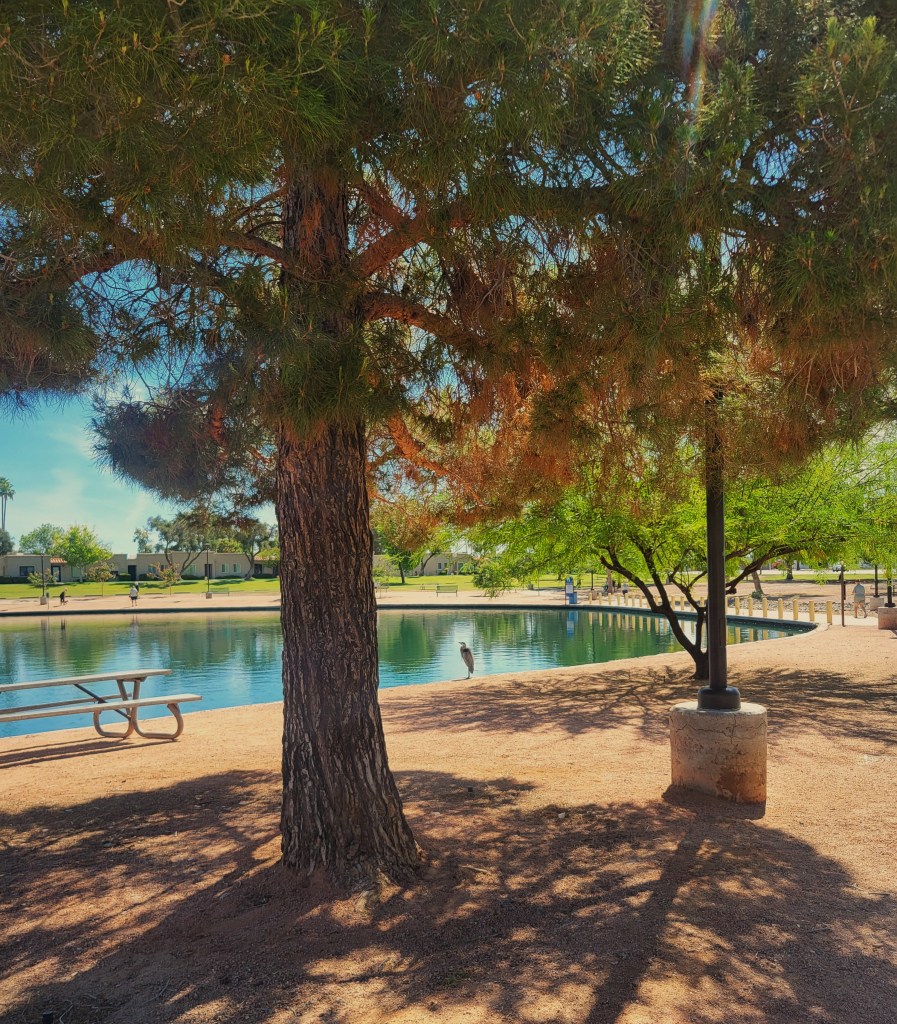
A lone blue heron stands at the water’s edge at Chaparral Lake in Scottsdale, Arizona.
In February 2024, John, Sharon, Tom, and I sat around a half-moon-shaped booth in Phoenix, devouring yummy, syrup-soaked, gluten-free waffles and nursing hot mugs of coffee at Jewel’s Bakery and Cafe.
They had been in town for a church retreat over a three-day weekend and were about to return their rental car to Sky Harbor Airport. Breakfast together was our sendoff before they flew home to St. Louis.
“Oh, did you see Nancy’s post on Facebook? There’s gonna be a Class of ’75, Affton High School, 50th reunion sometime, somewhere next September in St. Louis,” I reported.
“You guys should definitely do it. ” Sharon chimed in. “The four of us should go together! Don’t worry about Tom and me. We’ll keep each other company.”
“Sure. Why not!?” Tom agreed.
“I’m in if you’re in,” John stared directly at me. He and I were close junior and high school pals in Affton, though his family moved north, away to another St. Louis area school district before our senior year.
“Okay,” I concluded. “The journalist inside me is telling me we should go.”
Our scheme–hatched in Phoenix, to be realized more than a year and a half later in St. Louis–was born.
***
The sometime was 5 to 9 p.m. on September 21, 2025. The somewhere? Grant’s Farm, a rambling, forested 281-acre estate in south suburban St. Louis, named for Ulysses S. Grant and owned by the Busch family.
Specifically, our 50th reunion would occur in the Bauernhof Courtyard area there. It’s an old-world community space where–since its opening in 1954–St. Louisans have gathered to sample Anheuser-Busch products, and amble down hallways of vintage horse carriages past Clydesdale stables. It is an iconic St. Louis destination, draped in mid-twentieth-century nostalgia.
With the threat of showers in the air, John, Sharon, Tom and I arrived in the Grant’s Farm parking lot just before 5 p.m. Immediately, I began to spot familiar faces. I hugged Terri and Beth, two classmates I hadn’t seen in decades. We boarded a tram that would transport us through the woods to the Bauernhof. I inhaled the fresh-yet-familiar, dampness of the lush green forest.
The long-awaited immersion into my past Affton High School life–connecting one leg of my past as a seventeen-year-old, long-haired (remember, it was the 1970s), reserved, enterprising, unactualized gay adolescent with the other leg of my present much older, wiser, grayer, gayer, literary self–was about to commence.
When we arrived at the Bauernhof Courtyard entrance, we stepped out of the tram towards an archway. Nancy, our cheerful, detail-minded Class of ’75 organizer, greeted us with hugs.
We formed a line to check in and pick up drink tickets. Affton attendees (in this case, John and me) received name tags bearing our black-and-white high school yearbook photos. Significant others, such as Sharon and Tom, got tags with an image of a cougar beside their names. (The cougar is the Affton High School mascot.)
John and I proceeded through the line with our “cougar spouses” toward the courtyard. A photographer snapped photos as couples and singles entered. In that moment, as I turned to see the line queuing behind me, I spotted someone significant I had hoped to see. Not a fellow student, but a teacher I admired from my high school years. It was Judy Rethwisch, my drama teacher.
The high school version of me would have faded and stepped back, reticent to make a scene or a visible statement. But the confident me–the sixty-eight-year-old gay man with his husband by his side–stepped forward to reconnect with Judy.
“I want you to know what a positive difference you have made in my artistic life,” I smiled and reached forward to hug her. “With you at the helm, I found my peeps in the theatre program at Affton,” I went on. In a flash, I recounted roles I played in productions of Fiddler on the Roof and Gypsy under Judy’s dedication and tutelage.
Judy smiled and listened intently as Tom captured a few photos of us locked in conversation. She told me she is still teaching drama. Sixty-one years as an educator. Still vibrant. Still making a difference in the lives of other aspiring actors, musicians, and artists. She asked for my card and told me she is interested in reading one of my books. That was just the beginning of a stream of seminal reunion moments.
I quickly rediscovered a parade of classmates coming and going all around me. Some were fuzzy in my memory. Others, like Jon, more meaningful. He was a good friend in high school, who traveled to Colorado with John and me after our junior year of high school.
Suddenly, I was transported to August 1974. Somehow, the three of us had convinced our parents, that we–one seventeen-year-old and two sixteen-year-old boys–would be safe driving and camping together across country in John’s AMC Javelin, pulling a small trailer.
Yes, we were underage and found someone to buy us lots of Coors beer, which we swilled by the campfire at night. But we survived intact. I recall vividly shoveling down steak and eggs for breakfast in a bar somewhere in Wyoming, while in the corner of the tavern, Richard Nixon, was announcing his resignation on a beat-up black-and-white TV.
Back at the reunion, other male and female classmates trailed by to greet each under the courtyard tent. It featured a beautiful crystal chandelier that hung in the center of the space.
Soon a line formed at a barbeque buffet. We juggled our drinks and grabbed plates, before landing at one end of a long rectangular table Tom and Sharon had secured.
At one point, I turned, and Jeff appeared. He and I were pals, who shared a few classes. We ate together frequently in our high school cafeteria. Honestly, these memories are vague for me. But I remembered his handsome face. It hadn’t changed much, given the fifty-year gap in our connection.
When Jeff introduced his long-time partner Lee to Tom and me, I felt my past and present lives coalesce. Neither Jeff nor I were aware of the other’s sexual orientation in high school. Sadly, that was the norm for 1975 for unrealized, unfulfilled, budding gay adolescents.
But knowing that against the tide of social norms we had each found happiness with our male partners and had independently decided to return to the reunion was physical proof why I had come to the Class of 1975 reunion. I needed to fully reconcile my past closeted self with the authentic gay man I had become.
A little later in the evening, Tom returned to our table and said emphatically: “I can’t tell you why, but you need to go to the dessert table right now.”
Of course, I listened to my husband and followed suit. When I arrived there, I discovered Nancy and Jim (the reunion organizer and her husband) had brought two of my books–From Fertile Ground and Tales of a Rollercoaster Operator–to display there for all to see.
I don’t know that I gasped, but it felt like I did. To be appreciated for my writing that way, left me speechless in the moment. It was a lovely gesture, authored by Nancy and Jim. Another phenomenal moment, which connected one leg of my life with another.
Before the reunion came to a close and we boarded the tram, all of the Class of 1975 Affton High School classmates–about 120 of us in attendance–stood on a wobbly set of risers for a group picture. (Earlier in the evening, a large poster bearing the names and photos of our forty-nine classmates who have passed graced a corner of the same stage.)
Certainly, the wrinkles and gray hair for those of us who have survived into our late sixties were apparent on the evening of Sunday, September 21, 2025. But the smiles and fun-loving community spirit superseded all of that. Our hearts were full.
***
After treating John and Sharon to breakfast Monday morning, Tom and I had a few hours on our own before we needed to make our way to the St. Louis airport for the trip home to Arizona. There were a few loose ends for us to tie together.
First, we drove to Left Bank Books in the central west end of St. Louis to browse the stacks. It’s a renowned, LGBTQ-friendly, independent bookstore we had planned to visit on the morning of our shared sixtieth birthday. But after I suffered a mild heart attack that day–in the city where I was born–our lives took a vastly different path. Fortunately, we survived that experience together.
Appropriately, our final stop in St. Louis was the Gateway Arch. In the late 1970s, during my collegiate years, I was a National Park Service history interpreter there. Giving tours of the Museum of Westward Expansion, welcoming visitors to the top of the Arch, and–from time to time–introducing a fascinating documentary film about the construction of the Arch, called Monument to the Dream.
The film chronicles the beauty and simplicity of Eero Saarinen’s winning design, but also the herculean effort required for a diligent crew to erect the monument through all sorts of weather conditions.
On a warm autumn day when the Arch was completed–October 28, 1965–the crew sprayed a steady stream of water on the south leg, which was expanding in the heat, to allow the capstone–the final piece at the top between the two legs–to be wedged in and joined permanently.
In a symbolic sense, that is what this later-in-life St. Louis reunion with friends and family means to me.
Call it the arc of life or the Arch of life. Either way these sixty-something years began in Missouri, brought me to Chicago for a long career and life as a single father, and carried me to Arizona with my husband. There we have discovered a rewarding artistic life together among new and old friends–our chosen family–even as our freedoms and institutions in the America we still love are threatened by fascism.
Along the way, the highs and lows have transported me to a profound place of greater gratitude and understanding, which I have earned.
It is a welcome destination that once felt out of reach.
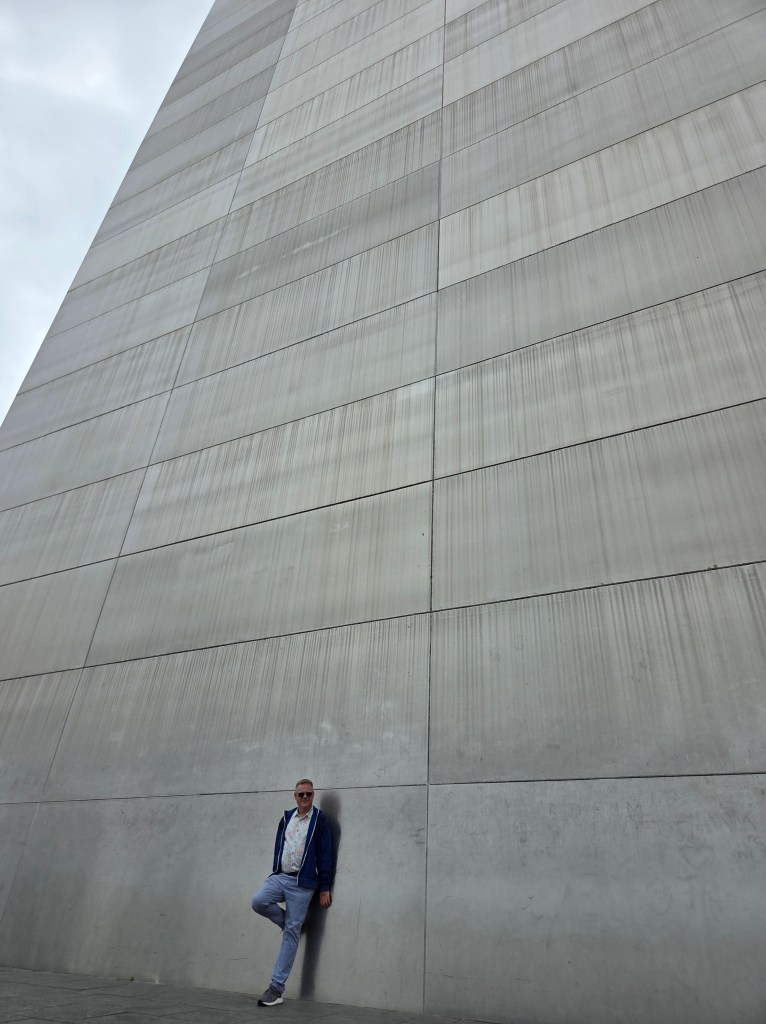
On Monday, September 22, 2025, Tom captured this photo of me leaning against the base of the north leg of the Gateway Arch in St. Louis, Missouri.
Spotty storm clouds gathered in the distance on the morning of Saturday, September 20. Tom and I drove northwest twenty miles, across the Missouri River.
Our destination was Breeze Park in Weldon Spring, Missouri. My cousin Phyllis–a retired teacher–is convalescing there, hoping to regain her strength after a series of health complications.
Phyllis’ mother Violet and my father Walter were twins born in St. Louis. It was 1913. More than fifty years later, the Gateway Arch would rise and transform the St. Louis riverfront. Teetering warehouses once stood on cobblestone streets there, in this fur-trading town founded just west of the Mississippi River in 1764.
In the arc of life, Phyllis and I (both Baby Boomers) also arrived–she in 1947, I in 1957–before the historic completion of the Arch, our nation’s tallest monument, on October 28, 1965.
But today I reflect on our personal connection. Like me, Phyllis and her husband Tom also raised two sons born in the 1980s. Austin and Bryant are now in their early forties and late thirties respectively. A touch younger than my son Nick; a shade older than my son Kirk.
Now in their late seventies, Tom and Phyllis are meeting the healthcare challenges of life head on. Negotiating the unpleasantness of aging and inherent losses (their lovable golden retriever Truman passed recently). They are doing their best to push ahead. To stay hopeful. Or as my mother–a child of the Depression–would have said “trying to keep a stiff upper lip.”
Given these developments, I wanted to spend time with them while we were in the St. Louis area. Especially because–beyond my sister Diane who now lives in northern Illinois–they are the closest remaining strands of family from my Missouri years: 1957 to 1980 … my Tales of a Rollercoaster Operator years.
On Saturday, when my husband and I arrived just past 9:30, we wound our way down halls, past friendly staff and other visitors, to Phyllis’ room. She was delighted to see us. So was her Tom. He arrived a few minutes later with a big smile and box of gooey pastries for us to share.
The next two hours were a heart-warming oasis of conversation and listening between the four of us. We spent our time commiserating over the latest news, but–more importantly–strengthening our family bond during a challenging period for them personally.
Phyllis is hoping to return to their home soon in nearby St. Charles. As anyone would, she is missing the familiarity and comfort of her life. Longing for peace away from medical equipment and disruptive procedures. Her kind, caregiving husband is also searching for peace.
Before Tom and I left, we hugged and took photos together outside on a beautiful, flower-laden patio at Breeze Park. I kissed Phyllis on the cheek. A few tears materialized for both of us, not knowing what tomorrow will bring.
At the least, we shared those upbeat Saturday moments, built upon our 1960s memories of our once-vital, long-gone boisterous St. Louis relatives gathering around us every Christmas, Easter, and Independence Day.
To our credit, in our later years, long after our sons became adults, we have formed reciprocal connections. Most notably, Phyllis, Tom and their family joined Tom and me for an Italian dinner in St. Louis in route to our new home in Arizona in July 2017.
Now they share stories and photos via text of their four growing grandchildren, and I write stories about my St. Louis origins, which she has encouraged, helped inspire, read, and followed diligently.
All of this, through a period of uncertainty, sustains us in our sixty-and-seventy-something years across the miles.
***
Just after noon Saturday, Tom and I returned to Creve Coeur. We landed in the driveway of our friends John and Sharon.
We were about to share the rest of the weekend with them and their loyal eight-year-old-shepherd-beagle-mix Nickel at their stylish, mid-century home … hike with John through a dense forested area overlooking Creve Coeur Lake, then get caught in the rain in historic downtown St. Charles … drive into St. Louis for a Cardinals/Brewers game at Busch Stadium Saturday night … and still later, on Sunday evening, attend our Class of 1975 Affton High School reunion together at Grant’s Farm.
The clouds cleared Saturday evening and ushered in cooler temperatures. Seated together with close friends at Busch Stadium, three levels up directly behind home plate, it didn’t seem to matter that my beloved Cardinals lost 3-2.
Yes, it was the latest evidence in a disappointing sub-par year. But on the horizon, beyond the stadium’s outfield walls, the twilight of a blue sky and puffy clouds perfectly framed the Gateway Arch at the center.
Architect Eero Saarinen’s monument to a dream is still standing, rising above the cobblestones and the fray, as it approaches its sixtieth birthday.
The arc of life in my sixties–its highs and lows–has proved mostly to be an unexpected artistic one. Yet it is an uneven tapestry of co-existing emotions: fear for our eroding democracy; love for new and old friends; and boundless gratitude currently after returning to St. Louis for my Affton High School Class of ’75 reunion and reconciling my midwestern roots with my southwestern reality.
***
A trip to St. Louis would not be complete without a visit to my parents’ graves at Jefferson Barracks National Cemetery. So, we began there.
On Friday, September 19, Tom and I stopped at Dierberg’s in Creve Coeur near our hotel to buy a handful of burnt orange carnations.
Twenty minutes later, we arrived in the sea of marble stones on rolling hills ten miles south of downtown St. Louis.
We parked our rented Mazda SUV and tiptoed past a veteran’s funeral in progress under a makeshift canopy. A female vocalist sang Amazing Grace. Instantly, my tears began to flow.
Each time I go to Jefferson Barracks, it is a touchstone experience. Tapping one side of the stone and then the other. Remembering the love and best intentions of Helen and Walter Johnson–both long gone but not forgotten.
Minutes later, sitting on a nearby bench with Tom under the sturdy branches of an oak tree that has lost its earliest leaves due to an especially dry Missouri summer.
Friday afternoon was also somber and reflective. We met our friend Mark, a docent at St. Louis Kaplan Feldman Holocaust Museum, for a visit there.
He guided us through horrific-then-hopeful survivor stories, images, and vintage artifacts, curated from proud Jewish St. Louis residents who lived through the awful experience. Only a few remain, but their legacies live on.
All in all, it was a chilling, relevant, immersive few hours. Cautionary evidence of hate and authoritarian evil that inundated the world in the 1930s and 40s, and now–in the US in 2025–threatens the existence of those who are not straight, Christian white men.
After deep breaths and a refreshing Friday nap in our hotel, Tom and I drove to University City for an evening with Mark and his husband David at their home. It was a celebration of our unfolding friendship.
At sunset, they lit candles and recited Shabbat blessings before we shared wine and bread. At their table, I felt our bond of friendship, which began just a few years ago, grow.
We met Mark and David when–as snowbirds living part-time in Arizona–they first attended one of Tom’s free film screenings at the Scottsdale Public Library.
Now, they have become the newest, welcoming community component of our St. Louis connection.
If we live long enough and look beyond the palms, we see the arc of our lives and the hint of a rainbow. We remember where we came from. Who we were. Who we are. How far we’ve come. Our best intentions. Our mistakes. Our progress. Our loves. Our losses. Our lessons learned. The connecting tissue that has made us who we are. All of it.
***
Fifty years ago, in June 1975, I graduated from Affton High School in south suburban St. Louis.
Tom and I travel back to St. Louis tomorrow for a reunion with my class of 1975 mates over the weekend.
I’m excited to see old friends. I also expect a few bittersweet moments.
Either way, the journalist inside me is sure to return with a story or two.
Because I am a writer. That’s not what I do. That’s who I am.
It was a bright September Tuesday morning. Clear skies, mild temperatures, and low humidity. A perfect day in the Chicago suburbs.
At around 7:30 on September 11, 2001, I pulled up to the curb at Lincoln Junior High to drop off Kirk, my twelve-year-old son. He scampered ahead and waved goodbye.
Forty-four-year-old me drove to the nearby RecPlex for a quick swim at the indoor pool. On the way to the locker room to change, I saw a small cluster of folks gathered silently around a TV.
A plane had just struck the north tower of the World Trade Center in New York. Dire images of smoke and debris filled the sky.
Minutes later, a second plane pierced the south tower. It was just the beginning of the madness.
Terror spread quickly through the skies to crash scenes at two other sites: the Pentagon in Washington, D.C., and a field in Shanksville, Pennsylvania.
Captivated and numb in disbelief near the vending machines in the lobby hundreds of miles away, we stood dumbfounded and helpless–gaping in September’s stillness–as ripples of the horrific news and images unfolded.
Ultimately, 2,977 victims died that day, casualties of the September 11 attacks at the hands of eighteen foreign hijackers and many more strategists who infiltrated American skies.
Thousands more were injured and sustained life-long trauma, including citizens and rescue workers exposed to toxins at Ground Zero in Lower Manhattan in New York.
***
It’s been twenty-four years. We are still trying to make sense of how much we lost, how much our lives changed, that day.
I don’t mean the inconveniences of air travel. Yes, that’s a pain.
Much worse, gun violence, school shootings, assassinations, and homegrown terrorism are the norm in the United States. Through it all, we have become as divided as ever.
Just yesterday, the latest two unrelated horrors–one a school shooting near Denver, the other the assassination of a vocal, right-wing protagonist–dominated the news cycle.
The solution is obvious. We need to remember our traumas and learn from them. Institute tighter gun laws in this country, not more thoughts and prayers.
I do believe our leaders have failed us. We have voted the wrong ones into positions of authority. Instead of quieting the storm and pulling us together, they are threatening those who don’t agree with them.
If we don’t make changes soon, our legacy will be continued bloodshed, not the freedom, opportunities, and equality we have espoused as a nation for generations.
***
My twelve-year-old son is now thirty-six and living in Chicago. He is a therapist. Kirk specializes in helping individuals who have experienced some sort of trauma.
I couldn’t be prouder of Kirk and the work he is doing. At a young age, I witnessed his kindness, his empathy toward classmates, neighbors, and family members.
Now he is honing his skills, while providing relief to those who need it most in American society.
I try to do the same through my writing. Telling the stories as I see them but leaving you with a glimmer of insight, relief and hope.
If there was one positive thing that sprang from the 9/11 attacks, it was the way our nation coalesced–at least in the short term–around the victims, their families, their stories in 2001.
As a nation, we were forced to take a breath as we dug through the rubble. We forged ahead to provide a salve to treat the psychological trauma we all felt.
Somehow, in 2025, we have lost our wits. We have forgotten how to love the less fortunate, protect our children, and teach them to be critical thinkers rather than conspiracy theorists.
We had better wake up fast, pass gun laws, rediscover our compassion, and find our better selves soon.
She’s survived another summer in the Valley of the Sun. Living life on the lam.
Climbing walls and trees. Stalking birds, lizards, and rodents. Dodging haboobs, monsoons, and ICE agents. Ducking in and out of covered patios … sleeping on weathered blue cushions melting into wicker chairs outside our front door.
Poly is her given name. Given by me to her. No doubt, she has other assumed names from other presumed cat lovers in our Polynesian Paradise condo community.
I hardly consider her a stray anymore, because we are three years into our relationship … our parlor game of fancy treats followed by quick goodbyes.
In 2022, she wouldn’t get close enough to touch. Tom and I left kibble outside our door in the same chipped dish you see here. She ate quickly, then darted off … back into her Sonoran neverland.
But in 2025 we have reached a deeper level of closeness, intimacy, love perhaps. Maybe she’s been reading the news and needs comforting. I know I do.
Every morning around 6, Tom or I open the security door and look for her. Nine out of ten days, she hops down from that day’s pre-selected chair, meows as she glides and stretches on the mat in our foyer.
She trails around our legs, marks our shoes and furniture with the scent of her furry face, and shimmies up and down as Tom or I (we take turns) prepare her dish of Sheba cuts in gravy with sustainable salmon.
The frequency and volume of meows increase as the dish comes close to the floor. Poly purrs loudly, then polishes that off in less than a minute. Her eyes sparkle with gratitude.
Lately, she’s been staying longer after her meal. Sometimes returning later in the morning or evening for a second round of treats. Dry savory salmon-flavor Temptations for the cat that deserves the best.
On September 1, at 11:13 a.m., Poly allowed me to sit on the floor and give her love. I patted her head, back, and tail as we talked about her morning … our day.
Then, I placed brunch before her and captured this kitty-calendar portrait of Poly, our cagey Sonoran friend, modeling in the kitchen on our new, natural oak flooring.
After she consumed her meal and licked her paws, she glided and sniffed through our bedroom, den, and sunroom.
Poly then departed through the front door, left ajar for her safe departure (she is a free spirit, after all!) back into the wild of intense sun, hissing sprinklers, spiky cacti, and random critters (animals and humans) … all of us living each day, giving and taking what we can, embracing or deflecting each moment as it comes.
Life repeats itself in strange and unexpected ways.
As Tom and I traveled throughout Ireland in August of 2017, some of our tour mates followed the US weather forecast with growing interest and anxiety.
Hurricane Harvey–a category 4 storm–was about to make landfall along the Texas coast.
Houston was in its path. Houston was their home.
Harvey unleashed its wrath. We never learned what impact it ultimately had on their lives.
Seven years and one month later, we were back in the United Kingdom on a tour of England and Scotland with twenty-two other tourists (plus Phil, our guide, and coach driver, John).
Two of our entourage, John and Jill of Tampa, told us they were watching the swirl of Helene–another category 4 storm–approach the Gulf coast of Florida and the vicinity of their home.
Though Tom and I knew we would return home to the Phoenix area and prolonged 110-plus temperatures, we felt lucky about our weather plight. Yes, more heat. But not John and Jill’s uncertainty.
There were no giant storm swirls for Tom and me to contend with in Phoenix.
Still–far away from pending devastation of Helene–John, Jill, Tom and I bonded in the United Kingdom.
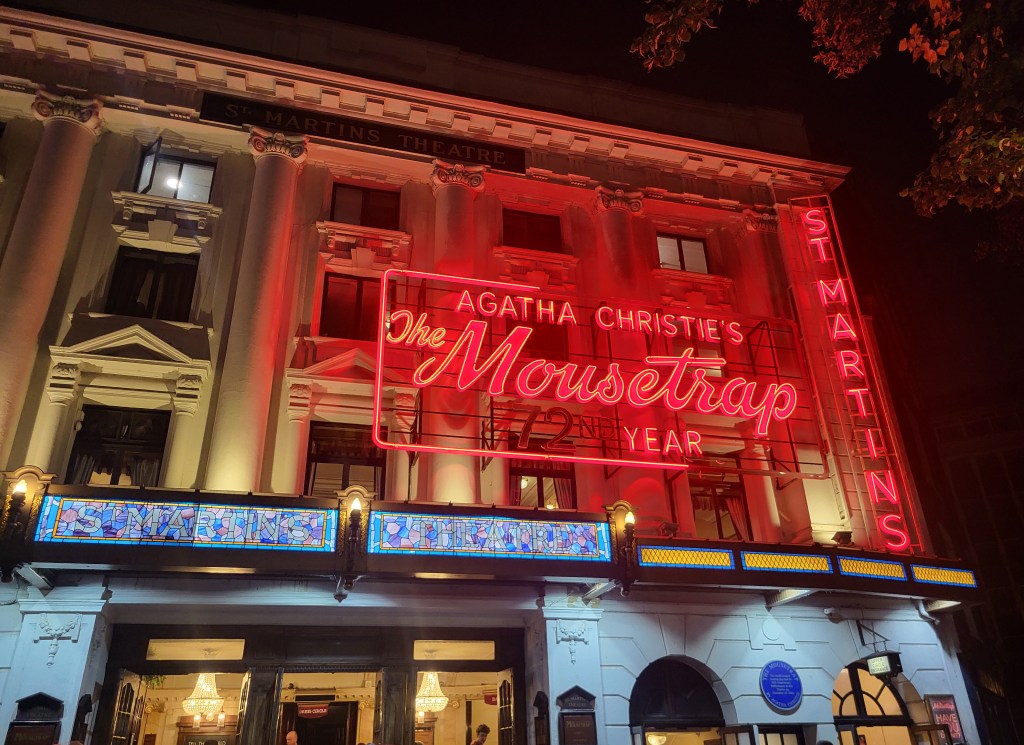
I remember telling them when we first met in London that we were excited to see a play independently in the West End at the St. Martin’s Theatre on Saturday, September 21.
Not just any play. The longest running play in the world. It’s called The Mousetrap.
Based on an Agatha Christie story, The Mousetrap, has been performed for seventy-two years in London.
(There were no performances during the height of the pandemic from March 2020 to May 2021.)
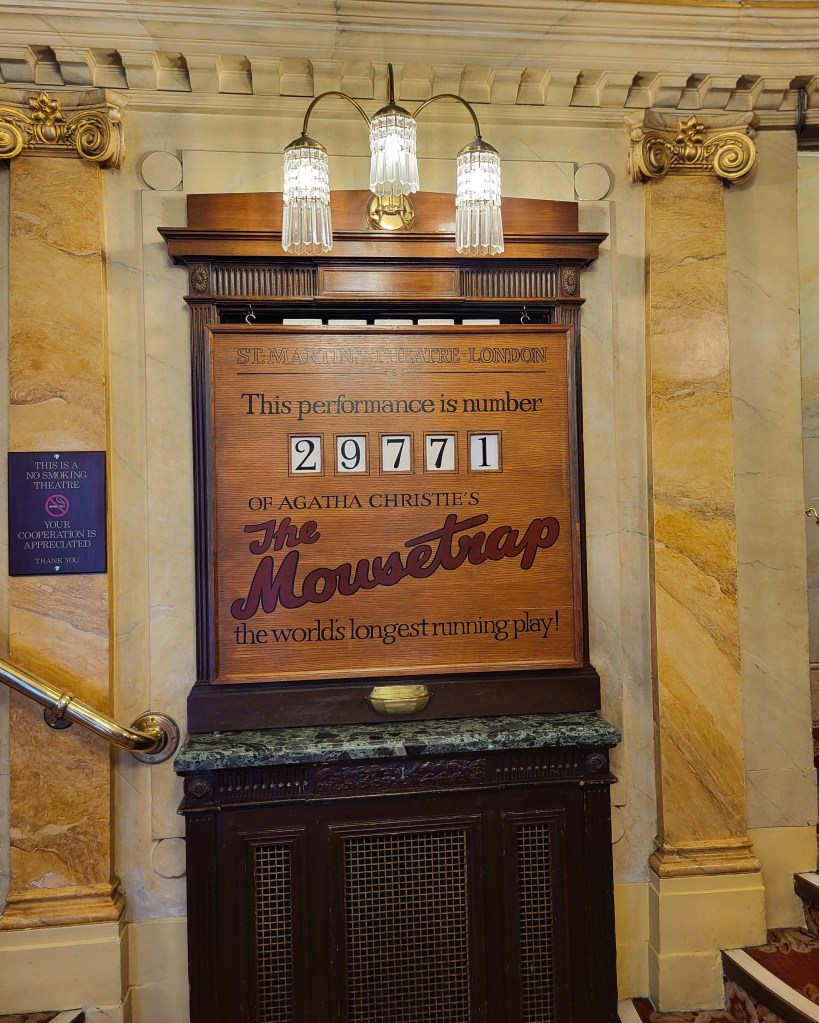
Tom and I were in the audience for performance #29,771.
It’s a classic whodunit with a twist ending.
A young couple owns Monkswell Manor guesthouse in England in the early 1950s.
Four guests arrive, while the snow (not a hurricane) swirls outside.
There is a radio report of a woman’s murder. A suspect is loose in the area.
A police sergeant arrives on skis to warn them that a notebook was found at the crime scene.
It contains the address of Monkswell Manor and the words “three blind mice.”
Pinned to the victim’s body is a note that says, “this is the first”.
Everyone at the inn is in danger. Everyone is a suspect.
At the end of the performance, the seven actors took their curtain call.
They asked us in the audience to keep their seventy-two-year-old secret.
You’ll get no spoilers here.
***
Anyway, along our journey through England and Scotland, we shared with John and Jill from Tampa how much we enjoyed this theatrical experience.
The night before we departed Edinburgh, Scotland–to return to our respective sunbelt homes via London–John and Jill suspected their flight from London to Tampa the following morning would be cancelled due to Helene.
When it was, they had a free day in London. They texted to say they bought two tickets to see The Mousetrap as we wound our way through Heathrow Airport security.
Later, during intermission on September 26, 2024, while Tom and I were making our way home, Jill texted: “We are in intermission, and I am stumped!” Then, a few hours later, “Great show!! So glad you both recommended it.”
The next day, we were relieved to learn from Jill that their home was safe, even though there were flooding waters all around them.
What does it all mean? This story is no mystery. But, nonetheless, still meaningful I think.
You can fly seven or eight thousand miles to a place you’ve never been and make a connection with fellow travelers you didn’t know … someone who has shared a coach, watched the scenery go by … someone who chooses a similar theatrical experience … someone who dodges the mousetrap of a catastrophic storm … someone you hope to see again someday in another London or Edinburgh or in the sunbelt of your everyday lives.