For the past two mornings, a chirpy flock of rosy-faced (also called peach-faced) lovebirds has descended upon our feeder. They sway and frolic under the eaves, near our gnarly fig. It’s lost it leaves.
Like last-minute holiday shoppers, the lovebirds push and shove. Jockeying for position–with thrashers, finches, and woodpeckers–to pluck precious seeds on a forty-two-degree morning outside our north-facing window.
These vivid, high-pitched creatures aren’t native to Arizona. Some are daring escapees from past caged lives; others released into the wild by careless owners. Who knows why.
Either way, the carefree lovebirds have assimilated. They flourish in the Phoenix area, and on December 11, 2022, they brighten our view as Tom and I sip coffee and split a delectable, just-ripened tangelo, snatched from the trusty tree near our community pool.
It wasn’t an unpleasant sound that stirred my brain before 5 a.m. It was a light desert wind filtering through our tubular chimes that woke and evoked me and distant sounds. Reassuring, comforting ones from suburban St. Louis.
***
Mom was always the first one up.
From my middle bedroom–a connecting space with two doors wedged between the hall and kitchen–I could hear her creaking on linoleum, shuffling in slippers, opening drawers, turning on the dial to the radio, reaching into the refrigerator, sizzling bacon in a skillet, placing the kettle on the stove, and pouring hot water over a teaspoon or two of instant coffee.
Then, at night–when the day was done–it was the splash of rain and swirling sensation of fallen leaves on the metal awning outside my bedroom window that soothed me. Or Happy’s soulful howl, craning his neck as he responded to the calls of other dogs in the neighborhood.
As I huddled under the covers on a twin bed, these sounds beckoned me to sleep. Now, as I remember them and write about them on my laptop, they exist and endure.
Certainly, the memory of them gets richer because they have been gone longer. They rise to the top like the cream of milk, while what happened yesterday might easily be forgotten tomorrow.
I would be lost if I couldn’t listen and remember the sounds of the past. In the moment they were invisible, fleeting footprints. But they echo in my thankful memory … lasting reminders of the texture, meaning, depth, people, and love I hear and remember.
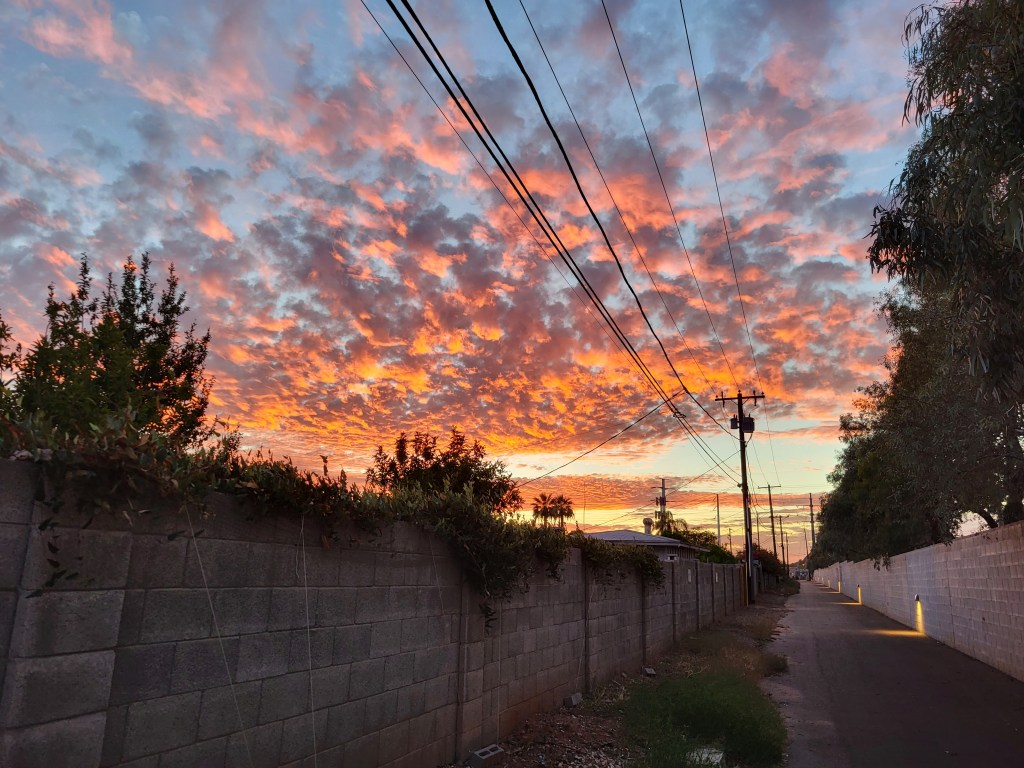
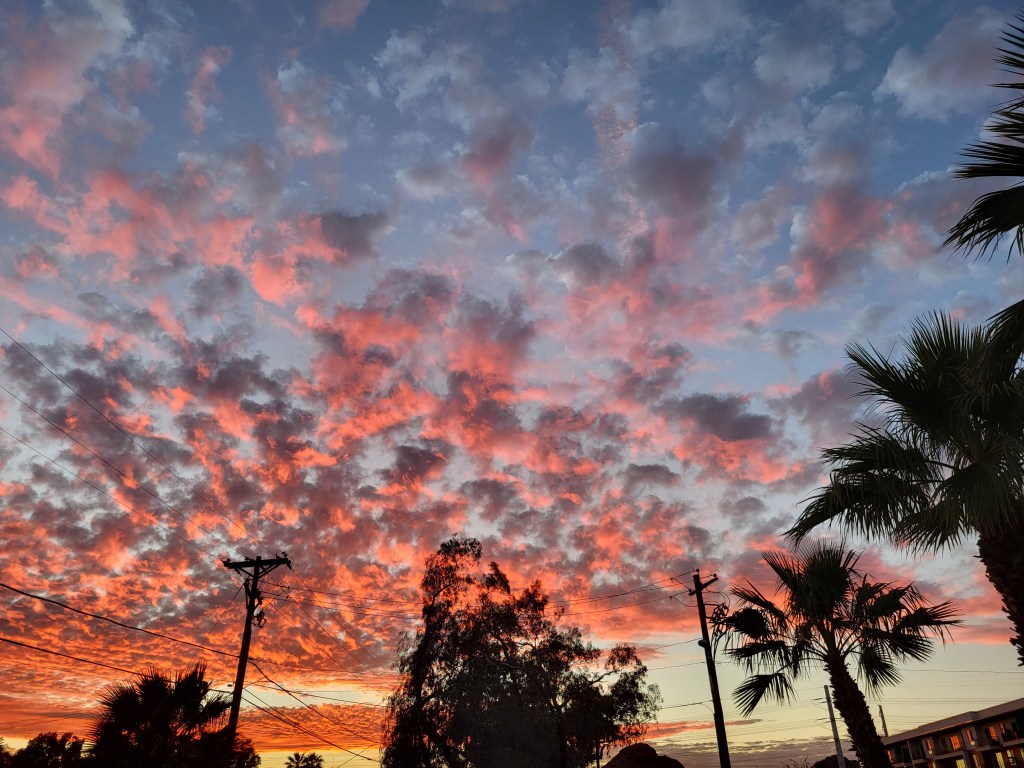
No ordinary Tuesday, but eleven moments (5:05 to 5:45 p.m.) captured as the end of the first day of the eleventh month draws near in our south Scottsdale neighborhood. Displayed in reverse order. Clearly, what the Sonoran Desert lacks in vibrant fall foliage, the sky delivers with kaleidoscopic splendor.
I lead a fortunate life. I don’t mean that in a material, financial or social sense; like many of you, I am concerned about inflation, the bear market, high gas prices, potential fall-out from the mid-term elections, and global and domestic horrors eroding personal freedoms, savings and investments, and a general sense of security for you and me.
Still, I acknowledge I have more to be thankful for than most people: a modest-but-comfortable home in a warm climate; a loving and supportive spouse; two adult sons who are gainfully employed and contributing members of society; a diverse community of friends; and the time to pursue and develop my literary and musical interests.
Plus, I’m a relatively healthy, sixty-five-year-old male. I make it a priority to exercise regularly, eat smart, and see my doctors as needed. Though it’s been more than five years since I suffered a mild heart attack, I haven’t forgotten the trauma of July 6, 2017, or dismissed the gratitude I feel for that team of doctors and nurses at Barnes-Jewish Hospital in St. Louis, Missouri–people I likely will never see again.
That painful experience no longer defines me. It has paled somewhat. Yet it informs my choices, perspective, and sense of gratitude. It has morphed into a badge of survivorship, which I feel an obligation to share with the universe through my writing and day-in-day-out personal encounters.
Occasionally, I receive a fund-raising or participation request from an Arizona contact with the American Heart Association (AHA). We met in 2018.
A few weeks ago, she asked me to share my story of survival–virtually–with employees of a large retail organization on October 17. To explain that donations to the AHA aid lifesaving research that allows heart and stroke survivors–like me–to enjoy longer and more complete lives.
So that’s what I’ll be doing on Monday. Twice … once in the morning; once in the afternoon. Telling my story of survival in three to five minutes to a large group of employees via video conference.
I figure it’s the least I can do to pay it forward and possibly ease the pain for some other unsuspecting man or woman, who with the help of the AHA might live longer, breathe more easily, and witness a few more breathtaking sunsets in the Valley of the Sun or elsewhere.
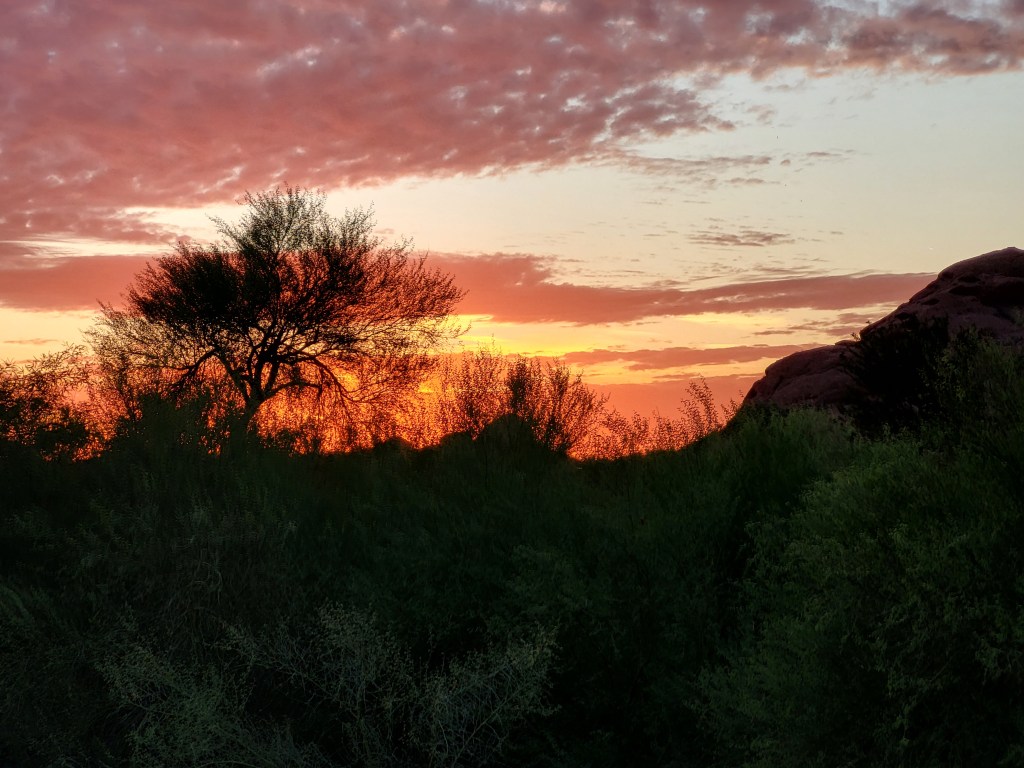
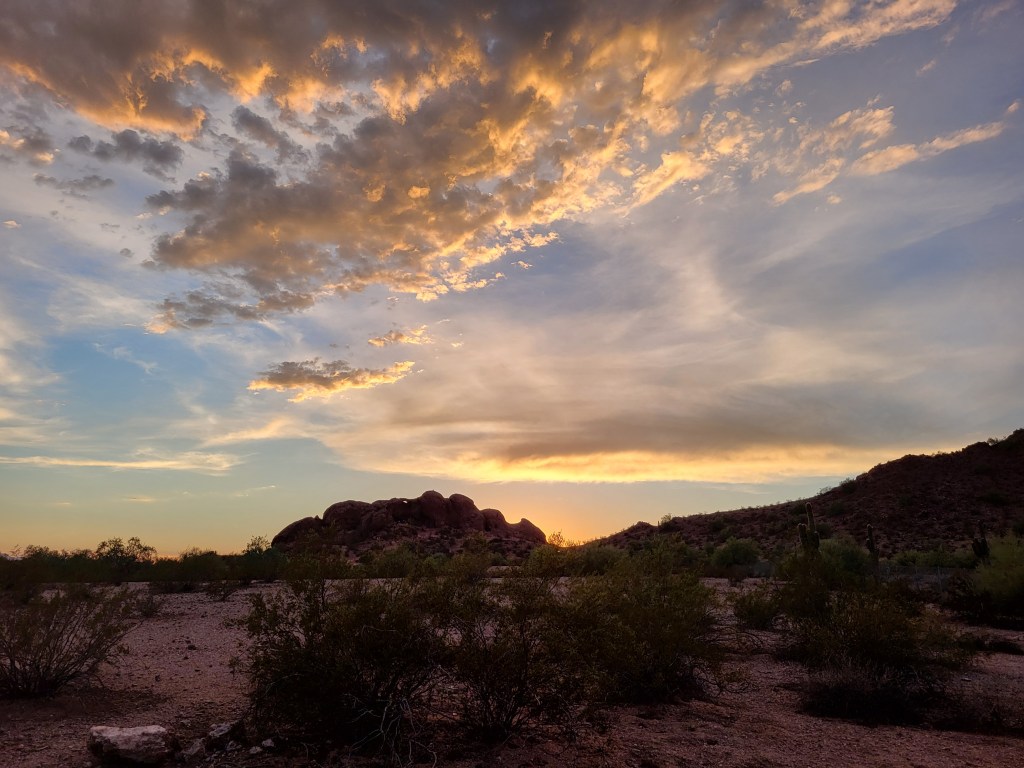
On October 5, 2022, I captured this Sonoran sunset in Papago Park on my walk with Tom a mile from our home in Scottsdale, Arizona.
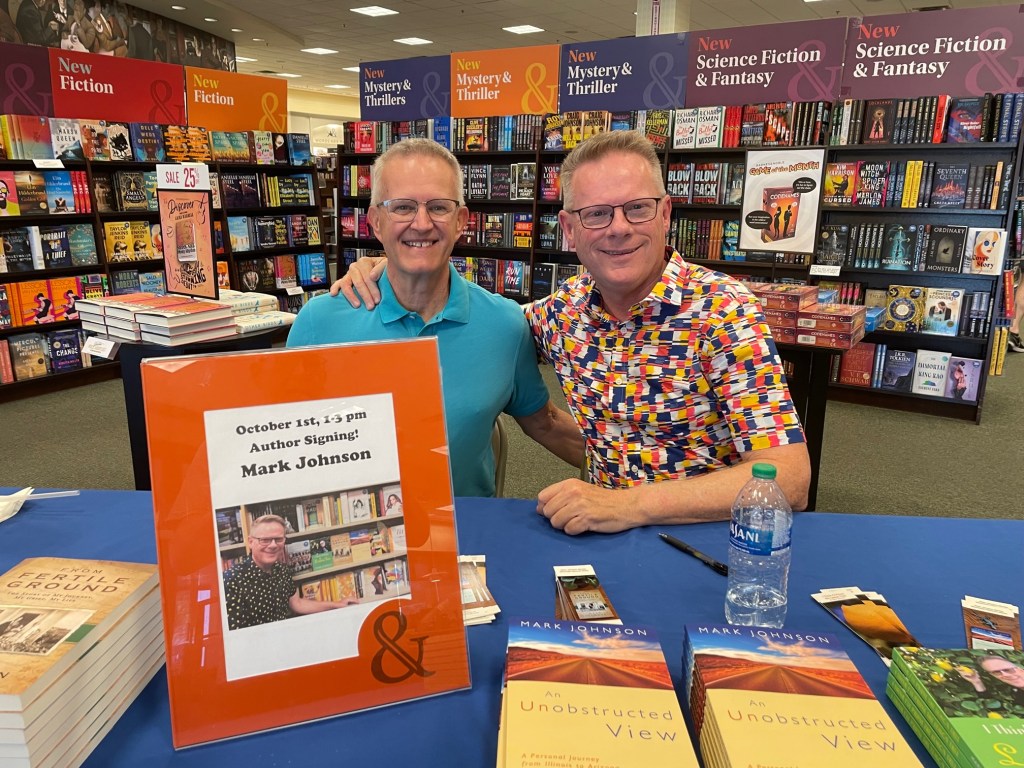
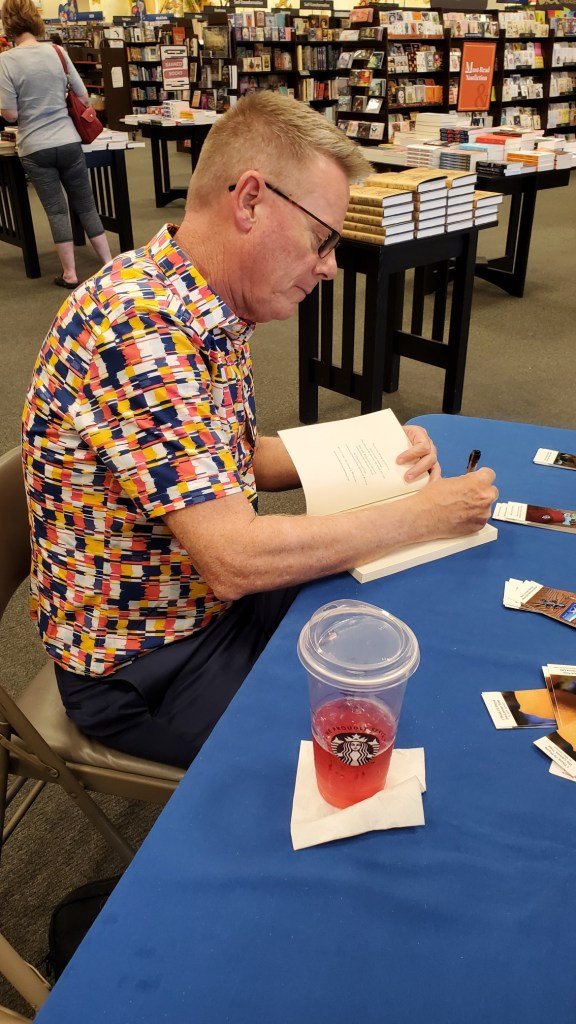
Like any and every significant life moment, Saturday afternoon at Barnes & Noble in Mesa on S. Val Vista Drive produced a series of visual snippets–memories which today on the day after (and hopefully, always) cascade through my tired, but appreciative brain.
It was a quiet, yet meaningful, experience for this independent writer–connecting with a handful of aspiring writers and avid readers (unfamiliar with my stories).
Best of all, I was the fortunate recipient of another giant dose of love from family and close friends here in the Valley of the Sun.
Thank you, Tom, Glenn, Dave, Jeff, Nick, Anastasia, Libby, Gregor, Ron, Carol, Merrill, Torie, Jasmine, and Tashi. It was a thrill to sign my books for you and feel the warmth and encouragement of your creative spirits.
Back in July, I wrote a story about Barnes and Noble stocking my memoirs on its shelves in Mesa, Arizona.
A month or so later Rachele, the community relations manager, invited me to sign my books there.
It will happen on Saturday, October 1, from 1 to 3 p.m. at their Dana Park store, located at 1758 S. Val Vista Drive. I’ll even have the opportunity to read a few passages.
(No, it hasn’t sunk in that this independent writer will have this blissful moment in a large bookselling space among the work of more-renowned writers.)
Anyway, I realize most of you who follow my blog don’t live in the Valley of the Sun. But if you do–and you’re looking for a creative outlet this weekend and a story or two to add to your fall reading–stop by.
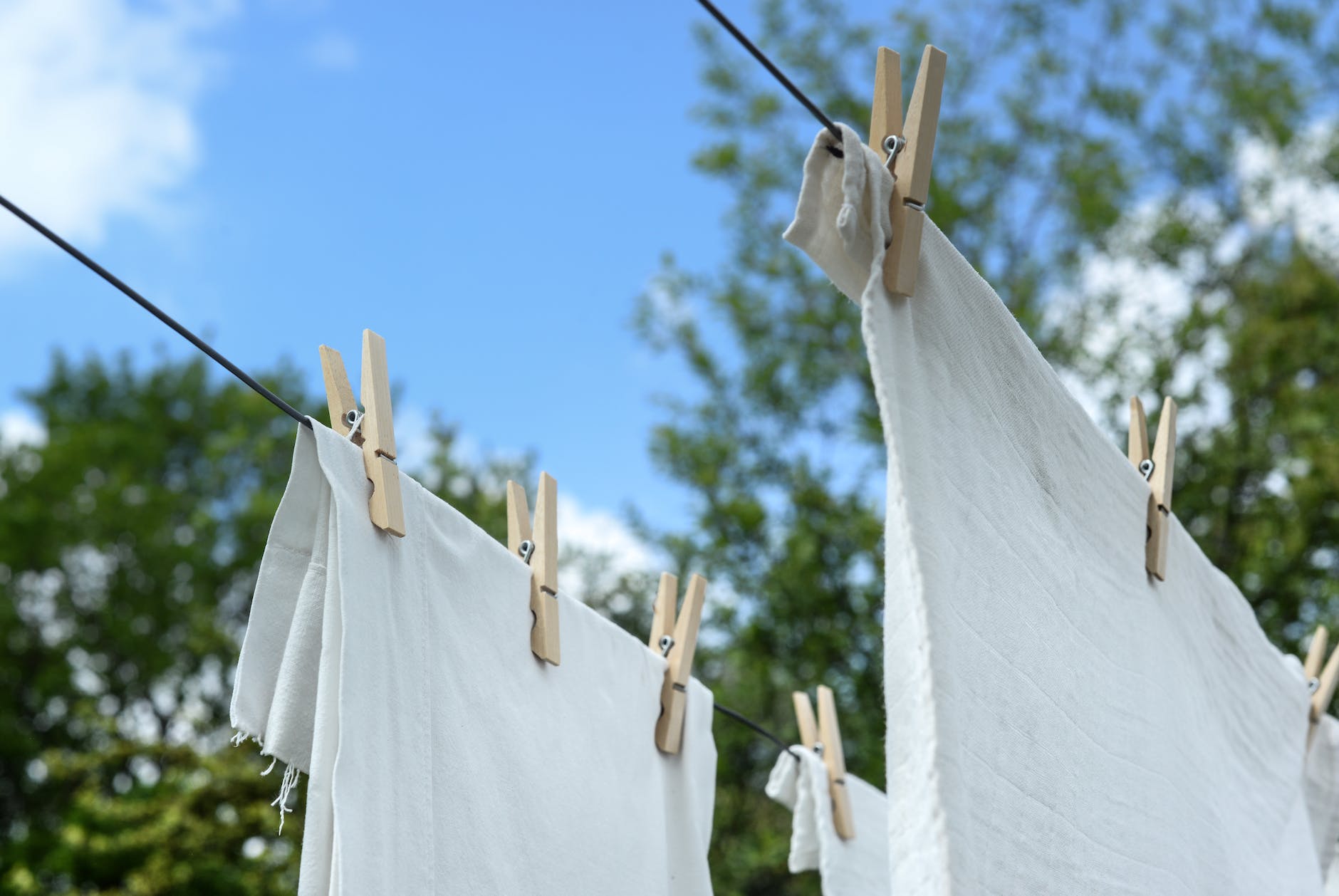
It was laundry day. So, this morning, Tom and I grabbed our pouch of wooden clothespins and walked five hundred steps or so to the landing behind our condo clubhouse.
For the next five minutes–shielding our eyes from the penetrating sun–we stood on the concrete there, hanging our just-washed, delicate shorts and shirts on the community clothesline to dry in the desert breeze.
Call me old fashioned. But I don’t mind doing this. In fact, I enjoy it. Especially as fall approaches and the air begins to cool.
More important, the plastic-coated clothesline connects my present life to my past. It represents the resiliency I’ve watched, absorbed, and carried forward.
It reminds me of the family members I’ve lost, but still love, and the survival instincts they instilled in me sixty years ago. What follows are excerpts from my book, Tales of a Rollercoaster Operator.
***
It was my second week of kindergarten, and I was just beginning to adjust to a new routine. On a warm and breezy mid-September afternoon in 1962–September 13 to be exact–I left my Mesnier School classroom and stepped aboard my regular bus for the trip home.
Within ten minutes, the driver arrived at the top of South Yorkshire Drive. She opened the door and several of us scampered down the stairs. I waved goodbye to a few remaining classmates still on board.
The driver closed the louvered door and pushed ahead. I meandered home. It was no more than a five-minute walk up our block and our driveway. Then, in an instant, a breathtaking late summer day transformed into an early fall for our family.
I saw my mother standing just beyond the backyard gate. She was wearing a sundress, lost in thought, uncoiling clean, damp towels and sheets from a laundry basket. Happy, our beagle-mixed hound, was out of reach too. He was sniffing the ground and frolicking miles away, it seemed, along the back fence.
“Your father’s had a heart attack.” Mom recited her words slowly and deliberately, like a woman treading deep water searching for a longer breath.
I didn’t comprehend what she had to say. But it couldn’t be good news, I thought as she plucked wooden clothespins from a pouch. She was working to keep her ragged emotions and the flapping sheets in check, preparing to clip wet linens to parallel plastic-encased clotheslines that stretched east and west across our yard.
Soon we walked into the house with our empty white-lattice basket, and I learned more. Dad had become ill on day two of his new job as a porter at McDonnell-Douglas. He was helping a coworker lift an airplane nosecone. Suddenly, he felt a sharp pain in his chest. He was rushed to Deaconess Hospital on Oakland Avenue near Forest Park. That’s where he would recuperate for the next month …
Each time we visited Dad, he was bedridden. I couldn’t comprehend what could keep my father lying in one location for so long–unable to toss horseshoes, fly kites, or drive us to parades or ballgames. But Dad insisted he would rebound.
Like the popular song from Bye Bye Birdie that played on the transistor radio near his bedside, Dad told me, “Son, I’ve Got a Lot of Living to Do.”
***
The next decade was difficult for our family. Watching Dad drift away physically and emotionally, filled me with anxiety. He never recovered fully, though the man who fought in World War II and the Battle of the Bulge soldiered on until his death in 1993.
Meanwhile, my mother kept our family afloat financially. She went back to work in March 1963 and did her best to balance life at home and in the office. When she died in 2013, she left behind a legacy of wisdom that I cherish and share.
Watching my parents toil produced a silver lining. Seeing them tread deep water for all those years gave me something I never imagined: the will to face my own personal challenges, standing tall as a proud gay man, and surviving my own heart attack on my sixtieth birthday.
Of course, it all began in the suburbs of St. Louis in September 1962. That sagging clothesline swayed. But it never snapped.
And, here in the Sonoran Desert in 2022, another clothesline sways 1,400 miles west.
The calendar says September, but August-like heat abounds across the American west.
Thanks to a dome of high pressure, triple-digit Septemperatures in the Pacific Northwest, California, the Intermountain West, and (of course) here in Arizona are expected through the Labor Day weekend.
In the desert, we know how to navigate the heat. Carry a water bottle everywhere. Slather on sunscreen. Wear a hat. Exercise early. Do your chores in the morning. Stay inside during the heat of the afternoon. Reemerge at sundown to catch another dazzling sunset.
But there are troubling resource ramifications for this region that lie beneath the stark beauty, beyond late-summer-heat inconveniences.
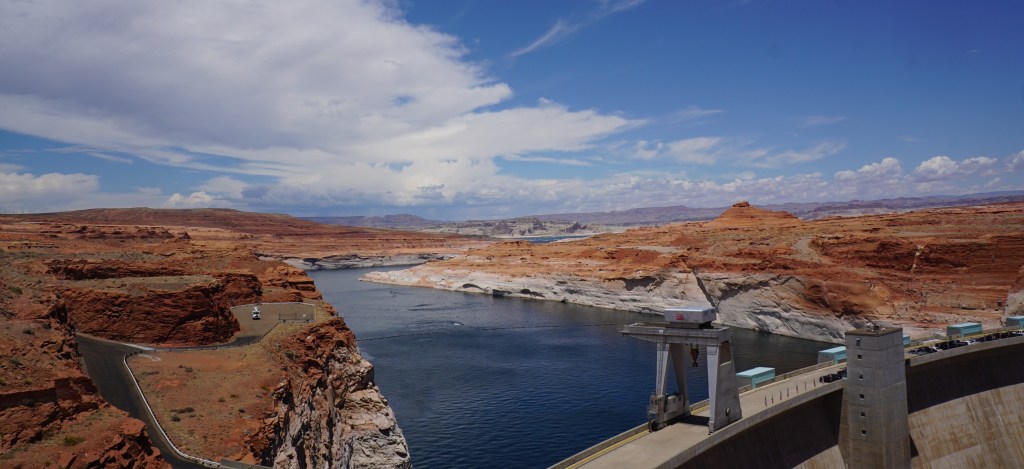
Lake Powell, our country’s second largest reservoir–it straddles the Utah and Arizona border–now stands at its lowest level since 1967.
According to a recent article on scitechdaily.com by Michael Carlowicz of the NASA Earth Observatory, on August 6, 2022, the water elevation of Lake Powell’s surface at Glen Canyon Dam was 3,535.38 feet. That’s 98 feet lower than August 2017 … and only twenty-six percent of its capacity.
In August, the U.S. Department of the Interior announced it will reduce the amount of water apportioned to states in the region.
Arizona will receive 21 percent less water from the Colorado River system in 2023. That is certain to hit farmers in the Grand Canyon State particularly hard.
Fortunately, water conservation efforts are trickling down across our state and communities like Scottsdale have begun to more aggressively manage the use of water. Plus, a wet monsoon season in our state has alleviated the drought in the short term.
But, with burgeoning population growth and climate uncertainties in this region, what will the future hold for the Colorado River basin and 40 million people–Las Vegas, Phoenix, Los Angeles, and San Diego–who rely on it for electric power and water?
In June 2021, I captured this photo of Lake Powell at Glen Canyon Dam in Page, Arizona.
Shy and suspect, she appeared in May 2021. Soon after, I named our feral friend Poly. It’s short for our Polynesian Paradise community where she resides on the lam.
Curious but skittish, Poly stared down at me from our neighbor’s roof the first time we met. Later on, she padded down the walk–past the lemon and orange trees–when Tom or I approached.
She didn’t allow us to get closer than thirty feet.
Last summer came and went. On warm mornings, she’d climb into the crook of our fig tree to search for food. Delectable fruits weren’t her thing. In her dreams, it was a birdie buffet, featuring an unsuspecting dove or finch.
In the months that followed, Poly paraded by frequently. Meanwhile, Tom and I sat for other cats: adorable Blanca and acrobatic Hex. They also live on our lane, but both will be leaving in the next few months. As is the way of life, they’re moving on with their owners for adventures in new homes.
Now, in August 2022, Poly is the featured performer. She appears at our front door most mornings. Here on the southwestern edge of Polynesian Paradise, she meows, stretches, and rolls on her back. Like a shifty circus character, who knows how long she’ll stay in town?
By now, you have surmised that Poly has become our friend. Perhaps even our pet without an official home or address.
If she had to call one place home, I think she’d scribble the number outside our door onto a legal document with the tip of her paw. That is my fantasy.
On her most trusting days, she stands on our threshold, brushes up against our legs, and peeks in. She waits patiently as I place a ramakin of milk, handful of dry kitty kernels, or dish of wet food from a can (turkey, chicken, or fish) at her feet.
She finishes her savory treats, licks her paws, and grooms herself. Then slinks down the lane to rest on another neighbor’s doormat.
During this active summer monsoon season, I wonder where Poly hides, where she sleeps at night. Perhaps under a low palm. Or, if she scales a wall, in the cozy corner of a neighbor’s empty, but protective, patio.
Chosen or not, this is the life of our feral friend.
Sure, Poly trusts us more. She has warmed to our food and advances. But she hasn’t quite come to terms with whatever shadows lurk in her checkered past.
Like any nomad, Poly believes she’s better off on her own … better off when left to her own devices.